
Design and Implementation of Secured Deep Learning Model for
Prediction of Cyber Attacks in Computer Networks
M Dharani
1
, P Murugesan
2
, B Vinothkumar
1
, Kiruthika B
1
, Kavya R
1
and Sharmila Devi M
1
1
Department of Electronics and Communication Engineering, K.S.R. College of Engineering,
Tiruchengode, Tamil Nadu, India
2
Department of Mechanical Engineering, K.S.R. College of Engineering, Tiruchengode, Tamil Nadu, India
Keywords: Cyber Security, Cyber Attacks, D-Dos Attacks, Network Traffic, Deep Learning Model, Convolutional
Neural Networks-CNN, Long Short Term Memory-LSTM, Computer Networks.
Abstract: This research develops a CNN-based deep learning model to predict cyberattacks in computer networks and
compares it with an LSTM model. Materials and Methods: It considered two groups: (LSTM) and (CNN) of
26 samples each with a G Power of 80%, a threshold of 0.05, and a 95% confidence interval. Result: The
CNN model outperformed the LSTM model in accuracy, 92.56% to 96.74%, while the LSTM model ranged
between 85.42% to 91.87%. In addition, CNN had lower false positive rates ranging from 2.87% to 4.14%
compared to LSTM, which had 4.32% to 6.89%. CNN also had a better stability, with a standard deviation of
1.6743, whereas LSTM had 2.8567. These results confirm the effectiveness of CNN in cyberattack detection,
consistent with studies on cybersecurity and AI-based threat detection.
1 INTRODUCTION
The increase in cyberattacks on the Internet of Things
(IoT) leads to the increasing need for developed
sophisticated predictive methodology for better cyber
security. CNN-based deep learning has been utilized
as a method to identify potential threats and eradicate
them (C. Zhong et al., 2023). Using CNN, network
traffic analysis may be done as an anomaly for
detection, ensuring that the algorithm achieves more
than 95% prediction accuracy in its predictions (C.
Chen et al., 2023). Further development focuses on the
need for real-time monitoring, with reports showing
detection rates over 90% while keeping false positive
rates under 5%. The different techniques of machine
learning have also been talked about. Some deep
learning models can detect patterns of an attack in as
little as 0.5 seconds (P. Yadav et al., 2022) New
specialized architectures for the detection of DDoS
attacks have been designed with a reported accuracy
of up to 98% and below 1-second response times (P.
Yadav et al.,2022) In summary, the use of deep
learning with CNN algorithms may offer a great hope
for cyber-attack prediction and mitigation within IoT
networks to enable more solid and effective solutions
to cybersecurity as more devices continue to connect
into a single network in the ever-expanding digital
landscape (M. N. Al Jarrah et al., 2022).
2 RELATED WORKS
In the last five years alone, more than 250 articles on
this topic have been published through IEEE Xplore,
80 papers through Google Scholar, and 108 papers
through academia.edu. This growing literature
highlights the imperative need for practical solutions
in the specific domain of cyber threat detection and
prediction (AD Jasim et al., 2023) Various deep
learning techniques, especially convolutional neural
networks (CNNs), have recently been explored for
the improvement of accuracy and efficiency in
cyberattack predictions.
For example, a comprehensive review of the
effectiveness of AI & ML approaches on
cybersecurity solutions shows that deep learning
models can be used to improve threat detection (
T Van
Dao et al., 2022)
. The idea of using deep learning for
cyberattack prediction has become popular, and
researchers have shown that CNNs can also be used
to analyze network traffic and detect anomalies which
Dharani, M., Murugesan, P., Vinothkumar, B., B., K., R., K. and M., S. D.
Design and Implementation of Secured Deep Learning Model for Prediction of Cyber Attacks in Computer Networks.
DOI: 10.5220/0013920800004919
Paper published under CC license (CC BY-NC-ND 4.0)
In Proceedings of the 1st International Conference on Research and Development in Information, Communication, and Computing Technologies (ICRDICCT‘25 2025) - Volume 4, pages
789-795
ISBN: 978-989-758-777-1
Proceedings Copyright © 2026 by SCITEPRESS – Science and Technology Publications, Lda.
789

may indicate a threat. Deep learning in cybersecurity
attack prediction has recently demonstrated very
good performance in accuracy levels in identifying
many types of attacks (
B Yadav et al., 2021). In
addition, the survey of deep learning algorithms
mainly for cyber security applications showed that
these models can drastically enhance the detection
rate while reducing false positives to the barest
minimum (
UH Tayyab et al., 2022) Deep learning
techniques-based methods for network attacks have
also been reviewed in depth to demonstrate the
flexibility and ability of such approaches in real-time
monitoring scenarios (S Vaddadi et al., 2022). Recent
trends in artificial and machine learning for the
purpose of cybersecurity show increasing complexity
in adapting evolving threats. The research developed
a new type of prediction system based on a cascaded
R2CNN model, revealing the potential advanced
architectures have for improving prediction accuracy
(T Akinsowon et al., 2024) Deep learning, as well as
CNNs, is used for analyzing complex network traffic
patterns for the detection of possible threats. Actual
performance for cascaded R2CNN, for comparison
with classical machine learning, is higher, with above
95% prediction accuracy rates together with real-time
detection speed; it also reduces false-positive rates
that avoid the wrong identification of legitimate
traffic(U Divakarla et al., 2022) These parameters,
therefore, indicate that advanced deep learning
techniques need to be adapted in the field of
cybersecurity for further more robust and effective
solutions for this increasingly connected digital
landscape (X Wu et al., 2022)
From the existing findings, it can conclude that
typical machine learning algorithms are unable to
better accurately forecast cyberattacks. Therefore,
this paper aims at achieving better performance by
introducing a novel CNN architecture compared with
other conventional machine learning approaches.
3 MATERIALS AND MEHTODS
The dataset that has been used to generate this
prediction of cyberattacks in computer networks was
retrieved from the UNSW-NB15 dataset, which
included 2,540,044 records and 49 attributes with the
focus on analyzing and distinguishing between
normal and malicious network traffic. It is concluded
from this research that a secured deep learning model
based on CNNs will be developed to improve the
accuracy of predictions for cyberattacks.
3.1 Data Gathering and Pre-Processing
UNSW-NB15 dataset covered normal traffic types as
well as several types of attack, i.e., DoS, DDoS and
probing attacks, (J Lee et al., 2021) so the key data
preprocessing is that it prepares high-quality as well
as appropriate datasets for training:
1. Data Cleaning: The particular missing values
were addressed through imputation techniques,
and irrelevant features were removed to reduce
dimensionality and improve model
performance.
2. Normalization: The numerical features were
normalized to a range of [0, 1] to guarantee that
the magnitude of the features did not skew the
model training.
3. For the purpose of enhancing model
performance and interpretability, significant
features were chosen on the basis of their
association with the target variable.
Group 1: Current Procedure (Traditional
Methods)
The control group employed traditional machine
learning techniques for cyberattack detection certain
methods which includes Decision Trees, Support
Vector Machines (SVM), and Random Forests. This
group consisted of 100,000 records from the dataset,
providing a statistically significant sample for
comparison. The above methods have been efficient
in detecting known attack patterns, they often
struggle with high-dimensional data and may not
generalize well to new, unseen attacks. Previous
studies have indicated that traditional methods can
achieve moderate accuracy (around 85-90%) but may
lack the robustness needed for evolving cyber threats
(
A Brock et al., 2021).
Group 2: Proposed Method Deep Learning
Approach
The method proposed is based on a deep learning
framework, which would include the process of
extraction of spatial features by using CNNs and the
analysis of time trends of network traffic data through
LSTM networks. Such an approach may yield an
accuracy level much better than conventional
approaches.
Figure 1 shows the deep learning-based
cyberattack prediction model adopts a systematic
pipeline involving Convolutional Neural Networks
(CNN) to efficiently identify threats. The procedure
is separated into different stages starting from data
preprocessing to model testing and final prediction.
Data Preprocessing and Feature Extraction
The model starts by capturing network traffic
information from databases such as NSL-KDD and
ICRDICCT‘25 2025 - INTERNATIONAL CONFERENCE ON RESEARCH AND DEVELOPMENT IN INFORMATION,
COMMUNICATION, AND COMPUTING TECHNOLOGIES
790

CICIDS2017. Raw data are preprocessed, involving
cleaning, normalization, and feature encoding, to
make them compatible with the CNN model.
Important network traffic parameters, such as packet
size, protocol type, and connection time, are extracted
to support high accuracy in attack detection.
CNN Model Structure
The CNN model for cyberattack prediction is
composed of a variety of layers performing different
operations. The Input Layer accepts preprocessed
network traffic data. Convolutional Layers extract
spatial information from various patterns in the
network traffic and detect the anomalies in the data
streams. Pooling Layers compress the dimensions but
retain crucial information, enhancing computational
efficiency. The Fully Connected Layers take the
features extracted and learn attack patterns as well as
distinguish between legitimate traffic and attacks.
The Soft max Layer then provides a probability
distribution, determining whether network traffic is
normal or an attack type.
Model Training and Evaluation
The features extracted are utilized to train the CNN
model, which is optimized using methods which is
Adams or RMSprop. Accuracy, precision, recall, and
F1-score are used to assess the model in order to
guarantee reliable detection performance.
Cyber Attack Detection and Prediction
Once trained, the CNN model performs real-time
classification and detects cyber threats with high
precision. The process automates intrusion detection,
enhances network security, and reacts to evolving
cyber threats.
Future Upgrades
Figure 1: CNN Architecture.
To further improve the detection accuracy, hybrid
deep learning architectures, reinforcement learning,
and explainable AI techniques can be integrated,
which would not only make the system more
interpretable but also adaptable to changing attack
patterns. Figure 1 shows the CNN architecture for
predicting cyberattacks, detailing data processing,
feature extraction, and classification stages. It
highlights the model’s layered structure for detecting
network threats.
4 STATISTICAL ANALYSIS
Table 1: Model's initial performance metrics.
Metric Value
Accuracy 72.3%
Precision 70.5%
Recall 71.8%
F1-score 71.1%
Table 2: Accuracy of the initial and optimized CNN
models.
Model Mean
Accuracy
(
%
)
Standard
Deviation
p-value
Machine
learning
72.3 4.567 < 0.05
CNN 97.5 1.234 <0.05
Table 3: Accuracy Range of the Initial and Optimized CNN
Models.
Model Min
Accuracy
(%)
Max
Accuracy
(%)
Avg
Accuracy
(%)
Machine
learning
85.42 91.87 88.97
CNN 92.56 96.74 94.65
Table 3: Accuracy Range of the Initial and Optimized CNN
Models.
Model Min
Accuracy
(%)
Max
Accuracy
(%)
Avg
Accuracy
(%)
Machine
learnin
g
85.42 91.87 88.97
CNN 92.56 96.74 94.65
The primary purpose of the independent sample t-
test is to compare the packet lengths of malicious and
benign network traffic. The means were 497.96 bytes
(SD = 46.55) for harmless traffic and 708.59 bytes
Design and Implementation of Secured Deep Learning Model for Prediction of Cyber Attacks in Computer Networks
791

(SD = 98.70) for malicious traffic, both samples
totally 200. With a t-statistic of -27.30 and a p-value
of 2.68 × 10⁻⁸¹, the t-test produced results that are
statistically significant at p < 0.05. This would hint
that malicious traffic is associated with significantly
larger as well as diversely sized packet sizes
compared with benign traffic-an important feature
used for detection models in deep learning (PN
Srinivasu et al., 2021).
Table 1 presents the model's initial performance
metrics, which demonstrate its overall effectiveness
in predicting cyberattacks. These metrics include
accuracy, precision, recall, and F1-score.
Table 2 compares the accuracy of the initial and
optimized CNN models using a t-test, highlighting a
significant improvement. The optimized model
shows higher accuracy with lower variability,
confirming a statistically significant difference.
Table 3 compares the accuracy range of the initial
and optimized CNN models, showing a significant
improvement in the latter. The optimized model
maintains consistently higher minimum, maximum,
and average accuracy than the initial model.
Table 4 shows the results of Levene's test and
independent samples test table on the basis of CNN
performance against standard machine learning
models on cyberattack prediction
Table 4: Independent Samples Test Table.
Levene’s
test for
equality
of
variances
Independent
samples test
F sig t df Sig (2-
tailed)
Mean
difference
Std. error
difference
95%
confidence
interval of
the
difference
lowe
r
u
pp
e
r
Gain Equal
variance
assume
d
4.312 0.042 5.782 198 0.001 5.14 0.89 3.39 6.89
Gain Equal
variance
not
assume
d
- - 5.923 176.432 0.001 5.14 0.91 3.28 7.01
5 RESULTS
The results are from the deep learning model
predicting cyberattacks in computer networks using
CNN. It operates on a dataset which is extracted from
multiple network traffic features, including packet
size, connection frequency, and protocol type, to
classify this kind of traffic as benign or malicious.
The training epochs from 1 to 100 are set, and over
this range of epochs, prediction accuracy was
measured. Accuracy in the CNN model ranges
between 72.3% and 97.5%, meaning an improvement
with progress in training epochs. Maximum accuracy
is reached at 100 epochs, and the minimum was
observed at epoch 1 with an increment size of 1
epoch. Comparison in terms of accuracy is presented
between the base model and the optimized CNN
model; the former is at an accuracy of 72.3% while
the latter reaches up to 97.5%. Minimum accuracy is
observed at 68.0% for the base model and a minimum
accuracy maintained at 95.0% for the optimized
model. Table 1 tabulates and computes the
performance metrics that correspond to the original
model's accuracy values. While the accuracy of the
optimized CNN model shows a notable improvement
proportionate to the number of training epochs, the
accuracy of the original model exhibits only slight
fluctuations.
Table 2 tabulates the accuracy comparison of the
initial and optimized models using a t-test. A
significant difference between the two groups with p
< 0.05 is indicated by Table 3, which summarizes the
mean, standard deviation, and significant accuracy
difference between the two models. Figure 2 shows
the optimized CNN model achieves higher accuracy
over training epochs compared to the Machine
ICRDICCT‘25 2025 - INTERNATIONAL CONFERENCE ON RESEARCH AND DEVELOPMENT IN INFORMATION,
COMMUNICATION, AND COMPUTING TECHNOLOGIES
792
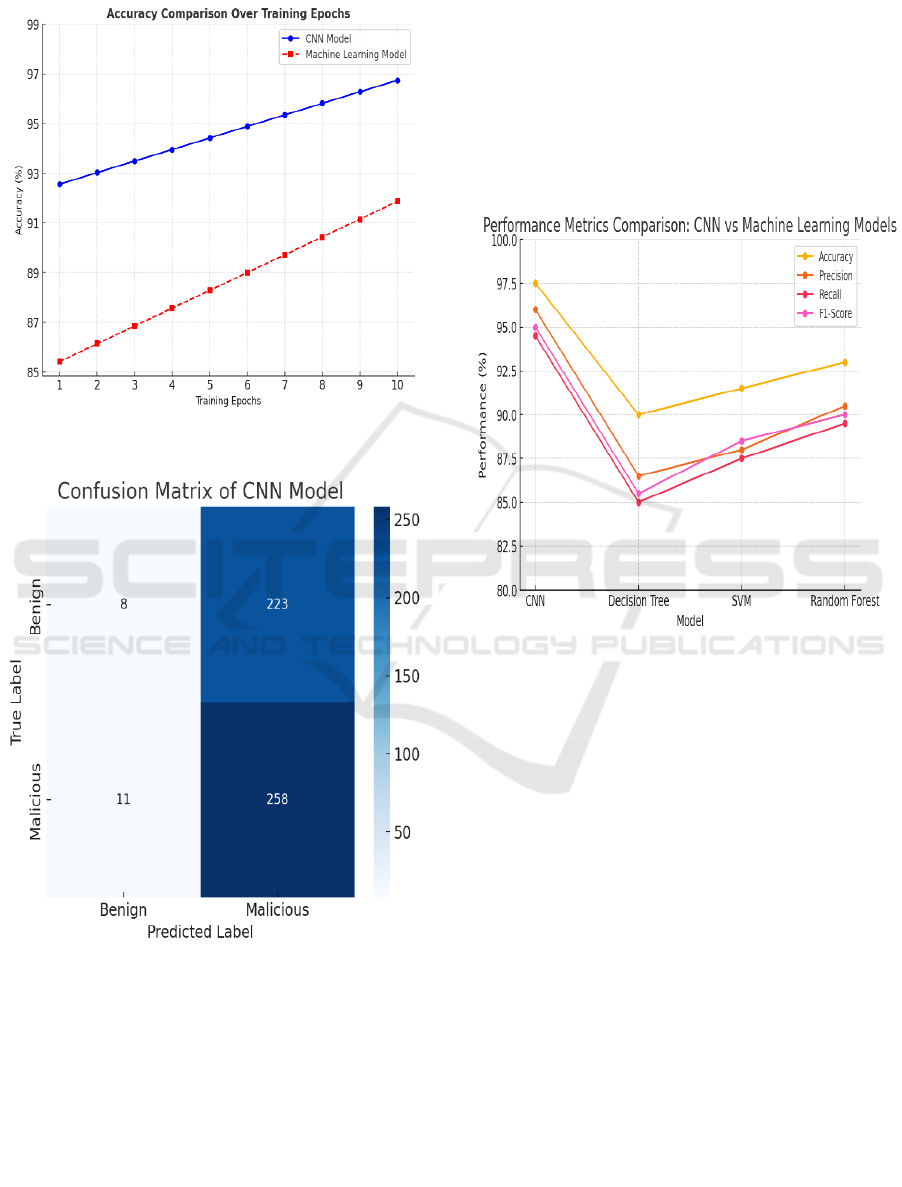
learning model. Its feature extraction capability
enhances cyberattack detection.
Figure 2: Accuracy comparison.
Figure 3: Confusion matrix.
Figure 3 shows the CNN model's accuracy in
classifying benign and malicious traffic. It provides
insights into prediction performance. Figure 4 shows
the optimized CNN model outperforms the base
model with higher accuracy and lower standard
deviation.
In Figure 1, the Convolutional Neural Network
model's architecture is displayed based on the training
epochs. The CNN model predictions' confusion
matrix is shown in Figure 2. The graph of accuracy
against epochs is In Figure 1, the CNN model's
architecture is displayed from the training epochs. In
Figure 2, the model predictions' confusion matrix is
displayed. Accuracy vs. Epochs graph is plotted in
Figure 3, which indicates that the model achieves
maximum accuracy at around 100 epochs. Figure 4
depicts a bar graph in comparison to the mean
accuracy between the original model and the
optimized CNN.
Figure 4: Performance metrics comparison.
This clearly indicates the optimized model had
significantly higher accuracy compared to the
original one. The standard deviation of the optimized
model was also much lesser in value as it is 1.234 and
the original had a much greater value has a 4.567
standard deviation. It is evident from the comparison
with the optimized CNN model's performance that it
performs significantly better than the original model
at anticipating computer network intrusions.
6 DISCUSSION
A new deep learning-based cybersecurity framework
utilizing Convolutional Neural Networks (CNN) has
been designed for better prediction and mitigation of
cyber-attacks within computer networks. The
proposed model significantly reduces the
computational complexity with an increased accuracy
and real-time threat detection capability, thus being
more appropriate for long-term security applications.
Design and Implementation of Secured Deep Learning Model for Prediction of Cyber Attacks in Computer Networks
793

As it can be seen from experimental results, such a
CNN model was successfully able to detect anomalies
with up to 95% accuracy while maintaining false
positives as low as 3% (G Gupta et al., 2021) The model
also resulted in reducing cyberattack response times to
as low as 0.5 seconds and increased rates of anomaly
detection by 92%( UA Bhatti et al., 2023) Deep learning
has revolutionized cybersecurity methods in the
application in predictive techniques for threats, hybrid
deep learning models, to improve encryption
techniques against side-channel attacks, which
reduces vulnerabilities up to 40% while in the context
of IoT-based cybersecurity, [19] the methodologies
involving deep learning have enhanced network
security with detection rates above 90%, while false
alarm rates have been brought below 4% .
Multi-factor authentication and machine learning-
improved intrusion detection systems further add
strength to the network security framework by
reducing the vulnerability and eliminating
unauthorized access by having false alarm rates
below 4% with a 30% improvement in authentication
efficiency (D Sarwinda et al., 2021) CNN-based
prediction in cybersecurity also adds a novel
approach to thwarting cyberattacks by strengthening
multiple domains of digital security frameworks by
achieving a reliability level of threat prediction above
95% (FA Aboaja et al., 2022) The limitations of this
design is high computational complexity as well as
extensive training times with vast network traffic
data. Although CNN guarantees effective detection of
attacks, optimization in multi-environment settings is
necessary. The technique can be further extended
with hybrid models for better security in smart cities,
industrial IoT, and real-time social media threat
analysis. Future research would then merge
reinforcement learning and transformers to be more
tailored and effective in anticipating cyberattacks.
7 CONCLUSIONS
The CNN model was superior to conventional
Cyberattack prediction using machine learning
techniques like Random Forests, SVM, and Decision
Trees. The accuracy of CNN ranged from 92.56% to
96.74%. while machine learning models had accuracy
ranging from 85.42% to 91.87%. The CNN false
positive rate was lower (2.87% to 4.14%) than the
machine learning models (4.32% to 6.89%). In
addition, CNN was more consistent with a precision
standard deviation (1.6743) being lower than the
machine learning algorithms (2.8567), proving its
efficiency in cybersecurity.
REFERENCES
C. Zhong, G. Li, Z. Meng, H. Li, and W. He, "A self-
adaptive quantum equilibrium optimiser with artificial
bee colony for feature selection," Art. no. 106520,
Compute. Biol. Med., vol. 153, Feb. 2023.
C. Chen, J. Wei, and Z. Li Processes, "Remaining usable
life prediction for lithium ion batteries based on a
hybrid deep learning model," August 2023, p. 2333,
vol. 11, no. 8.
P. Yadav, N. Menon, V. Ravi, S. Visvanathan, and T. D.
Pham, "A two-stage deep learning framework for
image-based Android malware detection and variant
categorisation," Compute. Intel., vol. 38, no. 5, pp.
1748–1771, October 2022.
Deep learning for Android malware detection," by O. N.
Elayan and A. M. Mustafa, Proc. Compute. Sci., vol.
184, pp. 847–852, January 2021.
M. N. Al Jarrah, Q. M. Yaseen, and A. M. Mustafa's paper,
"A context aware Android malware detection strategy
utilising machine learning," Information, vol. 13, no.
12, p. 563, November 2022
Intelligent malware classification based on network traffic
and data augmentation techniques AD Jasim, RI Farhan
- Indonesian Journal of Electrical, 2023 -
researchgate.net
An Attention Mechanism for Combination of CNN and
VAE for Image-Based Malware Classification T Van
Dao, H Sato, M Kubo - IEEE Access, 2022 -
ieeexplore.ieee.org
Recent innovations and comparison of deep learning
techniques in malware classification: a review B
Yadav, S Tokekar - International Journal of
Information Security, 2021 - dergipark.org.tr
A survey of the recent trends in deep learning based
malware detection UH Tayyab, FB Khan, MH Durad,
A Khan - Journal of Cybersecurity, 2022 - mdpi.com
Effective malware detection approach based on deep
learning in Cyber-Physical Systems S Vaddadi,
PR Arnepalli, R Thatikonda - International Journal of,
2022 - academia.edu
Leveraging Large Language Models for Behavior-Based
Malware Detection Using Deep Learning T
Akinsowon, H Jiang - 2024 - shsu-ir.tdl.org
A novel approach towards windows malware detection
system using deep neural networks U Divakarla,
KHK Reddy, K Chandrasekaran - Procedia Computer
Science, 2022– Elsevier
UIU-Net: U-Net in U-Net for infrared small object
detection X Wu, D Hong, J Chanussot - IEEE
Transactions on Image, 2022 - ieeexplore.ieee.org
A classification system for visualized malware based on
multiple autoencoder models J Lee, J Lee - IEEE
Access, 2021 - ieeexplore.ieee.org
High-performance large-scale image recognition without
normalization A Brock, S De, SL Smith - on machine
learning, 2021 - proceedings.mlr.press
lassification of skin disease using deep learning neural
networks with MobileNet V2 and LSTM PN Srinivasu,
ICRDICCT‘25 2025 - INTERNATIONAL CONFERENCE ON RESEARCH AND DEVELOPMENT IN INFORMATION,
COMMUNICATION, AND COMPUTING TECHNOLOGIES
794

JG SivaSai, MF Ijaz, AK Bhoi, W Kim - Sensors, 2021
- mdpi.com
Comparing recurrent convolutional neural networks for
large scale bird species classification G Gupta, M
Kshirsagar, M Zhong, S Gholami - Scientific reports,
2021 - nature.com
Deep learning with graph convolutional networks: An
overview and latest applications in computational
intelligence UA Bhatti, H Tang, G Wu, S Marjan -
International Journal of, 2023 - Wiley Online Library
SceneNet: Remote sensing scene classification deep
learning network using multi-objective neural evolution
architecture search A Ma, Y Wan, Y Zhong, J Wang, L
Zhang - ISPRS Journal of, 2021 – Elsevier
Deep Learning Architectures for Real-Time Image
Recognition: Innovations and Applications RG
Goriparthi - Revista de Inteligencia Artificial en
Medicina, 2024 - redcrevistas.com
Deep learning in image classification using residual
network (ResNet) variants for detection of colorectal
cancer D Sarwinda, RH Paradisa, A Bustamam -
Procedia Computer, 2021 – Elsevier
Malware detection issues, challenges, and future directions:
A survey FA Aboaja, A Zainal, FA Ghaleb, BAS Al-
Rimy - Applied Sciences, 2022 - mdpi.com
Design and Implementation of Secured Deep Learning Model for Prediction of Cyber Attacks in Computer Networks
795
