
Decoding the Subjective Symphony: Machine Learning for Music
Genre Classification Using Audio Features and Taxonomy Reduction
V. Ajitha, J. Nishitha, R. Naga Rishika, Md Sufiyan, K. Sai Umanth and K. Laxmi Narayana
Department of Computer Science and Engineering (AIML), Nalla Malla Reddy Engineering College, Hyderabad, India
Keywords: Music Genre Classification, Machine Learning, Audio Features, XGBoost, Neural Networks, K‑Nearest
Neighbours, Ensemble Models, Multi‑Label Classification.
Abstract: This paper addresses the application of machine learning to categorize music genres using audio attributes
from a dataset of 114,000 songs representing 125 genres. Addressing the difficulty of categorizing detailed,
subjective audio data into several genres, the research aimed to predict both individual and multi-genre
classifications while decreasing the goal taxonomy from 114 to 56 genres using hierarchical clustering.
Through exploratory data analysis, the dataset’s 15 features (11 numeric, 4 categorical) were pre-processed,
non-audio genres removed, and data balanced. Models tested included a neural network, Boost, K-nearest
neighbours, and an ensemble approach. Evaluated using top-3 categorical accuracy, a critical metric for
recommendation systems in which neural network achieved the highest performance (73.74%), followed by
the XG Boost (69.54%) and KNN (70.36%). Results revealed that genres with separate aural properties were
labelled more accurately than those with overlapping traits, underscoring the subjective complexity of musical
categorization. The study implies that while machine learning shows progress, genre subjectivity remains a
basic hurdle. Future directions include refining ensemble techniques, adding lyrics, and exploring multi-label
classification to enhance accuracy and nuance in music categorization.
1 INTRODUCTION
Music is part of human culture, transcending
boundaries and various languages. From traditional
folk music to modern complex electronic music,
music is diverse and exists in various forms, typically
categorized into various types. This categorization
aids listeners but poses giant issues to music suppliers
and researchers. As the volume of available music
data continues to rise, understanding and automating
genre classification has become an important subject
of study within the discipline of machine learning.
The rise of sites such as Spotify, which counts over
70 million music in its catalog, has further
complicated genre classification responsibilities.
Although the evaluation of the auditory qualities and
accompanying metadata gives some insight, innate
subjectivity in genre classification makes it a very
hard undertaking. Historically, genres have been
developed according to cultural and historical
settings, which often lead to overlaps and
ambiguities. For instance, a song may contain
elements of various styles such as pop, jazz, or
electronic, and it becomes difficult to categorize both
for humans and computers. New machine learning
technologies provide new methods to manage this
diversity. By applying massive datasets and
sophisticated computer approaches, researchers may
now examine the tremendous possibilities for
automated music genre classification. The issue
comes not just in the algorithms themselves but in
identifying the necessary features to train these
models. Features identified by audio analysis, such as
beat, tempo, and timbre, are vital in appreciating how
varied sounds compose the heart of a musical genre.
The confluence of auditory features with various
machine learning methods gives a viable path for
boosting categorization accuracy.
2 LITERATURE REVIEW
The study of music genres is an important element of
music analysis and classification. Various research
initiatives have been performed to study different
parts of music genre classification, including the
building of datasets, the invention of novel music
acoustic encoders, and the application of deep
762
Ajitha, V., Nishitha, J., Rishika, R. N., Sufiyan, M., Umanth, K. S. and Narayana, K. L.
Decoding the Subjective Symphony: Machine Learning for Music Genre Classification Using Audio Features and Taxonomy Reduction.
DOI: 10.5220/0013920400004919
Paper published under CC license (CC BY-NC-ND 4.0)
In Proceedings of the 1st International Conference on Research and Development in Information, Communication, and Computing Technologies (ICRDICCT‘25 2025) - Volume 4, pages
762-766
ISBN: 978-989-758-777-1
Proceedings Copyright © 2026 by SCITEPRESS – Science and Technology Publications, Lda.

learning algorithms. Roberts et. al., 2020 produced a
dataset for time-scale modification (TSM) with
subjective quality descriptors, spanning a wide range
of music genres. This dataset serves as a great
resource for obtaining objective measurements of
quality in TSM. Zhao et. al., 2020 proposed Music
Oder, a universal music-acoustic encoder based on
transformers, which outperformed existing models in
music genre categorization and auto-tagging tasks.
These breakthroughs in dataset development and
acoustic representation learning lead to the
improvement of music genre classification systems.
Cuesta et. al., 2020 focused on multiple F0 estimation
in voice ensembles using convolutional neural
networks, demonstrating the usefulness of CNNs in
varied circumstances and data configurations. Lerch,
2020 examined audio content analysis in the context
of music information retrieval systems, stressing
music genre classification as one of the primary
applications of audio content analysis. The study by
Ozan, 2021 uses convolutional recurrent neural
networks (CRNN) for audio segment categorization
in contact centre records, drawing parallels to music
genre classification problems’ et. al., 2021 extended
the usage of deep learning to electronic dance music
(EDM) subgenre categorization, including tempo-
related feature representations for better classification
accuracy. Muñoz-Romero et. al., 2021 studied
nonnegative orthogonal partial least squares (OPLS)
for supervised design of filter banks, with
applications in texture and music genre
categorization. These studies demonstrate the diverse
methodologies and techniques utilized in music genre
classification research. Zhao et. al., 2022 created a
self-supervised pre-training technique with Swim
Transformer for music categorization, underlining the
importance of learning meaningful music
representations from unlabelled data. Chak et. al.,
2022 presented the use of Generalized Morse
Wavelets (GMWs) in the Scattering Transform
Network (STN) for music genre categorization,
proving the superiority of this approach over
conventional methods. These works illustrate the
continual study of fresh strategies to boost music
genre classification accuracy. Ian, 2022 focuses on
optimizing musician impact models and assessing
musical qualities across different genres, highlighting
the necessity of recognizing the influence of
performers in music categorization tasks. Liu et. al.,
2022 discussed open set recognition for music genre
classification and presented an algorithmic approach
towards the segmentation of known as well as
unknown genre classes. Heo et. al., 2022 proposed a
framework for hierarchical feature extraction and
aggregation in the classification of music genres so
that short and long-term musical features are captured
appropriately.
3 METHODOLOGY
The music genre categorization experiment utilized a
dataset of 114,000 tracks collected from the Spotify
API, which comprised audio attributes and
information spanning 125 categories. The dataset was
partitioned into a training set of about 91,200 tracks
and a test set consisting of about 22,800 tracks to
evaluate model performance. The independent
variables comprised numerous audio parameters such
as danceability, energy, loudness, acoustics, pace, and
categorization features like key and time signature,
whereas the dependent variable was the track genre.
The dataset is realistic and interesting due to its
significant size, wide genre representation, and rich
audio features that mirror real-world music
categorization issues. This intricacy is further
highlighted by the overlap between genres, which
often share similar auditory traits. This poses a major
challenge to effective classification in the context of
machine learning. These characteristics not only
increase the model's applicability to real-world
scenarios in music streaming services, but they also
provide an interesting exploration of the intricacy of
music, illuminating the challenges associated with
genre classification and the effectiveness of
algorithms in this regard.
Algorithm: Music Genre Classification Using Neural
Networks
Data Preparation
1. Load Dataset: Import dataset D comprisinging
audio features X and genre labels y.
2. Clean Dataset:
o Remove duplicate tracks to maintain
uniqueness,eliminate non-sound-based
genres (e.g., language categories) and
extraneous attributes (e.g., track IDs).
o Implement One-hot encoding for
categorical features (e.g., key, time
signature).
o Convert boolean features (e.g., explicit
content) to binary values (0/1).
3. Split Data: Divide D into training (Xtrain,ytrain)
and test sets (Xtest,ytest) using test split ratio τ.
4. Normalize Features: Apply StandardScaler to
numerical features in Xtrain and Xtest.
5. Consolidate Genres:
o Perform hierarchical clustering on ytrain
and ytest using Ward’s method and
Euclidean distance.
Decoding the Subjective Symphony: Machine Learning for Music Genre Classification Using Audio Features and Taxonomy Reduction
763
o
Merge genres into g broader categories via
consolidation threshold θ (e.g., reduce 125
genres to 56).
Model Architecture
1. Build Neural Network:
o
Input Layer: Neurons = feature
dimensionality of X.
o
Hidden Layers: Sequential layers with 256,
128, 64, and 32 neurons (ReLU activation).
o
Output Layer: Softmax activation for genre
probabilities.
2. Compile Model:
o
Optimizer: Adam.
o
Loss Function: Sparse categorical cross-
entropy.
o
Metrics: Accuracy and top-k categorical
accuracy.
Training
1. Train Model: Fit the model M on Xtrain and
ytrain for E epochs. Validate performance on
Xtest and ytest.
Prediction
1. Generate Predictions: For each test sample xi
∈Xtest:
o
Compute softmax probabilities pi=M(xi).
o
Rank genres by descending probability.
2. Interpret Results: Assign the genre with the
highest probability (e.g., “Pop” with probability
p=0.65).
Evaluation
1. Compute Metrics:
o
Top-1 Accuracy: Proportion of exact
matches between predicted and true genres.
o
Top-k Accuracy: Proportion of true genres
in the top k predictions (e.g., k=3).
2. Store Results: Save metrics in Meval.
Results
The trials encompassed four distinct machine
learning models: Neural Network, XGBoost, KNN
Classifier, and Ensemble Model. In the classification
of music genres, numerous performance measures
were gathered to evaluate the efficacy of different
machine learning models in predicting musical genres
based on aural characteristics.
3.1 Top-K Categorical Accuracy
The Neural network model proved to be highly
effective for multi-class classification, as
demonstrated by its higher overall performance,
notably in the Top-3 ranking. In both metrics, the
XGBoost performed somewhat worse than neural
network model, requiring a lot of processing power
despite having a good capacity. Despite having a
lower Top-1 accuracy, the KNN Classifier was
competitive in terms of Top-3 accuracy and
substantially
faster in terms
of
training
time.
KNN
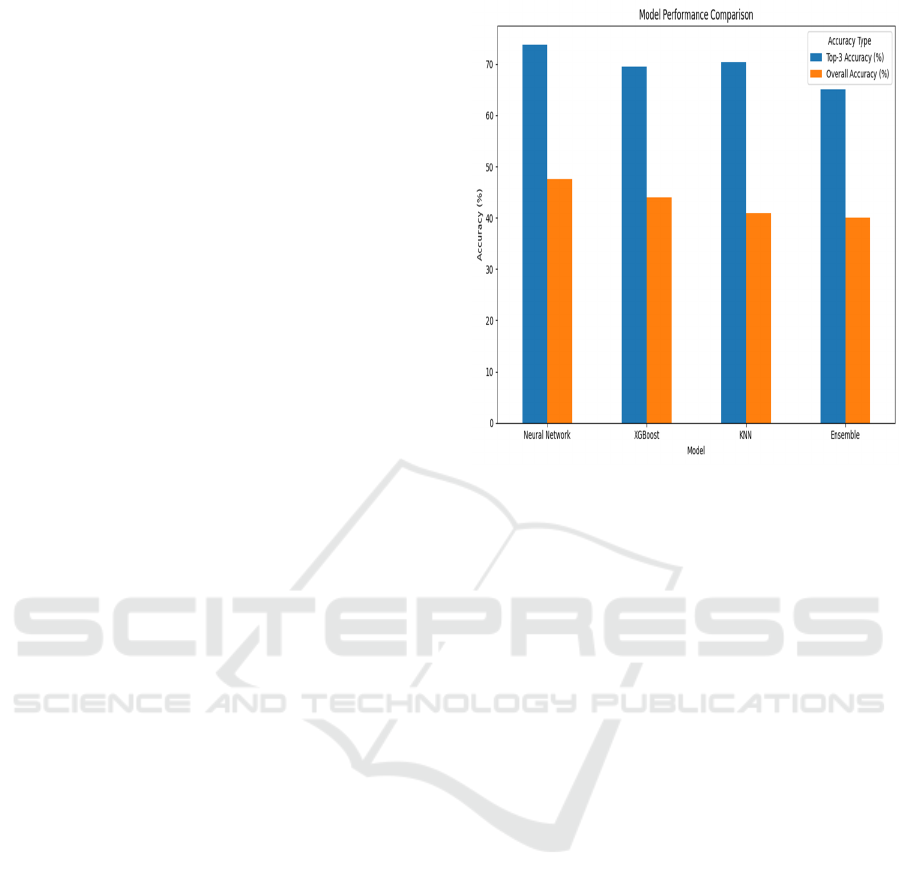
Figure 1: Top-1 Accuracy Shows the Percentage of Times
the Model Predicted the Exact Genre Correctly, With
Neural Network Leading at 47.47%. Top-3 Accuracy
Reflects How Often the True Genre Appeared Within the
Top Three Predicted, With Neural Network Again on Top
at 73.74%.
Classifier scored better than the Ensemble model but
lagged in both Top-1 and Top-3 accuracy compared
ZZ to XGBoost and Neural Networks. Figure 1
shows the Top-1 Accuracy shows the percentage of
times the model predicted the exact genre correctly,
with Neural network leading at 47.47%. Top-3
Accuracy reflects how often the true genre appeared
within the top three predicted, with Neural network
again on top at 73.74%. However, the KNN model’s
relative speed and efficiency make it a desirable
alternative in less resource-intensive settings. The
Ensemble Model fared poorer than the other models,
most likely as a result of including simpler models
(like SVC and Logistic Regression) that had problems
with the dataset's complexity. Ensemble Model
incorporated numerous classifiers but resulted in the
least favorable performance, both in Top-1 and Top-
3 accuracy. This shows that the simpler models
contained in the ensemble may not be consistent with
the complexity necessary for music genre
classification, resulting to lower overall predictions.
ICRDICCT‘25 2025 - INTERNATIONAL CONFERENCE ON RESEARCH AND DEVELOPMENT IN INFORMATION,
COMMUNICATION, AND COMPUTING TECHNOLOGIES
764
3.2 Overall Accuracy
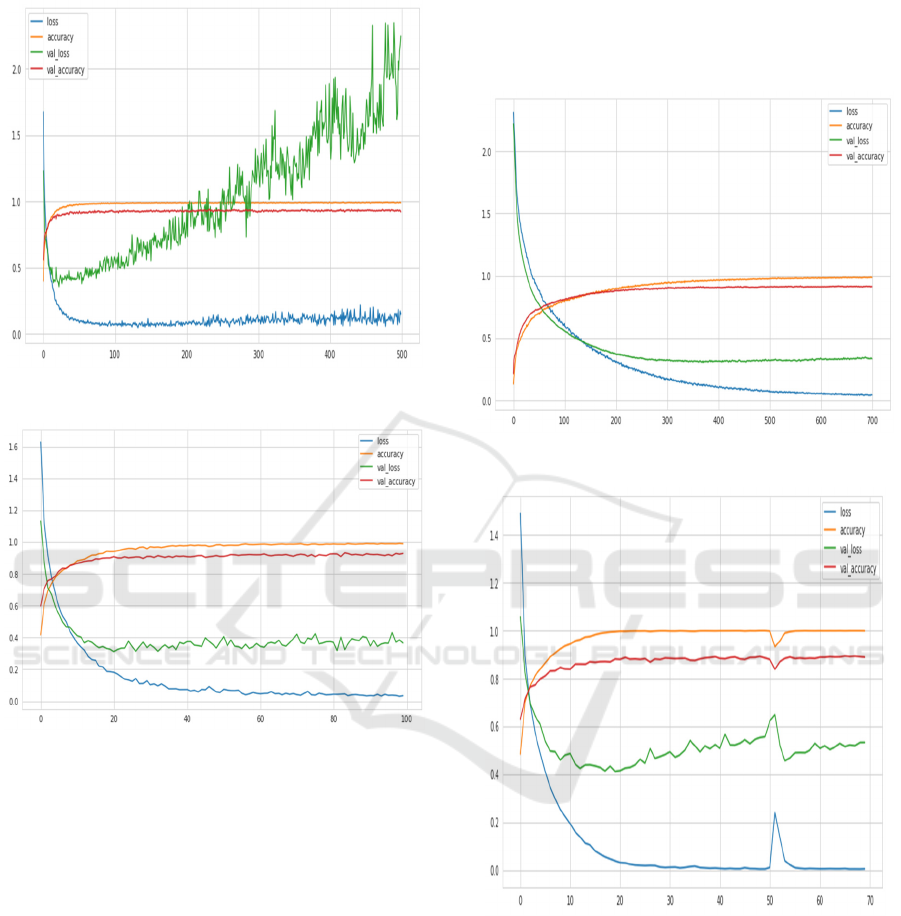
Figure 2: CNN Max. Accuracy 0.92.
Figure 3: XGBoostmax. Accuracy 0.91.
Convolutional Neural Network gives the greatest
balanced and consistent performance across all
permutations. Its training and validation metrics
indicate smooth convergence, with validation loss
closely resembling the training loss, indicating high
generalization capabilities. The figure 2 , 3,4,5 shows
the accracy of mdels XGBoost has great accuracy but
exhibits problematic behaviour in its validation
measures. While reaching 95-98% training accuracy,
the highly changing and growing validation loss
shows the model is overfitting to the training data
rather than learning generalizable patterns. This
shows a need for stronger regularization strategies,
either through dropout layers, reduced model
complexity, or adopting early halting around epoch
200. While its overall accuracy is significantly lower
than the CNN at roughly 90-95%, it maintains
constant validation metrics during training. The
stability in validation loss and very low variance
makes it a dependable choice, especially when speedy
deployment is favoured above reaching the exact best
accuracy.
Figure 4: KNN Validation Accuracy 0.93.
Figure 5: Ensemble Validation Accuracy 0.89.
The ensemble technique gives an interesting
middle ground, displaying smooth learning
progression and robustness to overfitting. There's a
large performance increase at epoch 50, presumably
owing to learning rate tweaks, but the model
maintains steady accuracy around 85-90% with stable
validation measures. This shows that merging
numerous models helps offset individual model faults
while maintaining consistent performance. Given
these results, CNN looks to be the most trustworthy
Decoding the Subjective Symphony: Machine Learning for Music Genre Classification Using Audio Features and Taxonomy Reduction
765

standalone solution for genre categorization,
delivering the optimum mix between performance
and computational efficiency.
3.3 Genre-Wise Accuracy
Table 1: Accuracy Distribution Through Genre.
Model
Best Predicted
Genres (Accuracy)
Worst Predicted
Genres
(
Accurac
y)
Neural
Network
Grindcore (86%),
Study (80%),
Comedy (78%)
Emo (5%),
Blues - R&B
(11%), Techno
(18%)
XGBoost
Grindcore (87%),
Sleep (85%),
Study (81%)
Techno (13%),
Emo (16%),
Blues - R&B
(16%)
KNN
Comedy (77%),
Grindcore (75%),
Sleep (70%)
Techno (10%),
Trip-Hop (8%),
Emo (8%)
This data reveals which music genres were
simpler or more difficult to categorize. Genre-specific
accuracy figures highlighted trends in performance,
allowing discussions about genres that algorithms
find particularly challenging. The table 1 shows the
Accuracy Distribution Through Genre. For instance,
genres characterized by distinct sonic features tended
to be categorized more accurately, whereas those with
broader or less defined characteristics saw lower
accuracy scores.
4 CONCLUSIONS
This investigation evaluated four machine learning
models for the classification of music genres: Neural
Network, XGBoost, K-Nearest Neighbors Classifier,
and Ensemble Model. Each model displayed distinct
strengths and limitations. The Neural Network
demonstrated the highest precision in Top-1 (47.47%)
and Top-3 (73.74%) predictions, excelling in multi-
class tasks despite its demand for substantial
computational resources. XGBoost showed a
competitive accuracy level; however, it showed signs
of overfitting, which highlights the need for applying
regularization methods. The KNN Classifier showed
an effective balance between computational cost and
Top-3 accuracy, with a rate of 68.5%, thus making it
suitable for resource-constrained environments. The
Ensemble Model showed poor performance, possibly
because it is based on basic classifiers that do not fully
capture the complexities of the dataset. Future studies
should explore the creation of hybrid architectures
that work towards minimizing overfitting and taking
advantage of heterogeneous feature representations.
The incorporation of multimodal data with
sophisticated regularization methods can improve
accuracy in domains with uncertainty.
REFERENCES
Cuesta, Helena, et al. “Multiple F0 Estimation in Vocal
Ensembles Using Convolutional Neural Networks.”
ArXiv.org, 2020, arxiv.org/abs/2009.04172.
Roberts, Timothy, and Kuldip K. Paliwal. “A Time-Scale
Modification Dataset with Subjective Quality Labels.”
The Journal of the Acoustical Society of America, vol.
148, no. 1, 1 July 2020, pp. 201210,https://doi.org/10.
1121/10.0001567
Zhao, Yilun, and Jia Guo. “MusiCoder: A Universal Music-
Acoustic Encoder Based on Transformer.” Lecture
Notes in Computer Science, 1 Jan. 2021, pp.
417429, arxiv.org/abs/2008.00781,https://doi.org/10.1
007/978-3-030-67832-6_34.
ICRDICCT‘25 2025 - INTERNATIONAL CONFERENCE ON RESEARCH AND DEVELOPMENT IN INFORMATION,
COMMUNICATION, AND COMPUTING TECHNOLOGIES
766
