
Accelerated and Intelligent Password Cracking with Performance
Optimization
Suresh Kumar C., Raja J. and Ragavan R.
Department of Computer Science and Engineering, School of Computing, Vel Tech Rangarajan Dr. Sagunthala R&D
Institute of Science and Technology, Chennai‑600062, Tamil Nadu, India
Keywords: Password Authentication, Biometrics, Cyber Security, Optimize Password Cracking, Multi‑Factor
Authentication, Brute Force, Dictionary Attack, Hybrid Attack.
Abstract: In the increasingly digitised world, security is a huge concern. Among all the security mechanisms, password
authentication is the most popular one, however, weak or simple passwords are still susceptible to security
attacks. This work introduces a system for distributed password cracking, for helping recover lost or forgotten
passwords as well as to assess the weaknesses of current password management methodologies Furthermore,
the system leverages cloud computing resources in order to allocate tasks towards workers, in-order to
enhance productivity and scalability. The study also examines the efficacy of password strength, hashing
algorithm, and encryption method in enhancing password security. The resulting system combines many
attack tactics such as brute-force, dictionary, or hybrid approach as well as state-of-the-art optimization
strategies. Anticipating passwords with heuristic-based predictions and machine learning model, and running
upon GPU-accelerated parallel devices, the system is orders of magnitude faster than the approaches that try
with candidate passwords alone. Ultimately, the project seeks to raise cybersecurity awareness by showing
how weaknesses exist in password-based authentication and encourage the implementation of stronger, more
secure authentication measures, such as multi-factor authentication (MFA) and biometrics.
1 INTRODUCTION
Passwords are the most widespread and least
expensive access control mechanism applied to
defend sensitive information on the internet, and they
can be found on a wide variety of online platforms,
for an endless range of applications. There are still
weak, common, or reused passwords, and we know
those are a gold mine, open to brute force, dictionary,
and credential-stuffing attacks. Hackers and other
cyber criminals always take advantage of these gaps,
which result in breaches, identity theft, and data leaks.
1.2.2 Project Purpose The purpose of the Optimized
Password Cracker System Project is to create a faster
and efficient password recovery system based on
modern computing methodologies. Combining
established machine learning algorithms, heuristic
based predictions, GPU accelerated computation, and
distributed computing, this project aims to improve
the reliability of password cracking, and to highlight
flaws in current password security methods. This
project is written with an ethics-first approach and it
is specifically aimed at penetration testing, security
auditing and other research into password-based
system security, so that security professionals can
pick weak passwords from a list and recommend the
system's owner to implement strong security
measures. In addition, we also analyse the
performances of some well-known hashing and
encryption methods in order to compare and evaluate
them. By pointing out the vulnerabilities in weak
password implementation, this initiative encourages
the implementation of stronger forms of
authentication, including multi-factor authentication
(MFA), biometric verification and password
managers. Ultimately, the Optimized Password
Cracker acts as a cybersecurity educator that urges
people and companies to start using better password
management practices. “The project improves upon
traditional password recovery methods by using a
smart alternate approach to crack passwords with the
help of the word lists provided. Through GPU
acceleration of high speed computations, adaptive
learning for evolving strategy, and AI-based
recognition of password patterns, this system
minimizes computational burden and enhances the
C., S. K., J., R. and R., R.
Accelerated and Intelligent Password Cracking with Performance Optimization.
DOI: 10.5220/0013920100004919
Paper published under CC license (CC BY-NC-ND 4.0)
In Proceedings of the 1st International Conference on Research and Development in Information, Communication, and Computing Technologies (ICRDICCT‘25 2025) - Volume 4, pages
741-749
ISBN: 978-989-758-777-1
Proceedings Copyright © 2025 by SCITEPRESS – Science and Technology Publications, Lda.
741
success rate of the attack. Ethical security norm is
followed to make it responsible use to avoid
unauthorized misuse. The work also stresses on the
use of strong password policy, secure hashing
mechanism (bcrypt, Argon2), multi-factor
authentication (MFA) to reduce the security threats.
This research focuses on bridging the gap between
traditional brute-force techniques and modern AI-
enhanced password recovery methods, demonstrating
how performance optimization can drastically
improve security assessments while maintaining
compliance with ethical hacking practices.
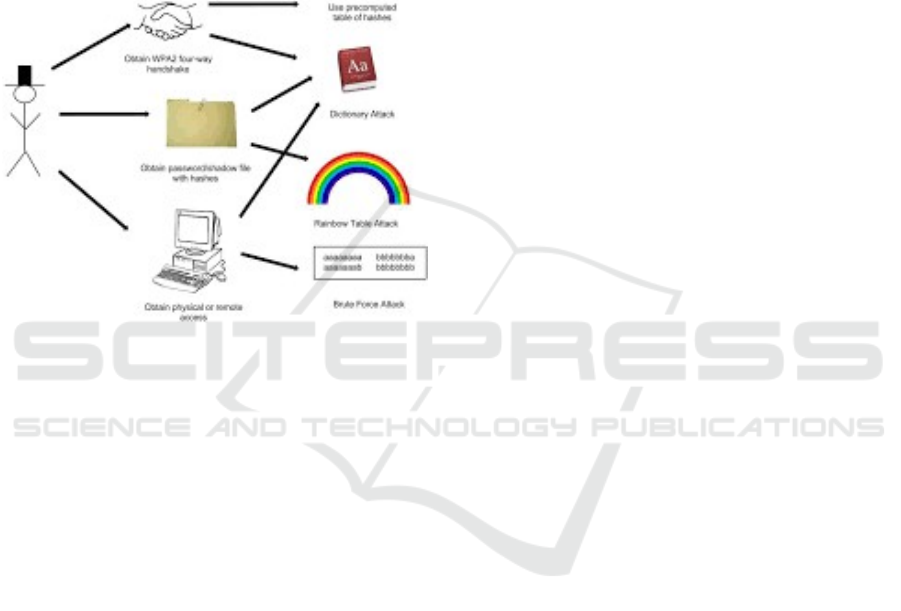
Figure 1: Use case diagram.
Figure 1 depicts the different ways in which
attackers, assuming they get hold of authentication-
data would try to crack a password. It as an example
showing how an attacker may be able to extract
credentials (i.e capturing a WPA2 4-way handshake,
obtaining a password hash file, physical access,
remote access). Techniques for cracking of password
Once the authentication data has been obtained, there
are various ways to crack the password. Fall:
precompute hash tables make it possible for an
attacker to find passwords by comparing them to pre-
computed hash values. Dictionary attacks perform
password guessing on the basis of predefined
wordlists of common words and charac-ter patterns.
Rainbow table attacks rely upon massive tables of
precalculated hashes to speed up cracking. A brute
force attack is an attempt to break the password of a
user account by systematically trying every possible
combination of characters. This demonstrates the
risks of short/simple passwords and the key defence
strong encryption and security practices bring to bear
against unauthorized access.
2 TRADITIONA METHODOLOGY
The conventional process of password cracking
involves algorithms to reverse-engineer passwords
from encrypted or hashed data in a structured manner
using classical algorithmic tools. These techniques
are brute force attacks, dictionary attacks and
rainbow table attacks. Brute force attacks entail
guessing combinations of characters in sequence until
the correct password is guessed. This method is
exhaustive, however grows in inefficiency as the
password size and complexity goes higher.
Dictionary attacks rely on lists of preselected
passwords and common words or phrases, allowing
far fewer trials than the naïve and explicit password
cracking methods. Rainbow table attacks use large
tables of precomputed hash values that enable
attackers to reverse cryptographic hashes rapidly
rather than computing them on the fly.
• Brute
Force
Attack:
This
method
involves systematically generating and
testing every possible
password
combination until the correct one is found.
It is highly time-consuming, especially for
complex passwords.
• Dictionary Attack: Instead of testing
random combinations, this technique uses
a predefined list of commonly used
passwords, words, and phrases to expedite
the cracking process.
• Rainbow Table Attack: This method
utilizes large precomputed tables of hashed
values, enabling quick reversal of
cryptographic hashes without generating
them in real time. Hybrid Attacks – A
combination of dictionary and brute force
methods where known words are modified
with numbers and special characters to
guess more complex passwords.
• Keylogging & Phishing: Some traditional
approaches involve capturing keystrokes or
tricking users into revealing their passwords
rather than breaking encryption directly.
These constraints are over come through the aid of
deep learning techniques with optimization
algorithms.
3 PROPOSED SYSTEM
The novelty IT expert system yet based on an
advanced and clever way (with artificial intelligence,
machine learning, GPU CUDA, heuristic and other
ICRDICCT‘25 2025 - INTERNATIONAL CONFERENCE ON RESEARCH AND DEVELOPMENT IN INFORMATION,
COMMUNICATION, AND COMPUTING TECHNOLOGIES
742
modern approaches) for cracking in pairing list is
suggested. This method, unlike brute-force and
dictionary-based attack, dynamically changes the
way of the attack with the lessons drawn from the
patterns until the system finds the password. With AI-
fed models, the system is capable of predictive
analysis and can therefore focus on likely
combinations rather than just trying them all.
Moreover, GPU parallel process is introduced to
highly accelerate computation speed, which can
efficiently conduct large-scale password-cracking
process. What is more, cloud-based distributed
computing further facilitates the scalability of the
system, in which multiple computing elements
cooperate smoothly to decrease processing time and
improve the success rates.
The overall security of the proposed scheme and
its security and ethical requirements, restrict the
password-cracking behavior to be conducted
according to the legitimate working range. Access
controls and audit logging are incorporated to track
all access to the data, minimizing unauthorized use
and achieving compliance with cybersecurity
requirements.
The UI has also been designed with the user in
mind and have been optimized for ease of use,
complete with an interactive dashboard to upload
password hashes, select the target attack strategy, and
monitor real-time progress. It's designed for use by
cybersecurity professionals in ethical hacking,
pentesting, and security auditing, and in any scenario
in which systems are to be evaluated and/or tested on
for changes in the security infrastructure.
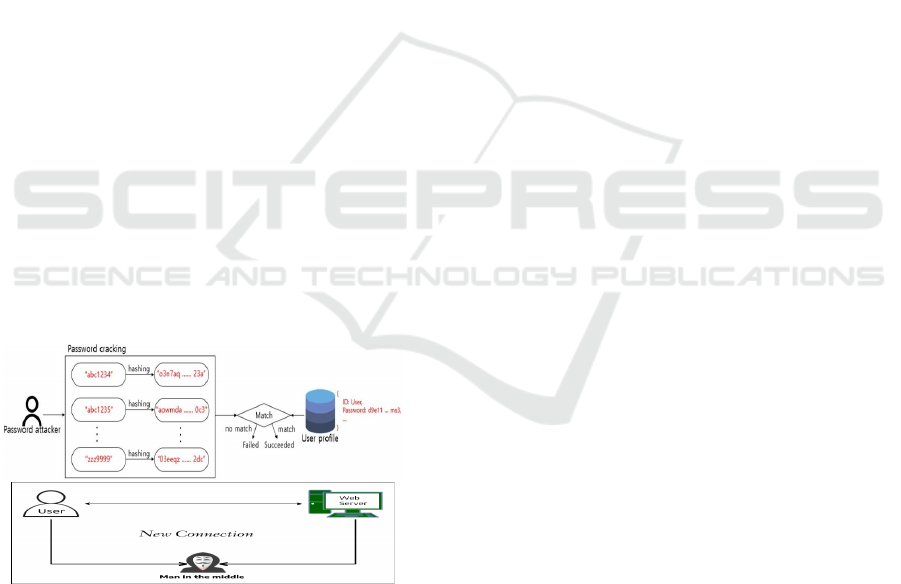
Figure 2: Password cracking process.
Leveraging AI predictions as well as high-
performance computing and an adaptive approach,
the developed system is faster, more accurate and
more resource-sensitive than traditional approaches,
while remaining ethically sound.
Figure 2 repesent password-cracking attack,
where an attacker systematically guesses passwords
by hashing input strings and comparing them to stored
password hashes.
The image highlights the brute-force approach, where
multiple possible passwords are hashed and compared
against the stored values in a database. If a match is
found, the attacker successfully retrieves the
password. Common password-cracking techniques:
• Brute-force attack: Tries every possible
combination. Dictionary attack: Uses a
predefined list of common passwords.
• Rainbow table attack: Uses precomputed
hash values to quickly reverse-engineer a
password.
• Preventive measures: Use strong hashing
algorithms (bcrypt, PBKDF2, Argon2),
enable multi-factor authentication (MFA),
enforce strong password policies, and
implement rate-limiting techniques.
4 ACCELERATED AND
INTELLIGENT PASSWORD
CRACKING WITH
PERFORMANCE
OPTIMIZATION
Password security continues to be an issue of vital
importance even in the new digital era while
sophisticated attacks are launched to beat
authentication systems. Classic password-cracking
methods like brute force and dictionary attacks have
advanced to a new level where optimization-based
approaches and smart computing models are taken
advantage of.
Speedy password cracking is made possible
thanks to the help of hardware acceleration,
parallelisation and optimalisation algorithms.
Cryptographic hash calculations are often accelerated
by Graphics Processing Units (GPUs) and Field-
Programmable Gate Arrays (FPGAs). Compared with
traditional, CPUs, GPUs are well known for their
good performance in taking massive parallelisable
tasks, thus being suitable for hash-rate computation
in password cracking.
Solutions Intelligent password-cracking
algorithms combine machine learning and artificial
intelligence to better guess passwords. If attacker has
access to the password patterns of the user such that
the AI based model can generate likely guesses then
the time a attacker needs to successfully guess is
drastically decreased. Leveraging deep learning
models built with massive password leak databases,
the attackers bypass conventional security by directly
Accelerated and Intelligent Password Cracking with Performance Optimization
743

targeting commonly used passwords, rather than
brute-forcing all the possible combinations.
Algorithm and heuristic based performance
improvements and adaptive approaches are used for
password cracking. Hashing mechanisms like bcrypt,
PBKDF2 and Argon2 are designed to mitigate high
speed attacks by introducing computational delays
and memory-hard functions. Consider rule-based
attack, hybrid attack, and the use of precomputed
hash tables (rainbow table) as optimizations and you
can see that cracking passwords is already much
faster.
The increasing use of fast and smart password
breaking methods illustrates the necessity of having
good security practices. Companies and users need to
enforce stronger password policies and 2FA, and also
implement strong cryptography to protect sensitive
credentials. With the growth of computing power,
authentication mechanisms need to adapt to meet new
password threats.
Password cracking has changed drastically with
increasing computing power and optimized
algorithms. Adversaries use high speed hardware,
key derivation functions, and performance-enhancing
tools to circumvent password security. Nowadays
brute-force attacks are complemented with ai-based
methods, heuristic examination or data mining which
makes the security of passwords a daunting task to
organizations as well as to people.
Table 1: Password searches.
lower
case
lower/upper
lower/
upper/
digits
lower/up
per/
digits/
symbols
1 26 52 62 95
2 676 2704 3844 9025
4 456,976 7,311,616 14,766,336
81,450,6
25
8 2.09×10¹¹ 5.35×10¹³ 2.18×10¹⁴
6.63×10¹
⁵
16 4.36×10²² 2.86×10²⁷ 4.77×10²⁸
4.40×10³
¹
Table 1 The table illustrates the total number of
possible password combinations based on different
character sets and password lengths. It categorizes
password strength into four different character set
groups: lowercase letters (26 characters), lowercase
and uppercase letters (52 characters), lowercase,
uppercase, and digits (62 characters), and a full set
including lowercase, uppercase, digits, and symbols
(95 characters). Each row represents an increasing
password length, starting from 1 character up to 16
characters. The table demonstrates how the total
number of possible passwords increases
exponentially with length. For instance, with just one
character, the possible combinations range from 26
(lowercase) to 95 (all characters). However, at 16
characters, the possibilities range from
4.36×10224.36 \times 10^{22}4.36×10²²
(lowercase) to 4.40×10314.40 \times
10^{31}4.40×1031 (full character set).
This data highlights the importance of increasing
password length and complexity to enhance security.
A longer password with a diverse character set
significantly improves security by making brute-force
attacks infeasible. The exponential growth in possible
combinations as length increases demonstrates why
modern security practices emphasize using long,
complex passwords to withstand advanced cracking
techniques.
4.1 Optimization algorithm
Optimization algorithms play a crucial role in
enhancing the efficiency of computational tasks,
including password cracking. These algorithms aim
to minimize computational complexity and maximize
the success rate of cracking attempts. Traditional
brute-force attacks, which involve testing every
possible combination, are highly inefficient and time-
consuming. Optimization techniques such as heuristic
algorithms, genetic algorithms, and machine learning
models improve performance by narrowing down the
search space and prioritizing probable password
patterns. Heuristic-based approaches analyze
commonly used password structures, enabling
attackers to focus on high- probability candidates.
Genetic algorithms simulate evolution by selecting
the best candidates, applying crossover and mutation,
and iterating until an optimal solution is found. Deep
learning models leverage vast datasets to predict
password tendencies, refining attack strategies
dynamically. Rainbow tables optimize attacks by
precomputing password hashes, allowing quick
lookups instead of real-time computations.
Markov models generate probable passwords based
on statistical likelihood, reducing unnecessary
attempts. Parallel computing and distributed
processing use multiple CPU or GPU cores to
execute large-scale attacks efficiently.
4.2 Object detection and tracking
Object detection and tracking is a hot topic in
computer vision, and is applied in surveillance,
autonomous vehicle, robot, augmented reality, etc.
ICRDICCT‘25 2025 - INTERNATIONAL CONFERENCE ON RESEARCH AND DEVELOPMENT IN INFORMATION,
COMMUNICATION, AND COMPUTING TECHNOLOGIES
744

Object detection requires the recognition as well as
localization of objects in an image or video frame,
while object tracking deals with the association of
objects over multiple frames in a video sequence.
State-of-the-art object detection methods are based on
deep learning approaches: Convolutional Neural
Network (CNN), Region Convolutional Neural
Network (R-CNN) and You Only Look Once
(YOLO). These models fuse object classification and
localization very effectively and can run in real time
with very high object classification accuracy. Faster
R- CNN and Single Shot MultiBox Detector (SSD)
strike a balance between detection accuracy and
speed that are appealing to practical use. On the other
hand, object tracking maintains a tracking record of
the detected objects through the frames. Tracking
algorithms consist of filters, e.g., correlation filters
such as MOSSE and deep learning-based trackers
such as DeepSORT, methods are based on optical
flow and etc. The former predict the motion of the
object by predicting its future location, the latter cope
with both simple and complex motion patterns.
Challenges in object detection and tracking
include occlusion, variations in lighting, motion blur,
and real-time constraints. Advanced solutions
integrate multiple sensors, improve feature extraction,
and apply reinforcement learning to enhance
performance. These techniques are crucial in
applications like automated surveillance, intelligent
transportation, and interactive human-computer
interfaces.
Figure 3: The spectrum of possibilities for password
cracking attacks.
Figure 3 demonstrates the idea of applying a time-
memory trade-off to the problem of cryptanalysis was
first proposed. Though his approach attacks a cipher
text encrypted using the Data Encryption Standard
(DES), it requires only minor modifications to instead
attack a password hashing scheme. Given a
precomputed table smaller than what would be
employed in an attack.
4.3 Redundancy Measures
Redundancy measures in password cracking and
authentication systems refer to strategies that enhance
security by making password cracking more difficult
and protecting authentication mechanisms against
attacks. These measures are crucial in preventing
unauthorized access, reducing vulnerabilities, and
increasing computational effort for attackers.One
common redundancy measure is password salting,
where a unique random value is added to each
password before hashing. This prevents attackers
from using precomputed hash tables, such as rainbow
tables, to crack passwords efficiently. Hashing
algorithms with high computational cost, like bcrypt,
PBKDF2, and Argon2, introduce redundancy by
requiring multiple iterations, making brute-force
attacks slower.Another redundancy measure involves
multi-factor authentication (MFA), where additional
verification steps, such as one-time passwords
(OTPs), biometrics, or security tokens, complement
traditional password-based authentication. This
reduces reliance on passwords alone and significantly
enhances security.Account lockout mechanisms and
rate limiting add redundancy by restricting repeated
login attempts, preventing brute-force and dictionary
attacks. CAPTCHA challenges further increase
complexity for automated password-cracking bots.
4.4 Integration System
Integration in the context of security and
authentication refers to the seamless combination of
multiple security measures, systems, or technologies
to enhance overall protection. In password
authentication and cybersecurity, integration plays a
crucial role in improving efficiency, user experience,
and resilience against attacks. One key aspect of
integration is combining authentication mechanisms
such as multi-factor authentication (MFA), biometric
authentication, and token-based authentication to
provide layered security. This reduces reliance on a
single method, making it harder for attackers to gain
unauthorized access.Another significant integration
approach involves the synchronization of
authentication systems across multiple platforms and
services. Single Sign-On (SSO) allows users to access
multiple applications with a single set of credentials,
reducing password fatigue and minimizing the risk of
weak passwords.Additionally, cybersecurity systems
integrate threat intelligence, anomaly detection, and
behavioral analysis to identify potential breaches.
Advanced monitoring tools and artificial intelligence-
driven security solutions work alongside traditional
Accelerated and Intelligent Password Cracking with Performance Optimization
745

authentication mechanisms to detect and prevent
suspicious activities in real-time.
5 EXPERIMENTAL ANALYSIS
Experiment analysis evaluates password cracking
efficiency, optimization algorithms, security
measures, and redundancy techniques to enhance
authentication system performance and resilience.
Table 5 demonstrates the dictionary data is
viewed to compare the efficiency of the data. Table 4
demonstrates the brute force attack works by trying
every possible combination of the users.
Table 4: Brute Force Data.
Password Length Attempts/Hashes
MD5 Time
(Seconds)
SHA-1 Time
(Seconds)
a 1 2 0.001 0.001
z 1 27 0.001 0.001
an 2 380 0.003 0.005
or 2 502 0.004 0.003
a1 2 1038 0.010 0.006
z9 2 2159 0.017 0.017
aA1 3 216029 1.705 1.714
z9 3 249381 2.126 1.966
aZ16 4 14970377 114.995 119.043
16Za 4 460207 3.617 4.257
abcd 4 80975 0.663 0.679
9999 4 14641 0.109 0.123
fast 4 407545 3.698 4.077
Slow 4 3466988 25.294 29.198
apple 5 290459 2.224 2.781
zebra 5 887355 6.493 7.301
fast1 5 53515623 394.666 440.198
Slow9 5 982495000 7310.119 8498.992
abcde 5 2738180 20.580 23.8
quick 5 5912046 45.004 49.023
pass1 5 53464980 419.349 454.406
abcdef 6 88831622 672.138 747.456
aaaaaa 6 214985 1.648 1.775
passwd 6 70006643 539.175 616.408
Total: 1295527188 9697.017 11147.821
Average(hashes/second): 133600.5895 116213.4903
ICRDICCT‘25 2025 - INTERNATIONAL CONFERENCE ON RESEARCH AND DEVELOPMENT IN INFORMATION,
COMMUNICATION, AND COMPUTING TECHNOLOGIES
746
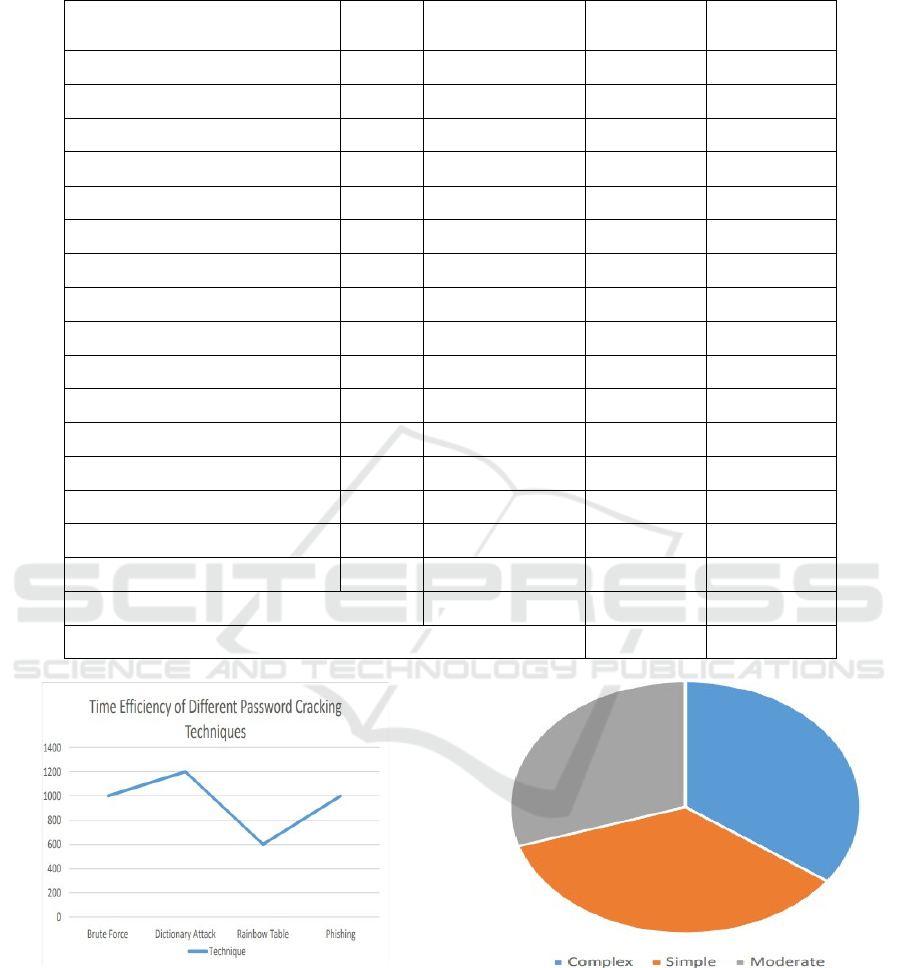
Table 5: Dictionary data.
Password Length Attempts/Hashes
MD5 Time
(Seconds)
SHA-1 Time
(Seconds)
a 1 2 0.001 0.001
l 1 1 0.001 0.001
an 2 7 0.001 0.001
or 2 65 0.001 0.001
and 3 124 0.001 0.001
try 3 763 0.008 0.008
test 4 3471 0.026 0.028
pass 4 2791 0.021 0.024
apple 5 4162 0.031 0.034
zebra 5 9967 0.073 0.078
kitten 6 14710 0.108 0.115
hacker 6 13901 0.100 0.136
balloon 7 21030 0.152 0.194
puppies 7 300018 0.214 0.263
password 8 44857 0.321 0.364
computer 8 37618 0.303 0.299
Total: 453448 1.362 1.484
Average(hashes/second): 332928.047 305557.9515
Figure 4: Time Efficiency.
The Figure 4 demonstrates the speed at which
password cracking techniques operate is a critical
factor in cybersecurity risk assessment. A rapid crack
can enable swift unauthorized access, posing severe
threats to personal and organizational security.
Figure 5: Password Complexity.
Figure 5 demonstrates the password complexity by
'Simple,' 'Moderate,' and 'Complex' based on their
length and character variety, we aim to unravel the
prevailing trends in user- generated passwords. This
exploration into password complexity not only
illuminates the existing vulnerabilities but also
informs security strategies, aiding in the creation of
stringent password policies.
Accelerated and Intelligent Password Cracking with Performance Optimization
747
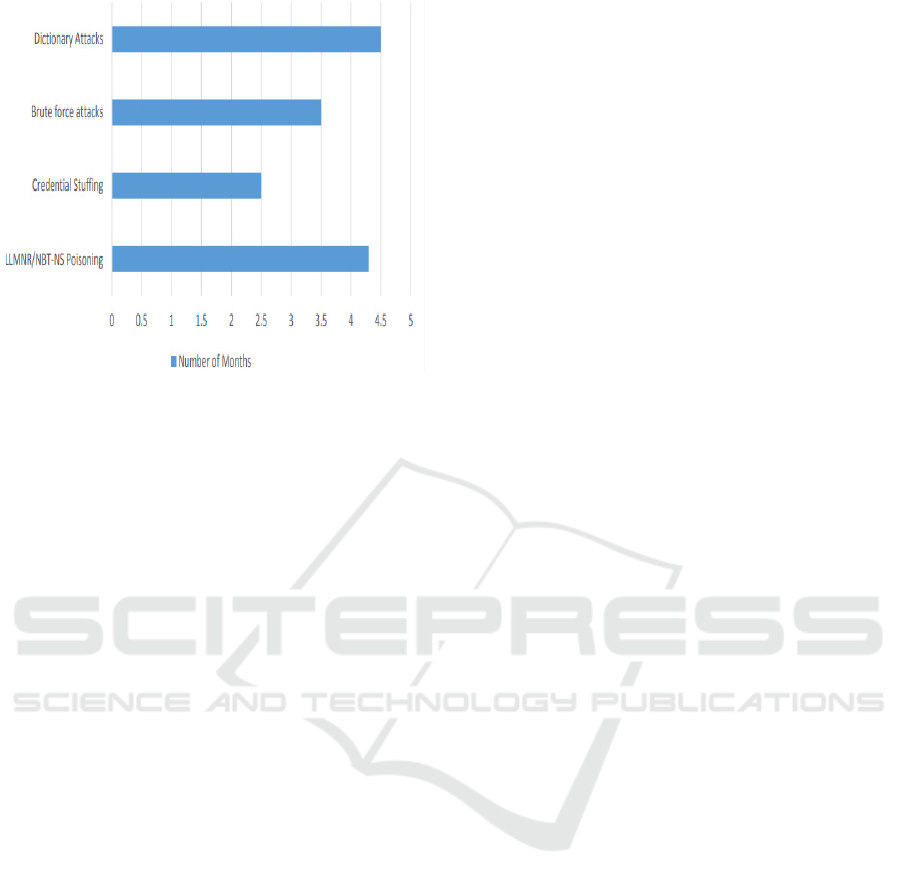
Figure 6: Success and Failure Bar Chart.
Figure 6 demonstrates the Success and Failure Bar
Chart. By visualizing our findings in a bar chart, we
aim to illuminate the patterns and trends underlying
the success and failure rates of these exploitation
techniques over a specific period.
6 CONCLUSIONS
The Optimized Password Cracker project highlights
the importance of password security, ethical hacking,
and penetration testing in modern cybersecurity. By
leveraging advanced password-cracking techniques,
AI-based predictions, GPU acceleration, and cloud
computing, this project significantly enhances the
efficiency and speed of password recovery while
analyzing authentication vulnerabilities. Through this
system, cybersecurity professionals can identify
weaknesses in password-based authentication
methods, assess the strength of hashing algorithms,
and reinforce security policies to mitigate cyber
threats. The project also emphasizes ethical and legal
considerations, ensuring that the tool is used strictly
for authorized security audits and educational
purposes. Ultimately, the project serves as a powerful
cybersecurity tool that contributes to strengthening
digital security by raising awareness about password
vulnerabilities and promoting best practices for
secure authentication. Future enhancements may
include improving AI-driven password prediction
models, integrating real-time threat analysis, and
expanding cloud-based distributed computing
capabilities for large-scale security assessments.
REFERENCES
Arjovsky, M.; Chintala, S.; Bottou, L. {W}asserstein
Generative Adversarial Networks. In Proceedings of
the 34th International Conference on Machine
Learning, Sydney, Australia, 6–11 August 2017;
Volume 70, pp. 214–223. [Google Scholar]
Cracking. IEEE Trans. Inf. Forensics Secur. 2015, 10,
1776–1791. [Google Scholar] [CrossRef]
CyberWarzonehttp://cyberwarzone.com/massive-
collection- password- wordlists- recover lost-
password/, last accessed on 22 March 2015
D. Pahuja and P. Sidana, "Implementing and comparing
different password cracking tools", International
Research Journal of Engineering and Technology
(IRJET), vol. 8, no. 5, pp. 2089-2095, 2021.Yazdi, S.H.
Probabilistic Context-Free Grammar Based Password
Cracking: Attack, Defense and Applications. Ph.D.
Thesis, Department of Computer Science, Florida State
University, Tallahassee, FL, USA, 2015. [Google
Scholar]
Dell’Amico, M., Mihajlin, I., Carminati, B., Ferrari, E.
(2010). Password Strength: An Empirical Analysis.
IEEE Transactions on Information Forensics and
Security.[DOI:10.1109/TIFS.2010.2046759].Discusse
s password entropy and cracking feasibility based on
real-world datasets.
Gasti, P., Rasmussen, K. (2012). On the Security of
Password Manager Database Formats. ACM
Conference on Computer and Communications
Security.Evaluates vulnerabilities in password
management tools.
Gershon Kedem and Yuriko Ishihara. Brute force attack on
unix passwords with simd computer. In Proceedings of
the 8th conference on USENIX Security Symposium -
Volume 8, pages 8–8, Berkeley, CA, USA, 1999.
USENIX Association.
He, K.; Zhang, X.; Ren, S.; Sun, J. Deep Residual Learning
for Image Recognition. In Proceedings of the 2016
IEEE Conference on Computer Vision and Pattern
Recognition (CVPR), Las Vegas, NV, USA, 27–30
June 2016; pp. 770–778.
He, K.; Zhang, X.; Ren, S.; Sun, J. Deep Residual Learning
for Image Recogni-tion. In Proceedings of the 2016
IEEE Conference on Computer Vision and Pat-tern
Recognition (CVPR), Las Vegas, NV, USA, 27–30
June 2016; pp. 770–778.
Hochreiter, S.; Schmidhuber, J. Long Short-Term Memory.
Neural Com-put. 1997, 9, 1735–1780. [Google
Scholar] [CrossRef] [PubMed].
Hochreiter, S.; Schmidhuber, J. Long Short-Term Memory.
Neural Comput. 1997, 9, 1735–1780. [Google Scholar]
[CrossRef] [PubMed]
Houshmand, S.; Aggarwal, S. Using Personal Information
in Targeted Grammar-Based Probabilistic Password
Attacks. IFIP Adv. Inf. Commun. Technol. 2017, 511,
285–303. [Google Scholar] [CrossRef] [Green Version]
Houshmand, S.; Aggarwal, S.; Flood, R. Next Gen PCFG
Password
ICRDICCT‘25 2025 - INTERNATIONAL CONFERENCE ON RESEARCH AND DEVELOPMENT IN INFORMATION,
COMMUNICATION, AND COMPUTING TECHNOLOGIES
748

Ibrahim Alkhwaja, Mohammed Albugami, Ali Alkhwaja,
Mohammed Alghamdi, Hussam Abahussain, Faisal
Alfawaz, et al., "Password Cracking with Brute Force
Algorithm and Dictionary Attack Using Parallel
Programming", Applied Sciences, vol. 13, no. 10, pp.
5979, 2023.
Katz, J., Lindell, Y. (2020). Introduction to Modern
Cryptography. CRC Press.Covers theoretical
foundations of cryptographic security, including hash
functions used in password storage.
Kaufman, C., Perlman, R., Speciner, M. (2016). Network
Security: PrivateCommunication in a Public World.
Prentice Hall.Covers network security protocols and
authentication mechanisms.
Li Zhuang, Feng Zhou, and J. D. Tygar. Keyboard acoustic
emanations revisited. ACM Trans. Inf. Syst. Secur.,
13:3:1–3:26, November 2009.
Narayanan, A., Shmatikov, V. (2005). ”Fast Dictionary
Attacks on Passwords Using Time-Memory Tradeoff.”
Proceedings of the 12th ACM Conference on Computer
and Communications Security (CCS).
National Institute of Standards and Technology. Digital
Identity Guidelines. 2004. Available online:
https://pages.nist.gov/800-63- 3/ (accessed on 10 June
2017).
S.Aggarwal, S. Using Personal Information in Targeted
Grammar- Based Proba-bilistic Password Attacks. IFIP
Adv. Inf. Commun. Technol. 2017, 511, 285–
303.[Google Scholar] [CrossRef] [Green Version]
Weir, M., Aggarwal, S., Collins, M., Stern, H. (2009).
”Testing Metrics for Password Creation Policies by
Attacking Large Sets of Revealed Passwords.”ACM
Conference on Computer and Communications
Security (CCS).
William, M.; Blase, U.; Sean M., S.; Saranga, K.; Lujo, B.;
Nicolas, C.; Lorrie Faith, C. Fast, Lean, and Accurate:
Modeling Password Guessability Using Neural
Networks. In Proceedings of the 25th {USENIX}
Security Symposium ({USENIX} Security 16), Austin,
TX, USA, 10–12 August 2016; pp. 175–191. [Google
Scholar]
Z. Zhang and P. Liu, "A hybrid-cpu-FPGA-based solution
to the recovery of sha256crypt-hashed
passwords", IACR Transactions on Cryptographic
Hardware and Embedded Systems, pp. 1-23, 2020.
Z. Zhang, P. Liu, W. Wang, S. Li, P. Wang and Y. Jiang,
"High-performance password recovery hardware going
from gpu to hybrid cpu-FPGA platform", IEEE
Consumer Electronics Magazine, vol. 11, no. 1, pp. 80-
87, 2022.
Accelerated and Intelligent Password Cracking with Performance Optimization
749
