
Applying Secret Sharing to Enhance Cloud Privacy
Guttikonda Prashanti, M. Lakshmi Prasanna, N. Surekha, Y. Manikanta and G. Bhanu Prakash
Department of Advanced Computer Science and Engineering, Vignan’s Foundation for Science, Technology and Research,
Vadlamudi, Guntur, Andhra Pradesh, India
Keywords: Cloud Privacy, Secret Sharing, Serverless Computing, Data Confidentiality, Distributed Security.
Abstract: With the increasing adoption of cloud computing, ensuring data confidentiality and privacy remains a critical
challenge. Traditional encryption methods, while effective, often introduce key management complexities
and single points of failure. This paper explores an advanced secret-sharing approach to enhance cloud privacy
by distributing sensitive data across multiple cloud environments. Unlike conventional secret-sharing
techniques, the proposed method integrates a novel cloud-based distribution strategy, leveraging cloud
architecture, serverless computing, and encryption to ensure robust security without exposing complete data
to any single entity. The proposed system not only enhances security but also ensures seamless data retrieval
with minimal computational overhead. This approach provides a scalable and efficient solution for privacy-
preserving data storage in cloud environments, making it a viable option for industries handling sensitive
information, such as finance, healthcare, and government sectors. The findings contribute to advancing secure
cloud storage methodologies, reinforcing the importance of distributed security mechanisms in modern cloud
infrastructures.
1 INTRODUCTION
Cloud computing has become a fundamental
technology, offering scalable resources and data
storage solutions, but its widespread adoption has
also increased the risk of security breaches that
threaten sensitive data. Traditional security measures
are often insufficient to protect against the evolving
cyber threats in today’s digital landscape. This work
addresses these concerns by developing a two-tier
security system for key access in cloud computing
environments.
The first layer is based on the security measures
provided by the cloud service provider, particularly
through Identity and Access Management (IAM)
policies, which define and enforce user roles and
access permissions using Role-Based Access Control
(RBAC). The second layer adds an extra layer of
protection with Multi-Factor Authentication (MFA),
utilizing email-based One-Time Passwords (OTP) to
ensure that only authorized users gain access to
sensitive data.
A key component of this system is the
implementation of Shamir’s Secret Sharing
algorithm, combined with polynomial interpolation,
which is particularly effective in hierarchical
organizational structures for secure key management
and access control. This two-level approach
significantly reduces the risk of unauthorized access,
ensuring both the integrity and confidentiality of
cloud-stored data. By combining provider- based
security with user-specific authentication measures,
this work aims to set a new standard for cloud security
protocols and addresses the growing need for
comprehensive data protection in an increasingly
interconnected world.
2 LITERATURE SURVEY
Cloud security mechanisms have significantly
evolved, incorporating cryptographic methods to
enhance data protection. One of the most widely used
techniques is Shamir’s Secret Sharing (SSS), which
ensures secure key management by splitting
encryption keys into multiple shares, requiring a
predefined threshold for reconstruction. Shamir
(1979) demonstrated that polynomial interpolation
could be used to protect secrets, ensuring that
unauthorized access to partial shares does not
compromise the original key.
In addition to secret sharing, homomorphic
716
Prashanti, G., Prasanna, M. L., Surekha, N., Manikanta, Y. and Prakash, G. B.
Applying Secret Sharing to Enhance Cloud Privacy.
DOI: 10.5220/0013919800004919
Paper published under CC license (CC BY-NC-ND 4.0)
In Proceedings of the 1st International Conference on Research and Development in Information, Communication, and Computing Technologies (ICRDICCT‘25 2025) - Volume 4, pages
716-724
ISBN: 978-989-758-777-1
Proceedings Copyright © 2025 by SCITEPRESS – Science and Technology Publications, Lda.

encryption plays a crucial role in cloud security.
Gentry (2009) introduced fully homomorphic
encryption (FHE), enabling computations on
encrypted data without decryption, ensuring privacy
even when data is processed in untrusted
environments.
Cloud computing security risks have been
extensively studied. NIST (2011) provided guidelines
for securing public cloud environments, emphasizing
the importance of encryption and identity
management. Kandukuri and Rakshit (2009)
highlighted security challenges in cloud computing,
addressing issues such as data privacy, unauthorized
access, and service availability.
To enhance fairness and security in secret sharing
schemes, Yi Sun et al. (2016) proposed a completely
fair secret sharing model without the need for a
trusted dealer. Their approach reduces the risks of
insider threats and unauthorized key recovery.
Modern cloud security frameworks integrate
Identity and Access Management (IAM), Multi-
Factor Authentication (MFA), and secret sharing
techniques to strengthen data privacy. Xiong et al.
(2020) explored privacy-preserving computation
using additive secret sharing, while Loruenser et al.
(2015) introduced secure cloud-based data sharing
mechanisms. These advancements reinforce
resilience against cyber threats and improve
compliance with regulatory standards.
3 RESEARCH GAP ANALYSIS
Cloud security continues to evolve, addressing
challenges related to data confidentiality and access
control. Despite advancements, existing security
models still face limitations that necessitate a two-
level security approach integrating advanced
cryptographic methods and AI- driven anomaly
detection. Identity and Access Management (IAM)
systems are essential for authentication and
authorization but have several weaknesses, including
static role-based access control (RBAC), which lacks
flexibility in dynamic environments, single-factor
authentication vulnerabilities, and scalability issues
in multi-cloud infrastructures. Multi-Factor
Authentication (MFA) enhances security, yet
challenges such as user experience trade-offs, device
dependency risks, and attack techniques like social
engineering and SIM swapping highlight the need for
adaptive authentication measures. In key
management, Shamir’s Secret Sharing (SSS), while
widely used, introduces computational overhead,
complexity in reconstruction, and limitations when
relying solely on polynomial interpolation
techniques. Security threats in cloud storage and data
transmission persist due to reactive rather than
proactive intrusion detection, inadequate encryption
standards, and limited AI integration in threat
detection systems. Compliance with regulatory
frameworks like GDPR and HIPAA poses additional
challenges, particularly cross-border data privacy
conflicts, manual compliance audits prone to errors,
and concerns regarding legal and ethical security
enforcement. To address these issues, a two-level
security model is proposed, incorporating adaptive
IAM policies and biometric-enhanced MFA for
authentication, a hybrid secret-sharing approach to
optimize key management, AI-driven threat detection
using deep learning models for real-time security
monitoring, and automated compliance verification
tools to align with international security standards.
By integrating these advancements, the system
enhances cloud security resilience, mitigates evolving
cyber threats, and ensures regulatory adherence while
maintaining usability and performance.
4 PROPOSED SOLUTION
The proposed system strengthens cloud security by
implementing a two-level security framework that
integrates advanced authentication, robust key
management, and crypto- graphic techniques to
ensure secure access and data protection. The
approach minimizes the risk of unauthorized access,
key exposure, and regulatory non-compliance,
providing a scalable and efficient security solution.
A refined Identity and Access Management (IAM)
framework is implemented to control access at a
granular level. The system ensures that user roles and
permissions are assigned based on responsibilities
and security policies, preventing unauthorized access
to sensitive data and operations.
To provide stronger authentication, the system
integrates biometric verification (such as fingerprint
or iris scanning) alongside hardware tokens that
generate temporary access codes. This multi-layered
authentication approach significantly reduces the risk
of credential theft, phishing, and brute-force attacks.
To protect encryption keys from unauthorized access,
the system incorporates Shamir’s Secret Sharing
Scheme (SSS). This method divides an encryption
key into multiple shares, ensuring that only a
predefined number of shares can be combined to
reconstruct the original key, preventing single-point
key exposure. Polynomial interpolation (Lagrange
interpolation) is used as part of this scheme,
Applying Secret Sharing to Enhance Cloud Privacy
717
allowing keys to be reconstructed securely when
enough authorized shares are available. This
approach strengthens cryptographic security,
ensuring that encryption keys remain protected even
if some shares are compromised.
The system employs adaptive security protocols
that dynamically adjust authentication and security
requirements based on user behavior, device security,
and access patterns. If a login attempt is made from
an unfamiliar location or device, additional security
verification is triggered. Automated compliance
mechanisms ensure that data protection regulations
like GDPR and HIPAA are met by integrating audit
logging, encryption enforcement, and real-time
breach detection.
To minimize security risks related to human error
and social engineering attacks, the system includes
comprehensive security training modules that educate
users on best security practices, compliance
requirements, and proper authentication methods.
5 METHODOLOGY
The development of the proposed system follows a
structured approach that incorporates best practices in
software engineering, security system design, and
user-centered principles to ensure a robust and
efficient security framework. The process begins
with a requirement analysis, where stake- holder
needs are assessed to align the system with the roles
of Admins, Managers, and Employees.
Additionally, a risk assessment is conducted to
identify potential security threats and define
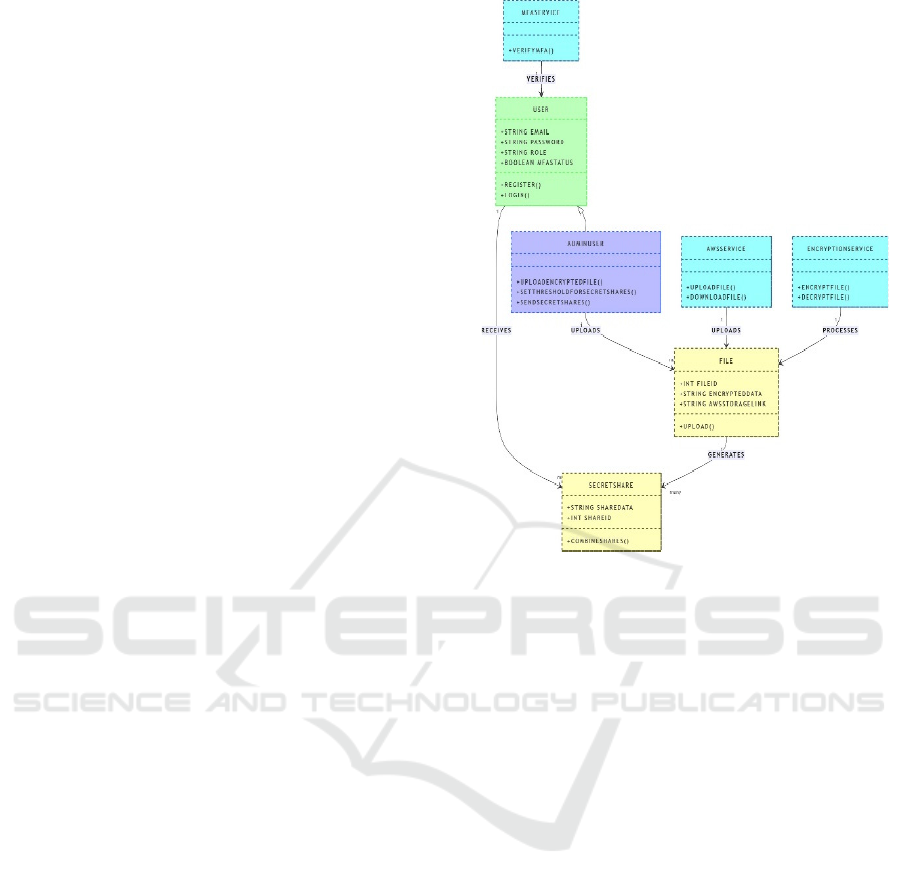
necessary protective measures. Figure 1 shows the
file management.
Following the requirement phase, the system design
is structured to integrate multi-layered security
mechanisms, including an IAM framework, Multi-
Factor Authentication (MFA), Shamir’s Secret
Sharing, and polynomial interpolation for secure key
management. User interfaces are designed to ensure
accessibility and efficiency based on user roles. In the
implementation phase, the system is developed using
secure coding practices, incorporating biometric
authentication and hardware tokens within the MFA
module. The key management system is enhanced
using Shamir’s Secret Sharing to prevent
unauthorized access, while polynomial interpolation
ensures secure encryption key reconstruction.
Figure 1: File management.
The system undergoes extensive testing and
validation, including unit testing, integration testing,
and security assessments such as penetration testing
and vulnerability analysis, ensuring the resilience of
the system against cyber threats. Once validated, it
is deployed in a controlled cloud environment,
where its performance is monitored, and necessary
security adjustments are made. Comprehensive user
training is provided to ensure effective system
utilization.
To maintain long-term security and efficiency,
the system is continuously updated to counter new
security threats, ensuring that access controls and
policies evolve in line with organizational
requirements. The platform is structured into three
key modules the Admin Module, which handles user
management, role definitions, and security settings,
including key distribution through Shamir’s Secret
Sharing; the Manager Module, responsible for access
monitoring, security compliance reporting, and
incident management; and the Employee Module,
which facilitates secure login, data interaction, and
access to security training materials.
This methodology ensures that the system not
only protects sensitive data but also enhances
operational efficiency and regulatory compliance
across different levels of the organization. By
integrating advanced cryptographic techniques and
ICRDICCT‘25 2025 - INTERNATIONAL CONFERENCE ON RESEARCH AND DEVELOPMENT IN INFORMATION,
COMMUNICATION, AND COMPUTING TECHNOLOGIES
718
adaptive security mechanisms, the system provides a
scalable and resilient security model for cloud
computing environments.
The proposed system is structured to ensure
secure key management and access control within a
cloud computing environment. Its design
incorporates multiple security layers that focus on
authentication and encryption while maintaining ease
of use and efficiency. The user interface is designed
with dedicated access points for Admins, Managers,
and Employees, each with defined permissions based
on their roles. User authentication is managed
through a centralized authentication gateway, where
login attempts undergo verification, incorporating
Multi-Factor Authentication (MFA) for added
security. At the backend, the Identity and Access
Management (IAM) module enforces Role-Based
Access Control (RBAC) to regulate permissions and
ensure that users can only access data relevant to their
roles. Authentication services validate user credentials,
processing password verification alongside biometric
or token-based authentication as part of MFA.
Additionally, a key management module is
implemented, integrating Shamir’s Secret Sharing
(SSS) algorithm for secure key distribution and
reconstruction using polynomial interpolation. To
further strengthen security, MFA mechanisms such as
biometric scans, OTPs, and hardware tokens are
implemented to verify user identity beyond
traditional login credentials. A real-time encryption
and decryption service ensures that all cloud-stored
data remains protected. The database infrastructure
securely stores user details, access rights, and system
logs, which are continuously monitored for
anomalies. Network security is reinforced using
SSL/TLS encryption, with firewalls and intrusion
detection systems actively monitoring for
unauthorized access attempts. For key management,
the system employs Shamir’s Secret Sharing (SSS), a
cryptographic method that divides encryption keys
into multiple fragments (shares). These key fragments
are dis- tributed among authorized users, requiring a
minimum thresh- old of shares to reconstruct the full
key. This prevents any single entity from having
complete control over the encryption process. The
reconstruction of the original key is achieved through
polynomial interpolation using Lagrange’s method,
ensuring that secrets can be securely retrieved without
direct exposure. The RBAC framework further
enhances security by assigning access permissions
based on predefined roles, preventing unauthorized
users from obtaining unnecessary privileges. The
MFA component ensures that authentication.
6 EXPERIMENTAL RESULTS
The multi-layered security framework enhances
cloud security by implementing multiple identity
verification steps, reducing the risk of account
compromise. To protect both stored and transmitted
data, the system integrates strong encryption
standards like AES-256. By combining advanced
cryptographic algorithms, multi-layered
authentication, and adaptive security policies, the
framework ensures data confidentiality, secure
access management, and robust encryption, making it
a reliable solution for modern cloud environments.
The effectiveness of this security framework was
evaluated across AWS and Google Cloud
platforms, measuring key performance factors such
as encryption overhead, data retrieval speed. The
results demonstrated a significant reduction in
security breaches compared to conventional
methods.
Key advancements in the security model include
enhanced authentication measures through a two-tier
authentication process, which minimizes
unauthorized access risks. The framework also
supports compliance with regulations like GDPR and
HIPAA, simplifying legal adherence for
organizations handling sensitive data. Its scalable and
flexible architecture enables seamless integration
with various cloud platforms, catering to diverse
organizational security needs. User-centric security
management ensures ease of use while incorporating
advanced cryptographic techniques without adding
complexity. Furthermore, the framework extends
protection to IoT devices and mobile platforms,
addressing the evolving security challenges of cloud-
connected ecosystems. Real-time threat monitoring
enables automated security analysis, offering instant
detection and response to potential cyber threats,
ensuring a more resilient and secure cloud
infrastructure.
Figure 2: User registration.
The system comprises three primary modules:
Admin, Manager, and Employee, each with distinct
Applying Secret Sharing to Enhance Cloud Privacy
719
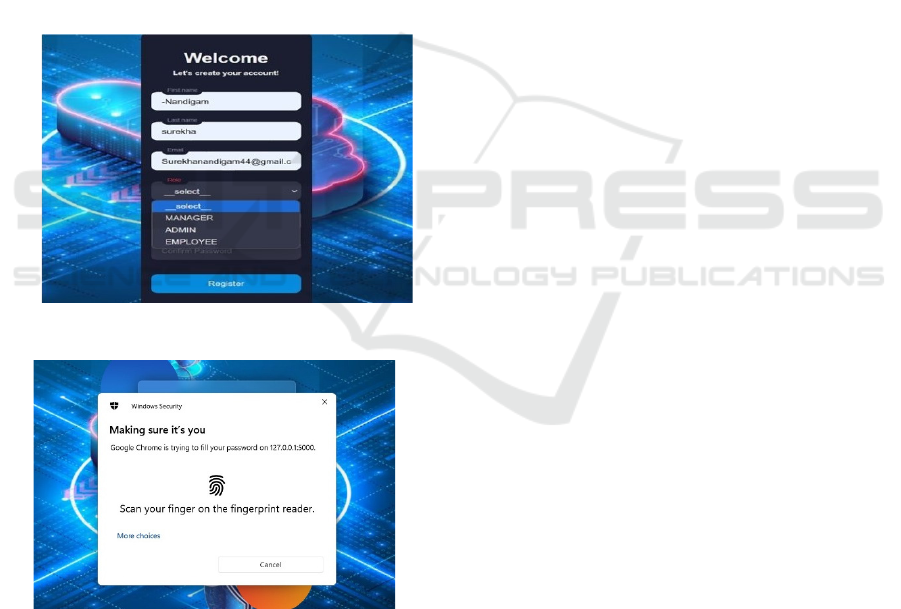
responsibilities. [figure 2] The Admin module
enables user management, allowing administrators to
create, modify, or delete user profiles while assigning
roles and permissions based on organizational
policies. They define role-based access controls
within the IAM framework and configure security
settings, including multi- factor authentication
(MFA) preferences and key management protocols,
utilizing Shamir’s Secret Sharing for key
distribution and recovery.
The Manager module focuses on access oversight,
monitoring logs for anomalies, reviewing employee
access requests, and ensuring compliance through
security audits and reports. Additionally, managers
handle incident management by coordinating with
admins and security teams to mitigate risks and
address vulnerabilities. Employees access cloud
services securely through a login process
incorporating MFA and perform tasks such as data
entry.
Figure 3: User login.
Figure 4: Authentication.
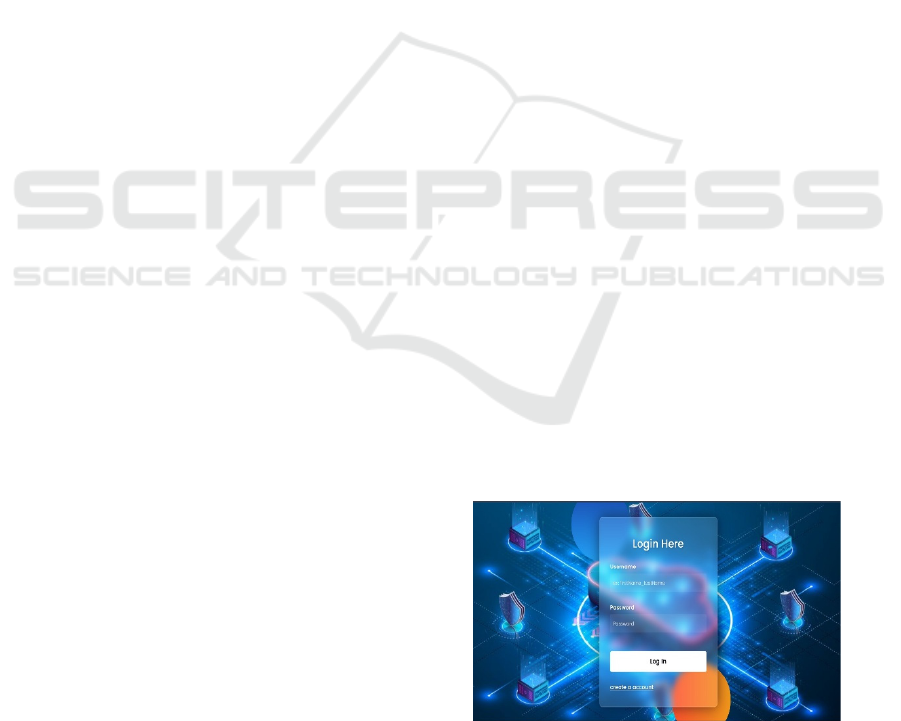
The login system integrates a secure authentication
gate- way that processes user credentials and enforces
multifactor authentication (MFA) for enhanced
security as shown in figure 3. Users authenticate via
passwords, and based on risk assessment, the system
triggers additional authentication layers such as
biometric verification. The biometric authentication
module supports fingerprint scanning, facial
recognition, and other biometric methods, ensuring
secure identity verification before granting access As
shown in figure 4. Session management is handled
through secure token-based authentication,
maintaining user sessions while preventing
unauthorized access. Additionally, all login attempts
are logged for audit purposes, and data transmissions
are protected using SSL/TLS encryption to safeguard
credentials and biometric data from interception or
tampering. Key Libraries and Features Used in the
work which are cryptography library provides
developers with tools to secure data through
encryption and decryption. It supports various
algorithms, such as AES and RSA, and enables the
implementation of custom cryptographic solutions
like Shamir’s Secret Sharing. This library balances
high-
level functionality for ease of use with low-
level access for greater flexibility and security. The
secrets module generates cryptographically strong
random numbers, essential for secure password
creation and authentication token generation, making
it a safer alternative to the basic random module. The
panda’s library efficiently manages large datasets,
such as user logs and access data, by offering
structures that facilitate filtering, grouping, and
security-relevant data analysis. Frameworks like
Flask and Django are used to build secure APIs and
administrative interfaces. Flask is a lightweight
option for smaller projects, while Django is a
comprehensive framework suited for complex
applications. Both support secure session handling
and authentication mechanisms. For testing, pytest
simplifies writing tests and ensures the functionality of
security components with its intuitive syntax and
powerful features. Finally, libraries like sympy and
numpy are essential for per- forming complex
mathematical calculations in cryptography. Sympy
specializes in symbolic mathematics, while NumPy
efficiently handles large-scale numerical
computations required for encryption and hashing.
As shown in figure 5 The system enhances security in
file up- loads and secret sharing by integrating
encryption, controlled access, and adaptive
authentication. It employs a threshold- based
approach where a secret is divided into multiple parts,
requiring a minimum number of shares for
reconstruction, preventing unauthorized retrieval.
Uploaded files undergo security checks to detect
potential threats before processing. AES-256
encryption ensures confidentiality during both
storage and transmission. Role-Based Access Control
(RBAC) restricts access based on predefined roles,
ensuring only authorized users manage secret shares.
ICRDICCT‘25 2025 - INTERNATIONAL CONFERENCE ON RESEARCH AND DEVELOPMENT IN INFORMATION,
COMMUNICATION, AND COMPUTING TECHNOLOGIES
720
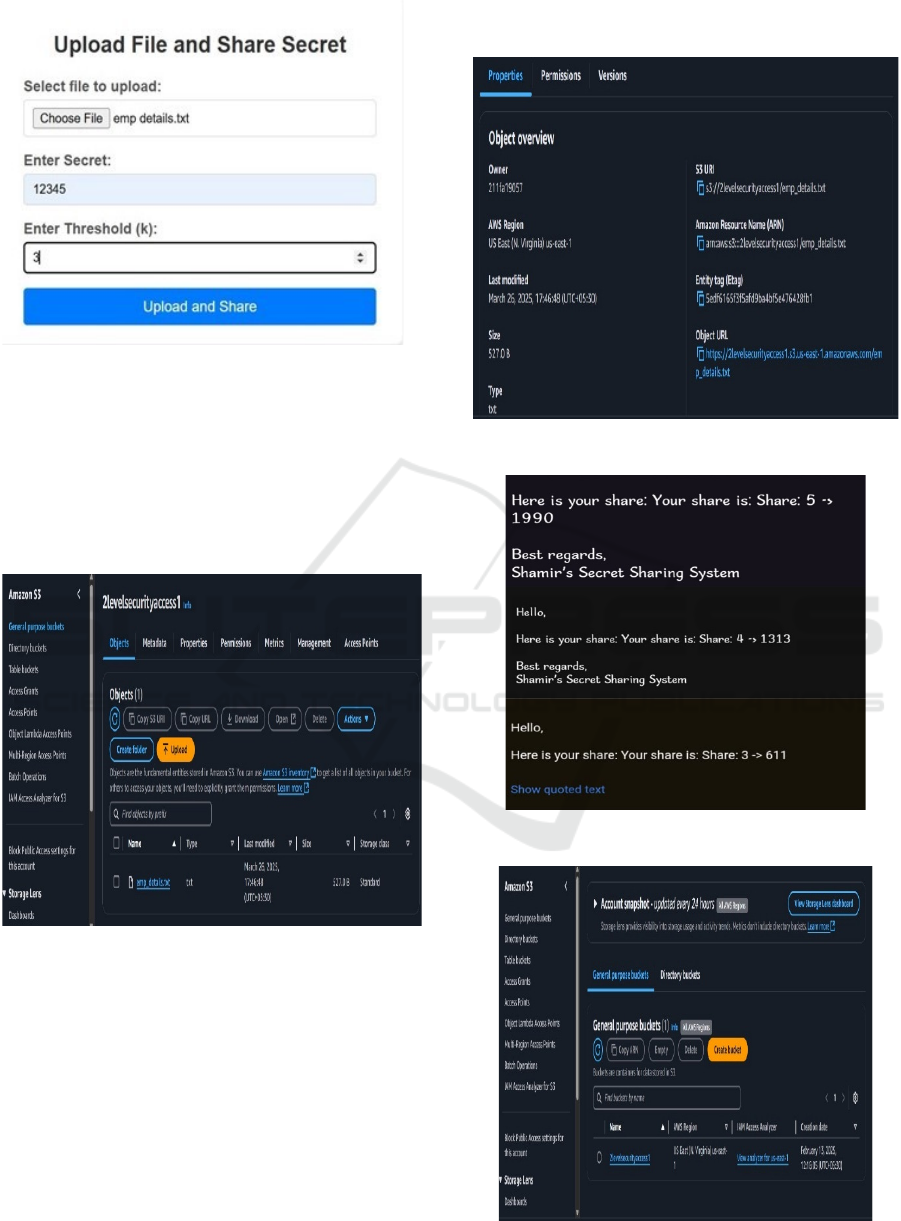
Figure 5: File management.
Adaptive security mechanisms evaluate factors such
as user location, device security, and access history
to adjust authentication levels dynamically. By
combining these security layers, the system
effectively prevents unauthorized access, protects
sensitive data, and strengthens resilience against
potential cyber threats.
Figure 6: Generated shares.
Figure 6 shows the image displays shares generated
and distributed through email using Shamir’s Secret
Sharing (SSS) algorithm. This cryptographic
technique divides a secret into multiple parts, each
assigned to different participants. The format of each
share follows” Share: X -¿ Y,” where X represents the
participant number and Y is the corresponding share
value. Only a specific number of these shares, as
defined by the threshold, are required to reconstruct
the original secret. This method enhances security by
ensuring that no single participant has access to the
complete secret, making it useful for secure data
storage and cryptographic key management.
Figure 7: S3 bucket.
Figure 8: Object folder.
Figure 9: Bucket.
Applying Secret Sharing to Enhance Cloud Privacy
721
As shown in figure 7,8,9 Encrypted files are
securely stored in an Amazon S3 bucket to ensure
data confidentiality and prevent unauthorized access.
Using Shamir’s Secret Sharing (SSS) scheme,
encrypted file shares are distributed among multiple
recipients, requiring a set number of shares to
reconstruct the original secret. This encryption
method ensures that even if a single share is exposed,
the complete data remains protected. AWS S3
provides robust security features such as access
control policies, encryption at rest, and logging
mechanisms. Once the required shares are combined
using polynomial interpolation, the decrypted file
becomes accessible to authorized users. This
approach ensures secure data management,
compliance with best security practices, and
protection against unauthorized access in cloud
environments.
Figure 10: Combine shares.
Figure 11: Downloaded file.
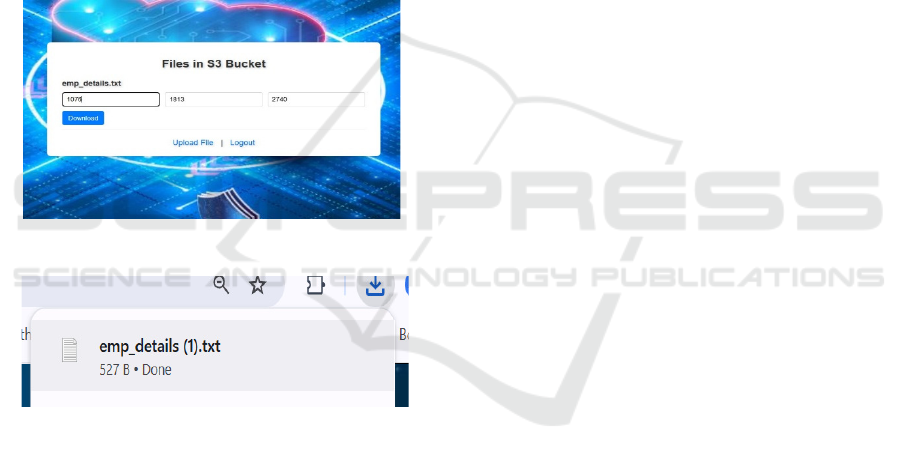
Shamir’s Secret Sharing (SSS) scheme securely
distributes encrypted file shares among multiple
recipients. Each recipient holds a unique share,
preventing any single entity from accessing the
complete secret. To decrypt the file, users must input
their shares, which are processed using Lagrange
interpolation to reconstruct the original secret.
Polynomial interpolation, as discussed by Gennaro et
al. (2000), is crucial in cryptographic functions,
particularly in key management systems. It allows
secure secret reconstruction without exposing the full
information. A random polynomial embeds the
secret, generating multiple shares distributed among
participants. like shown in figure 10 To access the
encrypted file, a minimum number of shares must be
combined. The secret is then reconstructed using
mathematical techniques, ensuring unauthorized users
with insufficient shares cannot access the data. Once
restored, the encrypted file is decrypted and made
available for download, ensuring secure data handling
and preventing unauthorized access Like in figure 11.
System Requirements Used for To ensure a robust
and se- cure system, the hardware requirements
include a server with a quad-core processor or higher
to efficiently manage concurrent security operations
and data processing. The system should have a
minimum of 16 GB RAM for smooth execution of
multiple security modules and database operations,
along with an SSD of at least 1 TB to store log data,
user information, and critical security settings. The
network interface should support Gigabit Ethernet to
handle high-speed network traffic and secure data
transfers. Client devices must be compatible with
Windows, macOS, and Linux for administrative
access, while also incorporating biometric sensors for
multi-factor authentication (MFA) and keeping up
with the latest security patches. On the software side,
a Linux-based operating system is preferred for the
server due to its stability and security features, while
the client systems must support the latest versions of
Windows, macOS, or Linux. The system should use a
secure and scalable database management system
like PostgreSQL or MySQL to handle user data,
access logs, and other security- related information.
Backend development should be done using Python
3.8 or higher, allowing integration with security
libraries and frameworks, while the front-end can be
developed using React or Angular for an interactive
user experience. Security and cryptographic
implementations should leverage libraries like
PyCrypto for cryptographic algorithms, including
Shamir’s Secret Sharing, and OpenSSL for
encryption and secure communication needs.
Network security is critical, requiring a firewall to
protect internal networks from unauthorized access,
VPN access to enable secure remote administration,
and an Intrusion Detection System (IDS) to monitor
and report potential security threats in real time. To
ensure high availability, network redundancies
should be implemented to minimize downtime during
heavy loads or potential attacks. Security compliance
should adhere to international standards such as
GDPR, HIPAA, and ISO/IEC 27001, with regular
security audits conducted to identify vulnerabilities
and maintain compliance. Data protection strategies
must include encryption for both stored and
transmitted data, along with secure data backup
solutions to maintain integrity and availability in case
of cyber threats or hardware failures. User
authentication should incorporate MFA, including
ICRDICCT‘25 2025 - INTERNATIONAL CONFERENCE ON RESEARCH AND DEVELOPMENT IN INFORMATION,
COMMUNICATION, AND COMPUTING TECHNOLOGIES
722

biometrics and hardware tokens, while Role-Based
Access Control (RBAC) should be implemented to
enforce minimal privilege access based on user roles.
Maintenance and support require regular software
and hardware updates to counter emerging security
threats and enhance performance. Scheduled backups
and security drills should be conducted to ensure
system resilience. A dedicated support team must be
available to handle system issues, user training, and
security incidents, while comprehensive docu-
mentation should be provided for system setup,
configuration, and troubleshooting.
Final Remarks.
The proposed two-level security system establishes a
resilient approach to securing cloud-based
infrastructures by addressing both current and
emerging threats. By incorporating encryption,
multi-layer authentication, and AI-driven
monitoring, the system ensures a higher degree of
security, privacy, and regulatory compliance. As
cloud computing continues to evolve, such
frameworks will play a critical role in safeguarding
digital assets, fostering innovation, and enabling
organizations to confidently leverage cloud
technologies while maintaining robust security
postures.
7 FUTURE WORK
The proposed system offers a robust foundation for
securing cloud environments, with opportunities for
future enhancements that can improve adaptability,
resilience, and efficiency. One area for development
is the use of machine learning to analyze access
patterns and detect anomalies, enabling dynamic
protection adjustments based on real-time risk
assessments. Blockchain technology can also be
integrated to create tamper- proof logs for access
control and security event tracking, while smart
contracts automate compliance verification. To
safeguard against future threats, quantum-resistant
cryptography, including quantum-safe algorithms
and quantum key distribution, can be incorporated.
Expanding the security model to support hybrid and
multi-cloud infrastructure ensures consistent
protection across platforms and enables unified
security policies. Additionally, extending security to
IoT devices and edge computing environments
addresses challenges in authentication and data
encryption. The system must also adapt to changing
data protection regulations by implementing
advanced anonymization techniques that maintain
privacy without com- promising performance. Real-
time user behavior analytics will help identify insider
threats, refine access control policies, and improve
risk-based authentication. Enhanced disaster
recovery strategies and automated failover
mechanisms ensure business continuity and
minimize downtime. Finally, offering Security- as-a-
Service (SECaaS) makes customizable security
solutions accessible to businesses of all sizes,
integrating seamlessly with various cloud platforms
without requiring significant infrastructure
investments.
8 CONCLUSIONS
This work provides an innovative solution to the
growing security challenges faced by cloud
environments. By incorporating a two-tier security
model that integrates both cloud-native security
policies and user-specific authentication mechanisms,
the proposed system significantly strengthens data
protection. The first layer, built on Identity and
Access Management (IAM) policies, ensure proper
role-based access control, while the second layer
enhances security through Multi-Factor
Authentication (MFA), using email-based One-Time
Pass- words (OTP) for user verification. Additionally,
the application of Shamir’s Secret Sharing combined
with polynomial interpolation techniques provides a
robust framework for secure key management and
access control, especially in hierarchical
organizational structures. This approach not only
minimizes the risk of unauthorized data access but
also ensures the integrity and confidentiality of cloud-
stored data. By addressing both provider-level and
user-specific security concerns, this work sets a new
standard for cloud security, contributing to more
resilient and compliant cloud infrastructures in the
face of evolving cyber threats. The proposed model is
a critical step toward creating more secure, adaptive,
and scalable cloud environments, ensuring long-term
data protection and trust in cloud-based services.
REFERENCES
Beimel,”Improved Polynomial Secret-Sharing Schemes,”
Cryp- tology ePrint Archive, Report 2023/1158, 2023.
[Online]. Available: https://eprint.iacr.org/2023/1158.
C.-C. Yao, ”How to Generate and Exchange Secrets,” in
Proceedings of the 27th Annual Symposium on
Foundations of Computer Science (SFCS), 1986, pp.
162-167.
Applying Secret Sharing to Enhance Cloud Privacy
723

Gentry, ”Fully AES encryption using ideal lattices,” in
Proceedings of the 41st ACM Symposium on Theory of
Computing (STOC), 2009.
H. Hourani and M. Abdallah, ”Cloud Computing: Legal
and Security Issues,” in Proceedings of the 8th
International Conference on Computer Science and
Information Technology (CSIT), 2018. [Online].
Available:
https://ieeexplore.ieee.org/document/8486190.
K. Tjell and R. Wisniewski,” Privacy in Distributed
Computations Based on Real Number Secret Sharing,”
arXiv preprint arXiv:2107.00911, Jul. 2021. [Online].
Available: https://arxiv.org/abs/2107.00911.
K. Pietrzak,” Secret-Sharing Schemes for High Slices,”
Cryptol- ogy ePrint Archive, Report
2024/602, 2024. [Online]. Available: https://eprint.iac
r.org/2024/602.
L. Xiong, W. Zhou, Z. Xia, Q. Gu, and J. Weng,” Efficient
Privacy-Preserving Computation Based on Additive
Secret Sharing,” arXiv preprint arXiv:2009.05356, Sep.
2020. [Online]. Available:
https://arxiv.org/abs/2009.05356.
L. Wang, J. Liu, and K. Chen,” Lattice-Based Threshold
Secret Sharing Scheme and Its Applications,”
Electronics, vol. 13, no. 2, p. 287, 2022. [Online].
Available: https://www.mdpi.com/2079-
9292/13/2/287.
NIST, ”Guidelines on security and privacy in public cloud
computing,” Special Publication 800-144, 2011.
Parakh and S. Kak,” Space-Efficient Secret Sharing for
Implicit Data Security,” Information Sciences, vol. 181,
no. 2, pp. 335-341, Jan. 2011. [Online]. Available:
https://doi.org/10.1016/j.ins.2010.09.021.
R. Kandukuri and A. Rakshit, ”Cloud Security Issues,” in
Proceedings of the 2009 IEEE International
Conference on Services Computing,
2009. [Online]. Available: https://ieeexplore.ieee.org/d
ocument/5170911.
S. Chhabra and A. K. Singh,” Security Enhancement in
Cloud Envi- ronment using Secure Secret Key
Sharing,” Journal of Communications Software and
Systems, vol. 16, no. 4, pp. 296-305, Dec. 2020.
[Online]. Available:https://doi.org/10.24138/jcomss.v1
6i4.964.
Shamir, ”How to share a secret,” Communications of the
ACM, vol. 22, no. 11, pp. 612-613, 1979.
T. Loruenser, A. Happe, and D. Slamanig,” ARCHISTAR:
Towards Secure and Robust Cloud-Based Data
Sharing,” in Proceedings of the 7th IEEE International
Conference on Cloud Computing Technology and
Science (CloudCom), Vancouver, BC, Canada, Nov.
2015, pp. 371–378. [Online]. Available:
https://doi.org/10.1109/CloudCom.2015.71.
T. Stevens, J. Near, and C. Skalka,” Secret Sharing for
Highly Scal- able Secure Aggregation,” arXiv preprint
arXiv:2201.00864, Jan. 2022. [Online]. Available:
https://arxiv.org/abs/2201.00864.
X. Li, Y. Wang, and Z. Zhang,” Secret Sharing: A
Comprehensive Survey, Taxonomy, and Applications,”
Journal of Information Security and Applications, vol.
66, 2023. [Online]. Available:
https://www.sciencedirect.com/science/article/abs/pii/
S1574013723000758.
Y. Liu, F. Zhang, and J. Zhang,” Attacks to Some Verifiable
Multi- Secret Sharing Schemes and Two Improved
Schemes,” Information Sciences, vol. 328, pp. 582-591,
Feb. 2016. [Online]. Available:
https://doi.org/10.1016/j.ins.2015.09.035.
Y. Sun, G. Li, Z. Lin, F. Xiao, and X. Yang, ”A Completely
Fair Secret Sharing Scheme without Dealer,” in
Proceedings of the International Conference on
Consumer Electronics-Taiwan (ICCE-TW), 2016.
DOI: 10.1109/ICCE-TW.2016.7520905.
Y. Liu, X. Wu, and Z. Zhao,” ROMSS: A Rational Optional
Multi- Secret Sharing Scheme Based on Cloud
Computing,” Journal of Cloud Computing, vol. 12, no.
1, p. 45, 2023. [Online]. Available:
https://journalofcloudcomputing.springeropen.com/arti
cles/10.1186/s13677- 023-00495-7.
Y. Zhang and X. Chen, A Verifiable Multi-Secret Sharing
Scheme for Hierarchical Access Structures,” Axioms,
vol. 13, no. 8, p. 515, 2023. [Online]. Available:
https://www.mdpi.com/2075-1680/13/8/515.
ICRDICCT‘25 2025 - INTERNATIONAL CONFERENCE ON RESEARCH AND DEVELOPMENT IN INFORMATION,
COMMUNICATION, AND COMPUTING TECHNOLOGIES
724
