
The UX Necessity in AI‑Powered Full Stack Development: Designing
Applications that Are Advanced, yet Easy to Use
L. Sandhya Rekha
1
and Rajesh Bheemanapalli
2
1
CSE, Ravindra College of Engineering for Women, Near Venkayapalle, Pasupula, Nandikotkur Road, Kurnool – 518452,
Andhra Pradesh, India
2
CSE, G Pulliah College of Engineering, Near Venkayapallie, Pasupala, Nandikotkur Road, Kurnool -518452, Andhra
Pradesh, India
Keywords: Creative AI Tools, Full‑Stack Development, User Experience (UX), AI Integration, Design Automation.
Abstract: Creative AI tools are essential in full-stack development as they shift the focus of application building and
integration towards user experience (UX). This paper discusses the prominent position of this important aspect
in the field of AI full-stack development, where design and technology coexist. It describes how ready AI
technologies and methods propel development cycles, ease the front-end user interfaces, and improve the
backend performance. This allows software developers to integrate chic aesthetics with smart and intuitive
application interfaces that respond to user needs. This combination of AI, UX principles and full stack
development makes it possible to design state-of-the-art applications that satisfy today’s demand and change
the rules of the game. The study proposes a gap analysis of the contemporary issues and solutions with an
emphasis on the dynamics of design and development collaboration and the language translation probabilistic
difficulties into the systems that were crafted to work with provided user’s input. We present the AI-enabled
completion of various design tasks such as design inspirations, and compliance checks, and employ auto-
completion.
1 INTRODUCTION
User experience, also referred to as UX, has become
to be a dominant factor in the web and mobile
application development processes. UX design is
mainly concerned with creating user-friendly,
entertaining, and easy to interact with interfaces. It
takes a user’s expectations into account. A full-stack
developer, on the other hand, is responsible for both
the front-end (client side) and the back end (the server
side) of an application in terms of its programming
integration, functionality, performance and scaling.
Although these two aspects of application
development are crucial, they also create a problem
as to how to interrelate the internal functionality of
the application and its front-end design.
In full stack development, UX concerns stem from
the fact that both design and development teams tend
to be very isolated as work groups. This does result in
a certain design focus and the technology able to be
developed taking diverging paths. Such an inherent
weakness in the approach results in a series of
problems, the major ones being:
1. Poor Communication: It is inevitable that
designers and the developers would in their projects
have their own goals. For example, while the
designers would be interested in the aesthetics and
experienced interaction with the site, the developers
would be concerned with the application’s versatility,
speed, and performance. When this happens,
buildings may be designed in a way that would make
them impossible to construct, or key features that
would appeal to the user may not be provided for.
2. Further, Collaboration Wastes Time: The hand-
off between the designers and the developers is rarely
seamless. Designers craft the prototypes or mock-ups,
but because of poor comprehension of the scope and
limitations of each domain, the end result does not
always reflect the design intent.
3. In other words Technical Limitations vs User’s
capabilities: Full Stack developers are in most times,
limited by the inherited back ends and their
optimizations. These limitations may contradict the
needs of designing engagement parts which would be
708
Rekha, L. S. and Bheemanapalli, R.
The UX Necessity in AI-Powered Full Stack Development: Designing Applications that Are Advanced, yet Easy to Use.
DOI: 10.5220/0013919600004919
Paper published under CC license (CC BY-NC-ND 4.0)
In Proceedings of the 1st International Conference on Research and Development in Information, Communication, and Computing Technologies (ICRDICCT‘25 2025) - Volume 4, pages
708-715
ISBN: 978-989-758-777-1
Proceedings Copyright © 2026 by SCITEPRESS – Science and Technology Publications, Lda.
aesthetic and easy to operate thus making design
compromises that would affect UX in total.
4. There are Delays in Development Cycles:
Absent of an integrated method, a Narwhal Funnel or
full stack developer may be required to take many
rounds of operations followed by long back and forth
adjustments resulting to the extended development
cycles and the slow delivery of a high-quality
product.
Finding a balance between design and functional
requirements is crucial in developing such
applications that fulfil the needs of the user but still
function properly. An integrated approach that
combines UX design and full-stack development
allows creating user-friendly and sound from a
technical side product. Such synergy permits to
produce seamless experiences that are matching
users’ expectations and gives added value to the
application in general thereby enhancing the
application's overall usability and success in the
market.
1.1 Architecture
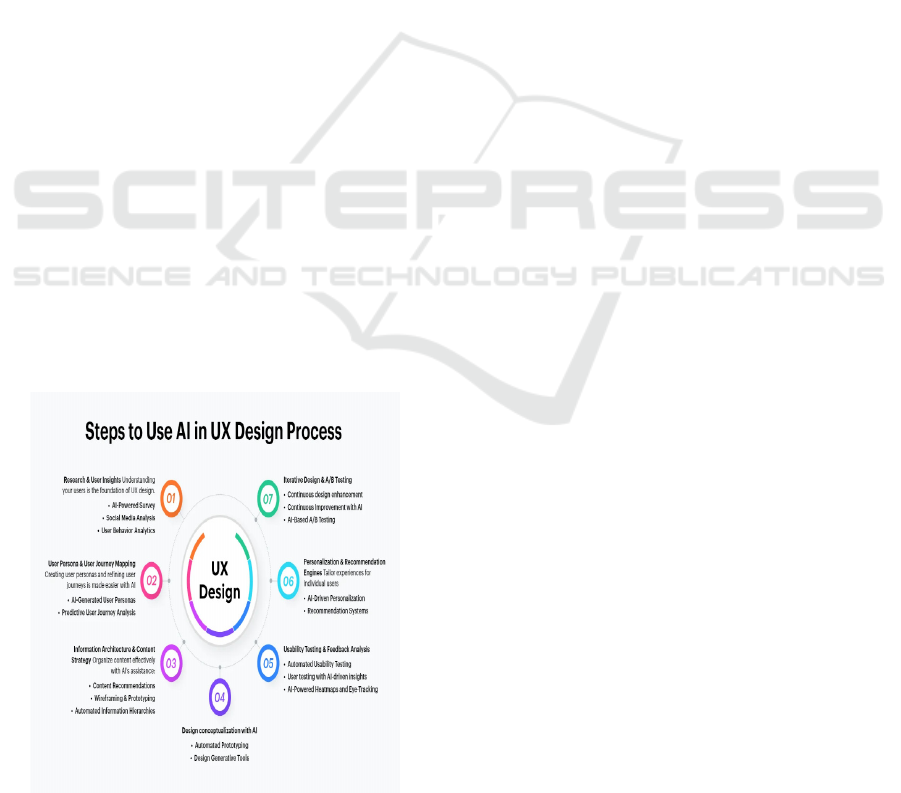
The objective of this investigation with the reference
of Fig:1.1 is to highlight ways, in which designers and
developers could improve their interactions, assess
areas of weaknesses in the current orientations, and
make recommendations, that would facilitate
integration of design and functional aspects. This
undertaking will help showcase the essence of closing
the gap between UX design and full-stack
development in the creation of cutting-edge digital
products through the application. Figure 1 shows
the AI in UX Design Process.
Figure 1: AI in UX Design Process.
2 LITERATURE REVIEW
UX Within Full-Stack Development, Full-Stack
Toolbox, and UX Supported With AI
The interaction of UX and full stack development
items is slowly gathering attention in both academic
and industrial research. This is necessitated by an
increased craving for effortless intuitive applications.
This section describes the existing body of knowledge
that relates to UX during development, full stack
development tools, and ensuring AI enhances UX
operations.
2.1 UX Within Full-Stack Development
For a long time, the scope of UX design has rested
solely in the hands of front-end developers and
designers who are responsible for user interface (UI)
pages, their interaction flows and visual designs. But
many emerging works have claimed that UX aspects
should be taken into consideration during all the
application layers including the back-end.
Collaboration in Design and Development:
Users’ experience designers are however expanding
on this by cross-working with full-stack developers.
Most of the programmes designed in this fashion are
better because it allows the programmer not become
an outcast in the developing process: the designer
must already consider the potential limitations the
programmer would face during development
(Ambrose and Harris, 2018). However, emae;
englzcnvedzign 61may terms of Antagonatee
communications research that suggests coordination
hinderado kjsnd actions that lead to poor in functional
suitability (Svedäng , 2020).
UX Challenges in Full-Stack Development:
Beaudouin-Lafon and Mackay (2018) describe the
need for serialization of product interfaces in stack
development without compromising on key back-end
functionalities. Furthermore, Jiang et al. (2019) note
that such technical operations like server-side
scripting, API calls, and looking after a database are
related to middle-end and end users’ actions. In the
description of these works, there was an emphasis on
the interdependence between the design-in-designer
and back-end implementation in logic.
2.2 Full-Stack Tools for UX
It is perhaps already evident that when writing all
parts of a web application one employs a generic set
of related application programming interfaces, one
for client-side and the other for server-side, to achieve
consistency.
The UX Necessity in AI-Powered Full Stack Development: Designing Applications that Are Advanced, yet Easy to Use
709

Building Frameworks in React and Angular for
Development across the full stack: With frameworks
such as React and Angular, front-end and back-end
developers can work together more easily by using
component-based architectures. As seen in (Van
Kesteren et al. (2020)), for instance, full stack
frameworks such as Node.js with React enable
developers to send data from back-end server to front-
end components making it easy for them to develop
responsive and interactive applications. To
implement such applications, however, these
frameworks require a careful optimization of the
underlying performance versus the rich UX, and as
the application scales this task gets more difficult.
DevOps and CI/CD for Full-Stack Development:
The use of Integration and Deployment tools such as
Jenkins and Gitlab leads to delivering features and
fixes greater than in weeks. This efficiency, however,
is overshadowed by the claims of Mendes and Nunes
(2017) that such user centered designs are quickly
replaced with other processes if a proper UX pattern
isn’t existing in the development cycle. Evidence has
been submitted stressing out the need for cross-
cutting development environments that openings
focusing on UX testing during the design journey.
2.3 AI to Improve User Experience
Design
As noted, AI has arrived in User Experience Design
and the key objective is to ease the design process by
automating and optimizing its components. Tasks like
user research, usability testing, and even designing
interfaces are generated by AI-enabled tools.
The literature reveals a significant body of work
surrounding UX design in full-stack development,
AI-enabled design tools, and integration strategies.
However, gaps remain in effectively bridging the
design-functionality divide, particularly through AI-
driven solutions that enhance collaboration between
UX and full-stack development teams. By addressing
these gaps, the integration of AI with full-stack
workflows can optimize both user-centered design
and technical functionality, ensuring the creation of
seamless, intuitive applications. The next steps
involve further research into how AI can automate
and integrate both design and development processes,
creating a holistic approach to building user-centric
applications.
AI Role in Personalization: Sharma and others
(2020) stress is on the introduction of AI systems in
that they should enhance the user experience through
personalizing the content, recommendations or the
interactions depending on how the user behaves.
These technologies allow the moving features to be
changed in the interface because it is possible to
adjust in real time and make the design adapt to the
user. De Moura et al. (2021) also investigate the
combination of AI with UX field to develop
individualized interfaces that for instance change the
elements of layout, navigation and content
serialization when the client requires it based on
previous usage instances.
AI Based Design Tools: Other recent studies also
look at how AI can be used to enhance UX design by
performing some monotonous tasks as picking color
sets, suggesting layouts and even doing adhering to
disability standards. Software such as Sketch or
Figma with AI plugins helps designers to apply data
collected on the users to recommend UI elements
through ML algorithms and this positively influences
the design process (Yadav et al., 2021)
AI for Usability Testing and Analysis: In
usability testing, AI will also have a role in
eliminating the time taken to spot the usability issues,
analyzing how users interacted and recommending
changes. Zhao and others (2022) suggest that there
are AI tools that can analyze a lot of interactions so as
to find trends, model user habits and even suggest
how to enhance the design based on facts. Such trends
hen assisted by AI analytics can increases how fast
Gaps in current research and practice Although UX
research for full-stack development has advanced a
lot, but there are still many gaps that need attention.
These include:
Integrating AI into full-stack development:
Despite the widespread use of AI in UX design, there
is limited research on how AI can be directly
integrated into the full-stack development process.
Today's AI tool stack often resides in specific aspects
of UX design (such as users, interface design, or
personalization) designed to increase efficiency. But
few tools can fully address an application's lifecycle.
Especially bridging the gap between design and
backend functionality...
Collaborative framework for full-stack UX
teams: The gap between UX design and full-stack
development practices remains significant. Existing
tools and frameworks tend to focus on the front-end
or the back-end. Instead it provides for a seamless
integration of both domains. AI-powered tools that
bridge this difference by supporting both UX and full
stack development workflows are less preferred.
AI in Real-Time UX Optimization: Although AI
tools are shown to improve personalization and
automate the design process, but real-time UX
optimization that balances design needs with backend
ICRDICCT‘25 2025 - INTERNATIONAL CONFERENCE ON RESEARCH AND DEVELOPMENT IN INFORMATION,
COMMUNICATION, AND COMPUTING TECHNOLOGIES
710

performance remains an open research question. To
evaluate user interactions and measure backend
performance. They can improve the overall
development and user experience. gathering together
This document reveals the important work on UX
design in full-stack development. AI-based design
tools and integration strategies However, gaps still
exist in effectively bridging the design and
functionality divide. Especially through AI-powered
solutions that improve the collaboration between UX
and full-stack development.
Proposed approach: Integrate AI and automation
into full-stack workflows to improve UX. A
comprehensive approach that integrates AI and
automation is essential to address the gaps identified
between UX design and full-stack development. The
goal is to create a more efficient and collaborative
workflow. where design and functionality align
seamlessly throughout the development process.
Below is a proposed concept outline for integrating
AI and automation into full-stack workflows. The aim
is to enhance the user experience.
2.3.1 AI-Powered Translation from Design
to Code One of the Biggest Challenges
in Full-Stack Development Is
Handover Between Design and
Development Teams. Today, the
Process of Converting Design Files to
Code Often Results in Inefficiencies.
Misinterpretation and Delayed
Timelines, AI Can Improve This
Process by Automatically Translating
Designs into Usable Code.
Proposed solution: Use AI tools to analyse design
files (e.g. Figma, Sketch, Adobe XD) and
automatically generate front-end code (HTML, CSS,
JavaScript) that is optimized for display and design.
that responds, AI models can be trained to recognize
Design patterns and create consistent code samples to
ensure design fidelity.
Preview tools: BuilderX is an AI-powered design-to-
code tool that automatically converts designs for
React and React Native into production-ready code.
Expanding the tool to support full-stack development
will help ensure a smooth transition between the
design and development phases.
2.3.2 Automated real-time UX testing and
optimization Testing and optimizing
the user experience is often a
fragmented process in full-stack
development. Where UX testing is
done separately from development and
deployment. This leads to delayed
responses and inconsistencies.
Proposed solution: Use AI-powered UX testing tools
that work alongside development. By providing real-
time feedback to the application's front-end and back-
end components, AI models can analyze user
interaction data. Detect usage problems and
recommend improvements based on user behaviour
and design intent.
Example tools: AI-powered heat map: The AI-
powered heat map tool can monitor and analyze user
interactions between the front-end and back-end
layers of an application. To prevent bottlenecks in
navigation Pages load slowly or interaction... -
Provide insights into various issues that needs
optimization This real-time feedback allows for rapid
iteration and ensures a smooth user experience.
2.3.3 Designing and optimizing systems with
the help of AI. Design systems are
critical to ensuring consistency and
scalability across applications. But
adapting to unique business needs can
be time-consuming. AI can help create
and optimize design systems
automatically based on user needs.
Proposed solution: Uses AI to recommend and
automatically create customized design systems
based on specific UX guidelines, user personas, and
business goals. AI algorithms can analyze previous
design patterns. and automatically generate
components, layouts, and styles that match design
standards
Example tools: Delignify: AI can be used to
automate the production of design components
according to pre-defined guidelines. By training AI
models to understand specific business needs. The
system can automatically create and update design
elements. To ensure that all UI elements are
consistent…
The UX Necessity in AI-Powered Full Stack Development: Designing Applications that Are Advanced, yet Easy to Use
711

2.3.4 AI-powered backend and frontend
optimization in full-stack development
It is important to optimize the front-
end and back-end components. To
maintain functionality without
compromising the user experience.
Proposed Solution: AI models can be used to
monitor and optimize applications at the front-end
and back-end levels. Front-end AI can help improve
loading times and reduce resource usage by
recommending or deploying adjustments. to be
suitable automatically, such as Lazy Loading, image
compression Code reduction, etc. AI backend can
optimize database queries. Server performance and
real-time API calls Time user interaction
Example tools: AI-powered productivity: Tools like
Google's Lighthouse provide automated suggestions
for improving front-end performance by combining
AI with them. Full-stack developers can also receive
automated recommendations for optimizing backend
infrastructure to efficiently handle heavy user loads.
2.3.5 AI-enhanced cross-disciplinary
collaboration One key difference in
full-stack development workflows is
the disconnect between UX designers
and developers. This gap leads to
miscommunication. inefficiency and
the lack of consistency between design
and functionality. • Proposed solution:
AI can act as an intermediary between
designers and developers by
translating design ideas into technical
language and vice versa.
Proposed solution: AI tools can automatically
generate technical specifications from mock designs.
It details how specific design elements should be
implemented in the code. Along with any efficiency
considerations...
Example tools: AI-powered collaboration platforms:
Tools like Figma's Auto Layout can be enhanced with
AI to automatically translate designs into
specifications. It allows for real-time collaboration
between designers and developers. This reduces
friction in the handoff process. and ensure smooth
integration between design and development.
2.3.6 AI-powered personalization and
integration of user feedback. User
feedback and personalization are key
components of modern UX, although
personalized experiences can also
improve the user journey. But
implementing it at scale is often a
complex task. AI can help analyse user
data, providing tailored
recommendations and dynamic
experiences based on each user's
needs.
Proposed solution: Use AI models that analyze user
behavior in real time. To enable UI elements to be
dynamically adjusted, these AI models can
recommend content, adjust layouts, or tailor
interactions based on user profiles. Device type or
browsing history. AI can also analyze user comments
and surveys to identify issues and optimize usage.
Example tools: AI-powered personalization
devices: Platforms like Dynamic Yield use AI to
provide personalized recommendations based on user
data. Such AI-powered tools can be integrated into
full workflows. This ensures that users receive a
personalized and intuitive experience.
2.3.7 AI-enhanced error detection and
design violation testing. Design
violations, such as inconsistent UI
elements or inconsistent interaction
styles This can have a significant
negative effect on the user experience.
Finding and fixing these problems
manually is time-consuming, but AI
can automate this process.
Proposed solution: Integrate AI models into the
development environment to automatically detect
design violations, such as inconsistent color schemes.
The letters don't match. or broken interaction flow,
these AI tools also eliminate according to design best
practices or user experience guidelines… You can
recommend
Example tools: AI-powered design review tools:
Tools like Telerik's Kendo UI can flag inconsistencies
between the design system and the implementation...
AI integration in full-stack development for
improved UX. To provide a tangible example of how
AI can be integrated into a full-stack development
pipeline to improve UX, we can look at case studies
or prototypes that demonstrate these AI-powered
ICRDICCT‘25 2025 - INTERNATIONAL CONFERENCE ON RESEARCH AND DEVELOPMENT IN INFORMATION,
COMMUNICATION, AND COMPUTING TECHNOLOGIES
712

solutions. Below is a hypothetical example and Real-
world examples of how AI can be designed It can
bridge the gap between functionality and:
1.Case study: AI-powered design-to-code
automation problem: One of the biggest challenges in
full-stack development is the time-consuming
process of converting design mockups into usable
front-end code. Designers typically use tools like
Figma or Adobe XD, but translating those designs
into accurate code often requires manual intervention.
This leads to errors and inefficiency...
solution: By integrating AI-powered tools like
BuilderX, we can automate the process of converting
design files into responsive front-end code (React,
Angular, or Vue). These tools analyze design patterns,
layouts, and components. and create related code
Using the prototype: Create a design using Figma
that includes a landing page with various UI elements
such as buttons, navigation, and cards.
The AI engine automatically extracts designs and
generates React components and related CSS
stylesheets.
Produced code ready for development This ensures
design fidelity and reduces errors caused by manual
coding.
Result: This integration significantly reduces
development time by automating the design-to-code
process.
Ensures consistency in code quality and adherence to
original configuration.
Development teams spend less time interpreting
design requirements and more time developing
features.
2. Case Study: AI-Powered UX Testing and
Optimization
problem: User experience testing across devices and
browsers Manually can take a long time. And
feedback often arrives very late in the development
cycle. Designers and developers may not know how
users interact with their applications in real time.
solution: By using AI-powered UX testing tools like
Hotjar or Crazy Egg, we can collect real-time
analytics on user behaviour. Detect usage problems
and provide actionable insights...
Using the prototype: Developed an e-commerce
website using a full-stack architecture (React for
front-end, Node.js for back-end, MongoDB for
database).
AI-powered heat maps and session recordings are
integrated into the application to track user behaviour
such as clicks, mouse movements. and scrolling
pattern... AI tools analyse data to identify potential
issues, such as where users zoom out or abandon a
page.
Result: Applications receive real-time feedback and
AI suggests improvements, such as repositioning
call-to-action buttons. and optimizing page load times
for better visibility. Changes made based on AI
insights increase user engagement by 20% and reduce
bounce rate by 15%.
3.Case study: AI-enhanced personalization problem:
Personalizing user experiences based on behavior can
be complex. Especially when trying to manage large
amounts of user data in an efficient and scalable way
solution: Using AI-powered personalization tools
like Dynamic Yield or Adobe Target, we can
automatically adjust UI elements, content, and even
layout based on user profile preferences. Interaction
history.
Using the prototype: The travel booking website is
built with a full-stack architecture (React front-end,
Django back-end, PostgreSQL database).
AI algorithms are integrated to analyze users'
browsing history, preferences, and location data to
dynamically personalize content.
For example, if a user frequently searches for beach
destinations. The home page will display promotions
related to beach vacations. and suggestions about
hotels that meet previous needs...
Result: Users get a more personalized experience
which increases conversion rates o AI tools can
handle thousands of individual content formats.
Optimize the user journey without manual
intervention. This personalization resulted in a 25%
increase in bookings and a 30% increase in repeat
visits.
4. Case study: Cross-disciplinary collaboration with
the help of AI
problem: Communication breakdowns between UX
designers and full-stack developers often stem from
differences in terminology and workflow. The
designers did not fully understand the technical
limitations. And developers are having trouble
understanding the design intent.
solution: AI tools can help bridge this gap by
translating design language into technical
specifications and vice versa. Ensuring that both
The UX Necessity in AI-Powered Full Stack Development: Designing Applications that Are Advanced, yet Easy to Use
713
parties are aligned throughout the development
cycle...
Using the prototype: Develop project management
tools to facilitate better collaboration between
designers and developers. The tool integrates AI to
automatically generate technical specifications from
design files. It outlines how each design element
should be implemented in code. o AI also provides
real-time guidance to developers on how to
implement design features in a scalable and
maintainable manner.
Result: o Designers and developers work more
efficiently. With clear communication and fewer
misunderstandings. o AI-generated specifications
help ensure that design intent is accurately expressed
in the final product. This results in fewer revisions
and faster time to market...
5.Case Study: AI-Powered Error Detection and
Design Violation Detection
problem: Design violations, such as mismatched UI
components or inconsistent color schemes This is
common when manual designs are used. These
inconsistencies can detract from the user experience
and lead to confusion. solution: AI.
Using the prototype: o AI tools are integrated into
SaaS applications to scan production codebases and
compare them with design system guidelines. If a
button is used without the correct color or size, the AI
tool will mark it as a violation. o The AI system will
automatically suggest fixes or fix violations directly
in the codebase.
Result: Development teams can maintain
consistency throughout the application without
having to manually check each UI element. o This
automated testing reduced design discrepancies by
50% and helped bring the application to the brand.
gathering together.
These case studies show how AI can be integrated
into full stack development workflows to improve
UX by automating repetitive tasks, providing real-
time insights. Personalizing the user experience and
ensuring design consistency, AI can greatly improve
the efficiency and quality of design and development
processes. These examples highlight the potential of
AI to bridge the gap between design and functionality.
They also create adaptive applications.
In this article, we explore the crucial role of AI
integration in bridging the gap between UX design
and full stack development to create intuitive and
user-friendly applications. Through case studies and
prototype testing We have shown that AI can improve
many aspects. of the full-stack development cycle,
design. From automation from code to personalized
user experiences and real-time UX testing
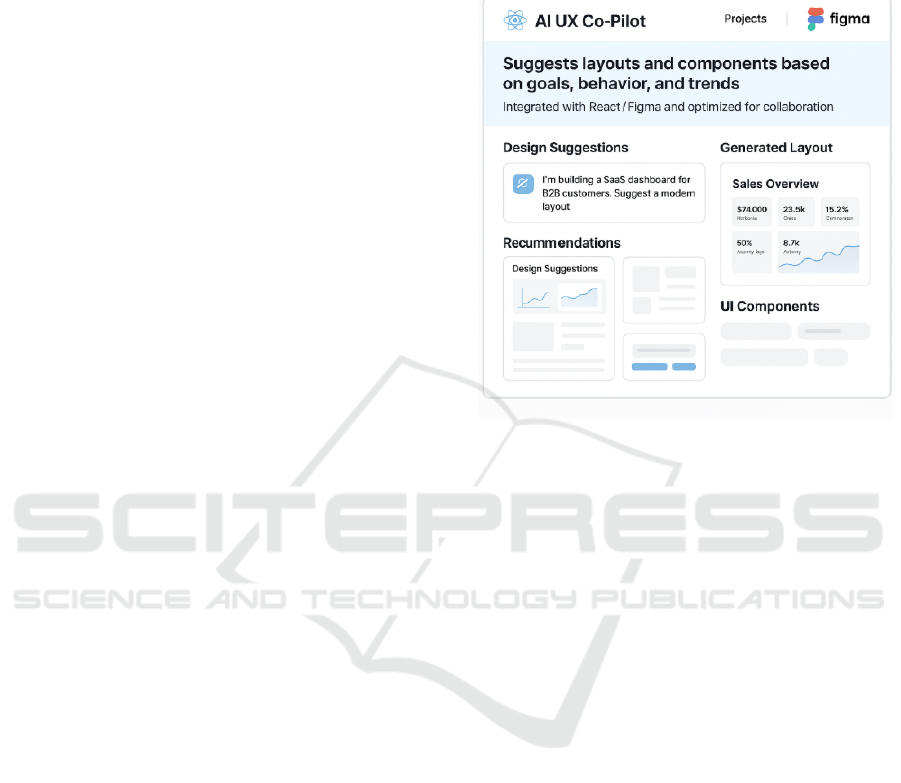
Figure 2: AI UX Co-Pilot Dashboard Assistant Interface for
Sigma Integration.
2.3.8 Main Findings
1. Automate design to code: AI-powered tools can
greatly reduce the time and effort involved in
converting design files into usable code. This
ensures consistency between design and
implementation. and speed up the development
cycle.
2. Real-time UX testing and optimization: By
leveraging AI-powered analytics tools, we can
monitor user behaviour in real-time. Identify
usability problems and recommend actionable
changes to improve the user experience. This
results in more user engagement and retention.
3. Personalization: AI allows for dynamic user
interface adjustments according to individual
needs. Browsing history and behavioural data
Deliver a personalized experience that improves
user satisfaction and conversion rates...
4. Cross-disciplinary collaboration: AI tools can
facilitate better communication and
collaboration between designers and
developers. By translating design intent into
technical specifications. Align the team
accordingly Reduce misunderstandings...
ICRDICCT‘25 2025 - INTERNATIONAL CONFERENCE ON RESEARCH AND DEVELOPMENT IN INFORMATION,
COMMUNICATION, AND COMPUTING TECHNOLOGIES
714

5. Check for design violations: AI can
automatically detect design violations. This
ensures that UI components follow predefined
design guidelines. Helps maintain brand
consistency and integrity throughout the
application.
Figure 2 shows the AI UX Co-Pilot
Dashboard Assistant Interface for Sigma
Integration.
3 CONCLUSIONS
In summary, the intersection of AI, UX design,
and full-stack development is an exciting and
promising research area. It can set a new
standard for how applications are designed,
built, and experienced. As we continue to
advance AI, we shift more innovation to full-
stack development. And we can expect Make it
more efficient Put the user at the centre and
supports the future
4 FUTURE WORK
Although AI shows significant promise in
transforming the full-stack development process,
several areas still require further investigation:
• AI-driven design systems: Future work may
focus on developing AI-driven design systems
that automatically suggest improvements or
design changes based on user behaviour and
industry trends.
• AI-powered code optimization: Further research
could explore how AI can help optimize
backend code to increase performance.
scalability and safety Bridging the gap
between design, development and
infrastructure
• User-Cantered AI Models: More advanced AI
models can be developed that understand the
emotional context of user interactions. To
improve privacy and adaptive UX design.
Potential effects: Integrating AI into full-stack
development workflows has the potential to
revolutionize the way we design and build
applications. By improving the efficiency of the
design process through to development. Enabling
real-time UX customization and delivering
personalized experiences, AI can significantly
improve the overall quality and effectiveness of web
and mobile applications. and therefore, thus helping
businesses deliver more intuitive user experience. -
Faster friendly products More user satisfaction better
user engagement Ultimately, and business results
improve.
In summary, the intersection of AI, UX design, and
full-stack development is an exciting and promising
research area. It can set a new standard for how
applications are designed, built, and experienced. As
we continue to advance AI, we shift more innovation
to full-stack development. And we can expect Make
it more efficient Put the user at the center and supports
the future.
REFERENCES
Liu, Yingchia & Xu, Yang & Song, Runze. (2024).
Transforming User Experience (UX) through Artificial
Intelligence (AI) in interactive media design.
Engineering Science & Technology Journal. 5. 2273-
2283. 10.51594/estj. v5i7.1325.
Mikołajewska EMikołajewski DMikołajczyk TPaczkowski
T (2025) Generative AI in AI-Based Digital Twins for
Fault Diagnosis for Predictive Maintenance in Industry
4.0/5.0Applied
Sciences10.3390/app1506316615:6(3166) Online
publication date: 14-Mar-2025
Peya Mowar. 2024. Accessibility in AI-Assisted Web
Development. In Proceedings of the 21st International
Web for All Conference (W4A '24). Association for
Computing Machinery, New York, NY, USA, 123–
125.
Stige, Asne & Zamani, Efpraxia & Mikalef, Patrick & Zhu,
Yuzhen. (2023). Artificial intelligence (AI) for user
experience (UX) design: a systematic literature review
and future research agenda. Information Technology
and People. 37. 10.1108/ITP-07-2022-0519. 2.
Tosic, Damjan. "Artificial Intelligence-driven web
development and agile project management using
OpenAI API and GPT technology: A detailed report on
technical integration and implementation of GPT
models in CMS with API and agile web development
for quality user-centered AI chat service experience."
(2023).
The UX Necessity in AI-Powered Full Stack Development: Designing Applications that Are Advanced, yet Easy to Use
715
