
Integrating Diverse Analytical Models for Enhanced Fraud
Prevention in Collaborative E‑Commerce Transactions
Neeli Sritha Rayal, Guduru Sreeja Reddy, Kamsali Lasya,
Gorle Sai Sree Varshini and Kota Lakshmi Prasana
Department of Computer Science and Engineering, Ravindra College of Engineering for Women, Kurnool 518002, Andhra
Pradesh, India
Keywords: B2C e‑Commerce, Support Vector Machine (SVM), Fraudulent Transactions, e‑Commerce Platforms,
Python, Django‑ORM, Html, CSS, JavaScript. MySQL (WAMP Server).
Abstract: Traditional e-commerce transaction security systems have been designed to prevent and detect fraudulent
transactions. Arresting the attackers only with the historical order information is difficult since e-commerce
is hidden. There are many studies that aim to build technologies to prevent fraud, but they lack multi-angle
perspectives on user behavioural evolution. Consequently, fraud detection is not very effective. To do so, this
paper proposes a novel process-mining- and machine-learning-based model for user behaviour in real-time
and its application in fraud detection. The user behaviour detection is the basis model on the B2C e-commerce
platform. Second, an approach to identifying anomalies to derive meaningful aspects from event logs is
proposed. The extracted features are then fed into a Support Vector Machine (SVM)-based classification
model that identifies fraudulent activity. Through these experiments, we demonstrate the effectiveness of our
proposed approach at capturing dynamic fraudulent behaviours in an e-commerce system.
1 INTRODUCTION
In recent years, new security threats have surfaced,
despite the fact that the expansion of modern
technologies and the growth of e-commerce present
better opportunities for online businesses. According
to reports, the substantial rise in online fraud cases
costs billions of dollars annually on a global scale.
Anti-fraud systems are now essential to ensuring the
security of online transactions due to the Internet's
dynamic and dispersed nature. When addressing new
security threats, vulnerabilities are still identified by
current fraud detection systems that concentrate on
identifying unusual user behavior. The ineffective
process management of current fraud detection
systems during the trading process is a significant
problem.
The monitoring function is one of the main
problems that needs attention. Because process
capture is missing from present work, the detection
viewpoint is usually poor. To accomplish this, we
propose a process perspective where historical big
data is transformed into controllable data, and the
process of user action is captured and scrutinized in
real time. In addition, we combine a multi-
perspective detection framework for detecting
anomalous behaviours.
To overcome the limitations of the current
procedure, this study proposes an innovative hybrid
solution for anomaly detection on data flows based
on all events in a control flow that incorporates both
process mining and machine learning model benefits.
By analysing a model of an e-commerce system
business process, this approach tries to dynamically
detect changes in the users' behaviour, processes in
the transaction, and noncompliance case. It can also
analyse and detect fraudulent transactions from
multiple dimensions.
2 EXISTING SYSTEM
The machine-learning-based techniques identify
potentially risky offline or online transactions by
classifying or predicting future observations based on
previously acquired historical data. A comparison of
machine-learning algorithm-based credit card fraud
detection techniques was carried out by Xuetong Niu
Rayal, N. S., Reddy, G. S., Lasya, K., Varshini, G. S. S. and Prasana, K. L.
Integrating Diverse Analytical Models for Enhanced Fraud Prevention in Collaborative E-Commerce Transactions.
DOI: 10.5220/0013919200004919
Paper published under CC license (CC BY-NC-ND 4.0)
In Proceedings of the 1st International Conference on Research and Development in Information, Communication, and Computing Technologies (ICRDICCT‘25 2025) - Volume 4, pages
697-702
ISBN: 978-989-758-777-1
Proceedings Copyright © 2026 by SCITEPRESS – Science and Technology Publications, Lda.
697

et al. On the dataset of credit card transactions, the
majority of machine-learning models exhibit good
performance. Furthermore, after further pre-
processing, like eliminating outliers, supervised
models outperform unsupervised models by a small
margin.
The concept of identifying particular abnormal
user behaviors to detect fraud is the basis for the
widespread application layer deployment of credit
card fraud detection. Because of its greater accuracy
and coverage, the supervised learning algorithm is the
most widely used learning technique in online fraud
monitoring transactions. Recent studies have
demonstrated the effectiveness of the machine
learning approach in identifying fraudulent credit
card transactions.
2.1 Drawbacks
1) Fraud mode one: A malicious actor modifies an
order: The malicious actor may trick the victim
merchant by posing as the cashier server and sending
a phony formal payment order, order F A. By altering
the order details, including the total amount, the
malicious actor was able to obtain the order items that
do not match the payment value.
2) The mode of fraud Second, the order is
subcontracted: The victim pays the malicious actor's
order rather than his own. The bad actors pose as
buyers and sellers in order to accomplish their
objectives. Before and after the payment, the order
details are updated.
3 PROPOSED SYSTEM
The suggested system introduces a hybrid approach
to anomaly detection in data flows, which gives
details about every action embedded in a control flow
model, combining the benefits of process mining and
machine learning models. By simulating and
examining the business process of the e-commerce
system, this approach can thoroughly examine and
identify fraudulent transactions from a variety of
angles, as well as dynamically detect changes in user
behaviors, transaction processes, and noncompliance
situations. The following is a list of this paper's
significant contributions:
1) To identify the anomalies in e-commerce
transactions, a conformance checking technique
based on process mining is used.
2) To carry out thorough anomaly detection based on
Petri nets, a user behavior detection technique is
suggested.
3) To automatically classify fraudulent behaviors, an
SVM model is created by integrating multi-
perspective process mining into machine learning
techniques.
3.1 Advantages
The event log and the DPN are compared and
analyzed using the plug-in Multi-Perspective Process
Explorer and Conformance Checking to produce a
more lucid outcome. This system displays the
outcome, with various colors denoting each action.
For example, purple indicates a move on the model
only, grey indicates invisible actions, or skipped
actions, and green indicates a move on both the model
and the log. We can get the information that matches
the model and the event log in the dataflow of each
action by clicking on it. A mismatch is indicated by
the red-marked data. We identify these questionable
anomalies and utilize them as the foundation for
further machine learning model training.
4 PRELIMINARY
INVESTIGATION
The primary approach to project development begins
with the idea of creating a mail-enabled platform for
a small business that makes sending and receiving
messages simple and convenient. It includes an
address book, search engine, and some fun games.
The first activity, or preliminary investigation, starts
after it has been approved by the organization and our
project guide.
There are three components to the activity:
• Request Clarification
• Feasibility Study
• Request Approval
4.1 Request Clarification
Once the project request has passed through an
investigation and has been granted approval by the
organization and project guide, the next step is to
analyse the project request to determine exactly what
the system requires. Thus, our project is primarily
meant for those users of the company whose systems
can be connected by LAN. These days, with men
ICRDICCT‘25 2025 - INTERNATIONAL CONFERENCE ON RESEARCH AND DEVELOPMENT IN INFORMATION,
COMMUNICATION, AND COMPUTING TECHNOLOGIES
698
constantly on the go, everything should be ready-
made. Hence, its-development of the corresponding
portal was based on the existing wide usage of the
internet in daily life.
4.2 Request Approval
Not every project that is asked for is good or feasible.
Some organizations receive excessive project
requests by client users that make only a small
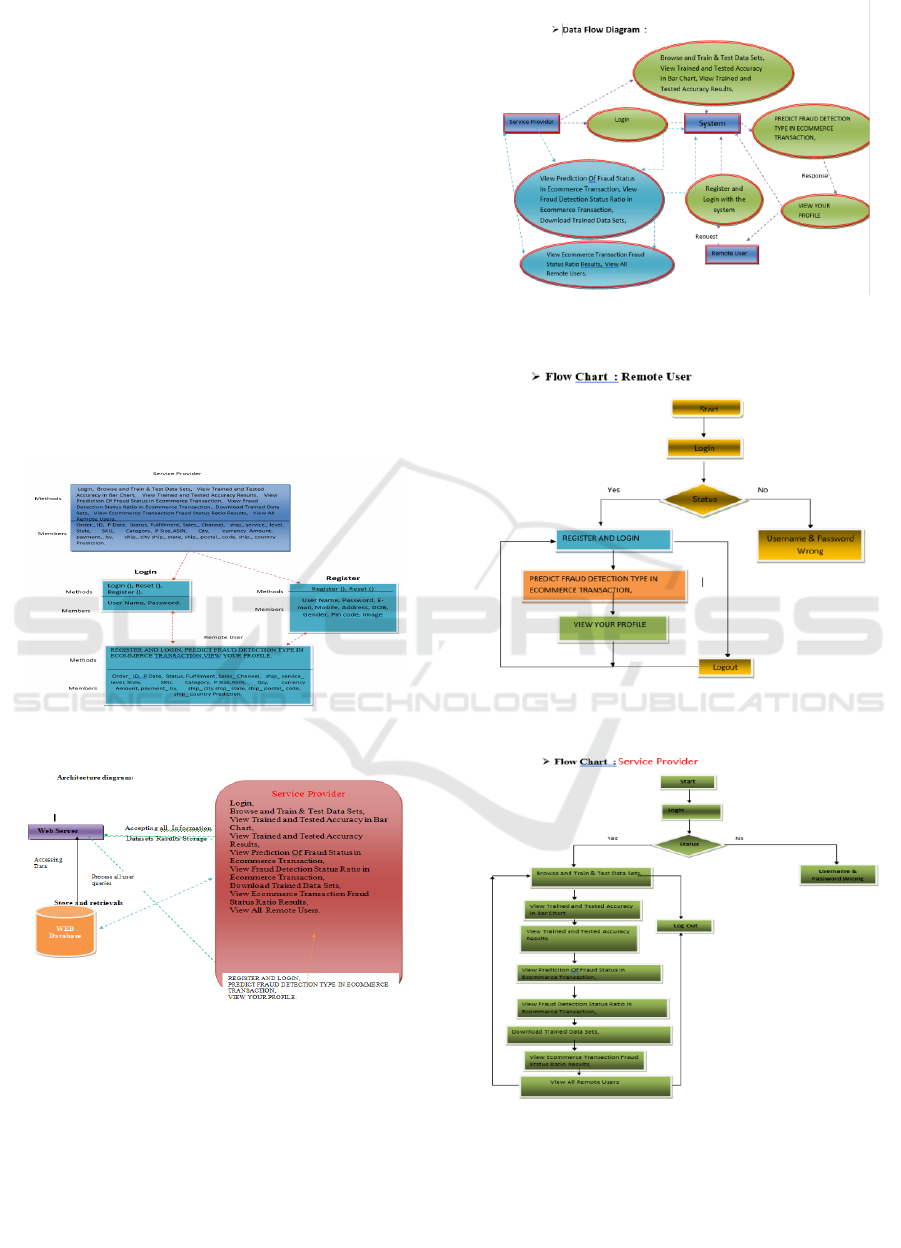
percent that are acted on. Figure 2 shows the service
provided. Such desirable and feasible projects,
however, should be scheduled. When you approve a
project request, you estimate its cost, priority,
completion time and staffing needs; that information
is then used to determine where the project request
should fall on any project lists. In reality,
development work can consider to begin after
obtaining approval of the above listed factors. Figure
1 shows the Architecture diagram.
Figure 1: Architecture diagram.
Figure 2: Service provided.
Figure 3: Data flow diagram.
Figure 4: Remote user.
Figure 5: Service provider.
Figure 3 show the Data flow diagram which the below
Figure 4 shows the Remote user and the Figure 5
illustrate the Service provider for the Request
Approval.
Integrating Diverse Analytical Models for Enhanced Fraud Prevention in Collaborative E-Commerce Transactions
699

5 IMPLEMENTATION
METHODOLOGY
5.1 Service Provider
The Service Provider must log in to this module
using a working user name and password. After
successfully logging in, he can do various activities
such as browsing and training and testing data sets.
View Results of Trained & Tested Accuracy, View
Trained & Tested Accuracy in Bar Chart, View the
Fraud Detection Status Ratio in E-Commerce
Transactions, View the Fraud prediction of Fraud
Status in E-Commerce Transactions, Get Trained
Data Sets Here E-Commerce Transactions + All
Remote Users: Fraud Status Ratio Results
5.2 View and Authorize Users
This module allows the administrator to view a list
of all registered users. There, the admin can view user
details, such as name, email, and address, and also is
able to assign users permission.
5.3 Remote User
This module consists of n present users. The user
must register before conducting any operation. The
data of the user would be stored in the database after
registration. After a successful registration, he is to
login using his password and authenticated user
name. No after successful login user will able to
REGISTER AND LOGIN, PREDICT FRAUD
DETECTION TYPE IN ECOMMERCE
TRANSACTION, VIEW YOUR PROFILE.
6 PYTHONS
Python is a high-level, interpreted, interactive and
object-oriented scripting language. Python was
designed to be readable. It has fewer syntactical
constructions than other languages, and often uses
English words as keywords while other languages
use punctuation.
• Python is Interpreted: Python is processed
at runtime by the interpreter. You do not
need to compile your program before you
can run it. Similar to PHP and PERL.
You are like Interactive Python: You could sit in
front of a Python prompt and work straight though
interpreter making your programs.
• Python is OOP: Python is defined as an
object-oriented programming, which allows
to encapsulate code into objects. Python is
Great.
7 RESULTS
Figure 6: Run project software.
Figure 7: Open dashboard.
Figure 8: Login registration form.
Figure 6 shows the run project software and Figure 7
shows the open dashboard.
Figure 8 illustrate the
Login registration form.
Figure 9 shows the view
profile details.
ICRDICCT‘25 2025 - INTERNATIONAL CONFERENCE ON RESEARCH AND DEVELOPMENT IN INFORMATION,
COMMUNICATION, AND COMPUTING TECHNOLOGIES
700
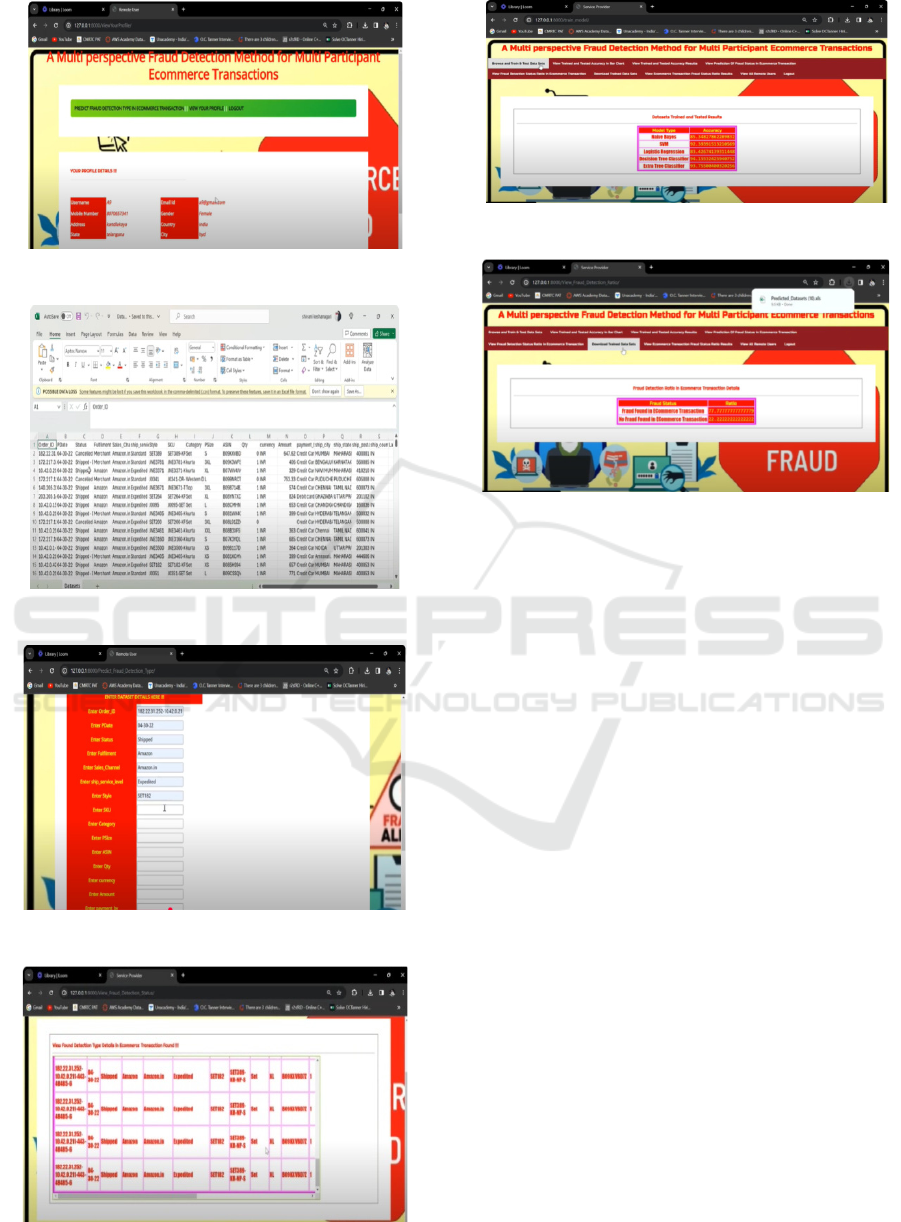
Figure 9: View profile details.
Figure 10: Datasets in CSV format.
Figure 11: Enter datasets.
Figure 12: View result analysis.
Figure 13: View predicted fraud transaction type.
Figure 14: Fraud detection ratio in economics transaction
details.
Figure 10 shows the datasets in CSV format and
Figure 11 shows the enter datasets. Figure 12 and 13
shows the view result analysis and view predicted
fraud transaction type.
Figure 14 illustrate the Fraud
detection ratio in Economics Transaction details.
8 CONCLUSIONS
In this study, a hybrid approach is proposed through
employing formal process modelling, along with
dynamic user behaviour to capture fraudulent
transactions. We also examined the e-commerce
transaction process based on five perspectives that we
established: the control flow, the resource, the time,
the data, and user behaviour patterns. In this study, a
support vector machine (SVM) model was built to
carry out fraud transaction detection, while high-level
Petri nets were employed as a basis for process
modelling to observe abnormalities in user
behaviours. The robust testing that retrained by
ourselves in against that the proposed method is able
to accurately detect fraud in the transactions and
actions. A: The multi-perspective detection method
we proposed summed up better than the single-
perspective detection method. In future work, we will
use model checking techniques and similar deep
learning within our proposed framework to enhance
the precision. Also extending the behaviour patterns
Integrating Diverse Analytical Models for Enhanced Fraud Prevention in Collaborative E-Commerce Transactions
701

with more time features will be needed in the future
for improving the accuracy of risk identification.
Furthermore, coordinate the model, apply the
proposed methodology to more areas of malicious
behaviour, and study the construction of a standard
REFERENCES
A. Abdallah, M. A. Maarof, and A. Zainal, “Fraud detection
system: Asurvey,” J. Netw. Comput. Appl., vol. 68, pp.
90-113, Apr. 2016.
C. Rinner et al., “Process mining and conformance
checking of long running processes in the context of
melanoma surveillance,” Int. J. Env. Res. Pub. He., vol.
15, no. 12, pp. 2809, 2018.
D. Choi, and K. Lee, “Machine learning based approach to
financial fraud detection process in mobile payment
system,” IT Conv. P. (INPRA), vol. 5, no. 4, pp. 12-24,
2017.
E. A. Minastireanu, and G. Mesnita, “An Analysis of the
Most Used Machine Learning Algorithms for Online
Fraud Detection,” Info.Econ., vol. 23, no. 1, 2019.
E. Asare, L. Wang, and X. Fang, “Conformance Checking:
I. M. Mary, and M. Priyadarshini, “Online Transaction
Fraud Detection System,” in 2021 Int. Conf. Adv. C.
Inno. Tech. Engr. (ICACITE), 2021, pp. 14-16.
J. J. Stoop, “Process mining and fraud detection-A case
study on the theoretical and practical value of using
process mining for the detection of fraudulent behavior
in the procurement process,” M.S. thesis, Netherlands,
ENS: University of Twente, 2012.
L. Zheng et al., “Transaction Fraud Detection Based on
Total Order Relation and Behavior Diversity,” IEEE
Trans. Computat. Social Syst.,vol. 5, no. 3, pp. 796-
806, 2018.
M. Jans et al., “A business process mining application for
internaltransaction fraud mitigation,” Expert Syst.
Appl., vol. 38, no. 10, pp.13351-13359, 2011.
M. D. Leoni, W. M. Van Der Aalst, and B. F. V. Dongen,
“Data-and resource-aware conformance checking of
business processes,” in Int.Conf. Bus. Info. Sys.,
Springer, Berlin, Heidelberg, 2012. pp. 48-59.
M. Abdelrhim, and A. Elsayed, “The Effect of COVID-19
Spread on the e-commerce market: The case of the 5
largest e-commerce companies in the world.”
Available at SSRN 3621166, 2020, doi:10.2139/ssrn.3
621166.
P. Rao et al., “The e-commerce supply chain and
environmental sustainability: An empirical investigati
on on the online retail sector. “Cogent. Bus. Manag.,
vol. 8, no. 1, pp. 1938377, 2021.
R. Sarno et al., “Hybrid Association Rule Learning and
Process Mining for Fraud Detection,” IAENG Int. J. C.
Sci., vol. 42, no. 2,2015.
R. A. Kuscu, Y. Cicekcisoy, and U. Bozoklu, Electronic
PaymentSystems in Electronic Commerce. Turkey: IGI
Global, 2020, pp. 114–139.
S. D. Dhobe, K. K. Tighare, and S. S. Dake, “A review on
prevention of fraud in electronic payment gateway
using secret code,” Int. J. Res.Eng. Sci. Manag., vol. 3,
no. 1, pp. 602-606, Jun. 2020.
W. Chomyat and W. Premchaiswadi, “Process mining on
medicaltreatment history using conformance checking,
” in 2016 14th Int. Conf.ICT K. Eng. (ICT&KE), 2016,
pp. 77-83.
Workflow of Hospitals and Workflow of Open-Source
EMRs,” IEEE Access, vol.8, pp. 139546-139566, 2020.
X. Niu, L. Wang, and X. Yang, “A comparison study of
credit card fraud detection: Supervised versus
unsupervised,” arXiv preprintarXiv: vol. 1904, no.
10604, 2019, doi: 10.48550/arXiv.1904.10604.
Z. Li, G. Liu, and C. Jiang, “Deep Representation Learning
withFull Center Loss for Credit Card Fraud Detection,”
IEEE Trans. Computat. Social Syst., vol. 7, no. 2, pp.
569-579, 2020.
ICRDICCT‘25 2025 - INTERNATIONAL CONFERENCE ON RESEARCH AND DEVELOPMENT IN INFORMATION,
COMMUNICATION, AND COMPUTING TECHNOLOGIES
702
