
A Comparative Analysis of Solving Sudoku Using Genetic Algorithm
and DLX
Manish S. R., Varshanth Reddy Y., Yuvraj R. and Gayathri Ramasamy
Department of Computer Science and Engineering, Amrita School of Computing, Amrita Vishwa Vidyapeetham, Bengaluru,
Karnataka, India
Keywords: Genetic Algorithm (GA), Dancing Links (DLX), Heuristic Exploration, Crossover, Mutation, Fitness
Evaluation.
Abstract: The Sudoku solving algorithms are very much essential for solving combinatorial optimization problems,
especially in areas of artificial intelligence, operations research, and recreational mathematics. This research
evaluates and compares the effectiveness of Genetic Algorithms (GA) and the Dancing Links (DLX)
algorithm in solving Sudoku puzzles, focusing on performance, computational efficiency, and accuracy. The
GA approach uses heuristics including population initialization, fitness evaluation, crossover, and mutation
for iterative approximation of solutions, whereas the DLX algorithm, also known as Algorithm X, translates
the Sudoku problem into an exact cover problem and employs a matrix-based linked list structure for
deterministic solution finding. The results of comparative analysis over a variety of puzzle complexities
indicate that the GA is considerably good at heuristic exploration. GA can solve relatively simpler puzzles
with ease but consumes much more computational resources for complex cases. Meanwhile, DLX always
obtains an exact solution with optimal efficiency but fails to explore suboptimal solutions flexibly. The results
show the strengths and weaknesses of both techniques, and offer substantial insight for algorithm selection
with criteria for problem conditions and complexity, relevant to a general class of larger combinatorial
optimization problems.
1 INTRODUCTION
Solving Sudoku has emerged as an important topic
within computational problem solving and
optimization, as Sudoku-solving is characterized by
its inherent complexity and practical relevance in
fields such as artificial intelligence, operations
research, and algorithmic research. The solving
algorithms for Sudoku not only evaluate the
efficiency of the algorithms but also cast insight into
the solution of other combinatorial optimization
problems. This work explores a comparative analysis
of two distinct approaches: Genetic Algorithms (GA)
and the Dancing Links (DLX) algorithm, each
representing a unique paradigm in the tussle to solve
Sudoku puzzles. The mechanism of GA is inspired by
the principles of natural selection and genetics. It uses
techniques such as population initialization, fitness
evaluation, crossover, and mutation iteratively to
refine solutions and navigate this vast solution space.
Therefore, its adaptability is high, but for problems
that are highly constrained, randomness can lead to
computational inefficiencies; that's why it is not
suited for moderately complex problems.
However, the DLX algorithm transforms the
Sudoku problem to be an exact cover problem and
solves it with perfect determinism. This is achieved
by using an efficient matrix-based linked list structure
that systematically ensures that all Sudoku constraints
are fulfilled with acceptable computational
efficiency. But the determinism limits the ability to
explore approximate or suboptimal solutions.
These methods are challenging in respect to
balance accuracy, computational efficiency, and
adaptability in solving Sudoku puzzles of various
complexities. While GA needs to deal with issues like
maintaining diversity in the solution pool and
avoiding premature convergence, DLX requires
careful handling of memory and computational
resources, especially when dealing with large or
dynamically changing problem instances.
This will be a project aiming to analyze and
compare the two methods in terms of performance,
efficiency, and accuracy for solving Sudoku puzzles.
R., M. S., Y., V. R., R., Y. and Ramasamy, G.
A Comparative Analysis of Solving Sudoku Using Genetic Algorithm and DLX.
DOI: 10.5220/0013918000004919
Paper published under CC license (CC BY-NC-ND 4.0)
In Proceedings of the 1st International Conference on Research and Development in Information, Communication, and Computing Technologies (ICRDICCT‘25 2025) - Volume 4, pages
631-637
ISBN: 978-989-758-777-1
Proceedings Copyright © 2026 by SCITEPRESS – Science and Technology Publications, Lda.
631

Incorporating a number of benchmark puzzles at
different complexity levels, the analysis will weigh
the strengths and weaknesses of both approaches.
Additionally, a closer and more detailed analysis of
the trade-offs between heuristic exploration and
deterministic precision will be conducted to highlight
their applicability across different scenarios. These
findings will be all the better to enrich general
knowledge in combinatorial optimization algorithms
and their ability to solve similar complex problems.
There is a list of related works in Section 2. In
Section 3, the recommended methods are presented.
The findings are presented in Section 4. The
conclusion is presented in section 5. The future work
is presented in section 6.
2 RELATED WORKS
Pratama et al. dealt with heuristic-based methods of
solving Sudoku problem of varying degree of
difficulty. The abstract mentioned that the paper
addresses the efficiency and accuracy problems of
heuristic search algorithms. The authors used a
mixture of depth-first search and constraint
propagation methods to minimize the space of the
search. It relies on prioritizing cells with the fewest
possible candidates, which enhances speed and
accuracy. A major limitation is its vulnerability to
multisolution puzzles, which might deteriorate its
performance.
Lina et al. compared two algorithms in solving
Sudoku: Breadth-First Search (BFS) and Depth-
Limited Search (DLS). In the abstract, it briefly states
that each method will be understood for its
computational complexity and feasibility. BFS is
complete since it explores all possible possibilities
while having high memory usage. DLS, though has
reduced memory demands because it limits recursion
depth, may fail to find any solution. The core
limitation of this paper is that it simply cannot solve
the advanced Sudoku puzzles, due to scalability
issues with BFS and suboptimal depth limits with
DLS.
Jana et al. their paper presents a hybrid approach
combining Genetic Algorithm (GA) with the Firefly
Mating Algorithm (FMA) to solve Sudoku. The
abstract mentions that this synergy between GA's
exploration capability and FMA's local search
efficiency describes the capability of the hybrid
algorithm. The hybrid approach combines crossover,
mutation, and firefly-inspired movement to
iteratively improve solutions. Although the method is
generally good for many different scenarios, it has a
disadvantage of leading to higher overheads due to
the hybridization process, which makes it unsuitable
for real time.
Indriyono et al. presents a paper of traditional
backtracking and brute force methods of solving
Sudoku is conducted. The abstract is about the ease
and dependability of these methods for providing
accurate solutions. Backtracking uses a form of
recursive traversal, while brute force attempts to
exhaustively try all combinations. Although simple,
both approaches suffer from high time complexity
and are inefficient for more difficult puzzles.
Wang et al. their paper introduces an evolutionary
algorithm enhanced with local search strategies
targeting columns and sub-blocks in Sudoku puzzles.
The abstract on the algorithm indeed shows a balance
between exploration and exploitation.
Implementation details show integration of crossover,
mutation, as well as adaptive local search. Though it
is found effective, its limitation lies in the sensitivity
to poor initial populations, which leads to slow
convergence.
Bukhori et al. reviews an application of GAs
toward puzzle games, including Sudoku. The abstract
mostly emphasizes the versatility and adaptability of
the GA method. Standard genetic operations such as
selection, crossover, and mutation are observed to be
implemented with variations geared toward the
different types of puzzles being solved. This reviewer
found the review too generic, in which there was not
enough insight into domain-specific challenges or
optimizations uniquely particular to Sudoku.
Jana et al. presents Inspired by neighborhood
search, a new mutation mechanism to improve the
GA for Sudoku solving is discussed in this paper. The
abstract shows that there would be better convergence
rates due to targeted mutations based on cell
neighborhoods. The implementation adjusts the
mutation rates dynamically based on the quality of the
solutions obtained. However, this might not
generalize for all different puzzles due to its
parameter-dependent nature.
Bhasin et al. in their paper, the use of GAs to solve
the N-Puzzle problem, similar in complexity to that
of Sudoku. The abstract demonstrates the algorithm's
adaptability to combinatorial puzzles. Key genetic
operations with heuristic evaluations guide the search
process. A major limitation is its heavy dependency
on initial populations, whereby it degrades badly in
poorly initialized scenarios.
Silva et al. applies GAs to Beehive Hidato
puzzles, emphasizing adaptability to unique grid
configurations. The abstract highlights genetic
operations tailored to hexagonal grids. While the
ICRDICCT‘25 2025 - INTERNATIONAL CONFERENCE ON RESEARCH AND DEVELOPMENT IN INFORMATION,
COMMUNICATION, AND COMPUTING TECHNOLOGIES
632

implementation successfully generalizes GA to
different puzzles, its limitation lies in scalability, as
computational costs increase with puzzle size.
Sevaljevic et al. discusses the application of
Dancing Links implementations of the Exact Cover
Problem which directly applies to Sudoku. Abstract
Discusses DLX's efficiency in dealing with constraint
satisfaction problems. Implementation The DLX
Algorithm with use of dynamically variable
constraints based on linked lists. Its limitation relies
strictly on very precise formulations and offers little
margin of error in setup.
3 METHODOLOGY
3.1 Theoretical Structure
The focus of the Sudoku Solver project is on
designing an efficient system that would work to
solve Sudoku puzzles using two different
algorithms—Genetic Algorithm (GA) and Dancing
Links (DLX)—for a comparative study of their
efficiency. The solver aims to address the
computational challenge that occurs when solving
Sudoku puzzles of different levels of difficulty while
analyzing performance along key metrics of
execution time, accuracy, and adaptability.
The Genetic Algorithm (GA) applies an
evolutionary approach inspired by biological
operators such as crossover, mutation, and selection.
Starting from an initial population of random
potential solutions, the GA computes a measure of
how close each solution is to being a valid Sudoku
solution. Through generations, it applies operators of
selection, crossover, and mutation to evolve the
population toward finding a good solution. The
algorithm is particularly well-suited for puzzles
where heuristic or approximate solutions are enough
because it explores a diverse space and continuously
enhances solutions iteratively.
On the other hand, the Dancing Links (DLX)
algorithm takes advantage of the Knuth's Algorithm
X's ability to find the exact cover problem. DLX uses
a doubly linked list structure that facilitates an
effective representation of the Sudoku constraints and
adopts a backtracking mechanism for the
systematic exploration of all potential solutions. The
algorithm guarantees the fulfillment of each Sudoku
rule by every solution found and, therefore, is a very
effective algorithm to look for exhaustive solutions.
Figure 1: Genetic algorithm.
To assess the performance of these algorithms, a
comparative analysis is performed. The system
measures aspects such as:
1. Execution Time: The time taken by each algorithm
to solve the puzzles for various complexities.
2. Solution Accuracy: The solutions obtained are
valid and complete.
A Comparative Analysis of Solving Sudoku Using Genetic Algorithm and DLX
633
3. Resource Usage: Memory and computational
overhead for each approach
4. Adaptability: Performed ability across puzzles
with constraint density and sizes.
As an implementation aspect, this approach integrates
a test suite of Sudoku puzzles that validate the
algorithms. Under controlled conditions of
evaluation, the analysis highlights the strengths and
weaknesses of heuristic methods, such as GA, versus
deterministic approaches like DLX.
It not only documents detailed insight in two
contrasting algorithmic paradigms, but also
contributes towards the larger field of constraint
satisfaction problems. The results can have
implications on the establishment of hybrid or
adaptive solvers for the consideration of more similar
problem-solving strategies in actual applications. The
Genetic Algorithm is as shown in Figure 1.
3.2 System Overview
Input Interface: A user-friendly graphical
interface or command-line input for the users to
present the initial Sudoku puzzles. It should validate
that the input format follows the standard Sudoku
rules for the grid.
Algorithm Selection: Users can choose between
the two algorithms: GA or DLX. This module helps
ensure that the user is able to make a comparison over
the very same input for both algorithms.
Genetic Algorithm Module: This module
implements the GA, containing components for the
generation of a population, fitness evaluation,
crossover, mutation, and selection. It solves the
Sudoku puzzle heuristically and returns the solution
along with some performance metrics such as
execution time and fitness score.
Dancing Links Module: This module uses the
DLX algorithm that converts the Sudoku problem to
an exact cover one. Using a matrix-based approach, it
finds the solution deterministically and reports the
result along with the execution time.
Output Module: This component presents the
solutions generated by the selected algorithm, along
with performance metrics such as computational
time, accuracy, and number of iterations. It also
provides visualizations of the solved Sudoku grid for
better clarity.
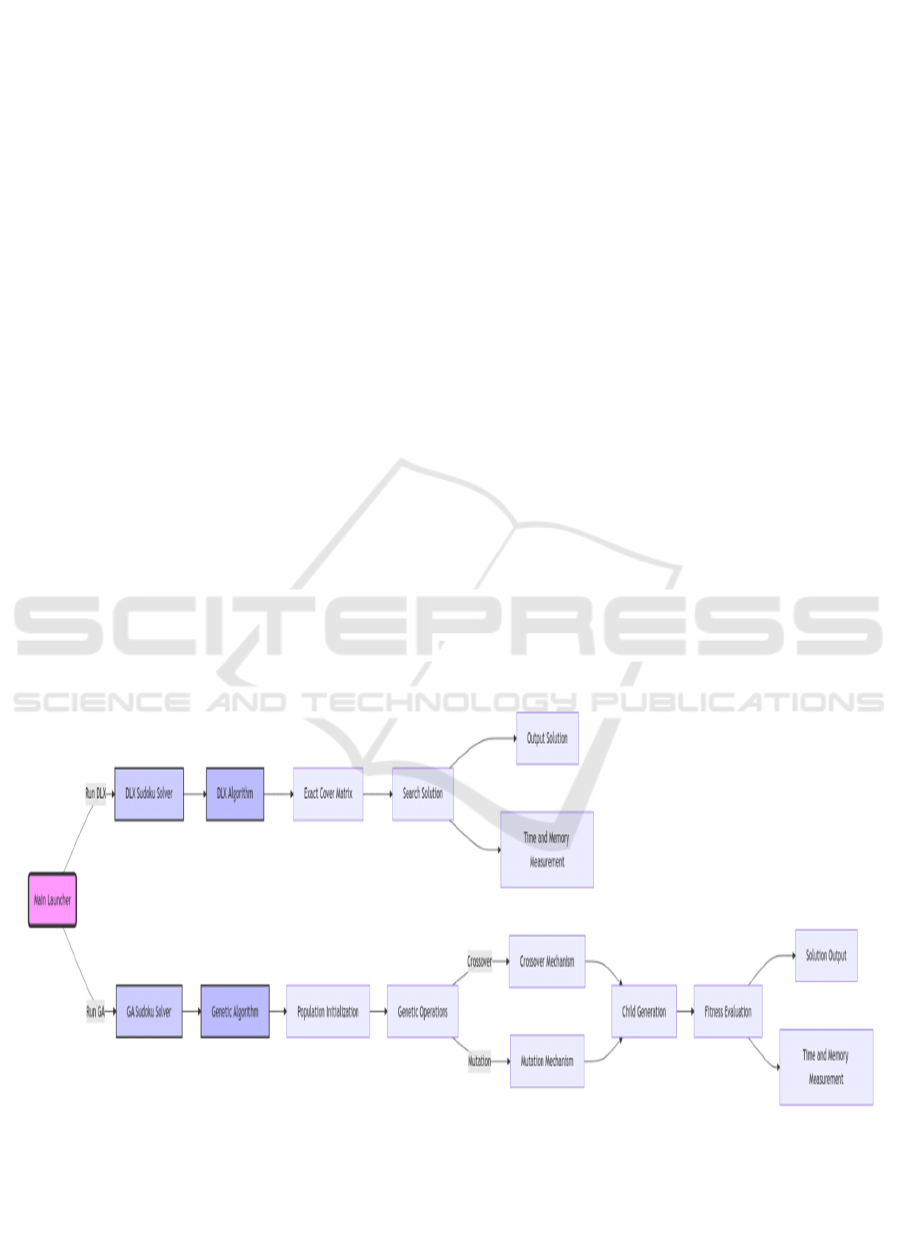
Workflow: The workflow (illustrated in the
architecture diagram) begins by taking a Sudoku
puzzle as input. The user selects one of the two
algorithms to solve the puzzle. If GA is used, the
system generates an initial population, determines the
fitness and iterates through crossover and mutation to
find a solution. If DLX is used, the system converts
the puzzle into a binary matrix and applies the exact
cover technique to find the solution. The system will
then output the solution, its performance metrics and
a visual presentation of the solved grid.
Figure 2: Architecture diagram.
The workflow in Figure 2 reads a Sudoku puzzle and
normalizes it according to standard rules. Further, the
chosen algorithm might use the puzzle to generate
GA or DLX. The system computes performance
measurements such as execution time, accuracy, and
computational efficiency. The result is the solved grid
ICRDICCT‘25 2025 - INTERNATIONAL CONFERENCE ON RESEARCH AND DEVELOPMENT IN INFORMATION,
COMMUNICATION, AND COMPUTING TECHNOLOGIES
634
along with the comparative results of algorithms
used. This design thus offers a strong framework for
comparing the capability and performance of Genetic
Algorithms and Dancing Links in solving Sudoku
puzzles.
4 RESULTS AND EVALUATION
4.1 Statistical Evaluation
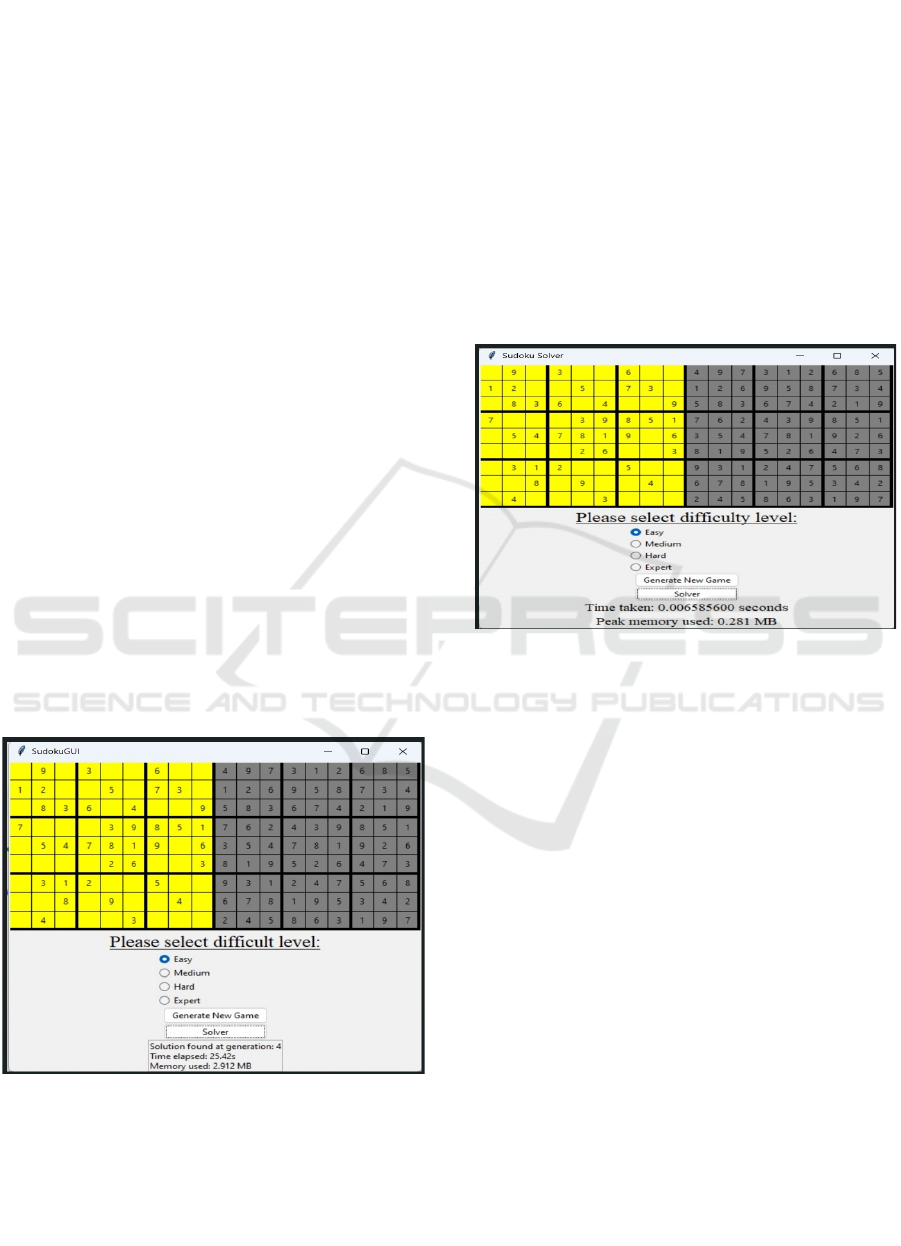
The number of difficulty variations is available as
well as options for new game generation as shown in
Figure 3. The fully filled grid thereby indicates that
the puzzle is completed effectively, as confirmed by
the indication of the solution after several iterations
of the interface. The overall performance metrics
presented here-in comprise time taken and memory
used, which are indicators of the resource
consumption involved in running the Genetic
Algorithm. The Genetic Algorithm has successfully
filled the Sudoku grid. It solves the puzzle correctly
with no conflicts or placement errors. It was also
reached within a computable number of generations,
signifying that the algorithm performs good
convergence towards the solution. The program
supplies information about the consumption of
computational resources: the time spent solving and
memory used, revealing the efforts made by a genetic
algorithm when using it to solve this particular type
of puzzle.
Figure 3: Genetic algorithm.
Options in the solver as shown in Figure 4 allow for
the choice of difficulty level and playing a new game
or solving an existing puzzle. The grid is fully filled
in, which results from the DLX algorithm's ability to
solve the puzzle effectively and with minimal time
with no errors. The puzzle is completely solved such
that the DLX algorithm accurately fills every cell
with a number based on Sudoku's strict rules. The
solver solves it so fast, which is an indication of
DLX's efficiency in running its algorithms to solve
constraint satisfaction problems quickly and
accurately. It only consumes a small amount of
memory, indicating the low overhead of the DLX
algorithm and its utility in applications where
resource computation is critical. This interface does
not only make it easy to solve Sudoku puzzles but
also shows the relevance of the DLX algorithm for
real-time applications and especially underscores
such an aspect as rapid processing with the use of
minimal resources.
Figure 4: DLX algorithm.
4.2 Comparison
The graph "Comparison of Execution Time by Puzzle
Size" as shown in figure 5c displays the performance
of the Genetic Algorithm (GA) and Dancing Links X
(DLX) across increasing Sudoku puzzle sizes (9x9,
16x16, 25x25). It illustrates how execution time
increases sharply in GA with puzzle size, indicating a
scalability problem, whereas the increase in DLX is
relatively less steep, indicating that DLX is much
more efficient and better scalable to larger puzzles.
Whereas GA might be competitive for small-size
puzzles due to potentially faster solutions, DLX's
continued performance over the whole range of sizes
makes it a choice for large-size challenges, where the
reliability and predictability of operation matter.
This comparison highlights DLX as an algorithm
of choice for hard tasks; indeed, GA needs additional
optimization or hybrid strategy in order to handle
sizeable puzzles properly.
A Comparative Analysis of Solving Sudoku Using Genetic Algorithm and DLX
635
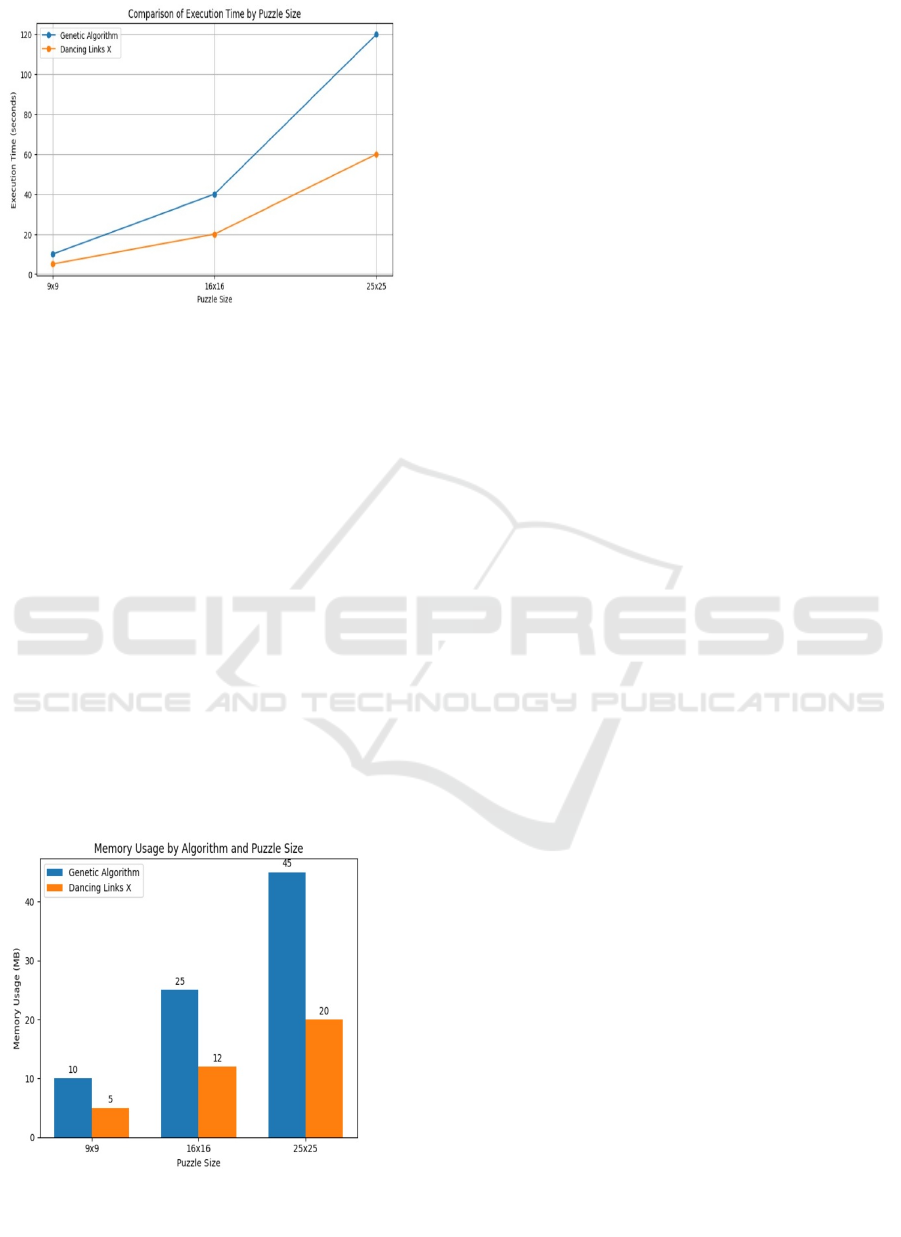
Figure 5: Comparison of execution time by puzzle size.
4.3 Memory Consumption
The bar graph as shown in figure 6d compares the
memory consumption of the Genetic Algorithm (GA)
and Dancing Links X (DLX) as they solve Sudoku
puzzles of varying sizes (9x9, 16x16, and 25x25). The
graph reveals that, with problem size, the memory
usage of GA really shoots up. For 9x9 problems, it
uses up to 10 MB and jumps to 45 MB for 25x25. This
therefore represents a very sharp increase as the
problem size increases. As compared to DLX, this is
much steeper; it uses 5 MB for 9x9 and 20 MB for
25x25 problems. This shows how DLX has good
memory performance, making it a better choice for
more complex problems where the memory
effectiveness is most valued. The comparison
between the two algorithms shows that GA requires
much more resources and how DLX is perfectly
suited for scenarios when free memory usage might
be very limited.
Figure 6: Memory consumption of GA and DLX.
5 CONCLUSIONS
Our work in this paper expands on these
developments concerning the methodologies for
solving Sudoku problems. We present a comparative
study of Genetic Algorithm (GA) and Dancing Links
(DLX) implementations. This is based on an analysis
of prior research, indicating that whereas exact
solutions are provided by techniques such as
backtracking and brute force, they do not overcome
the challenge of computations for bigger complex
puzzles. On the contrary, heuristic and hybrid
algorithms specifically those that use Genetic
Algorithms are scalable and efficient but are sensitive
to parameter tuning and incur some computational
overhead.
Dancing Links appears to be promising where the
problems can be constrained appropriately as
evidenced by its successful application to the Exact
Cover Problem. Its disadvantage would be that it
relies heavily on exact input formulations. The
juxtaposition of the two methodologies applied will
enable the strengths of evolutionary techniques for
adaptive applicability and the mathematical
correctness of DLX for precision.
Our work is a contribution to understanding the
performance of these different paradigms in finding
solutions for Sudoku puzzles with different levels of
difficulty. Through time complexity, convergence
behavior, and precision analysis, it is hoped that light
will be shed on their applicability. Therefore, our
effort eventually aims at developing a
computationally efficient yet adaptive robust
framework that propels state-of-the art combinatorial
problem-solving techniques forward.
6 FUTURE ENHANCEMENT
The horizon for future improvements upon this effort
includes hybrid approaches that integrate the fluidity
of Genetic Algorithms (GA) with the strength of
Dancing Links (DLX). These two methodologies
could effectively be integrated to create a solid
framework that capitalized on the best features of the
two methods, using the efficiency GA can produce
navigating difficult and vast search spaces and then
deploy DLX for solving exact constraints with
mathematical integrity.
In addition to this, machine learning techniques
would be used to dynamically optimize the
parameters of GA; this includes mutation rate,
crossover strategy, and selection mechanisms. The
ICRDICCT‘25 2025 - INTERNATIONAL CONFERENCE ON RESEARCH AND DEVELOPMENT IN INFORMATION,
COMMUNICATION, AND COMPUTING TECHNOLOGIES
636

second case is the use of machine learning models to
fine-tune configurations with DLX to achieve better
performance for a variety of Sudoku puzzles with
different degrees of difficulty.
The other areas for enhancement would be
extending this work into real-time applications.
Putting it into an interactive Sudoku solver or an
embedded system would then enable the algorithms
to be actually tested in the real world, measuring
responsiveness and accuracy under time constraints.
REFERENCES
Bukhori, Iksan, Jason Felix, and Saddam Ali. "Using
Genetic Algorithm to Solve Puzzle Games: A Review."
Journal of Computer Networks, Architecture and High-
Performance Computing 6, no. 1 (2024): 201-211.
Gurupriya, M., Ramasamy, G., Karthikeyan, B. (2023,
December). Combinatorial Bat Optimization for WSN
with Hoover Index Clustering. In 2023 International
Conference on Next Generation Electronics (NEleX)
(pp. 1-5). IEEE.
H. Bhasin and N. Singla, “Genetic based Algorithm for N -
Puzzle Problem,” Int J Computed Appl, vol. 51, no. 22,
pp. 44–50, Aug. 2012, doi: 10.5120/8347-1894.
Indriyono, Bonifacius Vicky, Ratna Wardani, Titin Susanti,
Laili Wulandari, Moh Fathurrohim, Rifka Sari Pratiwi,
and Endah Wulan Safitri. "Analysis of the Concept of
Solving the Sudoku Game Using Backtracking and
Brute Force Algorithms." International Journal of
Artificial Intelligence & Robotics (IJAIR) 6, no. 1
(2024): 40-47.
Jana, Sunanda, Anamika Dey, Arnab Kumar Maji, and
Rajat Kumar Pal. "A novel hybrid genetic algorithm-
based firefly mating algorithm for solving sudoku."
Innovations in Systems and Software Engineering 17,
no. 3 (2021): 261-275.
Jana, Sunanda, Anamika Dey, Arnab Kumar Maji, and
Rajat Kumar Pal. "A novel hybrid genetic algorithm-
based firefly mating algorithm for solving sudoku."
Innovations in Systems and Software Engineering 17,
no. 3 (2021): 261-275.
Krishna, K. S., Kumar, B. D., Reddy, M. D., Saketh, C. H.,
Ramasamy, G. (2024, May). A Multi-Class
Classification Framework with SMOTE Based Data
Augmentation Technique for Alzheimer’s Disease
Progression. In 2024 International Conference on
Advances in Modern Age Technologies for Health and
Engineering Science (AMATHE) (pp. 1-6). IEEE.
Lina, Tirsa Ninia, and Matheus Supriyanto Rumetna.
"Comparison analysis of breadth first search and depth
limited search algorithms in sudoku game." Bulletin of
Computer Science and Electrical Engineering 2, no. 2
(2021): 74-83.
M. M. P. Silva and C. S. Magalhães, “A Genetic Algorithm
for Solving Beehive Hidato Puzzles,” in Proceedings
XIII Brazilian Congress on Computational Intelligence,
ABRICOM, Jan. 2018, pp. 1–11. doi:
10.21528/CBIC2017-114.
Pratama, Moch Deny, Rifqi Abdillah, Darlis Herumurti,
and Shintami Chusnul Hidayati. "Algorithmic
Advancements in Heuristic Search for Enhanced
Sudoku Puzzle Solving Across Difficulty Levels."
Building of Informatics, Technology and Science
(BITS) 5, no. 4 (2024): 659-6671.
Ramasamy, G., Gurupriya, M., Vasavi, C. S., Karthikeyan,
B. (2024, May). A Cost-Sensitive Learning Approach
with Multi-Class Classification and Undersampling
Techniques for Pest Identification in the Coconut Leaf
Dataset. In 2024 3rd International Conference on
Artificial Intelligence for Internet of Things (AIIoT)
(pp. 1-5). IEEE.
S. K. Kumar, N. Dinesh and N. L, “Depression Detection
in Twitter Tweets Using Machine Learning
Classifiers,” 2022 Second International Conference on
Interdisciplinary Cyber Physical Systems (ICPS),
Chennai, India, 2022, pp. 81-86, doi:
10.1109/ICPS55917.2022.00023. keywords: Machine
learning algorithms; Social networking (online);
Blogs;Support vector machine classification; Mental
health;Depression;Decision trees;Support Vector
Machine; Decision Tree;CNN;Naive Bayes;Line
Kernel Convolutional Neural Network.
Sevaljevic, Andrija, and Paul Bodily. "Comparative
Empirical Analysis of Dancing Links Implementations
to Solve the Exact Cover Problem." In 2024
Intermountain Engineering, Technology and
Computing (IETC), pp. 255-258. IEEE, 2024.
Wang, Chuan, Bing Sun, Ke-Jing Du, Jian-Yu Li, Zhi-Hui
Zhan, Sang-Woon Jeon, Hua Wang, and Jun Zhang. "A
novel evolutionary algorithm with column and sub-
block local search for sudoku puzzles." IEEE
Transactions on Games 16, no. 1 (2023): 162-172.
A Comparative Analysis of Solving Sudoku Using Genetic Algorithm and DLX
637
