
Southern States Portal: A Digital Gateway to South India's
Government Resources
K. Venkatesh, Jayasri K., Chithra Maalya U., Sanjana U. Jain and Lily Arockia Ancy S.
Department of Computer Science and Engineering, Kalasalingam Academy of Research and Education, Virudhunagar,
Tamil Nadu, India
Keywords: Digital Governance, Southern States Portal, Government Services, Information Accessibility, User
Experience (UX), Service Integration, State‑Specific Portals, Digital India Portal, E‑Governance,
Comparative Analysis, Multilingual Support, Mobile Responsiveness, Real‑Time Updates, Usability,
Navigation, Digital Inclusion, SDG 9, SDG 16.
Abstract: This democratizing digital initiative connects primarily people from Tamil Nadu, Andhra Pradesh, Telangana,
Karnataka, and Kerala to the Government services from the State and Central governments. The portal aims
to reduce fragmentation of information and information delivery efforts by simplifying access to all relevant
government websites from a single source. This study discusses the Design, Development, and Sustenance
aspect, along with the outcome of the Portal and comparative assessment with Digital India Portal The study
evaluates the pros and cons of state specific portal, reinforces the fact that digital governance plays an essential
role in accessibility as well as service efficiency. Comparison between user experience, functionalities,
accessibility services and integration of the services are described through qualitative and quantitative
evaluations. Relevance to United Nations Sustainable Development Goals (SDGs): The conduct of this
research supports the SDGs of the United Nations, specifically Goal (SDG) 9 (Industry, Innovation and
Infrastructure) and Goal 16 (Peace, Justice and Strong Institutions). This portal is designed to fulfill these
goals by focusing on digital inclusivity, transparency, and efficiency in governance.
1 INTRODUCTION
The growth of digital platforms has led to a fast-
paced evolution of governance mechanisms in India.
Therefore, state specific portals have received never
before attention. Differentiated state-level platforms
such as the Digital India Portal notwithstanding that
provide citizens with an omni-access layer across the
services at a national-level, state-specific portals
have gained precedence in catering to citizens at the
regional level around their uniqueness in needs,
wants, and challenges. (2023) Government portals
are also critical on the road to closing the digital
divide and can support more efficient, transparent
and responsive governance that is grounded in local
realities. One of the initiatives is the Southern States
Portal which allots police services of five key
Southern Indian states Andhra Pradesh, Karnataka,
Kerala, Tamil Nadu and Telangana to be together in
one place to ensure easy navigation. Over Time this
has played a major role in allowing citizens to access
a variety of services in departments of public health,
education, transport, welfare schemes, etc.
Multilingual facility is provided in the portal, where
user can interact with the portal in his language which
overcome the barriers in Indian society, as India is a
multilingual country.
The habits formed during the pandemic are now
ingrained and citizens are more inclined to do their
governmental business through the digital medium.
State-specific portals have emerged as important
conduits for efficient service delivery in this context.
Portals provide many benefits such as minimising
need to visit government offices, timely updates, and
improved implementation in the face of large-scale
democratic accessibility. In addition, they also enable
the implementation of government schemes tailored
to the local populace thus making public service
more relevant and efficient. This paper explores the
functions, usability, and effectiveness of the
Southern States Portal, spotlighting strengths and
opportunities for improvement. In particular, we look
at whether and how the portal features such as multi-
department service integration and localized content
Venkatesh, K., K., J., U., C. M., Jain, S. U. and S., L. A. A.
Southern States Portal: A Digital Gateway to South India’s Government Resources.
DOI: 10.5220/0013917800004919
Paper published under CC license (CC BY-NC-ND 4.0)
In Proceedings of the 1st International Conference on Research and Development in Information, Communication, and Computing Technologies (ICRDICCT‘25 2025) - Volume 4, pages
617-622
ISBN: 978-989-758-777-1
Proceedings Copyright © 2025 by SCITEPRESS – Science and Technology Publications, Lda.
617

have an impact on ease-of-use and delivery
efficiency. Further, the paper also helps to evaluate
the extent to which these kinds of regional portals
contribute to the overall objectives of e-governance,
such as enhancing transparency, accountability, and
citizen participation. Giving a holistic understanding,
a cross-simulation is done taking Southern States
Portal & Digital India Portal as vertices for
comparison. This contrasts these offerings in ways
such as scope, user experience, and the mechanisms
used to deliver the service. The Digital India Portal
indeed catered to a range of National-level services
under one interface but state portals like the Southern
States Portal have taken a more regional approach by
providing services focusing on regional needs. This
comparison between state and national portals for
grievance redressal will help elucidate the different
aspects which can provide an insight into the state
portals complementing the national portals and their
collective contribution towards the vision of a
digitally empowered India. The broader
consequences of state specific portals in the future of
e-governance in India, will be discussed in this paper.
Keywords: user interface, design improvements,
integration, widgets, accessibility This analysis, by
uncovering these gaps, not only aids in providing
strong recommendations and insights for the
improvement of the Southern States Portal and
equivalent efforts, it lays the foundation for making
digital governance in the country more effective and
inclusive.
2 LITERATURE REVIEW
Literature Review Digital governance has developed
quickly over the last 10 years, with many studies
analysing the influence that online government
portals have had on accessibility, transparency and
efficiency. By reviewing relevant literature
surrounding the areas of digital governance,
including state-specific portals, comparative analysis
of e-governance, we can ensure that the different
facets of the research topic are covered (covering
significant studies in each area). E-Governance,
Digital Portals– A number of studies have explored
digital portals for improving government
availability. As Bhatnagar (2020) states, "e-
governance platforms are a key component in
bridging the digital divide and enabling citizens easy
access to public services". In the same vein, Sharma
& Gupta (2019) noted the importance of user-
friendly interfaces and central hubs of service
provision, which play a major role in enhancing
engagement and reducing bureaucratic stalling.
State-Specific Government Portals-Regional
government portals have been extensively studied to
assess the extent of localized services. A study by
Reddy et al. (2021) assessed the decentralized state-
specific portals in India and recommended better
multi-language facilities and real-time updates in
order to boost user satisfaction. Also, Verma (2022)
analysed the operational aspect of digital governance
with a focus on South Indian states stating that state
level specific portals increase efficiency as compared
to national level mechanisms. Comparative Studies
on Digital Government Platforms-Comparative
studies between national and regional portals
pinpointed some clear advantages and limitations of
the two different approaches. 4.4 Kumar et al.
Federated Learning for e Governance (2023) the user
feedback mechanism is integrated with an
underlying e-governance mechanism. Cybersecurity
in Digital Governance-A paper by Patel & Srinivasan
(2022) highlighted the significance of cybersecurity
in government portals. Multilingual Support in E-
Governance (Ghosh, 2021) examined how the
availability of multilingual support in terms of digital
services can contribute towards increasing the rate of
digital governance adoption. AI IN PUBLIC
SERVICE PORTALS-JAIN ET AL. (2023).
Exploring AI-based solutions for improvement of e-
government services. Mukherjee & Roy (2024)
Cloud Computing for Government Portals. Recent
Work on Digital Mobile First Government
Platforms- Sharma & Verma (2023) Sharma &
Verma (2023) Mobile-First Approach in Government
Digital Services Blockchain for secure digital
governance transactions-Bose et al. (2024) studied
blockchain applications within secured governance
exchanges.
3 METHODOLOGY
3.1 Existing Methodology
Existing Methodology: State-Specific Digital
Portals
Digital portals, specifically at the state level, have
emerged as an essential methodology in digital
governance, granting citizens direct access to
government services tailored to their states. These
portals operate autonomously, but are meant to serve
as a solution for localized governance based on the
needs of the state populations.
ICRDICCT‘25 2025 - INTERNATIONAL CONFERENCE ON RESEARCH AND DEVELOPMENT IN INFORMATION,
COMMUNICATION, AND COMPUTING TECHNOLOGIES
618

3.1.1 Overview of State-Specific Digital
Portals
State governments in India have launched dedicated
portals to deliver essential services, ensuring
accessibility and efficiency. These portals typically
provide services such as:
Public Grievance Redressal: Portals such as Jana
Sevaka (Karnataka) allow citizens to file complaints
and seek resolutions online.
Utility Services: Websites like TNeGA (Tamil
Nadu) provide access to electricity bill payments,
water connections, and tax services.
Citizen Certificates & Identification Services:
Systems such as MeeSeva (Andhra Pradesh &
Telangana) allow users to obtain birth/death
certificates, income certificates, and caste certificates
digitally. These portals are designed to bring
government services closer to the people while
reducing bureaucracy and processing delays.
3.1.2 Implementation Strategy
The implementation of state-specific digital portals
generally follows a structured methodology:
Requirement Analysis: Identifying the needs of
citizens and the most sought-after government
services.
Portal Development: Designing user-friendly
websites with interactive dashboards and mobile
accessibility.
Integration of Services: Connecting various
government departments and enabling seamless data
exchange.
Security and Data Protection: Implementing
cybersecurity measures to protect citizen data and
ensure secure transactions.
Multilingual Support: Enabling regional language
interfaces for better accessibility.
Performance Monitoring & Updates: Regularly
updating portals to improve efficiency and user
experience.
3.1.3 Advantages of State-Specific Portals
Localized Service Delivery: Ensures services are
tailored to regional requirements.
Faster Processing Time: Reduces bureaucratic
hurdles and automates approvals.
Enhanced Digital Inclusion: Provides services in
local languages, making them accessible to rural
populations.
Transparency & Accountability: (Patel, R. &
Srinivasan, A., 2 0 2 2 ) Allows tracking of
application statuses, reducing corruption and delays.
3.1.4 Challenges in State-Specific Portals
Fragmentation of Services: (Ghosh, D., 2021)
Users must navigate multiple portals if they require
services from different states.
Lack of Uniformity: (Jain, M. et al., 2023) Different
portals use varying UI/UX designs, leading to
inconsistency.
Limited Integration with National Platforms:
Many state portals operate independently without full
integration into central systems like DigiLocker or
UMANG.
Connectivity Issues: Rural areas with poor internet
infrastructure face difficulties in accessing services.
3.2 Proposed Methodology
The proposed methodology outlines The Southern
States Portal is designed to serve as a centralized
digital platform integrating the government services
of Tamil Nadu, Andhra Pradesh, Telangana,
Karnataka, and Kerala. The methodology focuses on
seamless access to services, enhanced security, and
improved efficiency.
3.2.1 System Architecture
The system architecture consists of five core
components:
Centralized Database: The portal will maintain a
unified database to store user information, service
requests, and government records. Data exchange
between different state departments will be seamless,
reducing redundancy and delays. A cloud-based
infrastructure will be adopted for scalability and real-
time updates.
User Authentication: To ensure security, users will
log in using Aadhaar- based authentication or mobile
OTP verification. Multi-factor authentication (MFA)
will be implemented to prevent unauthorized access.
Role- based access control (RBAC) will be used,
ensuring that citizens, government employees, and
administrators access only relevant data.
Service Modules: Services will be categorized based
on state and department, allowing users to find
relevant information efficiently. Examples of service
modules include land records, tax payments,
grievance redressal, and public welfare schemes. A
dashboard-based interface will be provided for easy
navigation.
Southern States Portal: A Digital Gateway to South India’s Government Resources
619
Multilingual Support: Since the portal caters to
multiple states, content will be available in English
and regional languages (Tamil, Telugu, Kannada,
Malayalam). Automatic language translation and
text-to-speech features will enhance accessibility.
Mobile and Web Accessibility: The portal will be
optimized for both mobile and web users, ensuring
smooth access on desktops, smartphones, and tablets.
A mobile app will be developed for Android and iOS,
providing push notifications for government updates.
The UI will follow responsive design principles to
ensure adaptability across devices.
Implementation Plan: The project will be
implemented in a structured, four-phase approach to
ensure smooth integration and performance.
Phase 1: Requirement Analysis and Prototype
Development
Conduct stakeholder meetings with government
officials, IT experts, and citizens to identify key
requirements. a prototype to visualize the portal’s
layout, service flow, and user interactions. Define the
data security policies and compliance with
government regulations (e.g., Digital India
guidelines).
Phase 2: Integration with Existing State Portals
Establish APIs (Application Programming
Interfaces) to connect with Tamil Nadu, Andhra
Pradesh, Telangana, Karnataka, and Kerala’s existing
digital services. Ensure data synchronization so that
user records remain consistent across platforms.
Address interoperability challenges by using
standardized protocols for communication between
systems.
Phase 3: Security and Performance Testing
Conduct penetration testing to identify potential
security vulnerabilities. Implement encryption
standards (such as AES-256 for data storage and
SSL/TLS for secure communication). Perform load
testing to ensure the portal can handle high traffic
efficiently.
Phase 4: Full-Scale Deployment and Continuous
Improvement
Roll out the platform for public use and conduct
awareness campaigns. Set up a real-time monitoring
system to track issues and ensure system uptime.
Gather user feedback and continuously update
features based on government policies and
technological advancements.
4 EXPERIMENTAL RESULTS
AND DISCUSSION
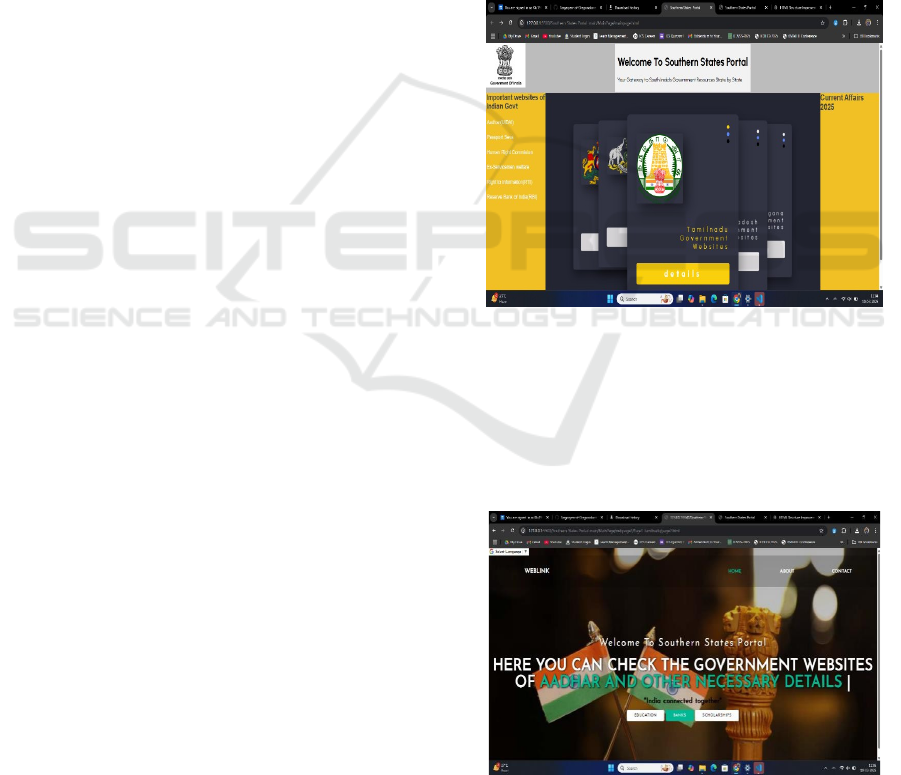
4.1 Image Acquisition
The input image and is referred to as the dataset
image. It is sourced from a specific dataset to ensure
that the intensity and pixel values of all images remain
nearly uniform Using images from the dataset yields
superior results compared to those obtained from
other web sources. The figure 1 shows the Image
Acquisition. Consequently, the accuracy of the
process is enhanced by selecting dataset images,
which provide consistent and reliable input for
analysis. The table 1 shows the Accuracies.
Figure 1: Image acquisition.
4.2 Preprocessing
In the realm of computer graphics and digital
imaging, scaling involves re-sizing a digital
image. The preprocessing is shown in figure 2.
Figure 2: Pre-processing.
ICRDICCT‘25 2025 - INTERNATIONAL CONFERENCE ON RESEARCH AND DEVELOPMENT IN INFORMATION,
COMMUNICATION, AND COMPUTING TECHNOLOGIES
620
4.3 Feature Extraction
In machine learning and image processing, feature
extraction begins with an initial set of measured data
to create derived values (features) that are both
informative and non-redundant. The feature
extraction illustrated in figure3.
Figure 3: Feature extraction.
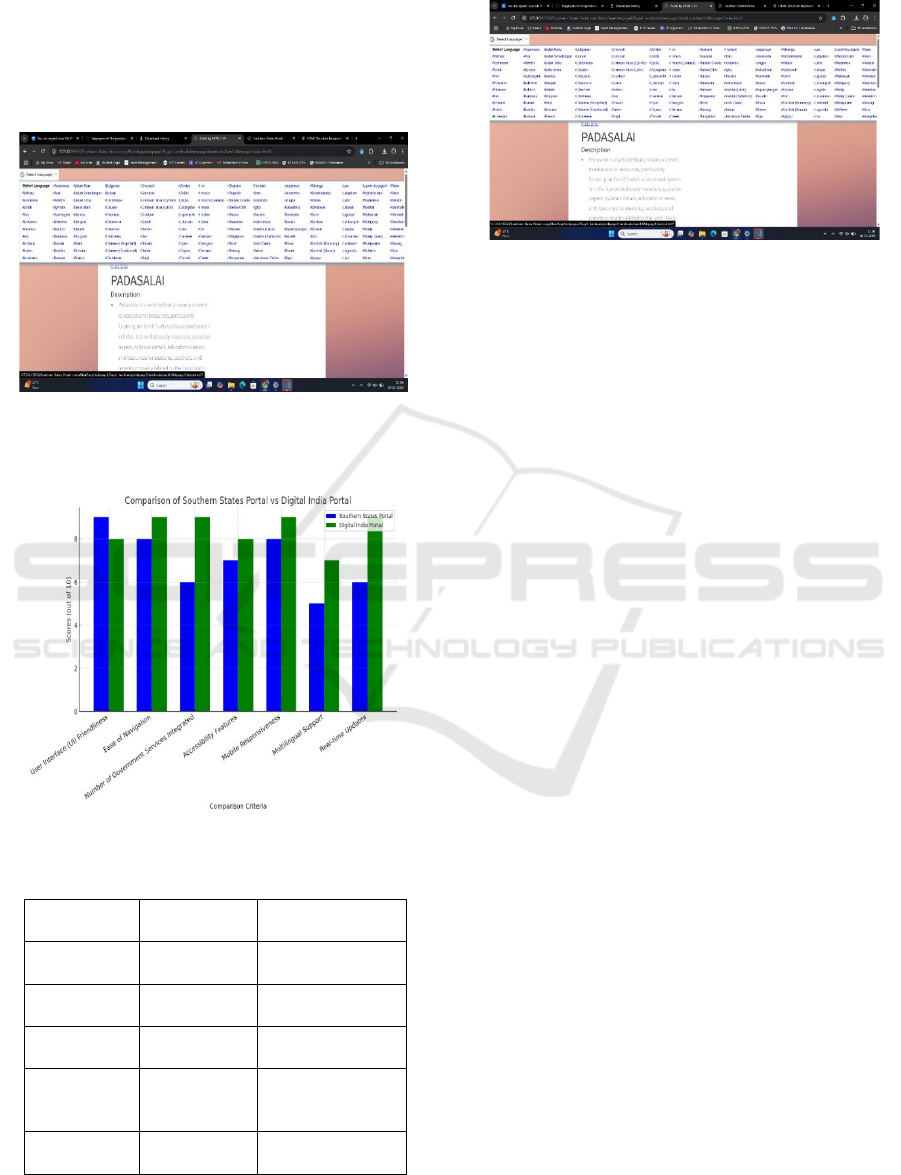
4.4 Comparison
Figure 4: Graphical representation of comparison.
Table 1: Accuracies.
Feature
Existing
Portals
Unified Southern
States Portal
Service
Integration
Low High
User
Experience
Inconsistent Standardized
Accessibilit
y
Varies by
State
Multi-state
access
Security Moderate
Enhanced with
AI/ML
monitorin
g
Updates &
Maintenance
State-
de
p
endent
Centrally
mana
g
e
d
5 RESULT
Figure 5: Result.
6 CONCLUSIONS
The implementation of a unified digital portal for
South Indian states marks a transformative step in
governance, ensuring accessibility, transparency, and
efficiency. This portal directly supports SDG 9
(Industry, Innovation, and Infrastructure) by
leveraging technology to improve public service
delivery and SDG 16 (Peace, Justice, and Strong
Institutions) by enhancing government
accountability. By centralizing services, it minimizes
bureaucratic delays and ensures uniform access to
information. Furthermore, integrating AI-driven
automation and cybersecurity measures enhances
user trust and system reliability. The comparative
analysis with existing state portals demonstrates the
potential for improved digital governance across
multiple states. As technology evolves, continuous
adaptation will be necessary to maximize its impact.
REFERENCES
Bose, S. et al., 'Blockchain for Secure Digital Governance
Transactions', IEEE, 2024.
Estonian Government Digital Strategy, ‘Lessons in E-
Governance’, 2022
Ghosh, D., 'Multilingual Support in E Governance',Journal
of Public Administration, 2021.
Indian Institute of Technology (IIT) Research Paper,
‘Challenges in Indian E-Governance Implementation’,
2023.
Jain, M. et al., 'AI in Public Service Portals', Journal of
Digital Governance, 2023.
K. Venkatesh, A Survey on Data Mining Techniques for
Website Phishing Detection, International Journal of
Pure and Applied Mathematics titled as Volume 119
No. 16 2018, pp.no: 2127-2133. ISSN: 1314-3395.
Impact factor7.19
Southern States Portal: A Digital Gateway to South India’s Government Resources
621

K. Venkatesh, An energy efficient computational task
offloading and resource allocation for mobile edge
computing for environmental applications, Journal of
Environmental Protection and Ecology, 2023, Vol. 24,
Issue 6, pp. 2183–2194.
Karnataka Sakala Mission, ‘Time-Bound Service Delivery
Analysis’, 2023.
Kumar, S. et al., ‘User Feedback in E-Governance
Systems’, IEEE Access, 2023.
MeeSeva 2.0, Telangana Government., ‘Digital Service
Efficiency Study’, 2023.
Ministry of Electronics and IT, India, ‘E-Governance in
India: Digital Transformation Strategies’, 2023.
Mishra, V. & Gupta, P., 'Service Integration in Governme
nt Platforms', IEEE, 2023.
Patel, R. & Srinivasan, A., ‘Cybersecurity in Digital
Governance’, IEEE Transactions, 2022.
Reserve Bank of India, ‘Financial Inclusion through Digital
Portals’, 2023.
Roy, P. & Mukherjee, B., 'Cloud Computing for Governm
ent Portals', 2024.
Sharma, A. & Verma, K., 'Mobile-First Approach in
Government Digital Services’, 2023.
Singapore Smart Nation Initiative, ‘Integrated Government
Digital Services’, 2022.
Tamil Nadu e-Governance Agency (TNeGA), ‘State
Digital Services Report’, 2023.
United Nations E-Government Survey, ‘Trends in Digital
Public Services’, 2023.
World Bank Digital Governance Report, ‘Enhancing Gove
rnment Transparency’, 2023.
ICRDICCT‘25 2025 - INTERNATIONAL CONFERENCE ON RESEARCH AND DEVELOPMENT IN INFORMATION,
COMMUNICATION, AND COMPUTING TECHNOLOGIES
622
