
Real‑Time Facial Expression Recognition Based on CNN
R. Deepthi Crestose Rebekah, Pawar Bhavya, Avula Vasanthi,
Arava Mamatha Sumanjali and Valchannagari Vyshnavi
Department of CSE, Ravindra College of Engineering for Women, Kurnool, Andhra Pradesh, India
Keywords: Real‑Time Recognition, Facial Expression Analysis, Convolutional Neural Networks (CNNs), Deep
Learning, Feature Dimensionality Reduction, Principal Component Analysis (PCA), Bayesian Optimization,
Computational Efficiency.
Abstract: Facial expression recognition through CNN in real-time is a deep learning technique that is intended to
recognize and classify facial emotions instantly. The accurate recognition, though, is difficult to attain because
of factors such as changes in lighting, occlusions, and prominent facial features. Furthermore, high
computational requirements create problems, particularly for resource-constrained devices. It is essential to
balance accuracy with efficiency for maximum performance. In response to these issues, the suggested system
includes PCA for dimension reduction and Bayesian optimization for model adjustment. PCA boosts
computational efficiency through data dimensions reduction, while Bayesian optimization tunes
hyperparameters to increase accuracy. The system surpasses current models through increased precision,
reduced processing time, and minimized computational complexity, ultimately providing an efficient real-
time facial expression recognition solution.
1 INTRODUCTION
Facial expression recognition (FER) is an important
area of human-computer interaction, enabling
machines to recognize and react to human feelings.
Real-time FER with the help of Convolution Neural
Networks (CNNs) has become popular because it can
automatically detect and classify facial expressions
with minimal intervention. Yet, high accuracy in real-
time applications still a challenging task because of
facial expression variations, lighting, occlusions, and
personal facial variations. Additionally, the high
computational complexity of CNN models
complicates the achievement of an optimal balance
between processing time and accuracy, especially on
low-resource devices.
A better real-time FER system that is intended to
enhance accuracy as well as efficiency is introduced
in this research as a solution to these challenges. The
suggested method utilizes Principal Component
Analysis (PCA) for reducing the dimensionality of
features, minimizing computational complexity while
preserving important facial expression features. For
hyperparameter adjustment, Bayesian optimization is
also utilized, allowing optimal CNN configurations to
be chosen in order to enhance model performance.
These techniques together allow the system to perform
more effectively in real-time applications (N.-H. Chang
et al., 2019).
The suggested system surpasses the current
models both in recognition precision and computation
efficiency using PCA and Bayesian optimization. It is
ideal for real-time emotion recognition in many
applications, such as human-computer interaction,
surveillance, and healthcare, since it conserves
processing time while still achieving good
classification accuracy. This work highlights the
suitability of deep learning-driven solutions in
promoting FER technology while overcoming issues
related to the limitations of real-time processing
2 RESEARCH METHODOLOGY
2.1 Research Area
The Field Domain with CNN, the objective of the
field of Real-Time Facial Expression Recognition
(FER) is to develop deep models that are capable of
fast and accurate real-time facial expression
Rebekah, R. D. C., Bhavya, P., Vasanthi, A., Sumanjali, A. M. and Vyshnavi, V.
Real-Time Facial Expression Recognition Based on CNN.
DOI: 10.5220/0013917600004919
Paper published under CC license (CC BY-NC-ND 4.0)
In Proceedings of the 1st International Conference on Research and Development in Information, Communication, and Computing Technologies (ICRDICCT‘25 2025) - Volume 4, pages
605-609
ISBN: 978-989-758-777-1
Proceedings Copyright © 2025 by SCITEPRESS – Science and Technology Publications, Lda.
605

recognition. The study enhances healthcare
applications, surveillance, and human-computer
interaction applications by fusing computer vision
and artificial intelligence. Overcoming challenges
such as lighting changes, occlusions, and differences
between faces with high accuracy and computation
speed is one of the biggest challenges in real-time
FER. Although CNNs are superior in automatically
extracting and classifying facial features, their high
computations limit them for use in devices with
limited power resources. This research employs
Principal Component Analysis (PCA) to minimize
feature dimensionality and Bayesian optimization to
optimize hyperparameters to address these issues.
The system becomes more effective for application in
real-world scenarios due to these techniques’ faster
processing speed, reduced computational burden, and
improved recognition accuracy.
2.2 Literature Review
Facial Expression Recognition (FER) has received
intensive and there are several researchers who used
deep models of learning, i.e., Convolution Neural
Network (CNNs), to attain higher recognition rates in
facial expression recognition (FER). The earlier FER
methods that relied on hand-crafted feature
extraction algorithms like Local Binary Patterns
(LBP) and Histogram of Orientend Gradients (HOG)
generally struggled with variations in lighting,
occlusions, and individual facial differences.CNNs
have greatly enhanced FER through self-extraction of
hierarchical features from face images, reducing
dependence on hand-engineered feature engineering.
Despite their success, CNN-based FER systems still
suffer from drawbacks, particularly computational
complexity and real-time computation, such that they
are less suited for deployment on resource-limited
devices.
Recent studies have highlighted the optimization
of CNN models and feature reduction techniques to
enhance efficiency to bridge these gaps. Various
dimension reduction techniques, including Principal
Component Analysis (PCA) and Linear Discriminant
Analysis (LDA), have been employed to preserve
essential facial expression features while diminishe
Computation costs. PCA has proved to be particularly
valuable in eliminating redundant data, hence
facilitating real-time processing of data. Further,
techniques such as Genetic Algorithms and Bayesian
optimization have been applied to optimize
hyperparameters so that CNN models are more
precise but utilizes less computational power. These
Optimization methods enable FER systems to be
utilized in actual circumstances by making certain
that the maximum trade-off between recognition
performance and processing complexity is achieved.
3 EXISTING SYSTEM
Facial Expression Recognition (FER) systems today
are based on deep learning techniques Convolutional
Neural Networks (CNNs), employed for automated
face feature extraction and classification, form the
basis of the current facial expression recognition
(FER) systems. CNNs have produced much better
recognition performance compared to traditional
approaches such as the Histogram of Oriented
Gradients (HOG) and Local Binary Patterns (LBP).
Nonetheless, the general performance of current
CNN-based FER models is hindered by problems
such as occlusion, facial structure variations, and light
sensitivity to changes. Real-time processing is also
challenging because CNNs are computationally
intensive, particularly on hardware with limited
resources. Most FER systems depend on high-end
computing or cloud processing, making them less
viable for real-time use in environments with limited
resources. While other models combine data
augmentation and transfer learning to enhance
accuracy, they are usually not able to find an optimal
balance between speed and precision. These
challenges highlight the need for better FER systems
with high recognition accuracy in real-time
applications.
Two Limitations of the Current System:
Vulnerability to Lighting Changes and Obstructions
CNN-based facial expression recognition (FER)
systems face difficulties when dealing with varying
lighting conditions, shadows, and obstructions such
as glasses, masks, or facial hair. These challenges can
negatively impact the system’s ability to accurately
extract and classify facial features, resulting in
misidentifications. Consequently, the system's
reliability decreases in diverse real-world settings.
High Processing Power Demand
Real-time FER models built on CNNs require
significant computational resources, making them
impractical for devices with limited processing
capabilities. The substantial computational load
slows down inference speed, limiting deployment
possibilities on mobile or edge devices without cloud-
based infrastructure. This drawback hinders
accessibility and scalability for widespread
applications.
ICRDICCT‘25 2025 - INTERNATIONAL CONFERENCE ON RESEARCH AND DEVELOPMENT IN INFORMATION,
COMMUNICATION, AND COMPUTING TECHNOLOGIES
606
4 PROPOSED SYSTEM
The proposed system overcomes the challenges of
traditional CNN-based facial expression recognition
(FER) by employing statistical regression techniques
to enhance accuracy and computational performance,
the suggested system is able to overcome the
challenges of standard CNN-based facial expression
recognition (FER). Changes in lighting, occlusion,
and high processing requirements are all typical
issues for standard CNN models. To overcome these
issues, more accurate relationships between facial
expressions and emotions are created with techniques
such as linear regression, logistic regression, and
ridge regression. The system efficiently suppresses
noise, simplifies distinguishing facial expressions,
and becomes more robust to external influences such
as shadows and obstructions through regression’s
contribution to reducing dimensionality, processing
speed and computational complexity are minimized.
Owing to this optimization, real-time FER can now
be efficiently applied in limited-resource
environments and can be integrated on edge devices
without sacrificing performance. Regression is
blended with deep learning to come up with an
optimally well-balanced strategy that achieves its best
recognition performance, processing throughput, and
usage of hardware resources.
Through the application of statistical regression
methods such as linear regression, and ridge
regression, the new facial expression recognition
accuracy is enhanced by the system considerably.
These methods improve feature selection, denoise,
and make the system operate more effectively to
combat such issues as unstable light conditions,
shadows, and occlusion. This results in a system that
offers more accurate emotion recognition under
diverse real-world conditions.
Faster processing and real-time execution are
facilitated by regression-based dimensionality
reduction, which simplifies computing. Regression-
based dimensionality reduction, unlike traditional
CNN-based approaches, accelerates processing and
facilitates real-time execution. Our approach
enhances feature extraction and classification,
making it suitable for deployment on resource-
constrained devices, including smartphones and edge
computing platforms, without compromising
recognition speed or accuracy. This is different from
traditional CNN-based models, which need a lot of
processing power.
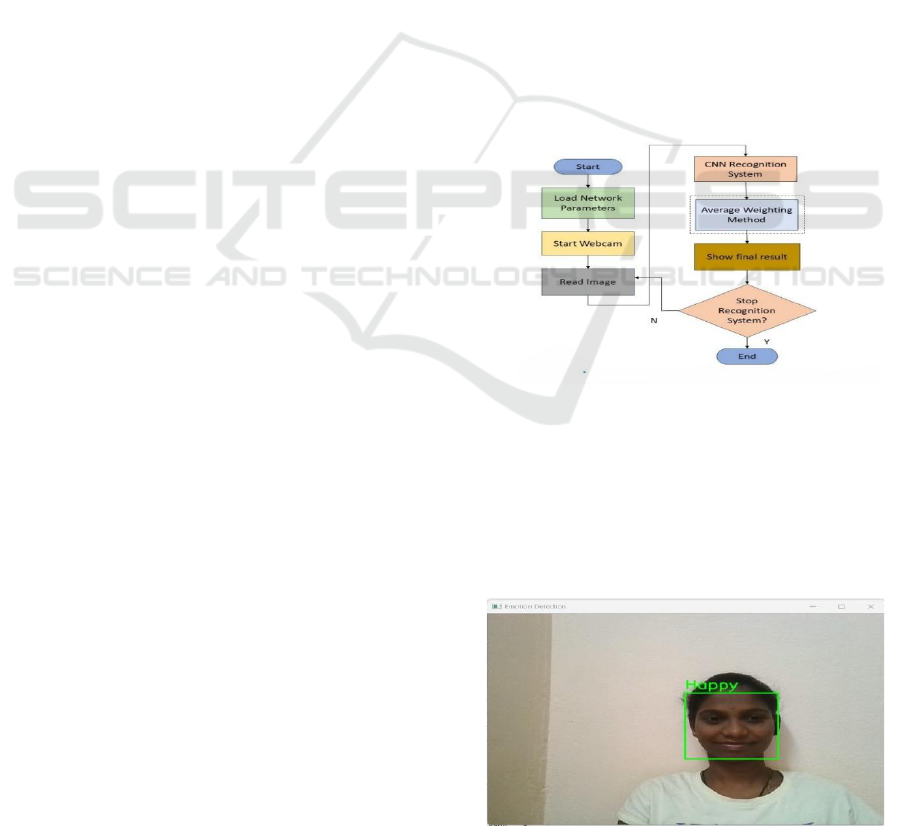
4.1 Architecture
Deep hierarchical facial expression features are
subsequently captured through a CNN-based feature
extraction technique. Principal Component Analysis
(PCA) is applied to diminish dimensionality without
losing vital features for the purpose of controlling
computational complexity. Removal of redundant
information. Furthermore, statistical regression are
applied in an effort to improve feature selection,
eliminate noise, and form reliable relationships
between facial features and emotions. Bayesian
optimization is also used to adjust CNN
hyperparameters to get the best possible compromise
between recognition speed and accuracy. In the last
phase, for classifying expressions, a hybrid model
combining deep learning and regression-based
approaches is deployed. Real-time application on low-
resource devices like mobile platforms and edge
computing platforms is enabled by this technique,
which also reduces processing time enormously,
enhances resistance to environmental effects like
shadows and occlusions, and enhances environmental
robustness. Figure 1 shows the Architecture diagram.
Figure 1: Architecture diagram.
5 RESULT
The following images (figure 2) are the output
obtained as the real-time facial expression recognition
based on CNN.
Real-Time Facial Expression Recognition Based on CNN
607
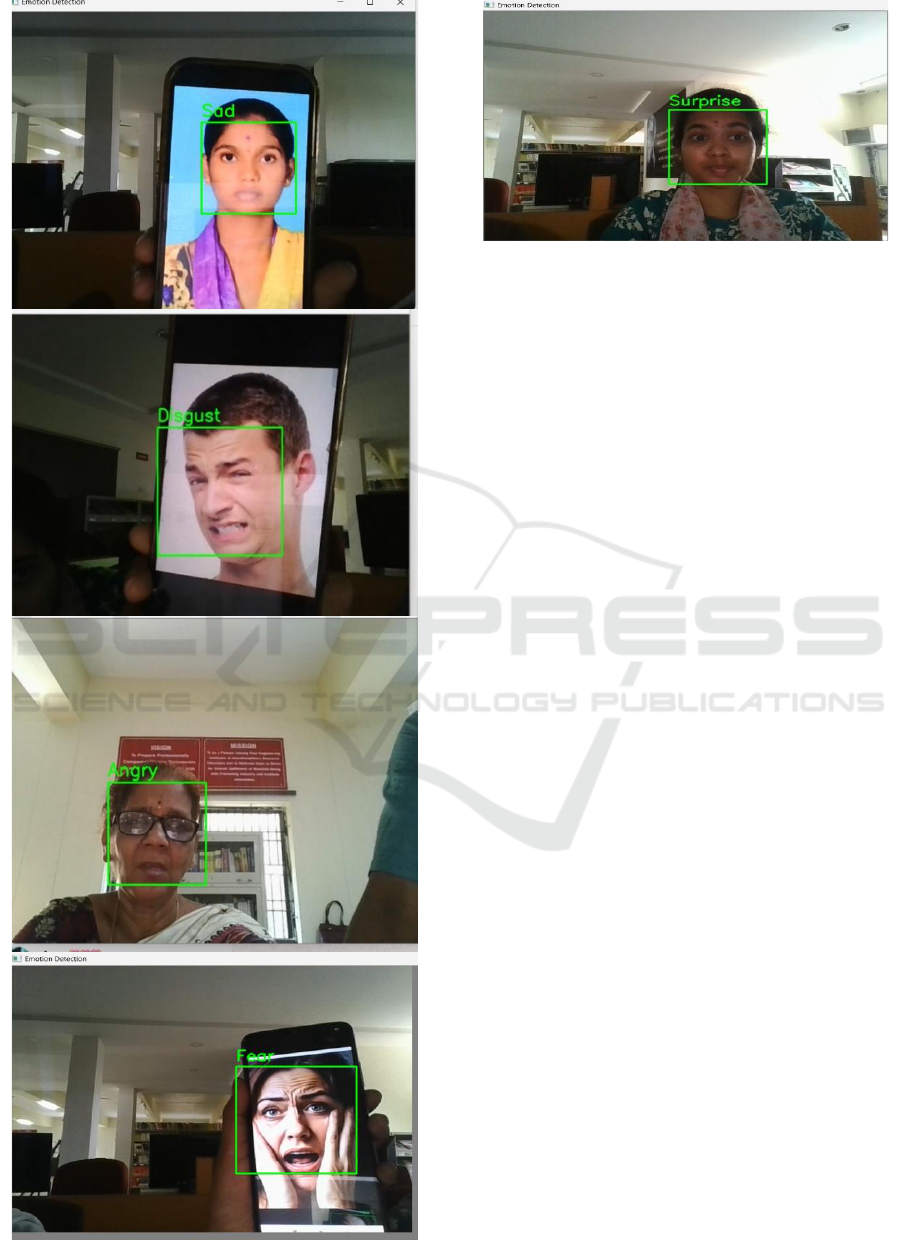
Figure 2: Results Obtained.
6 CONCLUSIONS
The standard convolutional neural network real-time
facial expression recognition errors can be minimized
through the use of this paper’s average weighting
scheme. Environmental noise can be minimized
through the use of a high frame rate camera. The
average weighting scheme also enhances facial
expression recognition robustness between frames,
leading to better accuracy. Experimental results
indicate that the proposed facial expression
recognition system is more dependable than the
standard CNN method.
ACKNOWLEDGMENT
In the framework of the Ministry of Education (MOE)
Taiwan Higher Education Sprout Project, National Taiwan
Normal University’s “Chinese Language and Technology
Center” funded this research under. The Featured Areas
Research Center Program. It was also funded by Taiwan’s
Ministry of Science and Technology under Grants number.
MOST 108-2634-F-003-002 and MOST 108-2634-F-003-
003 were supported by pervasive Artifical Intelligence
Research (PAIR) Labs. We also like to thank the National
Center for High-performance computing for granting
computer time and facilities for conducting this research.
REFERENCES
B. Knyazev, R. Shvetsov, N. Efremova, and A. Kuharenko,
“Convolutional neural networks pretrained on large
face recognition datasets for emotion classification
from video,” in IEEE Conference on Computer Vision
and Pattern Recognition (CVPR), Honolulu, Hawaii,
July 21-26, 2017.
based method on the segmentation and recognition of
Chinese words,” in Proc. of the 2018 International
ICRDICCT‘25 2025 - INTERNATIONAL CONFERENCE ON RESEARCH AND DEVELOPMENT IN INFORMATION,
COMMUNICATION, AND COMPUTING TECHNOLOGIES
608

Conference on System Science and Engineering (ICSS
E), Taiwan, June 28-30, 2018.
I. J. Goodfellow et al., “2013. Challenges in representation
learning: A report on three machine learning contests,”
in International Conference on Neural Information
Processing. Springer, pp.117-124.
J. Kim, J. K. Lee, and K. M. Lee, “Deeply-recursive
convolutional network for image super-resolution,” in
IEEE Conference on Computer Vision and Pattern
Recognition (CVPR), Las Vegas, US, June 26-July 1,
2016.
J.-H. Chen, Y.-H. Chien, H.-H. Chiang, W.-Y. Wang, and
C.-C. Hsu, “A robotic arm system learning from
human demonstrations,” in Proc. Of the 2018 Internati
onal Automatic Control Conference (CACS), Taoyuan
, Taiwan, Nov. 4-7, 2018.
M. Pantic and J. M. Rothkrantz, “Facial action recognition
for facial expression analysis from static face images,”
IEEE Trans. Systems, Man and Cybernetics, vol. 34,
no. 3, pp. 1449-1461, 2004.
M. S. Bartlett, G. Littlewort, M. G. Frank, C. Lainscsek, I.
Fasel, J. Movellan, “Fully Automatic Facial Action Re
cognition in Spontaneous Behavior", Proc. IEEE Int'l
Conf. Automatic Face and Gesture Recognition
(AFGR), Southampton, UK, April 10-12, 2006, pp.
223-230.
Mohebbanaaz, M. Jyothirmai, K. Mounika, E. Sravani and
B. Mounika, “Detection and Identification of Fake
Images using Conditional Generative Adversarial
Networks (CGANs),” 2024 IEEE 16th International
Conferences on Computational Intelligence and
Communication Networks (CICN), Indore, India, 2024,
pp. 606-610, doi;10.1109/CICN63059.2024.10847379.
N.-H. Chang, Y.-H. Chien, H.-H. Chiang, W.-Y. Wang, and
C.-C. Hsu, “A robot obstacle avoidance method using
merged cnn framework,” in Proc. Of the 2019 Internat
ional Conference on Machine Learning and Cyberneti
cs (ICMLC), Kobe, Japan, July 7-10, 2019.
S. Alizadeh and A. Fazel, “Convolutional neural networks
for facial expression recognition,” in IEEE Conference
on Computer Vision and Pattern Recognition (CVPR),
Honolulu, Hawaii, July 21-26, 2017.
S. Li and W. Deng, “Reliable crowdsourcing and deep
locality preserving learning for unconstrained facial
expression recognition,” IEEE Trans. Image Process.,
vol. 28, no. 1, pp. 356-370, Jan. 2019.
T. H. H. Zavaschi, L. E. S. Oliveira, A. L. Koerich, "Facial
Expression Recognition Using Ensemble of Classifiers
", 36th International Conference on Acoustics Speech
and Signal Processing (ICASSP), Prague, Czech
Republic, May 22-27, 2011, pp. 1489-1492.
V. D. Van, T. Thai and M. Q. Nghiem, “Combining
convolution and recursive neural networks for sentime
nt analysis,” in Proc. 8th Int. Symp. Information and
Communication Technology, Nha Trang City, Dec. 7-
8, 2017, pp.151-158.
Y. Tian, T. Kanade, and J. Cohn, “Recognizing action units
for facial expression analysis,” IEEE Trans. Pattern
Analysis and Machine Intelligence, vol. 23, no. 2, pp.
97-115, 2001.
Y.-T. Wu, Y.-H. Chien, W.-Y. Wang, and C.-C. Hsu, “A
YOLO-
Real-Time Facial Expression Recognition Based on CNN
609
