
Selection of Dataset for Emotion Detection with Respect to Federated
Learning
G. K. Jakir Hussain
1
and G. Manoj
2
1
Division of Electronics and Communication Engineering, Karunya Institute of Technology and Sciences, Karunya Nagar,
Coimbatore 641114, Tamil Nadu, India and Department of Electronics and Communication Engineering, KPR Institute of
Engineering and Technology, Coimbatore 641407, Tamil Nadu, India
2
Division of Electronics and Communication Engineering, Karunya Institute of Technology and Sciences, Karunya Nagar,
Coimbatore 641114, Tamil Nadu, India
Keywords: Emotion Detection, Federated Learning, Dataset, Data Diversity, Human Computer Interactions.
Abstract: Emotion detection (ED) plays a vital role in applications like health, human–computer interaction (HCI), and
personalization. Federated learning (FL) has the potential to provide robust models for ED while keeping data
private across distributed clients. This work has considered the critical factors that influence dataset selection
for FL on ED tasks. The range of dataset types, class balance for varying emotional states, and attention to
privacy considerations that safeguard users' sensitive information are among the important factors to consider.
Therefore, several datasets are examined in terms of how well they extent the range of emotional expressions
and replicate actual client data distributions. This study highlights datasets such as FER-2013 for photos,
RAVDESS for audio, and ISEAR for textual data are highly relevant for the construction of generalized ED
models in FL setups that simulate near-real-world settings, as per review publications. The FL technique can
balance the data diversity and privacy preservation and hence saves a pathway to harness collective
intelligence from distributed data sources while ensuring ethical practices for handling data. Finally, FL is
becoming a critical topic for addressing issues in identifying ED by selecting the suitable datasets.
1 INTRODUCTION
Emotion detection (ED) is a process that identifies
and classifies human emotions into modalities such as
text, audio, and images. This requires methods for
text by way of natural language processing (NLP)
methods and those for audio through speech analysis,
facial expression recognition (FER) from images, and
more advanced ones that use deep learning (DL) and
machine learning (ML) algorithms. Specifically, in
ED through federated learning (FL), models are
trained across decentralized devices, ensuring user
privacy since data remains local while model updates
are aggregated at a central location. It helps in
improving mental health support, enhancing human
computer interaction, and making the marketing
strategies more personalized. Facilitating early
identification of emotional disorders, it makes
Artificial Intelligence (AI) empathetic and
personalizes marketing campaigns according to the
user's emotions for better engagement and customer
satisfaction.
FL enables the training of decentralized models
across a number of devices while maintaining local
privacy of data, and at the same time, it centrally
aggregates updates to models for better performance.
FL is an approach to ML whereby model training
takes place across decentralized devices holding local
data samples, without transferring data to a central
server (G. K. J. Hussain and G. Manoj, 2022). Key
principles include data privacy, where data resides on
local devices; iterative model updates, where only
model parameters or gradients are shared and
aggregated to create a global model; and security
features enhancing scalability. The interaction
between ED and FL gives privacy-preserving models
that can analyze emotional states from decentralized
devices, hence providing personalized experience to
users with the safety of sensitive data. FL applied to
ED faces several obstacles, including heterogeneity in
device data, ineffective communication, and bias
against the model due to unequal data distributions.
Selecting a dataset for ED in FL involves privacy,
diversity, and representativeness. The dataset needs
Hussain, G. K. J. and Manoj, G.
Selection of Dataset for Emotion Detection with Respect to Federated Learning.
DOI: 10.5220/0013917400004919
Paper published under CC license (CC BY-NC-ND 4.0)
In Proceedings of the 1st International Conference on Research and Development in Information, Communication, and Computing Technologies (ICRDICCT‘25 2025) - Volume 4, pages
593-599
ISBN: 978-989-758-777-1
Proceedings Copyright © 2025 by SCITEPRESS – Science and Technology Publications, Lda.
593

text, speech, and facial data for emotional cues.
Anonymized data with consent is crucial for privacy.
Diverse and representative datasets aid model
performance across demographics. Public datasets
like IEMOCAP and Sentiment140 may be adapted for
FL. Data partitioning is essential for non-independent
identity (non-iid) data in FL to ensure effective
generalization.
2 EMOTION DETECTION
ED involves the identification and subsequent
classification of human feel through various inputs,
either text, speech, or facial expression. The
techniques from NLP, Computer Vision, and ML are
attached in analysis of emotional signals. ED can be
categorized into three main types. ED can express
feelings like joy or anger through text, speech, and
facial recognition. Text-based detection uses NLP for
sentiment analysis, while speech-based methods
analyze tone and pitch in audio. Facial expression-
based detection employs computer vision to identify
emotions through facial movements. These
approaches can be used combined or separately to
enhance accuracy of ED systems in applications like
customer service and mental health monitoring.
2.1 Types of Datasets
Type, diversity, and balance of emotional label are
important considerations when choosing datasets for
FL based on ED. For a strong model training, one
would desire datasets that can be expressive about
various journeys for emotional expression. Privacy is
of the utmost importance, and datasets must adhere to
regulations controlling the suppression of sensitive
data. A dataset that can enable realistic client data
distributions is also necessary in order to simulate
real-world scenarios in FL. FER-2013 is used for
images, RAVDESS for audio, and ISEAR for textual
data. All of these offers decentralised learning and are
helpful in acquiring some understanding of the
emotional state.
2.1.1 Text Based ED
Selecting a dataset for text-based ED should be done
in accordance with its relevance, balance, and
diversity. It will involve a combination of labeled and
emotive content, for example, for social media posts
or reviews, or primed conversations. These range
from widely used and richly emotional-annotation
ones like ISEAR (International Survey on Emotion
Antecedents and Reactions) and EmoReact. The real-
world scenarios should be represented in the dataset
for the model to build resilience. Moreover, datasets
would be split to simulate scenarios of real-world FL
enabling decentralized training of a model preserving
confidential and private information associated with
several users.
2.1.2 ISEAR Dataset
The ISEAR dataset is a unique database of 7,666
emotional statements contributed by 1,096
participants belonging to different cultural
backgrounds. The dataset can be used in creating an
Emotion Dominant Meaning Tree for the
classification of emotional statements to obtain
higher precision with increased emotion categories.
The algorithms will be trained to learn how to identify
and classify expressed emotions using the ISEAR
Dataset from statements provided by participants.
About 60% of the dataset is used in constructing the
Emotion Dominant Meaning Tree. Jain and Asawa
(Jain, S. and Asawa, K, 2019). mention the following
strengths of the ISEAR dataset: it holds a large
number of reports from respondents who expressed a
wide range of emotions within a variety of settings. A
deep analysis of emotional states is possible to be held
due to the links between each emotion and certain
event assessments and responses. It subsequently
assures the model's effectiveness by selecting
relevant records to increase the elicitation conditions'
accuracy, thus proving to be a valuable dataset in case
scenarios of real-world tests and validation of
elicitation rules.
Table 1: Emotions described in ISEAR dataset. (Source:
author).
Types of Emotions Number of examples
Anger 1096
Disgust 1096
Fea
r
1095
Sadness 1096
Shame 1096
Joy 1094
Guil
t
1093
Total 7666
This is based on the ISEAR dataset, which
Alotaibi (Alotaibi, F.M., 2019) used to recognize
emotions from text with logistic regression, which
has since gone on to be categorically distinguished
between fear, joy, sadness, guilt, and humiliation.
Assessment metrics include the F1-score, precision,
and recall. Better performance can be seen with
logistic regression compared to the rest: support
ICRDICCT‘25 2025 - INTERNATIONAL CONFERENCE ON RESEARCH AND DEVELOPMENT IN INFORMATION,
COMMUNICATION, AND COMPUTING TECHNOLOGIES
594
vector classifier, K-nearest neighbor, and extreme
gradient boosting. Table 1 displays the emotions
described in ISEAR dataset.
Asghar et al. (2019): The primary aim is the
internet information identification of emotions
through the effective utilization of supervised ML
algorithms. It considers, in an assessment of the ML
classifier, ISEAR data that contains 5477 reviews,
basically categorized as joy, fear, sadness,
humiliation, and guilt; this is after applying various
preprocessing techniques on them, such as
tokenization and stop word removal, before applying
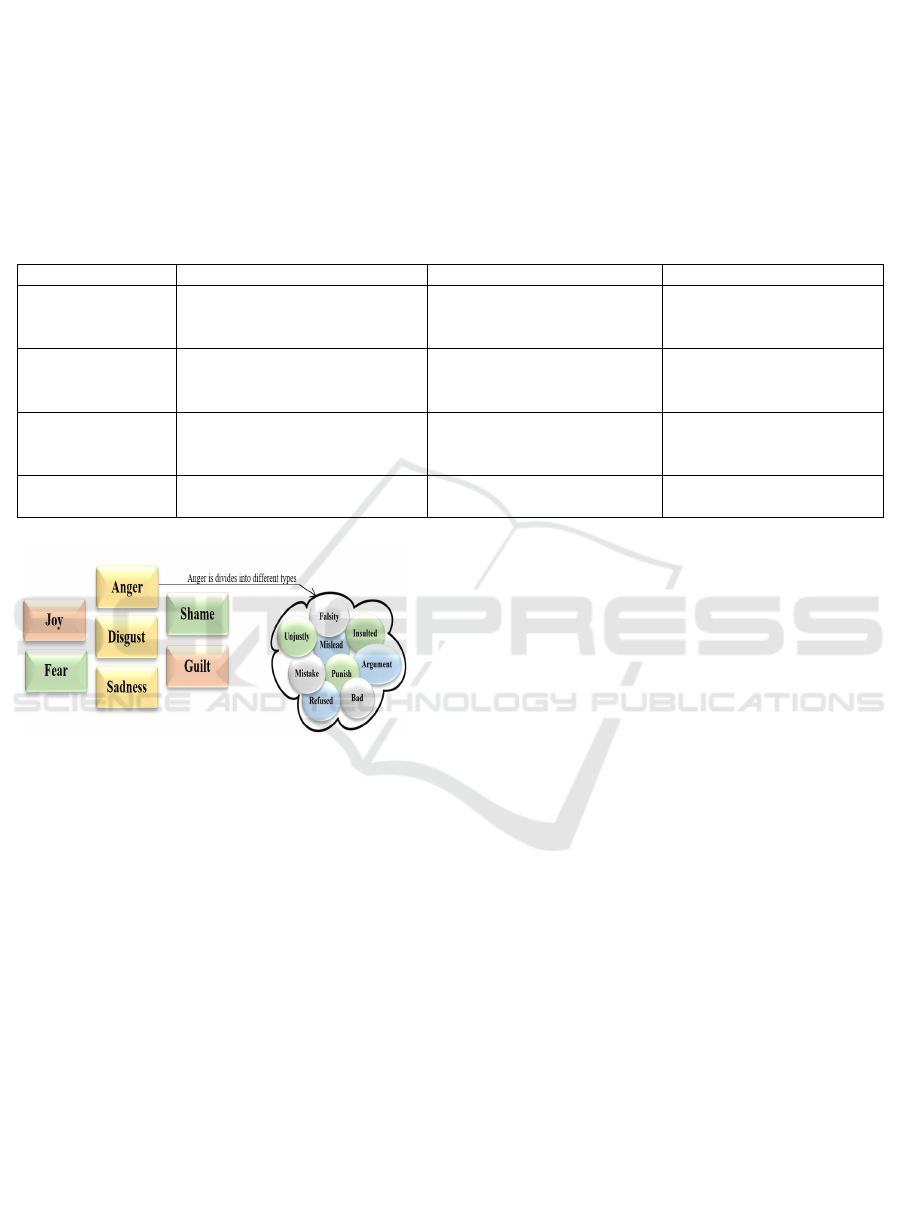
the classifier. Table 2 shows the detail description of
ISEAR dataset and figure 1 depicts the types of anger
based on the graphical representation of emotions
from ISEAR dataset.
Table 2: Detail description of the ISEAR dataset. (Source: author).
Citation Variet
y
Ex
p
lanation Real-world Pertinenc
y
[2]
Various settings for eliciting
emotions are modeled
Assumed to be high because
of the construction of the
co
g
nitive-emotive
Relevant to cognitive
systems that simulate
emotions
[3]
Moderate, encompassing
fundamental feelings
Manual annotation with
distinct emotional descriptors
Helpful for classifying
emotions using logistic
regression
[4]
High, based on many web
sources
High, utilising methods for
supervised ML
Appropriate for identifying
feelings in a variety of web
material
[5]
Various conditions for eliciting
emotions are modelle
d
High, making use of BERT's
a
p
titudes
Efficient at recognising
emotions from text
Figure 1: Graphical representation of the emotions in
ISEAR dataset.
Among the many uses for the dataset in Adoma et al.
2020 is the assessment of machine learning models
for emotion categorization. This dataset is ISEAR,
consisting of 7666 sentences labeled for seven
emotions. By making the dataset balanced, training
and testing are possible without mitigation for class
imbalance. As such, this dataset will have several
preprocessing tasks such as tokenization or stop word
removal. Results from this study may be compared to
results from other studies in the same field,
particularly serving as a benchmark for future ED
studies with the application of ML models.
2.1.3 Speech Based ED
The audio-visual data in IEMOCAP dataset consists
of 12 hours, which contains data from 10 actors in 5
sessions. It contains data that was both improvised
and scripted, and it is divided into four emotional
classes: neutral, happy, sad, and angry. Three to four
assessors comment each utterance, and they award
labels by majority vote. This multimodal dataset
makes use of text, audio, and motion capture (Mocap)
information. Its vast nature and good quality make it
extremely important to research on ED. Using the
IEMOCAP dataset, research by Tripathi and Beigi
focuses on multi-modal emotion identification. This
dataset allows neural network models for robust
emotion recognition to be trained and evaluated. It
consists of a variety of audio, video, and text data
from dyadic interactions. The 1440 audio-only WAV
files in the RAVDESS Emotional Speech Audio
dataset have a sampling rate of 16 bits @ 48 kHz.
Recorded in a neutral North American accent, it
contains 24 professional actors 12 female, 12 male
delivering lexically-matched phrases. Emotions
manifest at two intensity levels (normal and strong),
with a neutral expression in between. Calm, pleased,
sad, furious, afraid, surprised, and disgusting are
among the emotions. The RAVDESS dataset has
been widely used in recent research to improve voice
emotion recognition techniques. Table 3 displays the
Comparison of the four datasets based on Speech
based ED type.
Selection of Dataset for Emotion Detection with Respect to Federated Learning
595

Table 3: Comparison of the Four Datasets Based on Speech Based Ed (Source: Author).
Dataset IEMOCAP RAVDESS CREMA-D EmoDB
Explanation Emotion speech database
Emotional speech
audio
Emotional speech Emotional speech
Source
USC Institute for
Creative Technologies.
Ryerson Audio-
Visual Database of
Emotional Speech
Crowd-sourced
Technische
Universität Berlin
Contributors 10 actors 24 actors 91 actors 10 actors
Reactions
Anger, Happiness,
Sadness, Neutral,
Surprise, Frustration,
Excitedness, and Fear.
Calm, Happy, Sad,
Angry, Neutral,
Fearful, Disgust,
Surprised.
Angry, Disgusted,
Fear, Happy,
Neutral, Sad,
Surprise
Anger, Boredom,
Disgust,
Anxiety/Fear,
Happiness, Sadness
A varied dataset called CREMA-D has 7,442 original
audio clips with 91 performers representing a range
of demographics (48 men and 43 women, ages 20 to
74, and different races). Twelve standardized words
representing six different emotions Anger, Disgust,
Fear, Happy, Neutral, Sad across four intensity ranges
Low, Medium, High, and Unspecified were uttered
by each actor. This dataset has a broad demographic
representation and is used for voice emotion
recognition research.
An innumerable of research into emotion
recognition depends on the CREMA-D dataset.
Shahzad et al. utilize CREMA-D for multi-modal
deep learning, where text and audio inputs are fused
to capture complex emotional expressions. The
variation of this dataset substantially enhances model
generalization across different modalities and thereby
improves both the accuracy and the system's
robustness in recognizing emotions.
The EMODB database developed by the Institute
of Communication Science at the Technical
University of Berlin which is an open-source German
emotional database. It contains 535 utterances from
ten professional speakers five of whom are male and
the other five are female. The seven emotions covered
by this database are: neutral, disgust, happiness,
sorrow, anxiety, anger, and boredom. The data was
down-sampled to 16 kHz for standardization after
being initially captured at a 48 kHz sampling rate.
2.1.4 Facial Recognition-Based ED
Another The process of facial recognition-based ED
trains algorithms to recognize human emotions from
facial expressions using datasets like the Extended
Cohn-Kanade Dataset (CK+) , the Facial Expression
Recognition 2013 (FER2013), the Multimodal
Database of Emotionally Salient Stimuli (MMI), the
Japanese Female Facial Expression (JAFFE) Dataset,
and the Affect Net Dataset. Labeled datasets for
posed and naturalistic expressions are provided by
CK+ and FER2013. MMI offers audio-visual signals
for analyzing emotions, and JAFFE offers insights
through the expressions of Japanese women.
The CK+ dataset includes 920 photos that have been
modified and taken from the original CK+ dataset.
These pictures have been pre-processed using the
`haarcascade_frontalface_default’ method to provide
standard 48x48 pixel grayscale dimensions and face
cropping. A Haar classifier was used to filter noisy
images that were impacted by things like skin tone
fluctuations, hair artifacts, and room illumination in
order to improve clarity and identification. The
dataset is organized into three columns for each entry:
pixel values (2304 per image), emotion label (which
has predefined indices for various emotions), and
usage classification into three categories: training
(80%), public test (10%), and private test (10%).
Table 4 shows the Demonstration of the CK+ dataset
and the number of samples.
Table 4: Demonstration of the CK+ dataset and the number
of samples (Source: Author).
Types of Emotions in CK+
dataset
Number of
Samples
Ange
r
45
Dis
g
ust 59
Fea
r
25
Ha
pp
iness 69
Sadness 28
Surprise 83
Neutral 593
Contem
p
t 18
The FER2013 dataset, which includes approximately
35,000 grayscale photos classified into seven
emotional categories anger, disgust, fear, pleasure,
ICRDICCT‘25 2025 - INTERNATIONAL CONFERENCE ON RESEARCH AND DEVELOPMENT IN INFORMATION,
COMMUNICATION, AND COMPUTING TECHNOLOGIES
596

sorrow, surprise, and neutral is used for FER. It was
chosen specifically for use in FER task training and
evaluation models. Every image of 48x48 pixels is
labeled with different emotion categories.
Researchers frequently utilize FER2013 to
benchmark algorithms for applications involving
computer vision and emotion identification. A
number of DL-based facial ED studies are thus
heavily reliant on the FER-2013 dataset. By
incorporating audio, visual, and textual modalities,
the Multimodal Emotion Lines Dataset (MELD)
builds upon the Emotion Lines dataset. It features
numerous speakers and more than 1,400 lines and
13,000 utterances taken from the Friends television
series. Every word is annotated both with sentiment
positive, negative, or neutral along with an emotion:
Anger, Disgust, Sadness, Joy, Neutral, Surprise, or
Fear. The dataset includes 213 TIFF-formatted, high-
resolution grayscale pictures of 10 Japanese female
expressers wearing 7 posed facial expressions,
including neutral. Every expression has different
photos from each expresser, for a total of many
images per emotion. It contains 60 Japanese viewers
averaged semantic judgments of six different face
expressions. Table 5 shows the Comparison of the
five datasets based on the Facial recognition-based
ED.
Table 5: Comparison of the five datasets based on the facial recognition-based ED (Source: Author).
Dataset CK+ [10] FER2013 MMI JAFFE AffectNet
Source Kaggle Kaggle Kaggle Kaggle Kaggle
Determination FER FER ED FER FER
Quantity of
Images
593 35,887
18,000 (video
frames)
213 1,000,000+
Image Category Grayscale, posed
Grayscale,
posed
Video frames
(multimodal)
Grayscale,
posed
RGB, diverse
Resolution Various 48x48 pixels Various 256x256 pixels Various
Reaction types
8 (fear, anger,
disgust, surprise,
contempt,
happiness, neutral,
sadness)
7 (fear, angry,
surprise,
disgust, happy,
neutral, sad)
7 (anger, fear,
surprise,
disgust, sadness,
neutral,
happiness)
7 (disgust,
anger, sadness,
happiness,
neutral, surprise,
fear)
8 (fear,
neutral,
surprise,
happy, anger,
sad, contempt,
disgust)
Notation FACS action units
Crowd-sourced
labels
Video-based
labels
Human labeled
Crowd-
sourced labels
2.1.5 Highly Used Datasets in ED
A wide range of datasets specialized to various
modalities, including text, speech, and video, are
extremely beneficial to emotion recognition research.
Every dataset has a unique function: SemEval-2018
task 1 employs labelled tweets for text-based emotion
analysis, whereas IEMOCAP offers emotional
annotations in voice scenarios. For tasks involving
the recognition of emotions in videos, Emo React is
perfect because it comes with annotated clips that
cover a wide range of emotions. MELD facilitates
study into multimodal emotion comprehension by
integrating emotion labels with textual dialogues
from the Friends TV series. Emo Bank provides
dimensional emotion rankings that are taken from
blog sentences and social media, which gives a
distinctive viewpoint. The versatility of SEMAINE's
records, which allow for the examination of
emotional states in text, video, and audio modes, is its
main strength. These varied datasets are essential for
creating and assessing ED models, which advances
NLP and affective computing. Federated learning is
the most common approach for emotion detection
because it maintains decentralized data, improves
model robustness by utilizing a variety of data
sources, and facilitates collaboration among
dispersed clients without jeo pardising sensitive data.
The figure 2 shows some challenges in ED Dataset.
Selection of Dataset for Emotion Detection with Respect to Federated Learning
597

Figure 2: Challenges in Ed Dataset.
2.2 Federated Learning
FL is a decentralized ML technique that uses local
input and allows several devices or edge servers to
cooperatively train a common model. Local
computation and aggregates are used to compute
model changes rather than transferring data to a
central server. This lowers communication costs
while protecting user privacy. FL comes extremely
handy in situations like healthcare, IoT, and mobile
applications when there are several, diverse datasets
dispersed over various places. It solves problems like
connectivity problems and data privacy laws, making
it appropriate for applications needing customised
models without sacrificing the confidentiality of
individual data.
2.2.1 Federated Learning: Dataset
Necessities
In FL, datasets must meet requirements for effective
and secure decentralized model training by ensuring
privacy and security through encryption and secure
aggregation techniques. Differential privacy adds
noise to data or model updates to protect against re-
identification. Following FL protocols like Federated
Averaging (FedAvg) shares only model parameters,
not raw data, during updates. Handling data
heterogeneity in FL involves addressing non-
independent and identically distributed data with
personalized models, data clustering, or federated
transfer learning. Robust aggregation techniques like
Trimmed Mean, Median or Krum help manage
outliers or skewed data distributions. To enhance
model performance, adaptive learning rates make
adjustments in response to data heterogeneity.
Protocols adapting to network conditions reduce
communication overhead and transmission
frequency. Scalability in FL supports a large number
of devices by distributing workload, using
hierarchical FL with local coordinators, and
employing efficient resource management and load
balancing techniques. Addressing these requirements
enables effective leveraging of decentralized datasets
while maintaining privacy, handling data
heterogeneity, ensuring communication efficiency,
and scaling to support numerous devices.
2.2.2 Analysis of the Federated Learning ED
Dataset
FL analyses datasets dispersed across several devices
without centrally aggregating them, particularly in
emotion recognition tasks. This method allows for
cooperative model training while continuing data
privacy. Assuring data consistency across
heterogeneous sources, controlling device
heterogeneity, and addressing potential biases
generated by different data distributions are some of
the key issues in analyzing such datasets. These
difficulties are lessened by FL, which permits local
model updates on every device. These changes are
then combined to improve a global model without
requiring the raw data to leave the devices.
Preprocessing stages include data normalization,
feature extraction and maybe data augmentation to
improve model generalization in order to analyze
such datasets successfully. Recurrent neural networks
(RNNs) for sequential data, such as text or time-series
physiological signals, or CNNs for image-based
emotions are examples of ML models appropriate for
FL in ED. To sum up, in order to analyze ED datasets
for FL, it is necessary to undertake thorough
preprocessing, choose suitable models, and pay close
attention to privacy and performance measures that
are specific to distributed learning settings.
2.2.3 Problems in FL Dataset Selection
Making sure datasets abide with privacy laws like the
GDPR and getting consent from data owners to use
and share their information safely in FL. In FL,
striking a balance between a variety of representative,
heterogeneous data sources and preserving data
quality and schema uniformity throughout all
involved clients. Collaborative learning: identifying
and reducing biases to guarantee fair model
performance across many demographic groups.
Managing the communication overhead associated
with FL as well as restrictions on the processing,
memory, and storage capabilities of client devices. FL
ICRDICCT‘25 2025 - INTERNATIONAL CONFERENCE ON RESEARCH AND DEVELOPMENT IN INFORMATION,
COMMUNICATION, AND COMPUTING TECHNOLOGIES
598

frequently involves handling identically dispersed
and non-independent data in an efficient manner to
provide reliable model training. Ensuring sure
datasets may be split and distributed among numerous
clients in an efficient manner while preserving
successful training.
3 CONCLUSIONS
Choosing an appropriate dataset for ED is essential to
developing dependable, widely applicable models
that preserve anonymity. Datasets like ISEAR,
IEMOCAP, RAVDESS, CREMA-D, EmoDB, CK+,
FER-2013, MMI, JAFFE, AffectNet, SemEval-2018,
and SEMAINE provide a great variety of modalities:
text, audio, and facial expressions. These datasets
form the basis for an in-depth study of emotion
recognition. For example, more insightful audio
samples into very emotional speech come forth from
IEMOCAP and RAVDESS, whereas the ISEAR
dataset is rich with textual data in terms of emotional
responses. Again, some of these datasets are focused
on facial expressions relevant to visual ED, such as
FER-2013, CK+, and JAFFE. These datasets can be
used by several clients due to the fact that FL is
innately distributed, which will not risk user privacy
and promote data diversity in order to increase model
performance. Comprehensively including multi-
modal datasets ensures an all-round approach in
emotion identification to improve the accuracy of
capturing the complexity of human emotions.
However, class disparities should be dealt with and
the databases should represent real situations. FL can
significantly advance the science of ED by thoughtful
selection and class balancing of these datasets, so that
more morally correct applications be derived in health
and other fields that are more personalized. Future
applications of emotion detection with FL include
promising enrichments of human-machine
interactions and protections of the privacy of users.
This develops in terms of multimodal integration,
privacy, scalability, cultural diversity, and real-time
applications.
REFERENCES
Adoma, A.F., Henry, N.M., Chen, W. and Andre, N.R.,
December. Recognizing emotions from texts using a
bert-based approach. In 2020 IEEE 17th International
Computer Conference on Wavelet Active Media
Technology and Information Processing (ICCWAMTI
P), (2020) 62-66.
AffectNet Dataset: https://www.kaggle.com/datasets/ngot
hienphu/affectnet
Alotaibi, F.M., Classifying text- based emotions using logi
stic regression. VAWKUM Transactions on Computer
Sciences, 7(1), (2019) 31-37.
Asghar, M.Z., Subhan, F., Imran, M., Kundi, F.M.,
Shamshirband, S., Mosavi, A., Csiba, P. and Varkonyi-
Koczy, A.R., Performance evaluation of supervised
machine learning techniques for efficient detection of
emotions from online content. arXiv preprint
arXiv:1908.01587 (2019).
CK+ Dataset: https://www.kaggle.com/datasets/davilsena/
ckdataset
CREMA- D Dataset: https://www.kaggle.com/datasets/ejl
ok1/cremad
EmoDB Dataset: https://www.kaggle.com/datasets/piyush
agni5/berlin-database-of-emotional-speech-emodb
FER2013 Dataset: https://www.kaggle.com/datasets/msa
mbare/fer2013/code
G. K. J. Hussain and G. Manoj, Federated Learning: A
Survey of a New Approach to Machine Learning, 2022
First International Conference on Electrical, Electronic
s, Information and Communication Technologies (ICE
EICT), Trichy, India, (2022) pp. 1-8.
IEMOCAP Dataset: https://www.kaggle.com/datasets/sa
muelsamsudinng/iemocap-emotion-speech-database
JAFFE Dataset: https://www.kaggle.com/code/mpwolke/j
apanese-female-facial-expression-tiff-images
Jain, S. and Asawa, K., Modeling of emotion elicitation
conditions for a cognitive- emotive architecture. Cogn
itive Systems Research, 55, (2019) 60-76.
MMI Dataset: https://kaggle.com/datasets/zaber666/meld-
dataset
RAVDESS Dataset: https://www.kaggle.com/datasets/uw
rfkaggler/ravdess-emotional-speech-audio
Selection of Dataset for Emotion Detection with Respect to Federated Learning
599
