
Sensor-Based Safety Helmets: IoT Innovations for Crash Prevention
and Rider Protection
S. Karuppusamy, Sethupathi R, Sudharsan C. N and VimalSiva A
Department of Computer Science and Engineering, Nandha Engineering College, Erode, Tamil Nadu, India
Keywords: Smart Helmet, Alerting, Proactive Protection, Safety, Emergency Response.
Abstract: The purpose of this project is to improve motorcycle safety through state-of-the-art IoT integrated smart
helmets. Drivers must wear helmets to enable security features. As soon as an accident occurs, the system
immediately recognizes the effect and sends an emergency response. SOS services, nearby emergency
vehicles and up to 5 registered trustworthy people will be automatically alerted. The helmet provides
security before unauthorized use, as it is not permitted to start the engine when the vehicle carries it. The
application forces the helmet to counter the occurrence of a fatal injury. This security solution promotes
proactive protection and ensures a rapid rescue process. Individual drivers benefit a lot as they ensure that
someone is on the way to save themselves, even without a bystander to provide help.
1 INTRODUCTION
Motorcycle accidents, which account for a majority
of serious injuries and deaths worldwide, are
typically caused by slow emergency response and a
lack of protective gear. In view of all these issues,
this work will design smart helmets (Jesu doss A. et
al. 2019. integrated with IoT for driver’s safety. The
helmet has sensors that react instantaneously to
accidents and trigger automatic emergency
responses. Immediately send alerts to SOS services,
ambulances surrounding the setting of the collision,
and up to five registered contacts of the victim to
ensure instant access to medical assistance in an
event of a road traffic accident. Such automated
response systems can help mitigate injury and
enhance survival odds. Another intelligent helmet
capable of accident detection that does more than
accident detection it's also management in the parts
helmet and will not start the motorcycle machine.
Due to its simplicity and efficiency, Yolo model is
generally used for real-time object detection tasks.
Unlike other methods that use complex pipelines or
multiple machining stages, Yolo predicts class
probabilities and bounding boxes directly from the
entire image in a single forward pass through the
network. Besides reducing computing efforts, this
mode drives deeper real-time proficiencies. With
each new publication.
This helps maintain that security protocols are
provided 24/7 and reduces the risk of head injuries
that can prove fatal. The GPS prosecution also gives
responders the ability to pinpoint accurate scenes of
the accident, resulting in even more efficient
rescues. This system is particularly beneficial for
individual drivers as it guarantees instant assistance
even for the viewers. This smart helmet provides
predictive security solutions to make your
motorcycle trip safer by incorporating IoT
technology.
2 LITERATURE STUDY
In the last few years the generation of smart IoT-
based helmets has been an area of main attention in
research. Jesu Doss et al. Smart Helmet to Avoid
Accident (2019) that suggested using real-time
monitoring systems to protect riders. Likewise,
Mehata et al. developed an automated IoT-based
helmet for monitoring safety and health for workers
that included a data logging algorithm to monitor
safety parameters at the site. In the field of
transportation, Divyasudha et al. (IEEE) devised a
smart IoT-enabled low-cost helmet that prevents
accidents and increases emergency response. Due to
various other innovations in smart helmet
technology, Uniyal et al. researched and proposed an
Karuppusamy, S., R., S., N., S. C. and A., V. S.
Sensor-Based Safety Helmets: IoT Innovations for Crash Prevention and Rider Protection.
DOI: 10.5220/0013917000004919
Paper published under CC license (CC BY-NC-ND 4.0)
In Proceedings of the 1st International Conference on Research and Development in Information, Communication, and Computing Technologies (ICRDICCT‘25 2025) - Volume 4, pages
569-573
ISBN: 978-989-758-777-1
Proceedings Copyright © 2026 by SCITEPRESS – Science and Technology Publications, Lda.
569
IoT-based system with a data logging mechanism
where it can log the activities of the rider and
environmental conditions.
Shabbeer and Meleet (2017) proposed smart
helmet based on which the system can detect the
accident and gives the alert message for providing
help in emergencies. Roja and Srihari (2018)
brought smart helmet applications to the mining
industry by developing a helmet that monitors air
quality, preventing exposure of workers to
hazardous conditions. Similarly, Behr et al. (2016),
focused on detecting hazardous events in mines to
provide real time alerts to improve the safety of a
worker. In addition to accident prevention and
environmental surveillance, Chandran et al. revolves
around Konnect, an IoT-enabled smart helmet
specifically designed to sense and inform accidents
so as to generate auto-alerts towards emergency
services. Aree buddin and Manoj (2017) have also
extended the smart helmets concept to beyond a
single sensor for the safety of riders (Divyasudha N
et al.) and real-time observation. Finally, Archana et
al. engineered an overall safety comfort system
integrating various cutting-edge elements to promote
riders’ full security. Collectively, these studies
highlight the role of IoT technology in smart helmet
design and provide solutions that enhance user
safety through immediate emergency response,
environmental awareness, and accident prevention.
3 METHODOLOGY
The methodology used to develop the IoT-integrated
smart helmet system involves a thorough
requirement analysis and planning stage that defines
all the functional and non-functional requirements of
the system from surveys, stakeholder consultations,
and existing technology analysis. This is followed
by the system design, which defines high-level
requirements for hardware and software
components. Hardware design focuses on the
selection of (Divyasudha N et al.) sensors, including
accelerometer, gyroscope and GPS, (Manish Uniyal
et al.) integration of a microcontroller for processing
data, (Shoeb Ahmed Shabbeer et al.) and
implementation of a communication module (GSM
or Bluetooth).
The software design includes algorithms for
accident detection, an interface (application in app,
web based) to interact with the users, and a cloud-
based backend for security. It is also integrated with
security features like RFID or biometric
authentication to prevent unauthorized use. Then,
after assembling the hardware components, writing
firmware for the microcontroller, and integrating
with the mobile application and cloud backend, a
functional prototype is developed. The prototype is
subjected to extensive testing and validation in
simulated accident scenarios under different
environmental conditions to verify performance,
accuracy and reliability. The system is deployed
when validated for real-world use, including
partnerships to integrate it into motorcycle ignition
systems and collaboration with emergency services
to expedite SOS responses. It also trains users on
how to use both the smart helmet and the
accompanying app. After the deployment, the
system enters an ongoing phase of monitoring and
maintenance to handle false alarms, optimization of
algorithms, and updates based on users’ feedback
and technology advancements. Finally, evaluating
the impact of the project through data collection on
accident detection rates, response times, and user
satisfaction, and sharing findings to encourage the
widespread adoption of the system (Shoeb Ahmed
Shabbeer et al.). This approach is designed to result
in a strong, dependable, and easy-to-use solution for
preventing motorcycle accidents through preemptive
protection and quick emergency response.
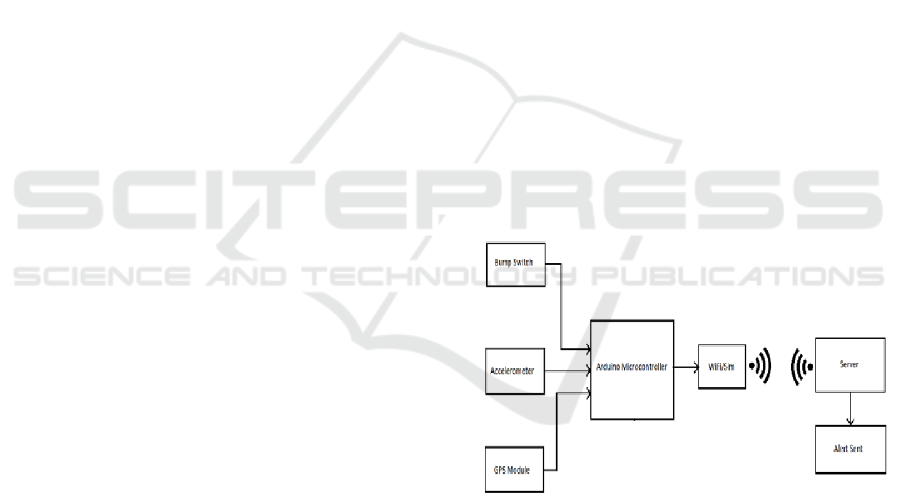
Figure1
shows Smart Helmet Accident Detection and Alert
System Architecture.
Figure 1: Smart Helmet Accident Detection and Alert
System Architecture.
4 SYSTEM IMPLEMENTATIONS
4.1 Hardware Requirements
4.1.1 Arduino Uno – Main controller
Arduino uno is a microcontroller board of
Electronics Project. It features 14 digital E/A pencils
(6 PWM), 6 analog inputs, and a 16-MHz-
ATMEGA328P chip It can use this to drive LEDs,
ICRDICCT‘25 2025 - INTERNATIONAL CONFERENCE ON RESEARCH AND DEVELOPMENT IN INFORMATION,
COMMUNICATION, AND COMPUTING TECHNOLOGIES
570
read sensors, iterate electrical engines, and create
IoT devices. MikroC for PIC Microcontroller
Programming. (Example: On pin 13, the LED will
blink. Power supply through USB (5 V) or external
(7°12 V). AT I2C, SPI or daisy-chain sensor to
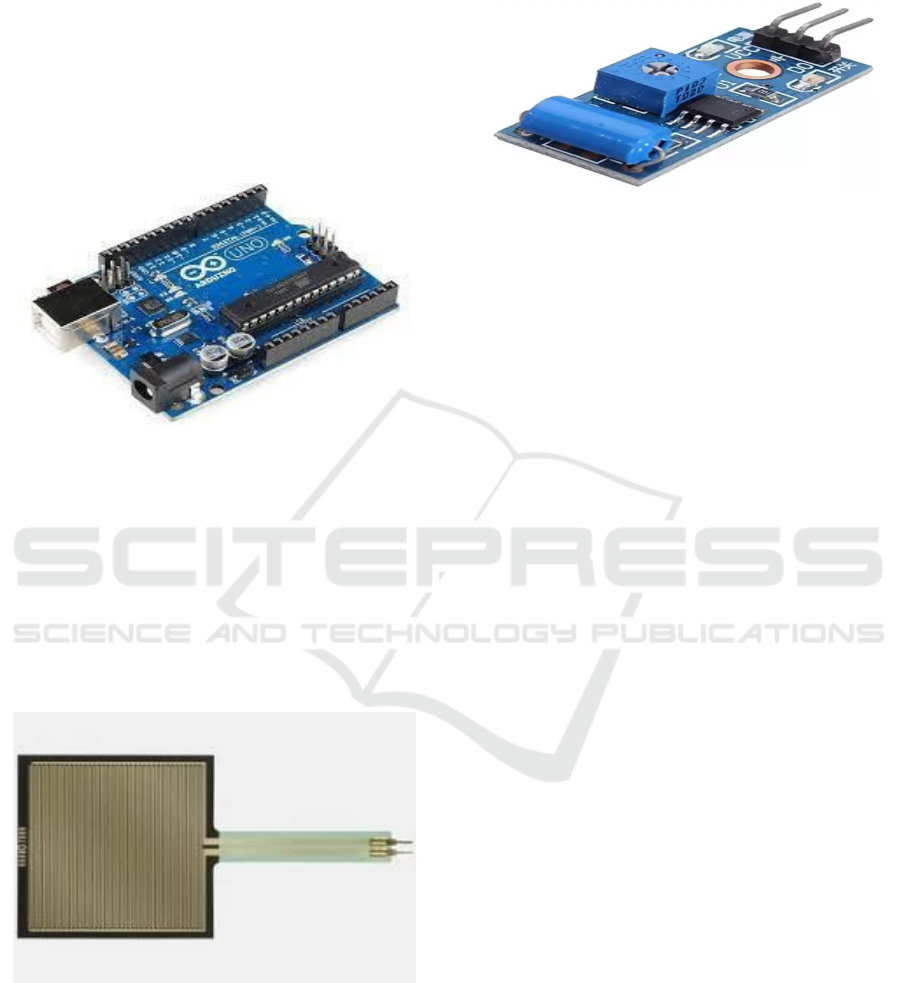
consult. Ideal for novices and experts alike. Figure 2
shows Arduino Uno. It is utilized for robotics,
automation, and prototyping. 5- More than 500 mA
shall not be drawn from the pin. Starting small
projects and moving to complex ones.
Figure 2: Arduino Uno.
4.1.2 FSR
The FSR (force sensing resistor) is used to sense the
physical pressure, squeezing. Their power
consumption is less. They are used for most touch
sensitive applications. They are low cost and less
weight. This sensor (figure 3) is configured with the
NodeMCU, then the data is being transmitted to the
cloud.
Figure 3: FSR sensor.
4.1.3 Vibrating Sensor
Vibrating sensor: The vibrating sensor (figure 4) is
also known as a piezoelectric sensor, when a band of
frequency created by the vibrating sensor based on
vibration, it measures pressure, temperature,
acceleration, force. Particularly it measures force
and damped vibration.
Figure 4: Vibrating Sensor.
4.2 Software Requirements
4.2.1 Arduino IDE
Arduino IDE is a free, open source software that is
used to write, compile and upload code to an
Arduino board. It is implemented by writing
program in C/C++ language. Now we collect the
errors and verify the code. Then upload the code to
your Arduino board. Or you can also use a serial
monitor to spy on the output and debug the program.
You will have the option to import libraries to give
your code even more functionality. Just select the
correct board type and the corresponding port and
you are good to go!
4.2.2 GSM Module
A GSM modem is a hardware device that enables
you to send and receive data, SMS, and voice calls
using a mobile phone connection. Connect GSM
modem to your computer/device using a USB cable
or serial connected. Install any required drivers and
software. Set modem on your mobile network like
APN, username, password, etc. Command to Send &
Receive SMS, Voice Calls, and Data It also enables
you to send and retrieve files, emails, and other data.
GSM modems are used in remote monitoring,
automation, and IoT projects. Ensure that your
modem has an active SIM card and mobile phone
signal
5 RESULT
IoT and intelligent helmets in the two-wheel safety
system increase the safety of the driver in the event
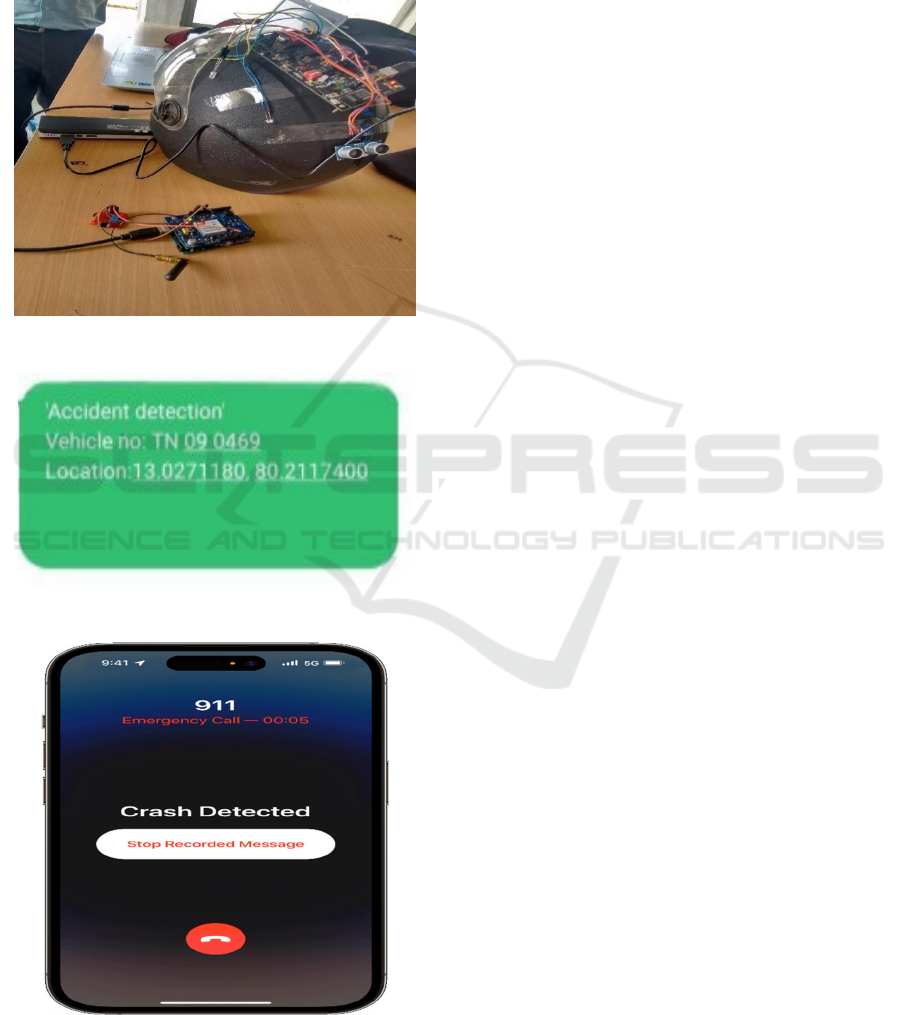
of an accident and avoid injury. Figure 5 shows End
Module. The accident is detected by checking the
comparison between the helmet binding and
Sensor-Based Safety Helmets: IoT Innovations for Crash Prevention and Rider Protection
571
predefined limits. The system sounds an alert or
takes a security measure if the tilt corresponds to a
fall in the helmet. Its innovative solution is based
only on the driving's behavior and becomes a trusted
and trusted security mechanism. Figure 6 and figure
7 shows Output interface.
Figure 5: End Module.
Figure 6: Output interface.
Figure 7: Output Interface.
6 CONCLUSION & FUTURE
ENHANCEMENT
To sum up, Two Wheel safety system is a
remarkable innovation in driver safety project
integrated into a smart helmet. The actual time data
as well as the tilt value is used to determine if an
accident has occurred, based on whether or not the
helmet button passes the predefined threshold. You
will write this to trigger immediate alerts or actions,
so that you are notified quickly. You don't have to
worry about carrying it if you are not driving or
without using the service. The latest design also
aims to minimize bike and motorcycle injuries and
overall road safety. With advanced IoT technology
along with some functional security features, this
intelligent helmet system solution is not only an
efficient way to avoid accidents but also acts as a
safety net for the riders. This is a hopeful move
towards making the streets safer and the risk of
travelling on two wheels lower.
Future updates for the smart helmet system
include AI analytics either to predict accidents
through riders' behavior and which can be read by
the helmet, avoiding potential accidents. Low-power
sensors providing constant functioning can be
motivated by solar charging or enhanced battery
efficiency. Voice and gesture commands integration
will allow hands-free operation of safety features for
improved convenience. A self-locking safety helmet
is another solution that can be integrated. When the
rider wants to start the bike, this mechanism would
be locked with the ignition system of the bike, and to
start it, the rider must put on the helmet, enhancing
safety and ensuring compliance. These capabilities
will make the system more intelligent, more efficient
and more user friendly.
REFERENCES
Jesu doss A, Vybhavi R, Anusha B “Design of Smart
Helmet for Accident Avoidance” International Confer
ence on Communication and Signal Processing, April
4-6, 2019, India.
K.M.Mehata, S.K.Shankar, Karthikeyan N, Nandhinee K,
Robin Hedwig P “IoT Based Safety and Health
Monitoring for Construction Workers. Helmet System
with Data Log System” International Conference.
Divyasudha N,Arulmozhivarman P,Rajkumar E.R
“Analysis of Smart helmets and Designing an IoT
based smart helmet: A cost effective solution for
Riders” @IEEE.
Manish Uniyal, Manu Srivastava, Himanshu Rawat, Vivek
Kumar Srivastava “IOT based Smart Helmet System
ICRDICCT‘25 2025 - INTERNATIONAL CONFERENCE ON RESEARCH AND DEVELOPMENT IN INFORMATION,
COMMUNICATION, AND COMPUTING TECHNOLOGIES
572

with Data Log System” International Conference on
Advances in Computing, Communication Control and
Networking.
Shoeb Ahmed Shabbeer, MerinMeleet “Smart Helmet for
Accident Detection and Notification”2
nd
IEEE Internat
ional Conference on Computational Systems and Infor
mation Technology for Sustainable Solutions 2017.
P.Roja, D.Srihari “IOT Based Smart Helmet for Air Qualit
y Used for the Mining Industry” @IJSCRT 2018
C. J. Behr, A. Kumar and G.P. Hancke“ASmart Helmet for
Air Quality and Hazardous Event Detection for the
Mining Industry”@IEEE2016.
Sreenithy Chandran, Sneha Chandrasekar, Edna Elizabeth
N “Konnect: An Internet of Things (IoT) based Smart
Helmet for Accident Detection and Notification.
Mohammed Khaja Areebudd in Aatif,Ainapurapu Manoj
“Smart Helmet Based On IoT Technology”@IJRASET
2017.
Archana.D, Boomija.G, Manisha.J, Kalaiselvi.V.KG “Mis
sion On! Innovations in Bike Systems to Provide a
Safe Ride Based.
N. Manjesh., Sudarshan Raj, Smart Helmet using GSM &
GPS Technology for Accident detection and Repo
rting System, International Journal of Electrical an
d Electronics Research, 2 (2014) 122-127.
Abhinav Anand, Alcoholic detection, Department of
Electronics and Telecommunications, IJEETC, 2015.
M. K. A. M. Rasli, N. K. Madzhi, J. Johari, (2013) Smart
Helmet with Sensors for Accident Prevention, In 2013
International Conference on Electrical, Electronics
and System Engineering (ICEESE), IEEE, 21-26.
V. Krishna Chaitanya, K. Praveen Kumar, (2013) Smart
helmet using arduino, Hyderabad,
R. Prudhvi Raj, Ch. Sri Krishna Kanth, A. Bhargav
Aditya, K. Bharath, Smart tec Helmet, Advance in Ele
ctronic and Electric Engineering, 4 (2014) 493-498,
M. Penta, M. Jadhav, P. Girme, Bike Rider’s Safety Using
Helmet, International Journal of Electrical and
Electronic Engineering & Telecommunications, 4
(2015) 37-44.
N. James, C. Aparna, T. P. John, Alcohol Detection
System, International Journal of Communication and
Computer Tchnologies, 3 (2014) 59-64.
R. Nazir, A. Tariq, S. Murawwat, S. Rabbani, Accident
Prevention and Reporting System Using GSM (SIM
900D) And GPS (NMEA 0183), International Journal
Communications, Network and System Sciences, 7
(2014) 286-293.
E.D. Bekiaris, A. Spadoni, S.I. Nikolaou, (2009) New
Safety and Comfort in Powered Two Wheelers, In
2009 2nd Conference on Human System Interactions,
IEEE, 600-602.
M. Pieve, F. Tesauri, A. Spadoni, (2009) Mitigation
Accident Risk in Powered Two Wheelers: Improving
Effectiveness of Human Machine Interface Collision
Avoidance System in Two Wheelers, In 2009 2nd
Conference on Human System Interactions, IEEE,
603-60.
Sensor-Based Safety Helmets: IoT Innovations for Crash Prevention and Rider Protection
573
