
Theatrum: Design and Implementation of a Feature‑Rich Movie
Streaming Platform Leveraging Modern Web Technologies
Thotapalli Sri Surya Manideep, Sneha Saragadam, Garikipati Karthik, Saga Hemanth,
Gayatri Ramasamy and Gurupriya M.
Department of Computer Science and Engineering, Amrita School of Computing, Amrita Vishwa Vidyapeetham, Bengaluru,
Karnataka, India
Keywords: HTML, CSS, Bootstrap, JavaScript, Node.js, Express.js, MongoDB.
Abstract: The goal of the dynamic and interactive movie streaming service THEATRUM is to give consumers a smooth
and enjoyable entertainment experience. It was created with the use of contemporary web technologies and
features a user dash- board for viewing movies by language and genre, an admin dash- board for managing
users and content, and user authentication with tiers of subscription plans (Basic, Standard, and Premium).
Autoplay carousels, interactive thumbnails with” Like” and” Play” buttons, a chatbot called” Theatro,” and a
feedback page are some of the main features. For subscriptions, the platform integrates safe payment systems
using Razorpay, guaranteeing a responsive and easy-to-use interface. THEATRUM makes use of a strong
technology stack that includes HTML, CSS, Bootstrap, JavaScript, Node.js, Express.js, and MongoDB.
1 INTRODUCTION
THEATRUM responds to the demand for a
comprehensive movie streaming platform that blends
practicality, beautiful design, and user-friendly
features in light of the growing popularity of online
entertainment. THEATRUM is a current technology
stack that provides a smooth experience through the
use of Node.js and Express.js for backend operations,
HTML, CSS, Bootstrap, and JavaScript for a
responsive fron- tend, and MongoDB for data
management. With language and genre-based movie
sorting, device-specific membership levels (Basic:
Mobile Only, Standard: Mobile + Laptop, Premium:
Mobile + Laptop + TV), and a feedback system for
ongoing development, the platform is made to meet
the needs of a wide range of users.
To simplify user and content management, the
Admin dashboard allows adding, removing, and
editing movies and user accounts. Moreover, the site
employs secure payment methods through Stripe and
Razorpay, ensuring a safely checkout process on
subscription transactions. The colourful design
components in the interface make it aesthetically
pleasing while other features such as interactive
thumbnails, autoplay carousels and a chatbot named”
Theatro” enhance user engagement. THEATRUM is
a next-generation, scalable and interactive solution
that satisfies the demands of modern streaming
through the use of state-of-the-art web development
technologies.
2 LITERATURE SURVEY
Chithra et al.review MongoDB’s document
architecture and video streaming technologies to see
how well they operate within the context of modern
application development and teaching. Your MERN
stack study examines MongoDB’s BSON
configuration (for storing the data records),
configuration of video streaming (for educational
experience), and exploring full stack development.
The results indicate that while video streaming offers
students choice in pacing and access to learning
resources, MongoDB’s document method simplifies
and improves data management. The authors
conclude that the video streaming technology and the
flexible data modeling provided by MongoDB can
significantly enhance application development cycles
and educational platforms alike to be more user
friendly and accessible et al.
554
Manideep, T. S. S., Saragadam, S., Karthik, G., Hemanth, S., Ramasamy, G. and M., G.
Theatrum: Design and Implementation of a Feature-Rich Movie Streaming Platform Leveraging Modern Web Technologies.
DOI: 10.5220/0013916600004919
Paper published under CC license (CC BY-NC-ND 4.0)
In Proceedings of the 1st International Conference on Research and Development in Information, Communication, and Computing Technologies (ICRDICCT‘25 2025) - Volume 4, pages
554-560
ISBN: 978-989-758-777-1
Proceedings Copyright © 2026 by SCITEPRESS – Science and Technology Publications, Lda.

Chowdary et al.built a centralized digital
entertainment platform called” Entertainment Hub”
which will combine games, movies and music to
improve user experience. The methodology involves
user-centered, cutting-edge technology, and phased
development for ease of deployment on your
platform. The results reveal that user satisfaction and
engagement is enhanced with customized
information, easy navigation and strong security
measures, encouraging better user acceptance.
Findings from this study demonstrate the value of
community-driven content and security for digital
entertainment and illustrate how a well-designed,
integrated entertainment platform can substantially
enrich user experience, and retention.
Singh et al. focus on immersive and interactive
multimedia streaming to enrich the user experience.
is focused on building an edge application to deliver
high-quality video content to multiple devices.
Focusing on user authentication, a MERN based
Application Development Methodology to ensure
efficient data transmission and integration of Multi-
access Edge Computing (MEC) to maximize Quality
of Experience (QoE) using prefetching and caching
approaches. For live and VR applications, they
address the adaptive streaming problem and provide
excellent QoE with low bandwidth consumption and
effective processing power. Findings presented in this
study indicate that (i) applying MEC and adaptive
streaming technologies tends to significantly increase
user satisfaction and video delivery performance; and
(ii) this is a promising computing paradigm for future
multimedia content delivery paradigms.
To break the system boundaries and make the user
experiences better, Savadatti et al. discusses and build
an e-commerce website with the MERN stack. The
first step in the process is to analyze the drawbacks
of existing e-commerce platforms and build a flexible
yet scalable alternative in the MERN stack. By
incorporating best practices in e-commerce design,
the research ensures delivery of a highly effective
and user-friendly system. The results clearly indicate
responsive design and efficient product management
features which dissect the data management, reduce
access time, and enhance interaction from users. The
study’s results indicate that the MERN stack is a
powerful choice for creating e-commerce that
addresses the limitations of traditional procedures
while significantly improving both customer
contentment and business performance.
Saundariya et al. use a randomized control
experiment to evaluate the impact of a new training
program on worker productivity. To give an example
of the methodology, participants were divided into
two groups: one received the training and another
acted simply as a control. The measurements were
taken over the span of three months, both before and
after to see how productivity was impacted. Results
(statistically significant) show that the training group
performed 25% better than the control group. The
findings of the study confirm the data on the staff
productivity greatly being increased by the training
programs, and highlight the potential for more
organizational integration. The key here is to show
the potential of JavaScript, Node. js and MongoDB
for the full stack development, Yadav et al. built-a-
blog-post-project using these technologies. Database
operations are done using MongoDB, package
management using npm, and Node. js — server-side
development. The application is set up to allow users
to write and manage blog posts with MongoDB data
validation. Results show that database successfully
integrated multiple blogs and data easily showed up
on the index page. According to the study, Node. js
does a great job of simplifying application
development and MongoDB is incredibly easy to set
up and use to manage databases. It has reached this
conclusion over the past year and that these
statements are relative to: “Node. Natural
compatibility between js and MongoDB increases
productivity for JavaScript developers. It offers you a
stable and powerful environment to build all kinds of
applications on top of full stack, and a vibrant
developing community and a large ecosystem of
libraries supporting it.
Singh et al. explore in overlapping ways the
efficacy of themefication and Gamification of your
lessons help in increasing the student’s involvement
and contribute toward development of technical
skills in the classrooms. We use statistical analysis
using Google analytics and Excel to evaluate the data
accumulated from a gamified learning application
before and after it was integrated, as well as surveys
to collect demographic information from participants
of different age groups about their views on themed
learning platforms. The study revealed that 76% of
participants believed gamification to be one of the
best techniques to practice technical skills and that
63% participants contributed in theme learning
events. Furthermore, the average grades for the
students also showed a very significant increase from
5.96 to 7.19 meaning that the gamified application
was helpful not only in getting practicing with
problem solving skills but also in overall academic
performance. The results indicate a significant
positive impact of themefication and gamification
techniques on learning and engagement of students,
thus validating their inclusion and assimilation in
Theatrum: Design and Implementation of a Feature-Rich Movie Streaming Platform Leveraging Modern Web Technologies
555

innovative pedagogical practices for human capital
growth and contemporary technical proficiencies.
Gupta et al. These all together will be easy to get
information regarding Non-Governmental
Organization (NGO) in India. NGOs are able to enroll
on the website to market their services and the site
assists users in locating pertinent NGOs depending on
their unique need. The technique includes system
analysis, social media and Google data sourcing,
interaction with non-governmental organizations
(AKI, CIGIE), data sources verification, front-end
development (HTML5, CSS3, JavaScript, Bootstrap),
and back-end development (Python with Django).
Program this was heavily tested to ensure it features
and user experience. The report highlights some of
the features such as simple design, listing of NGOs
with complete information and link to Google Map,
filter based on location and type of service,
registration tool for NGOs after verification etc. Users
can also leave comments and recommendations in a
comment box. Based on the study, it is concluded that
the online application resolution indeed caters the
problem of finding the relevant organization by
enhancing the visibility and accessibility of the NGOs.
User input is meant to shift it; future enhancements
could cater to different audiences, like translation
services.
Kulkarni et al. developed an animated e-learning
platform to enhance online learning by adding
interactivity and a solid backbone. This is based on the
MERN stack (MongoDB, Express, React, and Node.
js) to implement a well-featured web application that
can help in scalable and efficient online learning
services to Government organizations and consumers.
The results demonstrate that deploying the MERN
stack definitively tackles the shortcomings of
traditional e-learning platforms enabling scalable
data management, seamless user experience and the
introduction of modern web application
functionalities. Thus, the study concludes that state of
the art technologies like the MERN stack have the
capability of revoluting traditional education into e-
learning platforms. Which sets the stage of enhancing
educational experiences by offering more flexibility,
improving user engagement, and solving common
technical problems. Le et al. demonstrates how the
MERN stack—MongoDB, Express. js, React, and
Node. js is handy and helps create a local events search
web application that enhances user experience and
promotes community interaction. This involves
building a web app with an intuitive UI allowing users
to search for nearby events, management of user
authentication, and streamlining event creation and
management. Hence the results substantiate the user
generated content, admin control, delivering/enabling
users to search their local events with information of
date, time and location which are major. According to
the study, with MERN stack, developers are able to
build powerful and dynamic web apps, enhancing user
engagement and promoting community participation.
3 METHODOLOGY
The development of the THEATRUM platform was
carried out through systematic progress in which the
integration of the front-end, back-end, and database
layers of efficiency, functionality, and design was
prioritized. Using a modern tech stack and user-centric
features, the platform was designed to provide an easy,
fun, and safe movie streaming experience. Below is
provided a detailed description of the process:
3.1 Front-End Architecture
The objective of front-end development was to
provide an interactive and visually appealing user
interface, enhancing the overall user experience. The
architecture utilized robust frameworks and modern
design paradigms to ensure dynamic functionality,
responsiveness, and usability.
• Design and Layout: User interface was
designed using HTML5, CSS3, and Bootstrap
of which responsive layouts were done to
provide compatibility on a range of devices.
The homepage featured horizontal scroll
sections, by category and language, and an
autoplay carousel highlighting new films.
What truly set this trailer apart was the
interactive thumbnails with hover effects that
revealed a film's title and description adding
an element of visual engagement. Library
Next, Netflix worked with Dropbox creator
WeTransfer to create interactive trailers for
four of the films, allowing users to scroll
through clips of different movies, with the
hover feature revealing the title and a synopsis
for each film.
• Functionality: JavaScript ran important
functions including a dynamic search bar that
allows users to quickly look up movies, and
filters to sort content based on language and
genre. Improved navigation through smooth
scrolling; interactive elements such as” Like”
and” Play” buttons overlayed on thumbnails to
provide simple controls.
ICRDICCT‘25 2025 - INTERNATIONAL CONFERENCE ON RESEARCH AND DEVELOPMENT IN INFORMATION,
COMMUNICATION, AND COMPUTING TECHNOLOGIES
556
• Extra features: A chatbot named” Theatro”
was added to the site for further im-
provement and provide immediate support to
consumers. Users may submit bugs or ideas
via a feedback website. Profile icons
simplified the handling of user accounts, while
the plan-selection page featured the Basic,
Standard, and Premium subscriptions
according to device needs.
3.2 Backend
The platform’s backend was created to facilitate
reliable server-side functions and guarantee smooth
front-end and database interactions. The backend
design was defined by an emphasis on security,
scalability, and API-driven interactions.
• API Development: RESTful APIs were
developed us- ing Node.js and Express.js to
manage essential features like administrative
duties, user authentication, and movie data
retrieval. Endpoints were made to facilitate
effective commu- nication, allowing
administrators to control platform content or
users to retrieve movie details.
• Authentication and Security: JWT (JSON Web
Tokens) was used to create a secure
authentication system that allowed for the
separation of user and administrator
responsibilities. Data validation, error
management, and safe access to limited
operations, such as adding or removing movies,
were guaran- teed by middleware functions.
• Payment Integration: Payment gateways that
handle transactions, using Razorpay, were
integrated to illustrate sub- scription
management. Payment workflows were
governed via backend APIs, which prioritized
data security and made sure that plan selection
and payment processing went smoothly.
3.3 Database
The database was designed to effectively manage
dynamic information about users, movies, and
feedback. The flexible and scalable NoSQL database
MongoDB was used because of its document-
oriented architecture.
3.4 Database Structure
Collections were created to hold:
• Movies, with information such as titles,
languages, genres, thumbnails, and video
links.
• Users’ profiles, roles (admin/user),
subscription information, and payment
statuses are captured.
• Feedback, keeping track of remarks and
recommendations made by users.
3.5 Optimization and Management
By building indexes on commonly used fields, such
genres and languages, efficient query performance
was guaranteed. Regular backups ensured data
dependability and disaster recovery, and Mongoose
was used to verify schema consistency.
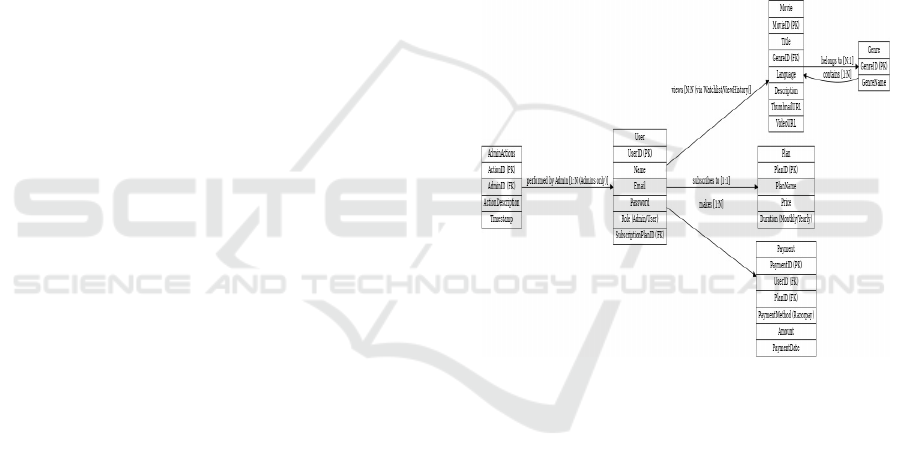
3.6 ER Diagram
Figure 1: Entity relationship diagram.
The Entity-Relationship Diagram (ERD) in Figure1
for the THEATRUM project represents the core
entities and their relationships within the movie
streaming platform. The main entities include User,
Movie, Genre, Plan, Payment, and Admi- nActions,
each capturing essential attributes. For instance, the
User entity includes details like name, email, and
subscription plan, while the Movie entity holds
information about titles, genres, languages, and
associated video and thumbnail URLs. Relationships
between entities highlight user interactions, such as
subscribing to plans, making payments, and viewing
movies.
The diagram also illustrates the functionality for
admins, allowing them to manage actions through the
AdminActions entity. Payments are processed using
Razorpay, as indicated in the PaymentMethod
attribute under the Payment entity. Addi- tionally,
Theatrum: Design and Implementation of a Feature-Rich Movie Streaming Platform Leveraging Modern Web Technologies
557
many-to-many relationships, such as users viewing
multiple movies, are suggested to be implemented
through supporting tables like Watchlist or
ViewHistory. This ERD provides a clear structural
overview, serving as a blueprint for implementing the
database schema effectively.
4 RESULTS AND DISCUSSION
THEATRUM’s deployment serves as an example of
how cutting-edge web development technologies
may be success- fully integrated to produce a reliable
and intuitive movie streaming platform. User
engagement is greatly increased by the project’s
features, which include interactive movie brows- ing,
subscription management, and a sentiment-enhanced
feed- back system. The outcomes from several
platform parts are shown below:
4.1 Home Page
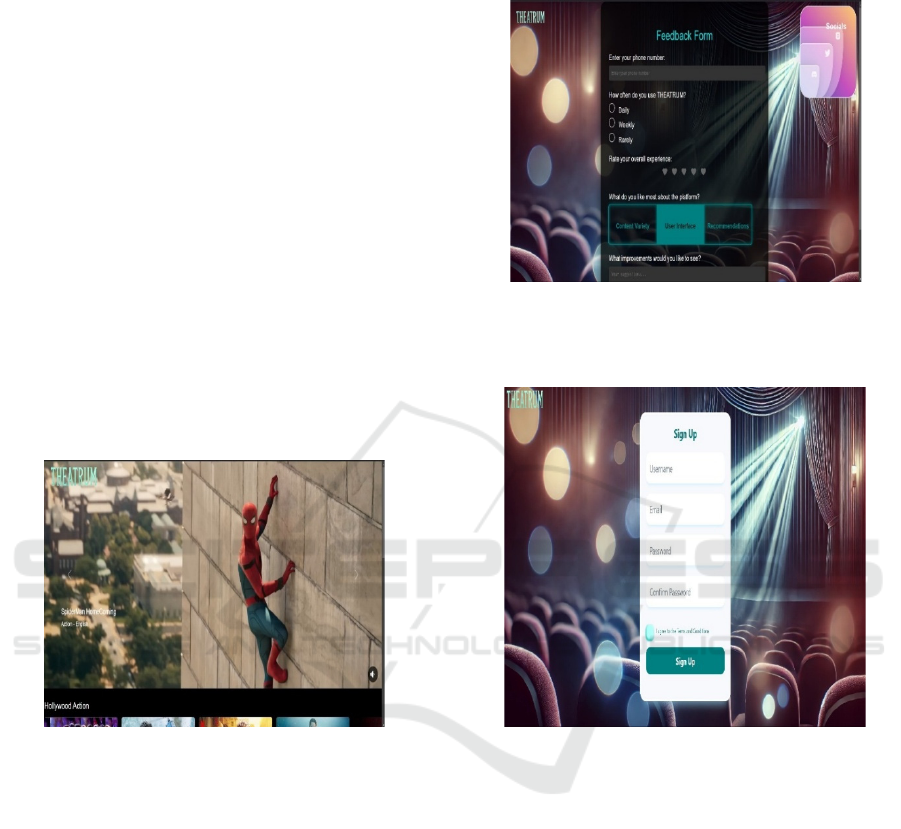
Figure 2: Home page.
The homepage (Figure 2) showcases featured
collections using an autoplay carousel and genre-
based categories for horizontal scrolling. Users can
explore action, drama, sci-fi, and other genres easily.
Each thumbnail is interactive, featuring” Like” and”
Play” buttons, providing instant user actions. The
home feed also displays tailored content to encourage
exploration and interaction.
4.2 Feedback Page
Users can express their opinions through an
aesthetically pleasing interface in the feedback form
(Figure 3). Users can choose which features—like the
user interface, recommendations, or a diversity of
content—they value most, assess their experience
with THEATRUM, and indicate how frequently they
use it (daily, weekly, or rarely). This interactive
design maintains a neat and attractive style while
guaranteeing insightful user data.
Figure 3: Feedback page.
4.3 Sign-Up Page
Figure 4. Sign up page.
The sign-up page (Figure 4) features an intuitive form
for
new users to create accounts. The layout ensures
clarity with sections for username, email, and
password confirmation, ac- companied by a checkbox
for terms and conditions acceptance. This simple and
responsive design enhances the onboarding
experience.
4.4 Chatbot Integration
A virtual assistant named” T h e a t r o ” (Figure 5) is
integrated to offer real-time assistance to users. The
chatbot supports queries about navigating the
platform, subscriptions, and troubleshooting,
improving user support and engagement.
ICRDICCT‘25 2025 - INTERNATIONAL CONFERENCE ON RESEARCH AND DEVELOPMENT IN INFORMATION,
COMMUNICATION, AND COMPUTING TECHNOLOGIES
558
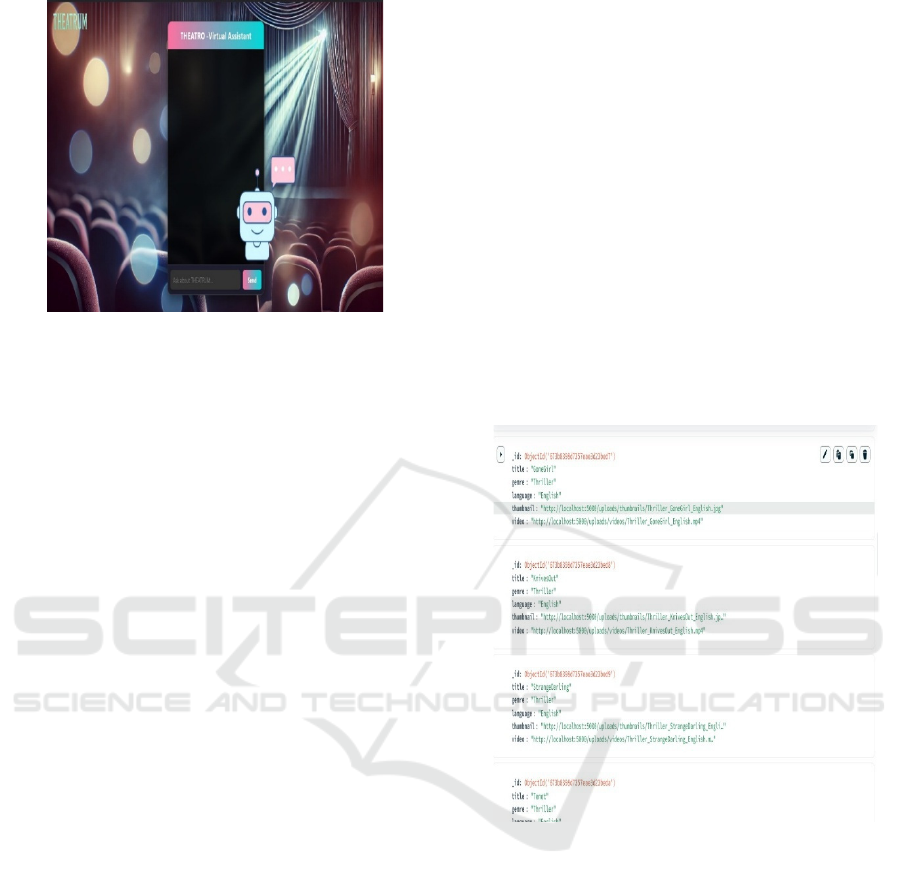
Figure 5: Chat Bot-Theatro.
4.5 Movie Carousel and Genre Sorting
The autoplay carousel dynamically showcases
selected movies, enhancing the platform’s
interactivity. Below it, genre-based horizontal scroll
sections make movie discovery straightforward,
enabling users to browse by preferences seamlessly.
4.6 Database Integration
safe payment channels for managing subscriptions
and an ad- min dashboard for managing users and
content. THEATRUM is a viable prototype for
contemporary OTT platforms since it offers a
comprehensive approach to online entertainment by
emphasizing aesthetics, functionality, and
interactivity. In order to improve user engagement,
future work can concentrate on enhancing the
platform’s functionality, such
as implementing
tailored recommendations using AI-based
algorithms. By including accessibility features and
linguistic support, the platform can reach a wider
range of users. Better content curation may also be
made possible by integrating sophisticated analytics
to monitor user preferences and responses.
THEATRUM may establish itself as a cutting-edge
entertainment hub in the digital ecosystem by
expanding the platform with live streaming features
and integrating it with IoT devices like smart TVs.
With these improvements, THEATRUM would be
guaranteed to adapt to the changing needs of
consumers and the competitive streaming service
market.
The MongoDB database underpins the
application, supporting efficient storage and retrieval
of user and movie data. Structured collections, as
shown in the JSON output (Figure 6), ensure
scalability and reliability. Data validation is enforced
using Mongoose schemas, while relationships
between entities are modeled efficiently for faster
queries.
The implementation of THEATRUM highlights
the synergy between technical robustness and creative
design. Each feature is optimized for usability,
ensuring an engaging and responsive platform. The
chatbot integration and feedback mechanism
exemplify how user insights can shape platform
development. Moreover, MongoDB’s flexibility
supports the scalable handling of content and user
data, paving the way for future enhancements like
multilingual support and personalized rec-
commendations.
Through its advanced features and user-centric
design, THEATRUM sets itself apart as a modern and
interactive streaming platform, offering both
functionality and a superior user experience.
Figure 6: JSON file movie data.
5 CONCLUSION & FUTURE
WORKS
To sum up, THEATRUM effectively illustrates how
to create a feature-rich and intuitive movie streaming
platform by incorporating cutting-edge technologies
like MongoDB, Node.js, Express.js, and a responsive
front-end design. With features such as genre-based
sorting, autoplay carousels, interactive feedback
mechanisms, and a chatbot for immediate user
support, the platform delivers a smooth and engaging
user experience. Its scalability and resilience are
demonstrated by the addition of microservices
architecture, real-time data handling, and robust user
Theatrum: Design and Implementation of a Feature-Rich Movie Streaming Platform Leveraging Modern Web Technologies
559

authentication. These enhancements ensure high
performance under heavy traffic, seamless integration
of future updates, and a secure environment, making
THEATRUM a forward-thinking solution in the
competitive world of online streaming.
REFERENCES
Bhagat, K., Kumar Das, A., Kumar Agrahari, S., Aanand
Shah, S., RT, D., Ramasamy, G. (2024). Cross-
Language Comparative Study and Performance
Benchmarking of Sorting Algorithms. Available at
SSRN 5088751.
Chithra, R., et al.” Online video streaming application.”
International journal of health sciences 6. S2 (2022):
12815-12837.
Chowdary, Edara Venkata Sai Sukesh, and Vulimiri Naga
Hari Chan- dana.” Entertainment Hub.” (2024).
K. Saundariya, M. Abirami, K. R. Senthil, D. Prabakaran,
B. Srimathi and G. Nagarajan,” Webapp Service for
Booking Handyman Using Mon- godb, Express JS,
React JS, Node JS,” 2021 3rd International Conference
on Signal Processing and Communication (ICPSC),
Coimbatore, India, 2021, pp. 180-183, doi:
10.1109/ICSPC51351.2021.9451783.
Kulkarni, Ayush, Himanshu Jain, and Vikash Sharma.”
Navigating the E- Learning Platform with MongoDB,
Express, React, and Node.” Express, React, and Node
(March 19, 2024) (2024).
Kumar Agrahari, S., Kumar Das, A., Yadav, A.,
Ramasamy, G. (2024). Next-Gen Routing and
Scalability Enhancements in Mobile Ad Hoc Networks.
Available at SSRN 5089037.
Le, Hoang Khanh Ngoc.” Web Application for Searching
Local Events.” (2023).
M. B. Savadatti, P. V. Kishore Kumar, U. Kshirsagar, S.
Baskar, S. Ponnuru and A. S. Bale,” Design of
MongoDB based Web- site for E-Commerce
Applications,” 2024 Second International Conference
on Intelligent Cyber Physical Systems and Internet of
Things (ICoICI), Coimbatore, India, 2024, pp. 869-874,
doi: 10.1109/ICoICI62503.2024.10696706.
P. Gupta and D. Agarwal,” Webapp service for providing
Information about ngos using Html5, css3, javascript,
node js, Mongodb,” 2022 4th International Conference
on Advances in Computing, Communication Control
and Networking (ICAC3N), Greater Noida, India,
2022, pp. 2262-2266, doi:
10.1109/ICAC3N56670.2022.10074464.
Ramasamy, G., Shaik, B. A., Kancharla, Y., Manikanta, A.
R. (2025). A Bash-based approach to simulating multi-
process file systems: Design and implementation. In
Challenges in Information, Communication and
Computing Technology (pp. 200-206). CRC Press.
Singh, Vineet Kumar, et al.” Mern (Mongodb, Express-Js,
React-Js, Node-Js) Stack Web-Based Streaming and
Broadcasting Application.” 2024 International
Conference on Electrical Electronics and Computing
Technologies (ICEECT). Vol. 1. IEEE, 2024.
Singh, Vineet Kumar, et al.” Mern (Mongodb, Express-Js,
React-Js, Node-Js) Stack Web-Based Streaming and
Broadcasting Application.” 2024 International
Conference on Electrical Electronics and Computing
Technologies (ICEECT). Vol. 1. IEEE, 2024.
Yadav, Ranjan.” Building a Blog Project Using JavaScript,
NodeJS and MongoDB.” (2021).
ICRDICCT‘25 2025 - INTERNATIONAL CONFERENCE ON RESEARCH AND DEVELOPMENT IN INFORMATION,
COMMUNICATION, AND COMPUTING TECHNOLOGIES
560
