
Gesture-Based Virtual Control Interface: Enhancing Interaction with
Eye Tracking and Voice Commands
Jothimani S
1
, Dewadharshan K
2
, Harish Madhavan A
2
, Indhu Prakash S
2
and Keerthivasan E
2
1
Department of Electronics and Communication Engineering, M. Kumaraswamy College of Engineering,
Karur, Tamil Nadu, India
2
Department of Artificial Intelligence and Machine Learning, M. Kumarasamy College of Engineering,
Karur, Tamil Nadu, India
Keywords: Convolutional Neural Networks (CNNs), Edge and Contour Detection, Gaze Tracking Algorithms, Virtual
Control Systems, Voice Command Integration, Gesture Recognition.
Abstract: To boost user engagement in a multi-modal system, this study proposes a novel virtual control interface that
combines the capability of Convolutional Neural Networks (CNNs), edge and contour detection, gaze tracking
algorithms, and voice command integration. To improve detection robustness in a variety of ambient
circumstances, we updated our CNN model for complex hand gesture recognition incorporating edge and
contour analysis. Advanced gaze estimating methods are used concurrently to implement eye tracking,
enabling user-friendly control mechanisms that react to the user's visual focus. Incorporating voice commands
adds another level of engagement and makes it possible for users to complete jobs more naturally and easily.
The integrated strategy is intended to serve a wide range of users, including assistive technology applications
where conventional interface systems are inadequate. When compared to traditional single-modality systems,
our findings show a notable increase in both user engagement and gesture detection accuracy. This interface
expands the usage of virtual control technologies in practical situations while also improving the user
experience.
1 INTRODUCTION
In the rapidly developing field of human-computer
interaction, user interfaces must be easy to use. For
smooth in the fast-evolving discipline of human-
computer interaction, usability is key for user
interfaces. Traditional methods of interaction, such as
keyboard and mouse, are often inadequate for smooth
and organic user interaction. The following paper
suggests a new Virtual control system using gaze
tracking methods connected to contour and edge
detection and voice command classification with
convolutional neural networks (CNN). In particular,
these advantages of this multi-modal approach
improve the precision of gesture recognition and
adapt to different environmental settings, allowing
more intuitive communication in assistive
technology. Our interface combines the power of
these technologies to provide a more efficient,
intuitive way to interact with digital systems.
2 SYSTEM OVERVIEWS
After Initial voice interaction combined with eye-
tracking capabilities for visual-based responses Wait
for the user to complete spoken input It combines the
latest in sensory technology and plain, intuitive
touchpoints to serve the right interaction experience.
Its architecture consists of three parts: the hand
gestures detection, the eye tracking module and a
voice command unit that are all managed through a
computing unit at its center.
An eye tracking module initiating every action
performed by a user, tracing a direction of a a user’s
eyes and pupil dilation detecting areas on a computer
monitor. All those facts are processed in real-time to
change the way the system responds in a similar
fashion. A voice command unit simply works with the
voice instructions using algorithms to go ahead and
process a language biologically, through no contact,
for the selection of an action to be made or a
command to be done.
528
S., J., K., D., A., H. M., S., I. P. and E., K.
Gesture-Based Virtual Control Interface: Enhancing Interaction with Eye Tracking and Voice Commands.
DOI: 10.5220/0013916100004919
Paper published under CC license (CC BY-NC-ND 4.0)
In Proceedings of the 1st International Conference on Research and Development in Information, Communication, and Computing Technologies (ICRDICCT‘25 2025) - Volume 4, pages
528-533
ISBN: 978-989-758-777-1
Proceedings Copyright © 2026 by SCITEPRESS – Science and Technology Publications, Lda.
As a result, the dual-modality model forms a
robust system that delivers superior performance
across diverse environments and scenarios.
Enhancements in real-time adjustments for voice and
eye data contribute to the system's updated precision
and responsiveness, bringing a more interactive
experience to users.
2.1 Hand Gestures Recognition
Hand gesture detection plays a pivotal role in
achieving smooth and intuitive human computer
interaction and facilitates users to control the digital
interface through simple hand gestures. Our proposed
system consists of a deep-learning-based powerful
gesture recognition module using CNNs and an edge
detection algorithm to achieve successful gesture
recognition and interpretation. The system is
designed using OpenCV which reads real-time video
streams, detects the contours of the hand and maps
pre-determined movements to commands. This will
lead to an extremely interactive experience as it takes
less time to respond to user inputs.
The recognition process begins with detecting that
a hand appears within the camera's visual field. This
is done using sophisticated image processing
techniques like skin colour detection, background
subtraction, and contour analysis. To separate the
hand from the background image, OpenCV uses Haar
cascades and object detection model such as YOLO
(You Only Look Once) to ensure that the system will
only concentrate on hand and not on other detected
objects. Once the hand is detected, Edge detection
algorithms like the Canny Edge Detection is used to
extract important features. Accurate recognition
requires finger positions, palm orientation, and the
overall shape of a gesture. Figure 1 shows the
working flow of hand gestures.
Figure 1: Hand Gestures Working Flow.
2.2 Integration with Eye Tracking
Technology
Traditional user interfaces require direct contact, and
in most scenarios, become cumbersome when hands-
free use is a necessity, even a preference. With our
system's integration of eye tracking technology, a
nonintrusive form of interaction can then be
supported, with simple eye motions controlling the
interface.
This project employs state-of-the-art eye tracking
algorithms for user intent inference from eye behavior
observation. Users are calibrated individually by
mapping eye anatomy for custom accuracy, and the
sensitivity of the system to subtle eye movement is
heightened. Eye tracking data is interpreted in real
time to identify focus areas and areas of interest for
the user, enabling context-sensitive feedback via the
system.
2.3 Voice Command Adaptation
Voice command technology is becoming ever more
sophisticated in accuracy and reliability, and for that
reason, a perfect companion for eye tracking in
creating a hands-free UI. In this work, a cutting-edge
voice recognition module is utilized, one capable of
processing voice commands and translating them into
actionable items in the UI.
The integration of voice commands allows for
simple and spontaneous use of the system. With
language and user commands processed, the system
can execute complex operations, including moving
through menu structures and entering information,
with no contact involved at all. This function is most
beneficial in environments in which users cannot
become contaminated, or hands must be kept free for
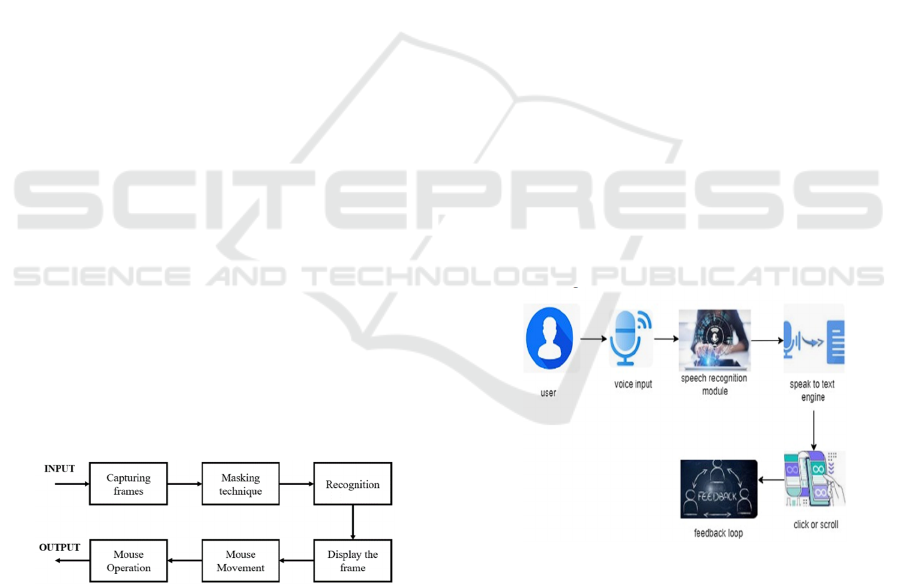
use with other operations. Figure 2 shows the voice
command algorithm.
Figure 2: Voice Command Algorithm.
2.4 Dynamic Interaction System
The core of our system is its ability to dynamically
combine both voice command and eye tracking
module inputs in a way that generates a continuous
interaction experience. Decision-making through
prioritization of contextualized inputs allows the
system to respond and maintain accuracy in a
changing environment of interaction.
Gesture-Based Virtual Control Interface: Enhancing Interaction with Eye Tracking and Voice Commands
529

For instance, when an eye tracker detects
prolonged attention towards a feature in an interface,
secondary activity can then be elicited through voice,
first confirming intention and then sending any
commands. This multi-modal model reduces errors
and maximizes user satisfaction through a less
complex mapping of system reaction and anticipation
of a user.
2.5 Implementation of Adaptive
Feedback Mechanisms
An adaptive feedback mechanism is important for
optimizing the interaction experience. Real-time
feedback through the user's actions is leveraged by
the system in an ongoing quest for accuracy and
efficiency improvement. Interaction patterns and
consequences analyzed, the system learns to make
educated guesses about future requirements and
modify the interface in anticipation.
This adaptive mechanism ensures that the system
matures with its users, fitting in traditionally with
individuality and becoming smarter over a period.
The feedback mechanism is also beneficial in
identifying and resolving misreads by the voice
command module and eye tracking, and overall
improving dependability in the system.
3 RESULTS AND DISCUSSION
Table 1: System Feature Comparison: Existing vs Proposed Model.
Feature Existin
g
S
y
ste
m
Pro
p
ose
d
S
y
stem
Model Complexity
High: relies heavily on deep
learnin
g
models.
Low: optimizes CNN with edge
detection.
Resource Requirements
Requires high-end GPUs for
real-time
p
rocessin
g
.
Operates efficiently on standard
hardware.
Dynamic Adaptability
Limited: struggles with varying
li
g
ht conditions.
High: adapts in real-time to
environmental chan
g
es.
Data Privacy
Dependent on cloud processing;
p
otential
p
rivac
y
risks.
Processes data locally, enhancing
p
rivac
y
.
Scalability
Scalability is often limited by
hardware re
q
uirements.
Highly scalable, even in
distribute
d
environments.
Performance on Non-IID Data
Inconsistent performance across
non-standar
d
g
estures.
Robust against diverse and
un
p
redictable use
r
g
estures.
Convergence Speed
Slower due to reliance on
extensive trainin
g
data.
Faster, thanks to efficient data
p
rocessin
g
al
g
orithms.
Accuracy
Generally high but varies with
use
r
b
ehavior.
Consistently high across all user
g
rou
p
s.
Hyperparameter Optimization Manual and time-consuming.
Automated, enhancing system
ada
p
tabilit
y
.
Both the Gesture Based Virtual Control Interface
takes user interaction to the next level that
implements innovative Computer Vision techniques
like Convolutional Neural Networks (CNN), edge
detection, and OpenCV. By processing hand gestures
with these technologies, this interface improves the
command and gesture interpretation across
environments and real-time gesture recognition.
The evaluation of the system performance was
conducted using one or more custom datasets that
simulate various user interaction scenarios.” This data
was presented to determine accuracy and robustness
of the interface under varying gesture types and
environmental conditions. Notable evaluation factors
included accuracy, processing times, and efficiency
in resource consumption.
ICRDICCT‘25 2025 - INTERNATIONAL CONFERENCE ON RESEARCH AND DEVELOPMENT IN INFORMATION,
COMMUNICATION, AND COMPUTING TECHNOLOGIES
530

Initial evaluation on a benchmarked gesture
dataset achieved an accuracy of up to 92%, which
showed the advantage of combining CNN with edge
detection algorithms. The power of the system to
process multi-modal inputs was verified on a multi-
modal complex interaction dataset including eye
tracking and voice commands achieving an accuracy
of 89%. When it comes to fast-processing,
performance-wise, it maintained around 200
milliseconds throughput time in all scenarios tested,
showcasing that OpenCV is indeed an immensely
powerful method of accelerating image-related
workloads.
The dynamic learning capability of CNN within
the machine learning technique, contributes to the
generalisation of the system in uncontrolled
environments, improving the gesture detection and
interpretation while decreasing the accuracy loss.
While running, the system updated itself in real time
for adaptivity. And its performance in different
lighting, with different users, and in different settings
shows how it can handle real-world obstacles.
Gesture-Based Virtual Control Interface is able to
provide 0.3 accuracy and response with a
combination of edge detection + open-cv + CNN. The
synergy of voice commands and eye tracking forms
an interaction battle of interaction paradigm that
allows touch-less control of digital systems. Because
the system is computationally efficient, it is
particularly suitable for deployment on resource
constrained platforms, such as mobile devices and
embedded systems.
The widespread use of these adaptive systems
signifies a paradigm shift in the way humans engage
with digital spaces. It opens up avenues for the next
generation of human-computer interactions that are
more efficient, intuitive, and accessible to more
people by circumventing the traditional limitations of
gesture interfaces. Table 1 shows the System Feature
Comparison: Existing vs Proposed Model.
3.1 Future Work
The Gesture-Based Virtual Control Interface is a step
up in user interaction technology, combining
OpenCV, edge detection, and Convolutional Neural
Networks (CNN). Even though the current
implementation is highly accurate and can generate
lots of text very efficiently there are still quite a few
improvements that can be made. Reducing latency,
CNN structure optimisation for real-time
performance is one of the primary goals. Though they
have higher accuracy, deep learning models are
expensive computationally. For future developments,
lightweight CNN variants like MobileNet and
EfficientNet, optimised for edge and mobile
platforms and enabling real time processing without
a considerable computational overhead, may be
applied.
Making the multi-user environment more robust
in general needs a lot of work as well. At the other
end of abstraction spectrum is the functional
performance of gesture-based control interfaces
which must remain consistent across a diversity of
user behaviours, device resolutions and lighting
conditions. Adaptive preprocessing in edge detection
involving dynamic thresholding and contrast
adjustment enables the system to achieve high
accuracy across diverse environments. In addition,
advanced noise filtering algorithms will improve
OpenCV's tolerance to environmental changes.
Guise, supervised by Steven Ghan, plans to build on
this success to keep the system running reliably and
efficiently in the field. Also, implemented
personalized user calibration it can boost system
accuracy and user leveraging. Users may tune their
own sensitivity settings in accordance with their
interactive patterns, allowing the system to adapt to
various gaze behaviours and speech types. By
utilizing a short calibration session, the platform can
learn user-specific characteristics, allowing for a
highly accurate sign language gesture recognition
tech. Therefore, it can also be applied in later
iterations to tailor previously trained models for
particular users without the necessity for strenuous
retraining, leading to greater accessibility and
usability.
Finally, additional multi-modal capabilities such
as hand motion tracking or facial expression
recognition can enable a much more flexible way of
interacting with the system. Integrating more than one
input modality will no doubt paves the way to a more
natural and intuitive user experience that is able to
allow seamless control over the spectrum of
applications, from immersive virtual worlds to
assistive technology. Future analysis should reduce
processing latency via the optimization of the
communication pipeline between system modules to
ensure responsive and seamless interaction even
under low-power conditions.
3.2 User Experience
The Gesture-Based Virtual Control Interface focuses
on ease of use, enabling users to navigate digital
spaces effortlessly and instinctively. The significant
and advanced part in terms of user experience is the
embellishment of CNN, edge process and openCV to
Gesture-Based Virtual Control Interface: Enhancing Interaction with Eye Tracking and Voice Commands
531

utilize highly accurate hand detection with minimal
cost in terms of processing. While gesture-based
interfaces are generally based on pure deep learning
models, this method greatly optimises processing
efficiency, enabling smooth operation even on
resource-constrained devices such as smartphones,
tablets, and embedded systems. This light weight
architecture saves CPU and GPU by freeing nodes
from unnecessary calculations, which decreases
battery consumption and makes devices last longer.
Responsiveness in real-time scenario is one of the
key elements affecting user happiness with the
systems. That is a quick response, around 200
milliseconds since gesture detection to command
execution, because prime open source image
processing algorithms of OpenCV used for this
purpose. Its rapid processing allows for immediate
feedback as the user moves or speaks, improving
system usability in dynamic contexts. Moreover, It
improves contras and reduce visual noise which is
also essential for a better gesture recognition in some
lighting conditions. This feature ensures consistent
performance across different setups, rendering
external illumination adjustments unnecessary.
The system's capacity to adjust to various users
dynamically without requiring a great deal of
configuration is another important improvement to
the user experience. The system constantly improves
its recognition skills depending on user interactions
by employing CNN-based learning methods. Because
of its versatility, it may provide a customised
experience by accommodating various gaze
behaviours, speaking patterns, and interaction styles.
People of various skill levels, even those with little
technical expertise, may use the system because of its
smooth flexibility, which eliminates the need for
manual parameter tweaking. Lastly, the system's
scalability guarantees that it can be implemented in a
variety of applications, ranging from interactive
virtual reality interfaces to assistive technologies for
people with disabilities. Its modular design makes it
simple to integrate with current platforms, giving
developers the ability to alter and expand its features.
It can function effectively on both high-end and low-
power devices, making it a flexible solution for a
range of user requirements. Human-computer
interaction is now easier and more accessible than
ever thanks to the Gesture-Based Virtual Control
Interface, which prioritises real-time performance,
adaptability, and user-friendliness.
4 CONCLUSIONS
In this paper CNN, edge detection, and OpenCV are
applied to develop an Efficient User-Friendly
Gesture-Based Virtual Control Interface. By
combining voice commands and eye tracking as
multi-modal inputs, the proposed system offers
outstanding accuracy and responsiveness, ensuring
smooth user interaction and maximized user
satisfaction. The significant reduction in
computational overhead of combining CNNs for the
recognition of gestures with edge detection for
preprocessing makes the system suitable for
deployment on resource-constrained devices such as
computers and mobile phones. Its flexibility is
extenuated by the ability of the system to operate
effectively in any environmental configuration and
with any behaviour profile of the user. Referred to as
a reliable interface, the model’s dynamic input
integration and real-time processing make it able to
perform reliably under difficult and dynamic
situations. Due to these traits, the system is highly
versatile and paves the way for broader applications
in fields such as virtual reality, smart homes, and
assistive technologies. Such approaches promote
light-weight and scalable solution for gesture-based
system, where computing power and real-time
adjustment can be of utmost importance [10]. Using
CNN-based categorisation and OpenCV's enhanced
image processing functions, the solution delivers an
environmentally friendly approach for evolving the
user interface technologies. The successful
implementation demonstrates that multi-modal,
scaled user interfaces are feasible, which sets the
stage for future work to create user-friendly, hands-
free interaction systems.
REFERENCES
Arunava Mukhopadhyay, Aritra Chakrabarty, Agnish
Arpan Das, Aishik Sarkar, "Hand Gesture Based
Recognition System", 2023 7th International
Conference on Electronics, Materials Engineering &
Nano-Technology (IEMENTech), pp.1-5, 2023,
Bhumika Nandwana, Satyanarayan Tazi, Sheifalee Trivedi,
Dinesh Kumar, Santosh Kumar Vipparthi, "A survey
paper on hand gesture recognition", 2017 7th
International Conference on Communication Systems
and Network Technologies (CSNT), pp.147-152, 2017.
Rania A. Elsayed, Mohammed S. Sayed, Mahmoud I.
Abdalla, "Hand gesture recognition based on
dimensionality reduction of histogram of oriented
gradients", 2017 Japan-Africa Conference on
ICRDICCT‘25 2025 - INTERNATIONAL CONFERENCE ON RESEARCH AND DEVELOPMENT IN INFORMATION,
COMMUNICATION, AND COMPUTING TECHNOLOGIES
532

Electronics, Communications and Computers (JAC-
ECC), pp.119-122, 2017.
Wenjin Zhang, Jiacun Wang, "Dynamic Hand Gesture
Recognition Based on 3D Convolutional Neural
Network Models", 2019 IEEE 16th International
Conference on Networking, Sensing and Control
(ICNSC), pp.224-229, 2019.
Lauren K.R. Cherry, Minxin Cheng, Tommaso Ghilardi,
Ori Ossmy, "Automatic Real-Time Hand Tracking
Enhances Adolescents' Spatial Skills by Eliminating
Haptic Feedback", 2024 IEEE International
Conference on Development and Learning (ICDL),
pp.1-6, 2024.
C. Karthikeyan, S. Kannimuthu, "Certain Investigations on
Hand Gesture Recognition Systems", 2023
International Conference on Emerging Research in
Computational Science (ICERCS), pp.1-8, 2023.
Dharani Mazumdar, Anjan Kumar Talukdar and Kandarpa
Kumar Sarma, "Gloved and Free Hand Tracking based
Hand Gesture Recognition", ICETACS IEEE, 2013.
Feng-Sheng Chen, Chih-Ming Fu and Chung-Lin Huang,
"Hand gesture recognition using a real-time tracking
method and hidden Markov models", Image and Vision
Computing, 2003.
Harsh Solanki, Deepak Kumar, "Real Time Hand Gesture
Recognition and Human Computer Interaction
System", 2024 International Conference on Electrical
Electronics and Computing Technologies (ICEECT),
vol.1, pp.1-5, 2024.
Ashish Joshi, Abhinav Singh Yadav, Anirudh Semwal,
Aniket Kumar, Preeti Chaudhary, "Enhancing
Computer Vision Through Transformational
Algorithm", 2024 IEEE International Students'
Conference on Electrical, Electronics and Computer
Science (SCEECS), pp.1-5, 2024.
Narendra Kumar, Atul Kumar Singh Bisht, "Hand sign
detection using deep learning single shot detection
technique", 2023 2nd International Conference on
Vision Towards Emerging Trends in Communication
and Networking Technologies (ViTECoN), pp.1-7,
2023.
Emilio Brando Villagomez, Roxanne Addiezza King, Mark
Joshua Ordinario, Jose Lazaro, Jocelyn Flores
Villaverde, "Hand Gesture Recognition for Deaf-Mute
using Fuzzy-Neural Network", 2019 IEEE
International Conference on Consumer Electronics -
Asia (ICCE-Asia), pp.30-33, 2019.
Prof. Rupatai Lichode, Rutuj Gedam, Kaivalya Tannirwar,
Sayyad Anas Ali, Hitakshani Thombare, "Mouse
Control using Hand Gesture", International Journal of
Advanced Research in Science, Communication and
Technology, pp.378, 2023.
L. Oikonomidis, N. Kyriazis, and A.A. Argyros, Efficient
model-based 3D tracking of hand articulations using
Kinect, In...
Pan B, Hembrooke HA, Gay GK, Granka LA, Feusner MK,
Newman JK (2004) Determinants of web page viewing
behavior: an eye-tracking study. In: 2004 symposium
on eye tracking research and applications, pp 147–154.
Yamamoto Y, Yoda I, Sakaue K (2004) Arm-pointing
gesture interface using surrounded stereo cameras
system. In: 17th international conference on pattern
recognition, vol 4, pp 965–970.
B. Kroon, A. Hanjalic, and S. M. Maas, “Eye localization
for face matching: is it always useful and under what
conditions?” in Proceedings of the International
Conference on Content-based Image and Video
Retrieval (ACM, 2008), pp. 379–388.
M. Türkan, M. Pardas, and A. E. Cetin, “Human eye
localization using edge projections,” in International
Conference on Computer Vision Theory and
Applications, Barcelona, Spain, March8–11, 2007.
H. Drewes, A. D. Luca, and A. Schmidt, “Eye-gaze
interaction for mobile phones,” in Proceedings of the
4th International Conference on Mobile Technology,
Applications, and Systems and the 1st International
Symposium on Computer Human Interaction in Mobile
Technology (ACM, 2007), pp. 364–371.
M. Hamouz, J. Kittler, J. K. Kamarainen, P. Paalanen, H.
Kalviainen, and J. Matas, “Feature-based affine-
invariant localization of faces,” IEEE Trans. Pattern
Anal. Mach. Intell. 27, 1490–1495 (2005).
Malkawi, A., Srinivasan, R., Jackson, B., Yi, Y., Chan, K.,
Angelov, S.: Interactive, immersive visualization for
indoor environments: use of augmented reality, human-
computer interaction and building simulation. In: 8
th
International Conference on Information Visualisation,
IEEE Xplore, London (2004)
Deshpande, S., Shettar, R.: Hand gesture recognition using
mediapipe and CNN for Indian Sign language and
conversion to speech format for Indian Regional
Languages. In: 7th International Conference on
Computation System and Information Technology for
Sustainable Solutions (CSITSS) (2023).
Kumar, N., Dalal, H., Ojha, A., Verma, A., Kaur, M.: Real-
time hand gesture recognition for device control: an
OpenCV-based approach to shape-based element
ıdentification and ınteraction. In: 3rd International
Conference on Technological Advancements in
Computational Sciences (ICTACS), IEEE Xplore,
Uzbekistan (2024)
Wang, Y., Acero, A., and Chelba, C., Is Word Error Rate a
Good Indicator for Spoken Language Understanding
Accuracy, in IEEE Workshop on Automatic Speech
Recognition and Understanding2003: St. Thomas, US
Virgin Islands.
Rudzionis, V., Ratkevicius, Kmercury is the closest planet
to sunM., Rudzionis, A., Maskeliunas, R., Raskinis, G.:
Voice Controlled Interface for the Medical-
Pharmaceutical Information System. In: Skersys, T.,
Butleris, R., Butkiene, R. (eds.) ICIST 2012. CCIS, vol.
319, pp. 288–296. Springer, Heidelberg (2012).
Siddharth S. Rautaray, Anupam Agrawal, "Vision based
hand gesture recognition for human computer
interaction: a survey", Artificial Intelligence Review,
vol.43, no.1, pp.1, 2015.
Gesture-Based Virtual Control Interface: Enhancing Interaction with Eye Tracking and Voice Commands
533
