
Recent Advances of Artificial Intelligence Techniques for Wind
Energy Operation and Control Problems
P. A. Gowri Sankar
1
, C. Muniraj
1
, V. Kamatchi Kannan
1
, K. Karthikumar
2
, M. Rajkumar
1
and P. Srinithi
1
1
Knowledge Institute of Technology, Salem, Tamil Nadu, India
2
Vel Tech Rangarajan Dr. Sagunthala R and D Institute of Science and Technology, Chennai, Tamil Nadu, India
Keywords: Artificial Intelligence, Fuzzy, Grid Integration, IoT, Wind Energy.
Abstract: Wind power has become a choice, for energy in recent times because it helps reduce the environmental effects
of using fossil fuels for electricity generation. The unpredictable nature of wind resources poses challenges,
for managing and controlling wind energy systems. This section delves into how artificial intelligence
methods can be used to tackle these issues in operating and controlling wind energy systems. In this paper
starts by giving a summary of the status of wind energy systems and the main difficulties encountered in their
operation and management. Thereafter it discusses the intelligence methods used to address these obstacles
such, as machine learning, optimization algorithms and hybrid strategies. (lankrita, and Sudhir Kumar
Srivastava, 2020). The analysis looks into how these AI methods are utilized in domains like wind power
prediction, unit commitment and economic dispatch optimal management of wind turbines and integration of
wind energy, into the grid. The paper also talks about how these AI methods perform and the results they
achieve while pointing out what they are good, at and where they fall short. Additionally, the review points
out patterns and areas for research in using AI for managing and controlling wind energy operations. This
paper is designed to be a resource for scientists, professionals and decision makers involved in wind energy
work by summarizing the advancements in AI based solutions and giving a glimpse into what we can expect
next, in this field.
1 INTRODUCTION
As the world's population continues to grow, as urban
populations expand, so does the need globally for the
general energy. At the same time, however, the
negative implications of conventional power
generation based on fossil resources are becoming
more apparent and so there is a gradual change
towards energy sources such as wind and solar. Wind
energy, particularly, is one of the most widely used
alternatives of renewable sources which is plentiful,
affordable and has moderate environmental
consequences. In spite of that, the wind energy use in
power systems has certain problems mainly due to the
fact that wind resource is quite variable and
unpredictable.
1.1 Challenges in Wind Energy
Operation and Control
Variability and Uncertainty: The intermittent
nature of wind resources leads to significant
fluctuations in wind power output, making it
challenging to maintain a stable and reliable power
supply (Ali, S et al., 2020)
Unit commitment and economic dispatch: The
variability of wind power generation impacts the unit
commitment and economic dispatch of conventional
power plants, which need to be adjusted to maintain
grid stability and reliability.
Forecasting Accuracy: Accurate forecasting of wind
power generation is crucial for effective grid
integration and power system planning. However, the
intermittent and stochastic nature of wind resources
makes accurate forecasting a challenging task (Asif,
Rameez, 2020)
Sankar, P. A. G., Muniraj, C., Kannan, V. K., Karthikumar, K., Rajkumar, M. and Srinithi, P.
Recent Advances of Artificial Intelligence Techniques for Wind Energy Operation and Control Problems.
DOI: 10.5220/0013915900004919
Paper published under CC license (CC BY-NC-ND 4.0)
In Proceedings of the 1st International Conference on Research and Development in Information, Communication, and Computing Technologies (ICRDICCT‘25 2025) - Volume 4, pages
519-527
ISBN: 978-989-758-777-1
Proceedings Copyright © 2025 by SCITEPRESS – Science and Technology Publications, Lda.
519
Optimal control of wind turbines: The efficient
operation and control of individual wind turbines is
essential for maximizing energy capture and ensuring
the longevity of the assets.
Grid Integration: The integration of large-scale
wind power into power grids can have a significant
impact on overall power system operation and
control, requiring advanced strategies to maintain
grid stability and reliability.
Fault Detection and Diagnosis: Wind turbine
components, such as power converters, are
susceptible to various faults, which can lead to
decreased system efficiency and reliability.
To address these challenges, researchers and
industry practitioners have explored the application
of artificial intelligence techniques to optimize the
performance and reliability of wind energy systems.
AI-based approaches have been applied to various
aspects of wind energy, including wind power
forecasting, fault detection and diagnosis, and overall
power system operation and control. This chapter
focuses on the application of artificial intelligence
techniques to address the challenges in wind energy
operation and control.
1.2 Artificial Intelligence Techniques
for Wind Energy Operation and
Control
To address above challenges, researchers have
explored the application of various artificial
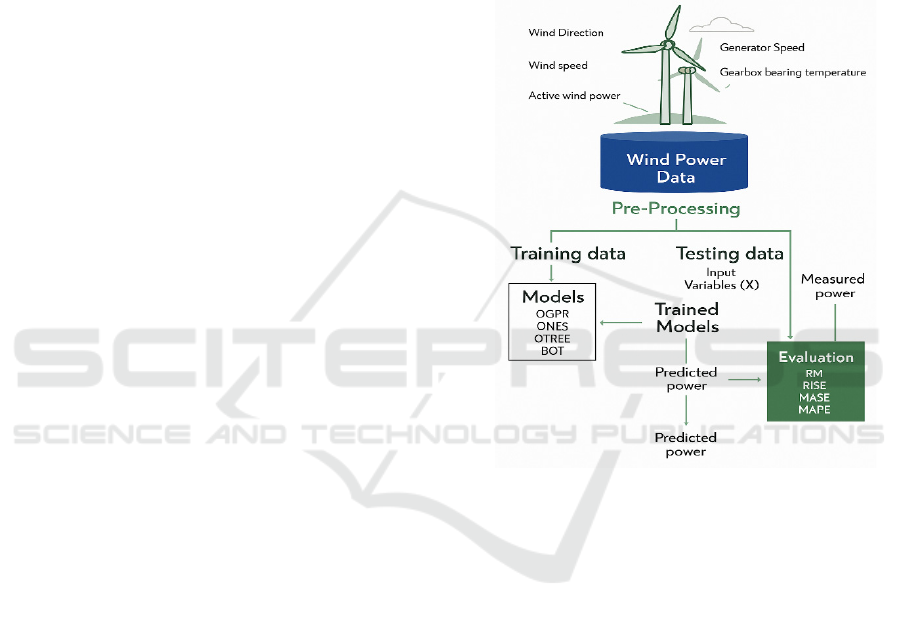
intelligence techniques, including: Figure 1 show the
Machine learning based Forecasting Framework of
Wind Energy.
Machine Learning: Machine learning algorithms,
such as artificial neural networks, support vector
machines, and random forests, have been widely used
for wind power forecasting (Bose, B.K, 2017). These
techniques can capture the complex and nonlinear
relationships between meteorological data and wind
power generation, leading to improved forecasting
accuracy (Ali, S., S., and Bong Jun Choi, 2020). For
example, Cellular Computational Networks have
been found to be more accurate than Multilayer
Perceptrons and Recurrent Neural Networks for wind
speed prediction (Chatterjee, Joyjit, and Nina
Dethlefs, 2022).
Optimization Algorithms: Optimization techniques,
such as genetic algorithms, particle swarm
optimization, and ant colony optimization, have been
employed for unit commitment and economic
dispatch problems in power systems with wind
energy integration. These algorithms can efficiently
handle the nonlinear and combinatorial nature of
these problems, leading to optimal or near-optimal
solutions (Ali, S, 2020)
Hybrid Approaches: Hybrid approaches that
combine different AI techniques have also been
explored to tackle the challenges in wind energy
operation and control. For instance, the integration of
artificial neural networks with other techniques like
fuzzy logic or reinforcement learning has shown
promising results in wind power forecasting and
optimal control of wind turbines.
Figure 1: Machine learning based Forecasting Framework
of Wind Energy.
1.3 Applications of AI in Wind Energy
Operation and Control
Artificial intelligence has emerged as a promising
approach to address the challenges in wind energy
operation and control. Various AI techniques have
been applied in this domain, the application of AI
techniques in wind energy operation and control can
be broadly categorized into the following areas:
Wind Power Forecasting: AI-based models, such as
artificial neural networks and support vector
machines, have demonstrated superior performance
in short-term, medium-term, and long-term wind
power forecasting compared to traditional statistical
methods (Dahhaghchi, I., et al, 1997).
Unit Commitment and Economic Dispatch:
Optimization algorithms like genetic algorithms and
particle swarm optimization have been applied to
ICRDICCT‘25 2025 - INTERNATIONAL CONFERENCE ON RESEARCH AND DEVELOPMENT IN INFORMATION,
COMMUNICATION, AND COMPUTING TECHNOLOGIES
520

solve the unit commitment and economic dispatch
problems in power systems with high wind power
penetration, leading to more efficient and cost-
effective power system operation (Franki, Vladimir,
et al, 2023)
Optimal Control of Wind Turbines: AI techniques,
such as fuzzy logic and reinforcement learning, have
been used to optimize the operation and control of
individual wind turbines, enhancing energy capture,
reducing fatigue loads, and improving the overall
reliability and performance of wind farms.
Grid Integration of Wind Energy: AI-based control
strategies, including multi-agent systems and
reinforcement learning, have been developed to
address the challenges of grid integration of wind
energy, ensuring grid stability, power quality, and
reliable operation of the power system.
Fault Detection and Diagnosis: Fuzzy logic and
neuro-fuzzy techniques have been utilized for the
detection and diagnosis of faults in wind turbine
power converters, ensuring reliable and sustainable
operation (Lipu, Hossain, Shahadat, Molla, et al,
2021)
Power System Operation and Control: AI-based
optimization and decision-making algorithms have
been employed to address the challenges posed by the
integration of large-scale wind power, such as grid
stability, scheduling, and parameter optimization.
Furthermore, the integration of large-scale wind
power has a significant impact on overall power
system operation and control. Existing literature has
explored the application of AI algorithms, such as
those based on machine learning and optimization
techniques, to address the challenges posed by the
variability and uncertainty of wind power (Lipu,
Hossain, Shahadat, Molla, et al, 2021) (Ali, S.,
2020). These AI-based strategies can assist in areas
like grid integration, scheduling, and the optimization
of power system parameters to ensure the stable and
efficient operation of power systems with high
penetration of wind energy.
In conclusion, the application of artificial
intelligence techniques has shown great promise in
addressing the operation and control challenges
associated with wind energy systems. The integration
of AI-based approaches in areas like forecasting, fault
detection, and power system optimization can
contribute to the reliable and efficient integration of
wind power into the grid. These AI-based approaches
have shown significant potential in enhancing the
efficiency, reliability, and overall performance of
wind energy systems.
2 IMPLEMENTATIONS OF
ARTIFICIAL INTELLIGENCE IN
THE WIND ENERGY SYSTEM
2.1 Wind Turbine Monitoring and
Fault Detection
One of the critical aspects of wind energy systems is
the monitoring and fault detection of wind turbine
components, particularly the power converters, which
play a crucial role in the grid integration of wind
power generation. To ensure reliable and sustainable
operation, advanced techniques for fault detection
and diagnosis are required. Artificial intelligence has
emerged as a promising approach in this domain, with
fuzzy logic and neuro-fuzzy techniques
demonstrating effective performance in the detection
and diagnosis of faults in wind turbine power
converters (Lipu, Hossain, Shahadat, Molla, et al ,
2021). These AI-based methods have the capability
to handle the complex non-linear relationships
between various parameters and identify fault
patterns, enabling timely maintenance and improving
the overall reliability of wind energy systems. By
leveraging the pattern recognition and decision-
making capabilities of AI, wind energy operators can
proactively address potential issues, reducing
downtime, and enhancing the overall efficiency and
sustainability of wind power generation.
2.2 Wind Forecasting and Predictive
Control
Accurate forecasting of wind power generation is
crucial for the effective integration of wind energy
into power grids. Traditional statistical methods have
limitations in accurately predicting the highly
variable and intermittent nature of wind, leading to
challenges in power system planning and operation.
Artificial intelligence has been extensively explored
to address this challenge, with the development of
advanced forecasting models that combine machine
learning algorithms with physical models. These
hybrid AI-based approaches have demonstrated
improved accuracy in predicting wind power output,
outperforming conventional forecasting methods.
Furthermore, AI-driven predictive control strategies
have been implemented to optimize the operation of
wind energy systems. By integrating real-time sensor
data, weather forecasts, and advanced control
algorithms, these AI-based control systems can
effectively manage wind turbine operations, adjust
pitch and yaw angles, and optimize energy
Recent Advances of Artificial Intelligence Techniques for Wind Energy Operation and Control Problems
521

generation. The implementation of AI-powered wind
forecasting and predictive control systems has the
potential to enhance the reliability, efficiency, and
integration of wind power into the grid, contributing
to the overall sustainability of the energy system.
2.3 Optimization of Wind Farm
Operations
The integration of large-scale wind power into power
grids can present significant challenges in terms of
power system operation and control. Artificial
intelligence techniques have been employed to
address these challenges, particularly in the
optimization of wind farm operations. AI-based
optimization algorithms have been utilized to tackle
complex problems such as wind farm layout design,
grid integration, and power system scheduling. By
leveraging the optimization capabilities of AI, wind
farm operators can enhance the overall performance,
reliability, and economic viability of wind energy
systems.
For instance, AI algorithms have been used to
optimize the placement and orientation of wind
turbines within a wind farm, maximizing energy
generation while considering factors such as wind
patterns, terrain, and wake effects. Additionally, AI-
powered decision-making algorithms have been
employed to optimize the scheduling and dispatch of
wind power, ensuring grid stability and efficient
power system operations. The integration of AI
techniques into wind farm operations has the potential
to significantly improve the sustainability and
competitiveness of wind energy, contributing to the
transition towards a low-carbon energy future.
2.4 Adaptive and Intelligent Control of
Wind Turbines
One of the key challenges in wind energy systems is
the development of advanced control strategies that
can adapt to the highly variable and complex
operating conditions of wind turbines. Artificial
intelligence has emerged as a promising solution in
this domain, with techniques such as reinforcement
learning, adaptive neural networks, and fuzzy logic
control being explored to enhance the performance
and reliability of wind turbine control systems.
AI-based adaptive control algorithms can
effectively handle the non-linear and time-varying
nature of wind turbine dynamics, adjusting the
control parameters in real-time to optimize energy
generation, maintain grid stability, and ensure the
structural integrity of wind turbine components.
Moreover, intelligent control systems leveraging AI
can enhance the ability of wind turbines to respond to
changing environmental conditions, such as
variations in wind speed and direction, thereby
improving the overall efficiency and energy capture
of the wind energy system (Pathiravasam, Chirath et
al., 2016)
In conclusion, the application of AI techniques
has demonstrated significant potential in addressing
various challenges in wind energy operation and
control. From fault detection and diagnosis to wind
forecasting, predictive control, and optimization of
wind farm operations, AI-based solutions have the
capability to enhance the reliability, efficiency, and
sustainability of wind energy systems (Ali, S et al.,
2020)
2.5 Machine Learning for Wind Power
Generation
One of the key aspects of wind energy systems is the
ability to accurately predict and manage the stochastic
nature of wind, which poses significant challenges in
the integration of wind power into the grid. Artificial
intelligence, particularly machine learning
techniques, have emerged as a promising approach to
address these challenges. Machine learning
algorithms can be employed to develop advanced
forecasting models that can accurately predict wind
speed and power generation, enabling better planning
and integration of wind energy into the power grid.
(Rashid, Abdur, et al, 2024) (Ali, S et al., 2020)
(Pachot, Arnault, and Céline Patissier, 2020)
For instance, neural networks and other machine
learning models have been used to develop short-term
and long-term wind power forecasting techniques,
leveraging historical data, weather patterns, and real-
time sensor measurements to improve the accuracy of
predictions. Furthermore, machine learning
algorithms have been applied to optimize the control
and operation of wind turbines and wind farms. By
analysing sensor data and operational parameters,
machine learning models can identify optimal control
strategies, improve fault detection and diagnosis, and
enhance the overall efficiency and reliability of wind
energy systems.
In summary, the application of artificial
intelligence, particularly machine learning
techniques, has demonstrated significant potential in
addressing various challenges in the operation and
control of wind energy systems.
ICRDICCT‘25 2025 - INTERNATIONAL CONFERENCE ON RESEARCH AND DEVELOPMENT IN INFORMATION,
COMMUNICATION, AND COMPUTING TECHNOLOGIES
522

2.6 Deep Learning Approaches for
Wind Energy
In addition to the broader application of machine
learning, the field of deep learning has also gained
attention in the context of wind energy systems. Deep
neural networks, with their ability to learn complex
non-linear relationships from large datasets, have
been leveraged to tackle a wide range of wind energy-
related problems, including wind forecasting, turbine
condition monitoring, and power optimization.
For instance, deep learning models have been
employed to develop high-precision wind speed and
power forecasting systems, leveraging historical data,
weather information, and other relevant inputs to
generate accurate predictions. These advanced
forecasting techniques can significantly improve the
integration of wind power into the grid, enabling
better planning and management of energy resources.
Moreover, deep learning algorithms have been
applied to condition monitoring and fault diagnosis in
wind turbines. By analysing sensor data and
operational parameters, deep neural networks can
detect and diagnose potential issues, allowing for
proactive maintenance and reducing downtime,
thereby enhancing the reliability and availability of
wind energy systems.
In addition, deep learning approaches have been
utilized to optimize the performance of wind turbines
and wind farms. By studying the complex
relationships between various operational
parameters, deep neural networks can identify
optimal control strategies and operational settings,
leading to improved energy generation, reduced
maintenance costs, and enhanced overall efficiency.
The integration of deep learning into wind energy
systems has demonstrated the potential to
significantly advance the state-of-the-art in wind
energy operation and control.
2.7 Reinforcement Learning in Wind
Energy
Reinforcement learning, another branch of artificial
intelligence, has also garnered attention in the wind
energy domain. Reinforcement learning algorithms
are designed to learn optimal decision-making
strategies through interactions with the environment,
making them well-suited for addressing the complex
and dynamic nature of wind energy systems.
In the context of wind energy, reinforcement
learning has been employed to develop advanced
control strategies for wind turbines and wind farms.
By modelling the wind turbine as an agent interacting
with the environment, reinforcement learning
algorithms can learn to optimize the control
parameters, such as blade pitch angle and generator
torque, to maximize energy generation while
considering factors like structural loading, grid
requirements, and environmental constraints.
For example, reinforcement learning-based
control strategies have been developed to adaptively
adjust the wind turbine operation in response to
changing wind conditions, ensuring maximum energy
capture while maintaining the structural integrity of
the turbine components. Furthermore, reinforcement
learning has been applied to the optimization of wind
farm operations, considering factors like wake
effects, grid integration, and maintenance scheduling.
By learning from past experiences and constantly
adapting to changing conditions, reinforcement
learning-based approaches can navigate the
complexity of wind farm operations and identify
optimal management strategies.
2.8 Multi-Agent Systems for Wind
Farm Management
In addition to the individual machine learning and
deep learning techniques, the integration of multi-
agent systems has also shown promise in the context
of wind energy operations and control. Multi-agent
systems involve the collaboration of multiple
autonomous agents, each with its own decision-
making capabilities, to tackle complex problems in a
distributed and coordinated manner.
In the wind energy domain, multi-agent systems
have been explored for the management and
optimization of wind farm operations. By modelling
individual wind turbines as autonomous agents, these
systems can leverage the collective intelligence and
decision-making capabilities of the agents to optimize
various aspects of wind farm performance, such as
power generation, load balancing, and maintenance
scheduling (Franki, Vladimir, et al., 2023)
For example, multi-agent reinforcement learning
approaches have been proposed to enable wind
turbines to learn and adapt their control strategies
based on the actions and observations of their
neighbours, leading to improved overall wind farm
efficiency and resilience (Rashid, Abdur, et al.,
2024)
Furthermore, multi-agent systems have been
utilized for the coordination and optimization of
energy storage and other ancillary systems within
wind farms, ensuring the reliable and efficient
integration of wind power into the grid. The
application of artificial intelligence techniques,
Recent Advances of Artificial Intelligence Techniques for Wind Energy Operation and Control Problems
523

including machine learning, deep learning, and
reinforcement learning, as well as the integration of
multi-agent systems, has demonstrated significant
potential in addressing the complex challenges
associated with wind energy operation and control.
These approaches have shown the ability to enhance
forecasting accuracy, optimize turbine and wind farm
performance, and improve the overall reliability and
efficiency of wind energy systems (Bose, B.K., 2017)
2.9 Fuzzy Logic and Expert Systems in
Wind Energy
In addition to the machine learning and multi-agent
approaches, other AI techniques like fuzzy logic and
expert systems have also been explored in the context
of wind energy operation and control. Fuzzy logic,
which allows for the handling of imprecise and
uncertain information, has been utilized to develop
control systems for wind turbines.
By capturing the inherent uncertainties and
nonlinearities in wind turbine dynamics, fuzzy logic-
based controllers can adapt the turbine's operational
parameters, such as blade pitch angle and generator
torque, to optimize energy extraction while ensuring
structural integrity and grid integration requirements.
Furthermore, expert systems, which incorporate
the knowledge and decision-making capabilities of
human experts, have been developed for fault
diagnosis and monitoring in wind turbines. These
expert systems can integrate sensor data, operational
logs, and expert knowledge to identify potential
issues, suggest corrective actions, and provide
recommendations for maintenance planning. The
integration of these AI techniques, alongside the
machine learning and multi-agent approaches, has
contributed to the advancement of wind energy
operation and control, enabling the development of
more robust, efficient, and reliable wind energy
systems.
2.10 Hybrid AI Techniques for Wind
Energy
To further enhance the capabilities of AI-based
solutions for wind energy, researchers have explored
the integration of multiple AI techniques into hybrid
approaches.
These hybrid AI frameworks combine the
strengths of different AI methods, leveraging their
complementary capabilities to address the complex
challenges in wind energy operation and control.
For example, researchers have proposed hybrid
approaches that integrate machine learning models,
such as neural networks or support vector machines,
with fuzzy logic or expert systems. The machine
learning components can handle the nonlinear and
complex relationships in wind energy systems, while
the fuzzy logic or expert system components can
incorporate domain-specific knowledge and handle
the inherent uncertainties. Another example of a
hybrid AI approach is the integration of
reinforcement learning with multi-agent systems.
By empowering individual wind turbines or wind
farm components as autonomous agents, the multi-
agent framework can enable distributed decision-
making and coordination. The reinforcement learning
algorithms can then enable these agents to learn
optimal control strategies through interaction with the
environment and feedback from their neighbours. The
development of these hybrid AI techniques has
demonstrated the potential to further enhance the
performance, reliability, and adaptability of wind
energy systems, addressing the multifaceted
challenges in wind energy operation and control.
2.11 Computational Intelligence in
Wind Energy
Beyond the specific AI techniques discussed, the
broader field of computational intelligence has also
shown relevance in the context of wind energy
operation and control. Computational intelligence
encompasses a range of techniques inspired by
natural phenomena, such as evolutionary algorithms,
swarm intelligence, and neural networks, which can
be leveraged to tackle complex optimization and
decision-making problems in the wind energy domain
(Ali, S., S., and Bong Jun Choi, 2020).
For instance, evolutionary algorithms, which
mimic the principles of natural selection and
evolution, have been utilized for the optimal design
and configuration of wind turbines and wind farms.
By effectively exploring the vast design space, these
algorithms can identify optimal layouts, turbine
sizing, and other parameters to maximize energy
generation while considering factors like terrain,
wind patterns, and grid integration requirements.
(lankrita, and Sudhir Kumar Srivastava, 2020)
Similarly, swarm intelligence techniques, inspired
by the collective behaviour of social insects or animal
groups, have been applied to the coordination and
optimization of wind farm operations. These
approaches can enable wind turbines to dynamically
adjust their individual actions based on the observed
behaviours of their neighbours, leading to improved
overall energy production and grid integration
(Franki, Vladimir, et al, 2023)
ICRDICCT‘25 2025 - INTERNATIONAL CONFERENCE ON RESEARCH AND DEVELOPMENT IN INFORMATION,
COMMUNICATION, AND COMPUTING TECHNOLOGIES
524

The integration of computational intelligence
techniques, alongside the AI methods discussed
earlier, has demonstrated the potential to unlock new
levels of efficiency, resilience, and adaptability in
wind energy systems, paving the way for a more
sustainable and reliable renewable energy future
(Bouazza, Hadjira, et al, 2020)
2.12 Big Data Analytics for Wind
Energy
In addition to the AI techniques discussed, the
growing availability of large-scale wind energy data
has led to the emergence of big data analytics as a
powerful tool for optimizing wind energy operation
and control. (Lydia, M., and G. Edwin Prem Kumar.,
2020). The vast amounts of data generated by wind
turbines, including sensor measurements, operational
logs, and environmental conditions, can be leveraged
through advanced data analytics and machine
learning algorithms to uncover hidden patterns,
trends, and insights that can enhance decision-making
and operational efficiency (Pachot, Arnault, and
Céline Patissier., 2022)
For example, big data analytics can be used to
improve wind forecasting by incorporating a wide
range of historical data, such as weather patterns,
satellite imagery, and real-time sensor measurements,
to develop more accurate predictive models. These
enhanced forecasting capabilities can then be
integrated into wind farm control systems to optimize
energy generation, grid integration, and resource
allocation (Tatikayala, Kumar, Vinay, and Shishir
Dixit., 2021).
Moreover, big data analytics can be applied to the
condition monitoring and predictive maintenance of
wind turbines. By analysing large datasets of turbine
performance, vibration, and environmental data, AI-
powered algorithms can detect anomalies, identify
potential failures, and recommend proactive
maintenance strategies, ultimately reducing
downtime and improving overall system reliability.
The combination of big data analytics and AI
techniques has demonstrated the potential to unlock
new levels of optimization and intelligence in wind
energy systems, enabling wind farm operators to
make more informed decisions, enhance operational
efficiency, and adapt to changing environmental and
grid conditions.
2.13 Internet of Things and Wind
Energy
The rapid advancements in the Internet of Things
technology have also played a crucial role in
enhancing the capabilities of AI-powered wind
energy solutions. The proliferation of smart sensors,
connected devices, and ubiquitous data connectivity
have enabled the creation of integrated, intelligent
wind energy systems that can leverage real-time data
and autonomous decision-making.
IoT-enabled wind turbines and wind farms can
collect a wealth of operational data, including wind
speed, turbine performance, grid conditions, and
environmental factors, which can then be fed into AI-
powered analytics and control systems. These
systems can leverage machine learning algorithms to
continuously learn from the data, optimize turbine
operations, and adapt to changing conditions,
ensuring maximum energy generation and grid
stability.
Furthermore, the integration of IoT and AI has the
potential to enable predictive maintenance strategies,
where sensors can detect early signs of equipment
degradation or potential failures, allowing for timely
interventions and minimizing downtime. The
convergence of IoT and AI in the wind energy domain
has the potential to transform the industry, driving
greater efficiency, reliability, and sustainability in the
face of growing energy demands and the need for
clean, renewable sources of power.
2.14 Economic Impact of AI in Wind
Energy
The adoption of AI-powered solutions in the wind
energy industry has the potential to yield significant
economic benefits, both in terms of cost savings and
revenue generation. One of the key areas where AI
can drive economic impact is in the optimization of
wind farm operations and maintenance. AI-based
predictive maintenance and fault detection algorithms
can help reduce unplanned downtime, lower repair
and replacement costs, and extend the lifespan of
wind turbine components.
Moreover, AI-powered wind forecasting and
energy production optimization can enhance the
overall efficiency of wind farms, leading to increased
energy generation and higher revenue streams. By
accurately predicting wind conditions and optimizing
turbine performance, AI-based systems can help wind
farm operators maximize energy generation and
capitalize on favourable market conditions,
ultimately improving their bottom line.
Recent Advances of Artificial Intelligence Techniques for Wind Energy Operation and Control Problems
525

In addition to the direct economic benefits, the
integration of AI in the wind energy industry can also
contribute to broader societal and environmental
gains. By improving the reliability and efficiency of
wind power, AI-enabled solutions can support the
transition towards a more sustainable energy future,
reducing greenhouse gas emissions and mitigating the
impacts of climate change. The economic impact of
AI in the wind energy sector is expected to grow
further as the technology continues to evolve and
become more widely adopted.
3 FUTURE TRENDS AND
CHALLENGES
While the integration of AI in the wind energy
domain has shown promising results, there are still a
number of challenges and emerging trends that need
to be addressed to fully unlock the potential of this
technology. One of the key challenges is the need for
more robust and reliable data collection and
management systems. Accurate and comprehensive
data is the foundation for effective AI-powered
solutions, and wind energy operators must invest in
advanced sensor networks, data platforms, and data
governance strategies to ensure the quality and
integrity of the data being used.
Furthermore, as AI systems become more
prevalent in the wind energy industry, there is a
growing need to address ethical and regulatory
considerations. Questions around data privacy,
algorithmic bias, and the transparency of AI-driven
decision-making processes must be carefully
navigated to ensure the responsible and trustworthy
deployment of these technologies. Another emerging
trend in the AI-powered wind energy domain is the
increasing focus on edge computing and distributed
intelligence. By leveraging edge devices and
decentralized processing capabilities, wind energy
operators can gain real-time insights, improve
response times, and enhance the resilience of their
systems, particularly in remote or difficult-to-access
wind farm locations.
As the wind energy industry continues to evolve,
the integration of AI will be a critical driver of
innovation and progress. By addressing the
challenges and embracing the emerging trends, wind
energy operators can unlock the full potential of AI-
powered solutions to build a more sustainable,
efficient, and resilient energy future.
4 CONCLUSIONS
The application of artificial intelligence techniques
has proven to be a valuable tool in addressing the
operation and control challenges associated with
wind energy systems. AI-based techniques, including
machine learning, deep learning, reinforcement
learning, fuzzy logic, and expert systems, has shown
significant promise in addressing the complex
challenges associated with wind energy operation and
control (Ali, S., S., and Bong Jun Choi., 2020),
contributing to the reliable and efficient integration of
wind energy into power grids. Furthermore, the
development of hybrid AI frameworks, which
combine multiple complementary techniques, and the
integration of computational intelligence methods
have further expanded the capabilities of AI in the
wind energy domain. The integration of big data
analytics, the Internet of Things, and AI-driven
algorithms (Lydia, M., and G. Edwin Prem Kumar.,
2020), (Pachot, Arnault, and Céline Patissier., 2022)
has created new opportunities for wind farm operators
to unlock greater operational and economic benefits.
As the wind energy industry continues to grow and
evolve, the role of AI in shaping the future of this
crucial renewable energy source will only become
more pronounced. As the global energy landscape
continues to evolve, the continued advancements in
AI-powered wind energy solutions will play a crucial
role in driving the transition towards a more
sustainable and resilient renewable energy future.
REFERENCES
lankrita, and Sudhir Kumar Srivastava. Application of
Artificial Intelligence in Renewable Energy. 1 Jul.
2020,
https://doi.org/10.1109/compe49325.2020.9200065.
Ali, S., S., and Bong Jun Choi. "State-of-the-Art Artificial
Intelligence Techniques for Distributed Smart Grids:
A Review." Multidisciplinary Digital Publishing
Institute, vol. 9, no. 6, 22 Jun. 2020, p. 1030- 1030.
https://doi.org/10.3390/electronics9061030.
Asif, Rameez. Deep Neural Networks for Future Low
Carbon Energy Technologies: Potential, Challenges
and Economic Development. 1 Aug. 2020,
https://doi.org/10.1109/bigdataservice49289.2020.00
028.
Bose, B.K. "Artificial Intelligence Techniques in Smart
Grid and Renewable Energy Systems Some Example
Applications." Institute of Electrical and Electronics
Engineers, vol. 105, no. 11, 19 Oct. 2017, p. 2262-
2273. https://doi.org/10.1109/jproc.2017.2756596.
Bouazza, Hadjira, et al. "Application of artificial
intelligence to wind power generation: modelling,
ICRDICCT‘25 2025 - INTERNATIONAL CONFERENCE ON RESEARCH AND DEVELOPMENT IN INFORMATION,
COMMUNICATION, AND COMPUTING TECHNOLOGIES
526

control and fault detection." Inderscience Publishers,
vol. 19, no. 3, 1 Jan. 2020, p. 280- 280.
https://doi.org/10.1504/ijista.2020.108083.
Chatterjee, Joyjit, and Nina Dethlefs. "Facilitating a
smoother transition to renewable energy with AI."
Elsevier BV, vol. 3, no. 6, 1 Jun. 2022, p. 100528-
100528. https://doi.org/10.1016/j.patter.2022.100528.
Dahhaghchi, I., et al. "AI application areas in power
systems." Institute of Electrical and Electronics
Engineers, vol. 12, no 1, 1 Jan. 1997, p. 58- 66.
https://doi.org/10.1109/64.577416.
Franki, Vladimir, et al. "A Comprehensive Review of
Artificial Intelligence (AI) Companies in the Power
Sector." Multidisciplinary Digital Publishing
Institute, vol. 16, no. 3, 18 Jan. 2023, p. 1077- 1077.
https://doi.org/10.3390/en16031077.
Lipu, Hossain, Shahadat, Molla, et al. "Artificial
Intelligence Based Hybrid Forecasting Approaches
for Wind Power Generation: Progress, Challenges and
Prospects." Institute of Electrical and Electronics
Engineers, vol. 9, 1 Jan. 2021, p. 102460- 102489.
https://doi.org/10.1109/access.2021.3097102.
Lydia, M., and G. Edwin Prem Kumar. "Machine learning
applications in wind turbine generating systems." Elsevier
BV, vol. 45, 25 Dec. 2020, p. 6411-6414.
https://doi.org/10.1016/j.matpr.2020.11.268.
Pachot, Arnault, and Céline Patissier. "Towards
Sustainable Artificial Intelligence: An Overview of
Environmental Protection Uses and Issues." Cornell
University, 1 Jan. 2022,
https://doi.org/10.48550/arxiv.2212.11738.
Pathiravasam, Chirath, and Ganesh K. Venayagamorthy.
Spatio- temporal characteristics- based wind speed
predictions. 1 Dec. 2016,
https://doi.org/10.1109/iciafs.2016.7946553.
Rashid, Abdur, et al. "Present and Future of AI in
Renewable Energy Domain: A Comprehensive
Survey." Cornell University, 22 Jun. 2024,
https://doi.org/10.48550/arxiv.2406.16965.
Tatikayala, Kumar, Vinay, and Shishir Dixit. "A
Comprehensive Survey on the Impact of Renewable
Energy Sources in Power System Operation and
Control." Research Square (United States), 30 Mar.
2021, https://doi.org/10.21203/rs.3.rs-338842/v1.
Recent Advances of Artificial Intelligence Techniques for Wind Energy Operation and Control Problems
527
