
Deep Fake Detection for Identifying Machine Generated Tweets
Using NLP and DL
G. Shabana
1
, E. Madhuri
2
, A. Nadeem
2
,
D. Charan Kumar Reddy
2
and Y. Harshavardhan Lourdu Reddy
2
1
Department of Computer Science and Engineering (AI&ML), Srinivasa Ramanujan Institute of Technology, Rotarypuram
Village, B K Samudram Mandal, Anantapur, Andhra Pradesh, India
2
Department of Computer Science and Engineering (Data Science), Srinivasa Ramanujan Institute of Technology,
Rotarypuram Village, B K Samudram Mandal, Anantapur, Andhra Pradesh, India
Keywords: Deepfake Detection, Machine‑Generated Text, NLP, Deep Learning, CNN, FastText Embeddings,
Bot‑Generated Tweets, Social Media Misinformation, Fake Tweet Detection, AI‑Generated Content.
Abstract: The rise of advanced natural language generation models has led to an increasing prevalence of deepfake
content on social media, particularly machine-generated tweets designed to manipulate public opinion. This
research presents a deep learning-based approach for detecting AI-generated tweets using a Convolutional
Neural Network (CNN) combined with FastText word embeddings. The proposed model outperforms
baseline machine learning methods that utilize Term Frequency (TF), Term Frequency-Inverse Document
Frequency (TF-IDF), and traditional FastText embeddings. Experimental results demonstrate the superior
accuracy of the CNN-FastText model in distinguishing human-written tweets from bot-generated ones. This
study contributes to combating misinformation and enhancing online discourse integrity by providing an
effective and scalable detection mechanism.
1 INTRODUCTION
Social media has revolutionized communication,
enabling global connectivity and information sharing.
However, it has also become a platform for
misinformation, with AI-generated content such as
deepfake text, images, and videos being used to
manipulate public opinion. The rapid evolution of
natural language generation models has made it
increasingly difficult to distinguish between human-
written and machine-generated text, raising concerns
about online discourse integrity.
Deepfake text refers to AI-generated content
designed to mimic human writing convincingly.
Advances in deep learning models like GPT-2 and
GPT-3 have enabled the creation of highly realistic
tweets, making detection a significant challenge.
Unlike long-form deepfake text, which has been
widely studied, detecting machine-generated tweets
remains an underexplored area, despite their potential
for spreading misinformation on a large scale.
Existing approaches to deepfake text detection
primarily rely on graph-based and feature-based
machine learning techniques. However, these
methods are often designed for longer texts such as
news articles and lack efficiency in detecting AI-
generated content in short social media posts.
Additionally, traditional models struggle with
challenges such as sarcasm, ambiguous language, and
linguistic diversity, limiting their effectiveness in
real-world applications.
To address these limitations, this study proposes a
deep learning-based approach using a CNN with
FastText embeddings to classify tweets as either
human-generated or bot-generated. FastText
embeddings enhance detection accuracy by capturing
sub word-level information, making the model more
robust against linguistic variations and complex
language structures. The proposed method aims to
improve detection performance while ensuring
computational efficiency and scalability for real-time
applications.
Shabana, G., Madhuri, E., Nadeem, A., Reddy, D. C. K. and Reddy, Y. H. L.
Deep Fake Detection for Identifying Machine Generated Tweets Using NLP and DL.
DOI: 10.5220/0013915700004919
Paper published under CC license (CC BY-NC-ND 4.0)
In Proceedings of the 1st International Conference on Research and Development in Information, Communication, and Computing Technologies (ICRDICCT‘25 2025) - Volume 4, pages
507-511
ISBN: 978-989-758-777-1
Proceedings Copyright © 2026 by SCITEPRESS – Science and Technology Publications, Lda.
507

2 LITERATURE SURVEY
• ‘Big data analytics: Challenges and
applications for text, audio, video, and social
media data: A recommendation system can
track a user's watching and reading behavior to
locate relevant and entertaining material. A
Hadoop-based recommendation engine for
internet data on any item is shown in our study.
This data collection includes review scores,
complaints, notes, feedback, and reviews. We
examined movie review and rating site data with
Mahout Interfaces.
• The emergence of deepfake technology: A
review: Modern internet technologies make
fake media harder to spot. The latest challenge
is deepfakes, lifelike videos that use AI to make
people say or do things they didn't. Credible
deepfakes can hurt society by reaching millions
on social media. Despite the paucity of scientific
literature, the paper defines deepfake, names its
creators, evaluates its pros and cons, offers
examples, and recommends strategies to stop its
spread. It analyses 84 public online news stories.
The results show that law, corporate policy and
volunteer action, education and training, and
new technology can detect, authenticate, and
prevent deepfakes. Deepfakes plague politics,
society, and business. This paper examines
deepfakes and gives cybersecurity and AI
companies’ ways to counteract media forgeries
and misinformation.
• Deepfake warnings for political videos
increase disbelief but do not improve
discernment: Evidence from two
experiments: Recent advances in ML allow the
creation of a "deepfake" a convincing computer-
generated picture of a celebrity saying
something they never said. No evidence
suggests deepfakes alter elections or fool voters.
Deepfakes may cause voters to reject all
political videos if they are constantly warned
about their hazards and existence. Two online
studies found that individuals couldn't identify
genuine from deepfake videos. Deepfake
warnings did not affect participants' ability to
spot distorted information. Even though the
films were real, participants were led to believe
the cautions were fake. Due to the ubiquity of
deepfakes, the course warned attendees to be
skeptical of internet videos. Our results suggest
that politicians and campaigns may influence
actual videos using deepfake language,
regardless of their credibility.
• Industrialized disinformation: 2020 global
inventory of organized social media
manipulation: Democracy is under jeopardy
when social media influence polls. For the last
four years, we have closely observed the social
media campaigns launched by political parties
and governments throughout the globe in an
effort to sway public opinion, as well as their
links to private companies. How resources,
tactics, techniques, and expertise are evolving to
influence public opinion is the focus of our 2020
study, which investigates computational
propaganda in 81 countries. Three erroneous
trends emerge from this year's data:
• Socialbots: Human like by means of human
control? Opinions are swayed by anonymous
social bots. The present election may have been
impacted by online propaganda and social
media. Strangely, the term "Social Bot" has
varying definitions in different branches of
science. The essay begins with a fair overview
before moving on to detail the technical
limitations of Twitter social bots. The
advancements in Deep Learning and Big Data
have not made bots capable of doing many jobs.
We break down the keys to productive human
relationships and the ropes to controlling bot
capabilities.
3 METHODOLOGY
3.1 Proposed System
The suggested system leverages a DL-based approach
to detect machine-generated tweets using a
Convolutional Neural Network (CNN) combined
with FastText embeddings. Unlike traditional
methods that rely on hand-crafted features or feature-
based machine learning, this approach enhances
detection accuracy by capturing subword-level
information, making it effective in handling complex
language structures, sarcasm, and ambiguous text.
FastText embeddings improve linguistic
adaptability by representing words based on their
subword components, allowing the model to
recognize rare and misspelled words effectively. This
enhances the system’s ability to detect bot-generated
tweets across diverse linguistic and cultural contexts.
The CNN architecture is optimized for feature
extraction, providing a scalable and computationally
ICRDICCT‘25 2025 - INTERNATIONAL CONFERENCE ON RESEARCH AND DEVELOPMENT IN INFORMATION,
COMMUNICATION, AND COMPUTING TECHNOLOGIES
508

efficient framework suitable for real-time detection of
deepfake tweets.
By integrating FastText embeddings with a CNN-
based model, the system overcomes limitations of
existing methods, such as high computational costs
and poor performance in short-text detection. The
proposed solution ensures improved accuracy,
adaptability, and scalability, contributing to the fight
against misinformation on social media platforms.
3.2 System Architecture
The proposed system follows a structured approach to
detecting deepfake tweets using deep learning and
natural language processing techniques. The process
begins with data collection and preprocessing, where
a dataset containing both human-generated and bot-
generated tweets, such as the Tweepfake dataset, is
gathered. The text undergoes cleaning operations,
including tokenization, stopword removal, and
normalization, to ensure consistency. FastText
embeddings are then applied to convert text into
numerical representations, capturing semantic and
contextual information at the subword level.
Once the data is preprocessed, feature extraction
is performed using FastText embeddings, which
provide robust representations by considering word
structures and linguistic patterns. Unlike traditional
embeddings, FastText effectively handles
misspellings, rare words, and subword components,
making it particularly suitable for detecting
manipulated content in tweets.
The DL model used for classification is based on
a CNN architecture. The CNN processes the
FastText-embedded tweets using multiple
convolutional layers, which extract key features by
identifying patterns in the text. Max-pooling layers
help reduce dimensionality while retaining essential
information, improving the model's efficiency. The
extracted features are then passed through fully
connected layers that apply activation functions to
refine classification accuracy. A final softmax or
sigmoid layer determines whether a tweet is human-
generated or bot-generated based on learned features.
To ensure optimal performance, the evaluation
and optimization phase involves comparing the CNN-
FastText model against baseline machine learning
techniques, such as TF, TF-IDF, and traditional
FastText embeddings. Hyperparameter tuning is
performed to enhance accuracy while maintaining
computational efficiency.
3.3 Modules
3.3.1 Data Collection and Preprocessing
• Collects human-generated and bot-generated
tweets from datasets like Tweepfake.
• Cleans text by removing stopwords, special
characters, and performing tokenization.
• Converts text into numerical representations
using FastText embeddings.
3.3.2 Feature Extraction
• Uses FastText embeddings to capture
subword-level and contextual information.
• Enhances handling of misspellings, rare
words, and linguistic variations.
3.3.3 Deep Learning Model: CNN
Architecture
• Processes extracted features using a
Convolutional Neural Network (CNN).
• Uses convolutional layers to detect patterns
and relationships in text.
• Applies max pooling to retain key information
while reducing dimensionality.
3.3.4 Classification and Prediction
• Fully connected layers process extracted
features for classification.
• Uses a softmax or sigmoid layer to classify
tweets as human-generated or bot-generated.
3.3.5 Model Evaluation and Optimization
• Compares CNN-FastText performance with
baseline models (TF, TF-IDF, traditional
embeddings).
• Tunes hyperparameters to improve accuracy
and efficiency.
3.3.6 Real-Time Detection and Deployment
• Ensures scalability for large-scale tweet
classification.
• Integrates the model into social media
monitoring tools for real-time detection.
3.4 Algorithms
CNN: The Convolutional Neural Network (CNN)
Algorithm processes the FastText embeddings to
Deep Fake Detection for Identifying Machine Generated Tweets Using NLP and DL
509
extract meaningful patterns from the text. CNNs use
convolutional layers to detect relationships between
words, followed by max-pooling layers that reduce
dimensionality while preserving essential features.
The extracted features are passed through fully
connected layers, which refine the classification
process and improve accuracy.
FastText Embeddings Algorithm: The FastText
Embeddings Algorithm is used to convert words into
vector representations while capturing subword-level
information. Unlike traditional word embeddings,
FastText breaks words into character n-grams,
enabling better handling of rare words, misspellings,
and linguistic variations. This approach ensures richer
contextual representation, improving the model's
ability to differentiate between human-generated and
machine-generated tweets.
Hyperparameter Tuning Algorithm: To further
enhance performance, the Hyperparameter Tuning
Algorithm is employed. This involves optimizing key
parameters such as learning rate, batch size, and
convolutional filter size to improve detection
accuracy and computational efficiency. By fine-
tuning these parameters, the model achieves better
generalization and scalability for real-time deepfake
tweet detection.
4 EXPERIMENTAL RESULTS
Accuracy: How well a test can differentiate between
healthy and sick individuals is a good indicator of its
reliability. Compare the number of true positives and
negatives to get the reliability of the test. Following
mathematics:
𝐴𝑐𝑐𝑢𝑟𝑎𝑐𝑦 = 𝑇𝑃 + 𝑇𝑁 / (𝑇𝑃 + 𝑇𝑁 + 𝐹𝑃 + 𝐹𝑁) (1)
Precision: The accuracy rate of a classification or
number of positive cases is known as precision.
Accuracy is determined by applying the following
formula:
𝑃𝑟𝑒𝑐𝑖𝑠𝑖𝑜𝑛 = 𝑇𝑃 / (𝑇𝑃 + 𝐹𝑃) (2)
Recall: The recall of a model is a measure of its
capacity to identify all occurrences of a relevant
machine learning class. A model's ability to detect
class instances is shown by percentage of correctly
anticipated positive observations relative to total
positives.
𝑅𝑒𝑐𝑎𝑙𝑙 =𝑇𝑃 / (𝑇𝑃 +𝐹𝑁) (3)
Table 1: Evaluation metircs.
Algorith
m Name
Accurac
y
Precisi
on
Recall
F1
Sco
re
Navie
Bayes
56 61.191 59.078
54.8
44
Logistic
Regressio
n
59.5 59.037 59.134
59.0
48
Decision
Tree
58.5 57.5 57.323
57.3
38
Random
Forest
58.5 57.655 57.588
57.6
08
Gradient
Boostin
g
51 55.507 54.256
49.3
59
Propose
CNN
87.545 87.707 87.525
87.5
27
Extension
Hybrid
CNN
94.089 94.193 94.014
94.0
79
F1-Score: A high F1 score indicates that a machine
learning model is accurate. Improving model
accuracy by integrating recall and precision. How
often a model gets a dataset prediction right is
measured by the accuracy statistic.
𝐹1 𝑆𝑐𝑜𝑟𝑒 = 2 / ((1 / 𝑝𝑟𝑒𝑐𝑖𝑠𝑖𝑜𝑛) + (1 / 𝑟𝑒𝑐𝑎𝑙𝑙)) (4)
𝐹1 𝑆𝑐𝑜𝑟𝑒 =
××
(5)
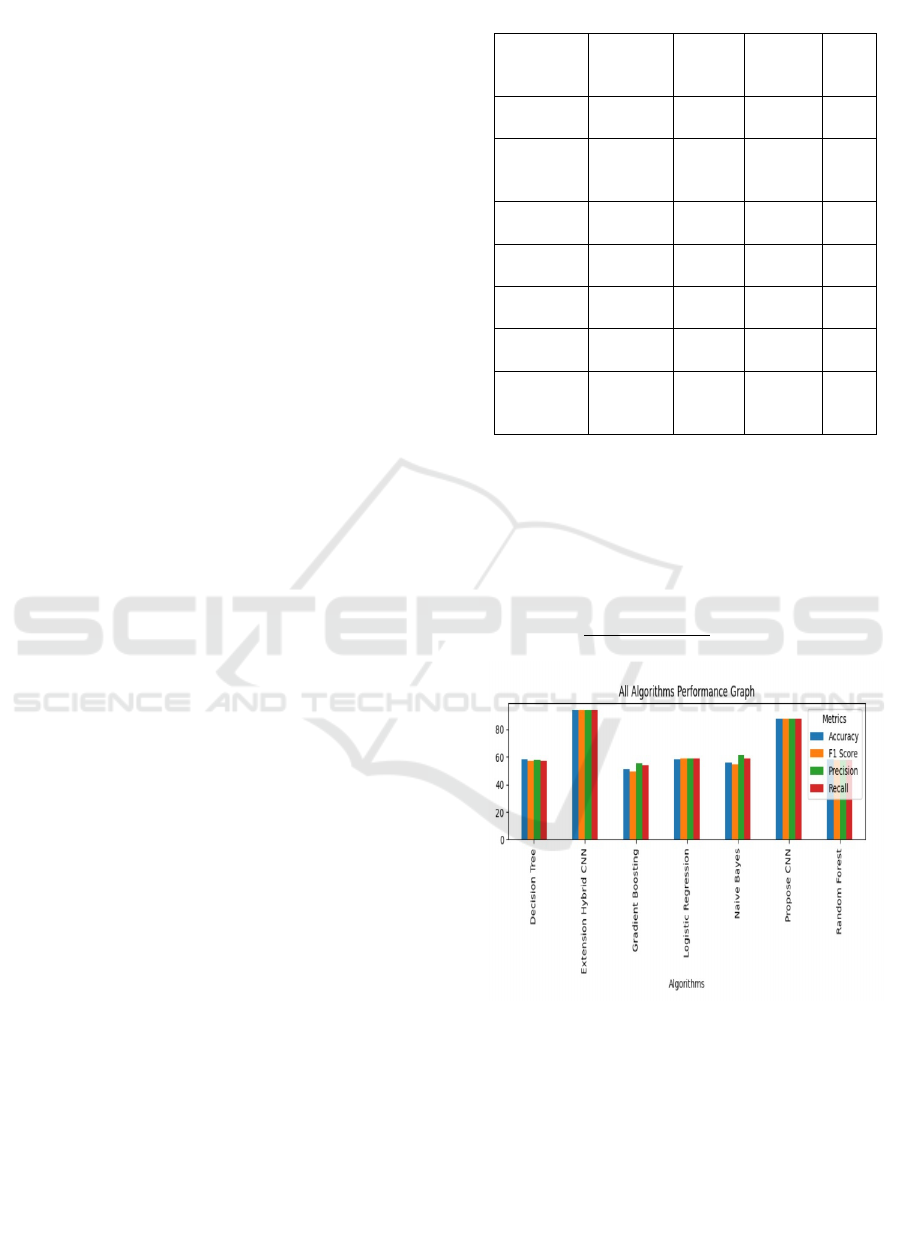
Figure 1: Accuracy graph.
5 CONCLUSIONS
This research presents a deep learning-based
approach for detecting machine-generated tweets
using CNN architecture with FastText embeddings.
The proposed system effectively differentiates
between human-generated and bot-generated tweets
ICRDICCT‘25 2025 - INTERNATIONAL CONFERENCE ON RESEARCH AND DEVELOPMENT IN INFORMATION,
COMMUNICATION, AND COMPUTING TECHNOLOGIES
510

by leveraging subword-level text representations and
deep feature extraction techniques. Experimental data
shows that the CNN model outperforms standard
machine learning methods in accuracy, durability,
and scalability. By addressing the challenges of
misinformation and manipulated content on social
media, this study contributes to the development of
reliable tools for safeguarding online discourse and
ensuring the integrity of digital interactions. Table 1
and figure 1 shows the results obtained.
6 FUTURE SCOPE
The proposed deep learning model for detecting
machine-generated tweets can be extended and
enhanced in several ways. Future research can focus
on improving detection accuracy by incorporating
transformer-based architectures like BERT or GPT
for more advanced contextual understanding.
Additionally, expanding the dataset to include
multilingual tweets will improve the model's
adaptability to diverse linguistic patterns.
Integrating real-time detection mechanisms with
social media platforms can help in the proactive
identification of deepfake content, reducing
misinformation spread. Further, combining textual
analysis with multimodal data such as images and
videos can enhance the detection of complex
deepfake content. The system can also be extended to
detect evolving AI-generated text by continuously
updating training data with the latest generative
models.
REFERENCES
C.Grimme, M.Preuss, L.Adam, and H.Trautmann,
‘‘Socialbots: Human like by means of human control?’’
Big Data, vol. 5, no. 4, pp. 279–293, Dec. 2017.
H. Siddiqui, E. Healy, and A. Olmsted, ‘‘Bot or not,’’ in
Proc. 12th Int. Conf. Internet Technol. Secured Trans.
(ICITST), Dec. 2017, pp. 462–463.
J. P. Verma and S. Agrawal, ‘‘Big data analytics:
Challenges and applica tions for text, audio, video, and
social media data,’’ Int. J. Soft Comput., Artif. Intell.
Appl., vol. 5, no. 1, pp. 41–51, Feb. 2016.
J. Ternovski, J. Kalla, and P. M. Aronow, ‘‘Deepfake
warnings for political videos increase disbelief but do
not improve discernment: Evidence from two
experiments,’’ Ph.D. dissertation, Dept. Political Sci.,
Yale Univ., 2021.
J.-S. Lee and J. Hsiang, ‘‘Patent claim generation by fine-
tuning OpenAI GPT-2,’’ World Pat. Inf., vol. 62, Sep.
2020, Art. no. 101983.
L. Beckman, ‘‘The inconsistent application of internet
regulations and suggestions for the future,’’ Nova Law
Rev., vol. 46, no. 2, p. 277, 2021, Art. no. 2.
M. Westerlund, ‘‘The emergence of deepfake technology:
A review,’’ Technol. Innov. Manage. Rev., vol. 9, no.
11, pp. 39–52, Jan. 2019.
R. Zellers, A. Holtzman, H. Rashkin, Y. Bisk, A. Farhadi,
F. Roesner, and Y. Choi, ‘‘Defending against neural
fake news,’’ in Proc. 33rd Int. Conf. Neural Inf.
Process. Syst. (NIPS), Dec. 2019, pp. 9054–9065, Art.
no. 812.
R. Dale, ‘‘GPT-3: What’s it good for?’’ Natural Lang. Eng.,
vol. 27, no. 1, pp. 113–118, 2021.
S. Vosoughi, D. Roy, and S. Aral, ‘‘The spread of true and
false news online,’’ Science, vol. 359, no. 6380, pp.
1146–1151, Mar. 2018.
S. Bradshaw, H. Bailey, and P. N. Howard, ‘‘Industrialized
disinformation: 2020 global inventory of organized
social media manipulation,’’ Comput. Propaganda
Project Oxford Internet Inst., Univ. Oxford, Oxford,
U.K., Tech. Rep., 2021.
W. D. Heaven, ‘‘A GPT-3 bot posted comments on Reddit
for a week and no one noticed,’’ MIT Technol. Rev.,
Cambridge, MA, USA, Tech. Rep., Nov. 2020, p. 2020,
vol. 24. [Online]. Available:
www.technologyreview.com
X. Liu, Y. Zheng, Z. Du, M. Ding, Y. Qian, Z. Yang, and J.
Tang, ‘‘GPT understands, too,’’ 2021,
arXiv:2103.10385.
Deep Fake Detection for Identifying Machine Generated Tweets Using NLP and DL
511
