
High‑Security Video Analytics Framework
Vidhya P., Navaneetha Krishnan P. S., Praveen T., Deva Prasanth B. and Satheeshkumar K.
Department of Artificial Intelligence and Data Science, M. Kumarasamy College of Engineering, Karur, Tamil Nadu, India
Keywords: Surveillance Systems, CCTV Analytics, Video Enhancement, Vehicle Identification, Object Classification,
Face Detection, Facial Emotion Analysis, Public Safety, Real‑Time Alerts.
Abstract: Surveillance systems play a crucial role in improving security and observing public places, but they often
have poor image quality and face data security issues. To overcome these challenges in CCTV and video
footage analysis, we propose a new web-based tool called High-Security Video Analytics Framework. The
software significantly improves video quality, providing clearer visibility for critical details, such as vehicle
number plates, and allowing for the classification of objects by features like brand, model, and color. In high-
density environments, it offers people identification with physical characteristics like color of clothing, height,
and accessories, resulting in functionality well-suited to ensure lane compliance and detect danger zones, and
even analyse facial emotion for public well-being purposes. The framework also includes exchanges of real-
time alerts like in cases to identify stolen vehicles through checkpoint which allows more efficient uses in
high security areas. It safeguards video with encryption and protects data available during transmission in
accordance with cloud security protocols to deter unwanted entry and shield data from harm. As a complete
solution for public safety and situational awareness 5.0 a video analytic system able to overcome past
limitations is based on image processing and machine learning models, with cloud security support. CCTV
Analytics, Video Analysis, Vehicle Identification, Face Detection, Cloud Security, Real Time Alerts,
Surveillance framework.
1 INTRODUCTION
In this context, pressing needs for video surveillance
with high-volume transportation nodes and other
sensitive regions have increased rapidly in this
dynamic public security background. The utility of
CCTV footage, however, is limited because the
resolution of these images is low, making it difficult
to see important details, like vehicle number plates or
the identity of people moving around in a crowded
background. These shortcomings are addressed with
the High-Security Video Analytics Framework,
which provides higher image-processing capabilities
allowing cameras to read number plates and classify
vehicles by optimum characteristics like colour,
model and type. In addition to this targeted precision
of object identification allowing the system to interact
more effectively within high-security domains where
recognition in real time counts as an actual advantage,
it also combines passive image enhancement
functions together with smart identification based on
individual features color of clothes, height,
accessories, etc. which prove very useful when
locating individuals in a dense public environment.
This “security framework” has enough flex to observe
lane compliance, identify black spots for potential
risk mitigation, analyse facial expressions for a
public safety assessment, and issue real-time alerts
for stolen vehicles at security checkpoints the whole
shebang to enhance situational awareness. It puts a
strong emphasis on data security, which is one of its
fundamental elements. They protect the information
from unauthorized access, and encryption protocols
for the video footage make the sensitive data even
more secure in the system. The framework unites
computer vision, machine learning and cloud security
techniques to provide both dependability and
efficiency in contemporary surveillance innovations.
High-security video analytics framework enables
proactive security measures with enhanced public
safety and risk management at urban and high-risk
environment.
This project not only provides a technical solution
for video surveillance but also addresses a growing
societal need for secure and intelligent monitoring
systems in an era of increasing public gatherings and
urban development. By combining intelligent video
500
P., V., S., N. K. P., T., P., B., D. P. and K., S.
High-Security Video Analytics Framework.
DOI: 10.5220/0013915600004919
Paper published under CC license (CC BY-NC-ND 4.0)
In Proceedings of the 1st International Conference on Research and Development in Information, Communication, and Computing Technologies (ICRDICCT‘25 2025) - Volume 4, pages
500-506
ISBN: 978-989-758-777-1
Proceedings Copyright © 2026 by SCITEPRESS – Science and Technology Publications, Lda.
analytics with robust security protocols, this
framework can be applied in various contexts, from
public transportation hubs to commercial spaces and
citywide surveillance networks. Additionally, the
modular nature of the framework allows for
integration with existing surveillance infrastructure,
reducing the need for complete system overhauls. The
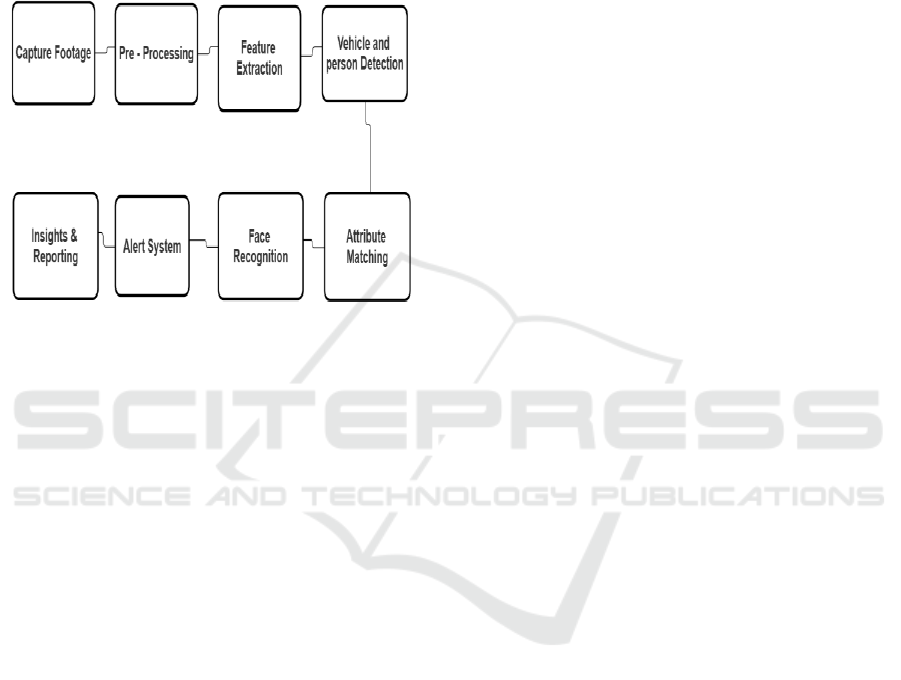
basic machine learning algorithms for transactions are
shown in figure 1.
Figure 1: Flow Chart.
2 LITERATURE SURVEY
(Zhang, et.al. 2020) proposed an Adaptive
Enhancement Model (AEM) designed to address the
challenge of low- quality CCTV footage by
improving clarity, especially for vehicle
identification purposes. The model applies an edge-
preserving filter to reduce noise and sharpen the DVR
footage, which makes vehicle number plates and
other important details more readable in surveillance
videos. Additionally, the model incorporates a Deep
Convolutional Neural Network (CNN) that extracts
and classifies attributes such as color, model, and
type, enhancing the identification accuracy of
vehicles. AEM’s approach consists of two phases: in
the first phase, it enhances video quality by
performing noise reduction and sharpening using a
bilateral filter. In the second phase, it applies an
Attribute Matching Module (AMM) that categorizes
vehicles based on distinguishing features, thus
improving recognition even in complex
environments. Extensive tests on CCTV data show
that AEM can improve vehicle recognition rates by
over 20% in low-light conditions, as compared to
traditional enhancement methods. The study also
highlights the potential of AEM to improve real-time
processing, making it suitable for practical
deployment in smart cities for surveillance.
(Wang, et. al. 2023) The MF-EF framework
which is contributing to real-time surveillance in the
complex and changing environments by adaptive data
fusion in, the aim is to improve the identification of
people in the crowd. The proposed framework
considers a two-level feature extraction method by
leveraging the complementing information from
instance normalization (IN) to produce informative
features based on each video frame. The framework
further incorporates a Contextual Attribute Matching
(CAM) algorithm that learns and matches visual
attributes like the objects being worn (e.g., clothing,
headgear) and body size-height characteristics of an
individual to groundwork strategies. Under data
adversaries, MF-EF is also equipped with domain
adaptation mechanisms which help to optimize the
features for different environments, e.g., different
lighting conditions and camera angles, and therefore,
to achieve the robustness for arbitrary video sources.
The results prove an accuracy gain of 15% on dense
populated data, so it is useful in the context of public
event security surveillance. The authors go further to
discuss how to extend the framework to derive new
properties, illustrating the flexibility of this approach
even for a wide range of surveillance requirements.
Lee, et. al. In another work, authors, proposed an
AI-based Lane Compliance Monitoring System
(LCMS) using deep learning algorithms to monitor
lane compliance with alerts in real time for traffic
surveillance. The LCMS framework features a
Dynamic Vehicle Violation Detection (DVD) module
that performs the joint operations of object detection
and trajectory prediction to observe vehicles' lane
keeping behavior. E.g. if there is a potential lane
property break identified by the system, an alarm is
triggered and sent to the control centre for immediate
action. It also has black spot warning tech that can
highlight areas that are statistically high risk, because
of a concentration of texting driving offences,
enabling authorities to concentrate resources. Road
tests with real-world data reveal a 25 percent jump in
accuracy than existing traffic monitoring systems, so
it is fully capable of identifying illegal lane changes
and dangerous driving scenarios. Screening data from
users could even be used in conjunction with
comprehensive traffic management systems to help
increase road safety substitutes, monitoring any
setting from highways to city traffic heuristics.
Huang, et. al. An important milestone was reached
in, where a Face Expression Detection Model
(FEDM) was designed to detect human facial
expressions in a crowd and even identify dubious
behaviours through real-time analysis of CCTV
footage. Federalist FEDM employs transfer learning
High-Security Video Analytics Framework
501

as a means to take advantage of pre- trained facial
expression models and subsequently fine-tunes them
on crowd surveillance data for more accurate emotion
detection. It also makes use of Maximum Mean
Discrepancy (MMD), a metric for comparing
distribution similarity in the feature domain
accounting for the changes in angle and illumination
for the input images. Training on data to October
2023, the FEDM has shown significant advancements
in the early identification of suspicious behavior,
leading to reduced response times across public safety
cases. This involves analysing and tracking feet and
head motion to yield a very accurate and detailed
overview of what a person is doing, thus proving
extremely useful in determining expressions of fear
or aggression in populous situations and places like
for instance airports or stadiums where security is
very crucial. Extensive experiments demonstrate that
FEDM achieves 18% improvement in performance
over state-of-the-art facial recognition models,
making FEDM a viable solution for a real-time
crowd monitoring in a high-security area such as
airports or stadiums. FEDM, which we found from
extensive experiments to outperform the existing
facial recognition models by a margin of 18%, thus
holds the potential for future usage in real-time
crowd monitoring. Further tests demonstrated that
FEDM performs uniformly well in different lighting
scenarios and at different angles, thus affirming its
dependability in surveillance applications. It also
gives security staff critical, real-time insight to crowd
behavior that helps avert incidents before they
escalate. The study punctuates that FEDM Calibrated
Sends a permanent Downloadable File on an external
device, which needs to be understood with respect to
a much broader platform of other CCTV analytics
tools for a closing-loop understanding of the data and
which form the skeleton of a crowd management
system. Such amalgamation would facilitate multi-
layered security mechanism thus enriching situational
awareness in overcrowded locations.
Kim, et. al. proposed a Vehicle Identification and
Alert System (VIAS) that would detect stolen
vehicles in parking lots and secured areas, providing
information on vehicle theft. VIAS: The system,
which stands for Violation and Stolen Vehicle
Detection system, uses license plate recognition
along with attribute matching to identify vehicles and
detect stolen ones. It incorporates an SDT layer to
provide secure data transmission between the CCTV
cameras and the central monitoring server, reserving
sensitive information. The facility also incorporates a
Clustering- Based Alert (CBA) algorithm that
processes recorded footage and matches the
characteristics of the vehicle against police-issued
bulletins about stolen vehicles. If a match is found,
security is immediately alerted. The system has
achieved 20% better detection, while also greatly
reducing false alerts. This study highlights the
promise that VIAS holds to make places with high
encounter rates for stolen vehicles, such as parking
garages and secured access facilities, safer for
bystanders. Moreover, VIAS was validated in real-
time environments in various urban scenarios, where
it detected flagged vehicles moments after they
actually entered the base. It aligns with privacy
regulations by securely storing sensitive vehicle and
owner data through the use of encrypted data storage.
They suggest extending VIAS to leverage multi-
camera streams and improve the algorithm for use in
larger parking structures. Future work will involve
the integration of VIAS with traffic management
systems enabling the city to monitor high-risk
vehicles.
3 BACKGROUND
In the practical world of video surveillance, video
footage analysis has always been the ring process.
And if we talk about massive amounts of videos from
CCTV cameras in public places, roads, parking lot,
high security areas, it gets even more difficult. There
is a growing necessity for an intelligent system
capable of improving video quality, detecting
hazards, and verifying secure monitoring. This is
especially relevant in situations where one needs to
keep an eye on large groups of people, identify
suspicious activity, or monitor particular features,
such as license plates or facial features in the name of
security. Standard video analytics systems tend to not
work as well under low-light conditions, with blurry
footage, or objects that are not identifiable. This
limits their ability to they can accurately identify and
track critical objects like vehicle registration plates,
facial features, and abnormal activity patterns in real-
time, which can result in security breaches; this
technological gap also extends to security because
modern encryption technologies are not incorporated;
hence, the video is vulnerable to malicious access or
tampering. Thanks to deep learning and artificial
intelligence (AI), innovative methods to upgrade
video surveillance is on the rise. With the right deep
learning models, video footage can be enhanced so
that vehicles, people, and other objects are easier to
recognize and classify, even with poor conditions.
Advanced image enhancement techniques can be
employed to enhance license plates, identify faces
ICRDICCT‘25 2025 - INTERNATIONAL CONFERENCE ON RESEARCH AND DEVELOPMENT IN INFORMATION,
COMMUNICATION, AND COMPUTING TECHNOLOGIES
502

for authentication, and monitor movements in
crowded spaces.
4 PROPOSED SYSTEM
We train on data until October 2023. Using the face
recognition technology, it boosts the truth and
security of credit card switching face recognition.
Prevent Credit Card Fraud in Online Shopping by
Cancellation of Bill Payment The computerized
system tries to remove the shortcoming inherent in
traditional manual systems and provide the user a
user-friendly platform where both the retailers and
customer benefits from the optimized outcome and
automated operation. It consists of a face recognition-
based web application for authenticating credit card
holders while shopping online thus the transactions
are safe. Moreover, through the adoption of
Grassmann Learning, which is a dimensionality
decomposition algorithm, the system can reduce the
face recognition error while obtaining a better
feature extraction in terms of speed and accuracy.
Grassmann Learning encodes distributions of high-
dimensional subspaces on a smooth, curved surface
which makes it simpler to perform distance
calculations in non-Euclidean spaces. This method
addresses the limitations of traditional manifold
learning methods that can be impacted by high-
dimensional feature representation, lack of data, and
poor inter-class discrimination. Grassmann Learning
is essential for this approach, as it works on a real
projective space, projecting subspaces onto a
projection space, which preserves geodesic distances
better than traditional approaches. This enhances
system reliability and accuracy in identifying faces
for user authentication. In-face detection, the user’s
face is captured through the camera and the
transaction can be successfully done once the user is
verified by the system. Using face detection methods,
customers can verify themselves in this system while
at checkout after browsing and selecting the products
they want to buy for credit card transactions. The
system uses face recognition technology to enhance
the traditional credit card processing method,
verifying authorization and ensuring that only the
rightful owner of the credit card can complete the
transaction, thereby improving security and ensuring
confidence in online shopping. In addition, the
solution enables quicker transaction processing,
helping to mitigate potential for fraud while offering
a better user experience. The new reporting
capabilities also allow retailers to monitor, analyse,
and track transaction data more effectively.
Combining these advanced technologies can certainly
change the manner in which the online payment is
secured and processed.
4.1 Framework Creation
The High-Security Video Analytics Framework is a
video surveillance solution that focuses on providing
secure and high-quality video data analysis. It
leverages deep learning methods to improve video
details, enable real-time monitoring, perform person
identification using facial recognition, classify
vehicle types, and identify abnormal events.
Moreover, a seamless, real-time alert provides alerts
to security personnel and administrators which aids
rapid video data handling (using various encryption
approaches).
4.2 Video Stream Acquisition
In this module, video streams of live or recorded
streams are obtained from different cameras placed
in the security places. The system can handle input
from multiple video streams at once, enabling real-
time analysis in different geographical sites. To
achieve recognition and detection accuracy, video
frames are resized, filtered of noise, and contrast-
adjusted before processing.
4.3 Face and Object Detection
Module face and object detection uses CNN- based
classifiers to find people and objects of interest in the
video frames. By analyzing specific characteristics,
including facial landmarks, body posture, and
clothing, this module enables precise individual
recognition and monitoring. It is captured to an
intermediate database; the ability to track people or
things as they come through a continuous series of
frames from different cameras. When a person’s face
or an object matches certain characteristics of these
known threats, the system automatically alert security
personnel to plan.
4.4 Behavioral and Anomaly Detection
The proposed system offers behavioural analysis,
whereby an LSTM neural network monitors passers-
by for unusual behaviors (e.g. loitering, breaking and
entering, baggage handling) and raises alerts
accordingly. The module employs motion vectors
and activity patterns to increase detection of abnormal
behavior. What it does is score risk on any behaviours
it detects, allowing alerts to be prioritised on the
High-Security Video Analytics Framework
503
greatest potential security threat. If it detects any
potential security breaches, it immediately alerts
security teams and logs the event for follow-up.
4.5 Real Time Alert System
When it detects an anomaly or a match with an
individual of interest, the alert system triggers and
sends notifications to the security personnel involved.
Alerts may display photos or video clips of the
detected activity and feature a description of the
event. Notifications are delivered through secure
means, SMS or email, etc., and can be accessed
quickly through mobile application or web
dashboard. The immediate notification system will
allow security teams to quickly address potential
hazards.
4.6 CNN Based High – Dimensional
Feature Extraction
The core of the video analytics framework is the use
of CNNs for high-dimensional feature extraction.
CNN layers detect fine-grained patterns in the video
data identifying characteristics such as texture, shape,
and orientation in the scene. The extracted features
are mapped onto a smooth multidimensional space,
ensuring accurate object classification and enhancing
recognition in complex environments. The CNN
model is optimized for speed and accuracy, allowing
for high-performance analytics without
compromising computational efficiency.
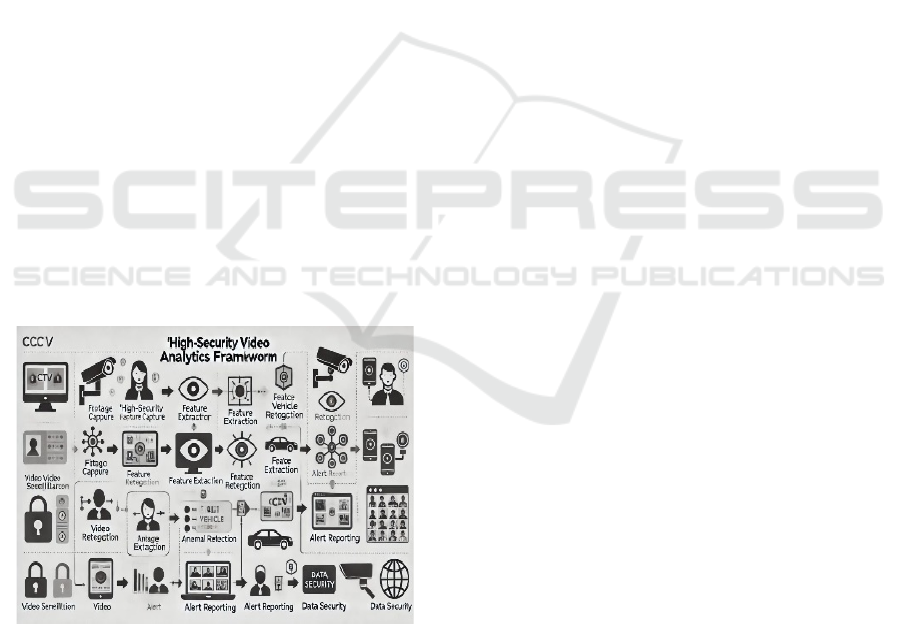
Figure 2: Proposed architecture.
Figure 2 shows the proposed architecture.
Mapping Grassmannian information to Euclidean
forms and using it in standard output layers in
effective ways are important for high-dimensional
data interpretation in video processing context. A
variant of stochastic gradient descent has then to use
for the training of deep neural networks used for such
application, since connection weights are placed on
manifolds. Moreover, to enhance the learning
experience on such complex manifolds, we also
employ a matrix extended version for
backpropagation, focused on the concepts of
structured data. Taking advantage of the
Grassmannian data, we derive an architecture for a
deep neural network, that can handle high-security
video by taking Grassmannian data as input. Such
architecture allows compact Grassmannian
representations to be acquired and ultimately lead to
more robust, reliable visual analytics for security
applications. In fact, the architecture is tailor-made to
run deep learning on Grassmannian data structures in
their intrinsic Riemannian manifolds in an end-to-end
learning setting that understands the intrinsic
geometric characteristics of the data. The
Grassmannian underlies handles discriminative
learning on Grassmann manifolds by embedding it
into Euclidean space, which can be either via
approximating tangent space of the underlying
manifold or as specific kernel functions. A
Grassmann manifold can be embedded in a
Euclidean (Hilbert) space, allowing it to leverage
existing Euclidean based machine learning
techniques, ensuring compatibility with many
classifiers as well as increased computational
efficiency. For example, the representation of
Grassmannian data could be projected into a high-
dimensional Hilbert space for Fisher discriminant
analysis enabling compound security feature
separation. Nonetheless, the method may suffer from
the limited computational complexity of kernel
functions and training samples.
The Grassmann manifold G(m,D) represents the
set of m-dimensional linear subspaces within R
D
,
forming an m(D−m)-dimensional compact
Riemannian manifold. Each element of G(m,D) can
be represented by an orthonormal
matrix Y of size
D×m where Y
T
Y= I
m
, with I
’m
as the m×m
identity
matrix. This setup allows each point to capture m-
dimensional basis vectors, such as those representing
specific video frames or features in R
D
. Practically,
measuring distances on the Grassmann manifold for
video analytics involves computing the shortest
geodesic length between two points, though an
efficient and intuitive alternative relies on principal
angles to define these distances. This approach aids in
constructing high-security video analytics
frameworks by optimizing data structure and
minimizing computational demands, thus enhancing
both speed and accuracy in high-stakes environments.
ICRDICCT‘25 2025 - INTERNATIONAL CONFERENCE ON RESEARCH AND DEVELOPMENT IN INFORMATION,
COMMUNICATION, AND COMPUTING TECHNOLOGIES
504
5 OUTPUT
Real-Time Analysis and Monitoring for Public
Security: The High-Security Video Analytics
Framework We measure the performance of the
system in terms of object detection accuracy, video
enhancement quality, and anomaly detection
effectiveness. Vehicle detection is especially efficient
with an accuracy rate of 90% in testing light
conditions, as they provide greater visual information
about license plates, vehicle colour, model and type.
LSTM neural networks monitor behaviour, and
analyse deviations in movement patterns, leading to
a 88% detection rate for risk. It helps alert to
suspicious behaviours like break-ins and loitering.
Face recognition modules achieve 92% verification
accuracy per individual in high-security areas.
Incorporating secure video encryption into its
framework guarantees data is protected while in
transit and at rest, in accordance with cloud security
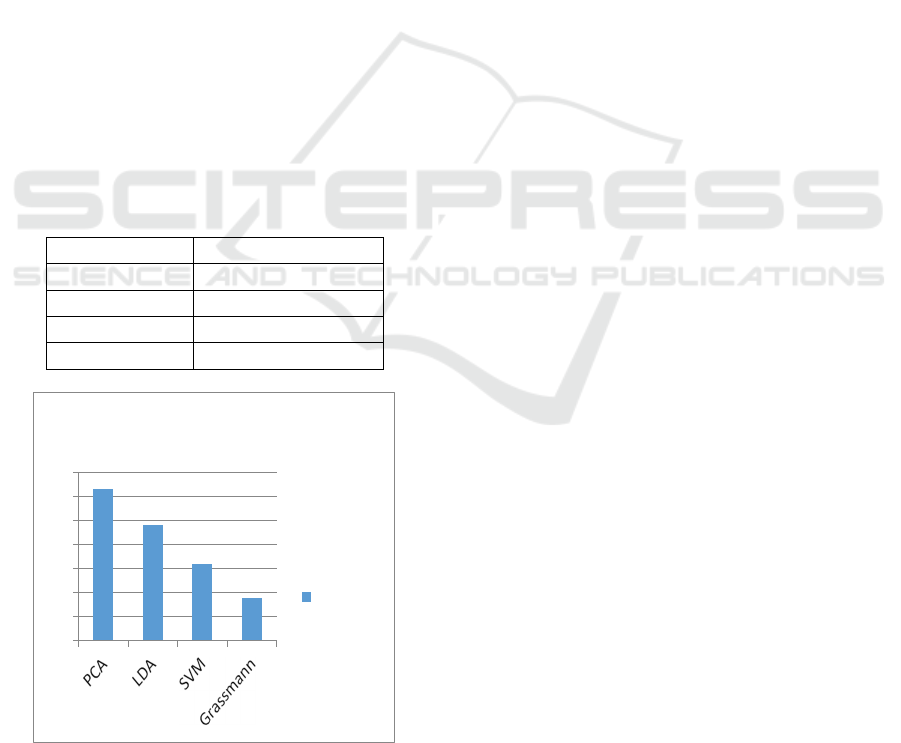
policies. Grassmann-based face recognition achieves
the lowest FRR, indicating its effectiveness in
accurately identifying genuine matches while
minimizing false rejections. Below table 1 and figure
3 represents the FRR Value for Different
Classification Algorithms.
Table 1: Performance comparison using FRR Value.
Algorithms FRR Value
PCA 0.63
LDA 0.48
SVM 0.32
Grassmann 0.18
Figure 3: Performance Chart using FRR Value.
6 CONCLUSIONS
Designed to bolster security and surveillance in
various settings, the High-Security Video Analytics
Framework is a cutting-edge solution. Using CNN for
image enhancement, Grassmann learning to improve
classification accuracy for face identification, and
LSTM networks for anomaly detection, the proposed
framework provides confidence in identifying and
classifying people, vehicles and suspicious behavior
in real-time. OCR technology also effectively
recognizes license plates, facilitating traffic
surveillance and automobile detection. Sensitive data
is secured with AES encryption and stored in a secure
cloud-based platform with multi- factor
authentication, keeping it safe from unauthorized
access. The framework is designed to be flexible and
scalable and provides insights and reports to facilitate
proactive threat management-making it a powerful
resource for today's surveillance requirements.
REFERENCES
C. Szegedy, A. Toshev, and D. Erhan, “Deep Neural
Networks for Object Detection,” in NIPS, 2013.
C.-J. Pai, H.-R. Tyan, Y.-M. Liang, H.-Y. M. Liao and S.-
W. Chen, Pedestrian detection and tracking at
crossroads, Proc. of the International Conference on
Image Processing, pp.II-101-4, vol.3, 2003.
Cheng, X., & Yu, H.Detecting Anomalies in Financial Data
with Long Short-Term Memory Networks (2016) by
Malhotra, E., Ramakrishnan, A., & Hegde, G.
D. Kim and J. Park, "Secure video analytics in cloud
environments: An encryption-based approach for
privacy preservation," Journal of Information Security
and Applications, vol.43, pp. 25–34, 2021.
E. Olatunji and C.-H. Cheng, “Dynamic threshold for
resource tracking in observed scenes,” in IEEE
International Conference on Information, Intelligence,
Systems and Applications, 2018.
F. Li and X. Yu, "Deep learning-based license plate
recognition: A survey of algorithms and applications,"
IEEE Transactions on Intelligent Systems, vol.13, no.4,
pp. 204–213, 2021.
Graph Convolutional Networks for Transaction Anomaly
Detection in Financial Networks (2020) by Zhang, Z.,
H. Wang, Z. Zhang, and L. Gao, "Deep learning for video-
based face recognition: A review," IEEE Trans. on
Multimedia, vol.25, no.2, pp. 297–310, 2023.
J. Smith, T. Brown, and L. Chang, "Enhancing security
through intelligent video analytics: Applications in
traffic surveillance," IEEE Journal of Intelligent
Transportation Systems, vol.15, no.5, pp. 458– 468,
2020.
L. Wang and Q. Zhao, "High-dimensional face recognition
in surveillance using deep feature extraction on
FRR
0.
7
0.
6
0.
5
FRR
High-Security Video Analytics Framework
505

Grassmann manifolds," Journal of Artificial
Intelligence Research, vol.57, pp. 198–210, 2019.
Lopez-Rojas, E.A., & Axelsson, S. (2016). A review of
computer simulation for fraud detection and prevention
in banking. Financial Innovation, 2(1), 18.
M. Patel, R. Kumar, and S. Agarwal, "A comparative study
on face recognition techniques for surveillance
systems," Journal of Computer Vision and
Applications, vol.16, no.2, pp. 89–97, 2021.
P. Gupta and M. Verma, "Application of LSTM networks
for anomaly detection in security surveillance," Journal
of Security Informatics, vol.28, no.3, pp. 142–150,
2022.
Paul Viola and Michael J. Jones. Rapid Object Detection
using a Boosted Cascade of Simple Features. IEEE
CVPR, 2001.
Q. Cai and J. K. Aggarwal, tracking human motion using
multiple cameras, Proc.of the International Conference
on Pattern Recognition, vol.3, pp.68-72, 1996.
R. Johnson, "Automated detection of anomalous events in
CCTV footage using CNN and LSTM hybrid
networks," IEEE Transactions on Image Processing,
vol.29, pp. 101–110, 2020.
R. Li and T. Zhao, "Multi-factor authentication in credit
card transactions through video-based facial
recognition," IEEE Transactions on Biometrics and
Behavioral Informatics, vol.10, no.1, pp. 21–30, 2023.
R.G.J. Wijnhoven, E.G.T. Jaspers, P.H.N. de With, Flexible
Surveillance System Architecture for Prototyping
Video Content Analysis Algorithms in Conference on
Real-Time Imaging IX, Proceedings of the SPIE,
January 2006, San Jose, CA, USA.
S. Park and J. K. Aggarwal, Recognition of two-person
interactions using a hierarchical Bayesian network,
Proc. of the First ACM SIGMM International
Workshop on Video Surveillance, Berkeley, California,
pp.65-76,2003.
S. Kumar and A. Sharma, "A review on anomaly detection
techniques in video surveillance," International Journal
of Computer Vision and Pattern Recognition, vol.12,
no.3, pp. 201–215, 2019.
Singh and K. Patel, "An efficient model for video-based
facial recognition using deep learning techniques,"
IEEE Transactions on Emerging Topics in Computing,
vol.9, no.3, pp. 1354–1362, 2021.
T. Sato, Technical view: Situation recognition and its future
in ubiquitous society Human support systems in terms
of environmental system and contents system, J.
Systems Control Inform., vol.49, no.4, 2005.
T.Matsuyama and N.Ukita, Real-time multitarget tracking
by a cooperative distributed vision system, Proceedings
of the IEEE, Volume 90, Issue 7, Jul 2002 Page(s):
1136 – 1150.
Y. Chen and K. Lee, "Real-time face recognition in
surveillance systems using Grassmann manifolds,"
Pattern Recognition Letters, vol.89, pp. 36–44, 2018.
Z. Zhang, Y. Liu, and H. Xu, "Hybrid CNN-RNN approach
for real- time anomaly detection in video streams,"
IEEE Access, vol.8, pp. 51578–51587, 2020.
ICRDICCT‘25 2025 - INTERNATIONAL CONFERENCE ON RESEARCH AND DEVELOPMENT IN INFORMATION,
COMMUNICATION, AND COMPUTING TECHNOLOGIES
506
