
A Multi‑Layer Perceptron Model for Predicting Smartphone
Addition Levels
S. Nasrin, M. Fahimunnisa, Aslam Shareef, S. Ananya Jyothi and P. Jasmin
Department of Computer Science, Ravindra College of Engineering for Women, Venkayapalle, Pasupala, NH 340C,
Nandikotkur Rd, Kurnool, Andhra Pradesh, India
Keywords: Machine Learning, Behavioral Analysis, Predictive Model, Digital Well‑Being, Classification Algorithms,
User Behavior, Artificial Intelligence, Neural Networks (ANNs), Mental Health.
Abstract: Smartphone addiction is a serious issue, with adverse effects on mental health, academic achievement, sleep
and social relationships. Conventional self-reported questionnaires tend to be inaccurate and susceptible to
bias, requiring automated approaches. This research suggests a machine learning model to forecast
smartphone addiction based on behavioral metrics like screen time, app usage, social media usage, call
duration, and phone unlock frequency. Psychological variables from well-validated questionnaires are also
included to enhance prediction accuracy. Different machine learning algorithms such as Decision Trees,
SVM, Random Forests, and Neural Networks are experimented with on a labeled dataset. Accuracy, precision,
recall, and F1-score are used to evaluate the models, and the results indicate that ensemble methods such as
Random Forests work best. The system allows real-time tracking of smartphone addiction risks. It provides
an early intervention proactive approach and management of addiction. It can be implemented into digital
health applications for users, educators, and healthcare providers. It ultimately seeks to enable healthier
smartphone use and digital well-being.
1 INTRODUCTION
In recent years, smartphones have transformed from
mere communication tools into indispensable digital
companions. Their integration into everyday life
ranging from social networking and entertainment to
education and business has created a deep reliance on
mobile devices. While smartphones offer immense
convenience and connectivity, their overuse has given
rise to a modern behavioral disorder known as
smartphone addiction. This addiction is characterized
by compulsive and excessive use of smartphones,
leading to negative impacts on mental health,
interpersonal relationships, and overall productivity.
Numerous studies have shown a significant
correlation between excessive smartphone usage and
issues such as anxiety, depression, sleep disturbances,
and poor academic or professional performance.
Particularly among adolescents and young adults, the
increasing screen time and engagement in digital
platforms have raised concerns about behavioral
dependence. Traditional diagnostic methods such as
surveys and psychological evaluations are effective
but often limited by subjective interpretation, delayed
analysis, and the inability to monitor behavioral
patterns in real-time.
The rise of artificial intelligence and machine
learning technologies presents an opportunity to
address this issue in a more dynamic and data-driven
manner. Machine learning algorithms can analyze
large volumes of behavioral data to uncover patterns
and detect signs of addictive behavior. By utilizing
smartphone usage metrics such as app usage duration,
screen time frequency, social media interactions, and
phone unlock counts along with psychological inputs,
machine learning models can provide an accurate and
automated assessment of smartphone addiction risk
levels.
This project aims to develop a machine learning
model capable of predicting smartphone addiction by
analyzing behavioral and psychological data. The
model is trained on datasets collected from
smartphone users, incorporating both usage logs and
responses from validated psychological
questionnaires. Various supervised learning
algorithms, including Decision Trees, Support Vector
Machines (SVM), Random Forest, and Neural
Networks, are employed and evaluated to determine
482
Nasrin, S., Fahimunnisa, M., Shareef, A., Jyothi, S. A. and Jasmin, P.
A Multi-Layer Perceptron Model for Predicting Smartphone Addition Levels.
DOI: 10.5220/0013915300004919
Paper published under CC license (CC BY-NC-ND 4.0)
In Proceedings of the 1st International Conference on Research and Development in Information, Communication, and Computing Technologies (ICRDICCT‘25 2025) - Volume 4, pages
482-486
ISBN: 978-989-758-777-1
Proceedings Copyright © 2025 by SCITEPRESS – Science and Technology Publications, Lda.
the most effective method for classification and
prediction.
The goal of this study is not only to enhance the
early detection of smartphone addiction but also to
support the development of preventive tools and
digital well-being solutions. By integrating such a
system into mobile applications, users can receive
timely alerts and recommendations for healthier
smartphone habits. Additionally, educators,
psychologists, and health professionals can use the
insights generated by the model to guide individuals
toward more balanced digital lifestyles and reduce the
long-term consequences of technology
overdependence.
2 RELATED WORKS
Several studies have explored smartphone addiction
prediction using machine learning. Research by Kim
et al. (2018) used Decision Trees and Logistic
Regression on usage data, showing high correlation
with addiction levels. Wang et al. (2020) applied
SVM and Random Forest for addiction classification,
achieving considerable accuracy. Lee & Lee (2021)
improved predictions by combining behavioral and
psychological data, while Chen et al. (2022)
emphasized the role of feature selection in model
performance. This study builds upon existing
research by integrating behavioral metrics with
psychological assessments and evaluating multiple
machine learning algorithms for robust addiction
prediction.
3 METHODOLOGY
3.1 Theoretical Structure
The research methodology adopted for this study
involves a systematic approach to collecting,
processing, and analyzing smartphone usage and
psychological data to develop a machine learning
model capable of predicting smartphone addiction.
The first phase involves data collection from
participants using both primary and secondary
sources. Primary data is gathered through smartphone
usage monitoring applications that log features such
as screen time, app usage frequency, call and message
duration, and unlock counts. Simultaneously,
participants are asked to complete validated
psychological questionnaires such as the Smartphone
Addiction Scale (SAS), which helps in labeling the
addiction severity.
In the second phase, the collected data is
preprocessed to ensure consistency and reliability.
Data cleaning techniques are applied to remove
duplicates, handle missing values, and standardize
feature values. Feature engineering is performed to
select the most relevant attributes that contribute
significantly to addiction prediction. This phase also
includes normalization and encoding of categorical
data to prepare the dataset for machine learning
algorithms.
The third phase focuses on model development
and training. Several supervised learning algorithms
such as Decision Trees, Support Vector Machines
(SVM), Random Forest, Logistic Regression, and
Artificial Neural Networks are implemented using
programming tools like Python and machine learning
libraries such as Scikit-learn and TensorFlow. The
dataset is split into training and testing sets to evaluate
model performance. Hyperparameter tuning and
cross-validation techniques are applied to enhance the
accuracy and generalization of the models.
Finally, model evaluation is conducted using
performance metrics such as Accuracy, Precision,
Recall, F1-score, and ROC-AUC. The model with the
highest predictive performance is selected as the final
model. The results are interpreted to determine the
patterns and factors contributing most significantly to
smartphone addiction. The methodology ensures a
robust, data-driven, and repeatable process for
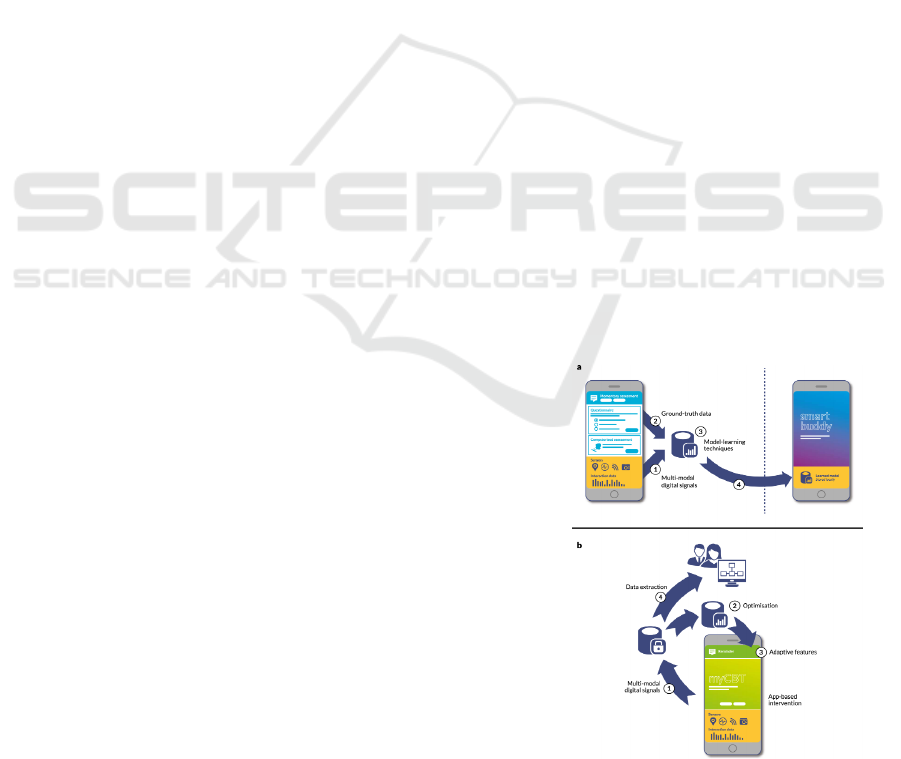
developing a predictive tool that can sbe. Figure 1
Shows the Schematic Flow of Theoretical Structure.
Figure 1: Schematic flow of theoretical structure.
A Multi-Layer Perceptron Model for Predicting Smartphone Addition Levels
483
3.2 Perceived Features
3.2.1 Data Collection and Processing
Data is collected through smartphone monitoring
apps and validated psychological scales such as the
Smartphone Addiction Scale (SAS). The dataset
undergoes preprocessing, including data cleaning,
feature selection, and encoding. Feature engineering
is applied to extract the most relevant attributes for
addiction prediction.
3.2.2 Machine Learning Model Development
Various supervised learning models are implemented,
including Decision Trees, SVM, Random Forest, and
Artificial Neural Networks. The dataset is split into
training and testing sets, with hyperparameter tuning
and cross-validation performed to enhance accuracy.
Model performance is evaluated using Accuracy,
Precision, Recall, F1-score, and ROC-AUC.
3.2.3 Statistical Analysis
Structural Equation Modeling (SEM) is used to assess
the relationship between smartphone usage behaviors
and addiction severity. Pearson’s correlation analysis
identifies the strongest predictors of addiction. The
final model is selected based on its predictive
accuracy and generalization capability.
4 PURPOSE
The proposed system aims to develop an intelligent,
data-driven, and automated model for the prediction
of smartphone addiction using machine learning
techniques. Unlike traditional systems that rely
heavily on self-reported data and static assessments,
this system leverages real-time smartphone usage
patterns and behavioral metrics to assess addiction
risk. By collecting and analyzing data such as screen
time, app usage frequency, unlock count, call
duration, and notifications, the system can detect
early signs of addiction without user intervention. A
core element of the proposed system is the integration
of machine learning algorithms to accurately classify
and predict smartphone addiction levels.
Additionally, the proposed system is designed to be
adaptive and personalized. It monitors behavioral
trends over time and adjusts risk prediction based on
a user’s changing habits. Users receive feedback in
the form of addiction risk levels (low, moderate, or
high) along with actionable suggestions such as
screen-time reduction tips, app usage control, and
wellness prompts. This feedback mechanism helps
users stay aware of their usage patterns and motivates
them to adopt healthier digital behaviors proactively.
Ultimately, the proposed system addresses the
limitations of existing solutions by providing an
intelligent, real-time, and scalable framework for
smartphone addiction prediction. It can be deployed
in mobile applications, institutional wellness
programs, or digital therapy platforms to support
individuals, students, and employees in maintaining
digital well-being. By identifying at-risk users early,
the system can contribute to preventive mental
healthcare and reduce the long-term impact of
smartphone addiction.
5 RESULT
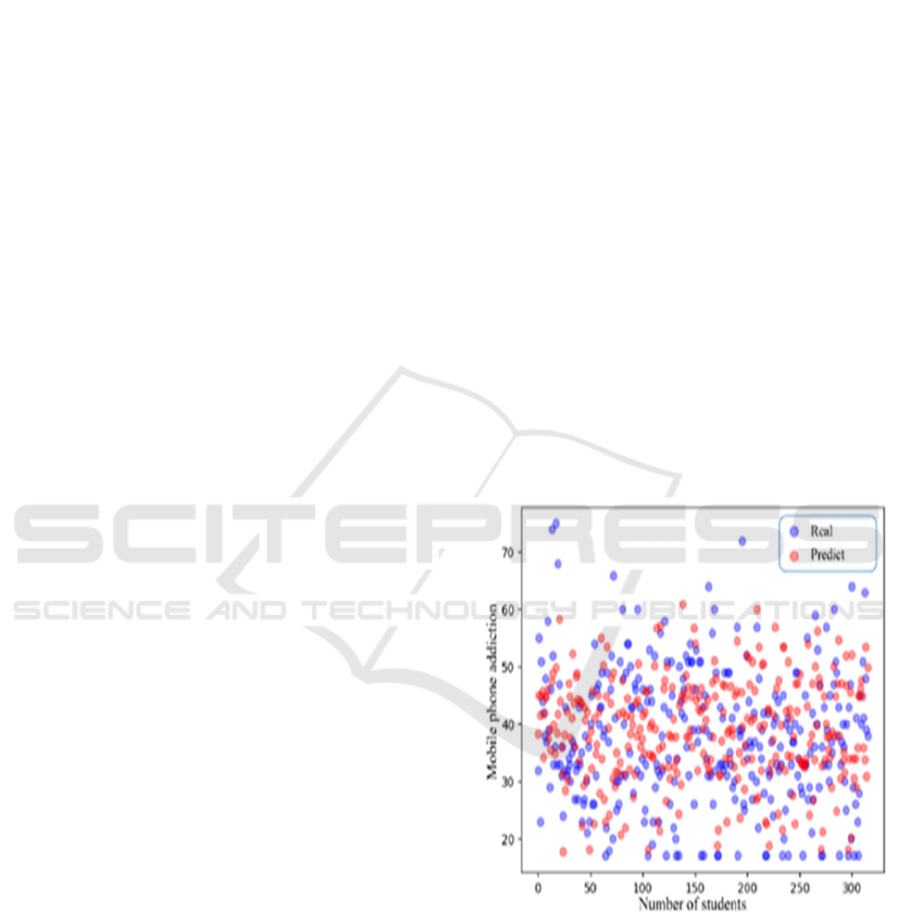
The performance of the prediction model is evaluated
by comparing real and predicted mobile phone
addiction levels among students (Figure 2).
Furthermore, the effectiveness of different machine
learning techniques is assessed using R² values across
three model variants (Figure 3).
Figure 2: Comparison of real and predicted mobile phone
addiction levels among students.
The scatter plot presented in the image visualizes
the performance of a Multi-Layer Perceptron (MLP)
model in predicting smartphone addiction levels
among students. The X-axis represents the number of
students, while the Y-axis indicates their respective
smartphone addiction levels.
ICRDICCT‘25 2025 - INTERNATIONAL CONFERENCE ON RESEARCH AND DEVELOPMENT IN INFORMATION,
COMMUNICATION, AND COMPUTING TECHNOLOGIES
484
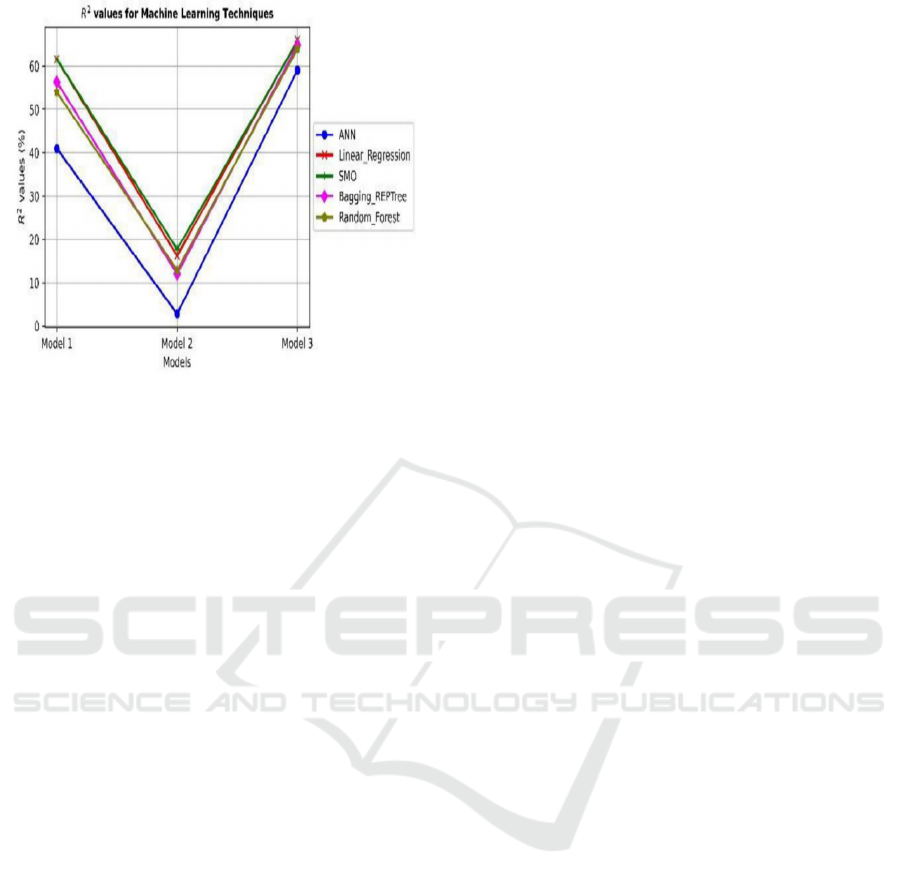
Figure 3: R² value comparison of various machine learning
models across three model variants.
6 CONCLUSIONS
In today’s technology-driven world, smartphone
addiction has become a significant concern affecting
the mental health, productivity, and social well-being
of individuals, especially among youth. Traditional
methods of identifying addiction are limited by their
dependency on subjective responses and delayed
interventions. This project presents a modern solution
by utilizing machine learning techniques to automate
and enhance the accuracy of addiction prediction,
thus enabling timely awareness and preventive
actions.
The proposed system leverages real-time
smartphone usage data and psychological inputs to
build intelligent models capable of predicting
addiction levels effectively. By integrating various
supervised machine learning algorithms and
analyzing key behavioral features such as screen
time, app usage, and unlock frequency, the model
offers a more comprehensive and accurate assessment
of smartphone addiction risk.
Moreover, the system is designed to be adaptive,
scalable, and user-centric. It not only identifies high-
risk individuals but also provides personalized
suggestions and insights to help users regain control
over their smartphone usage. The use of hybrid
data—combining behavioral and psychological
parameters—enhances the depth of analysis, making
the system a powerful tool for digital wellness and
mental health awareness.
In conclusion, this machine learning-based
approach to smartphone addiction prediction marks a
significant step forward in addressing the growing
challenges of digital dependency. With further
development and real-world implementation, this
system has the potential to support individuals,
institutions, and healthcare professionals in
promoting healthier digital habits and improving
overall quality of life.
REFERENCES
Bianchi, A., & Phillips, J. G. (2005). Psychological
predictors of problem mobile phone use.
CyberPsychology & Behavior, 8(1), 39–51.
Chen, Y., Sun, X., & Zhao, J. (2022). Feature selection
methods for smartphone addiction prediction: A
comparative study. Journal of Computational Science,
58, 101512
Demirci, K., Akgönül, M., & Akpinar, A. (2015).
Relationship of smartphone use severity with sleep
quality, depression, and anxiety in university students.
Journal of Behavioral Addictions, 4(2), 85–92.
Jeong, S. H., Kim, H., Yum, J. Y., & Hwang, Y. (2016).
What type of content are smartphone users addicted to?
SNS vs. games. Computers in Human Behavior, 54,
10–17.
Kim, J. H., Seo, M., & David, P. (2015). Alleviating
depression only to become problematic mobile phone
users: Can face-to-face communication be the antidote?
Computers in Human Behavior, 51, 440-447.
Kwon, M., Kim, D. J., Cho, H., & Yang, S. (2013). The
Smartphone Addiction Scale: Development and
validation of a short version for adolescents. PLOS
ONE, 8(12), e83558.
Lee, Y. K., Chang, C. T., Lin, Y., & Cheng, Z. H. (2014).
The dark side of smartphone usage: Psychological
traits, compulsive behavior, and technostress.
Computers in Human Behavior, 31, 373–383.
Leung, L. (2008). Linking psychological attributes to
addiction and improper use of the mobile phone among
adolescents in Hong Kong. Journal of Children and
Media, 2(2), 93–113.
Lin, Y. H., Lin, Y. C., Lee, Y. H., Lin, P. H., Lin, S. H.,
Chang, L. R., & Kuo, T. B. (2015). Time distortion
associated with smartphone addiction: Identifying
smartphone addiction via a mobile application (App).
Journal of Psychiatric Research, 65, 139-145.
Liu, C., & Ma, J. L. (2020). Social media addiction and
burnout: The mediating roles of envy and social media
engagement. International Journal of Environmental
Research and Public Health, 17(10), 3723.
Roberts, J. A., & David, M. E. (2019). The social media
party: Fear of missing out (FoMO), social media
intensity, connection, and well-being. International
Journal of Human–Computer Interaction, 35(10), 909–
914.
Rozgonjuk, D., Saal, K., Täht, K., & Vassil, K. (2020).
Predicting problematic smartphone use with personality
traits and usage patterns. Heliyon, 6(11), e05448.
A Multi-Layer Perceptron Model for Predicting Smartphone Addition Levels
485

Samaha, M., & Hawi, N. S. (2016). Relationships among
smartphone addiction, stress, academic performance,
and satisfaction with life. Computers in Human
Behavior, 57, 321–325.
Suresh, A., & Ganapathi, V. (2021). Smartphone addiction
detection using data mining techniques: A survey.
International Journal of Scientific Research in
Computer Science, Engineering and Information
Technology, 7(1), 18–23.
Wang, P., Liu, T., & Zhang, J. (2020). Machine learning-
based detection of smartphone addiction using
behavioral data. International Journal of Environmental
Research and Public Health, 17(22), 8500.
ICRDICCT‘25 2025 - INTERNATIONAL CONFERENCE ON RESEARCH AND DEVELOPMENT IN INFORMATION,
COMMUNICATION, AND COMPUTING TECHNOLOGIES
486
