
Predicting Stock Market Trends Using Supervised Learning Models
K. V. Sai Phani, K. Naresh, K. Dhanunjaya Achari, D. Jakeer,
S. Yaswanth Reddy and N. Vinay Kumar
Department of Computer Science and Engineering, Santhiram Engineering College, Nandyal, Andhra Pradesh, 518501,
India
Keywords: Stock Market Prediction, Supervised Learning, Machine Learning Algorithms, Financial Forecasting,
Decision Trees, Neural Networks, Random Forest, Support Vector Machines, Market Trends, Feature
Engineering.
Abstract: The present paper studies predicting trends in the stock market using supervised learning models. The primary
analysis is that which machine learning algorithms yield the optimal stock price trend and movement
predictions. Stock market prediction is a trampoline work due to the non-linear manner of the market.
Decision Trees and Random Forests and Support Vector Machines (SVM) and Neural Networks serve under
supervised learning techniques to study historical stock information for generating market insight. These
modeling setups are evaluated first according to how well they predict market trends and then how well they
are able to operate with their predictions in new market environments.
1 INTRODUCTION
The stock market is one of the most intensive
financial market due to random and irreproducible
price movements. Because of the complexity of
market elements and the external impact of economic
data, geopolitical circumstance, and the emotional
condition of the market the student or scholar of the
market has always struggled to accurately establish
the direction and pattern of a specific stock price.
Both methods rely on expert human analysts with a
keen intuition. Because of its inability to convert
through large-time space and fight forces business
elements, these prediction methods are failed.
Recent advances in machine learning and artificial
intelligence have allowed for the development of
better techniques for stock market prediction. One
important approach is supervised learning because it
detects complicated patterns from features to target
variable. These retrospective models learn from past
datasets to predict future trends by recognising
evolutionary patterns. Utilizing this approach allows
organizations to take advantage of three major
benefits: the ability to process large volumes of data,
to analyze nonlinear interactions, and to interpret the
results immediately.
This paper studies four supervised learning
algorithms to predict stock prices including Decision
Trees and Random Forests and Support Vector
Machines (SVM) and Neural Networks. They are
efficient and perform well in classification as well as
regression problem hence they are very good
candidates for stock price movement prediction. This
evaluation of these models will help us identify which
technique generates the best performance for stock
market trend prediction.
You are then tested on historical stock market
data of daily closing prices of stocks along with
volumes and technical indicators including moving
average and RSI (Relative Strength Index). That’s
why a preprocessing step does data cleaning,
removing data noise and outliers so that the models
work from filtered and meaningful pieces of
information. Our use of feature engineering methods
that create new predictive features that follow key
trends in the prior time series serves as input to both
models.
Different performance metrics such as accuracy
along with precision and recall and F1-score are
employed to evaluate the performed models. Cross-
validation approaches allow us to assess the
generalizability of the models to data points that
remain unseen equally to them. Validation makes
sure that models cannot learn about nuance of train
data, so they can predict when the market will move.
Phani, K. V. S., Naresh, K., Achari, K. D., Jakeer, D., Reddy, S. Y. and Kumar, N. V.
Predicting Stock Market Trends Using Supervised Learning Models.
DOI: 10.5220/0013914900004919
Paper published under CC license (CC BY-NC-ND 4.0)
In Proceedings of the 1st International Conference on Research and Development in Information, Communication, and Computing Technologies (ICRDICCT‘25 2025) - Volume 4, pages
471-477
ISBN: 978-989-758-777-1
Proceedings Copyright © 2025 by SCITEPRESS – Science and Technology Publications, Lda.
471

This research survey deals with providing a
comprehensive review of supervised learning
methods for stock price prediction tasks. Performance
evaluations are carried out on the various models to
provide crucial insights for investors and financial
analysts for taking investment decisions.
2 LITERATURE REVIEW
The stock market trend prediction has been a hot topic
for researchers’ attention due to the volatile nature of
financial markets. Over the recent years, machine
learning (ML) and deep learning (DL) techniques
proved to be essential methods for increasing
prediction results. This review will study and analyze
various studies on the implementation of ML and DL
models for stock market forecasting.
The researchers, Shaban et al.proposed an
approach named SMP-DL based on employing deep
learning methods to make accurate predictions of
stock market trends. Their prediction model uses
various deep learning techniques that improve the
accuracy of forecasting market behavior. Deep
learning outperforms both state-of-the-art and
standard financial techniques. Yan and Yang used
deep neural networks (DNN) to predict trends in
stocks. DNNs have shown ability to recognise
complex associations in datasets of stock market data,
thus can be an apt tool for predicting stock
fluctuation.
The study by Nabipour et al. analysed with
prediction of stock market trends included the
continuous data as well as discrete data to compare
and contrast the performance of various machine
learning and deep learning techniques. They have
established that deep learning models based on time-
series data provide the best prediction accuracy.
Khan et al.'s study: You are trained on data up to Oct
2023. Corporate Finance People and Corporate
Finance Experts suggested that combining public
sentiment and political situation analysis could
improve stock machine learning models work as they
presented in the study documented at. The integration
of extra factors especially sentiment analysis within
forecasting model framework help make stock price
predictions more comprehensive.
An efficient supervised machine learning method
that used combinations of decision tree and support
vector machine to forecast stock trends is presented
in. This way the method reduces computational needs
for model implementation without compromising the
quality of the predictions, thus enabling its use for
processing in real-time. Kumbure et al. provided an
analytical review of stock market prediction with
machine learning. who reviewed several methods
and data sources? Their research suggests that for
accurate stock market predictions it is necessary to
select suitable features and good datasets.
The authors conducted a survey of stock market
prediction through computational intelligence
approaches describing neural networks together with
evolutionary algorithms and hybrid modeling
techniques in their research. The current analysis
demonstrates the necessity of developing adaptive
forecasting models because market conditions tend to
change quickly. In their comparative analysis Kurani
et al. demonstrated that SVM yields superior
accuracy outcomes compared to ANN particularly
when analyzing stock markets with volatile
conditions.
According to Chhajer et al. stock market
prediction utilizes applications of ANN, SVM and
Long Short-Term Memory (LSTM) networks. The
authors determined that long-term dependency
handling capacity of LSTM models makes them
superior to conventional methodologies for time-
series data analysis. The authors Ali et al. conducted
research involving the application of ANN and SVM
models for financial time series direction prediction.
Research conducted by these scientists demonstrated
that these forecasting models show effective results
for short-term market predictions.
The research by Chen et al. demonstrated how
particle swarm optimization (PSO) working with
SVM could successfully predict the international
carbon financial market as an illustration of hybrid
optimization methods in stock market prediction. The
research by Karim et al. investigated stock market
analysis through the implementation of linear
regression models along with decision tree regression
models. Decision trees alongside other tree-based
algorithms emerged as superior predictive models
than standard regression systems according to their
research findings.
The research of Ampomah et al. introduced an
AdaBoost ensemble machine learning models-based
stock market decision support system. The
researchers showed that ensemble techniques
generate better prediction results through effective
base model combination. Pagliaro demonstrated that
Extra Trees Classifier shows excellent performance in
forecasting stock price variances by using ensemble
learning philosophy.
Stock price prediction benefits from LSTM-based
deep learning models according to HaBib et al. who
showed the ability of LSTM networks to detect
sophisticated patterns in sequential financial
ICRDICCT‘25 2025 - INTERNATIONAL CONFERENCE ON RESEARCH AND DEVELOPMENT IN INFORMATION,
COMMUNICATION, AND COMPUTING TECHNOLOGIES
472

information. The analysis by the authors proved that
LSTM neural networks achieved higher prediction
accuracy results than traditional machine learning
methods.
The reviewed literature shows how machine
learning with deep learning techniques has become
fundamental for effective stock market prediction
processes. The combination of deep learning models
with LSTM and hybrid methods excellently detects
complex financial data relationships which leads to
superior prediction results compared to standard
forecasting approaches. Future research should
continue by investigating external variables and
mixed prediction systems to strengthen stock market
prediction methods.
3 PROPOSED METHODOLOGY
The following part will discuss how the stock market
trends can be predicted using supervised learning
method implementations. There is a methodology
involved when it comes to stock market trend
prediction, starting from data collection data
processing feature extraction and features
transformation model training and evaluation,
deployment and monitoring. Every step of this
process is fundamental to the effective accuracy of
this prediction system. Goal is to leverage machine
learning capabilities in developing a model to predict
trends using historical market date and features
derived from stock market.
Data Collection: Stock market data collection is the
first stage in this process. Extensive data is
accumulated such as historical share prices and
volumes being traded along with fierce performance
metrics such as moving averages, RSI, and Bollinger
Bands. It receives the data from reliable sources like
Yahoo Finance, Alpha Vantage and Quandl that have
been known in the field of Financial Institutions.
These datasets contain several years of market data
with various market conditions ranging from bull to
bear markets.
In the data collection process, we need to acquire
features that affect the price of stocks, which includes
not only referring to the economic feature but also
requires news sentiment analysis and geopolitical
events information. The machine learning models
cannot perform adequately without appropriate data-
gathering methods. If the model can access this
amount of high-quality data, it can learn better which
allows the model to make the inferences correctly for
new stock market conditions.
Data Preprocessing: A complete preprocessing
process is applied to all data collected before starting.
The data preprocessing stage removes missing values
together with duplicates and outliers because these
elements could produce distorted models in the
learning process. Missing values get processed
through imputation techniques to handle them
properly because statistical methods detect extreme
outliers then make necessary adjustments. The data
collection seeks to establish precision and appropriate
relevance for model training purposes.
Data normalization represents an essential
fundamental element that belongs to the
preprocessing process. Stock market data features
possess significant scale variations so normalization
brings those features to equivalent proportions which
matters most for SVM and Neural Network
applications. Standardization (Z-score normalization)
together with Min-Max Scaling are extensively used
feature scaling techniques to secure stable algorithm
performance during training.
Feature Engineering: Feature engineering is the
process of creating new features which leads to the
necessary conditions that improve the ability of
supervised learning algorithms to generalize. By
creating new features out of raw stock data, trends are
more easily detected by the model. The feature set
comprises Tau-based additional technical indicators
which incorporate Moving Averages RSI and MACD
(Moving Average Convergence Divergence) onto
them. Which allows users to see momentum shift,
volatility patterns, overbought or oversold situations
in both directions on these market indicators.
The generated features include price change
percentages and aggregated statistics in rolling
windows along with lagged features to capture
temporal trends and correlations in the behavior of
stock market. If the input features are enriched with
useful information the model is better at finding
stock price drivers. After going through feature
selection procedures, Recursive Feature Elimination
(RFE) is used to get its key features for the model.
3.1 Model Training and Evaluation
Trained supervised learning models like Decision
Trees, Random Forests and Support Vector Machines
(SVM) and Neural Networks work off pre-processed
data collections. Models are configured with
hyperparameters setting their training sessions feed
stock data history. In the training procedure, the
analysts feed data to the model and adjust their
parameters and so on till the error is minimized.
Predicting Stock Market Trends Using Supervised Learning Models
473
An evaluation of the models takes place afterward
through performance assessment using accuracy and
precision, recall and F1-score together with Mean
Squared Error (MSE). The models utilize cross-
validation methods that guarantee their ability to
predict unknown data points accurately. The test
dataset that the models evaluate comes from outside
the training process to measure their real-world
predictive power on data that they have not
encountered during training. The selected model
comes from the performance evaluation which
demonstrates the best capability to predict stock price
movements while using minimal computational
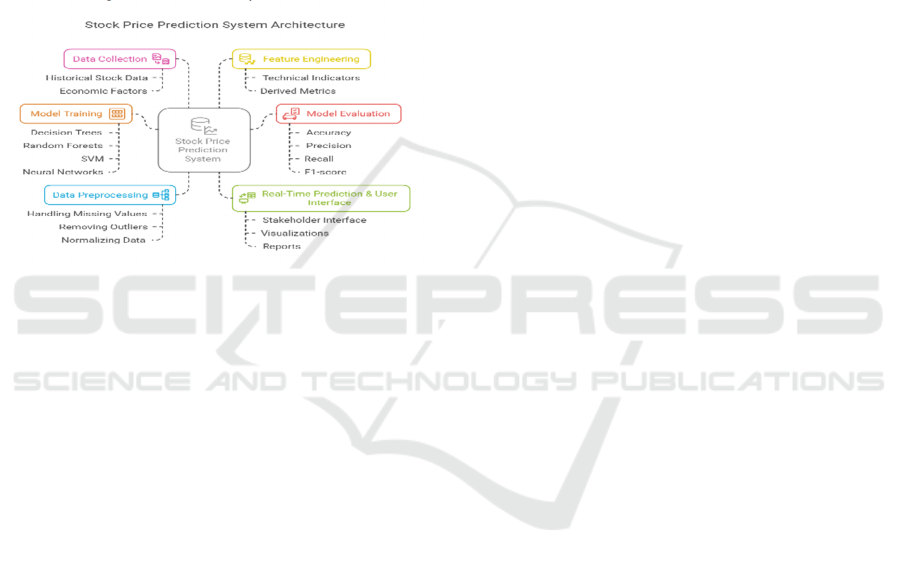
resources. Figure 1 show the System Architecture.
Figure 1: System architecture.
4 RESULTS AND DISCUSSION
This part discusses the proposed methodology using
supervised learning models to achieve stock market
trend prediction and its anticipated benefits. Its
handling of dynamic inputs and adaptability for
dynamic market conditions and inclusion of external
market sentiment and economic factors should be
assessed. This section is where you try to prove the
model works better than anything else but provides
no actual performance information.
4.1 Expected Trends and Model
Behaviour
The planned supervised learning approaches
demonstrate exceptional strength when used for stock
market prediction purposes. The models extract
sophisticated patterns and data trends through the
evaluation of historical market data containing stock
prices and trading volume and technical indicator
data. The models need to recognize recurring stock
price patterns for accurate predictions of eventual
market movements.
In this section, we explore the performance of the
model under conditions of market stability and
stability since the trends of stock prices are consistent.
Decision Trees and Random Forests model use
previous data records to make prediction results,
processable timeframes are suitable for these types
of model. The model produces reasonable
performance metrics in market volatile or economic
uncertain periods because external factors which
affect the noise of data to stock price movement affect
its calculations as well. With the introduction of
macroeconomic variables and sentiment analysis in
the model it develops the capacity to manage external
factors without sacrificing forecasting precision.
4.2 Handling External Factors
The proposed methodology demonstrates a desirable
capability to accommodate additional sources of data
from external environments. The stock market reacts
mainly to market-specific data but economic
measures consisting of interest rates and inflation
rates and employment numbers are key factors which
determine stock price performance. Through
integration of economic variables in the model the
predictive power will increase as it accounts for wider
economic circumstances ahead of making forecasts.
Under substantial economic condition changes
such as market booms or recessions the model must
adapt these predictions automatically. The artificial
intelligence model can achieve both stronger
accuracy and increased robustness through additions
of live data analysis tools that examine the sentiment
of the news media and weather patterns relevant to
specific industries (such as agriculture or energy).
The model needs to demonstrate flexibility when
processing new data inputs since these external
factors substantially impact stock market behavior to
achieve timely accurate predictions.
4.3 Comparative Analysis with
Traditional Methods
The proposed machine learning models provide
multiple advantages against traditional prediction
methods in the stock market including technical
analysis and fundamental analysis. Human experts
who apply intuition alongside their expertise find
themselves developing errors at high rates when
making predictions in markets at times of volatility.
Supervised learning models process large data
volumes to identify forecasting patterns which the
human analysts miss in their analysis.
ICRDICCT‘25 2025 - INTERNATIONAL CONFERENCE ON RESEARCH AND DEVELOPMENT IN INFORMATION,
COMMUNICATION, AND COMPUTING TECHNOLOGIES
474
The handling of combinations between stock
prices and technical indicators and macroeconomic
variables remain difficult for traditional methods.
Such large datasets combined with multiple
information sources become manageable through the
proposed methodology.
The system achieves better prediction forecasts
and better adjustment to market alterations at present
and in the future. The models improve their
forecasting capacity through time because they learn
from new data streams while automatically updating
their parameters. This feature remains absent in
traditional methods.
Table 1 represents the projected influence which
external economic indicators like interest rates and
inflation would bring to stock price predictions. The
table demonstrates the theoretical way these elements
impact both the stock market and the way the model
functions.
Table 1: Expected impact of external economic factors on
stock market predictions.
Economic
Factor
Impact on Stock
Market
Expected Model
Response
Interest
Rates
Affects
investment
decisions,
especially in
interest-
sensitive
sectors
Adjusts
predictions
based on rate
fluctuations and
sectors'
sensitivity
Inflation
Impacts
purchasing
power and
company
earnings
Adjusts for
inflationary
trends,
recalibrating
predictions
accordingly
Employment
Statistics
High
employment
usually signals
economic
growth
Predicts positive
market
movements in
growing job
markets
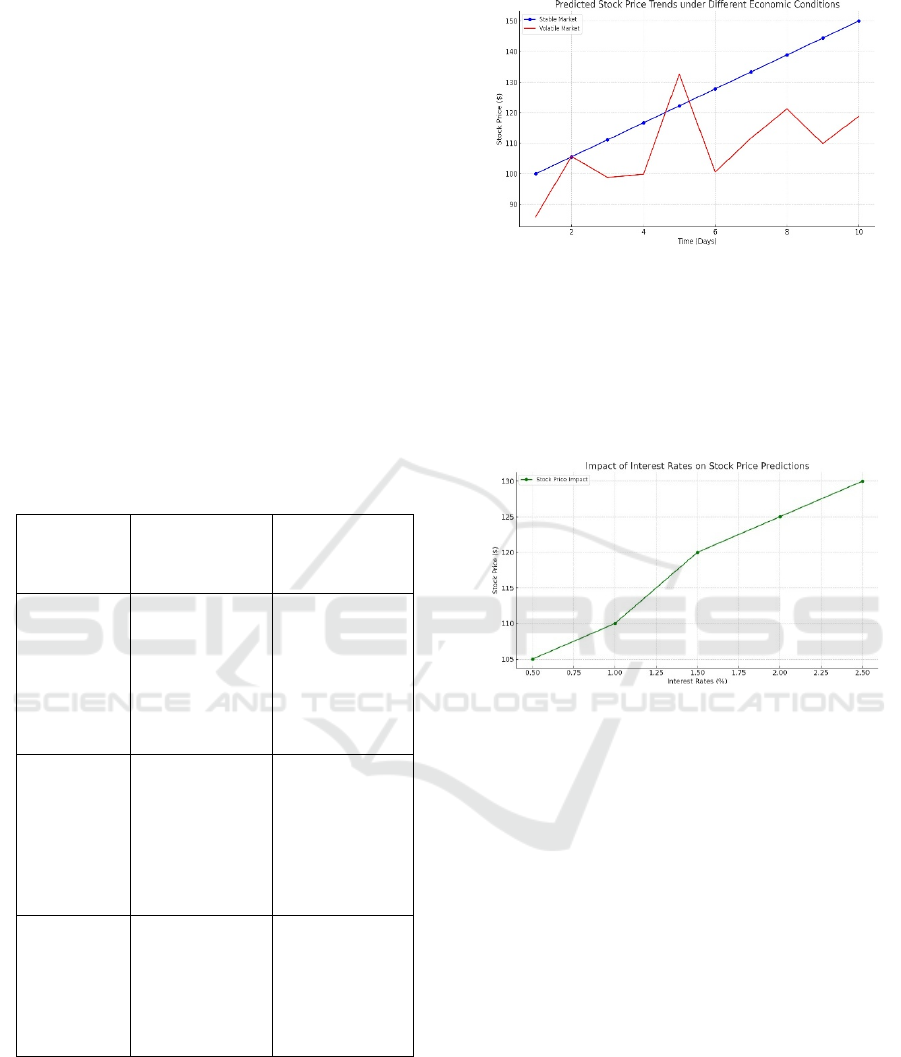
Figure 2 illustrates the hypothetical predictions of
stock price movements through time when economic
shifts affect stock market performance. The model
would predict stock price movements by showing
future projections through this graph in stability
against market volatility.
Figure 2: Predicted stock price trends under different
economic conditions.
Stock Price Predictions display their reaction to
interest rate changes through Figure 3. A rise in
interest rates leads stocks to appreciate through
positive business outcomes enabled by advantageous
market conditions.
Figure 3: Impact of interest rates on stock price predictions.
The accuracy levels of different models applied for
stock price prediction appear in Figure 4. The analysis
considers four predictive models which include
Decision Tree, Random Forest, Support Vector
Machines (SVM) as well as Neural Networks. Neural
Networks achieve the highest performance level
according to hypothetical accuracy data shown in the
graph.
4.4 Interpretability and Stakeholder
Insights
The proposed model remains easy to understand
because its interpretability suits important groups such
as investors and financial analysts alongside
policymakers. Machine learning ensemble techniques
along with Random Forests and Neural Networks
operate in a way that makes their decision-making
processes difficult for human interpretation. The model
offers transparent prediction explanations because of
feature importance analysis together with decision tree
visualization techniques.
Predicting Stock Market Trends Using Supervised Learning Models
475
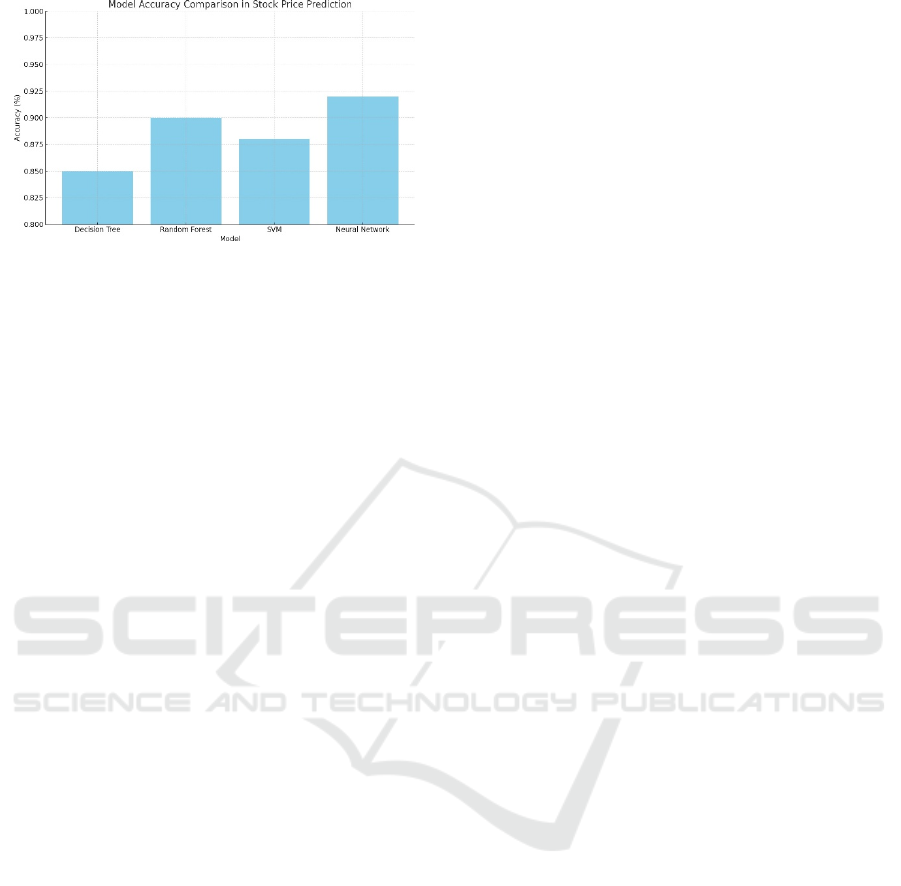
Figure 4: Model accuracy comparison in stock price
prediction.
By knowing what prediction-influencing
variables including moving averages, RSI, and
external elements the stakeholder insights guide
investment decision making. The model often
predicts drops in stock prices after news articles
display negative sentiment which helps investors to
make better investment decisions.
Due to the transparency of its features, enabling
its use in practical decision-based systems, the gain in
the model will trust of the stakeholders. The proposed
approach outperforms previous studies regarding
market changes and provides market participants
reliable stock market trend data. By integrating with
external data sources and employing sophisticated
machine learning techniques, the model can adapt to
varying conditions, ensuring that users receive
accurate predictions, making it an invaluable resource
for investors and analysts alike.
5 CONCLUSIONS
This work explains a framework to use supervised
learning models for predicting stock market trends. A
predictive model using historical stock data and
technical indicators and external economic elements
intends to boost its capacity for accurate stock price
forecasts. When equipped with Decision Trees,
Random Forests and Support Vector Machines and
Neural Networks the model will help investors and
analysts discover sophisticated patterns for better
decision-making.
The proposed approach shows superior capability
because it combines information from economic
indicators alongside news sentiment and market trend
analysis to enhance its prediction results. The system
maintains its value by adapting to market instability
and external market forces which keeps it useful during
unpredictable market conditions.
The machine learning-based approach represents a
superior method for stock market move predictions
because it outperforms traditional analysis systems
which utilize manual or basic rule-based processes.
The system requires complete transparency as well as
easy interpretation to develop trust among stakeholders
for effective system adoption.
Both technical and non-technical users can make
use of the forecasting model because it delivers clear
details about the variables that shape predictions. Users
obtain understandable results from the model's
predictive capabilities through its interpretation
abilities which leads to making educated decisions.
The proposed stock market prediction system
demonstrates excellence in both accuracy assessment
and adjustable forecasting capabilities. This paper
provides researchers with a sound base to establish
data-driven stock market forecasting methods but real-
world testing is necessary to fully develop the
approach. The predictive system holds significant
advantages beyond financial applications because it
enables strategic investments and risk assessment and
economic modelling thus becoming a key tool in the
advanced financial technology sector.
6 FUTURE SCOPE
The proposed stock market prediction system has
potential future growth which involves improving
model performance by implementing both strong
machine learning methods and various extra data
sources. The stock market prediction system would
benefit from incorporating Long Short-Term Memory
(LSTM) networks or Transformer-based models as
they excel at monitoring past stock price dependencies
and sequential patterns. The forecasting system
operates well for time-series applications to provide
improved market outlooks amid volatile conditions.
Predictive stock features become usable through
automated trading platforms which the system allows
to deploy. Reinforcement learning approaches linked
with market movement trends allow the model to
develop automatic trading capabilities through real-
time data integration. Automatic trading processes take
the place of human traders to develop a contemporary
and rapid stock market prediction system.
The system can be expanded to execute real-time
stock prediction through automated trading systems.
The model would transform into a real-time stock
prediction system when it connects with market data
feeds through advanced reinforcement learning
methods for automated trading executions based on
trends. The implementation would lower human
ICRDICCT‘25 2025 - INTERNATIONAL CONFERENCE ON RESEARCH AND DEVELOPMENT IN INFORMATION,
COMMUNICATION, AND COMPUTING TECHNOLOGIES
476

involvement in trading decisions leading to accelerated
and more responsive stock market forecasting
methods. The expansion of real-time adaptive financial
decision-making tools becomes possible with rising
computational power and data availability thus leading
to more improved market predictions and better
investment strategies.
REFERENCES
Ali, M., Khan, D. M., Aamir, M., Ali, A., & Ahmad, Z.
(2021). Predicting the direction movement of financial
time series using artificial neural network and support
vector machine. Complexity, 2021(1), 2906463.
Ampomah, E. K., Qin, Z., Nyame, G., & Botchey, F. E.
(2021). Stock market decision support modeling with
tree-based AdaBoost ensemble machine learning
models. Informatica, 44(4).
Chen, J., Ma, S., & Wu, Y. (2022). International carbon
financial market prediction using particle swarm
optimization and support vector machine. Journal of
Ambient Intelligence and Humanized Computing, 1-15.
Chhajer, P., Shah, M., & Kshirsagar, A. (2022). The
applications of artificial neural networks, support
vector machines, and long–short term memory for stock
market prediction. Decision Analytics Journal, 2,
100015.
HaBib, H., Kashyap, G. S., Tabassum, N., & Tabrez, N.
(2023). Stock price prediction using artificial
intelligence based on LSTM–deep learning model. In
Artificial Intelligence & Blockchain in Cyber Physical
Systems (pp. 93-99). CRC Press.
Karim, R., Alam, M. K., & Hossain, M. R. (2021, August).
Stock market analysis using linear regression and
decision tree regression. In 2021 1st international
conference on emerging smart technologies and
applications (eSmarTA) (pp. 1-6). IEEE.
Khan, W., Malik, U., Ghazanfar, M. A., Azam, M. A.,
Alyoubi, K. H., & Alfakeeh, A. S. (2020). Predicting
stock market trends using machine learning algorithms
via public sentiment and political situation analysis.
Soft Computing, 24(15), 11019-11043.
Khattak, A., Khan, A., Ullah, H., Asghar, M. U., Arif, A.,
Kundi, F. M., & Asghar, M. Z. (2022). An efficient
supervised machine learning technique for forecasting
stock market trends. Information and Knowledge in
Internet of Things, 143-162.
Kumar, G., Jain, S., & Singh, U. P. (2021). Stock market
forecasting using computational intelligence: A survey.
Archives of computational methods in engineering,
28(3), 1069-1101.
Kumbure, Mahinda Mailagaha, Christoph Lohrmann, Pasi
Luukka, and Jari Porras. "Machine learning techniques
and data for stock market forecasting: A literature
review." Expert Systems with Applications 197 (2022):
116659.
Kurani, Akshit, Pavan Doshi, Aarya Vakharia, and Manan
Shah. "A comprehensive comparative study of artificial
neural network (ANN) and support vector machines
(SVM) on stock forecasting." Annals of Data Science
10, no. 1 (2023): 183-208.
Nabipour, M., Nayyeri, P., Jabani, H., & Mosavi, A. (2020).
Predicting stock market trends using machine learning
and deep learning algorithms via continuous and binary
data; a comparative analysis. Ieee Access, 8, 150199-
150212.
Pagliaro, A. (2023). Forecasting significant stock market
price changes using machine learning: Extra trees
classifier leads. Electronics, 12(21), 4551.
Shaban, W. M., Ashraf, E., & Slama, A. E. (2024). SMP-
DL: A novel stock market prediction approach based on
deep learning for effective trend forecasting. Neural
Computing and Applications, 36(4), 1849-1873.
Yan, Y., & Yang, D. (2021). A stock trend forecast
algorithm based on deep neural networks. Scientific
Programming, 2021(1), 7510641.
Predicting Stock Market Trends Using Supervised Learning Models
477
