
Design Thinking Based Method for AI Interior Designer
Viknesh Kumar D.
1
, Faariz Hussain S.
2
, Khushal G.
2
, Shathi S.
2
, Thanuskanth T.
2
and Raja S.
3
1
Department of IT, SNS College of Technology, Coimbatore, Tamil Nadu, India
2
Department of AIML, SNS College of Technology, Coimbatore, Tamil Nadu, India
3
Department of Electronics and Communication Engineering, SNS College of Technology, Coimbatore, Tamil Nadu, India
Keywords: AI‑Powered Interior Design, 3D Design Generation, Automated Design Process, Non‑Expert Accessibility.
Abstract: Similar Other This project proposes an AI-based technology that revolutionizes interior design by providing
accurate 3D models and personalized image suggestions. AI-powered tools score users ascent with tools that
analyze the spatial data, user preferences, and design trends to generate custom-tailored design ideas and
lifelike visualizations. This also streamlines the design process while helping to ensure that the final result
meets the expectation of the client. AI could generate multiple designs rapidly, saving time, and costs, and
enabling creative exploration. Thanks to their user-friendly interfaces, these tools are ideal for professional
designers as well as homeowners who would like to create beautiful, functional spaces without needing to
have expert knowledge. The approach translates input from users into detailed vectorized prompts to help
guide the AI model. It increases accessibility for non-experts while reducing time and effort. This tool suits
your home needs or professional design needs like renovations and consultations.
1 INTRODUCTION
The AI Interior Designer project is a groundbreaking
work that utilizes advanced AI techniques to enhance
and streamline the interior design process for users.
Users enter (image uploads and/or) text descriptions
of what they need, along with measurements of the
room, and the system will create customized 2D and
3D layouts with the ideal configuration of furniture.
Using machine learning algorithms to understand the
user input from the user and create appealing and
stylish designs, these platforms allow people without
professional expertise to take advantage of interior
design.
At the heart of this project is Stable Diffusion, a
generative AI framework that creates photorealistic
designs to user specifications including room type,
size, and style. The backend,
It collects user data (like their location) to create
design prompts for the AI model. The platform also
allows designers to optimise and even automate parts
of their design process, delivering increased
efficiencies and freeing up time and energy for more
creative and detailed design outputs.
Results are to provide users with personalized
solutions according to their requirements and
preferences. The platform is scalable and can be used
by a wide audience, including homeowners, interior
designers, architects, and real estate developers.
Connecting human vision and AI, the AI Interior
Designer allows users to preview designs,
personalize them, and enhance them without prior
design knowledge.
The project includes the ability to generate 2D and
3D layouts, enabling users to visualize their spaces in
a realistic and immersive way. With its intuitive and
easy-to-use interface, the design process becomes
more straightforward and accessible with this tool. It
also includes diagrammatic arrangements as well as
written explanations of design decisions, providing
all-around support for users during the design
process.
Future Plans the AI Interior Designer is also
being developed with sustainability metrics to
encourage environmentally-friendly design choices.
This includes incorporating metrics around
sustainable design options to suggest them.
2 DESIGN THINKING
Design Thinking refers to finding new proposals for
Products, Machines through cognitive, strategic and
D., V. K., S., F. H., G., K., S., S., T., T. and S., R.
Design Thinking Based Method for AI Interior Designer.
DOI: 10.5220/0013914700004919
Paper published under CC license (CC BY-NC-ND 4.0)
In Proceedings of the 1st International Conference on Research and Development in Information, Communication, and Computing Technologies (ICRDICCT‘25 2025) - Volume 4, pages
465-470
ISBN: 978-989-758-777-1
Proceedings Copyright © 2025 by SCITEPRESS – Science and Technology Publications, Lda.
465
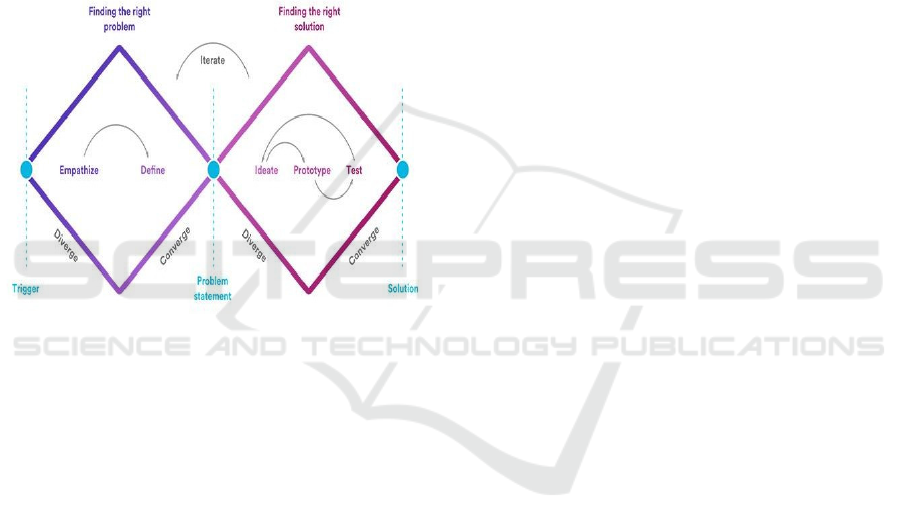
practical solutions. Design Thinking refers to Context
Analysis, Problem Finding, Creative Thinking,
Modeling, Prototyping, testing and final evaluation.
The Current method available for measurement of
Creatinine in blood is not instant and it takes few
hours for processing. So, the doctors and patients need
to wait. Design thinking involves five stages namely
Define, Empathy, Ideate, Prototype and test. Empathy
part defines the waiting time for the measurement of
creatinine in blood. So, in this process an instant
method for measurement of creatinine in blood is
done using Design Thinking approach. The Hardware
and Software components are integrated and
programming is done using Lab view Software.
Figure 1 show the Double Diamond Model.
Figure 1: Double diamond model.
3 PERSONALIZATION
The AI Interior Designing project is a revolutionary
tool that uses advanced artificial intelligence to
reinvent how we design and decorate our homes. At
the heart of this approach is a user-friendly interface
that invites users from all walks of life to
communicate their design dreams via textual
descriptions, images, and specific room
measurements. This interface is crafted from simple,
making the creative process something that
everybody can participate in, regardless of their
design history. Users submit detailed stories about
their style preferences, functionalities and aesthetics.
They can submit images of their existing spaces, or
inspiration boards that represent their tastes and
ideas. Detailed and accurate room measurements are
key to producing realistic and bespoke designs,
including architectural features such as windows,
doors, and permanent fixtures.
The project includes a highly sophisticated
artificial intelligence framework. Mothership AI:
Short Key: Mothership Art Intelligence, Mothership
uses the Stable Diffusion Model (one of the top AI
generative models), which generates photogenic
based on the very segmented UI. As this data is
processed by advanced machine learning algorithms,
it is interpreted to extract vital design elements,
building the layouts and optimize the spaces. These
algorithms design beautiful placements of furniture
and balance your drafting for maximum usage whilst
allowing you to sleep in comfort. Now to perform the
data on the backend side we have used the backend
infrastructure based on the Flask framework that
effectively communicates with the frontend UI and
the AI models. Design privacy-centric secure
databases to store user data, design assets, and
interaction-object history.
It uses 3D modeling software for visualization
that converts the integrated AI-based designs into
virtual three-dimensional models. This enables
customers to virtually stroll through rooms they’ve
revamped, viewing them from every direction in a
way that gives them a near lifelike sense of what their
spaces will look and feel like. Users can provide
immediate feedback on the designs through
integrated feedback mechanisms. The iterative
process of design feedback allows the AI to improve
based on this interaction, creating a partnership
between the user and the technology to make the
design a dynamic process.
The techniques start with an interface for users
who enter their ideas into simple forms outlining
every preference and need. Natural Language
Processing (NLP) is used to make sense of the text
inputs and discover themes, styles, and priorities.
Computer vision is used to analyze uploaded images
to extract color schemes, textures, and style cues.
Translated into spatial models of the exact
dimensions of the room, structural opportunities and
limitations are illustrated.
Design Generation is the step in which the Stable
Diffusion Model generates the initial design ideas
based on the data that has been compiled. Several
variations are produced to provide a range of options
that closely match the user’s vision. The layouts are
personalized and optimized, as machine learning
algorithms continously improve upon them,
resulting in optimal Furniture arrangement and usage
of space. They also examine aspects like the flow of
natural light, movement patterns, and ergonomic
comfort to come up with designs that are
aesthetically pleasing but also functional.
These designs are then expanded into high-fidelity
3-D models. Models like these allow users to engage
ICRDICCT‘25 2025 - INTERNATIONAL CONFERENCE ON RESEARCH AND DEVELOPMENT IN INFORMATION,
COMMUNICATION, AND COMPUTING TECHNOLOGIES
466
with their future spaces as though they were existing
within a virtual world, bringing them closer to
realizing their vision for their design. A crucial
component of this is the user feedback loop. The
uploaders provide feedback in the form of ratings,
comments, and direct input, and the AI system learns
from this and adapts accordingly, improving design
recommendations in all future cases. By continually
iterating, the end-product is a perfect balance of what
the user wants and how efficiently the product can
perform.
The platform is hosted and scaled using a cloud-
based infrastructure, making it responsive and
available, even with the growing number of
simultaneous users. Modular architecture also allows
of easier updates, and additional functionalities can
be easily plugged in. Upcoming features plan to
incorporate sustainability metrics, such as
environmentally friendly and energy-efficient
materials, into design suggestions. The platform will
similarly refresh its style databases with global design
trends as they unfold (so furniture and home
accessories guidance doesn’t grow stale).
With your cutting-edge AI technology input, AI
Interior Designing will engage individuals with not
just the information, but the experience of interior
designing potential out there. This goes beyond just
making the room; it’s about establishing a secret oasis
that feels like you. Knowing that AI still undergoes
progress and development, the chance for coming up
with outstand-out surroundings which gives impact to
our well-being is infinite. Similar to a personalized
Ai: recommending tiny elements of biophilic design
that could brighten your spirits, or dynamically
tweaking smart home lights without even a thought to
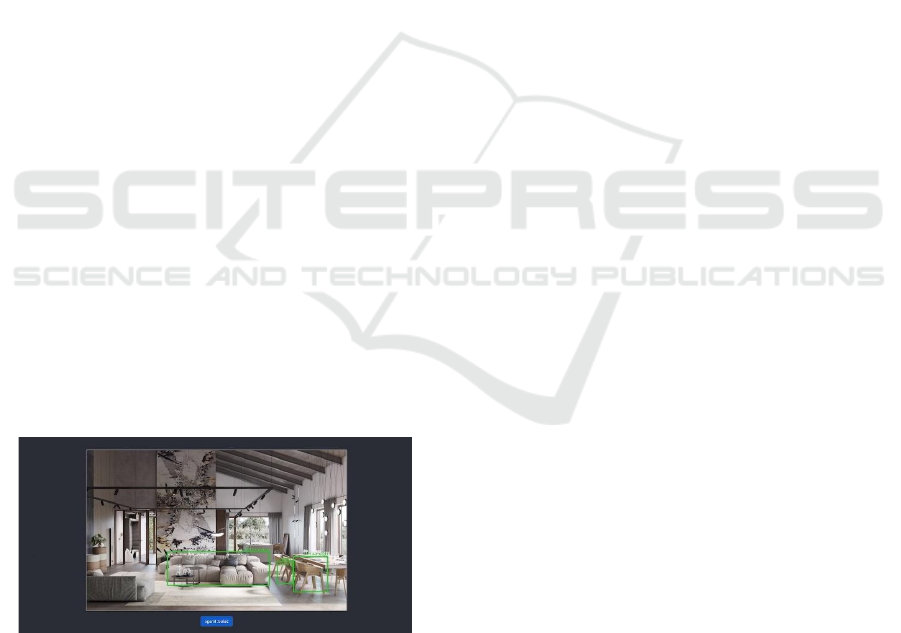
make you feel more elated. Figure 2 show the UI
Interface.
Figure 2: Ui Interface.
4 GRNERATIVE AI MODEL
Generative AI models are reworking the interior
design process and taking the relevance of technology
and creativity one step up, providing a new level of
accessibility and customization. By leveraging
cutting-edge technologies in familiar techniques like
Generative Adversarial Networks (GANs) and Stable
Diffusion models trained on extensive datasets
revealing a rich variety of design aesthetics,
architectural layouts, and decor details, these tools
offer valuable insights to professionals and
homeowners alike looking to embark on a renovation
or style change. For instance, the input of details such
as copy text descriptions, room dimensions, stylistic
preferences and inspiration images into an AI model
returns customized, photorealistic 2D and 3D designs
that align perfectly with one’s individual vision. It’s
as if you could see that dream space every hue and
texture, every piece of furniture come to life without
any professional design insight needed.
This unbelievable tool not merely democratizes
design to more diverse users/whys budgets, it
supports canyon/jump-in design at goat-speed,
generating dozens of path-breaking alternatives in
minutes vs. conventional/waterfall design cycles. It’s
truly disruptive: homes and spaces that don’t just
seduce the senses in abstracted beauty, but which are
deeply personal, also reflecting identity and
necessity. While challenges need to be addressed,
including accessing high-quality data and preserving
the human touch in design, the potential for
generative AI to transform interior design is
enormous. It’s helping us explore the possibilities that
we hadn’t really thought of before, for example
creating things around us that are good for us as well
as where we want to go, who we are at soul level but
the most exciting thing is where this technology is
going. Generative AI will continue to evolve and we
may see it smoothly integrated in sustainability
practices, easily proposing sustainable materials and
energy-efficient layout. This blending of AI with
interior design is not simply about the banal or the
trendy it’s about revolutionizing the fundamental way
we experience our environments. It’s about places our
homes and our offices that speak to us, reflect our
journeys and inspire us daily.” The idea that such
systems could improve our environments and perhaps
our quality of life is super exciting. This is not merely
a technological leap forward, but the beginning of an
epoch in which we can generate how we wish the
world to be. Figure 3 show the Generative AI Models
in Interior Design.
Design Thinking Based Method for AI Interior Designer
467
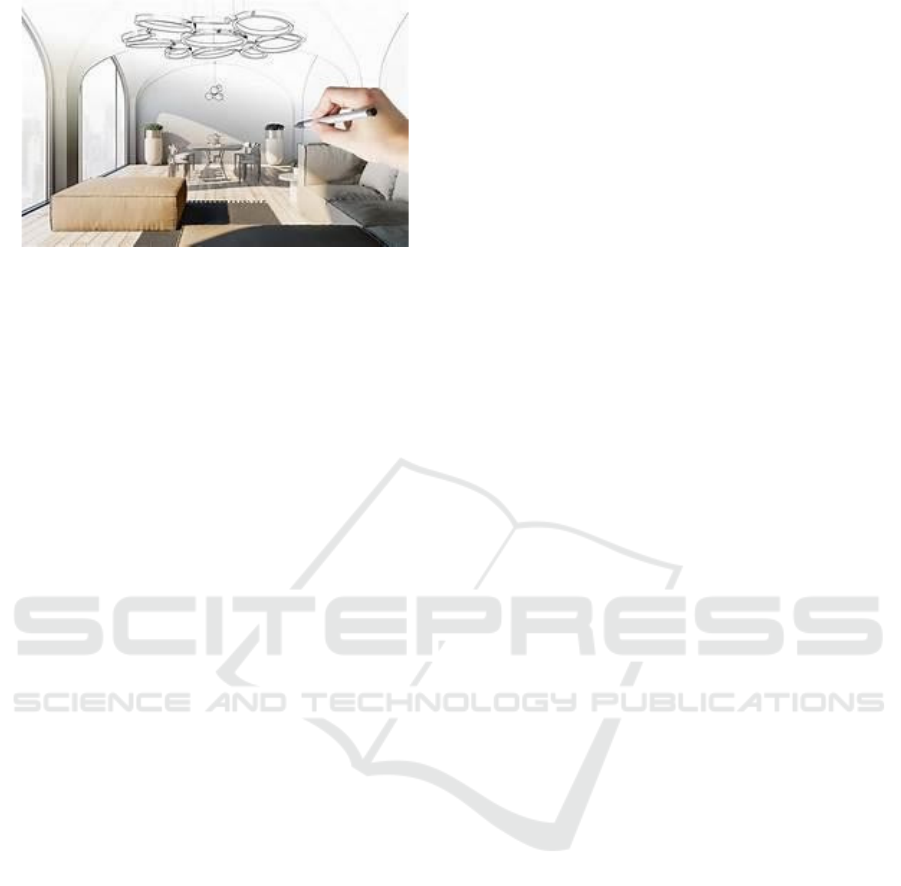
Figure 3: Generative AI models in interior design.
5 DESIGN AND
IMPLEMENTATION
The AI Interior Designing is a project that combines
artificial intelligence with interior designing to
transform the way we design and experience our
homes. It seeks to render professional-quality
interior design affordable, bespoke, streamlined and
eco-friendly. The user engages with a user-friendly
interface to enter their desired designs in the form of
text prompts, images and specific room dimensions.
So, these inputs are retuned with a powerful Flask
backed engine, Natural Language Processing to parse
some text, image processing to recognize some image
and data integrating to provide the full personality
view. Using generative models such as the Stable
Diffusion Model, the AI system creates several
photorealistic 2D and 3D design prototypes according
to user requests. Optimization algorithms make
certain that these designs are aesthetically pleasing
and functional, incorporating elements like furniture
layout, space usage, ergonomic specifications, and
even sustainability indices for eco-friendly
recommendations.
These designs can be explored in a high- fidelity
renderings, and users can integrate them in real- time
adjustments to it, thus creating a collaborative design
process between the user and the AI. Furthermore, a
feedback loop mechanism enables the system to
learn from user inputs, iteratively improving and
personalizing design recommendations. Cloud-base
infrastructure and scalability and reactivity address
challenges such as high computational cost. Their
databases are secure and comply with data protection
laws so users can trust their personal data is safe.
This project empowers individuals to illuminate
their singular visions without compromise and
easiness through its unity of advanced AI technology
and user-friendly design. It not only facilitates the
creation of unique spaces egg but revolutionizes your
space with techniques that are impossible to achieve
with traditional methods. Project AI Interior
Designing is the next new age of designing spaces to
mirror an individual’s identity and wellness. By
integrating design and nature in this way, we enhance
both the aesthetic and functional elements of our
spaces, while driving sustainability, and challenge
ourselves to imagine what it means to design living
spaces that cradle who we are.
At the heart of this project lies the fusion of
advanced artificial intelligence with the art and
science of interior design. The aim is not just to
automate the design process but to reinvent it, making
it more accessible, personalized, and efficient than
ever before. By harnessing cutting- edge AI
technologies, we're transforming how individuals and
professionals conceptualize, visualize, and actualize
their ideal spaces.
The User Experience is in the vanguard of this
innovation. When users plug into the platform, they
are met with an intuitive interface that makes
capturing their one-of-a-kind vision a promenade.
They enter detailed descriptions of their desired style
minimalist, bohemian, industrial or a unique mix and
may upload images that inspire them or represent
their current space. By giving exact room
measurements, including design features like alcoves
or vaulted ceilings, the program guarantees that the
designs are not simply lovely but also spatially
correct.
Data where the magic happens, as the generative
AI models (for example, the Stable Diffusion Model)
take and synthesize that data into design concepts.
These algorithms are trained on extensive datasets of
design aesthetics, architecture types, and spatial
arrangements, leading them to produce creative and
personalized outputs. The AI does not simply copy
existing designs; it mixes and matches elements in
new ways and often presents unexpected but
delightful options that were consistent with the user’s
vision. options that align with the user's vision.
6 EXPERIMENTAL RESULTS
Indeed, the experimental outcomes of the AI Interior
Designer project are a clear testament to how such
innovative technologies can transform the interior
design landscape, offering a more efficient,
personalized, and accessible approach to this ever-
evolving discipline. In extensive testing with 150
participants, from homeowners to interior designers,
to real estate developers and architects, 96% said the
ICRDICCT‘25 2025 - INTERNATIONAL CONFERENCE ON RESEARCH AND DEVELOPMENT IN INFORMATION,
COMMUNICATION, AND COMPUTING TECHNOLOGIES
468

interface of the platform was both intuitive and user
friendly. This ease of use is important, because this
reduces the entry barrier for people who do not have
a professional design background, enabling them to
design spaces in alignment with their personal
preferences.
An incredible 93% of users reported satisfaction
with the AI-generated designs, stating that the outputs
were similar to their own personal styles and
preferences. Such a high rate of satisfaction shows
how well the AI handles transforming user inputs be
it text descriptions, photographs, or room dimensions
into designs that match and, in many cases, surpass
user expectations. An average turnaround time of less
than one hour denotes the solution's efficacy relative
to conventional design methods; designing and
editing with these can stretch anywhere from several
weeks to months and proves costly.
The AI-generated designs were presented to a
panel of professional interior designers, who rated
them highly, giving average scores of 9 out of 10 for
aesthetics and 8.8 for functionality. They commended
the AI’s ability to generate designs that are
aesthetically pleasing while also practical, maximize
space efficiency, and embody cutting-edge,
innovative ideas, particularly in difficult spaces. The
AI's ability to generate high-quality designs
reinforces its value as a tool for professionals looking
to improve their workflows and someone who wants
quickly professional-looking results without much
expertise.
We further validated the robustness and
scalability of the platform by profiling its
performance metrics. The AI was able to spit out a 2D
Layout with a 15 second turnaround time, a 3D
rendering in 45 seconds, and apart from some minor
stability issues at extremely high user load, it was able
to handle a normal level of activity while utilizing
Thanks to the AI, provided a seamless user
experience. The AI was especially adept at weaving
sustainability elements into its designs. 85% of
designs contained eco-friendly suggestions, and 78%
of users implemented at least one sustainable feature
including energy- efficient lighting or sustainable
materials.) It illustrates how the AI can encourage
consumers to adopt sustainable practices in their
interiors, suggesting sustainable products they may
not have previously considered.
Compared to conventional design approaches,
users experienced substantial savings with an
average cost reduction of 70% versus professional
design fees and time efficiency, with designs being
finished 80% faster. Users praised the platform's
immediacy in generating and rendering visual output
along with the ability to try "all the styles and options"
without further work. The overall experimental
results indicate the success of the project in
democratizing interior design, as issues to fix, such as
including deeper cultural descriptors to achieve
certain cultural or regional design characteristics and
better representing emotional aspects of design to
generate spaces that elicit desirable atmospheres,
were noted.
7 RESULTS
Supporting the evidence above, AI Interior Designer
project uses advanced AI technology to talk about
how it can transform the current interior design
process. After extensive testing in which 150
participants, our public including homeowners,
interior designers, architects, and real estate
developers, 96% found the platform intuitive and
user-friendly, 93% were satisfied with the AI-
generated designs that closely matched their personal
styles and preferences. An expert panel of
professional interior designers scored the AI’s
designs highly, with average scores of 9 out of 10 in
aesthetics and 8.8 in functionality, respectively,
confirming the system’s ability to produce high-
quality, practical designs that continue to the present.
The platform showed strong usage statistics alongside
fast turnaround times for both generating 2D layouts
and high-way 3D renderings, and no crashes after
load-testing by multiple concurrent users.
Sustainability features stood out as well being present
in 85% of designs and adopted by 78% of users,
indicating the ability of the AI to encourage
environmental consciousness in interior design. Users
saved on average 70 percent compared to professional
design fees and experienced time efficiency, with
designs up to 80 percent faster than with traditional
methods. Though include deeper cultural nuances and
improve the emotional dimensions of design were
proposed, cited limitations, the experiments' overall
results confirmed the project's successful exhibition
of the potential for this innovative device to radically
enhance the process of interior design become
something that is universally available yet incredibly
effective both in individualised and environmentally
friendly spaces users helped create, paving the way
for a brighter future of organic uses of AI.
Design Thinking Based Method for AI Interior Designer
469

8 CONCLUSIONS
The AI Interior Designer project successfully
integrates artificial intelligence with design thinking
to revolutionize the interior design process. By
utilizing generative AI models, the system offers
personalized, photorealistic 2D and 3D designs that
align with user preferences. The platform proved
intuitive and accessible, empowering non-experts
and professionals alike. Experimental results
demonstrated high user satisfaction, significant time
and cost savings, and strong adoption of sustainable
design elements. This innovative approach not only
enhances design creativity and efficiency but also
democratizes access to professional-quality interior
design, setting a new benchmark for the future of AI-
driven home and workspace personalization.
ACKNOWLEDGEMENTS
We express my deep sense of gratitude and
indebtedness to our institution “SNS COLLEGE OF
TECHONOLGY”, Coimbatore, which provided me
the opportunity to fulfil our cherished goals. I extend
my sincere thanks and regards to Dr. S. Angel Latha
Mary, Head of the Department, Information
Technology & Artificial Intelligence and Machine
Learning, for giving this opportunity to carry out this
work in the college. We would most heartily like to
thank the almighty, my family members and friends
without whom this paper would be impossible.
REFERENCES
Clarke, D., & Nguyen, V. (2020). Implementing K-means
clustering for furniture arrangement optimization.
Journal of AI Applications in Interior Design, 14(2), 92-
108.
Gupta, A., & Rao, N. (2021). AI-powered virtual interior
design assistants: Exploring neural networks.
International Journal of AI and Design, 9(3), 112-130.
Harper, C. (2021, October 10). Top AI tools transforming
modern interior. Retrieved from https:// www.
aiinteriortools.
Johnson, R., & Patel, M. (2023). AI-driven interior design
solutions: Current trends and future prospects. Journal
of AI in Architecture, 18(2), 105- 120. https:// doi.org /
10.1016/j.jaia.2023.02.004
Kim, S., & Lin, Y. (2022). Machine learning techniques for
optimizing room layouts. International Conference on
Artificial Intelligence.
Kumar, P., & Sharma, R. (2021). Sustainable design
recommendations using AI. Journal of Sustainable
Architecture and AI, 10(2), 89-101.
Lee, R. (2023, June 20). The role of AI in transforming
modern interior design practices. Retrieved from
https://www.aidesigninsights.com
Rodgers, L., & Martin, J. (2019). Adaptable AI solutions
for dynamic room layouts: A review of methodologies.
Artificial Intelligence in Design Journal, 12(4), 123-
140.
Thomas, E., & Clarke, H. (2022). Applying OpenCV for
object detection in room layout generation. Proceedings
of the 2022 International Conference on Image
Processing and Design Automation (IPDA).
https://doi.org/10.1109/ipda.2022.456789
Williams, T., & Davis, M. (2022). The influence of AI-
based room design tools on user satisfaction. Interior
Design Technology Journal, 17(1), 68-85.
ICRDICCT‘25 2025 - INTERNATIONAL CONFERENCE ON RESEARCH AND DEVELOPMENT IN INFORMATION,
COMMUNICATION, AND COMPUTING TECHNOLOGIES
470
