
Factors Affecting Workplace Ostracism among Government and
Private Firms’ Employees
Pushkar Dubey
1
, Kshitijay Singh
1
and Kailash Kumar Sahu
2
1
Department of Management, Pandit Sundarlal Sharma (Open) University Chhattisgarh, Bilaspur (CG), Chhattisgarh,
India
2
Amity Business School, Amity University Chhattisgarh, Raipur (CG), Chhattisgarh, India
Keywords: Workplace Ostracism, Abusive Supervision, Workplace Bullying, Workplace Incivility, Interpersonal
Deviance, Interpersonal Distrust, Negative Workplace Gossip, Organizational Politics, Social Undermining,
Supervisor Support, Voice Behavior.
Abstract: I don’t want to overlook workplace ostracism the experience of being ignored/ excluded from workplace
communication for life which has devastating consequences on both, the employee and the organization. This
research explores the drivers of workplace ostracism (WO) of frontline employees working in government
and private organizations within Chhattisgarh, India, which include abusive supervision (AS), workplace
bullying (WB), workplace incivility (WI), interpersonal deviance (IDS), interpersonal distrust (ID), negative
workplace gossip (NWS), organizational politics (OP), and social undermining (SU), supervisor support (SS)
and voice behavior (VB) as the antecedents of WO. Data from 629 employees from government and private
sector firms was collected through a structured questionnaire, and the relationship between workplace
ostracism and its antecedents was analyzed using the PLS-SEM method. Results show that WI and WB are
the leading predictors of WO, thus implying exacerbation of social exclusion. AS, IDS, ID, NWG, OP, SU,
SS, and VB were not found to have a direct effect from other variables. These findings underscore the
importance of inclusive workplace policies, effective leadership training, conflict resolution and emotional
intelligence programs to mitigate workplace ostracism and foster a more positive work environment.
1 INTRODUCTION
Workplace ostracism, or the perception of being
ignored, excluded, or isolated in professional settings,
is a severe problem that harms both employees and
organizations (Wang et al., 2023; Das & Ekka, 2024).
When employees find themselves sidelined, they tend
to face emotional turmoil, decreased motivation, and
lower satisfaction at work. Such an approach only
fuels poor relationships within the workplace,
unhealthy relationships with co-workers and the
misery experienced by colleagues as they are forced
to work around such toxicity, thereby hindering work
performance and productivity. Studies (Zhong, 2025;
Chaudhary et al., 2024) have shown that workplace
ostracism can fuel knowledge hoarding, when
employees withhold valuable knowledge
intentionally from others, which hampers
collaboration and innovation. But one of the most
disturbing outcomes of ostracism is its association
with increased turnover. Das and Ekka (2024)
highlight that exclusion can make employees think
about leaving their jobs, resulting in higher turnover
intentions and more recruitment cost for organization.
In some cases, workplace ostracism also promotes
counterproductive work behaviors, such as retaliatory
revenge, defensive silence, and pure work
disengagement, which also seriously damages
workplace harmony (Izhan et al., 2024).
Ostracism has a particularly debilitating impact in
service and healthcare sectors. Sharma et al. (2024)
indicated that workplace ostracism in service
industries correlates with ill psychological well-
being, increased absenteeism, and decreased work
performance. In healthcare sector, Ramadan et al.
(2023) shows that these mechanisms are similar to
those identified for how ostracism adversely impacts
organizational commitment potentially also
degrading patient care and treatment outcomes. As a
result, in the face of their supervisors' ostracism,
employees may doubt themselves and become less
confident and even procrastinate, which negatively
438
Dubey, P., Singh, K. and Sahu, K. K.
Factors Affecting Workplace Ostracism among Government and Private Firms’ Employees.
DOI: 10.5220/0013914400004919
Paper published under CC license (CC BY-NC-ND 4.0)
In Proceedings of the 1st International Conference on Research and Development in Information, Communication, and Computing Technologies (ICRDICCT‘25 2025) - Volume 4, pages
438-446
ISBN: 978-989-758-777-1
Proceedings Copyright © 2026 by SCITEPRESS – Science and Technology Publications, Lda.

impact work efficiency (Sarwar et al., 2024).
Workplace ostracism can also be very damaging, yet
it is often overlooked because it is less overt than
bullying or harassment (Gamian-Wilk & Madeja-
Bien, 2021). While normal entering workplace
strategies, strong leadership, or a positive work
culture may help and be beneficial in some cases, they
are not enough to eradicate the issue (Lestari et al.,
2024). Thus, organizations need to proactively need
to come up with inclusive policies, emotional
intelligence training, and a supportive work
environment to eliminate ostracism and enhance
employee engagement (Das & Ekka, 2024; Izhan et
al., 2024; Sharma et al., 2024; Ramadan et al., 2023).
The current study aims to see the relationship of
various elements to workplace ostracism to derive
the impact of workplace ostracism and also its
relevance in the present modern settings.
2 LITERATURE REVIEW
Previous studies have established that abusive
supervision increases workplace ostracism. And it
makes employees silent, ineffective, and frustrated,
particularly in power-dominating authorities (Khalid
et al., 2023; Anjum et al., 2023). According to Wang
and Xu (2022), when workers are unable to stand up
to tyrannical superiors, they might instead ignore
peers, thus exacerbating ostracism. Bai et al. (2021)
observed that others might emulate the leader’s bad
behavior, leading to greater exclusion. Supervisors
ignoring employees can make them feel unvalued and
disconnected, and damage their well-being and
engagement (Brison et al., 2024). So, the study
proposes that,
H
1
: Abusive supervision would have a significant
effect on workplace ostracism.
Workplace ostracism negatively affects voice
behavior, meaning employees who feel excluded are
less likely to speak up or share concerns, which
lowers their performance and engagement. Imran et
al. (2021) showed that ostracized employees may
suppress their emotions instead of improving
performance. Wu et al. (2019) further stated that new
employees also struggle to express ideas when their
psychological needs are unmet. Both supervisor and
coworker ostracism reduce voice behavior, though in
different ways (Li & Tian, 2016). Wu et al. (2018)
added that group ostracism weakens team cohesion,
making employees less likely to speak up. Moreover,
workers are less willing to voice concerns when they
see colleagues being excluded, unless they have
strong political skills (Wang & Liao, 2022). Hence,
the study hypothesizes that,
H
2
: Voice behaviour would have a significant effect
on workplace ostracism.
Previous studies suggest that supervisor support
can reduce workplace ostracism. The lower levels of
engagement when not supported can lead to turnover
and even spill over to personal life stress (Zeng et al.,
2024; Brison et al., 2024). However, as per Ahmed et
al. Mitchell et al. (2013), supportive supervisors can
reduce these biases and create a more inclusive
workplace. This boosts employee sense of value and
belonging, thus mitigating the negative effects of
ostracism on job satisfaction and turnover (Singh et
al., 2024). Additionally, Brison et al. (2021) that
supportive leadership can stop employees from
experiencing dehumanization in the workplace. Thus,
the study's hypothesis is that,
H
3
: Supervisor support would have a significant
effect on workplace ostracism.
This indicates that workplace bullying is a
significant driver of workplace ostracism, which has
negative consequences for employees and
organizations alike. According to Li et al. (2021),
ostracism, or social death, has a negative impact on
job satisfaction, commitment and well-being. That is,
those who experience exclusion are more likely to
quit their jobs, particularly in high turnover sectors
such as information technology (Das & Ekka, 2024;
Singh et al., 2024). It leads to stress, burnout, and
envy, which ultimately impacts employees (Kim &
Jang, 2023). According to Sharma et al. (2024), this
ostracism results in low productivity and
absenteeism, although decreased impact is possible
through organizational support. Therefore, the study
postulates that,
H
4
: Workplace bullying would have a significant
effect on workplace ostracism.
Social undermining and workplace ostracism are
closely linked, with research showing that envy and
self-threat can lead to exclusion at work. According
to Yarivand (2024), envy-driven undermining
damages workplace relationships and organizational
health. Employees who feel threatened by ethical
comparisons may respond by undermining and
excluding others (Quade, 2013). This makes social
undermining a possible cause of workplace ostracism.
Studies (Li et al., 2021; Das & Ekka, 2024) also
showed that ostracism leads to lower job satisfaction,
higher turnover, and negative workplace behaviors.
Yang and Treadway (2018) added that employees
Factors Affecting Workplace Ostracism among Government and Private Firms’ Employees
439

who feel ostracized may engage in counterproductive
behaviors, especially those with a strong need for
social acceptance. Hence, the study hypothesizes that,
H
5
: Social undermining would have a significant
effect on workplace ostracism.
Workplace ostracism and workplace incivility
both negatively impact employees and organizations.
Studies (Lestari et al., 2024; Das & Ekka, 2024;
Singh et al., 2024) suggested that ostracism, or social
exclusion, leads to increased turnover intentions and
decreased job performance, and that neither
leadership nor workplace culture can do much to
deter people from leaving jobs in such contexts.
Likewise, rudeness or disrespect or incivility results
in stress and low-satisfaction and poor relationship at
a workplace (Jackson et al. 2024; Chakraborty et al.,
2024). According to Jackson et al. (Nelson et al.,
2024, p. poor leadership, heavy workloads and
ineffective communication exacerbate incivility.
Chakraborty et al. (2023) recommended developing
emotional intelligence, conflict resolution, and
inclusive practices would reduce these effects and
ultimately improve staff morale and retention.
H
6
: Workplace incivility would have a significant
effect on workplace ostracism.
According to Hameed et al. (2025), negative
workplace gossip contributes to workplace ostracism,
making employees feel excluded and isolated. It also
reduces psychological safety, increasing the
likelihood of ostracism among those who hear the
gossip (Guo et al., 2021). Kim and Jang (2023)
revealed that ostracism worsens job stress and
burnout, especially when fueled by envy. Das and
Ekka (2024) added that workplace ostracism
increases turnover intentions, highlighting the need to
address exclusion to improve employee retention.
Hence, the study hypothesizes that,
H
7
: Negative workplace gossip would have a
significant effect on workplace ostracism.
Hua et al. (2023) revealed that interpersonal
deviance is significantly correlated with workplace
ostracism, where ostracized employees are more
likely to deploy negativity to peers, with those with
low self-control and high negative emotion being
more prone to such negative behaviors. Similarly,
ostracism is an inescapable stressor, which causes
defensive silence and emotional burnout, thus,
provoking deviant behaviors (Jahanzeb, 2022;
Jahanzeb & Fatima, 2018). Luo et al. (2022) wrote
that attending to psychological needs and creating an
inclusive workplace can mitigate these effects.
Moreover, Liu et al. (2024) explained that team
dynamics, like envy, amplify this relationship, and
consequently proactive employees are more likely to
engage in deviant behavior. Thus, the study postulates
that,
H
8
: Interpersonal deviance would have a significant
effect on workplace ostracism.
Studies (Al-Dhuhouri & Shamsudin, 2023; Al-
Dhuhouri et al., 2024) found that interpersonal
distrust increases workplace ostracism, leading to
negative behaviors like knowledge hiding and
employee silence. Al-Dhuhouri et al. (2024) stated
that ostracism acts as a bridge between distrust and
harmful outcomes, worsening workplace
relationships. It also leads to interpersonal deviance,
defensive silence, and emotional exhaustion, as
employees struggle to cope (Jahanzeb, 2022). As per
Chaman et al. (2022), since trust reduces ostracism,
higher distrust makes exclusion more likely. Building
trust can help minimize workplace ostracism and its
negative effects. Hence, the study hypothesizes that,
H
9
: Interpersonal distrust would have a significant
effect on workplace ostracism.
Matsson (2023) highlighted that organizational
politics can lead to workplace ostracism, as seen in a
Swedish hospital where exclusion was used to
enforce silence and control. According to Das and
Ekka (2024), ostracism increases employee turnover,
with studies showing a strong link between exclusion
and the desire to leave. It also lowers job performance
and engagement, especially in manufacturing and IT
sectors (Lestari et al., 2024; Singh et al., 2024).
Brison et al. (2024) stated that supervisor and
coworker ostracism further worsen work conditions,
causing stress and reduced motivation. While good
leadership can help, addressing organizational
politics is key to creating a supportive work
environment (Lestari et al., 2024; Singh et al., 2024).
Hence, the study hypothesizes that,
H
10
: Organisational politics would have a significant
effect on workplace ostracism.
3 METHODOLOGY
3.1 Sampling and Data Collection
The study focused on middle and top-level employees
from government and private organizations in
Chhattisgarh, India. Participants were selected using
purposive sampling, ensuring only willing managers
ICRDICCT‘25 2025 - INTERNATIONAL CONFERENCE ON RESEARCH AND DEVELOPMENT IN INFORMATION,
COMMUNICATION, AND COMPUTING TECHNOLOGIES
440
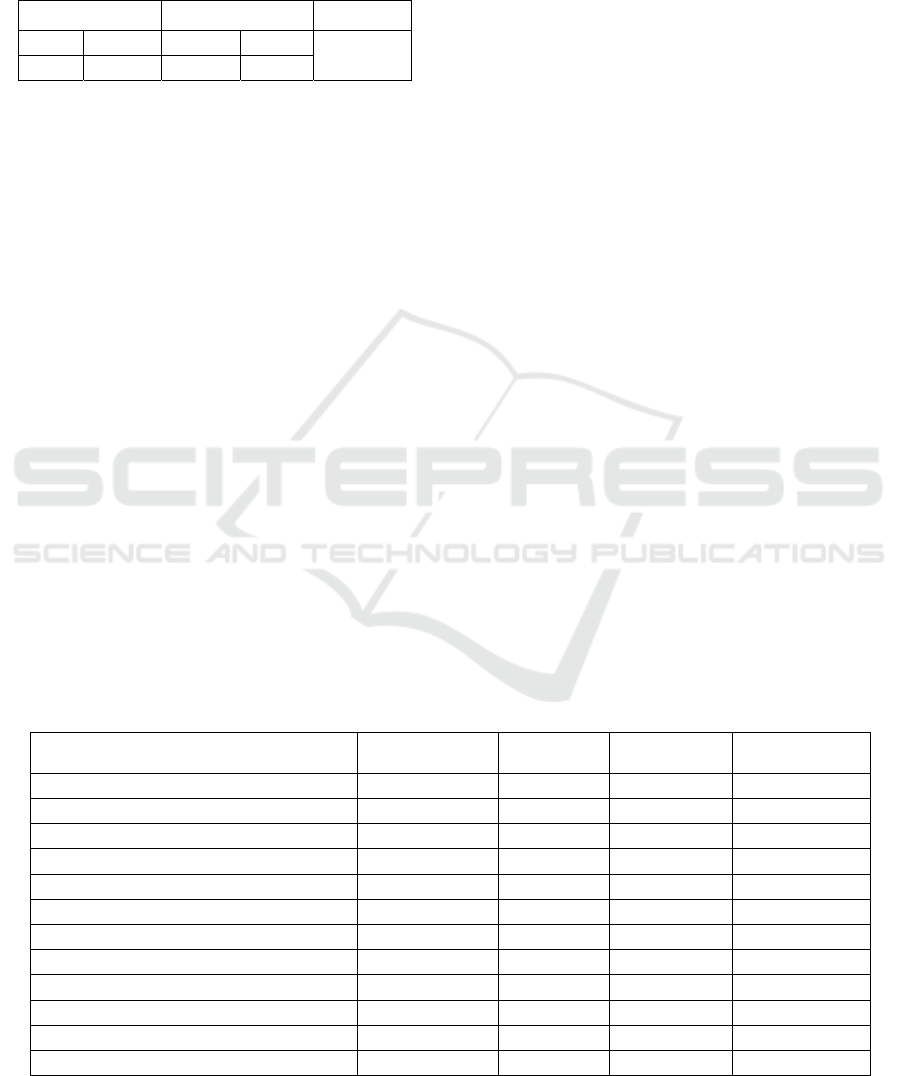
took part. Out of 800 distributed questionnaires, 629
were valid (see Table 1). Data was collected over six
months (January–June 2024) to capture diverse views
and reduce timing-related biases.
Table 1: Demographic description.
Gender Job Type Total
Male Female Govt. Private
629
373 256 329 300
3.2 Research Instrument
To develop strong measurement scales, the
researchers modified 10 existing scales and created
one new scale to fit the study's needs. To
accommodate participants' cultural and linguistic
backgrounds, the questionnaire was translated into
Hindi for better understanding. A multi-step
validation process ensured accuracy and reliability.
Four experts reviewed the scales, suggesting fewer
items for clarity and efficiency while refining
wording and format. A pilot study with 50
participants tested these changes, leading to further
refinements. The final questionnaire comprised 56
items ensuring clear, reliable, and culturally
appropriate data collection.
The study used different rating scales to measure
workplace behaviors and perceptions. Most
constructs were assessed using a 5-point Likert scale,
ranging from 1 (Strongly Disagree) to 5 (Strongly
Agree). Abusive supervision (4 items) was adapted
from Ghayas and Jabeen (2020), workplace ostracism
(3 items) from Dalain (2021), and workplace
incivility (6 items) from Cortina et al. (2001). A self-
structured scale measured interpersonal deviance (5
items). Supervisor support (5 items) from Kazmi and
Javaid (2022) and workplace bullying (7 items) from
Einarsen et al. (2009) were also included. Voice
behavior (5 items) from Rubbab (2021) used a 5-point
scale from 1 (Never) to 5 (Constantly), while
interpersonal conflict (5 items) from Wright et al.
(2017) ranged from 1 (Never) to 5 (Very Often).
Organizational politics (4 items) from Kacmar &
Carlson (1997) used a scale from 1 (Definitely Not)
to 5 (Definitely). Interpersonal distrust (6 items) and
negative workplace gossip (5 items) from Brady
(2018) were rated on a 7-point scale from 1 (Never)
to 7 (Daily). Social undermining (6 items) from Duffy
et al. (2002) used a 6-point scale from 1 (Never) to 6
(Everyday). These scales ensured accurate and
diverse measurement of workplace experiences.
3.3 Statistical Tools Used in the Study
The study used Confirmatory Factor Analysis (CFA)
and Partial Least Squares Structural Equation
Modeling (PLS-SEM) to assess the reliability and
validity of the collected data and to test the proposed
hypotheses. These analyses were conducted using
Smart PLS 3 (trial version).
3.4 Scale Validation
The study assessed the reliability and validity of its
measurement scales using Cronbach’s alpha, Rho A,
composite reliability (CR), and average variance
extracted (AVE) (see Table 2). The Cronbach’s alpha
values for all variables were above 0.7, indicating
good internal consistency. Rho A values, which
provide an alternative reliability measure, were also
Table 2: Measurement Results.
Variables Cronbach alpha Rho A CR AVE
Abusive Supervision 0.771 0.74 0.816 0.600
Interpersonal Deviance 0.892 0.926 0.920 0.697
Interpersonal Distrust 0.746 0.701 0.762 0.521
Negative Workplace Gossip 0.873 0.884 0.913 0.724
Organisational Politics 0.773 0.72 0.764 0.629
Supervisor Support 0.865 0.882 0.902 0.647
Social Undermining 0.920 0.920 0.938 0.715
Voice Behaviour 0.884 0.940 0.919 0.739
Workplace Bullying 0.852 0.860 0.890 0.575
Workplace Incivility 0.911 0.911 0.931 0.695
Workplace Loneliness 0.891 0.892 0.92 0.698
Workplace Ostracism 0.839 0.844 0.903 0.757
Factors Affecting Workplace Ostracism among Government and Private Firms’ Employees
441
found above 0.7 for all the variables. The Composite
Reliability (CR) values confirmed the overall
reliability of the scales explaining its values above 0.7
for all the variables. The AVE scores, which measure
how much variance in a construct is explained by its
indicators, were all above 0.50, ensuring adequate
convergent validity. These results indicate that the
measurement tools used in the study were both
reliable and valid for data analysis.
4 ANALYSIS AND
INTERPRETATION
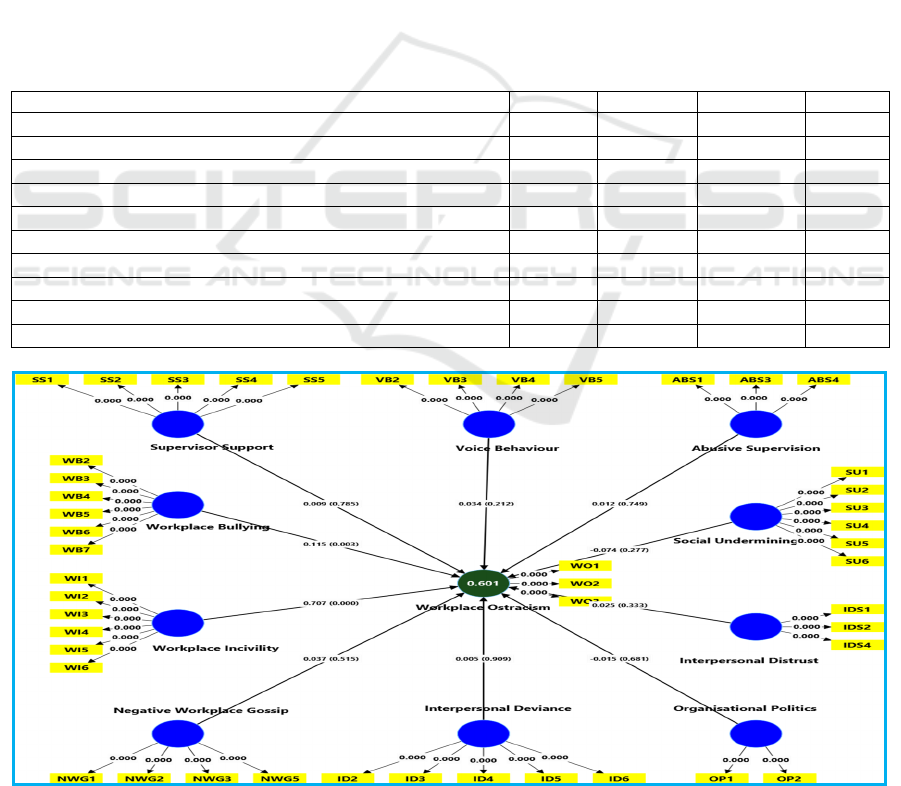
The results of the PLS-SEM analysis reveal several
insights into the relationships influencing workplace
ostracism (see Table 3 and Figure 1). Among the
predictors, workplace bullying exhibits a significant
positive relationship with workplace ostracism (β =
0.115, t = 2.973, p = 0.003), indicating that
experiences of bullying substantially contribute to
ostracism. Furthermore, workplace incivility emerges
as the strongest predictor, showing a highly
significant positive relationship (β = 0.707, t =
17.788, p < 0.001), underscoring its critical role in
fostering ostracism in organizational settings. Other
predictors such as abusive supervision (β = 0.012, t =
0.320, p = 0.749), interpersonal deviance (β = 0.005,
t = 0.114, p = 0.909), interpersonal distrust (β = 0.025,
t = 0.968, p = 0.333), negative workplace gossip (β =
0.037, t = 0.651, p = 0.515), organizational politics (β
= -0.015, t = 0.412, p = 0.681), social undermining (β
= -0.074, t = 1.088, p = 0.277), supervisor support (β
= 0.009, t = 0.273, p = 0.785), and voice behavior (β
= 0.034, t = 1.248, p = 0.212) do not show significant
effects. These findings highlight the critical influence
of workplace incivility and bullying on ostracism
while suggesting that other variables may have
limited or no direct impact.
Table 3: Sem Results of Objective 1 (Effect on Workplace Ostracism).
Predicted Relationshi
p
s
β
value STDEV t statistics
p
values
Abusive Supervision -> Workplace Ostracism 0.012 0.038 0.320 0.749
Interpersonal Deviance -> Workplace Ostracism 0.005 0.041 0.114 0.909
Interpersonal Distrust -> Workplace Ostracism 0.025 0.026 0.968 0.333
Negative Workplace Gossip -> Workplace Ostracism 0.037 0.057 0.651 0.515
Organisational Politics -> Workplace Ostracism -0.015 0.036 0.412 0.681
Social Undermining -> Workplace Ostracism -0.074 0.068 1.088 0.277
Supervisor Support -> Workplace Ostracism 0.009 0.034 0.273 0.785
Voice Behaviour -> Workplace Ostracism 0.034 0.027 1.248 0.212
Workplace Bullying -> Workplace Ostracism 0.115 0.039 2.973 0.003
Workplace Incivility -> Workplace Ostracism 0.707 0.040 17.788 0.000
Figure 1: Effect of Antecedent Variables on Workplace Ostracism.
ICRDICCT‘25 2025 - INTERNATIONAL CONFERENCE ON RESEARCH AND DEVELOPMENT IN INFORMATION,
COMMUNICATION, AND COMPUTING TECHNOLOGIES
442

5 DISCUSSIONS
This preliminary PLS-SEM analysis is a helpful way
of quantifying and understanding the drivers of
workplace ostracism, and distinguishes important
predictors from less significant ones. Bullying is one
of the major drivers of workplace exclusion
(Einarsen & Ågotnes, 2023). This indicates that
employees subjected to bullying are more prone to
feel excluded or neglected in both social and formal
settings (Verma et al., 2023; Glambek et al., 2018).
Workplace exclusion can be toxic with serious
ramifications, including stress, diminished job
satisfaction, decreased organizational commitment
and even considering leaving the organization.
Previous research backs this up too, finding that
bullying often alienates the victims, leaving them
feeling weak and disconnected from their coworkers.
This strengthens the belief that a toxic work
environment can lead employees to withdraw
socially, further compromising their mental health
and career development. When it comes to social
exclusion among employees, workplace incivility
ranks the highest (Holm, 2021; Zhou, 2024). It
suggests that even small but repeated rude behaviors
failing to acknowledge colleagues, making impolite
comments, forgetting to credit contributions are
capable of producing ostracism. Unethical and uncivil
behaviors are tolerated, and seem more acceptable
than overt bullying, making incivility both more
common and less visible to those affected (Jackson et
al., 2024). Such behaviours leave the employees
impersonal than before, it reduces the feeling of
belongingness, they do not want to socialize (Zhou,
2024). Why this discovery matters: It’s made clear
that organizations need to act against rude behavior,
and can’t only look for more egregious mistreatment,
like bullying or harassment. By addressing these
subtle forms of disrespect, we can build a more
inclusive and supportive work environment.
Workplace ostracism does not link significantly
with other factors like abusive supervision,
interpersonal deviance, interpersonal distrust,
negative workplace gossip, organizational politics,
social undermining, supervisor support, and voice
behavior. If these results may appear insipid, they
actually contribute to a more nuanced understanding
of the intricacy of workplace exclusion. For
example, abusive supervision is an overall negative
in the workplace, but this study found that it does not
directly contribute to the occurrence of ostracism.
That might mean that although abusive supervisors’
resort to intimidation and hostility, they still talk to
employees, and don’t totally disregard them. Thus,
while their actions are harmful, it does not in itself
drive employees into absolute social emarginality.
Similarly, interpersonal deviance and distrust
among colleague’s weakly influence workplace
ostracism. This might also help explain why dividing
behaviours into good and bad categories does not
always bring about social exclusion but a way for
disciplinary action or corrective action. Similarly,
although distrust can damage workplace
relationships, it does not directly contribute to
ostracism. Employees continue collaboration even
when distrust is evident, albeit with guardedness or
defensiveness. This suggests that desiring some
mistrust and rule-breaking is not a fast track to
unheededness or exclusion at work.
Ironically, negative workplace gossip is not
associated with ostracism. While gossip is typically
associated with hostility and exclusion in the
workplace, it doesn’t always result in total social
ostracism. Sometimes gossip can even unite certain
employees although it could hurt others. Like
organizational politics, it is not a strong predictor of
ostracism. Office politics can contribute to rifts and
divisions within the workplace, but it does not
inherently mean that individuals will be ostracized.
This might be because workplace political workers
who use workplace politics maintain networks and
alliances, rather than completely ostracizing other
workers. However, social undermining (the actions
that undermine someone's career advancement.) is
very irrelevant in the factors causing ostracism at
work. This means we address a co-worker in a way
that doesn’t ruin his or her reputation, protecting him
or her from being excluded from workplace
interactions, turning topic over to damage one’s
visibility or opportunity. For supervisor’s support
does not have a meaningful impact on ostracism. It
has been shown that even if supervisors are
encouraging their subordinates (Holzman 2005), they
will not necessarily prevent social exclusion
(Vasilenko et al. 2018). Finally, voice behavior (i.e.,
speaking up to others about thoughts and concerns)
has little correlation with ostracism. This implies that
speaking up at work isn’t inherently exclusionary
based. Indeed, many organizations may value
proactive employees rather than separate them for
expressing their opinions.
Factors Affecting Workplace Ostracism among Government and Private Firms’ Employees
443

6 FUTURE RESEARCH
AVENUES
Filling this research gap, future studies may also
examine how workplace ostracism affects employees
over time, such as its effects on their well-being and
job performance. Whether exclusion at the
workplace vary across organizations is questionable
and may require looking at cross cultural studies.
Another avenue for researchers is examining the
impact of online communication on workplace
ostracism. Moreover, more studies should direct
towards preventing ostracism, for example, imposing
better leadership training or workplace policy
strategies that can promote a supportive and
inclusive workplace.
7 LIMITATIONS
This study has some limitations. It focuses only on
employees in Chhattisgarh, India, limiting its
generalizability. The data is self-reported, which may
introduce bias. Also, the study uses a cross-sectional
design, preventing conclusions about cause and
effect.
8 CONCLUSIONS
This study highlights the key factors influencing
workplace ostracism, with workplace incivility and
bullying emerging as the strongest predictors. Subtle
disrespectful behaviors and repeated mistreatment
significantly contribute to employees feeling
excluded. However, other factors like abusive
supervision, interpersonal deviance, distrust, gossip,
organizational politics, social undermining,
supervisor support, and voice behavior do not show a
direct impact on ostracism. These findings suggest
that while certain negative behaviors harm workplace
relationships, they do not always lead to complete
social exclusion. Organizations should focus on
reducing workplace incivility and bullying through
strong policies, training programs, and supportive
leadership. Encouraging respectful communication
and inclusive practices can help prevent workplace
exclusion. Future research should explore long-term
effects, cultural differences, and digital workplace
interactions to gain deeper insights. Addressing
ostracism effectively can create a healthier and more
productive work environment, ensuring employees
feel valued and engaged in their organizations.
REFERENCES
Ahmad Izhan, F. F., Othman, N. A. F., & Majid, M. B.
(2024). Workplace ostracism through the lens of
reciprocity theory. Insight Journal, 11(1).
https://doi.org/10.24191/ij.v0i0.24927
Ahmed, I., Wan Ismail, W. K., Amin, S., & Islam, T.
(2013). Evading ostracism: A look at critical role of
organizational and supervisory support. Research
Journal of Applied Sciences, Engineering and
Technology, 6(14), 2535– 2537. https://doi.org/10.19
026/RJASET.6.3734
Al-Dhuhouri, F. S. S., & Shamsudin, F. M. (2023). The
mediating influence of perceived workplace ostracism
on the relationship between interpersonal distrust and
knowledge hiding and the moderating role of person-
organization unfit. Heliyon. https://doi.org/10.1016/j.h
eliyon.2023.e20008
Al-Dhuhouri, F. S., Mohd-Shamsudin, F., & Bani-Melhem,
S. (2024). Feeling ostracized? Exploring the hidden
triggers, impact on silence behavior and the pivotal role
of ethical leadership. International Journal of
Organizational Theory & Behavior. https://doi.org/10.
1108/ijotb-12-2022-0237
Ali, M., Usman, M., Pham, N. T., Agyemang-Mintah, P., &
Akhtar, N. (2020). Being ignored at work:
Understanding how and when spiritual leadership curbs
workplace ostracism in the hospitality industry.
International Journal of Hospitality Management, 91,
102696. https://doi.org/10.1016/j.ijhm.2020.102696
Anjum, S., Ahmad, I., Ullah, M., & Al Gharaibeh, F.
(2023). Impact of abusive supervision on job
performance in education sector of Pakistan:
Moderated mediation of emotional intelligence and
workplace ostracism.
Global Business Review. https://doi.org/10.1177/0972
1509231169360
Bai, Y., Lu, L., Lin-Schilstra, L., & Lin-Schilstra, L.
(2021). Auxiliaries to abusive supervisors: The
spillover effects of peer mistreatment on employee
performance.
Journal of Business Ethics, 1– 19. https://doi.org/10.1
007/s10551-021-04768-6
Barua, B., & Vázquez de Príncipe, J. (2024). How
workplace loneliness impacts workplace wellbeing? In
Advances in Human Resources Management and
Organizational Development Book Series (pp. 263–
284). IGI Global. https://doi.org/10.4018/979-8-3693-
6079-8.ch011
Brison, N., Huyghebaert-Zouaghi, T., & Caesens, G.
(2024). How supervisor and coworker ostracism
influence employee outcomes: The role of
organizational dehumanization and organizational
embodiment. Baltic Journal of Management.
https://doi.org/10.1108/bjm-09-2023-0370
Brison, N., Huyghebaert-Zouaghi, T., & Caesens, G.
(2024). How supervisor and coworker ostracism
influence employee outcomes: The role of
organizational dehumanization and organizational
ICRDICCT‘25 2025 - INTERNATIONAL CONFERENCE ON RESEARCH AND DEVELOPMENT IN INFORMATION,
COMMUNICATION, AND COMPUTING TECHNOLOGIES
444

embodiment. Baltic Journal of Management.
https://doi.org/10.1108/bjm-09-2023-0370
Chakraborty, T., Sharada, V. S., & Tripathi, M. (2024).
Promoting well-being through respect. In Advances in
Human Resources Management and Organizational
Development Book Series (pp. 117–154). IGI Global.
https://doi.org/10.4018/979-8-3693-6079-8.ch006
Chaman, S., Shaheen, S., & Hussain, A. (2022). Linking
leader’s behavioral integrity with workplace ostracism:
A mediated-moderated model. Frontiers in Psychology,
13. https://doi.org/10.3389/fpsyg.2022.726009
Chaudhary, R., Srivastava, S., & Bajpai Singh, L. (2024).
Does workplace ostracism lead to knowledge hiding?
Modeling workplace withdrawal as a mediator and
authentic leadership as a moderator. The International
Journal of Human Resource Management, 35(21),
3593–3636.
Das, S. C., & Ekka, D. (2024). Workplace ostracism and
turnover intention in organizations: A meta-analytic
review. Technology, 5(1), 48–73.
Das, S. C., & Ekka, D. (2024). Workplace ostracism and
turnover intention in organizations: A meta-analytic
review. SAGE Open.
https://doi.org/10.1177/25819542241250147
Das, S. C., & Ekka, D. (2024). Workplace ostracism and
turnover intention in organizations: A meta-analytic
review. SAGE Open. https://doi.org/10.1177/2581954
2241250147
Das, S. C., & Ekka, D. (2024). Workplace ostracism and
turnover intention in organizations: A meta-analytic
review. SAGE Open.
https://doi.org/10.1177/25819542241250147
Gamian-Wilk, M., & Madeja-Bien, K. (2021). Ostracism in
the workplace. In Special topics and particular
occupations, professions and sectors (pp. 3–32).
Guo, G., Gong, Q., Li, S., & Liang, X. (2021). Don’t speak
ill of others behind their backs: Receivers’ ostracism
(sender-oriented) reactions to negative workplace
gossip. Psychology Research and Behavior
Management, 14, 1– 16. https://doi.org/10.2147/PRB
M.S288961
Hameed, F., Shaheen, S., & Younas, A. (2025). What drives
ostracised knowledge hiding? Negative workplace
gossips and neuroticism perspective. VINE Journal of
Information and Knowledge Management Systems.
https://doi.org/10.1108/vjikms-11-2023-0311
Hua, C., Zhao, L., He, Q., & Chen, Z. (2023). When and
how workplace ostracism leads to interpersonal
deviance: The moderating effects of self-control and
negative affect. Journal of Business Research, 156,
113554. https://doi.org/10.1016/j.jbusres.2022.113554
Imran, M. K., Fatima, T., Sarwar, A., & Iqbal, S. M. J.
(2021). Will I speak up or remain silent? Workplace
ostracism and employee performance based on self-
control perspective. Journal of Social Psychology, 1–
19. https://doi.org/10.1080/00224545.2021.1967843
Jackson, D., Usher, K., & Cleary, M. (2024). Workplace
incivility: Insidious, pervasive and harmful.
International Journal of Mental Health Nursing.
https://doi.org/10.1111/inm.13315
Jahanzeb, S., & Fatima, T. (2018). How workplace
ostracism influences interpersonal deviance: The
mediating role of defensive silence and emotional
exhaustion. Journal of Business and Psychology, 33(6),
779–791. https://doi.org/10.1007/s10869-017-9525-6
Jahanzeb, S. (2022). How workplace ostracism influences
interpersonal deviance: The mediating role of defensive
silence and emotional exhaustion. In Workplace
Ostracism and Employee Outcomes (pp. 27–39).
Springer. https://doi.org/10.1007/978-3-031-19937-
0_3
Khalid, S., Malik, N., & Atta, M. (2024). Employee silence
predicted by abusive leadership and workplace
ostracism: Role of employee power distance.
International Journal of Educational Leadership and
Management, 12(1), 13–35.
Kim, H.-R., & Jang, E.-M. (2023). Workplace ostracism
effects on employees’ negative health outcomes:
Focusing on the mediating role of envy. Behavioral
Sciences, 13(8). https://doi.org/10.3390/bs13080669
Kim, H.-R., & Jang, E.-M. (2023). Workplace ostracism
effects on employees’ negative health outcomes:
Focusing on the mediating role of envy. Behavioral
Sciences, 13(8). https://doi.org/10.3390/bs13080669
Kuo, C.-C., Chang, K., Kuo, T.-K., & Cheng, S. (2020).
Workplace gossip and employee cynicism: The
moderating role of dispositional envy. Chinese Journal
of Psychology, 62(4), 537– 552. https://doi.org/10.61
29/CJP.202012_62(4).0005
Lestari, U. D., Haq, M. A., Rahmat Syah, T. Y., &
Supriatna, E. (2024). Bagaimana workplace ostracism
mempengaruhi turnover intention yang dimediasi oleh
job performance dan organizational virtuousness serta
authentic leadership sebagai moderasi. Religion,
Education, and Social Laa Roiba Journal (RESLAJ),
6(12). https://doi.org/10.47467/reslaj.v6i12.4701
Lestari, U. D., Haq, M. A., Rahmat Syah, T. Y., &
Supriatna, E. (2024). Bagaimana workplace ostracism
mempengaruhi turnover intention yang dimediasi oleh
job performance dan organizational virtuousness serta
authentic leadership sebagai moderasi. Religion,
Education, and Social Laa Roiba Journal (RESLAJ),
6(12). https://doi.org/10.47467/reslaj.v6i12.4701
Li, C.-F., & Tian, Y.-Z. (2016). Influence of workplace
ostracism on employee voice behavior. American
Journal of Mathematical and Management Sciences,
35(4), 281– 296. https://doi.org/10.1080/01966324.20
16.1201444
Li, M., Xu, X., & Kwan, H. K. (2021). Consequences of
workplace ostracism: A meta-analytic review. Frontiers
in Psychology, 12, 641302. https://doi.org/10.3389/fp
syg.2021.641302
Li, M., Xu, X., & Kwan, H. K. (2021). Consequences of
workplace ostracism: A meta-analytic review. Frontiers
in Psychology, 12, 641302. https://doi.org/10.3389/fp
syg.2021.641302
Liu, C., Peng, Y., Xu, S., & Azeem, M. U. (2024). Proactive
employees perceive coworker ostracism: The
moderating effect of team envy and the behavioral
outcome of production deviance. Journal of
Factors Affecting Workplace Ostracism among Government and Private Firms’ Employees
445

Occupational Health Psychology. https://doi.org/10.1
037/ocp0000389
Luo, J., Li, S., Gong, L., Zhang, X., & Wang, S.-B. (2022).
How and when workplace ostracism influences
employee deviant behavior: A self-determination
theory perspective. Frontiers in Psychology, 13.
https://doi.org/10.3389/fpsyg.2022.1002399
Matsson, A. (2023). How to organize silence at work: An
organizational politics perspective on pragmatic
mistreatment at work. Employee Responsibilities and
Rights Journal. https://doi.org/10.1007/s10672-023-
09454-5
Quade, M. J. (2013). The goody-good effect: When social
comparisons of ethical behavior and performance lead
to self-threat versus self-enhancement, social
undermining, and ostracism [Doctoral dissertation,
University of Oklahoma]. https://shareok.org/handle/1
1244/15076
Ramadan, W., Obeid, H., & Shaheen, R. (2023). Relation
between nurses’ workplace ostracism and their
organizational commitment. Tanta Scientific Nursing
Journal. https://doi.org/10.21608/tsnj.2023.328849
Sarwar, B., Mahasbi, M. H. ul, Zulfiqar, S., Sarwar, M. A.,
& Huo, C. (2024). Silent suffering: Exploring the far-
reaching impact of supervisor ostracism via sociometer
theory. Journal of Applied Research in Higher
Education. https://doi.org/10.1108/jarhe-07-2023-0296
Sharma, A., Abdullah, H., & Bano, A. (2024). Workplace
ostracism in the selected service sector organizations in
Chhattisgarh: Implications for employee well-being
and organizational performance. ShodhKosh: Journal
of Visual and Performing Arts, 5(1).
https://doi.org/10.29121/shodhkosh.v5.i1.2024.3243
Sharma, A., Abdullah, H., & Bano, A. (2024). Workplace
ostracism in the selected service sector organizations in
Chhattisgarh: Implications for employee well-being
and organizational performance. ShodhKosh: Journal
of Visual and Performing Arts, 5(1).
https://doi.org/10.29121/shodhkosh.v5.i1.2024.3243
Singh, S., Subramani, A., David, R., & Jan, N. (2024).
Workplace ostracism influencing turnover intentions:
Moderating roles of perceptions of organizational
virtuousness and authentic leadership. Acta
Psychological, 243, 104136. https://doi.org/10.1016/j.
actpsy.2024.104136
Singh, S., Subramani, A., David, R., & Jan, N. A. (2024).
Workplace ostracism influencing turnover intentions:
Moderating roles of perceptions of organizational
virtuousness and authentic leadership. Acta
Psychologica, 243, 104136. https://doi.org/10.1016/
j.actpsy.2024.104136
Singh, S., Subramani, A., David, R., & Jan, N. A. (2024).
Workplace ostracism influencing turnover intentions:
Moderating roles of perceptions of organizational
virtuousness and authentic leadership. Acta
Psychologica, 243, 104136. https://doi.org/10.1016/j.a
ctpsy.2024.104136
Wang, A. Y., & Liao, E. Y. (2022). Does political savviness
enhance employee voice? Speaking up when coworkers
are ostracized. Academy of Management Proceedings,
2022(1), 17029. https://doi.org/10.5465/ ambpp.2022.
17029abstract
Wang, H. J., & Xu, S. (2022). Does abusive supervision
trigger displaced aggression? Academy of Management
Proceedings, 2022(1). https://doi.org/10.5465/ambpp.
2022.13963abstract
Wang, L. M., Lu, L., Wu, W. L., & Luo, Z. W. (2023).
Workplace ostracism and employee wellbeing: A
conservation of resource perspective. Frontiers in
Public Health, 10, 1075682. https://doi.org/10.3389/fp
ubh.2022.1075682
Wu, W., Wang, H. (Jason), & Lu, L. (2018). Will my own
perception be enough? A multilevel investigation of
workplace ostracism on employee voice. Chinese
Management Studies, 12(1), 202– 221. https://doi.org/
10.1108/CMS-04-2017-0109
Wu, W., Qu, Y., Zhang, Y., Hao, S., Tang, F., Zhao, N., &
Si, H. (2019). Needs frustration makes me silent:
Workplace ostracism and newcomers’ voice behavior.
Journal of Management & Organization, 25(5), 635–
652. https://doi.org/10.1017/jmo.2017.81
Yang, J., & Treadway, D. C. (2018). A social influence
interpretation of workplace ostracism and
counterproductive work behavior. Journal of Business
Ethics, 148(4), 879– 891. https://doi.org/10.1007/s105
51-015-2912-x
Yarivand, M. (2024). How envy drives social undermining:
An analysis of employee behavior. International
Journal of Innovative Science and Research
Technology, 2005–2011. https://doi.org/ 10.38124/
ijisrt/ijisrt24jul1339
Zeng, Q., Zhihui, D., Zhu, B., & Yang, W. (2024). Taking
anger home: Are employees who experience ostracism
from supervisors more likely to undermine family
harmony? The perspective of anger displacement.
SAGE Open, 14(4). https://doi.org/10.1177/21582440
241290930
Zhong, J. Y. (2025). Impact of workplace ostracism on
knowledge hoarding. Qeios. https://doi.org/ 10.32388/
hujuk7
ICRDICCT‘25 2025 - INTERNATIONAL CONFERENCE ON RESEARCH AND DEVELOPMENT IN INFORMATION,
COMMUNICATION, AND COMPUTING TECHNOLOGIES
446
