
Design and Implementation of an IoT‑Based Air Quality Monitoring
and Control System
Anist A., Mohammed Afrideen Ismail A. and Muralikrishnan K.
Department of Electronics and Communication Engineering, St. Joseph’s Institute of Technology, Chennai, Tamil Nadu,
India
Keywords: Air Quality Monitoring, Gas Detection, Real‑Time Alerts, Air Purification, Hazardous Gas Management,
Environmental Safety, Health Improvement.
Abstract: Air pollution is a serious threat to public health and environmental sustainability, particularly in industries
and confined areas where poisonous gases have the potential to aggregate. The current systems of air-quality
monitoring are costly and do not provide real-time intervention. To overcome this, we intend to implement a
low-cost and automated air-quality monitoring and purification system incorporating MQ2 and MQ7 gas
sensors, ESP8266, an LCD, a buzzer, and an air purifier. The novelty of this work comes from the fact that it
cannot only sense dangerous gases in real time but also act upon it immediately by triggering an air purifier,
thus taking a proactive stance towards air-quality control. The system incorporates an L293D motor driver
for driving and is powered with a low-power supply, which makes it very effective on an economical scale.
By allowing for early detection and rapid mitigation, this system promotes safety and adds to an indoor
environment that is healthier, providing a sensible solution for industrial, laboratory, and residential use.
1 INTRODUCTION
Air quality is a key factor determining human health
and environmental sustainability, especially in
regions where toxic gases can build up to harmful
concentrations. The growing number of air pollution
events and the related risks to human health
underscore the necessity for efficient and cost-
effective air quality monitoring systems. This project
presents a (N. Hossein Motlagh et al.,2023) complete
system intended to monitor and enhance air quality
utilizing MQ2 and MQ7 gas sensors, a buzzer, and an
air purifier. The project seeks to counter the
difficulties with poor air quality, particularly in
sensitive areas like industrial establishments,
laboratories, and indoors, where the buildup of unsafe
gases can result in major health and safety hazards.
The system uses gas detection technology and
sophisticated integrated circuits for real-time
detection and prompt response against deterioration
in air quality. The MQ2 sensor is commonly used (D.
Iskandaryan et al. 2023) to detect different gases,
including carbon monoxide, methane, and LPG. To
complement this, the MQ7 sensor is carbon monoxide
specific, being colorless and odorless but highly
toxic. Both offer sufficient protection for the majority
of the dangerous gases that could be anticipated in the
region being monitored, and with their assistance, the
system is able to rapidly identify the presence of
potential air quality dangers.
When gas levels surpass specified safety limits,
the system sounds a buzzer to warn occupants or
concerned authorities. This instant (R. Purbakawaca
et al. 2022) warning allows appropriate measures to
be taken in a timely manner to avoid possible damage.
In addition, the system has a built-in air purifier that
automatically kicks in to counteract the presence of
toxic gases. This anticipatory measure not only
enhances air quality but also curtails the effects of
long-term exposure to toxicants, which can cause
critical health problems such as respiratory illnesses
and cardiovascular disorders.
The design of the system will be minimalist and
cost-effective, hence general-purpose. In particular,
the system will be based around the ESP8266
microcontroller, which is handling data gathered and
the (L. Miasayedava et al. 2023) functionality of the
system. Real-time data from gas sensors will be
projected on an LCD display such that users are
immediately aware of the air quality status. The
power supply unit will guarantee consistent
operation, whereas the L293D motor driver will
A., A., A., M. A. I. and K., M.
Design and Implementation of an IoT-Based Air Quality Monitoring and Control System.
DOI: 10.5220/0013914100004919
Paper published under CC license (CC BY-NC-ND 4.0)
In Proceedings of the 1st International Conference on Research and Development in Information, Communication, and Computing Technologies (ICRDICCT‘25 2025) - Volume 4, pages
413-420
ISBN: 978-989-758-777-1
Proceedings Copyright © 2026 by SCITEPRESS – Science and Technology Publications, Lda.
413

regulate the buzzer and air purifier for their smooth
integration into the system. Such air quality
monitoring system is especially useful in settings
where conventional ventilation techniques can be
inadequate or even unfeasible. In industrial buildings,
for example, the buildup (M. A. Zaidan et al., 2022)
of gases such as methane or carbon monoxide can
result in explosion risks or poisoning threats. In the
same way, laboratories that work with volatile
chemicals need to be constantly monitored to prevent
accidents to human personnel. Even in domestic
areas, where the use of LPG for cooking is prevalent,
a system like this can be an added security measure
by being able to sense gas leaks and ensuring a clean
indoor environment.
Aside from its direct advantages, this system is a
major breakthrough in solving the larger problem of
air quality management. Air pollution is a worldwide
pressing issue, responsible for causing millions (X.
Lin et al. 2022) of premature deaths every year and
fueling climate change. Through offering a
dependable and cost-effective means of monitoring
air quality around the clock, this system gives
individuals and organizations the ability to take
proactive action to safeguard human health and the
environment. The potential applications for this type
of system do not end at health and safety. The
compiled data incorporated into broader systems
might help go towards smart city initiatives that
facilitate the upkeep and regulation of urban air
quality. Such data would also be beneficial for
research into trying to comprehend trends of pollution
and find effective measures to mitigate it. In addition,
the modular construction of the system would make it
expandable at a later point, such as with the
installation of sensors to detect other sources of
pollutants or connecting it to a feature enabling long-
distance control and monitoring.
The suggested system for air quality monitoring
provides an effective and worthwhile solution (Y.
Cao et al 2024) to air quality problems facing vital
locations. By taking advantage of sophisticated
sensor technology, real-time processing, and
automated response systems, it enables safety and
healthier environments. Its cost-effectiveness and
versatility render it applicable to a broad variety of
uses, from factories to homes, leading to a safer,
healthier, and more sustainable world. This project
emphasizes the need for the incorporation of
technology into environmental management, laying
the ground for innovations that ensure both human
welfare and the globe.
This work is organized as Section II presenting a
review of the literature survey. Section III describes
the methodology, highlighting its key features and
functionality. Section IV discusses the results,
analysing the system's effectiveness. Lastly, Section
V concludes with the main findings and explores
future implications.
2 LITERATURE SURVEY
Air quality monitoring is a heavily researched
subject due to pollution causing health and
environmental issues. Study mentions the systems
that can detect toxic gases and pollutants in different
environments, such as industrial, urban and
residential. These systems are primarily used to
provide real-time data to monitor air quality and
increase awareness about possible hazards. Studies
suggest that detection of air pollutants, since most of
these pollutants are harmful in the long term,
including carbon monoxide, methane, particulate
matter (PM), etc. Attention should be paid to
detection when the concentration of air pollutants in
the environment is low or air pollutant particles are
ineffective, to avoid long-term irreversible effects.
The development of affordable and reliable solutions
has been a key emphasis, to foster widespread
adoption and accessibility.
And the research suggests ways to reduce the
harmful effects of air pollution on human health and
the environment. Recent scientific publications have
focused on new approaches to recognize toxic
pollution and monitor air quality smartly (G. A.
López-Ramírez and A. Aragón-Zavala, 2023) in real
time. These indicate the need for a monitoring system
to mitigate the risk from toxic exposure and to ensure
compliance with tolerable limits. However, there is
potential for increased pollution in laboratories,
industries, and urban areas with thick human
collections where these monitoring systems are
useful. Air quality solutions that are good, make good
air make for good spaces that are good for health and
the environment.
The study explore approach to detecting and
mitigating air pollution in areas that matter. Research
centers on systems which (S. Al-Eidi, et al. 2023)
continuously monitor the presence of harmful agents
such as carbon monoxide, methane, and particulate
matter to provide health hazards. They are intended
to warn people promptly and promote interventions
to prevent exposure to toxic gases. Such systems will
thus inevitably have more interest in the practical use
of monitoring solutions in, for example, factories,
urban spaces, or residential areas. The study
highlights the need for continuous monitoring to
ICRDICCT‘25 2025 - INTERNATIONAL CONFERENCE ON RESEARCH AND DEVELOPMENT IN INFORMATION,
COMMUNICATION, AND COMPUTING TECHNOLOGIES
414

combat pollution problems and improve public health
and the environment.
Air quality monitoring for human health and
environmental safety has focused on real-time
pollution assessment research. In studies (H. A. D.
Nguyen and Q. P. Ha et al.2022) the evaluation of a
system to analyze (N. Liu et al. 2022) and even
perform early intervention against exposure to toxic
pollutants was performed. Issues resulting in
accumulation of dangerous gases in industrial and
urban areas lead research to emphasize the
importance of continuous monitoring in such areas.
Because on this matter, efficient solutions link to
raising awareness of pollution levels and nurturing
approaches to maintain air quality standards at safe
levels. It has been observed for the monitoring
system to minimize health related hazards due to
pollution and support the endeavor of environmental
management.
The work addresses the need for reliable
solutions to identify and control air pollution. Studies
focus on monitoring systems designed to assess
pollutant levels in real-time and provide actionable
(C. Liu et al. 2023) data for intervention. Researchers
emphasize the importance of monitoring air quality in
environments with elevated risks, such as urban areas,
workplaces, and laboratories. Monitoring systems
play a vital role in identifying pollution trends and
implementing safety measures to minimize health
risks. Research demonstrates that air quality
monitoring supports long-term sustainability goals by
mitigating environmental and health impacts caused
by air pollution.
The work has been one of the widely studied
systems because of the growing concern about
pollution and its health effects. Research has been
carried out to show different approaches in
identifying the pollutants, for instance, carbon
monoxide (L. Pang et al 2023), volatile organic
compounds, and particulate matter, that pose serious
risks. Systems intended for real-time monitoring are
assessed regarding their potential contribution toward
better security of the public and the environment.
Emphasis is based on deployment in high-risk areas,
such as urban centers and industrial zones.
The study has emphasized the need for
identification and mitigation in areas where air
quality is such that health and safety are affected. The
studies (S. Berkani et al. 2023) are directed towards
real-time systems that offer the capability for
pollutant detection and provide insights into
actionable information for the prevention of harm.
Applications are industrial, urban, and residential,
where air quality monitoring is important as part of
complying with the set standards of safety. The
literature highlights monitoring can raise awareness
of risks due to pollution and allow timely
intervention. Contributing to this research are efforts
toward lessening health issues related to pollution and
increasing sustainability across different settings.
The paper assesses creative strategies for
pollution control (G. Ramirez-Espinosa et al. 2024)
and the related hazards. Research focuses on systems
built to constantly monitor air quality and send alerts
for prompt intervention. Applications range from
industrial to urban and residential environments,
focusing on detecting noxious pollutants in order to
mitigate health risks. However, reliable data are
needed to implement safety measures and promote
effective air quality management. These initiatives
are part of a larger environmental framework, as
tracking systems inform approaches to reducing
pollution and improving human health.
This research explores management strategies in
order to prevent and identify pollution in public
health and safety hotspots. These studies emphasize
systems that can measure pollutant levels in real
time, providing the necessary data for people to act.
These fields are particularly relevant in high-risk
environments, such as industrial facilities and urban
centers where pollution exposure is higher. To
mitigate toxic pollutant emissions and air
contamination, research stresses the need for
ongoing monitoring. Thanks to them we have safer
environments and more strong efforts in
sustainability.
Pollution is a longstanding problem that is
becoming more challenging to manage; the research
reported here focuses on both real-time detection and
mitigation of the impact. Research focuses on
applications that detect contaminants in various
settings such as industrial properties, city areas, and
residences (E. I. Fernández et al. 2024). The
researchers underscore the value of ongoing
monitoring in both awareness of air quality
challenges and in enabling preventative actions. Such
systems promote health and safety by minimizing
exposure to hazardous materials. This study
highlights how monitoring and compliance is a major
means of ensuring adherence to these standards to
drive long-term efforts to prevent the detrimental
effects of pollution on human health and the
ecosystem.
The study has attracted much attention following
an increasing concern about pollution and its
consequences on health and safety. To detect
pollutants (F. Naz et al., 2023) and evaluate air
quality at places that are critical, the research answers
Design and Implementation of an IoT-Based Air Quality Monitoring and Control System
415
certain solutions. These are done to provide real-
time monitoring that enables the collection of credible
data at all times to facilitate early intervention to
prevent exposure to harmful substances. This has
applications for industrial output and urban,
residential groups that experience significant
pollution. Overall, these studies confirm that such
systems can turn back the tides of pollution, ensure
the continuation and improvement of public health,
and provide reinforcement for general goals around
sustainability.
The research evaluates the effectiveness of
systems designed to address pollution in high-risk
areas. Studies highlight real-time monitoring
solutions that provide data on pollutant levels and
enable proactive responses to deteriorating air
quality. Key applications (J. Pellegrino et al. 2025)
include industrial zones, urban environments, and
laboratories, where exposure to harmful substances
must be minimized. Continuous monitoring is
recognized for its role in improving safety and
compliance with health standards. The literature
emphasizes that air quality monitoring not only
protects human health but also supports
environmental management efforts aimed at reducing
pollution's long-term impacts.
The work is geared toward solving the challenges
arising from pollution. The studies have focused on
the detection and analysis of pollutants (F. Gandino
et al. 2023) to ensure a safe and healthy environment.
Additionally, real-time systems are called for in light
of their ability to provide exact and timely data that
aids in quick interventions in the most needed
locations. The applications vary from urban areas to
industrial settings where pollution is likely to be high.
Researchers also express that air quality monitoring
ensures awareness, reduction of health risks, and
sustainability that help in creating healthier and
greener communities.
The work addresses the urgent need for effective
pollution management systems. Research focuses on
solutions capable of detecting (M. A. Zaidan et al.,
2023) harmful pollutants and providing real-time
insights into air quality. Studies underline the
significance of monitoring in environments where
health risks are heightened, such as industrial
facilities and urban centers. These systems facilitate
timely actions to mitigate exposure to toxic
substances, ensuring compliance with safety
regulations. Research demonstrates that air quality
monitoring plays a vital role in improving public
health outcomes and advancing broader efforts to
reduce pollution's impact on the environment.
3 METHODOLOGY
Air pollution is one of the significant health and
environmental hazards, particularly in enclosed
spaces where toxic gases can accumulate. These
hazards must be contained, requiring efficient air-
quality monitor and improvement system. Traditional
monitoring systems are passive and costly, which
leads to a lack of adaptability. This paper describes
an inexpensive way of monitoring and purifying air
quality using MQ2 and MQ7 gas sensors, an
ESP8266 microcontroller, a buzzer and an air
purifier. The system acts not only by detecting toxic
gases in real time but also by applying immediate
corrective actions. This is a preventive measure that
moves air quality into the management phase and
makes it safe and sustainable under various
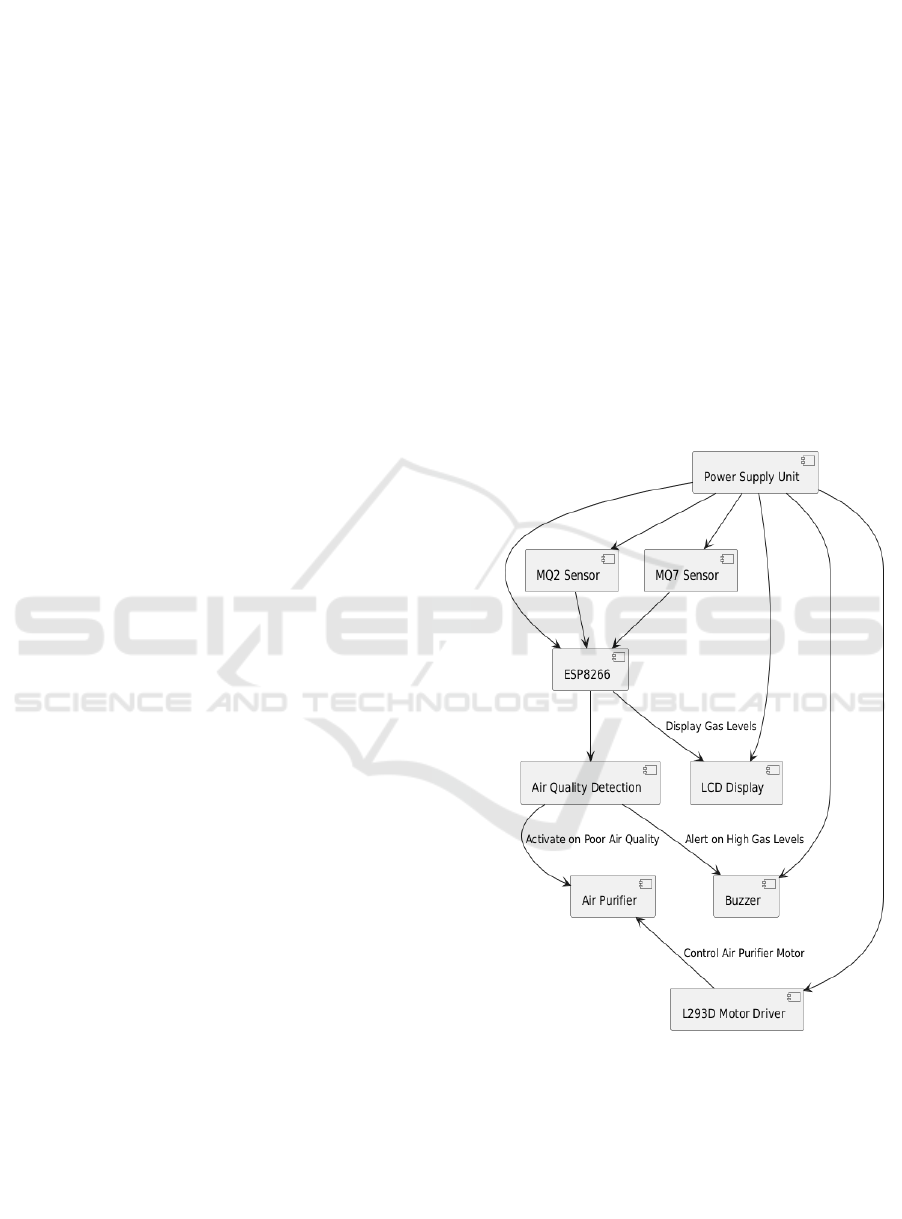
conditions. Figure 1 shows the block diagram.
Figure 1: Block Diagram.
3.1 System Architecture
It consists of some hardware, which are combined to
map the air quality and to clean it. Both the MQ2 and
MQ7 identify the gas components like carbon
monoxide, methane and LPG, while the MQ7 only
identifies carbon monoxide. Real-time sensor data is
ICRDICCT‘25 2025 - INTERNATIONAL CONFERENCE ON RESEARCH AND DEVELOPMENT IN INFORMATION,
COMMUNICATION, AND COMPUTING TECHNOLOGIES
416

written in the ESP8266 microcontroller and used to
determine if gas concentrations are above specific
thresholds or not. If unsafe levels are detected, an
alarm buzzer sounds, and the air purifier is activated.
The LCD screen shows constant air quality
information for real-time monitoring. A stable power
supply powers all elements of the system, ensuring
continuous operation of the air purification units
when needed.
3.2 Sensor Calibration
Because MQ2 and MQ7 are gas sensors, they need
calibration to make sure the output gas concentration
is accurate. Each sensor must be subjected to known
concentrations of gases to determine its baseline
resistance. These sensors operate on the principle
that the resistance across them changes when they are
exposed to different gas species. Sensor output is
taken in a controlled environment to prepare a
calibration curve. This calibration data is stored in
the ESP8266 microcontroller and is used to convert
sensor output to actual gas concentration
measurements. Proper calibration ensures the
accuracy of the system, avoiding false-positive
readings and enabling accurate monitoring of
damaging gas levels in real-time air-quality
monitoring applications.
3.3 Data Collection
In this phase, the ESP8266 microcontroller keeps
taking data from the calibrated MQ2 and MQ7
sensors. It reads sensor readings at intervals and
compares it with a predefined safety limit. The
system logs gas concentration readings, tracking air-
quality trends over time. An LCD display reads data
out for real-time visualization, allowing feedback
right away. In necessary areas, the data extracted can
also be transmitted without wires for monitoring
purposes. This real-time air-quality awareness assists
in the rapid intervention of mitigating harmful health
effects of prolonged exposures to toxic gases and
ongoing data collection.
3.4 Threshold Detection and Alert
Mechanism
Threshold concentrations of gas must be defined
beforehand from safety standards and also from
sensor calibration data. If the values read by the
sensors exceed the defined parameters, an alert
mechanism is activated by the system. The buzzer is
a noise alarm that informs members of the household
that something is wrong. Simultaneously, an LED
light indicator on top of the LCD display provides a
visual alert. This two-tier warning array ensures
users detect air-quality issues right away. As long as
gas levels are above the safety threshold, the alert
system remains active. Such alerts, when coupled
with each other, help improve safety by providing
early warnings and allowing timely action to avoid
exposure to hazardous gases.
3.5 Automatic Air Purification System
The air purifier is automatically powered on if gas
levels are over safety thresholds. The L293D motor
driver is employed for motor control to ensure
effective operation. The purifier is kept on until the
sensors are able to detect safe levels of air quality.
Automation minimizes human interaction and
ensures a consistent reaction to worsening air quality.
The purification system ensures the elimination of
toxic gases, making the indoor environment safer.
With automatic purification integrated into the
system, it not only monitors air pollution but also its
effect, providing a complete solution to air-quality
enhancement.
3.6 Communication and Power
Management
The ESP8266 microcontroller allows for wireless
connectivity, which makes remote monitoring
features available if required. The system is able to
send real-time air-quality data to a cloud platform,
which makes it easy for users to monitor
environmental conditions remotely. The power
management unit ensures stable voltage regulation to
all components, thus eliminating power variations
that might impair sensor accuracy. The system is
powered to run on low power, thus it is ideal for
round-the-clock monitoring in industrial, laboratory,
or home environments. Efficient power management
maximizes the operational life of the system and
guarantees stable performance, even in power-
constrained or varying supply environments.
3.7 Testing and Validation
The system is thoroughly tested to assess its accuracy,
response time, and efficiency under actual operating
conditions. Sensors are subjected to testing in
industrial environments, laboratories, and enclosed
spaces to evaluate their dependability under diverse
atmospheric conditions. The system's performance in
accurately measuring gas concentrations and
Design and Implementation of an IoT-Based Air Quality Monitoring and Control System
417

initiating proper alerts is tested against reference air-
quality monitoring equipment. Performance
parameters like response time, false alarm rate, and
purification efficiency are examined. The ultimate
implementation makes sure that the system is reliable
and able to give good air-quality monitoring and
improvement in real-world applications.
4 RESULT AND DISCUSSION
The proposed air-quality monitoring system was
tested under varying environmental conditions to
evaluate its performance in detecting toxic gases and
improving indoor air quality. For accurate detection
of carbon monoxide, methane, and LPG, the MQ2
and MQ7 sensors were calibrated with standard
concentrations of gases. The time response of the
system was determined by activating the sensors
under a particular concentration of gases and counting
how long it took to turn on the buzzer and air purifier.
These readings showed that the sensors could
measure gas concentration from about 5 to 10
seconds, and the interval depended on the type and
concentration of gas.
For assessing system performance, gas
concentration levels were measured before and after
switching on the air purifier. Under a controlled
setting with high carbon monoxide concentrations,
the air purifier lowered concentrations by about 40%
in 10 minutes, indicating its performance in
enhancing air quality. Similar decreases were
witnessed for methane and LPG but with varying
efficiency depending on the initial concentration
levels. The real-time monitoring function offered
constant updates on air quality condition, showing
gas concentration values on the LCD display. The
sensors' precision was tested using a comparison
against a reference gas analyzer. It was found that the
reading deviations were within ±5%, demonstrating
that the envisioned system is not far from what is
required to provide accurate, real-time analysis.
Minor disparities were, however, found with the
sensors operated in mixed-gas environments,
suggesting potential issues of cross-sensitivity. Such
a limitation poses the necessity to apply sensor fusion
methods to allow for greater confidence in multi-gas
detection settings.
From figure 2, one of the key features of the
analysis was the performance of the buzzer alarm
system. The system actuated the buzzer instantly once
gas levels exceeded specified safety levels, warning
residents in a matter of seconds. This feature
facilitates a quick reaction to dangerous gas buildup,
preventing possible health harm. The purifier
activation by the system automatically on the basis of
gas concentration levels also relieved the need for
human intervention.
Figure 2: Simulated Output.
The system was also subjected to various
environmental tests, including fluctuating
temperatures and humidity. In results, very high
humidity values were found to slightly impact
response times of the sensors, introducing minor
delays into detection. Regardless, overall
functionality of the system was not hindered, thus
demonstrating its adaptability in any environment. In
addition, the use of algorithms for temperature and
humidity compensation might further improve
performance of the sensors under changing
environments.
A cost comparison was done to evaluate the new
system against traditional air-quality monitoring
systems. The implementation cost was much less than
commercial gas analyzers, and hence this system is a
cost-effective option for industrial and domestic use.
The ESP8266-based wireless connectivity also
provides scope for future development, such as IoT-
based monitoring and remote access. Practically, the
system was deployed in a sealed room with
intermittent exposure to cooking gas and vehicle
exhaust. Around-the-clock monitoring for a week
showed trends of gas buildup, with peak
concentrations during certain times of the day. These
data can be used for predictive maintenance so that
proactive actions are taken before air quality becomes
hazardous.
Overall, the findings confirm the system's ability
in delivering real-time gas detection, instant alerts,
and efficient air purification. Although the system
works efficiently under normal conditions, further
refinements, including adaptive filtering algorithms
ICRDICCT‘25 2025 - INTERNATIONAL CONFERENCE ON RESEARCH AND DEVELOPMENT IN INFORMATION,
COMMUNICATION, AND COMPUTING TECHNOLOGIES
418

and sophisticated data analytics, may further enhance
its accuracy and efficiency.
5 CONCLUSIONS
The patent successfully demonstrates a low-cost, real-
time air-quality monitoring and enhancement system
that reports gas concentrations and activates an air
purifier from delayed gas concentrations in remote
areas by means of MQ2 and MQ7 (gas) sensors using
ESP8266 microcontroller, buzzer, and air purifier. It
is capable of detecting hazardous gases such as
carbon monoxide, methane, and LPG, and issue an
immediate warning via a buzzer while activating an
air purifier automatically to avoid potential threats.
These elements together create a self-sustaining
system that ensures more security against indoor time
in industrial, laboratory, and dwelling places. Years
of experience have been built on experiences, we
carried out experiments to ensure the system can
detect and react to dangerous gas concentration
within only a few seconds since detected, to assure
prompt actions. Under performance in background
gas environment, slight error (< 5% in average
relative to commercial gas analysers) was recorded
within the acceptable limit of accuracy from the data
of these sensors. The system was effective in
achieving a reduction of concentrations of carbon
monoxide, methane, and LPG, justifying its use
towards the mitigation of air pollution. The buzzer
alarm system did its job well, warning residents, or
the authorities if necessary, if gas levels exceeded the
safety limits.
By being able to eliminate harmful gases sans the
need for human intervention, the automated air
purification process adds a valuable practicality to the
system. Tests under different environmental
conditions, such as temperature and humidity
fluctuations, showed small differences in
performance but the overall functionality of the
system was not impacted. The work also emphasizes
the system’s cost-effectiveness compared to
commercial gas analyzers, making it a potentially
low-cost solution for long-term air-quality
monitoring. Despite its efficiency, the study
acknowledges its flaws; for instance, the sensors are
cross-sensitive and have low responses in mixed
gases, with slight delays in over-high humidity.
These issues can be addressed with further
refinements, for example sensor fusion techniques
and adaptive calibration schemes. IoT-enabled
remote health monitoring and predictive analytics
integration can even more adapt the system, making
it responsive and intelligent.
Its future applications involve optimizing air-
quality management through high-accuracy machine
learning models for anticipating gas build-up trends
and process-based optimization of air cleansing
activities. Further, the system is implementable for
intelligent home automation with optimal
environment management. Additionally, integrating
energy-saving hardware in its setup will ensure the
possibility of long-term field deployment while
utilizing negligible amounts of power. The research
offers an all-around, result-driven method of air-
quality monitoring and improvement. Through real-
time gas detection, instant alarm, and active
purification, the system helps provide a healthier and
safer indoor atmosphere. The results confirm its real-
world application and open the door to further
developments in smart air-quality management.
REFERENCES
C. Liu, G. Pan, D. Song and H. Wei, "Air Quality Index
Forecasting via Genetic Algorithm-Based Improved
Extreme Learning Machine," in IEEE Access, vol. 11,
pp. 67086-67097, 2023, doi:
10.1109/ACCESS.2023.3291146.
D. Iskandaryan, F. Ramos and S. Trilles, "Graph Neural
Network for Air Quality Prediction: A Case Study in
Madrid," in IEEE Access, vol. 11, pp. 2729-2742, 2023,
doi: 10.1109/ACCESS.2023.3234214.
E. I. Fernández, A. J. J. Valera and J. T. F. Breis,
"Improving Air Quality Zoning Through Deep
Learning and Hyperlocal Measurements," in IEEE
Access, vol. 12, pp. 38700-38716, 2024, doi:
10.1109/ACCESS.2024.3374208.
F. Naz et al., "Comparative Analysis of Deep Learning and
Statistical Models for Air Pollutants Prediction in
Urban Areas," in IEEE Access, vol. 11, pp. 64016-
64025, 2023, doi: 10.1109/ACCESS.2023.3289153.
F. Gandino, P. Chiavassa and R. Ferrero, "Measuring
Particulate Matter: An Investigation on Sensor
Technology, Particle Size, Monitoring Site," in IEEE
Access, vol. 11, pp. 108761-108774, 2023, doi:
10.1109/ACCESS.2023.3319092.
G. A. López-Ramírez and A. Aragón-Zavala, "Wireless
Sensor Networks for Water Quality Monitoring: A
Comprehensive Review," in IEEE Access, vol. 11, pp.
95120-95142, 2023, doi:
10.1109/ACCESS.2023.3308905.
G. Ramirez-Espinosa, P. Chiavassa, E. Giusto, S. Quer, B.
Montrucchio and M. Rebaudengo, "Improving Data
Quality of Low-Cost Light-Scattering PM Sensors:
Toward Automatic Air Quality Monitoring in Urban
Environments," in IEEE Internet of Things Journal, vol.
Design and Implementation of an IoT-Based Air Quality Monitoring and Control System
419

11, no. 17, pp. 28409-28420, 1 Sept.1, 2024, doi:
10.1109/JIOT.2024.3405623.
H. A. D. Nguyen and Q. P. Ha, "Wireless Sensor Network
Dependable Monitoring for Urban Air Quality," in
IEEE Access, vol. 10, pp. 40051-40062, 2022, doi:
10.1109/ACCESS.2022.3166904.
J. Pellegrino, H. Aziza, M. Guerin, P. Taranto, W.
Rahajandraibe and B. Ravelo, "Development of a
Multi-Sensor Mobile Device for Urban Air Quality
Monitoring at the Street Corner: The SMILE Project,"
in IEEE Access, doi: 10.1109/ACCESS.2025.3530145.
L. Miasayedava, J. Kaugerand and J. A. Tuhtan,
"Lightweight Open Data Assimilation of Pan-European
Urban Air Quality," in IEEE Access, vol. 11, pp.
84670-84688, 2023, doi:
10.1109/ACCESS.2023.3302348.
L. Pang, C. Luo and W. Pan, "Research on the Impact of
Indoor Control Quality Monitoring Based on Internet of
Things," in IEEE Access, vol. 11, pp. 139614-139627,
2023, doi: 10.1109/ACCESS.2023.3336706.
M. A. Zaidan et al., "Dense Air Quality Sensor Networks:
Validation, Analysis, and Benefits," in IEEE Sensors
Journal, vol. 22, no. 23, pp. 23507-23520, 1 Dec.1,
2022, doi: 10.1109/JSEN.2022.3216071.
M. A. Zaidan et al., "Intelligent Air Pollution Sensors
Calibration for Extreme Events and Drifts Monitoring,"
in IEEE Transactions on Industrial Informatics, vol. 19,
no. 2, pp. 1366-1379, Feb. 2023, doi:
10.1109/TII.2022.3151782.
N. Liu, X. Liu, P. -T. Lin, Y. Wang and L. Zhang,
"Enhanced Air Quality Inference via Multi-View
Learning with Mobile Sensing Memory," in IEEE
Access, vol. 10, pp. 36616-36628, 2022, doi:
10.1109/ACCESS.2022.3164506.
N. Hossein Motlagh et al., "Unmanned Aerial Vehicles for
Air Pollution Monitoring: A Survey," in IEEE Internet
of Things Journal, vol. 10, no. 24, pp. 21687-21704, 15
Dec.15, 2023, doi: 10.1109/JIOT.2023.3290508.
R. Purbakawaca, A. S. Yuwono, I. D. M. Subrata, Supandi
and H. Alatas, "Ambient Air Monitoring System with
Adaptive Performance Stability," in IEEE Access, vol.
10, pp. 120086-120105, 2022, doi:
10.1109/ACCESS.2022.3222329.
S. Al-Eidi, F. Amsaad, O. Darwish, Y. Tashtoush, A.
Alqahtani and N. Niveshitha, "Comparative Analysis
Study for Air Quality Prediction in Smart Cities Using
Regression Techniques," in IEEE Access, vol. 11, pp.
115140-115149, 2023, doi:
10.1109/ACCESS.2023.3323447.
S. Berkani, I. Gryech, M. Ghogho, B. Guermah and A.
Kobbane, "Data Driven Forecasting Models for Urban
Air Pollution: MoreAir Case Study," in IEEE Access,
vol. 11, pp. 133131-133142, 2023, doi:
10.1109/ACCESS.2023.3331565.
X. Lin, H. Wang, J. Guo and G. Mei, "A Deep Learning
Approach Using Graph Neural Networks for Anomaly
Detection in Air Quality Data Considering
Spatiotemporal Correlations," in IEEE Access, vol. 10,
pp. 94074-94088, 2022, doi:
10.1109/ACCESS.2022.3204284.
Y. Cao, D. Zhang, S. Ding, W. Zhong and C. Yan, "A
Hybrid Air Quality Prediction Model Based on
Empirical Mode Decomposition," in Tsinghua Science
and Technology, vol. 29, no. 1, pp. 99-111, February
2024, doi: 10.26599/TST.2022.9010060.
ICRDICCT‘25 2025 - INTERNATIONAL CONFERENCE ON RESEARCH AND DEVELOPMENT IN INFORMATION,
COMMUNICATION, AND COMPUTING TECHNOLOGIES
420
