
Design and Implementation of a Scalable and User‑Centric Blog
Application Using Modern Web Frameworks and Tools
Gayatri Ramasamy, Gurupriya M., Sujay R., Naveen S., Shashank K. and M. Akhil Reddy
Department of Computer Science and Engineering, Amrita School of Computing, Amrita Viswa Vidyapeetham, Bengaluru,
Karnataka, India
Keywords: React, Mongoose, MongoDB, Styling, next JS.
Abstract: This project presents the design and implementation of a modern blog application that combines efficiency,
scalability, and user-centric design. Leveraging Next.js for server-side rendering and static site generation,
the application ensures fast load times and improved SEO. Tailwind CSS enhances the user interface, creating
a responsive and visually cohesive experience across devices. User authentication is seamlessly integrated
using Clerk, ensuring security and ease of access. The backend is built on MongoDB, a NoSQL database,
with Mongoose providing an efficient and structured approach to data modeling. Deployed on Vercel, the
application is optimized for performance and scalability, demonstrating the effective integration of
contemporary frameworks and tools for building secure and high-performing web applications.
1 INTRODUCTION
Weblogs are now widely considered as an essential
tool for transferring messages from one person to
another or from an organization to its clients.
Advancements in modern web development means
that the expectations from the performance of the
website, the subjective qualities of the experience as
well as the interactivity demand the deployment of
new frameworks and tools. This application uses
modern technologies in order to provide a set of
features and, at the same time, to be effective,
scalable and easy to use for the blog authors.
The application is built with Next.js, a framework
based on React, that will allow the application to have
server-side rendering and being Static Site
Generation. These features allow it to perform the
best for large platforms that are contents centric as
well as optimizing page loads, search engine
visibility. Tailwind CSS is used for styling because it
is a utility-first CSS framework that provides facility
and ease to create a responsive and highly cohesive
designs.
The secure yet simple and efficient user
authentication solution is Clerk that is implemented,
which has solid APIs and components to support
sign-up, login, and profile. As a principle,
authentication is significant part of guaranteeing
individual client encounters set to standard security
measures.
The back-end functionality is backed by MongoDB,
which is flexible and scalable, NoSQL type of DB.
Mongoose is used for defining schemas, validation,
managing interactions with the database as it
alleviates tasks for handling dynamic content like
blog posts, comments, and users.
Published to Vercel, the platform is assured to still be
capable of growth and optimization. Through the
features supported by Vercel, such as global content
delivery, continuous deployment, it becomes possible
to create a highly responsive and stable user
experience even with high loads.
These technologies work together to create virtually
a unified environment where content generation and
delivery happens. Therefore, by prioritizing
responsive design, strong authentication, data
utilization, and the deployment of this app, this work
illustrates how more recent web development tools
can improve both functionality and flexibility
throughout the application.
Ramasamy, G., M., G., R., S., S., N., K., S. and Reddy, M. A.
Design and Implementation of a Scalable and User-Centric Blog Application Using Modern Web Frameworks and Tools.
DOI: 10.5220/0013913700004919
Paper published under CC license (CC BY-NC-ND 4.0)
In Proceedings of the 1st International Conference on Research and Development in Information, Communication, and Computing Technologies (ICRDICCT‘25 2025) - Volume 4, pages
389-395
ISBN: 978-989-758-777-1
Proceedings Copyright © 2026 by SCITEPRESS – Science and Technology Publications, Lda.
389

2 RELATED WORKS
In the 2024 article by Paunikar et al., the team
elucidates the process and advantages of constructing
a real-time web-based chat application using a
modern stack that includes Next.js, MongoDB, and
Prisma ORM. The framework of Next.js, with its
server-side rendering capabilities, is chosen for its
benefits in performance and SEO. Socket.IO is
utilized to facilitate real-time, bidirectional
communication essential for instant messaging. The
article thoroughly describes the integration of these
technologies, emphasizing how they enhance the user
experience through the improved responsiveness and
effective data management. MongoDB, with its
flexible schema, and Prisma ORM, which simplifies
database transactions, are highlighted as pivotal in
managing the chat data efficiently. This study not
only demonstrates a practical application of
combining these technologies but also sheds light on
their synergistic potential to create robust digital
communication platforms.
In their 2023 paper, Srivastava et al. provide
comprehensive overview of the Next. js freelancer
and demonstrating how it takes the central stand to
augment the performance of web applications via
server-side rendering (SSR) and additional advanced
scopes. Combining results from a number of different
studies, they present a case for the transformative
potential of Next js's file-based routing, and dynamic
routing capabilities that simplify and accelerate web
development. Featured key optimization strategies
like Image Optimization, Lazy Loading and data
fetching to usable patterns, to demonstrate how these
features can translate to a substantial improvisation in
the response time of page loads and enhance overall
user experience. With these technologies and
capabilities, Next js as an essential framework for
developers looking to create faster and more
interactive websites. The paper illustrates the
practical advantages, and uses, of Next. js, and
argue for its adoption in modern web development
environments.
Next: A straightforward system for improving
web application performance (including the fast file)
in Jartarghar et al 2022 Beautiful and easy system to
speed up web application, including fast file work js
framework, that uses server-side rendering for better
load times and SEO results. The article describes how
Next. Unlike traditional of other client-side rendering
frameworks,js pre-renders the page on server side and
serve to from server which are initially save initial
loading time and its help to others for search on
engine optimization because search engine have
ability to crawl pages in fully rendered format. This
paper additionally mentions the significance of
HTML5 technology on emphasizing the issue of web
development and the essential role of modern
JavaScript frameworks in building high-performance,
evolvable web applications. This combination of
Next. The story of dynamic original websites -before
devices- with different languages increased, more
than anything, and it made better search engine
performance, not only better performance, but also
aligned with current standards and user expectations.
Vicente et.al, (2021) designed an architecture that
utilises only an RDBMS to implement all the layers,
namely the presentation, the business logic and the
data access layers. This extreme form of database
orientation takes advantage of RDBMS features,
including SQL and Database Programming
Languages (DBPLs), to reduce architecture
differentiation and middleware intricacy. Based on
this idea, they reproduced a resolution version using
PostgreSQL to prove the practicability and reliability
of this structure for some specific scenes including
the e-commerce platforms. Initial findings suggested
that it achieved comparable throughput to
conventional multi-layer architectures to support its
applicability in low-scale deployment cases and
frequent middleware modifications.
In their 2023 study, Susanto et al. address the
pressing challenges faced by regional student
organizations in managing their activities due to a
lack of digital infrastructure. The authors propose a
web-based management information system tailored
for student organizations in Kendal Regency,
utilizing the Next.js framework and Node.js
technology. This system aims to streamline processes
such as proposal approvals and program submissions,
thereby enhancing organizational efficiency and
member participation. The research methodically
employs the System Development Life Cycle with a
waterfall model, emphasizing meticulous design in
database and user interface construction. Future
developments, as suggested by Susanto et al., should
focus on the practical deployment of the system to
validate its effectiveness in real-world settings,
potentially transforming how student organizations
operate and engage with their members.
Buraga et al. (2022) developed an ontology using
OWL 2 in order to enhance techniques on how the
user can filter and understand DBMSs. This ontology
concerns itself with several DBMS paradigms, query
languages, platforms and operational scenarios and
takes advantage of resources such as DBpedia,
Wikidata. As well it addresses the issues of decision
making, enhancing the query functionalities and
ICRDICCT‘25 2025 - INTERNATIONAL CONFERENCE ON RESEARCH AND DEVELOPMENT IN INFORMATION,
COMMUNICATION, AND COMPUTING TECHNOLOGIES
390

offers educational tools in selecting DBMSs and
understanding the semantic web. In this work, the role
of semantic ontologies in assessing DBMSs and
advancing knowledge-oriented
applications is underscored.
To explore the latest trends in web development,
Mishra et al. developed a social networking
platform(2021) using MongoDB, Node.js, and
React.js. They opted for a monolithic architecture due
to its straightforwardness and implemented media
queries for responsive design. For security, they
utilized bcrypt, and Adobe XD was used for UI/UX
design. The advantages of MongoDB's non-relational
structure were highlighted, particularly its ability to
manage large databases more effectively than
MySQL. Additionally, the study incorporated
Postman API, Git, GitHub, and Heroku to enhance
the development and deployment process,
showcasing the effectiveness of modern tools in
creating scalable and efficient web applications.
In the 2024 study by Mohamed et al., a novel web-
based visual simulator for power distribution
systems, GSIM, is introduced, utilizing the GridLAB-
D framework alongside modern web technologies
such as Next.js. This innovative tool significantly
enhances the accessibility and user-friendliness of
complex grid simulations. By integrating a graphical
user interface that allows for intuitive model
configuration and real-time collaboration, GSIM
empowers users to efficiently analyze and visualize
the impacts of various market designs on grid
performance. The incorporation of cloud computing
resources ensures the scalability necessary for
handling extensive grid simulations, thereby
broadening the potential for research and innovation
in smart grid technologies. This approach not only
democratizes advanced simulation capabilities but
also fosters greater interaction and shared learning
among researchers and practitioners in the field.
In the paper authored by Tamizharasi et al.,2024
an innovative approach to streamlining the healthcare
appointment process is explored through the
development of a web-based doctor appointment
booking system using Next.js, Strapi, and REST API.
This system addresses several prevalent issues in the
traditional appointment setting, including limited
availability, geographic constraints, and inflexibility
in rescheduling or cancelling appointments. By
leveraging modern web technologies, the system
enhances user experience through an intuitive
interface and provides doctors with more efficient
schedule management tools. The use of Strapi as a
headless CMS allows for flexible content
management and scalability, while Next.js facilitates
server-side rendering for improved SEO and
performance. This integrated solution not only
simplifies appointment scheduling but also
introduces a higher level of transparency and
accessibility in patient-doctor interactions,
potentially reducing missed appointments and
enhancing overall healthcare delivery.
3 METHODOLOGY
The development of the blog application followed a
structured approach, combining modern technologies
to build a scalable, efficient, and user-friendly
platform. This section details the methodology,
focusing on the frontend, backend, database, ER
diagram, deployment, security, scalability, and user
experience.
3.1 Frontend
The frontend was developed using Next.js, a React-
based framework known for its server-side rendering
(SSR) and static site generation (SSG) capabilities,
enhancing performance and SEO.
3.1.1 Routing
Next.js’s file-based routing system simplifies
navigation within the application. Pages are
dynamically created based on the file structure,
ensuring intuitive and efficient routing.
3.1.2 Dynamic Rendering
SSR is utilized for blog posts and user dashboards,
fetching data at the server level before sending a
fully rendered page to the client, reducing latency and
improving SEO.
3.1.3 Styling
• Tailwind CSS was employed for its utility-
first approach, enabling rapid development of
a consistent and responsive user interface.
• Custom components were designed for blog
cards, comment sections, and dashboards.
Tailwind ensures the design adapts to various
screen sizes seamlessly.
Design and Implementation of a Scalable and User-Centric Blog Application Using Modern Web Frameworks and Tools
391

3.1.4 State Management
Minimal client-side state management was
implemented using React’s Context API for global
states like user authentication and theme preferences.
3.1.5 Interactive Features
• Real-time interaction is achieved through
Next.js’s client-side hydration.
• Dynamic content updates are supported via
serverless API calls to backend endpoints.
3.2 Backend
The backend ensures content management,
authentication, and user interaction while maintaining
data security and performance.
3.2.1 Serverless Architecture
Next.js API routes were utilized to create serverless
endpoints for CRUD operations related to blog posts,
comments, and categories.
3.2.2 Authentication
• Clerk was integrated for secure user
authentication, featuring sign-up, login,
password recovery, and session management.
• Pre-built Clerk components ensured high-
security standards and simplified
implementation.
3.2.3 Middleware
Custom middleware handled:
• Authentication checks: Ensuring only
authorized users access restricted routes.
• Request validation: Verifying API inputs to
prevent invalid data processing.
3.2.4 API Design
RESTful APIs were designed for CRUD operations.
Server-side caching was implemented to optimize
API response times for frequently requested
resources.
3.3 Database
MongoDB serves as the primary database for
managing dynamic content, hosted on MongoDB
Atlas for reliability and scalability.
3.3.1 Data Modeling with Mongoose
Schemas: Key schemas include
• User Schema: Stores email, username, and
profile image.
• Blog Post Schema: Includes title, content,
author, timestamps, and categories.
• Comment Schema: Tracks content, author, and
as sociated blog posts.
• Category Schema: Stores blog categories for
con tent grouping.
Relationships:
• One-to-Many: A user can author multiple blog
posts.
• Many-to-Many: A blog post can belong to
multiple categories.
• One-to-Many: A blog post can have multiple
comments linked to users.
• Indexes: Indexes on frequently queried fields,
such as user ID and timestamps, optimize
query performance.
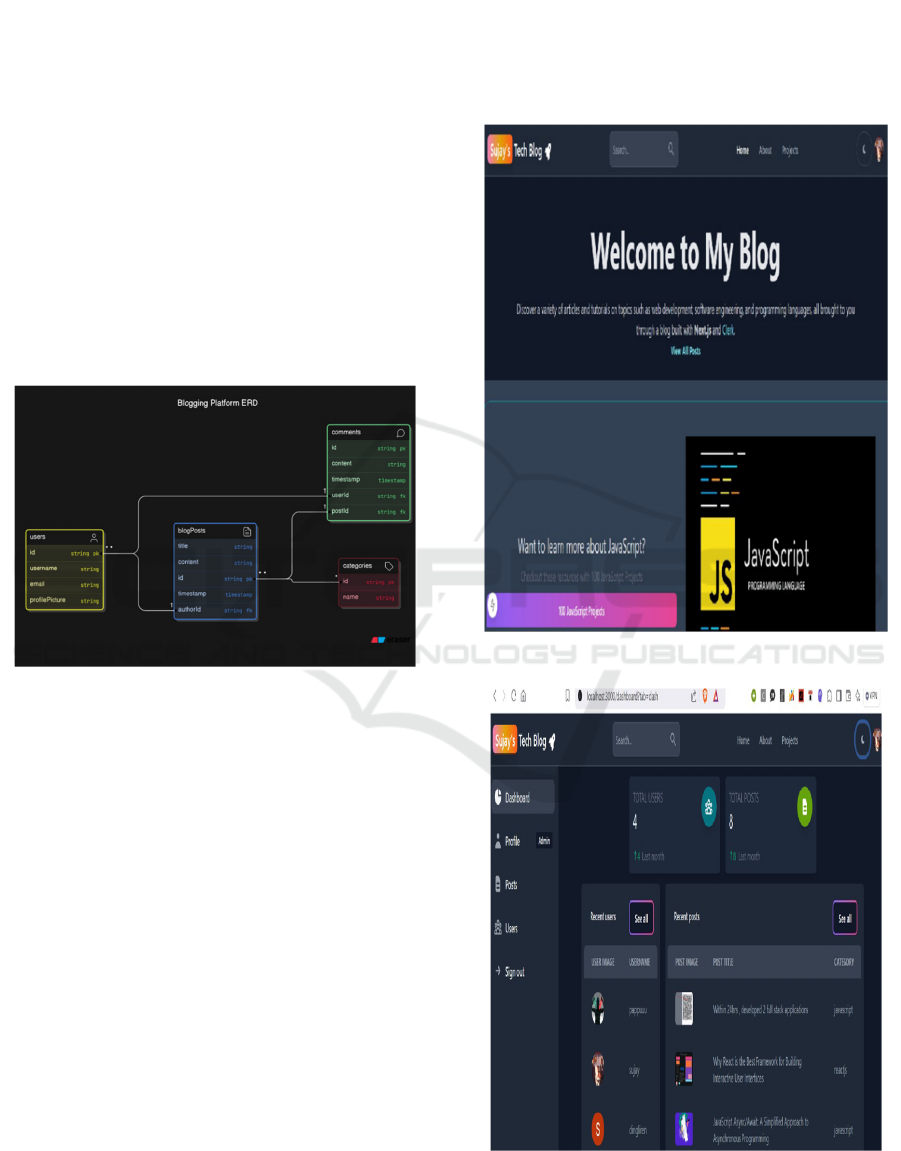
3.4 Entity-Relationship (ER) Diagram
The ER diagram visually represents entities and their
relationships:
• User: Stores user ID, username, email, and
profile image.
• Blog Post: Captures title, content, timestamps,
and associated categories.
• Comment: Represents content, the associated
post, and the author.
• Category: Defines blog categories for content
organization.
3.5 Deployment
The application is deployed on Vercel, a platform
optimized for Next.js applications. GitHub
integration enables CI/CD pipelines for automatic
deployment. Sensitive credentials are securely
managed via Vercel’s environment variable settings.
A global CDN ensures fast and reliable delivery.
3.6 Security
Security measures include encrypted user sessions
managed through Clerk and strict API input
validation to prevent vulnerabilities. HTTPS is
enforced for secure communication, safeguarding
user data.
ICRDICCT‘25 2025 - INTERNATIONAL CONFERENCE ON RESEARCH AND DEVELOPMENT IN INFORMATION,
COMMUNICATION, AND COMPUTING TECHNOLOGIES
392
3.7 Scalability
Scalability is achieved using SSR in Next.js, reducing
client-side workload. MongoDB Atlas enables
database scalability, while Vercel’s global
infrastructure efficiently handles traffic spikes with
load balancing.
3.8 User Experience
The application prioritizes seamless user experience
through and figure 1 shows the ER diagram.
• Responsive Design: Tailwind CSS ensures
adaptability across devices.
• Interactive Dashboard: Content creators can
manage posts and categories effortlessly.
• Optimized Navigation: Fast page loads and
smooth routing enhance user engagement.
Figure 1: ER diagram.
4 RESULTS AND DISCUSSION
This blog application is an excellent example of how
modern web technologies can be seamlessly
combined to create a scalable, responsive and user-
friendly platform. Next. Sturdy front-end was
powered by Reactjs to allow for fast page load times
with server-side rendering (SSR) and static site
generation (SSG), while Tail wind CSS provided
consistency and responsiveness irrespective of
devices. It allowed for secure and seamless
authentication, thus reducing registration and login
time for the user. MongoDB with Mongoose stored
users-post-comment relationships throughout
Mongoose, allowing us to take advantage of the
dynamic nature of MongoDB with versatility through
Mongoose and index queries.
Deploying to Vercel gave us global availability,
easy scalability, and automatic updates via CI/CD.
Content creators were able to successfully create and
manage posts, categories and comments using the
intuitive user dashboard. The challenges ranged from
complex many-to-many relationships, which were
solved through MongoDB’s flexible schema design.
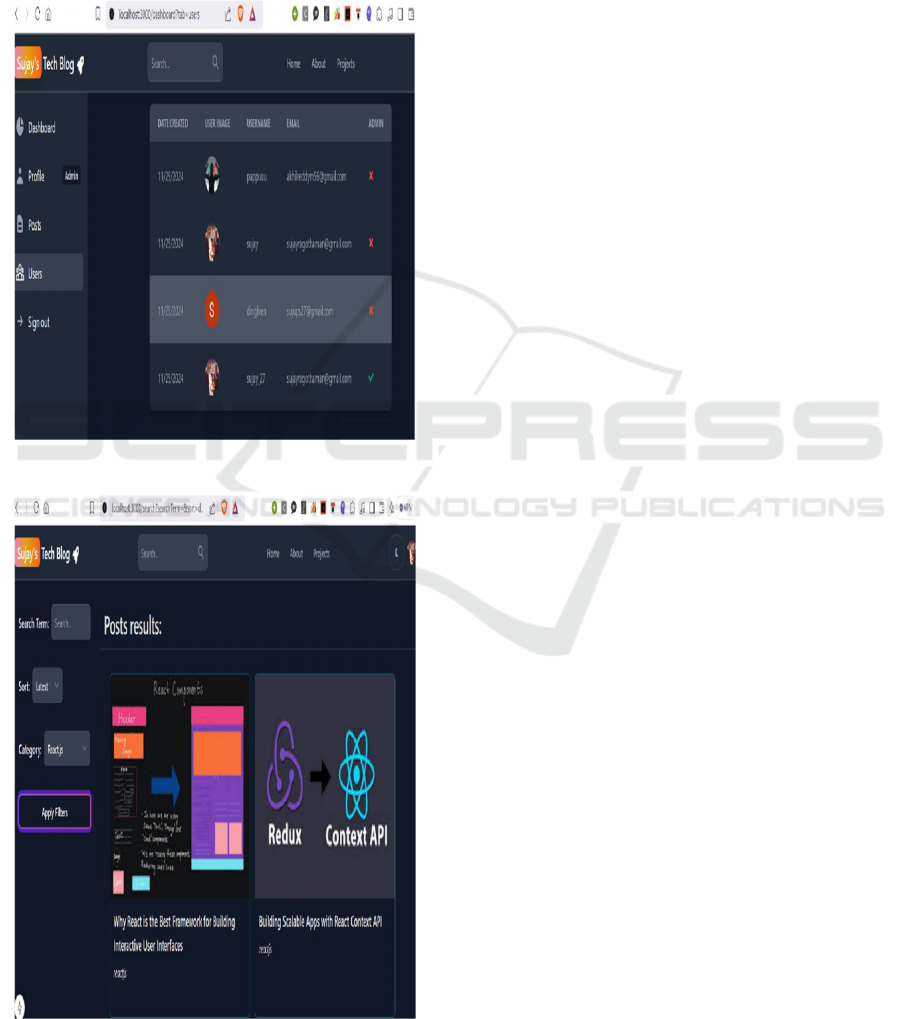
Figure 2 and 3 shows the home page and admin
dashboards.
Figure 2: Home page.
Figure 3: Admin dashboard.
Design and Implementation of a Scalable and User-Centric Blog Application Using Modern Web Frameworks and Tools
393
MERN is an ideal full-stack solution for high-
performing web applications. Future improvements,
like augmented analytics and AI powered
recommendations could improve the engagement and
make it more functional. As a whole, this
application is a secure, scalable, and robust blogging
platform. Figure 4 and 5 shows the dashboard users
and search bar.
Figure 4: Dashboard users.
Figure 5: Search bar results.
5 CONCLUSIONS
This project shows how modern web tools can be
used to build a blog application that is fast, easy to
use, and ready to grow. By using Next.js, the app
loads quickly and works well with search engines.
Tailwind CSS helps make the design clean,
responsive, and good-looking on all devices. The
backend uses MongoDB and Mongoose to store and
manage blog posts, comments, and user data
efficiently. Clerk is used for secure and smooth user
login and signup. Hosting the app on Vercel makes it
easy to update and available worldwide with great
speed. The design and structure of the app make it
easy to maintain and improve in the future. Users can
create and manage content easily through a user-
friendly dashboard. The app is stable, secure, and
performs well under load. In the future, we plan to
add features like AI-based recommendations and
analytics to make the app even smarter and more
engaging. This project proves that using the right
tools can help build powerful, modern websites.
REFERENCES
A Jartarghar, H.., Rao Salanke, G, A.R, A. K.., G.S, S..,
Dalali, S. (2022). React Apps with Server-Side
Rendering: Next.js. Journal of Telecommunication,
Electronic and Computer Engineering (JTEC), 14(4),
25–29. https://doi.org/10.54554/jtec.2022.14.04.005
Buraga, Sabin Amariei, Daniel Dospinescu, Octavian.
(2022). An OWL-Based Specification of Database
Management Systems. Computers, Materials Continua.
70. 5537-5550. 10.32604/cmc.2022.021714.
Kumar Agrahari, S., Kumar Das, A., Yadav, A.,
Ramasamy, G. (2024). Next-Gen Routing and
Scalability Enhancements in Mobile Ad Hoc Networks.
Available at SSRN 5089037.
Mishra, Debani Rout, Kshirod Salkuti, Surender Reddy.
(2021). Modern tools and current trends in web-
development. Indonesian Journal of Electrical
Engineering and Computer Science. 24. 978.
10.11591/ijeecs. v24.i2. pp978-985.
Mohamed, C., Imad, M., Mounir, R.M. and Mohamed, E.,
2024. GSIM: a web-based visual simulator for power
distribution systems using GridLAB-D, Next. js.
Studies in Engineering and Exact Sciences, 5(2), pp.
e8332-e8332.
Ojas, O., Vashishtha, A., Kumar Jha, S., Kumar Shah, V.,
Kumar, R., Ramasamy, G. (2024). James: Enhancing
Judicial Efficiency with Smart Administration.
Available at SSRN 5091509.
Paunikar, P., Londhe, D., Pawar, S., Phulari, R., Dondge, S.
and Chauhan, R., 2024. Building a Real-Time Web-
Based Chat Application with Next. js, MongoDB, and
Prisma ORM: Enhancing User Experience Through
ICRDICCT‘25 2025 - INTERNATIONAL CONFERENCE ON RESEARCH AND DEVELOPMENT IN INFORMATION,
COMMUNICATION, AND COMPUTING TECHNOLOGIES
394

Optimized Decision-Making. Journal of Basic Science
and Engineering, 21(1), pp.225-241.
Sabiguero, Ariel Etcheverry, Lorena Vicente, Alfonso.
(2021). An RDBMS-only architecture for web
applications. 10.1109/CLEI53233.2021.9640017.
Srivastava, Shraddha and Shukla, Harsh and Landge, Nisha
and Srivastava, Agam and Jindal, Devansh, A
Comprehensive Review of Next.js Technology:
Advancements, Features, and Applications (May 16,
2024).
SUSANTO, Fx Guntur Putra; FADLAN, Nizar Izzuddin
Yatim; HARYANI, Prita. Web-Based Management
Information System Design for Student Organizations
in Kendal Regency Using Next.js Framework.
Compiler, [S.l.], v. 12, n. 1, p. 9- 20, may 2023. ISSN
2549-2403.Available at:
https://ejournals.itda.ac.id/index.php/compiler/article/v
iew/1616. Date accessed: 25 nov. 2024. doi:
http://dx.doi.org/10.28989/compiler.v12i1.1616.
Tamizharasi, A., Siddharth, D.S., Srivatsan, G.S. and
Shreenath, V., 2024, May. Optimization and
Enhancement of Doctor Appointment Booking System
Using Next. js, Strapi, and REST API. In 2024 4th
International Conference on Pervasive Computing and
Social Network ing (ICPCSN) (pp. 79-83). IEEE.
Vashishtha, A., Kumar Jha, S., Kumar Shah, V., Prasad
Chauhan, J., Bhagat, K., Ramasamy, G. (2024).
Empowering Student Success: A Comprehensive Task
Management and Notification System. Available at
SSRN 5091489.
Design and Implementation of a Scalable and User-Centric Blog Application Using Modern Web Frameworks and Tools
395
