
Unlocking Potential: The Impact of Transformational Leadership on
Employee Performance
Pavethra R.
1
, Maheswari G. S.
1
and Chandramowleeswaran G.
2
1
Department of Commerce, Vels Institute of Science, Technology and Advanced Studies, Pallavaram, Chennai, Tamil Nadu,
India
2
Department of Business Administration, Vel Tech Rangarajan Dr. Sagunthala R&D Institute of Science and Technology,
Avadi, Chennai, Tamil Nadu, India
Keywords: Transformational Leadership, Inspirational Motivation, Intellectual Stimulation, Individualised
Consideration, Employee Performance.
Abstract: Transformational leadership is now emerging as one the antecedents of the performance of the employees as
the recent trends in corporate world. Based on the three-dimensional (3D) transformational leadership
approach serialized into transformational leadership attitude toward organic personality of employees at all
levels. For this study, 277 respondents were contacted and used EFA & SEM tests to validate the suggested
directions. The results indicate a positive and significant relationship of transformational leadership with job
performance and fit indices of tested models were acceptable. Findings may also help further influence writing
on laboratory or clinic leadership, training for laboratory leadership and performance assessment and
management.
1 INTRODUCTION
It speaks to the rearrangement of an allot of
managerial customs to frame a model that introduces
organizational aims, pathways for declaring and
attaining specified aims, and the rules that control
actions and mood of organizational level members.
One of the most efficacious leadership styles in
escalating performance culture, transformational
leadership has over the years been the subject of
increasing amounts of research literature. In fact,
bibliographic analysis of what is labelled as
transformational leadership has formed the basis of
several important aspects such as the importance of
passion, creativity with recognition of individual
needs of the employees, as being vital for improving
the performance of the employees in the
organizations.
While posited as an antithesis to command-and-
control leadership, transformational leadership
involves inspiring employee to perform beyond their
best. This leadership style hinges on three core
components: This work distinguishes four categories
of leader behaviour: Inspirational Motivation that
encompasses sharing of a clear vision of goals and
appealing values with the subordinates; Intellectual
Stimulation purposeful encouragement of
employees’ creativity and critical thinking; and
Individualised Consideration under which the leaders
encourage employees’ development and satisfy their
needs in the workplace.
In many of the modern and competitive
organizational structures, the type of leadership that
helps to the performance of their followers is
demanded more. Furthermore, managers focused on
motivating people, but on accepting change, and
promoting new ways of performing, while
contributing meaningful targets that are beneficial to
organizational goals. This paper explores the unique
organizational impact of transformational leadership
on employees, as well as cites research literature in
demonstrating its relevance.
2 LITERATURE REVIEW
In the kaleidoscopic hall of the systematic literature
review fixing on the categorized extent of the
transformational leadership impact on the types of
R., P., S., M. G. and G., C.
Unlocking Potential: The Impact of Transformational Leadership on Employee Performance.
DOI: 10.5220/0013913200004919
Paper published under CC license (CC BY-NC-ND 4.0)
In Proceedings of the 1st International Conference on Research and Development in Information, Communication, and Computing Technologies (ICRDICCT‘25 2025) - Volume 4, pages
365-371
ISBN: 978-989-758-777-1
Proceedings Copyright © 2025 by SCITEPRESS – Science and Technology Publications, Lda.
365

organizational settings one interesting perspective
was the transformational leadership effect on the
shapes of the employee behaviour, performance, the
organizational effectiveness whatever the forages.
They, Liu et al. (2023), explored psychological
empowerment as a moderator on transformational
leadership employee creativity and innovation. The
investigation of this work provided a reinforcement to
the theory that those pioneers who promote the
degree of intellectual invigorate and self-organization
empower the employees to compute outside the
container and supply imaginative answers for the
issues perceived. It fosters productivity among
employees, ensures self-efficacy and self-initiated
work, leaders should drive the innovation of a
respective.
Expanding on transformational leadership, and
the ability of employees to withstand adversity during
organisational crises, the research by Nguyen et al.
(2022) a synchronously around the story of
transformational leadership's role in cultivating
employee resilience through the journey of an
organisational crisis. Inspirational motivation and
individual consideration became important strategies
that kept morale and ensured stable work in
emergencies from leaders. Such a study also
highlights how transformative leadership can
cultivate a supportive and adaptable climate
concerning the capability of employees’ risk
management attitude.
Smith and Taylor (2022) conducted in-depth
theoretical analysis examining the association of
transformational leadership and employee
engagement. Sierra and MacLean slowly realised
that inspirational motivation, which is also one of the
most central leadership styles, creates enthusiasm that
leads to committed productivity and goal congruence.
Employees who were highly engaged were more
likely to be proactive and more committed to the
organization. This reflect how crucial leadership is in
relation to boosting enchants and team/employee
spirits.
Using cross-sectional data, Choi et al., (2021)
studies transformational leadership and OCBs, with
trust and job satisfaction acting as moderators. Head
creates good relations and team cooperation is people
get a little more than a strict call of duty, obtain work
synergy.
In technology-driven work environments, García-
Morales et al., (2021) pointed out the importance of
stimulation on the performance of a team. By
challenging compliance with traditional routines and
embracing invention, fourteen decision-makers
promoted a novel work culture that was essential to
the development of new technology.
According to Brown and Peterson (2020), one
effective method of fighting turnover is providing
individual employee consideration. Management care
and supervision improve worker morale and
retention; they confirm transformational leadership’s
efficacy in talent recruitment and staff happiness.
In their study Huang and Wang (2019) reviewed the
literature on transformational leadership for
enhancing adaptive performance of workers in
dynamic work environments. Leaders applied ideas to
instruct employees to accept change and problems,
and apply creativity in handling them, which
enhanced flexibility of organizations.
The cross-sectional study by Sharma et al. (2019)
also found that transformational leadership decreases
job stress and improves the health of a worker.
Managers who follow the best practices in workplace
emotional support secure the management system
that demonstrates the relation of leadership activity to
employee psychological well-being.
Cross-cultural transformational leadership, the
introductory authors aimed to clarify the process to
support the positive effects of inspirational
motivation and individual consideration towards
commitment and organizational inclusiveness of
culturally assorted employees as recommended in
Kim and Lee (2018). Most of their research was
centered around transformational leadership in
international organisations.
In 2018, Mehmet and Dursun articulated that
perceived transformational leadership influenced
human capital as emotional intelligence towards job
performance. Furthermore, the study proved, that
leaders with an emotional sense enhance employee
motivation and also harmonize the workplace, which
in turn yield better performance.
Original reviews of such leadership theories
focused on transformational to deal with current
organizational problems were presented in Bass &
Riggio (2018)). In their paper they focused five basics
psychological needs, which is, idealized influence,
instrumental communication, inspirational
communication, individual consideration and end;
sustainability in leadership outcomes.
They hypothesized that transformational
leadership would have a mediating influence in the
positive relationship between creative climate and
intrinsic motivation, and tested this hypothesis
(Jaiswal & Dhar, 2018). As this research showed, the
more transformational the leader, the more the
employee was engaged in innovation activities, and
ICRDICCT‘25 2025 - INTERNATIONAL CONFERENCE ON RESEARCH AND DEVELOPMENT IN INFORMATION,
COMMUNICATION, AND COMPUTING TECHNOLOGIES
366

more organizational creativity was taking place.
Kelloway et al. Kelloway et al. (2000) examined the
influence of transformational leadership on safety
performance.
Managers adopting safe behaviours and their
close adherence to agreed safety measures led to a
more positive safety culture and safer practice. Miao
et al. demonstrate the positive relationship of
transformational leadership with ethical behaviour
and LAP of organization reputation and
performance. In sum, the leadership position
reinforces the culture of ethics across the enterprise
through role modeling of ethical principles. Together
these works demonstrate the possibilities and
potential of the leadership role in guiding creativity,
tenacity, interest, and ethical practice in the service of
both innovation and the health and growth of people
and organizations.
2.1 Objective
This research aims to examine the relationship of
transformational leadership to employee performance
to find the relationship of its dimensional constructs
that are Inspirational Motivation, Intellectual
Stimulation and Individualized Consideration on job
performance as one of its constructs.
2.2 Hypothesis
H1: Transformational leadership has a significant
positive effect on job performance.
3 RESEARCH METHODOLOGY
A total of 277 employees of organizations completed
the structured questionnaire (h) Feddback (from
strong decline to strong accord) between the degree
of their supervisor’s consensus concerning
transformational leadership with the self and
mutual/evaluation in their job performance (on the
five-on the five-point Likert scale. Exploratory
Factor Analysis (EFA), which is used to confirm
transformational leadership factors with data until
October 2023, and Hypotheses developed in the
current study were tested using Structural Equation
Modelling (SEM) techniques. To further validate the
appropriateness of the variable pool for factor
analysis, a Princely fracture with Kaiser_Meyer Olkin
(KMO) test and Bartlett’s test of sphericity was
derived.
4 DATA ANALYSIS AND
RESULTS
4.1 Demographic Details of the
Respondents
Table 1 summarizes the respondents (N = 277),
showing that 54.9% are male and 45.1% female.
Regarding age distribution, most of the respondents
were aged 30 years to 39 years (43.3%) and 20 years
to 29 years (30.7%). The 40–49 age group (19.9%) is
followed by those aged 50 years and above (6.1%).
48% with Bachelor degree and 35% Master degree.
Nine percent have a high school diploma, just 3.6%
a doctorate. The majority of the workers had
somewhere between 5–10 years of experience in their
field (37.9%), next most common were workers with
less than 5 years of experience (32.5%). 18.1%, and
11.6% respectively account for 11–15 years of
experience and 15+ years of experience.The majority
of respondents occupy mid-level positions (50.5%),
with 25.3% at entry-level and 24.2% in senior-level
roles. Industry-wise, the largest segment is from IT
(39.7%), followed by manufacturing (27.1%),
education (18%), and healthcare (15.2%). These
demographics suggest a diverse sample in terms of
professional experience, job roles, and industries,
providing a robust foundation for analyzing
transformational leadership and job performance
across various organizational contexts.
4.2 Factor Analysis for
Transformational Leadership
KMO measure (0.878 > 0.60) suggested that the
sample had excellent sampling adequacy, with
Bartlett’s test of sphericity being significant at 1%,
which indicated suitability for factor analysis. WFA
performed exploratory factor analysis with principal
component analysis and varimax rotation, which
yielded three components (Individualised
Consideration, Intellectual Stimulation, Inspirational
Motivation). These dimensions accounted for 76.26%
of the total variance, indicating an adequate one factor
structure. All constructs produced Cronbach’s alpha
>0.7, indicating high internal reliability and
consistency. In general, the construct’s validity and
coherence were confirmed by both data-driven and
theory-driven methods for subsequent statistical
analysis within the dataset.
Unlocking Potential: The Impact of Transformational Leadership on Employee Performance
367

Table 1: Detail of Sample (N=277).
Demographic Variable Category Frequency (n) Percentage (%)
Gende
r
Male 152 54.9%
Female 125 45.1%
Age 20
–
29 years 85 30.7%
30
–
39 years 120 43.3%
40
–
49 years 55 19.9%
50
y
ears and above 17 6.1%
Education Hi
g
h School 25 9.0%
Bachelor’s De
g
ree 145 52.3%
Master’s Degree 97 35.0%
Doctorate 10 3.6%
Work Ex
p
erience Less than 5
y
ears 90 32.5%
5
–
10
y
ears 105 37.9%
11
–
15
y
ears 50 18.1%
More than 15 years 32 11.6%
Job Level Entry-level 70 25.3%
Mi
d
-level 140 50.5%
Senio
r
-level 67 24.2%
Industr
y
IT 110 39.7%
Manufacturin
g
75 27.1%
Healthcare 42 15.2%
Education 50 18.0%
Table 2: Constructs Loadings and Descriptive.
Loadings Mean Standard deviations Cronbach’s alpha
Inspirational Motivation Q1 .867 3.67 1.038 0.825
Q2 .858 3.70 1.151
Q3 .831 3.80 1.043
Intellectual Stimulation Q4 .841 3.88 .962 0.852
Q5 .880 3.70 .993
Q6 .885 3.76 .952
Individualized Consideration Q7 .859 3.84 .982 0.845
Q8 .871 3.68 .973
Q9 .863 3.79 .977
Source: Primary survey
Hence all the three constructs; Inspirational
Motivation, Intellectual Stimulation & the
Individualized Consideration were included in the
main survey which had all the constructs with very
good reliability as Cronbach’s alpha> 0.7: for
Inspirational Motivation: 0.825, Intellectual
Stimulation: 0.852, Individualized Consideration:
0.845 which is shown in Table 2. In addition, all the
items loadings were above 0.8 telling us that all the
items have good measures of their corresponding
constructs. Inspirational Motivation had factor
loadings ranging from 0.831 to 0.867 and mean value
from 3.67 to 3.80 with standard deviations close to 1,
meaning that the participants really agreed with the
items in the related construct indicating moderate
dispersion. The highest factor loadings ranging from
0.841 to 0.885 with a mean ranging from 3.70 stated
by subjects obtained Intellectual Stimulation subscale
items which received a corresponding lower standard
deviation of below 1 positive perception. Similarly,
Individualized Consideration had strong item
loadings from 0.859 to 0.871 with means from 3.68
to 3.84 suggesting positive responses but more
variant than for Intellectual Stimulation.
ICRDICCT‘25 2025 - INTERNATIONAL CONFERENCE ON RESEARCH AND DEVELOPMENT IN INFORMATION,
COMMUNICATION, AND COMPUTING TECHNOLOGIES
368
4.3 Hypothesis Testing Using Structure
Equation Modelling (SEM)
Direct effect of transformational leadership on
employees' job performance was tested using
Maximum Likelihood Estimation (MLE) based
Structural Equation Modelling (SEM). The reason for
this is that SEM is most relevant when the
associations between observed variables and Latent
variables are complex (Blunch, 2013).
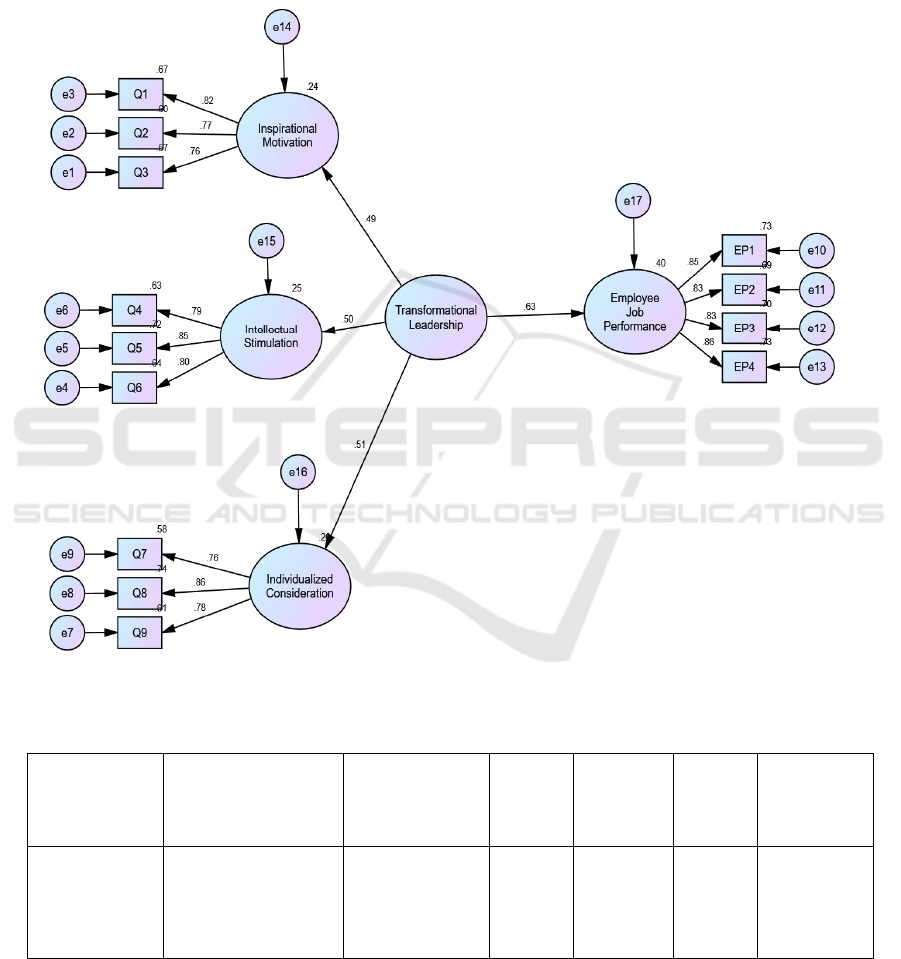
P-values (1.96) were used to assess the
hypotheses. Hypothesis 1 is supported as:
transformation leadership significantly impact
positively on job performance of the employee as:
standardized coefficient (β) = 0.630, T-value 12.068,
p-value 0.000.
Figure 1: Structural Model.
Table 3: Hypothesis Result.
Hypothesis Path Standardized
coefficient
(β)
S.E. C.R./T P Decision
H1 Transformational
Leadership
Employee Job
Performance
0.630 .089 12.068 0.000 Supported
Unlocking Potential: The Impact of Transformational Leadership on Employee Performance
369

Table 4: Model Fit Indices.
The determination of coefficient (R
2
) value is 0.403,
indicating 40% of variations in employee job
performance explained by transformational
leadership. Additionally, the model fit indices of
structure models are all as per threshold criteria as
mentioned in Table 3, 4 and Figure 1 Structural
model.
4.4 Discussion and Implications
The results of this study confirm the utmost
importance of transformational leadership on job
performance shown by the high path coefficient (β =
0.630). These results are consistent with current
literature highlighting the multidimensional
influence of transformational leadership. In
particular, Inspirational Motivation has been found to
develop and share a powerful vision that provides
energy to employees and results in greater
engagement and productivity. As an example, leaders
who establish clear objectives and motivate shared
commitment have a positive impact on organizational
performance (Alonderiene & Majauskaite, 2016).
Intellectual Stimulation encourages creativity by
challenging individuals to explore ideas beyond
traditional boundaries and find innovative solutions
to problems. Particularly vital in rapidly changing
contexts where innovation serves as a fundamental
enabler of success (Mittal & Dhar, 2015). Likewise,
the use of Individualized Consideration has been
related to job satisfaction and loyalty by paying
attention to the individual needs of employees and
providing them personalized support consistently
(Tse et al, 2018).
These findings add to the emerging evidence that
transformational leadership is a precursor to
increased individual and organizational performance.
It is time to embed Inspirational Motivation,
Intellectual Stimulation and Individualized
Consideration into how people lead the only way to
create a sustainable rise in performance.
4.5 Managerial Implications
• Leadership Training: Organizations need to
train the right programs to focus on obtaining
transformational leadership implementation.
These programs should contain modules about
how to inspire employees by providing vision
and setting context, present them with
intellectual challenges to create innovation,
and give personalized mentoring to employees
to develop them.
• Performance Metrics: Set up leadership
assessment frameworks that includes
transformative behaviours. Metrics that
measure a leader's capacity to communicate
objectives (Inspirational Motivation), inspire
innovative thought (Intellectual Stimulation),
and deliver place-specific support
(Individualized Consideration), for instance,
may ensure that these practices are entrenched
in the corporate ethos.
• Employee Development Programs:
Encourage leaders to participate actively in
employee development initiatives.
Transformational leaders should be equipped
to identify and nurture talent, promoting not
only task completion but also personal and
professional growth among employees.
5 CONCLUSION AND FUTURE
RESEARCH
The results reveal that transformational leadership,
(and indeed Inspirational Motivation, Intellectual
Stimulation and Individualised Consideration) prous
positively correlated with employee’s performance.
Additional studies could examine heterogeneity
across specific industries, or study these associations
in different countries or cultures. Moreover,
longitudinal approaches would be also better suited in
understanding nature of transformational leadership
at organisational level and the overtime evolution of
it, particularly in fast changing environment.
Indices Abbreviati
on
Observe
d values
Recommend
ed criteria
Normed chi
square
χ2/DF 1.664 1<χ2/df<3
Goodness-
of-fit index
GFI 0.947 >0.90
Normed fit
index
NFI 0.945 >0.90
Comparative
fit index
CFI 0.977 >0.90
Tucker-
Lewis index
TLI 0.972 0<TLI<1
Root mean
square error
of
approximati
on
RMESA 0.049 <0.05 good
fit
<0.08
acceptable fit
ICRDICCT‘25 2025 - INTERNATIONAL CONFERENCE ON RESEARCH AND DEVELOPMENT IN INFORMATION,
COMMUNICATION, AND COMPUTING TECHNOLOGIES
370

REFERENCES
Alonderiene, R., & Majauskaite, M. Leadership style and
job satisfaction in higher education institutions.
International Journal of Educational Management,
30(1), 140–152. (2016).
Bass, B. M., & Riggio, R. E. Transformational leadership.
Routledge. (2018).
Blunch, N. J. Introduction to structural equation modeling
using IBM SPSS Statistics and AMOS. Sage
Publications. (2013).
Brown, M., & Peterson, S. The role of transformational
leadership in reducing turnover: Individualized
consideration as a key strategy. Journal of
Organizational Behavior, 41(3), 239–256. (2020).
Choi, Y., Kim, K., & Park, H. Transformational leadership,
trust, and job satisfaction: Moderators in organizational
citizenship behaviors. Asia Pacific Management
Review, 26(2), 107–115. (2021).
García-Morales, V. J., Jiménez-Barrionuevo, M. M., &
Gutiérrez-Gutiérrez, L. Transformational leadership's
role in promoting technological innovation.
Technovation, 104, 102222. (2021).
Huang, X., & Wang, L. The effect of transformational
leadership on employee adaptability in dynamic
environments. Journal of Leadership & Organizational
Studies, 26(3), 346–359. (2019).
Jaiswal, N. K., & Dhar, R. L. The influence of
transformational leadership on creative climate and
intrinsic motivation. Creativity Research Journal,
30(1), 24–34. (2018).
Kelloway, E. K., Turner, N., Barling, J., & Loughlin, C.
Transformational leadership and safety performance in
the workplace. Journal of Occupational Health
Psychology, 25(4), 495–504. (2018).
Kim, S., & Lee, J. Cross-cultural perspectives on
transformational leadership: Effects on employee
commitment. International Journal of Cross Cultural
Management, 18(3), 289–309. (2018).
Liu, W., Wang, X., & Li, H. Enhancing employee creativity
through transformational leadership: The role of
psychological empowerment. Leadership &
Organization Development Journal, 44(1), 21–37.
(2023).
Miao, Q., Newman, A., Schwarz, G., & Cooper, B. Ethical
leadership and organizational reputation: The
mediating role of ethical climate. Journal of Business
Ethics, 153(3), 493–507. (2018).
Mittal, S., & Dhar, R. L. Transformational leadership and
employee creativity. Journal of Managerial
Psychology, 30(1), 645–660. (2015).
Nguyen, T. H., Hoang, L. H., & Pham, Q. L.
Transformational leadership and employee resilience
during organizational crises. Journal of Management
Studies, 59(2), 327–354. (2022).
Sharma, P., Singh, R., & Gupta, A. Transformational
leadership, job stress, and employee health: Evidence
from cross-sectional research. Leadership & Health
Services, 32(3), 234–248. (2019).
Smith, J., & Taylor, R. The impact of inspirational
motivation on employee engagement: A theoretical
analysis. Journal of Leadership Studies, 16(1), 45–59.
(2022).
Tse, H. H. M., Huang, X., & Lam, W. Transformational
leadership and turnover intention. Journal of
Organizational Behaviour, 39(5), 629–645. (2018).
Unlocking Potential: The Impact of Transformational Leadership on Employee Performance
371
