
A Survey on Rice Grain Classification from Traditional Methods to
Deep Learning Approaches
M. Niranjana and F. Kurus Malai Selvi
Government College for Women (A) (Affiliated to Bharathidasan University, Tiruchirappalli)
Kumbakonam, Tamil Nadu, India
Keywords: Raw Rice, Classification, Machine Learning Deep Learning, Ensemble Model.
Abstract: Challenges persist in developing a suitable method to distinguish cultivated quality rice seeds, which can be
estimated based on their characteristics. To avoid rice grain varieties from getting incorrectly labelled, the
quality and types of rice grains must be identified. In this paper, classification rice grains are analysed and
study is done on different types of algorithms for every stage. Generally, visual observations are made with
specialists using specific devices measuring various properties. The resultant data are fed into different stages
using various algorithms which are discussed in detail. This study reviews machine learning techniques to
differentiate between rice seeds using different types of algorithms. Every stage is analysed under different
objectives and important conclusions that gives extensions to the next stage of the research.
1 INTRODUCTION
Rice is a vital staple crop, serving as a primary food
source for over half of the world’s population (Heiser
et al., 1993). Following wheat and corn, it ranks as the
third most cultivated and consumed cereal globally.
In many regions, particularly in Asia and parts of
Africa, rice represents the principal source of both
dietary protein and caloric energy (Murshed,
Muntasir, and Muntaha Masud Tanha., 2021).
The economic significance of rice is underscored
by the fact that one-third of global rice consumption
is facilitated through international trade, with over
60% of the world’s population residing in Asia-where
rice is a dietary staple (Chatnuntawech I et al.,).
Beyond its economic value-generating employment
and foreign revenue-rice also provides numerous
nutritional and health benefits. It is a valuable source
of vitamin B1 and contributes positively to blood
sugar regulation, digestive health, and aging
prevention. Furthermore, rice is extensively used in
various industrial applications due to its high starch
content (Chatnuntawech I et al.,).
Rice is the principal staple food crop in South
India, playing a critical role in regional food security.
Various rice varieties are cultivated across different
parts of the country to meet the nutritional demands
of the growing population (Khanam, Rubina, et al.,
2020).
Farmers consistently encounter irrecoverable
losses due to multiple reasons such as climate change,
drought, and seed quality issues. Currently,
the Seed Testing Laboratories (STL) are responsible
for certifying seed quality, with trained technicians
conducting purity tests manually (Rajalakshmi,
Ratnavel, et al., 2024).
However, seed classification lacks uniformity
across various laboratories due to factors such as
technician fatigue, eye strain, and individual
circumstances (Hilton, Susan., 2018). Therefore, the
automation of rice seed variety identification is
essential for guaranteeing the quality and germination
potential of rice crops.
As highlighted in (Patrício, Diego Inácio, and
Rafael Rieder, 2018), the classification of rice grains
is essential due to the wide variety of rice types
available in the market. Manual classification,
however, is labor-intensive and time-consuming,
often leading to inconsistencies. To address this
challenge, the development of intelligent automated
systems is necessary to enhance efficiency and
accuracy in rice grain classification.
The result of these features is analysed using one
of the machine learning techniques. This study
identifies classified rice images under the following
steps, they are,
a. Images are captured using camera.
b. Captured images are undergone pre-processing
techniques to sharpen the image quality.
Niranjana, M. and Selvi, F. K. M.
A Survey on Rice Grain Classification from Traditional Methods to Deep Learning Approaches.
DOI: 10.5220/0013912200004919
Paper published under CC license (CC BY-NC-ND 4.0)
In Proceedings of the 1st International Conference on Research and Development in Information, Communication, and Computing Technologies (ICRDICCT‘25 2025) - Volume 4, pages
311-320
ISBN: 978-989-758-777-1
Proceedings Copyright © 2025 by SCITEPRESS – Science and Technology Publications, Lda.
311

c. Feature extraction is performed on the pre-
processed image.
d. Extracted features are fed to the selected
machine learning algorithms for classification.
This system should be capable of automatically
identifying and categorizing individual rice grains.
The primary process involves collecting a dataset and
extracting various parameters of individual rice
grains, such as major and minor axis, eccentricity and
length, and also the breadth.
2 LITERATURE REVIEW
The input image is ultimately utilized as training data,
where each grain of rice within the image is mapped
to its corresponding class for classification purposes
(Kiratiratanapruk, Kantip, et al., 2020)
Some traditional rice varieties of India cultivated
in different regions are Basmati, Joha, Jyothi, Navara
(Special varieties), Ponni, Pusa, Sona Masuri, Jaya
(Intermediate-varieties) Kalajiri (aromatic), Boli
Palakkad Matta etc.
Some varieties of colored rice are grown in the
country include Himalayan red rice; Matta rice,
Kattamodon, Kairali, Jyothy, Bhadra, and Asha in
Kerala; Rakthashali in Kerala; and Red Kavuni,
Kaivara Samba, Mappillai Samba, Kuruvi kar and
Poongar rice in Tamil Nadu. The classification of
such diverse rice types plays a critical role in
agricultural research and quality assessment.
However, manual classification is laborious, time-
consuming, and prone to human error. Therefore, the
adoption of intelligent automated systems has
become essential to streamline the classification
process.
Any rice sample analyzed by an automated system
typically undergoes a structured sequence of steps,
including classification, segregation, evaluation,
categorization, and grading. The primary contribution
of this study lies in categorizing existing algorithms
and techniques into five major approaches:
geometric, statistical, supervised learning,
unsupervised learning, and deep learning.
Deep learning techniques, in particular, have
produced promising findings and have sparked
interest in future. Also, these techniques can able to
separate rice grain into different classes efficiently
(Rathna Priya, T. S., et al., 2017)
To guarantee a good yield and quality, rice types
must be accurately identified. Grain attributes such as
color, shape, taste, aroma, cooking characteristics,
and head rice recovery are analyzed, together with
morphological features and visual inspection, as
traditional methods of rice variety identification)
Alfred, Rayner, et al., 2021)
Some key research questions that rose during the
study of the research topic. They are,
a) What methods and algorithms have been
previously suggested for categorising rice?
b) What are all the steps taken to identify the most
suitable method among the different types of
algorithms?
c) Differentiation between manual rice grading
and automated rice grading approach.
d) What could be the best fit approach which can
be extended for further research?
A detailed survey of rice classification techniques is
presented in separate subsections. Section III
provides a comprehensive overview of various
learning approaches used for classifying different rice
varieties, offering insights that may guide future
research in this domain.
Numerous research papers related to rice grain
classification were analysed as part of this study. The
collected articles are systematically categorized based
on the underlying methodologies, including
geometric, statistical, machine learning, and deep
learning approaches. Additionally, the study reviews
a range of algorithms and techniques employed for
rice grain detection and categorization.
Although traditional feature-based recognition
methods have yielded promising results, they often
rely on highly specific features. These features may
fail to capture the intrinsic characteristics of rice
grains, leading to limitations in classification
performance.
Methods of classifying collected research
articles have been explained in detail under stages
like screening, Eligibility analysis, Extraction of data.
Evaluating the quality of rice grains is essential to
meet consumer expectations, and grain quality is
primarily determined by geometric characteristics. In
local industries, mechanical classification methods
are commonly employed to rank food grains based on
geometric parameters. However, image processing
techniques offer a more versatile and efficient
alternative, enabling the extraction of various shape-
and geometry-based features for rice grain
classification.
Zhao et al. extracted eleven geometric properties
from binary images of rice kernels, including
perimeter, area, circularity, equivalent diameter,
number of contour points, major axis length, minor
axis length, rectangle elongation, maximum inscribed
circle, and minimum enclosing circle. In addition to
ICRDICCT‘25 2025 - INTERNATIONAL CONFERENCE ON RESEARCH AND DEVELOPMENT IN INFORMATION,
COMMUNICATION, AND COMPUTING TECHNOLOGIES
312

geometric features, texture features were extracted
from grayscale images such as mean, variance,
smoothness, consistency, entropy, and seven
statistically invariant moments.
In a related study, (Barbedo, J.G.A., 2016)
utilized textural features for corn image classification,
including energy, contrast, homogeneity, correlation,
and Local Binary Pattern (LBP)-based Gary Level
Co-occurrence Matrix (GLCM). These feature
extraction techniques can be broadly categorized into
geometry-based, statistics-based, and learning-based
methods. Learning-based approaches include both
unsupervised techniques-such as k-means clustering
for grouping unlabelled data-and supervised models
like neural networks, support vector machines
(SVM), and, more recently, deep learning
architectures.
Among all the approaches, the supervised
approach contributed maximum share. Better
performance of supervised approaches can be
attributed to use of handcrafted spatial features along
with different classifiers.
Based on the knowledge gained, further learning
approaches of machine learning were analysed in
section A.
3 MACHINE LEARNING
APPROACHES
Machine learning approach can be broadly classified
into supervised, unsupervised, and deep learning.
3.1 Unsupervised Learning
Large datasets are not necessary for the classifier to
be trained using unsupervised learning approaches.
Table 1 tabulates the different types of These methods
use clustering to divide the data into classes according
to how similar they are. A clustering-based method
for classifying rice is demonstrated in (T. Bera et al.,
2019).
The authors captured two images of a rice sample
consisting of eight different rice varieties. After that,
the photos underwent pre-processing. using edge
detection methods, thresholding, and the elimination
of noise and lens distortion. One such a PCA-based
approach to categorizing various Basmati rice
varieties was introduced in (T. Bera et al., 2019)
which, rather than using dendrograms, used
clustering based on K-Nearest Neighbours (KNN)
which is a basic machine learning algorithm that
considers the similarity between the new
case/information and available cases and assigns the
new case to the class that is most similar to the
available classes.
The rice image was pre-processed using KNN
clustering, noise reduction, and smoothing. In this
paper, has experimented with six different types of
rice seeds. After segmenting the coloured rice image,
binarization was performed. Morphological features
like order were used to improve and make sense of
the input image after the aforementioned operations
were completed. Area, major axis length, minor axis
length, eccentricity, and perimeter were among the
parameters used to extract the image. The various rice
grain varieties were then clustered using KNN as a
classifier. Along similar lines, the authors devised a
rice quality classification system that also used KNN
clustering. Techniques with extracted features of
geometric, texture and shape feature extraction
techniques.
Table 1: Feature based analysis on unsupervised and
Geometric features.
Author Algorithm/Techniques
Extracted
Features
Mahajan,
S(2015)
edge detection
techniques
Geometric
Features
and
Texture
features
Barbedo,
J.G.A.,
(2016)
GLCM and LBP
Geometric
Features
and
Texture
features
J. P.
Shah
(
2016
)
edge detection
techni
q
ues
Shape
features
T.
Bera(2016)
PCA based algorithm
+ KNN
Shape
features
3.2 Supervised Learning
It is a type of Artificial Intelligence where machines
are being trained in training data, and based on that
data machines predicted the outcome. The mentioned
data seems to be legitimate data that is currently
tagged with the correct outcome.
Supervised Learning In supervised learning, the
training data is given to the machines in such a way
that the supervisor works (Supervises) the machines
for Correct output. Morphological features such as
area of the seed, seed boundary, bounding box around
seed, width, length of major and minor axes, thinness
ratio, aspect ratio, rectangular aspect ratio, equivalent
diameter, filled area, area under major axis of ellipse,
A Survey on Rice Grain Classification from Traditional Methods to Deep Learning Approaches
313

convex area, solidity, and extent were systematic
extracted rice image. Furthermore, different color
features were also extracted including, red, green,
blue colors bands hue, saturation, intensity, and
standard deviation of hue.
3.3 Deep Learning Approaches
Deep learning refers to ANNs with more layers that
can make use of and learn from complex datasets such
as images, audio, and text. It is constructed on the
basis of the early designs and models of neural
networks.
During the 1980s and 1990s, more sophisticated
neural network architectures were introduced,
including Multi-Layer Perceptron’s (MLPs) and
Radial Basis Function Networks (RBFNs). However,
it was not until the early 2000s enabled by the
availability of high-performance computational
resources and large-scale datasets-that deep learning
gained significant momentum and practical success
(Naser, Samy Abu., 2018).
Deep learning models have the ability to learn
abstract level representations across different types of
input data such as text, image, audio and perception
signals. These models have already demonstrated
promising potential in rice grain classification. The
deep learning algorithms and the common extracted
feature methods for different studies are summarized
in Table2.
Among these, one of them and perhaps the most
famous and effective architecture, is the
Convolutional Neural Network (CNN), that will be
discussed next in detail.
Convolutional neural network (CNN): It is a type
of deep learning neural network specialized for
structured arrays of data, such as images. Some of the
applications are:
• The effectiveness of CNNs can be shown as
CNNs are widely applied in many vision
applications and its architecture became a state
of-the-art in many visual applications, like
image classification etc.
• CNNs have also been successful in various
natural language processing tasks, especially
text classification (Abu Naser, S. S. and M. J. Al
Shobaki, 2016).
• A CNN is a complex “deep learning neural
network” specialized to process and identify
images. It is particularly well at recognizing
patterns in an input image, e.g., circles, lines,
faces, eyes, and gradients. Abu Naser, S. S.
(2012).
• Because of this, CNN is extremely efficient in
the domains of computer vision.
• CNNs are feed-forward neural networks
composed of multiple types of layers including
convolutional layers and others; some models
have as many as 20 or 30 layers.
• CNNs take advantage of the power of
convolutional layers, which can learn to detect
increasingly complicated shapes when stacked
on top of one another.
Scratch Net has a simple architecture to make
understanding the concept clearer and the
applications added to CNN gave an overall idea of its
creation.
1) Convolutional layer is the fundamental layer that
is used to separate the various features from the input
image, where convolution is performed between the
input image and a channel of certain size Maxim. The
outcome is called the Element map which provides us
information regarding the photo such as the corners
and edges. Then this part map is used in various layers
for them to learn a few different parts of the input
image.
The convolution layer in CNN passes the result to
the next layer. Abu Naser, S. S. (2012).
From the papers J. Abu Naser, S. S. (2008). some key
points were founded which are being cascaded as
under.
2) Pooling layer decrease the information volume
and boundary count, which can help to prevent over
fitting and further develop network execution.
Further, pooling is separated in two classes:
a) Max Pooling- The maximum value within the
image covered by the kernel is provided by the Max
Pooling, and
b) Average Pooling- The average value within the
kernel's hidden image is provided by the Average
Pooling function.
3) Fully Connected layer a layer that is entirely
connected needs to be flattened. Before being fed into
the neural network, the entire pooling feature map
matrix is transformed into a single column.
function such as sigmoid. Convolutional layers
apply filters or kernels to the input data, resulting in
the generation of feature Devi, T. G., Neelamegam,
P., & Sudha, S., (2017).
Thus, creation of a model is obtained by
combination of the obtained feature map matrix using
attributes of completely linked layers. The output is
then classified using an activation.
ICRDICCT‘25 2025 - INTERNATIONAL CONFERENCE ON RESEARCH AND DEVELOPMENT IN INFORMATION,
COMMUNICATION, AND COMPUTING TECHNOLOGIES
314

Table 2: Presents A Summary of Deep Learning Algorithms.
Author Algorithm/Techniques Extracted Features
T. Bera(2019)
PCA based algorithm + KNN +
Neural networks
Shape features
Devi, T(2017) Machine vision algorithm Physical and chemical features
Patel, N(2017)
Neural networks & Support Vector
Machine
Shape features
Wah, T(2018) NB tree & SMO classifiers
Chalkiness and whiteness of grains along
with other mor
p
holo
g
ical features
Kuchekar, N. A(2018)
Random Forest classifier, decision
tree classifie
r
Shape and Geometric features
Son, N(2019) Multiclass SVM Shape descriptors, color descriptors
Han, Xu, et al(2021) BPNN 18 color features and 21 texture features
A study in (Kuchekar, N. A., & Yerigeri, V. V.,
2018). proposed new features to classify nine
varieties of rice grains, getting an accuracy of 95.78%
with the NB Tree and Sequential Minimal
Optimization (SMO) classifier. Chalkiness and
whiteness markers were extracted as features, along
with important morphological features like major and
minor axes, area, and perimeter.
In a separate study (Son, N. H., & Thai-Nghe, N.
2019), twenty features were extracted using a
Random Forest classifier, and its performance was
evaluated using standard metrics such as accuracy,
precision, recall, and F1-score. The results were
compared against those obtained using decision tree
classifiers. Experimental findings revealed that the
Random Forest classifier significantly outperformed
the decision tree model, achieving a highly promising
classification accuracy of 99.85%.
In work (Han, Xu, et al., 2021), a set of shape
descriptors and color descriptors were extracted from
every rice grain image and three types of
classification was done using Multi-class Support
Vector Machine which are basmathi, ponni and
brown rice. The classification accuracy obtained is
92.22%.
To evaluate and categorize rice grains, their
physical and chemical features were extracted using
the Machine vision algorithm which averages the
values of the extracted features which were
considered for grading and quality analysis of rice
grains Patel, N., Jayswal, H., & Thakkar, A., (2017).
In Wah, T. N., San, P. E., & Hlaing, T. (2018).
the extracted shape features of rice is evaluated based
on Neural Networks (NN) and Support Vector
Machine (SVM) algorithms and the results infer that
SVM based classification outperforms the neural
networks.
Figure 1 shows proposed idea of using CNN
model for classifying Kauvuni Rice. The idea has
been taken by adding three convolutional layers and
three pooling layers along with fully connected layers
which are going to be implemented to classify the
rice.
Scratched Net To extend the research, the review has
been done in leading pre-trained models which pave
the way to combine the existing architecture with
some leading pre-trained models to propose the new
scratched Net. The ResNet is a variation of CNN that
builds upon the concepts introduced in Inception
Networks and Residual Networks (ResNets). It
exemplifies the idea of cardinality for performance
and introduces a divide, transform and merge block.
Various ResNet variants have been proposed
to balance performance and computational cost on a
specific task and dataset ( Szegedy, Christian, et al.,
2017).
Pre-Trained model: These types of models are
neural networks are used to train on large datasets and
used for specific tasks (Han, Xu, et al., 2021). These
models capture convoluted patterns and features,
which is used to classify the selected features
effectively.
In this paper popular models like VGG,
ResNet, and Inception have set benchmarks in the
field.
A Survey on Rice Grain Classification from Traditional Methods to Deep Learning Approaches
315
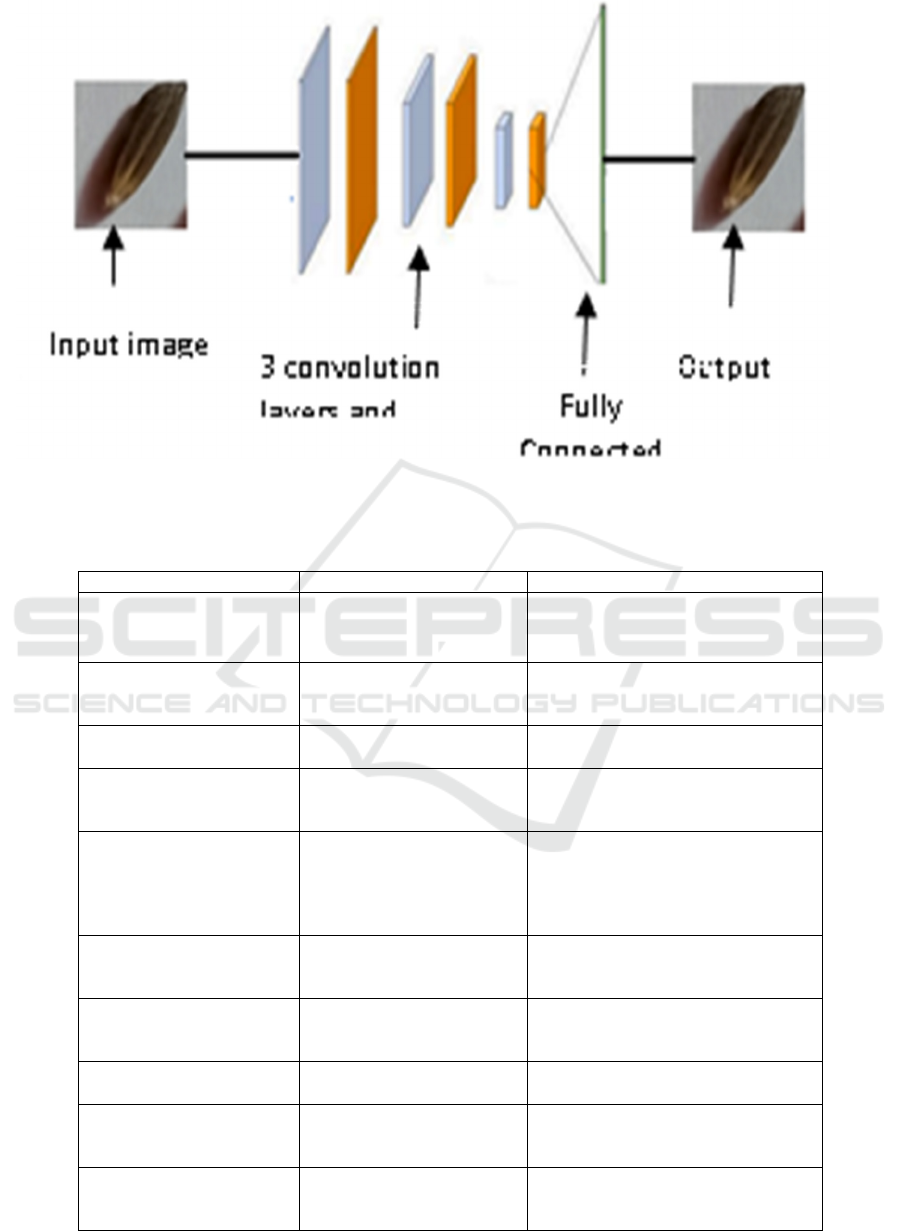
Figure 1: Proposed of CNN model.
Table 3: Top Pre-Trained Models with Scratch Net models.
Models Variants Ke
y
Features
ResNet (Residual
Networks)
ResNet-50, ResNet-101,
ResNet-152.
Deep architectures (up to 152 layers).
Residual blocks to allow gradients to
flow through shortcut connections.
Inception
Inception v3, Inception v4,
Inception-ResNet.
Inception modules with
convolutional filters of multiple
sizes.
VGG (Visual Geometry
Group)
VGG-16, VGG-19. Deep networks with 16 or 19 layers.
EfficientNet
EfficientNet-B0 to
EfficientNet-B7.
Compound scaling method to scale
depth, width, and resolution.
Efficient and accurate.
DenseNet (Dense
Convolutional Network)
DenseNet-121, DenseNet-
169, DenseNet-201.
Dense connections to improve
gradient flow and feature reuse.
Reduces the number of parameters
compared to traditional convolutional
networks.
MobileNet
MobileNetV1,
MobileNetV2,
MobileNetV3.
Lightweight architecture optimized
for mobile devices. Depthwise
separable convolutions.
NASNet (Neural
Architecture Search
Network)
NASNet-A, NASNet-B,
NASNet-C.
Automatically designed architectures
using reinforcement learning. High
accuracy with efficient performance.
Xception (Extreme
Inception)
-- Fully convolutional architecture.
AlexNet ------
Simple architecture with 8 layers.
ReLU activation functions and
dropout regularization.
Vision Transformers (ViT) ------
Transformer encoder architecture.
Scales well with large datasets and
computational resources.
ICRDICCT‘25 2025 - INTERNATIONAL CONFERENCE ON RESEARCH AND DEVELOPMENT IN INFORMATION,
COMMUNICATION, AND COMPUTING TECHNOLOGIES
316

Table 3 shows the Scratch Net models which are
the top pre-trained models which is used nowadays to
classify the features efficiently. Among the several
derived nets ResNet is discussed in detail.
In (Szegedy, Christian, et al., 2017) ResNet has
been discussed. This paper suggests that even in very
deep topologies, the network can more readily collect
and propagate gradients through the network by
employing residual layers.
ResNet employs skip connections or shortcut
connections or identical mappings: these connections
facilitate the flow of gradients directly from the end
layers to the earlier layers -- therefore bypassing the
intermediate layers.
It makes it easier for the gradients to move
backwards since they are not getting smaller and
smaller as they back propagate through the network.
Res Net also uses skip connections which allow the
network to be much deeper than previous
architectures. About the Author Res Net models are
built successfully with depths of 50, 101, or even 152
layers.
One significant development in the field of deep
learning has been the capacity to train and efficiently
optimize such deep networks. Res Net reduces the
vanishing gradient issue and makes training very deep
neural networks easier by utilizing residual layers and
skip connections. Image classification, object
detection, and image segmentation are just a few of
the computer vision tasks where this has improved
performance and accuracy (Shafiq et al., 2022).
The above analysis paved a way to create own
model combining one or two of the above said models
which may produce effective result. Also, these types
of hybrid models are otherwise known to be
Ensemble model. This Ensemble model aims to
improvise the prediction accuracy, and ultimately
reduces generalization error.
Ensemble model: A machine learning method called
ensemble learning blends w models to increase
prediction accuracy:
To provide more accurate predictions,
ensemble learning combines several learners, such as
neural networks or regression models. One student is
believed to be less accurate than a group of students.
Ensemble learning can be used to address problems
such as excessive variance, under fitting, and over
fitting. Classification, regression, and clustering are
just a few of the machine learning tasks that can
benefit from ensemble learning (Yadav, Pravin
Singh, et al., 2025)
Additionally, it can be applied to short-term
forecasting, landslide assessment, and incursion
detection. Voting is used in ensemble learning models
to decide the final result. Ensemble learning models
have shown significant promise across various
domains, including short-term forecasting, landslide
assessment, and incursion detection. These models
leverage the principle of voting among multiple
classifiers to determine the final outcome, thereby
improving prediction reliability and robustness.In
(Hasan et al., 2023), an enhanced ensemble
approach—Ensemble Model of the Stowing and
Helping Classifier (EMBBC)-was proposed for the
prediction of code smells. This model integrates
decision-making and data-balancing strategies to
improve classification performance. The
experimental analysis was conducted using four
publicly available code smell datasets: Blob Class,
Information Class, Long Boundary Rundown, and
Switch Statement. To address class imbalance, the
datasets were preprocessed using the Synthetic
Minority Over-sampling Technique
(SMOTE)Similarly, the study in (Tkatek, S et al.,
2023) introduced an ensemble machine learning
framework combining K-Nearest Neighbors (KNN),
Random Forest (RF), and Kernel Ridge Regression
(KRR). The model’s performance was evaluated
using four standard evaluation metrics: Mean
Absolute Error (MAE), Mean Squared Error (MSE),
Root Mean Squared Error (RMSE), and R² score. The
results demonstrated that the proposed KRR-based
ensemble method achieved superior accuracy in yield
prediction when compared with other conventional
machine learning models.
Work in (Long, C et al., 2024) tested ML models
(eXtreme gradient boosting (XG Boost), K-Nearest
Neighbor (KNN), Linear support vector machine
(SVM), Naive Bayes (NB) classifier, decision tree
(DT) regressors, and random forest (RF) regression)
to anticipate the potato crops that are both of excellent
and yield, and they utilized measurements like MAE,
MSE, RS, and RMSE for assessment.
Table 4 shows some Ensemble models that have
been analysed during this study. This exploration
analyses around different combinations of machine
learning algorithms as Ensemble to highlight the best
choice among the different procedures to find out the
best possible Ensemble solution for further research.
(Hasan, M et al., 2023)
Chalkiness is a crucial determinant of rice quality,
assessed through three key indicators: chalkiness size,
chalky rice rate, and chalkiness degree. The chalky
rice rate indicates the proportion of chalky grains,
while chalkiness size measures the percentage of
chalky area within each kernel. Chalkiness degree is
the product of these two factors. In a recent
agricultural experiment in China, human visual
A Survey on Rice Grain Classification from Traditional Methods to Deep Learning Approaches
317

inspection is used to evaluate chalkiness. While this
method is accurate for determining the chalky rice
rate, it can lead to significant errors in measuring
chalkiness size and requires substantial manpower.
Adopting more efficient evaluation methods could
improve rice quality control and benefit both
producers and consumers. Considering the above
factors review has been made as under.
The authors in (Tkatek, set al., 2024) examined
the chalkiness, fine starch structure, and
physiochemical properties of rice, and correlated and
additional studies were conducted under varying
nighttime temperatures throughout the early grain-
filling stage. Higher chalky grain rate (CGR) and
chalkiness degree (CD) were induced by medium
temperature (MT) and low (LNT) and high nighttime
temperatures (HNT) when compared to MT.
LNT mainly improved the chalkiness by increasing
short branch chains of amylopectin, increasing the
degree of branching and the ratio of small starch
granules, while reducing Long Branch chains of
amylopectin and amylose branches. It changed the
pasting properties, for example, the peak viscosity
and final viscosity were increased.
In (Long, C et al., 2024), the distance between
the chalky areas and the minimum enclosing
rectangle of the resulting rice kernel after separating
the residual embryo, back white, core white, mid
white through the Support Vector Machine (SVM)
classifier in a very careful manner was studied. This
innovative approach not only enables the clear
differentiation of embryos from chalky regions but
also facilitates the complete removal of residual
embryos while achieving remarkable accuracy in
pinpointing chalkiness locations. The results of this
research lay a robust theoretical and practical
foundation for the advanced application of computer
vision technology in the detection of chalkiness,
promising to revolutionize quality control in rice
production.
To conclude, this paper attempts to review the
variety of algorithms to imply ensemble deep
learning. The contributions of this paper are
highlighted as the following.
First, analysis is made on unsupervised learning
Secondly introduced the basic concepts of supervised
learning and their advantages are discussed with their
advantageous clearly. Thirdly deep learning
approaches are discussed along with basic
architecture of CNN and the advantages.
Table 4: Ensemble models.
Autho
r
Ensemble Model Name Combinations
Yadav, Pravin
Singh, et al(2025)
EMBBC MODEL Bagging and Boosting Classifiers
Hasan, M(2023)
K-Nearest Neighbor, Random
Forest, Ridge Regression (KRR)
Mean absolute error, Mean Square error
(MSE), Root mean square Error (RMSE),
and R2
Tkatek, S(2023) XGBoost
K-Nearest Neighbor (KNN), Linear
support vector machine (SVM), Naive
Bayes (NB) classifier, Decision tree (DT)
regressors, and Random forest (RF)
re
g
ression
Moreover, this paper discusses the different strategies
of ensemble deep learning models. Finally,
comprehensive review has made to elaborate the
proposed research work.
4 CONCLUSIONS
This paper reviews algorithms based on geometric
algorithms, machine learning, and deep learning
models and also the Ensemble model. These reviews
gave concrete ideas to extend the study into the next
level. This work has been ignited to classify the
results with the suitable algorithms are analysed and
identified images of rice grains are taken for further
study. This study looked at different ways to classify
things, including detection techniques, Gray-Level
Co-Occurrence Matrix (GLCM) and Local Binary
Pattern (LBP), PCA based algorithm combined with
KNN. It also analyses at different ways to choose
features, including geometric, texture and shape
features.
This study further extends its analysis by
evaluating several machines learning models,
including combinations such as Principal Component
Analysis (PCA) with K-Nearest Neighbors (KNN)
and Neural Networks, as well as hybrid approaches
like Neural Networks with Support Vector Machines
(SVM), Naïve Bayes Tree (NBTree) with Sequential
ICRDICCT‘25 2025 - INTERNATIONAL CONFERENCE ON RESEARCH AND DEVELOPMENT IN INFORMATION,
COMMUNICATION, AND COMPUTING TECHNOLOGIES
318

Minimal Optimization (SMO), Random Forest,
Decision Tree, Multiclass SVM, and
Backpropagation Neural Networks (BPNN).
Furthermore, we also investigate the performance
of both pre-trained and from-scratch deep learning
models, including state-of-the-art models like
ResNet, Inception, VGG, EfficientNet, DenseNet,
MobileNet, NASNet, Xception, AlexNet, and ViTs.
The findings from this research have practical
implications for software engineers and researchers,
particularly in understanding how to mitigate the
adverse effects of code smells on software quality.
Moreover, this study emphasizes the importance
of feature selection, which plays a critical role in
enhancing the effectiveness of ensemble learning
strategies. These insights may inspire further
exploration into optimal hybrid ensemble approaches
that can significantly improve classification
performance, particularly in the domain of rice grain
classification.
Author Contribution
Niranjana Mahalingam: Conceptualization,
Methodology, Writing - Original draft;
Kurus Malai Selvi: Review & editing,
Visualization, Supervision.
Declaration of Competing Interest
Competing interests, the authors declare no
competing interests.
Funding Information
Funding: This work was not supported by any
specific grant from funding agencies in the public,
commercial,
REFERENCES
Heiser, Charles B. Seed to civilization: the story of food.
Harvard University Press, 1990. W.-K. Chen, Linear
Networks and Systems (Book style). Belmont,
CA: Wadsworth, 1993, pp. 123–135.
Murshed, Muntasir, and Muntaha Masud Tanha. "Oil price
shocks and renewable energy transition: Empirical
evidence from net oil-importing South Asian
economies." Energy, Ecology and Environment 6.3
(2021): 183-203.
Chatnuntawech I, Tantisantisom K, Khanchaitit P,
Boonkoom T, Bilgic B, Chuangsuwanich E. Rice
classification using spatio-spectral deep convolutional
neural network. arXiv preprint 8; arXiv:1805.11491
Khanam, Rubina, et al. "Metal (loid) s (As, Hg, Se, Pb and
Cd) in paddy soil: Bioavailability and potential risk to
human health." Science of the Total Environment 699
(2020): 134330.
Rajalakshmi, Ratnavel, et al. "RiceSeedNet: Rice seed
variety identification using deep neural
network." Journal of Agriculture and Food
Research 16 (2024): 101062.
Hilton, Susan. "Improving Processing Vegetable Yields
Through Improved Production Practices." (2018).
Patrício, Diego Inácio, and Rafael Rieder. "Computer
vision and artificial intelligence in precision agriculture
for grain crops: A systematic review." Computers and
electronics in agriculture 153 (2018): 69-81.
Abbaspour-Gilandeh, Yousef, et al. "A combined method
of image processing and artificial neural network for the
identification of 13 Iranian rice
cultivars." Agronomy 10.1 (2020): 117.
Kiratiratanapruk, Kantip, et al. "Development of paddy rice
seed classification process using machine learning
techniques for automatic grading machine." Journal of
Sensors 2020.1 (2020): 7041310.
Rathna Priya, T. S., et al. "Nutritional and functional
properties of coloured rice varieties of South India: a
review." Journal of Ethnic Huang, Gao, et al. "Densely
connected convolutional networks." Proceedings of the
IEEE conference on computer vision and pattern
recognition. 2017.Foods 6.1 (2019): 1-11.
Alfred, Rayner, et al. "Towards paddy rice smart farming:
a review on big data, machine learning, and rice
production tasks." Ieee Access 9 (2021): 50358-50380.
Rice varieties - IRRI Rice Knowledge Bank. (n.d.). Rice
Varieties - IRRI Rice Knowledge Bank. doi:
http://www.knowledgebank.irri.org/step-by-step-pro
duction/pre-planting/rice-varieties.
Mahajan, S., Das, A., Sardana, H.K., 2015. Image
acquisition techniques for assessment of legume
quality. Trends Food Sci. Technol. 42 (2), 116–133.
https://doi.org/ 10.1016/j.tifs.2015.01
Barbedo, J.G.A., 2016. A review on the main challenges in
automatic plant disease identification based on visible
range images. Biosyst. Eng. 144, 52–60. https://doi.
org/10.1016/j.biosystemseng.2016.01.017. Zhai,
Xiaohua, et al. "Scaling vision
transformers." Proceedings of the IEEE/CVF
conference on computer vision and pattern recognition.
2022.
J. P. Shah, H. B. Prajapati, and V. K. Dabhi, ‘‘A survey on
detection and classification of rice plant diseases,’’ in
Proc. IEEE Int. Conf. Current Trends Adv. Comput.
(ICCTAC), Mar. 2016, pp. 1–8.
T. Bera, A. Das, J. Sil, and A. K. Das, ‘‘A survey on rice
plant disease identification using image processing and
data mining techniques,’’ in Emerging Technologies in
Data Mining and Information Security. Singapore:
Springer, 2019, pp. 365–376.
Naser, Samy Abu. "An agent based intelligent tutoring
system for parameter passing in java
programming." Journal of Theoretical and Applied
Information Technology 4.7 (2008).
A Survey on Rice Grain Classification from Traditional Methods to Deep Learning Approaches
319

J. Abu Naser, S. S. (2008). "Developing visualization tool
for teaching AI searching algorithms." Information
Technology Journal, Scialert 7(2): 350-355.
Abu Naser, S. S. (2012). "A Qualitative Study of LP-ITS:
Linear Programming Intelligent Tutoring System."
International Journal of Computer Science &
Information Technology 4(1): 209
Abu Naser, S. S. and M. J. Al Shobaki (2016). "Enhancing
the use of Decision Support Systems for Re-
engineering of Operations and Business-Applied Study
on the Palestinian Universities." Journal of
Multidisciplinary Engineering Science Studies
(JMESS) 2(5): 505-512
A. Sheeba, P.S. Kumar, M. Ramamoorthy, S. Sasikala,
Microscopic image analysis in breast cancer detection
using ensemble deep learning architectures integrated
with web of things, Biomed. Signal Process Control 79
(2023)
Devi, T. G., Neelamegam, P., & Sudha, S., (2017). Machine
vision-based quality analysis of rice grains. IEEE
International Conference on Power, Control, Signals
and Instrumentation Engineering (ICPCSI-2017),
1052-1055.
Patel, N., Jayswal, H., & Thakkar, A., (2017). Rice quality
analysis based on physical attributes using image
processing technique. 2nd IEEE International
conference on recent trends in electronics information
communication technology, 42-47.
Wah, T. N., San, P. E., & Hlaing, T. (2018). Analysis on
feature extraction and classification of rice kernels for
Myanmar rice using image processing techniques.
International Journal of Scientific and Research
Publications, 8(8), 603-606.
Kuchekar, N. A., & Yerigeri, V. V. (2018). Rice grain
quality grading using digital image processing
techniques. IOSR J Electronics Communication Eng,
13(3), 84-88.
Son, N. H., & Thai-Nghe, N. (2019, November). Deep
learning for rice quality classification. In 2019
international conference on advanced computing and
applications (ACOMP) (pp. 92-96). IEEE.
Han, Xu, et al. "Pre-trained models: Past, present and
future." AI Open 2 (2021): 225-250.
Shafiq, Muhammad, and Zhaoquan Gu. "Deep residual
learning for image recognition: A survey." Applied
Sciences 12.18 (2022): 8972.
Szegedy, Christian, et al. "Inception-v4, inception-resnet
and the impact of residual connections on
learning." Proceedings of the AAAI conference on
artificial intelligence. Vol. 31. No. 1. 2017.
Shah, Syed Rehan, et al. "Comparing inception V3, VGG
16, VGG 19, CNN, and ResNet 50: a case study on
early detection of a rice disease." Agronomy 13.6
(2023): 1633.
Koonce, Brett, and Brett Koonce.
"EfficientNet." Convolutional neural networks with
swift for Tensorflow: image recognition and dataset
categorization (2021): 109-123.
Sinha, Debjyoti, and Mohamed El-Sharkawy. "Thin
mobilenet: An enhanced mobilenet architecture." 2019
IEEE 10th annual ubiquitous computing, electronics &
mobile communication conference (UEMCON). IEEE,
2019.
Ren, Pengzhen, et al. "A comprehensive survey of neural
architecture search: Challenges and solutions." ACM
Computing Surveys (CSUR) 54.4 (2021): 1-34.
Chollet, François. "Xception: Deep learning with depthwise
separable convolutions." Proceedings of the IEEE
conference on computer vision and pattern recognition.
2017.
Ismail Fawaz, Hassan, et al. "Inceptiontime: Finding
alexnet for time series classification."
Data Mining and
Knowledge Discovery 34.6 (2020): 1936-1962.
Zhai, Xiaohua, et al. "Scaling vision transformers."
Proceedings of the IEEE/CVF conference on computer
vision and pattern recognition. 2022.
Zhi-Hua Zhou, Ensemble Methods: Foundations and
Algorithms, CRC Press, 2012.
Yadav, Pravin Singh, et al. "Ensemble methods with feature
selection and data balancing for improved code smells
classification performance." Engineering Applications
of Artificial Intelligence 139 (2025): 109527.
Hasan, M., M. A. Marjan, M. P. Uddin, S. Nam, Y. Kardy,
S. Ma, and Y. Nam. 2023. Ensemble machine learning-
based recommendation system for effective prediction
of suitable agricultural crop cultivation. Frontiers in
Plant Science 14:1234555. doi:10.3389/fpls.2023.
1234555
Tkatek, S., S. Amassmir, A. Belmzoukia, and J.
Abouchabaka. 2023. Predictive fertilization models for
potato crops using machine learning techniques in
Moroccan gharb region. International Journal of
Electrical and Computer Engineering (IJECE) 13
(5):5942. doi:10. 11591/ijece. v13i5.pp5942-5950.
Long, C.; Du, Y.; Zeng, M.; Deng, X.; Zhang, Z.; Liu, D.;
Zeng, Y. Relationship between Chalkiness and the
Structural and Physicochemical Properties of Rice
Starch at Different Nighttime Temperatures during the
Early Grain-Filling Stage. Foods 2024, 13, 1516.
https://doi.org/10.3390/ foods131015
Sun ChengMing, S. C., Liu Tao, L. T., Ji ChengXin, J. C.,
Jiang Min, J. M., Tian Ting, T. T., Guo DouDou, G. D.,
... & Liang XiuMei, L. X. (2014). Evaluation and
analysis the chalkiness of connected rice kernels based
on image processing technology and support vector
machine.
ICRDICCT‘25 2025 - INTERNATIONAL CONFERENCE ON RESEARCH AND DEVELOPMENT IN INFORMATION,
COMMUNICATION, AND COMPUTING TECHNOLOGIES
320
