
A Survey on Deep Fake Audio Detection Using Deep Learning
Sai Retish Reddy, Prakash Kumar Sarangi, Shravan Nikhil, M A Jabbar
and Sukanya Mekala
Department of CSE (AI&ML), Vardhaman College of Engineering, Hyderabad, Telangana, India
Keywords: Deep Fake Audio Detection, Audio Spoofing, wav2vec, Mel-Frequency Cepstral Coefficients (MFCC),
Voice Cloning, Deep Learning (DL).
Abstract: The rise of synthetic voice generation techniques such as deepfakes and voice cloning, has raised concerns
about potential misuse in areas like fraud, misinformation, and identity theft. Deep Learning has emerged as
an effective solution for detecting deep fake audio. Features from audio files were extracted and analyzed
using Mel-Frequency Cepstral Coefficients (MFCC) to illustrate the differences between real and fake audio.
By examining patterns in the audio data, models can learn to distinguish subtle discrepancies. Results
indicated that a Custom Architecture outperformed, with the VGG-16 architecture yielding the best results
for MFCC image features. Using Deep Learning approaches, this paper presents an overview of deep fake
audio detection methods, highlighting the importance of this study and the potential uses of Deep Learning
Models in the fight against deep fake audio.
1 INTRODUCTION
Deepfake technology involves the creation of
synthetic media, including audio, video, images,
and text, that are typically designed to appear
genuine
Shaaban
et al., (2023).
The evolution of artificial intelligence, particularly
in deep learning, has made the generation of
realistic synthetic audio, often known as "deepfake
audio," increasingly prevalent. This technology
allows for the replication of speech that closely
resembles an individual's voice, which raises
significant concerns over its use in identity theft,
misinformation, and fraud. Consequently,
distinguishing between genuine and synthetic
audio has become critical, particularly in sensitive
domains such as cybersecurity, journalism, and
content moderation
Rana et al., (2022).
Deepfakes pose threats to privacy, security, and
authenticity. While much research has
concentrated on deepfake video detection,
achieving higher accuracy, audio spoofing remains
an urgent issue that requires specialized detection
models Hamza et al., (2022).
Audio deepfake detection presents unique
challenges compared to image deepfakes, as visual
cues like unnatural facial movements are absent.
Synthetic audio convincingly mimics the subtleties
of human speech, such as tone, rhythm, and accent,
complicating detection efforts
Hamza et al., (2022).
Moreover, rapid advancements in audio synthesis
technology underscore the need for equally
sophisticated detection strategies. In order to
improve the accuracy of the classification models,
many approaches use machine learning algorithms
such as Random Forest, Decision Tree and SVM.
Our experiments utilized the Fake-or-Real Dataset,
which included four sub-tests for thorough
evaluation.
Deep learning offers a compelling approach to this
issue by enabling automatic learning and feature
extraction from extensive audio datasets.
Techniques such as Convolutional Neural
Networks (CNNs) and Recurrent Neural Networks
(RNNs) have demonstrated efficacy in areas such
as speech recognition and natural language
processing and can be adapted for the detection of
synthetic audio. Training models on real and fake
audio data allows neural networks to capture
nuanced patterns and inconsistencies that may be
challenging for human listeners to detect. Figure 1
illustrates the deep fake classification. Figure 2
shows the general deep learning models.
Reddy, S. R., Sarangi, P. K., Nikhil, S., Jabbar, M. A. and Mekala, S.
A Survey on Deep Fake Audio Detection Using Deep Learning.
DOI: 10.5220/0013911900004919
Paper published under CC license (CC BY-NC-ND 4.0)
In Proceedings of the 1st International Conference on Research and Development in Information, Communication, and Computing Technologies (ICRDICCT‘25 2025) - Volume 4, pages
283-289
ISBN: 978-989-758-777-1
Proceedings Copyright © 2026 by SCITEPRESS – Science and Technology Publications, Lda.
283
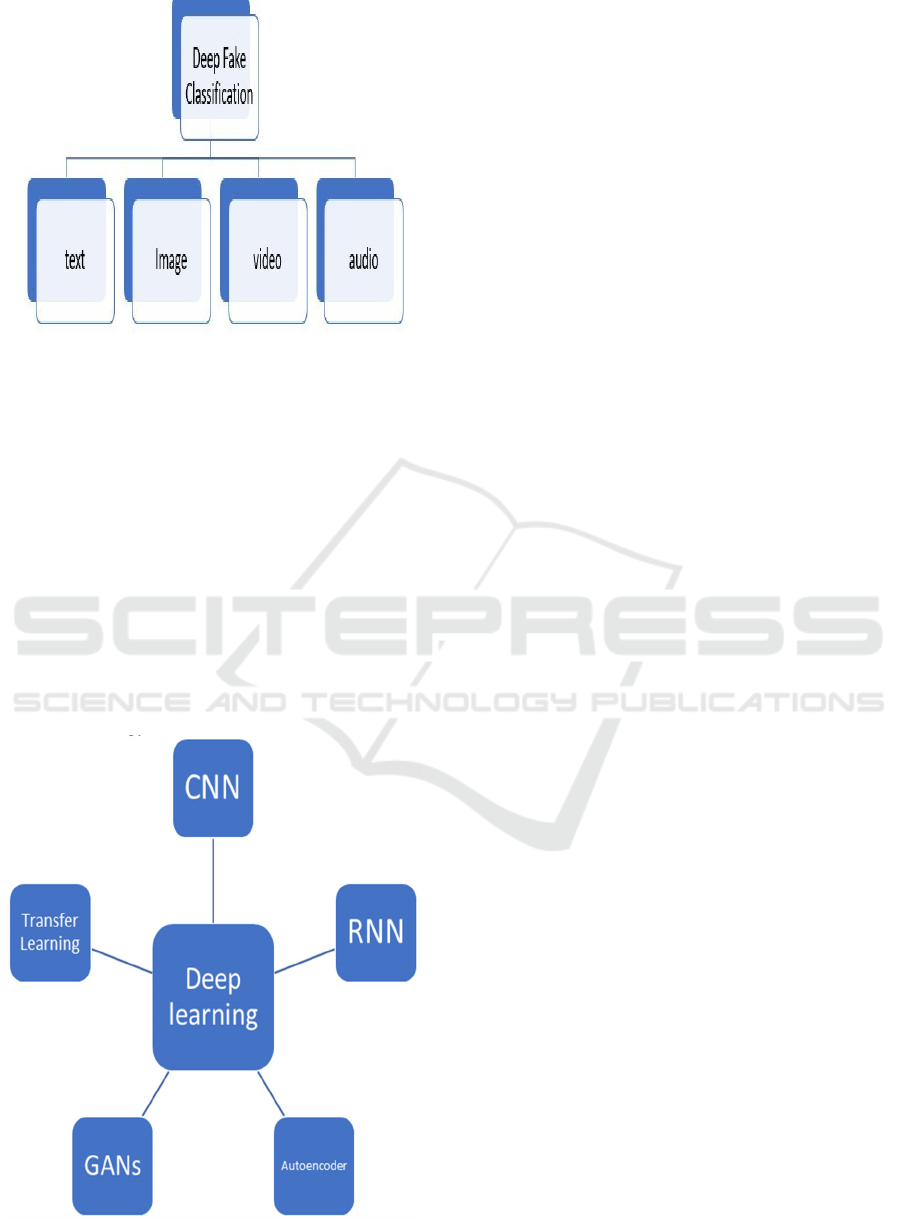
Figure 1: Deep Fake Classification.
A key component in deepfake audio detection is
the use of Mel Frequency Cepstral Coefficients
(MFCCs), which represent the short-term power
spectrum of sound. These coefficients, along with
various audio features, enable models to discern
acoustic differences between authentic and
synthetic audio. CNNs are particularly proficient in
detecting frequency domain variations, while
RNNs excel in recognizing temporal patterns,
which are essential for spotting irregularities in
speech rhythm or pronunciation. The field of deep
learning-based fake audio detection is rapidly
advancing and holds significant promise for
addressing the growing threats posed by synthetic
audio technology.
Figure 2: General Deep Learning Models.
Deep learning techniques are vital for the detection
of deep fake audio. Various approaches can be
utilized to achieve this. One prominent method is
the use of Convolutional Neural Networks
(CNNs), which excel in analyzing audio
spectrograms. CNNs can extract features from
these visual representations that signal the presence
of manipulated audio. Recurrent Neural Networks
(RNNs), particularly Long Short-Term Memory
(LSTM) networks, are another useful method.
These networks are good at identifying the
temporal correlations in audio data. LSTMs can
identify unique patterns that are often present in
deep fake audio. Autoencoders also play a role in
detecting deep fake audio. These neural networks
are designed to compress and then reconstruct
audio data. When trained on authentic audio
samples, autoencoders can recognize deviations
that suggest the audio has been altered. Moreover,
Generative Adversarial Networks (GANs) can be
utilized in this context. A GAN consists of a
generator, which creates new audio samples, and a
discriminator, which assesses how realistic these
samples are. By exposing the discriminator to real
audio data, it learns to distinguish between genuine
and deep fake audio. Lastly, Transfer Learning can
enhance deep fake audio detection. This technique
involves starting with a pre-trained neural network,
which has already been learned from a vast audio
dataset, and adapting it for the specific task of
identifying deep fake audio.
1.1 Need for Deep Fake Audio
Detection in
Digital Security
The emergence of deep learning methods has
brought about considerable progress in creating
highly realistic synthetic media, particularly in the
realm of audio deep fakes. While these innovations
hold promising potential for various creative fields,
they also pose significant risks, especially in areas
where the authenticity of audio is vital. Deep fake
audio can be misused for harmful purposes,
including fabricating voice recordings in legal
matters, generating fraudulent voice commands for
security violations, or impersonating people in
telephone scams.
Voice-based authentication systems, often utilized
in banking and other sensitive sectors, are
particularly susceptible to attacks using deep fake
audio. These threats not only jeopardize individual
privacy but also pose risks to institutional and
national security. Additionally, the alteration of
public figures' voices in political discussions can
ICRDICCT‘25 2025 - INTERNATIONAL CONFERENCE ON RESEARCH AND DEVELOPMENT IN INFORMATION,
COMMUNICATION, AND COMPUTING TECHNOLOGIES
284

erode trust in media and contribute to widespread
misinformation.
In light of these increasing dangers, it is critical to
develop effective systems for detecting deep fake
audio. Such detection mechanisms are vital for
preserving the authenticity of voice
communications, preventing identity theft, and
ensuring the reliability of digital audio content.
Integrating deep fake detection technologies within
digital security frameworks can help reduce these
threats and safeguard against the advancing
challenges of audio-based deception.
2 DEEP FAKE DETECTION
USING DEEP LEARNING
2.1 Deepfakes
The evolution of deepfake technology has
extended to audio, particularly concerning virtual
assistants and other forms of computer-generated
sound that are increasingly prevalent in our
everyday lives Shaaban et al., (2023). The use of
artificially created or altered audio content presents
a major risk to society, as it can create trust issues
when people struggle to differentiate between
genuine and fake material.
Deep fake audio, being a form of synthetic
media, has developed extremely fast with advances
in advanced machine learning models like
Generative Adversarial Networks (GANs) and
voice cloning technologies. These advances
facilitate the production of extremely realistic-
sounding audio recordings that can be almost
impossible to distinguish from genuine voices.
Though these technologies hold promising uses in
entertainment, accessibility, and other creative
applications, they also pose real risks of fraud,
disinformation, and security breaches. Deep fake
audio misuse for voice phishing, impersonation
fraud, and creating evidence for legal or political
purposes is of particular concern.
As the threat from audio deception grows, it has
become essential to develop effective detection
systems. Deep fake audio detection models are
now vital for maintaining the reliability of voice-
based systems, including biometric authentication,
legal documentation, and media content. By
identifying fraudulent audio, these detection
systems play a crucial role in ensuring the
credibility of digital materials and mitigating the
risks associated with manipulated voice data. This
paper examines different deep learning methods
used to detect deep fake audio and proposes a
methodology utilizing the Wav2Vec2 model.
2.2 Applications of Deep Fake Audio
Detection
Deep fake audio detection has applications across
multiple domains where voice authenticity is
critical. In the financial sector, many banks and
institutions use voice biometrics for authentication
in their systems Rana, M.S. and Sung, A.H., (2020)
A deep fake audio attack could be used to
impersonate a person, gaining unauthorized access
to sensitive information or funds. Similarly, in
cybersecurity, the rise of voice-controlled devices
has made it imperative to detect audio
impersonation to prevent unauthorized control
over these systems.
Beyond security, the detection of deep fake
audio is crucial in the media industry Patel et al.,
(2023). The use of fake voices to manipulate the
public's perception, especially involving public
figures, can lead to misinformation and
destabilization of trust in media sources. Political
campaigns, journalism, and entertainment all rely
on the authenticity of audio content, and the
development of effective detection models is vital
in maintaining credibility and preventing the
spread of false narratives.
2.3 Deep Learning Technique for
Deep Fake Audio Detection
Several deep learning techniques are used to detect
deep fake audio. Convolutional Neural Networks
(CNNs), though originally developed to analyze
images, have been applied to scan spectrograms of
audio signals. Focusing on the visual patterns
within these spectrograms, CNNs can detect
abnormalities common to deep fake audio, like
unsmooth frequency patterns. Also, Recurrent
Neural Networks (RNNs) and Long Short-Term
Memory (LSTM) networks are often utilized to
handle sequential audio data and encode the
temporal relations that get manipulated in creating
fake audio.
More recently, Transformers and speech
recognition models like Wav2Vec2 have emerged
as powerful tools for deep fake detection. These
models are capable of processing raw audio data
and extracting deep representations that can
highlight subtle anomalies present in synthetic
audio. Autoencoders are also employed in
A Survey on Deep Fake Audio Detection Using Deep Learning
285

detection systems, as they can learn the patterns of
genuine audio and flag deviations, indicating a
potential deep fake. Together, these deep learning
techniques form the backbone of modern deep fake
audio detection systems.
2.4 Deep Learning Approaches
Convolutional Neural Network
: Convolutional
Neural Networks (CNNs) are a powerful deep
learning framework widely used for detecting deep
fake audio. Like other neural network architectures,
CNNs comprise an input layer, an output layer, and
several hidden layers. In the realm of deep fake
audio detection, these hidden layers play a crucial
role in processing audio inputs and performing
convolutional operations on these signals.
By conducting these operations, CNNs can
identify significant features within audio that may
indicate modifications or artificial origins. Instead
of relying only on basic matrix multiplication,
CNNs utilize non-linear activation functions, such
as Rectified Linear Units (ReLU), which introduce
non-linearity into the model. This enhancement
allows them to capture complex patterns in audio
data. Furthermore, CNNs incorporate pooling
layers to reduce the dimensionality of the data while
preserving essential information. Techniques like
average pooling can be used to summarize feature
maps, thus lowering computational demands and
improving the model's generalization ability.
Through these architectural elements, CNNs can
effectively detect subtle artifacts and
inconsistencies in audio signals, making them a
strong option for identifying deep fake audio.
Recurrent Neural Network:
The Recurrent
Neural Network (RNN) is an application of
artificial neural networks that learns patterns from
sequential data. It consists of multiple hidden
layers, each characterized by its unique weights
and biases. In an RNN, the nodes are connected in
a directed cycle graph that sequentially processes
data. This structure provides a recurrent hidden
state, which effectively captures dependencies over
time, enabling the network to manage temporal
sequences Mary, A. and Edison, A., (2023).
Here, RNNs examine the temporal
dependencies and patterns in audio waveforms so
that they can detect speech nuances that could be
indicative of manipulation. Through training on a
dataset of both real and deep fake audio samples,
RNNs are able to learn to detect slight
inconsistencies in pitch, tone, and rhythm that are
typical of synthetic audio. This ability allows
RNNs to recognize real voices and artificially
synthesized ones, thereby proving to be an
effective resource against deep fake technology.
Transformers:
The attention mechanism acts as a
means of resource prioritization, allowing the
model to concentrate on the most significant areas
of an audio signal while suppressing the effect of
irrelevant information. In deep fake audio
detection, this approach helps the model emphasize
important audio features, including speech patterns
and changes in pitch, which are important for
identifying synthesized alterations. Through
focusing on these important characteristics, the
model becomes more proficient at distinguishing
between original and tampered audio and hence
increases classification accuracy.
The Transformer architecture has proven
effective in various fields. In computer vision, self-
attention has become increasingly important as it is
thought to generate superior deep feature
representations through the calculation of weighted
sums of features. Remarkable results have been
achieved in numerous challenging computer vision
tasks using self-attention techniques, alongside
ongoing efforts to elucidate the workings of the
self-attention mechanism.
Motivated by the successes in vision-related
tasks, we propose that self-attention may also
enhance efforts for detecting spoofed audio. In fact,
adopting a Transformer- based framework has led
to better performance outcomes. Some research
has investigated the implementation of self-
attention as a key mechanism to improve detection
for partially fake audio.
Transformers leverage self-attention techniques
to analyze audio data simultaneously, effectively
capturing both local and global relationships within
audio sequences. Unlike conventional recurrent
neural networks (RNNs) that handle data
sequentially, Transformers can examine complete
audio segments at once, which makes them more
efficient and effective in detecting complex
patterns. Models like BERT (Bidirectional
Encoder Representations from Transformers) and
GPT (Generative Pre-trained Transformer) can be
repurposed for audio applications, enabling them
to understand intricate relationships in speech and
sound. When fine-tuned for deepfake audio
detection, Transformers significantly bolster the
model’s ability to identify subtle inconsistencies
indicative of synthetic audio, thereby enhancing
overall detection performance.
ICRDICCT‘25 2025 - INTERNATIONAL CONFERENCE ON RESEARCH AND DEVELOPMENT IN INFORMATION,
COMMUNICATION, AND COMPUTING TECHNOLOGIES
286

3 METHODS FOR DETECTING
DIFFERENT TYPES OF FAKE
AUDIO
Detecting fake audio, particularly deep fakes, is a
growing area of research and development.
Various methods have been proposed to identify
synthetic audio, leveraging advancements in
machine learning, signal processing, and audio
analysis. Below are some of the prominent
methods used in this field
3.1 Detection of Synthesized Speech
Synthesized speech, generated using models like
GANs or text-to-speech systems, presents one of
the most common forms of deep fake audio.
Detecting this type of audio often involves
analyzing the unnatural tonal variations or
background artifacts present in the synthesized
audio Wani, T.M. and Amerini, I., (2023) Deep
learning models such as CNNs applied to the
spectrogram of the audio can reveal these
discrepancies. Additionally, machine learning
classifiers trained on synthesized versus real audio
samples can distinguish between real and fake with
high accuracy by recognizing the specific
characteristics of speech generation algorithms.
In machine learning, a logistic regression model
was designed to detect counterfeit audio files. To
obtain the dataset, the authors used an imitation
approach that entailed the extraction of entropy
features from authentic and artificial audio
samples. The model that was trained using this
dataset achieved a remarkable accuracy of 98%. It
is, however, noteworthy that preprocessing of the
data has to be done manually to obtain the relevant
features used by the model Rabhi et al., (2024).
3.2 Detection of Voice Cloning
Voice cloning, where a speaker’s voice is imitated
with high accuracy, poses a more challenging task
for detection. Advanced neural network models,
such as Wav2Vec2 or other transformer-based
systems, can capture subtle details in the speaker's
voice, making it possible to detect slight deviations
from the original speaker’s voice print Almutairi,
Z.M. and Elgibreen, H (2023). These models
analyze the prosody, pitch, and timbre of the audio
to identify voice cloning attempts. Features like
speaker embeddings, extracted using speaker
recognition models, also play a crucial role in
detecting cloned voices by comparing the
speaker’s identity with known voice profiles.
The Arabic-AD model on the Ar-DAD dataset
achieved an impressive 97% accuracy Almutairi,
Z.M. and Elgibreen, H (2023), while Deep
Ensemble Learning (DEL) with Multi-LSTM on
DF-TIMIT and Celeb-DF datasets yielded 89.73%
Rana et al., (2022). The combination of wav2vec
2.0 models with light-DARTS on ADD 2022 Track
1 and ASVspoof 2019 LA datasets resulted in
80.4%, reflecting dataset complexity challenges
Wang et al., (2022). A CNN integrated with a self-
attention mechanism and ResNet achieved 89.4%
accuracy on the ASVspoof 2021 dataset,
emphasizing enhanced feature extraction Huang,
L. and Pun, C.M (2024). Deep4SNet performed
exceptionally on the H Voices dataset with 98.5%
accuracy Rabhi et al., (2024), and a VGG-16 and
LSTM-based model on the FOR-REREC dataset
achieved 93% Hamza et al., (2022). Similarly, a
CQT and MFCC-based model on FakeAVCeleb
reached 94.15%, underscoring the value of
frequency-based features the FG-LCNN model
combined with ResNet achieved 95.93% accuracy
on GitHub audio demos Mcuba et al., (2023), while
ResNet18 on the ASVspoof 2021 DF dataset
showed moderate performance with 74.21% Yang
et al., (2024). Finally, a Siamese CNN with a Gated
Recurrent Unit (GRU) on the ASVspoof 2019
dataset demonstrated 55% accuracy for the
Siamese CNN model and a remarkable 99.8% for
the Transformer- based model, highlighting the
effectiveness of Transformers in audio deepfake
detection Shaaban et al., (2023). These studies
collectively reveal the progress and challenges in
developing robust models for audio deepfake
detection. Table 1 shows the deep learning models
used for deep fake audio detection.
A Survey on Deep Fake Audio Detection Using Deep Learning
287

Table 1: Deep Learning Models used for deep fake audio detection.
S. No
Reference
N
umbe
r
DL Model Used
Dataset
Accuracy
1
Almutairi, Z.M.
and Elgibreen, H.,
(2023)
Arabic-AD
Ar-DAD
dataset
97%
2
Rana, M.S.,
Nobi., (2022)
Deep Ensemble Learning
(DEL),
Multi-LSTM
DF-TIMIT,
Celeb-DF
89.73%
3
Wang, C., Yi,
(2022)
wav2vec 2.0- base + light-
DARTS,
ADD 2022
Track 1, ASVspoof
2019 LA
80.4%
4
Huang, L. (2024)
CNN, Self- attention
mechanism, ResNet
ASVspoof 2021 dataset 89.4%
5
Rabhi, M.,
(
2024
)
Dee
p
4SNet H Voices 98.5%
6
Hamza, A.,
(2022)
VGG-16, LSTM FOR-REREC DATASET 93%
7
Alshehri, A.,
Almalki, D.,
(2024)
CQT, MFCC
based model
FakeAVCeleb 94.15%
8
Mcuba, M.,
Singh, (2019)
FG-LCNN,
ResNet
audio demos. GitHub 95.93%
9
Yang, Y., (2024) ResNet18 ASVspoof 2021 DF 74.21%
10
Shaaban, O.A.,
(2023)
Siamese CNN, Gated
Recurrent Unit (GRU)
ASVspoof 2019
Siamese CNN: 55%,
Transformer Model:
99.8%
4 CONCLUSIONS
This study investigated the application of deep
learning methods for the detection of deepfake
audio, with a particular emphasis on convolutional
neural networks (CNNs), recurrent neural networks
(RNNs), and transformer models. Our findings
reveal that deep learning approaches can
effectively differentiate between genuine and
altered audio, with transformers demonstrating the
greatest potential. These models may serve as
important resources in the fight against the
increasing threat of deepfake audio. However,
further research is essential to enhance their
robustness and effectiveness in practical situations.
Future studies could consider the incorporation of
multimodal data, such as video in conjunction with
audio, to develop more comprehensive deepfake
detection systems. Additionally, addressing ethical
considerations and advancing policy development
will be crucial in tackling the challenges associated
with deepfake technology.
REFERENCES
Shaaban, O.A., Yildirim, R. and Alguttar, A.A., 2023.
Audio Deepfake Approaches. IEEE Access, 11,
pp.132652-132682.
Rana, M.S., Nobi, M.N., Murali, B. and Sung, A.H., 2022.
Deepfake detection: A systematic literature review.
IEEE access, 10, pp.25494- 25513.
Hamza, A., Javed, A.R.R., Iqbal, F., Kryvinska, N.,
Almadhor, A.S., Jalil, Z. and Borghol, R., 2022.
Deepfake audio detection via MFCC features using
machine learning. IEEE Access, 10, pp.134018-
134028.
Mcuba, M., Singh, A., Ikuesan, R.A. and Venter, H., 2023.
The effect of deep learning methods on deepfake audio
detection for digital investigation. Procedia Computer
Science, 219, pp.211-219.
Rabhi, M., Bakiras, S. and Di Pietro, R., 2024. Audio-
deepfake detection: Adversarial attacks and
countermeasures. Expert Systems with Applications,
250, p.123941.
Mubarak, R., Alsboui, T., Alshaikh, O., Inuwa-Dute, I.,
Khan, S. and Parkinson, S., 2023. A survey on the
detection and impacts of deepfakes in visual, audio, and
textual formats. IEEE Access.
Alshehri, A., Almalki, D., Alharbi, E. and Albaradei, S.,
2024. Audio Deep Fake Detection with Sonic Sleuth
Model. Computers, 13(10), p.256.
Wang, C., Yi, J., Tao, J., Sun, H., Chen, X., Tian, Z., Ma,
H., Fan, C. and Fu, R., 2022, October. Fully automated
ICRDICCT‘25 2025 - INTERNATIONAL CONFERENCE ON RESEARCH AND DEVELOPMENT IN INFORMATION,
COMMUNICATION, AND COMPUTING TECHNOLOGIES
288

end-to-end fake audio detection. In Proceedings of the
1st International Workshop on Deepfake Detection for
Audio Multimedia (pp. 27-33).
Conti, E., Salvi, D., Borrelli, C., Hosler, B., Bestagini, P.,
Antonacci, F., Sarti, A., Stamm, M.C. and Tubaro, S.,
2022, May. Deepfake speech detection through
emotion recognition: a semantic approach. In ICASSP
2022-2022 IEEE International Conference on
Acoustics, Speech and Signal Processing (ICASSP)
(pp. 8962-8966). IEEE.
Huang, L. and Pun, C.M., 2024. Self-Attention and Hybrid
Features for Replay and Deep-Fake Audio Detection.
arXiv preprint arXiv:2401.05614.
Mary, A. and Edison, A., 2023, May. Deep fake Detection
using deep learning techniques: A Literature Review.
In 2023 International Conference on Control,
Communication and Computing (ICCC) (pp. 1-6).
IEEE.
Chen, T., Kumar, A., Nagarsheth, P., Sivaraman, G. and
Khoury, E., 2020,
November.
Generalization
of
Audio
Deepfake
Detection. In Odyssey (pp. 132-
137).
Rana, M.S. and Sung, A.H., 2020, August. Deepfake stack:
A deep ensemble-based learning technique for
deepfake detection. In 2020 7th IEEE international
conference on cyber security and cloud computing
(CSCloud)/2020 6th IEEE international conference on
edge computing and scalable cloud (EdgeCom) (pp.
70-75). IEEE.
Patel, Y., Tanwar, S., Gupta, R., Bhattacharya, P.,
Davidson, I.E., Nyameko, R., Aluvala, S. and Vimal,
V., 2023. Deepfake generation and detection: Case
study and challenges. IEEE Access.
Yang, Y., Qin, H., Zhou, H., Wang, C., Guo, T., Han, K.
and Wang, Y., 2024, April. A robust audio deepfake
detection system via multi-view feature. In ICASSP
2024-2024 IEEE International Conference on
Acoustics, Speech and Signal Processing (ICASSP) (pp.
13131-13135). IEEE.
Yang, W., Zhou, X., Chen, Z., Guo, B., Ba, Z., Xia, Z., Cao,
X. and Ren, K., 2023. Avoid-df: Audio-visual joint
learning for detecting deepfake. IEEE Transactions on
Information Forensics and Security, 18, pp.2015-2029.
Ali, M., Sabir, A. and Hassan, M., 2021, October. Fake
audio detection using hierarchical representations
learning and spectrogram features. In 2021
International Conference on Robotics and Automation
in Industry (ICRAI) (pp. 1-6). IEEE.
Wani, T.M. and Amerini, I., 2023, September. Deepfakes
audio detection leveraging audio spectrogram and
convolutional neural networks. In International
Conference on Image Analysis and Processing (pp.
156- 167). Cham: Springer Nature Switzerland.
Almutairi, Z.M. and Elgibreen, H., 2023. Detecting fake
audio of Arabic speakers using self-supervised deep
learning. IEEE Access, 11, pp.72134-72147.
Sivaramakrishnan, M., Rajput, A. and Saravanan, M., 2024,
June. Classification of Deep Fake Audio Using MFCC
Technique. In 2024 IEEE International Conference on
Information Technology, Electronics and Intelligent
Communication Systems (ICITEICS) (pp. 1-6). IEEE.
A Survey on Deep Fake Audio Detection Using Deep Learning
289
