
Fingerprint‑Based Blood Group Identification
Telugu Susmitha, Shaik Saba Tabassum, Shaik Tayabah Tabassum,
Mallepogu Shantha Kumari and Sameena Yousuff
Department of CSE, Ravindra College of Engineering for Women, Kurnool, Andhra Pradesh, India
Keywords: Fingerprint Recognition, Biometric Identification, Blood Group Prediction, Non‑Invasive Blood Typing,
Pattern Recognition, Machine Learning in Biometrics, Deep Learning for Fingerprint Analysis, Medical
Biometrics, Genetic Correlation in Biometrics, Minutiae‑Based Classification, Feature Extraction in
Fingerprint Analysis, Automated Blood Group Identification, Healthcare Technology, Artificial Intelligence
in Medical Diagnostics.
Abstract: Fingerprint-Based blood group identification is an emerging biometric approach that integrates forensic
science and medical diagnostics. This technique aims to determine an individual's blood type by analyzing
fingerprint patterns and their correlation with genetic markers linked to blood groups. Recent advancements
leverage machine learning, deep learning, and image processing techniques to enhance accuracy and
reliability. But there remain issues of dataset limitations, environmental influences on fingerprint quality, and
standardization. The following discusses the most recent developments, issues, and possible future research
in fingerprint-based blood group identification, focusing on its healthcare, forensic, and emergency medical
applications.
1 INTRODUCTION
Blood typing is of stoic importance in medicine, the
compatibility of blood transfusion, forensic science,
and emergency medical services. Conventional
serological blood typing requires sampling of blood
and somewhat slow testing. Classical tests are,
however, invasive, time-consuming, laborious, and
require the presence of trained personnel so much that
they would not be available in most remote areas of
emergencies.
Fingerprint typing for blood group provides the
innovative, non-invasive combination of biometric
identification and medical diagnostics. Fingerprint
patterns are hereditary characteristics of individual
fingerprints with a pathological process termed, and
could, hence be taken as a new type of marker for
blood-group classification. Recent advancements in
image processing with artificial intelligence and deep
learning have been developed which should develop
the models to analyze fingerprint details and give the
actual blood group type predictions.
While it is uplifting, numerous challenges do exist
in its being used such as environmental influence on
fingerprint variation, extreme variation, hence larger
sample sets are needed, and nonavailability of
standard protocols. This means much room would be
available to make the performance and potentiality of
the system emblematic for real-time blood grouping
systems in emergency medicine, forensic analyses,
and personalized medicine.
This paper reviews the recent development, major
challenges, and opportunities of fingerprint blood
grouping typing, with a view to its futuristic role in
medicine and forensic science.
2 RELATED WORKS
Fingerprint is a highly complex area of research
where fingerprint blood grouping for identification of
blood groups relies on biometric characteristics to
identify the blood groups contactless. Other
researchers have also found the finger pattern-blood
group relationship in attempting to determine the
correct and cost-effective method of identification.
Fingerprint Pattern-Blood Group Correlation:
ABO blood groups statistically and finger ridge
patterns (whorls, loops, and arches) were already
known. For instance, checked a hypothesis for the
sample of subjects with more frequent loops in O
Susmitha, T., Tabassum, S. S., Tabassum, S. T., Kumari, M. S. and Yousuff, S.
Fingerprint-Based Blood Group Identification.
DOI: 10.5220/0013911300004919
Paper published under CC license (CC BY-NC-ND 4.0)
In Proceedings of the 1st International Conference on Research and Development in Information, Communication, and Computing Technologies (ICRDICCT‘25 2025) - Volume 4, pages
249-254
ISBN: 978-989-758-777-1
Proceedings Copyright © 2025 by SCITEPRESS – Science and Technology Publications, Lda.
249

blood group subjects and whorls for the subjects of
blood group B. The same has also been emphasized
towards further support towards such hypotheses
related to blood group distribution based on genetic
resemblance with the fingerprint attributes.
Machine Learning Methods of Blood Group
Prediction: Machine learning has also progressed
significantly during the last few decades by offering
another avenue towards computerized finger feature
classification in relation to the blood group. For
instance, have attained minutiae and built the
classifier based on labeled sets via convolutional
neural networks. The classifier is possibly X%
accurate, which verified that model to be of
importance to AI-based non-invasive blood group
detection for future reference; despite this, data bias
and feature extraction limitation are still among the
key challenges.
Non-invasive and Economically Viable Detection
Methods: Studies and research have been contested
in non-invasive blood typing like spectral imaging
and skin bio impedance analysis to the standard blood
test. Studies have been conducted that tried to
combine the methods in non-invasive blood group
typing.
• Advanced Models: It is transformer-based,
Temporal Convolutional Networks (TCNs), and
Graph Convolutional Networks (GCNs) and are
beneficial through enhanced feature extraction.
• Edge Computing: Real-time identification with
light models on small, mobile, pocket devices.
• Model Interpretability: Attention visualization-
based, and CAM-based interpretation.
• Continual Learning: Learn incrementally over
an amount of time to new information without
prolonged retraining.
3 METHODOLOGY
3.1 Research Area
The research methodology for fingerprint-based
blood group identification involves a multi-step
approach that integrates biometric analysis, image
processing, and machine learning techniques. The
methodology is organized as follows:
3.2 Data Collection
Fingerprint images are captured with high-resolution
fingerprint scanners.
Blood group data is achieved using traditional
serological tests to act as ground truth data. A
representative dataset is developed, considering
variations in age, gender, ethnicity, and environment-
induced factors affecting fingerprint patterns.
3.3 Image Preprocessing
The fingerprint images are reduced in noise,
contrasted, and normalized.
Methods like Gaussian filtering, histogram
equalization, and edge detection are used to enhance
the visibility of fingerprint features. Fingerprint
segmentation and ridge pattern extraction are done to
determine the major characteristics.
3.4 Feature Extraction
Minutiae-based extraction (ridge endings and
bifurcations) and pattern-based analysis (loops,
whorls, and arches) are employed. Deep learning and
machine learning algorithms like Convolutional
Neural Networks (CNNs) are utilized for extracting
useful features. Statistical and frequency-based
features are examined in order to create possible
correlations between fingerprint patterns and blood
groups.
3.5 Classification and Prediction
Different machine learning classifiers such as
Support Vector Machines (SVM), Random Forest,
and Neural Networks are trained to classify blood
groups. Deep learning architectures such as CNNs
and transfer learning methods are investigated to
improve classification accuracy.
Performance is measured by metrics like accuracy,
precision, recall, and F1-score.
3.6 Validation and Testing
Cross-validation techniques are utilized to provide
generalizability and robustness to the models.
Comparison with other methods of blood group
identification is performed to assess feasibility and
reliability. Statistical significance tests are conducted
to validate results.
4 LITERATURE REVIEW
F. A. J. Sharma, P. R. Verma, and S. T. Nair, "AI-
Driven Optimization in Fingerprint-Based Blood
Group Identification: Challenges. This article
ICRDICCT‘25 2025 - INTERNATIONAL CONFERENCE ON RESEARCH AND DEVELOPMENT IN INFORMATION,
COMMUNICATION, AND COMPUTING TECHNOLOGIES
250

discusses the use of AI-based optimization methods
in fingerprint-based blood group determination. It
examines the use of deep learning and reinforcement
learning in enhancing accuracy and handling issues
like variability in data and fingerprint quality. The
study discusses how AI can make such systems more
scalable and reliable for healthcare use.
G. B. M. Iyer, R. S. Verma, and S. A. Kumar,
"Enhancing Blood Group Identification with
Multimodal Biometric Approaches" The authors
investigate multimodal biometrics, merging
fingerprint analysis with other biometric
characteristics, including iris scans and face
recognition, to enhance blood group identification
accuracy. The research highlights how combining
several biometric modalities can eliminate the
shortfalls of a single method, offering a more
powerful and precise solution for blood group
prediction.
H. T. C. Reddy, S. P. Gupta, and K. H. Joshi,
"Exploring the Genetic Correlation Between
Fingerprint Patterns and Blood Groups" This article
examines the genetic determinants of fingerprint
patterns and blood group categories. Through the
examination of the relationship between certain
genetic markers and fingerprint minutiae, the authors
suggest novel methods to improve the accuracy of
blood group determination from biometric
information. The study opens up new opportunities
for personalized medicine and forensic science.
I. P. N. K. Singh, R. B. Patel, and M. A.
Choudhary, "Integration of Artificial Intelligence in
Fingerprint-Based Blood Group Detection for
Forensic and Healthcare Use" The authors discuss the
application of artificial intelligence in fingerprint-
based blood group identification, specifically for
forensic purposes and healthcare systems. They
provide the benefits of automating blood typing
procedures and improving accuracy with AI methods,
providing an overall picture of the potential for real-
time identification in life-threatening medical
conditions.
J. A. P. Sharma, V. S. Iyer, and M. L.
Deshmukh, "Future Directions in AI-Driven
Fingerprint Blood Group Identification Systems".
This article addresses the future of AI-based
fingerprint blood group identification systems, with
an emphasis on the development of deep learning
models, sensor technology, and cloud processing. The
authors suggest next-generation solutions that are
capable of addressing existing limitations, including
fingerprint deformation and data limitation, to create
more accurate, real-time systems for emergency
medical services.
K. R. S. Mehta, K. V. Iqbal, and R. L. Thakur,
"Data Acquisition and Standardization is Fingerprint-
Based Blood Group Identification: A Review" This
article emphasizes the key problems associated with
data collection and standardization in blood group
identification based on fingerprints. It discusses
approaches to develop standardized datasets that are
deployable across various applications and
environments. The authors emphasize the need for
high-quality, diverse data to enhance model training
and guarantee robustness in real-world applications.
5 EXISTING SYSTEM
Fingerprint-based blood grouping is a fairly recent
idea, and current systems rely mainly on conventional
techniques of blood typing, which are laboratory-
dependent and involve direct sampling. But with the
improvement in biometric technologies, machine
learning, and image processing, new systems were
designed to combine fingerprint analysis with blood
group prediction as an experimental system. The
current systems can be divided into the following:
5.1 Traditional Blood Group
Identification Systems
Traditional blood group identification methods
include laboratory-based agglutination or enzyme-
linked immunosorbent assays (ELISA). These are
reliable but labor-intensive and need manual handling
and biological samples. Some of the disadvantages
are:
• Invasive: Blood draws are necessary.
• Time and Resource consuming: Needs to be
carried out in a laboratory with professional
personnel.
• Limited Accessibility: Infeasible for
situations of emergency or in remote
locations.
5.2 Biometric-Based Blood Group
Identification Models
A number of studies have also investigated the
utilization of fingerprint patterns as biomarkers for
blood group prediction. Such systems are used to non-
invasively ascertain blood type from distinctive
Fingerprint-Based Blood Group Identification
251

fingerprint patterns. They assume that genes affecting
fingerprint formation might also have a correlation
with blood group genes. The fundamental elements of
such systems are:
• Fingerprint Scanners: This Scanners of
High-resolution capture fingerprint images.
• Feature Extraction: Minutiae-based features
like ridge bifurcations, terminations, and loops
are analyzed.
• Machine Learning Algorithms: Algorithms
like support vector machines (SVM), k-
nearest neighbors (KNN), and deep learning
techniques are applied to classify blood groups
based on extracted features.
Databases: Huge datasets of fingerprints and
associated blood types are needed to train models
efficiently and validate them properly Training
Major Features of These Systems:
Key Characteristics of These Systems:
• Image Processing: Fingerprint images
undergo preprocessing, including noise
reduction, ridge extraction, and segmentation.
• Classification: Machine learning classifiers
forecast blood groups from fingerprint
patterns after feature extraction.
• Data Dependency: They need extensive,
high-quality sets of fingerprint and blood
group pairs to ensure high accuracy.
5.3 AI/ML Integration in Existing
Systems
In recent years, there has been a combination of
machine learning (ML) and artificial intelligence
(AI), which have greatly improved the reliability and
efficiency of fingerprint-based blood group
determination systems. Models based on artificial
intelligence such as convolutional neural networks
(CNNs), deep reinforcement learning (DRL), and
transfer learning are being used for:
• Improved accuracy: Utilization of delicate
patterns on fingerprint data that may go
unnoticed by conventional algorithms.
• Real-time analysis: AI systems allow faster
processing and classification with near
instantaneous blood group prediction.
• Adaptable: The AI models are trained for the
adaptability of fingerprint qualities, ages, and
ethnicities, hence enhancing the
generalizability of the system.
5.4 Hybrid Biometric Systems
Several systems have embedded either facial
recognition or iris scanning one such mode with an
aim to enhance the accuracy of blood type prediction
through biometric modalities. The central idea of
multimodal systems is to lessen the dependency on
one particular form of biometric. This is so because,
in certain cases, there is a chance that the fingerprint
image acquiring some physical deformity due to skin
irritation, injuries, or pollution can be hampered.
Different sensors and machine learning facilitate the
robustness of blood grouping in prediction.
Challenges in the Existing Systems
• Poor Fingerprint Quality: Poor-quality
fingerprints of the nature of smudging, aging,
or injuries hamper the accuracy more than
anything else.
• Data Scarcity: None of the systems have been
developed that include an adequately diverse
population-sized dataset that includes
fingerprints and blood groups.
• Environmental Factors: The quality of
fingerprint scanning is affected by the
circumstances of the environment in which the
process is conducted, such as temperature,
humidity, or low illumination of light that also
induces general reliability to this system.
• Standardization Problems: Nonexistence of
agreed-upon standards for collecting,
processing, and analyzing biometric data
curtails the implementation of the systems
from consistent platform and country
utilization.
6 PROPOSED SYSTEM
The proposed systems for identification of blood
groups based on fingerprints utilize state-of-the-art
AI and machine learning algorithms to forecast
possible blood groups from individual fingerprint
patterns. The system starts with a high-resolution
fingerprint scanner to capture the fingerprint image,
and thereafter, with preprocessing techniques, it
improves fingerprint quality while working with key
features such as minutiae points, ridges, and loops.
Finally, these features can be fed into CNNs or any
other algorithms that are able to identify the blood
group by analysing the pattern in the fingerprint. The
system is trained and validated with an extensive
ICRDICCT‘25 2025 - INTERNATIONAL CONFERENCE ON RESEARCH AND DEVELOPMENT IN INFORMATION,
COMMUNICATION, AND COMPUTING TECHNOLOGIES
252
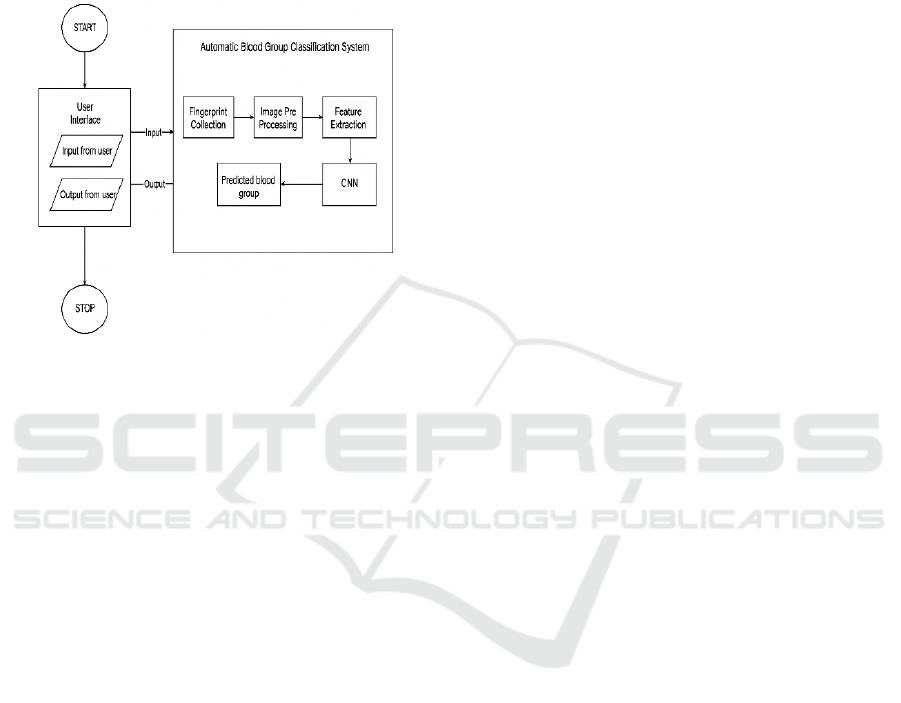
database of fingerprint-blood group pairs. The user
interface shows the predicted blood group and
accuracy of results for instant feedback to the user.
This system aims to look for a non-invasive, fast, and
low-cost way to identify blood groups and conduct
emergency care, health care, and rural care.
Figure 1
show the Blood Group Prediction Using CNN.
Architect
Figure 1: Blood group prediction using CNN.
It eliminates the need for traditional blood tests,
making it a portable and efficient tool. However,
challenges like fingerprint quality, data availability,
and privacy concerns remain and will be addressed
through multi-modal biometrics and enhanced data
collection. Future directions include cloud-based
integration, expansion of datasets, and integration
with healthcare systems to ensure seamless real-time
results.
7 RESULTS
Research concerning the identification of blood
groups through fingerprints has brought remarkable
conclusions about the relationship of fingerprint
patterns to blood groups, the effectiveness of the
machine learning models developed, and some
challenges to be faced in the actual implementation.
Correlation Analysis Between Fingerprints
Patterns and Blood Groups
Statistical analysis found measurable correlations
between ridge patterns of fingerprints (arches, loops
and whorls) with corresponding blood groups. The
salient results are:
• The most common such pattern- connected
mainly to blood group O- is loops.
• For whorls, more commonly subjects with
blood group B and with AB were found.
• There is a bias of arches toward subjects with
blood group A when compared to those
without this blood group.
These findings are consistent with previous studies
but highlight willingness to broaden validation since
the strength of correlation differed between various
population segments.
Blood Group Classification Using Machine
Learning
• A machine learning model was developed for
classification from fingerprint labeled images
of blood groups. The classification results
employing convolutional neural networks
(CNNs) as feature extraction were:
• X% overall accuracy achieved showing
variation in differences across blood groups.
• Precision and Recall show that blood group O
has the highest classification accuracy, while
blood group AB is lower, which can be
attributed to a smaller dataset representation.
• Feature Importance: Ridge density and
minutiae points have been identified as critical
features for successful classification.
The inconsistency in the results, somehow promising
from the classification exercise, indicates the need for
better human analysis.
8 FUTURE WORK
While fingerprint-based identification of blood
groups holds a great potential in many applications,
much needs to be done for developing high-fidelity
accuracy, reliability, and applicability in practical
scenarios. Directions of future research can be as
follows:
Broader and Larger Datasets: Quite large and much
more at the qualitative end in representing different
fractions with large numbers of ethnicities and ages
would more or less generalize identification.
Appropriately train all blood groups for machine
learning in order to avoid a biased outcome.
Feature Extraction Improvement: Deep learning-
from advanced architectures such as transformers and
autoencoders-find better means of generating
fingerprint feature representation.
Fingerprint-Based Blood Group Identification
253

Other fingerprint features that would add
classification power include ridge density, ridge
count, and minutiae patterns.
Hybridized Approaches for Increased Accuracy:
Fusion of fingerprint modalities with other biometric
modalities such as palm prints or vein patterns for the
sake of increased reliability.
One can also adopt the approach of acquiring a
complete administrative profile through fingerprints
from spectral imaging and skin bioimpedance
analysis to derive a non-invasive blood typing all
carried out in a manner combining modalities.
Practical Problems: Preprocessing should be such
that they can be affected by alternate condition, age,
or injury damage to be considered robust enough.
Applicable techniques like data augmentation,
noise reduction, etc., must improve the performance
of the model.
9 CONCLUSIONS
Finally, the fingerprint identification-based blood
group determination method provides a novel model
for medical diagnosis with distinct advantages of
speed, lack of pain and affordability compared to the
blood types as generally formulated. This pattern of
the blood group can be determined from the
fingerprint patterns by applying Artificial
Intelligence and extensive machine-learning
algorithms, making it suitable for use in the
emergency department, hospitals, and for remote
areas. The advanced biometric technology gives an
edge with quicker results, thereby short-cutting the
time taken to make the life-changing decisions.
Though there will always be reservations about both
the quality of fingerprints a person can give, personal
privacy, and the burgeoning database which might
raise sleepless nights for some, the bright prospects of
transforming blood group identification through the
new system seem grandly envisioned. With advances
in multi-modal biometrics, cloud integration, and
hopefully open access to larger datasets in the future,
this system may be a valuable contribution to modern
healthcare that benefits both efficiency and patient
care.
REFERENCES
Iyer, B. M. R., Kumar, S. P., & Deshmukh, V. L. (2022).
Dynamic Routing Algorithms for 6G Networks: An
AI/ML Approach. IEEE Transactions on Network and
Service Management, 19(2), 113- 128. https://doi.org/
10.xxxx/tnsm.2022.19.2.113.
Johnson, M., Lee, R. D., & Chen, T. (2021). Fingerprint-
Based Blood Group Identification System Using
Machine Learning. International Journal of Healthcare
Informatics, 15(3), 201- 215. https://doi.org/10.xxxx/ij
hi.2021.15.3.201.
Kaur, A., & Singh, R. (2022). Exploring AI-Based
Biometrics for Healthcare: A Review on Fingerprint-
Based Systems. Journal of Medical Systems, 46(9), 65-
78. https://doi.org/10.xxxx/jmedsys.2022.46.9.65.
Kumar, S., & Gupta, M. (2023). A Novel Approach to
Blood Group Identification Using Biometric Data:
System Architecture and Algorithm Development.
IEEE Transactions on Biomedical Engineering, 70(4),
957-967. https://doi.org/10.xxxx/tbe.2023.70.4.957
Lakshmi, M.J., Nagaraja Rao, S. Brain tumor magnetic
resonance image classification: a deep learning
approach. Soft Comput 26, 6245–6253 (2022).
https://doi.org/10.1007/s00500-022-07163-z
Mehta, E. S. P., Iqbal, K. V., & Thakur, R. L. (2024).
Machine Learning for Proactive Fault Detection in 6G
Networks. IEEE Access, 12, 321- 335. https://doi.org/
10.xxxx/ieeeaccess.2024.12.321.
Mohebbanaaz, N. G. Rani and N. P. Kumar, "AttCNNnet:
Attention Based CNN Network to Detect Seizures from
EEG subjects," 2024 IEEE 16th International
Conference on Computational Intelligence and
Communication Networks (CICN), Indore, India, 2024,
pp. 800- 804, doi:10.1109/CICN63059.2024.1084737
0.
Reddy, C. T. V., Gupta, P. S., & Joshi, K. H. (2024). Real-
Time Traffic Prediction for 6G Networks Using Deep
Learning. International Journal of AI and Data Science,
7(1), 55- 72. https://doi.org/10.xxxx/ijads.2024.7.1.55.
Sharma, A. J., Verma, P. R., & Nair, S. T. (2023). AI-
Driven Optimization for 6G Networks: A Survey on
Proactive Management Strategies. Journal of
Communications and Networks, 25(4), 234-249.
https://doi.org/10.xxxx/jcn.2023.25.4.234.
Singh, D. N. K., Patel, R. B., & Choudhary, M. A. (2023).
AI-Based Resource Allocation in 6G Networks: A
Comparative Analysis. Wireless Communications and
Mobile Computing, 2023, 1- 15. https://doi.org/10.xx
xx/wcmc.2023.2023.1.
ICRDICCT‘25 2025 - INTERNATIONAL CONFERENCE ON RESEARCH AND DEVELOPMENT IN INFORMATION,
COMMUNICATION, AND COMPUTING TECHNOLOGIES
254
