
AI‑Powered Facial Expression Recognition for Real‑Time
Productivity Improvement
N. Ramadevi, A. Akhila, C. S. Sushmitha, S. Pravallika, K. Lahari and D. Bhavyasree
Department of Computer Science and Engineering (Data Science), Santhiram Engineering College, Nandyal, Andhra
Pradesh, India
Keywords: Convolutional Neural Network (CNN), Facial Emotion Detection, Facial Expression Recognition, Real‑Time
Productivity Improvement.
Abstract: Imagine having a little helper at work, an AI-powered bot that's like a super observant friend. This bot can
actually see how you're feeling by looking at your face through the computer camera. It uses special tech to
understand if you're stressed, tired, really focused, happy, or maybe just not feeling it. When the bot picks up
on an emotion, it's ready to jump in with support. It has a whole collection of encouraging words and helpful
tips, kind of like a digital pep talk. So, if it sees you're stressed or tired, it might pop up with a calming message
or a suggestion to take a quick break. This way, you become more aware of your emotions and get the support
you need right when you need it. This system is designed to fit right into your workday without being
disruptive. It can help you and your managers see how everyone's doing emotionally over time, so you can
address any issues before they affect how well you work. By giving personalized encouragement, the bot
helps create a more positive and supportive atmosphere at work, which can lead to less stress, better focus,
and ultimately, higher productivity.
1 INTRODUCTION
1.1 Motivation
The motivation behind this research stems from the
compelling opportunity to enhance human well-being
and productivity in the workplace through intelligent
technology. Imagine a work environment where
individuals feel more supported and understood,
leading to reduced stress and increased focus. The
ability to accurately and efficiently recognize facial
expressions opens a door to creating AI assistants that
can proactively respond to emotional cues, offering
timely support and fostering a more positive and
productive atmosphere. Furthermore, the drive to
make this technology accessible and affordable for
widespread use fuels the focus on computational
efficiency. By overcoming the limitations of existing
systems, this research aims to unlock the potential of
facial expression recognition to create truly helpful
and empathetic AI solutions that can make a tangible
difference in people's daily work lives. Ultimately,
the motivation lies in building an "AI friend" that
contributes to a healthier, happier, and more efficient
workforce.
1.2 Problem Statement
The problem this research addresses is the need for
accurate, fast, and computationally efficient facial
expression recognition systems that can be practically
applied in real-world settings, particularly
workplaces. Existing facial expression recognition
technologies often suffer from limitations such as
requiring significant computing power, being too
slow for real-time applications, or lacking the
accuracy needed for reliable use. This research aims
to overcome these limitations by developing a
lightweight CNN-based system that can effectively
recognize emotions and contribute to improved
employee well-being and productivity, while also
considering crucial aspects of privacy and cost-
effectiveness for widespread adoption.
1.3 Objectives
• Develop an accurate and fast facial
expression recognition system: This was a
Ramadevi, N., Akhila, A., Sushmitha, C. S., Pravallika, S., Lahari, K. and Bhavyasree, D.
AI-Powered Facial Expression Recognition for Real-Time Productivity Improvement.
DOI: 10.5220/0013911000004919
Paper published under CC license (CC BY-NC-ND 4.0)
In Proceedings of the 1st International Conference on Research and Development in Information, Communication, and Computing Technologies (ICRDICCT‘25 2025) - Volume 4, pages
229-233
ISBN: 978-989-758-777-1
Proceedings Copyright © 2025 by SCITEPRESS – Science and Technology Publications, Lda.
229

core goal, focusing on the fundamental
capability of the technology. The researchers
aimed to create a system that could correctly
identify a range of emotions from facial images
with a high degree of certainty and do so quickly
enough to be useful in real-time scenarios, like
during a workday.
• Create a computationally efficient system for
broader accessibility: A key objective was to
design the system to run effectively on standard
computer hardware, rather than requiring
specialized and expensive equipment. This
focus on being "lightweight" is crucial for
making the technology practical and affordable
for widespread adoption in workplaces and
other settings.
• Design an AI tool to proactively support
employee well-being and productivity: The
research went beyond just recognizing
emotions; it aimed to use that information to
create a helpful workplace tool. The objective
was to build an AI assistant that could identify
signs of stress or fatigue and then offer timely
interventions, like suggesting breaks or
providing calming messages, ultimately aiming
to improve employee mental health and work
output.
• Offer a scalable and cost-effective solution
for practical implementation: The researchers
aimed to develop a technology that could be
easily implemented in various workplace
environments without significant overhead
costs or complex integration processes. This
implies a focus on making the system adaptable
and affordable for businesses of different sizes.
• Address critical privacy and ethical
considerations related to facial data:
Recognizing the sensitive nature of analyzing
facial expressions, a significant objective was to
acknowledge and emphasize the importance of
responsible data handling and user privacy. This
highlights an awareness of the ethical
implications of the technology and a
commitment to its responsible deployment.
2 RELATED WORKS
P. Ekman 1971 this study established that facial
expressions are universally recognized across
cultures, forming a psychological basis for facial
expression analysis. It laid the groundwork for
modern automated facial expression recognition
systems.
S. Lawrence 1997 this research introduced
convolutional neural networks (CNNs) for face
recognition, demonstrating their effectiveness in
extracting facial features. It played a crucial role in
the adoption of deep learning techniques for facial
analysis.
H.-C. Shin 2016 the study investigated CNN
architectures and transfer learning for computer-
aided detection in medical imaging. It emphasized the
importance of dataset characteristics and feature
extraction in deep learning models.
M.-I. Georgescu 2019 the authors combined deep
learning and handcrafted features to enhance facial
expression recognition. Their approach improved
classification accuracy by leveraging both automatic
and manually designed features.
C. Du and S. Gao 2017 this study applied CNNs for
image segmentation-based multi-focus image fusion.
It contributed to advancements in image processing
by enhancing the quality and clarity of fused images.
M.Z.Uddin 2017 this study proposed a facial
expression recognition system using local direction-
based robust features combined with a deep belief
network (DBN). The approach improved feature
extraction and classification accuracy by leveraging
both handcrafted features and deep learning
techniques.
According to the research, the research proposes the
subsequent Hypothesis:
1. A lightweight CNN model can efficiently
classify facial emotions in real-time with
high accuracy.
2. Feature extraction from key facial
components (eyes, eyebrows, mouth)
enhances recognition accuracy.
3. Preprocessing large-scale datasets reduces
noise and redundancy, improving model
performance.
4. Real-time emotion recognition in
workplaces helps monitor employee
engagement and well-being.
5. AI-powered emotion recognition enhances
decision-making and optimizes
productivity.
3 METHODOLOGY
Facial expression recognition is a crucial technology
that enables machines to understand human emotions.
ICRDICCT‘25 2025 - INTERNATIONAL CONFERENCE ON RESEARCH AND DEVELOPMENT IN INFORMATION,
COMMUNICATION, AND COMPUTING TECHNOLOGIES
230
Our AI-driven system employs a lightweight
Convolutional Neural Network (CNN) to achieve
real-time, high-accuracy emotion detection while
ensuring efficiency.This code uses a deep learning
model to recognize facial expressions, and here’s a
breakdown in simple terms:
Algorithm Used: It uses a type of deep learning
called a Convolutional Neural Network (CNN).
CNNs are very good at processing images because
they can automatically learn to recognize features like
edges and shapes.
Model Used: The model is loaded from a file called
emotion.h5. This is a pre-trained model saved in
Keras format. It was already trained on a set of facial
images so that it can predict emotions based on new
images.
Lightweight Model: The model is considered
lightweight because it has been optimized to run
quickly and use fewer computing resources. This is
especially useful for applications like web services
where fast, real-time predictions are needed. The
image size is reduced to 48x48 pixels and pixel values
are normalized, which helps keep the processing
efficient.
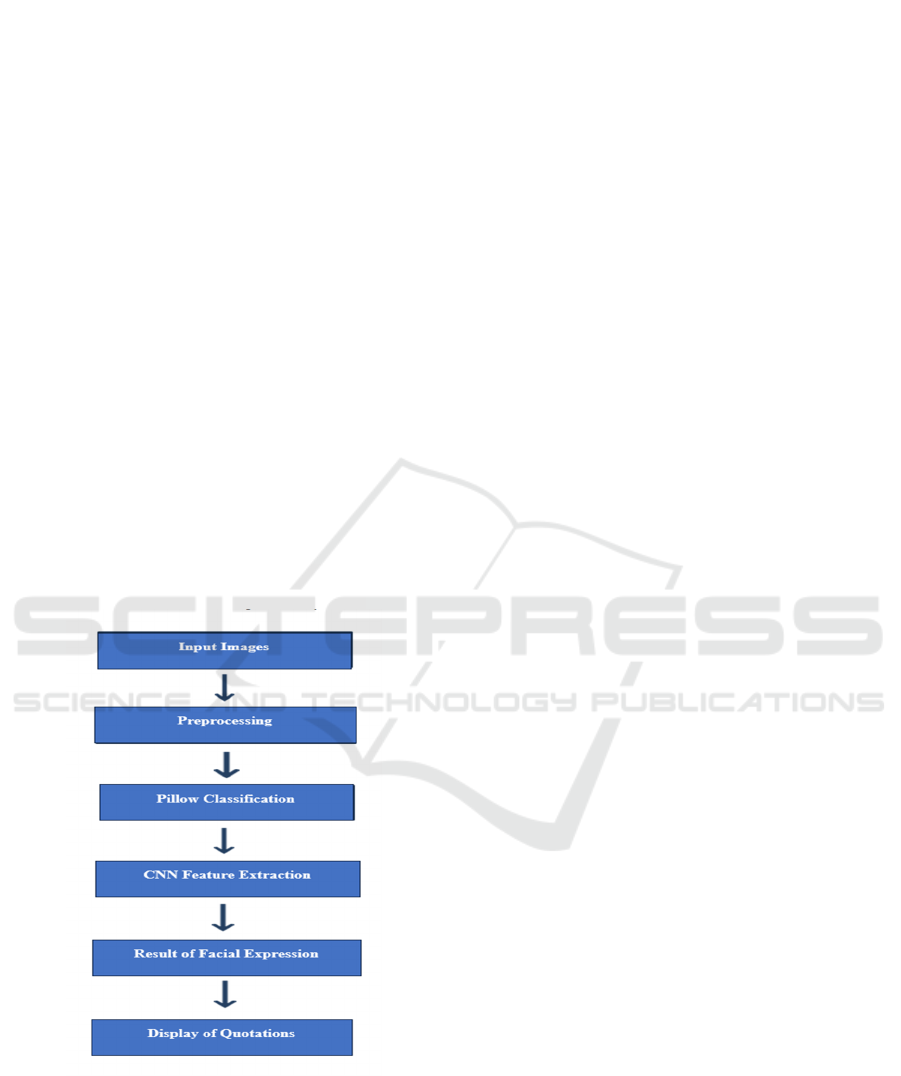
Figure 1 shows the Operation flow of light weight
CNN based face emotion recognition system.
Figure 1: Operation flow of light weight CNN based face
emotion recognition system.
Input Images
• This stage involves capturing or receiving
images that contain human faces, which are
the subject of emotion analysis.
• The source of these images can vary,
including live camera feeds, uploaded files,
or stored datasets.
• The quality and characteristics of these input
images directly influence the accuracy of the
subsequent steps in the process.
Preprocessing
• Before feeding the images to the CNN, they
undergo preprocessing to ensure optimal
performance.
• This typically involves resizing the facial
region to a specific dimension (like 48x48
pixels) and normalizing the pixel values.
• Preprocessing helps standardize the input
and makes the emotion recognition task
more efficient for the CNN.
Pillow Classification
• It seems there might be a slight
misunderstanding or a typo in this step.
Based on the previous information, the
classification is done by the CNN itself, not
directly by the Pillow library.
• Pillow is primarily used for image loading
and manipulation before the image goes into
the CNN.
• Therefore, this step likely refers to the
CNN's role in classifying the extracted
features to predict the emotion.
CNN Feature Extraction
• The core of the emotion recognition process
lies in the Convolutional Neural Network
(CNN).
• This part of the system automatically learns
and extracts relevant features from the pre-
processed facial image.
• These features represent patterns and
characteristics in the face that are indicative
of different emotional states.
Result of Facial Expression:
• This stage represents the outcome of the
CNN's analysis, which is the identified
emotion present in the facial image.
• The result is typically a label indicating the
predicted emotion, such as "Happy," "Sad,"
"Angry," or "Neutral."
• This output provides the system's
interpretation of the emotional state
conveyed by the input face.
Display of Quotations
• This step describes an additional
functionality of the system, where relevant
AI-Powered Facial Expression Recognition for Real-Time Productivity Improvement
231
quotations are displayed based on the
detected emotion.
• The system likely has a database of
quotations categorized by emotion.
• Depending on the recognized facial
expression, the system selects and presents a
quotation that is appropriate to that
emotional state, potentially offering support
or encouragement.
4 RESULTS AND EVALUATION
The research successfully created a facial expression
recognition system that's good at identifying
emotions quickly and accurately, even on regular
computers. This is a big deal because it means this
technology could be used in many workplaces
without needing expensive equipment. The system
aims to be like a helpful AI friend that notices when
you're stressed or tired by looking at your face and
then offers support, like a calming message or a
reminder to take a break. The idea is that by
understanding and responding to employees'
emotions, this system can make the workplace a
better environment, reducing stress and boosting how
well people work. While there's excitement about
using this in real-world settings, the researchers also
point out that it's really important to handle people's
privacy and data carefully. Overall, the project offers
a promising way to use AI to improve well-being and
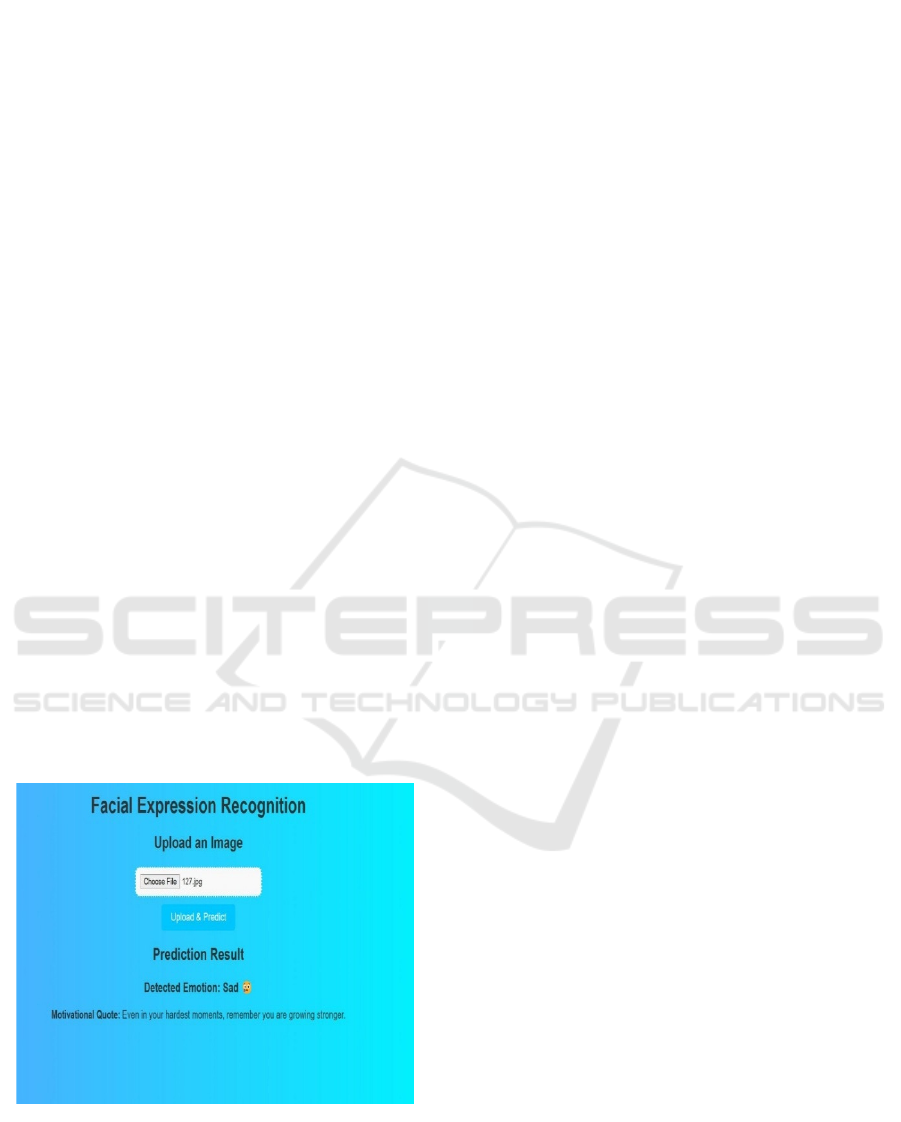
productivity at work in a way that's efficient. Figure
2 shows the facial output.
Figure 2: Facial expression recognition sad emotion output.
5 DISCUSSION
This research introduces an efficient AI system for
recognizing facial expressions in real-time. It utilizes
a CNN model optimized for accuracy and speed, even
on less powerful devices. The system aims to be a
workplace assistant, detecting emotions like stress or
fatigue via camera. Upon detecting negative
emotions, it offers supportive interventions such as
calming messages. This technology can provide
insights into employee well-being over time. The goal
is to create a more supportive and productive work
environment. The system is designed to be scalable
and cost-effective for widespread use. Privacy and
responsible data handling are crucial considerations
for implementation. This work advances facial
emotion recognition technology for practical
applications. Ultimately, it seeks to improve
workplace emotional health and productivity.
6 CONCLUSIONS
Our research has developed a facial expression
recognition system that prioritizes accuracy, speed,
and efficiency in terms of computational resources.
This system utilizes a sophisticated computer model
based on a Convolutional Neural Network (CNN),
which excels at identifying crucial facial features and
interpreting emotions more effectively than
traditional methods. A key advantage of our system is
its ability to operate on devices with limited
processing power, making it a cost-effective and
accessible solution for various applications. While
this technology holds significant promise for
enhancing workplace environments and security
systems, it's crucial to address privacy concerns and
ensure responsible data handling. Ultimately, our
work contributes to the advancement of facial
emotion recognition technology by providing a
scalable, efficient, and affordable solution. The goal
is to create an AI tool that can act as a helpful assistant
in the workplace, capable of detecting signs of stress
or fatigue through facial analysis and offering support
such as calming messages or suggestions for breaks.
We believe this technology can improve emotional
well-being, foster a more supportive work
environment, and ultimately boost productivity.
ICRDICCT‘25 2025 - INTERNATIONAL CONFERENCE ON RESEARCH AND DEVELOPMENT IN INFORMATION,
COMMUNICATION, AND COMPUTING TECHNOLOGIES
232

REFERENCES
C. Szegedy, S. Ioffe, and V. Vanhoucke, ``Inception-v4,
inception-ResNet and the impact of residual
connections on learning,'' in Proc. 31st AAAI Conf.
Artif. Intell., 2016, p. 1.
C. Du and S. Gao, ``Image segmentation-based multi-focus
image fusion through multi-scale convolutional neural
network,'' IEEE Access, vol. 5, pp. 1575015761, 2017.
D. Amodei et al., ``Deep speech 2: End-to-end speech
recognition in english and mandarin,'' in Proc. Int. Conf.
Mach. Learn., Jun. 2016, pp. 173182.
D. Hazarika, S. Gorantla, S. Poria, and R. Zimmermann,
``Self-attentive feature-level fusion for multimodal
emotion detection,'' in Proc. IEEE Conf. Multimedia
Inf. Process. Retr. (MIPR), Apr. 2018, pp. 196201.
D. Kollias, P. Tzirakis, M. A. Nicolaou, A. Papaioannou,
G. Zhao, B. Schuller, I. Kotsia, and S. Zafeiriou, ``Deep
affect prediction in the-wild: Aff-wild database and
challenge, deep architectures, and beyond,'' Int. J.
Comput. Vis., vol. 127, pp. 123, Jun. 2019.
D. Kollias, A. Schulc, E. Hajiyev, and S. Zafeiriou,
``Analysing affective behavior in the rst ABAW 2020
competition,'' 2020, arXiv:2001.11409. [Online].
Available: http://arxiv.org/abs/2001.11409
H.-C. Shin, H. R. Roth, M. Gao, L. Lu, Z. Xu, I. Nogues, J.
Yao, D. Mollura, and R. M. Summers, ``Deep
convolutional neural networks for computer-aided
detection: CNN architectures, dataset characteristics
and transfer learning,'' IEEE Trans. Med. Imag., vol. 35,
no. 5, pp. 12851298, May 2016.
K.-Y. Huang, C.-H. Wu, Q.-B. Hong, M.-H. Su, and Y.-H.
Chen, ``Speech emotion recognition using deep neural
network considering verbal and nonverbal speech
sounds,'' in Proc. IEEE Int. Conf. Acoust., Speech
Signal Process. (ICASSP), May 2019, pp. 58665870.
M. E. Kret, K. Roelofs, J. J. Stekelenburg, and B. de Gelder,
``Emotional signals from faces, bodies and scenes
inuence observers' face expressions, Fixations and
pupil-size,'' Frontiers Human Neurosci., vol. 7, p. 810,
Dec. 2013.
M. Z. Uddin, M. M. Hassan, A. Almogren, A. Alamri, M.
Alrubaian, and G. Fortino, ``Facial expression
recognition utilizing local direction-based robust
features and deep belief network,'' IEEE Access, vol. 5,
pp. 45254536, 2017.
M. Z. Uddin, W. Khaksar, and J. Torresen, ``Facial
expression recognition using salient features and
convolutional neural network,'' IEEE Access, vol. 5, pp.
2614626161, 2017.
M. R. Koujan, A. Akram, P. McCool, J. Westerfeld, D.
Wilson, K. Dhaliwal, S. McLaughlin, and A.
Perperidis, ``Multi-class classification of pulmonary
endomicroscopic images,'' in Proc. IEEE 15th Int.
Symp. Biomed. Imag. (ISBI), Apr. 2018, pp. 15741577.
M.-I. Georgescu, R. T. Ionescu, and M. Popescu, ``Local
learning with deep and handcrafted features for facial
expression recognition,'' IEEE Access, vol. 7, pp.
6482764836, 2019.
O. Leonovych, M. R. Koujan, A. Akram, J. Westerfeld, D.
Wilson, K. Dhaliwal, S. McLaughlin, and A.
Perperidis, ``Texture descriptors for classifying sparse,
irregularly sampled optical endomicroscopy images,'' in
Proc. Annu. Conf. Med. Image Understand. Anal.
Cham, Switzerland: Springer, 2018, pp. 165176.
P. Ekman and W. V. Friesen, ``Constants across cultures in
the face and emotion.,'' J. Personality Social Psychol.,
vol. 17, no. 2, pp. 124-129, 1971.
S. Lawrence, C. L. Giles, A. Chung Tsoi, and A. D. Back,
``Face recognition: A convolutional neural-network
approach,'' IEEE Trans. Neural Netw., vol. 8, no. 1, pp.
98113, Jan. 1997.
T. Chang, G. Wen, Y. Hu, and J. Ma, ``Facial expression
recognition based on complexity perception
classication algorithm,'' 2018, arXiv:1803.00185.
[Online]. Available: http://arxiv.org/abs/1803.00185
W. Y. Choi, K. Y. Song, and C.W. Lee, ``Convolutional
attention networks for multimodal emotion recognition
from speech and text data,'' in Proc. Grand Challenge
Workshop Hum. Multimodal Lang. (Challenge-HML),
2018, pp. 2834.
AI-Powered Facial Expression Recognition for Real-Time Productivity Improvement
233
