
Churn Prediction in Over‑The‑Top (OTT) for Customer Retention
Using Machine Learning Algorithms
G. Shabana, M. Jyothi, K. Ali Mahaboob Basha, D. Mounika Reddy and M. Charan Tej
Department of CSM, Srinivasa Ramanujan Institute of Technology, Rotarypuram, Anantapur, Andhra Pradesh, India
Keywords: Over‑The‑Top, Decision Tree, Random Forest, XG Boost, Gradient Boost, over Sampling, SMOTE, Churn
Prediction.
Abstract: In the view of content providers like Over-The- Top (OTT), the ability to predict the amount of churn is a key
part of the organization. With these predictions, the company can make better strategies in order to reduce the
churn rate. This paper presents a comprehensive study on Churn Prediction in Over-The-Top (OTT) using
various Machine Learning Algorithms. These include Decision Tree using both Entropy and Gini as
parameters, Random Forest, XG Boost, Gradient Boost algorithms. In which the class imbalance is found and
treated using Synthetic Minority Over- sampling Technique (SMOTE) and re-performed the machine learning
algorithms, in which the accuracy all algorithms are greater than 74% and better F1-Score, these findings can
be useful to the companies with real time data and to find the reasons behind customer attrition and increase
their customer life value and customer satisfaction.
1 INTRODUCTION
Churn is defined as the how many numbers of
customers are decided to leave the particular
company. Churn Prediction is the process of
identifying consumers who pose a danger of
cancelling their subscriptions or closing accounts
altogether.
It also detects the customers those who are in risk
of rejecting the subscription. Over-The-Top (OTT)
provides content like movies, web series, etc.
customers take subscription in order to get entertained
but due to some reasons they drop the subscriptions
in the middle and leave the platform, these platforms
will predict on what reasons customers are leaving. In
OTT platforms churn prediction is a vital concern.
Churn prediction is basically use machine learning
algorithms to detect the subscribed people leaving the
platform. Churn prediction considers both the "why"
and the "who". Companies may learn a lot about the
factors behind customer attrition by examining the
data used to forecast churn.
Various causes may contribute to this, such as
competitive products, unsatisfactory customer
service, absence of desired features, or cost.
Machine learning is very important for analysing
the customer data for future prediction over churn in
OTT. First, we collect the data on customers. Train
the data by using machine learning algorithms like
Decision Tree, Random Forest, XG Boost, Gradient
Boosting. After completion of training, we need to
evaluate the model to know the accuracy in
predicting churn. Once the model is done then it used
to predict the churn and reasons for the same.
Developing a model that can precisely anticipate
whether a customer will stick with this platform or not
is the aim of utilizing machine learning to forecast
subscriptions for Over-The-Top (OTT) services.
Strategy for client segmentation can be used with
churn prediction. Businesses are able to construct
more individualized customer experiences that meet
a range of wants and preferences by segmenting their
client base according to churn risk and other pertinent
characteristics. OTT firms need this information to
better understand and manage their marketing and
retention campaigns. To train the model, pertinent
data such as watching preferences and consumer
demographics is gathered and examined. In this
procedure, significant characteristics are chosen, the
data is cleaned, and a machine learning model is
trained.
In the following sections, we see each and every
methodology in detail, how the models are
performed, how the performance metrics is
calculated, finding the class imbalance and
224
Shabana, G., Jyothi, M., Basha, K. A. M., Reddy, D. M. and Tej, M. C.
Churn Prediction in Over-The-Top (OTT) for Customer Retention Using Machine Learning Algorithms.
DOI: 10.5220/0013910700004919
Paper published under CC license (CC BY-NC-ND 4.0)
In Proceedings of the 1st International Conference on Research and Development in Information, Communication, and Computing Technologies (ICRDICCT‘25 2025) - Volume 4, pages
224-228
ISBN: 978-989-758-777-1
Proceedings Copyright © 2025 by SCITEPRESS – Science and Technology Publications, Lda.

performing over sampling using SMOTE, drawing
recommendations and conclusions.
2 RELATED WORKS
Mohan, M., & Jadhav, A. (2022). uses machine
learning techniques like Hierarchical logistic
regression, decision tree, random forest, Ada Boost.
Factors like multiple subscription, switching
frequency, content satisfaction, price satisfaction
have higher impact on customer churn. These are
found with most effective algorithm among all those
Random Forest, this approach has higher accuracy
compared to others.
Retention strategies in order to reduce churn in
OTT platforms are clearly discussed in Senthil
Kumar, Needhi Devan, 2023. Finding the most
significant attributes for churn of a particular
individual, the OTT platform can take necessary steps
in order to reduce churn, Content satisfaction shows
more effect on churn, so by taking the videos, movies,
that are highly satisfied by the viewers churn can be
reduced. The highly satisfied content can be collected
by viewers or customers feedback, review of a
particular movie or video, etc. Showing the related
content to the viewers is another strategy of OTT.
This can be done by having the data of one viewer,
what kind of movies they are continuously watching,
what genre they are interested. Author used logistic
regression, multi-layer perceptron, random forest,
decision trees, and gradient boosting machines and
also bought the accuracy of 80%. However, they
faced the problems with the data, the model built was
complex, model drift.
Churn of one organization depends on the
competitors. With the increase of technology, OTT
platforms are increasing day-by-day, this can become
a big hurdle for one platform. So, these should build
strategies by keeping competitors in mind. These are
explained in detailed in Manish Mohan, Anil Jadhav
(2022). The availability of competing services, other
platform price, have effect in churn.
Other than machine learning algorithms,
Comprehensive Understanding was done in Srivalli
Leela., et al, 2021. They stated that there will be
increase of paid subscribers by 16.1% by the year
2028 i.e., the subscriber market will increase from
USD104.2 billion to USD293 billion.
Over-The-Top (OTT) providers and Internet
Services Providers (ISPs) joint service management
approach based on Customer Lifetime Value (CLV)
and benefits of joint services management are
discussed in A. Ahmad, et al, 2017. They also stated
that this can improve the customer experiences,
increase customer loyalty which are key factors in
reducing churn. Over-The- Top (OTT) providers and
Internet Services Providers (ISPs) joint service
management approach based on Quality of
Experience (QoE) and benefits of joint services
management A. Ahmad, et al, 2016. This is a measure
of satisfaction got by particular viewer with respect to
the service they received. Regression analysis is
performed between QoE and Churn in order to get a
relationship among those.
Over-The-Top (OTT) Churn is more affected by
content provided by particular OTT platforms and
also the price charged for that, plans and subscription
options provided. This is analyzed by performing
content analysis and economic analysis Priya
Malhotra, Akshay Kumar (2021). Found that
customers are increasing because they feel that OTT
platforms are for providing entertainment, treat as
stress busters. This was found based on various
factors like variety of content, affordability of OTT
subscriptions.
Sachika Luthra, The author stated there are
increase of OTT subscribers during Covid-19. Almost
7.5 million subscribers have been increased from the
year 2019 to 2020. Factors like Covid-19 pandemic,
increasing availability of high-speed internet, growth
popularity of streaming devices showed significant
effect on this particular growth.
3 METHODOLOGY
3.1 About the Dataset
The dataset contains 16 attributes along with the
target variable 'churn' that is binary which states 0-no,
1- yes. The 15 independent variables are Year,
customer_id, phone_no, Gender, Age, multi_screen,
no_of_days_subcribed, mail_subscrided, weekly_mi
ns_watched, maximum_daily_mins,minimum_daily
_mins, weekly_max_night_mins, videos_watched,
maximum_days_inactive, customer_support_calls.
The dataset contains 2000 entries.
3.2 Data Pre-Processing
The initial step of the project includes pre-processing
steps like removing unnecessary attributes, handling
null values, outlier detection, some visualizations,
creation of dummies. Here we removed customer_id,
year, phone_no attributes. While treating with null
values, we found the attributes gender,
maximum_days_inactive, churn have null values.
Churn Prediction in Over-The-Top (OTT) for Customer Retention Using Machine Learning Algorithms
225
Using imputation methods, we treated these, gender
is filled with mode, maximum_days_inactive is filled
with median, churn is filled with mode. No outliers
are detected hence proceed further. When correlation
matrix is plotted, found out that
maximum_days_inactive is highly correlated
minimum_daily_min. Attributes like gender,
multi_screen, mail_subscribed are converted
categorical to binary through dummies.
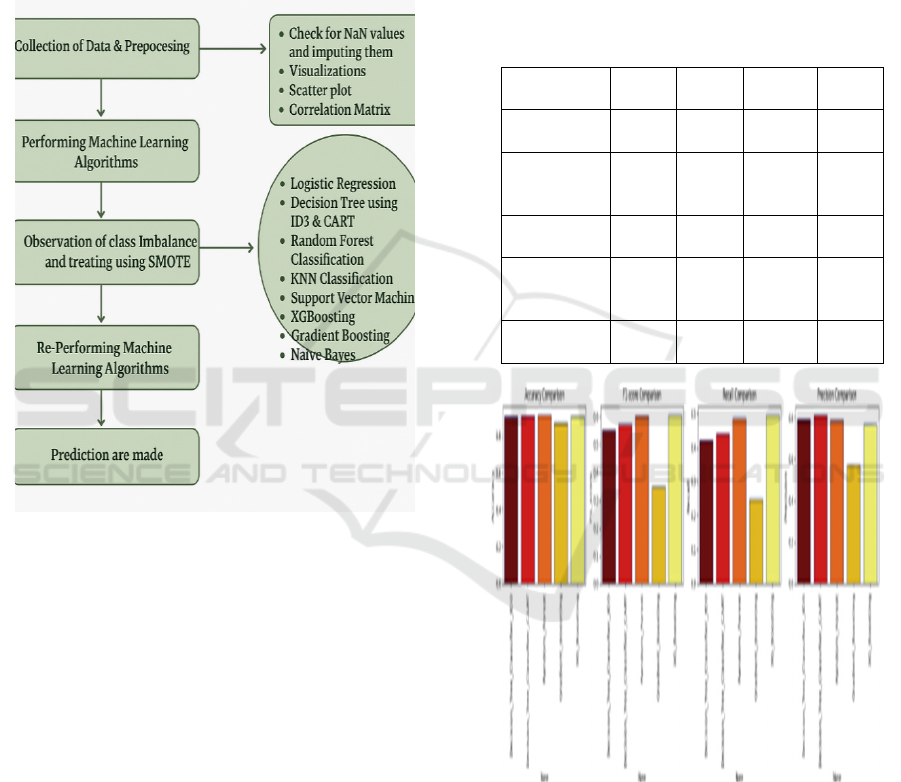
Figure 1
show the System Architecture for Ott Churn.
Figure 1: System Architecture for OTT Churn.
3.3 Model Selection
Splitting of the dataset into training and testing is
done, 40% of the data is provided for testing and 60%
for training and random state is taken as 78 and built
several machine learning algorithms. Models like
Decision Tree using entropy and gini, Random
Forest, Gradient Boosting, XG Boosting are trained,
tested, and validated. Figure 2 show the Model
Performance Comparison Using Graph
3.4 Performance Evaluation
Performance metrics, Confusion metrics is plotted for
each model and Accuracy, Precision, Recall, F1-
Score are retained, from that the efficiency of the
model is been said. Random Forest has higher
accuracy followed by Decision tree and then XG
Boost. However, we got F1 Score greater than 0.5 for
most of the models.
Accuracy TP TN / TP FP
TN FN
(1)
Precision TP / TP FN
(2)
Recall TP / TP FN
(3)
F1 Score 2 ∗ Precision ∗ Recall / Precision
Recall
(4)
Table 1: Evaluation Metrics Before Smote.
Accur
ac
y
F1_S
core
Recall Precis
ion
Random
Forest
0.912 0.602 0.486 0.791
Decision_T
ree_Classifi
er
_
ID3
0.911 0.590 0.468 0.797
XG_Boosti
ng
0.911 0.603 0.495 0.771
Decision_T
ree_Classifi
er
_
CART
0.906 0.540 0.404 0.815
Gradient
Boosting
0.873 0.346 0.248 0.574
Figure 2: Model Performance Comparison Using Graph.
3.5 Treating with Class Imbalance
Less F1-Score is occurred due to class imbalance, this
is treated with Synthetic Minority Over-sampling
Technique (SMOTE), for oversampling the data, after
performing SMOTE, all the above machine learning
models are performed again for the new data and do
the evaluation. Table 1 show the Evaluation Metrics
ICRDICCT‘25 2025 - INTERNATIONAL CONFERENCE ON RESEARCH AND DEVELOPMENT IN INFORMATION,
COMMUNICATION, AND COMPUTING TECHNOLOGIES
226
Before SMOTE After this we found out that XG
Boost has high accuracy followed by Random Forest
and Decision Tree with entropy.
4 RESULTS & DISCUSSION
All models are compared with accuracy, precision,
recall and F1-score to understand the performance of
various algorithms for churn prediction.
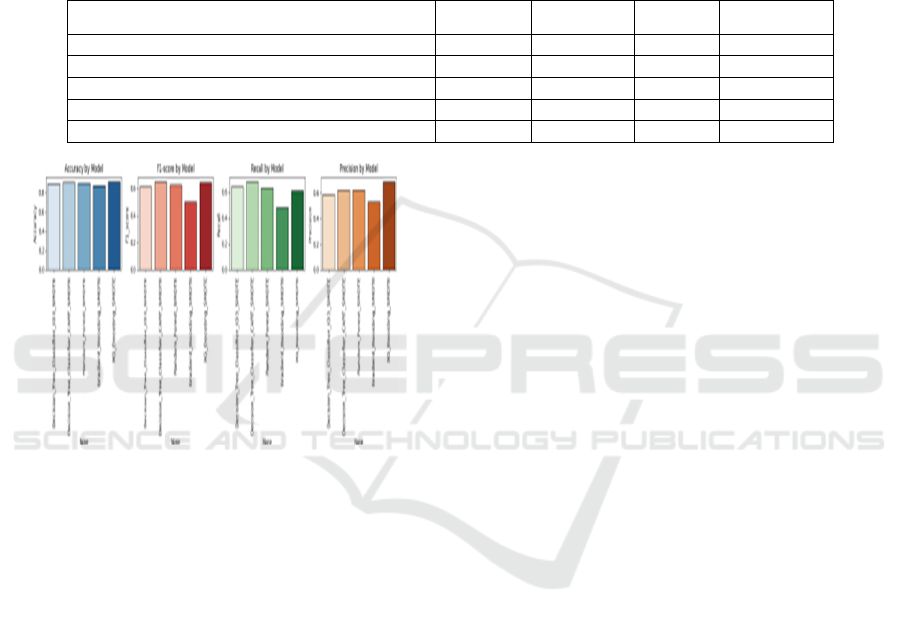
Figure 3
show the Model Performance Comparison Using
Graph In all the proposed models, XG Boost has high
accuracy of 90.9% followed by Decision Tree with
accuracy of 89.7% and Decision Tree with entropy
with accuracy of 89%. Gradient Boosting has less
accuracy of 87% and Random Forest has accuracy of
89.7%. All the performance metrics is as mentioned
in the following table 2.
Table 2: Evaluation Metrics After Smote.
Accuracy F1_Score Recall Precision
XG
_
Boostin
g_
SMOTE 0.909 0.644 0.606 0.688
Decision_Tree_Classifier_ID3_SMOTE 0.897 0.643 0.679 0.612
Random_Forest_SMOTE 0.897 0.627 0.633 0.622
Decision_Tree_Classifier_CART_SMOTE 0.890 0.614 0.642 0.588
Gradient
_
Boostin
g_
SMOTE 0.871 0.502 0.477 0.531
Figure 3: Model Performance Comparison Using Graph.
5 CONCLUSIONS
Churn prediction models are useful in identifying
typical problems, including excessive wait times or
terrible customer service, that result in subscriber
churns. Businesses may utilize this data to promptly
handle subscriber problems and enhance their
customer service. Businesses may lower attrition and
boost subscriber retention by rewarding devoted
customers with special offers and incentives. Which
subscribers are most likely to respond to loyalty
programs and what kinds of rewards work best may
be determined with the use of these models.
Through the analysis of subscriber behavior and
subscription history, businesses may enhance their
pricing methods.
In this project, four machine learning algorithms
had been used and we got the highest accuracy to be
0.90 and 0.89 in XG Boost and Decision Tree.
Random forest has higher accuracy when class
imbalance is not treated where as XG Boost has high
accuracy before and after treating the class
imbalance.
We draw the conclusion that ensemble approaches
for churn prediction will yield excellent accuracy as
well as additional performance measures. Future
developments, such as the use of AI chatbots and
gamification, may contribute to this effort.
Chatbots with artificial intelligence (AI) can
engage with subscribers and detect those who are
likely to leave. In order to reduce customer attrition,
chatbots may also be utilized to send subscribers
tailored offers and suggestions.
It is possible to utilize gamification to motivate
users to stick around on the service. One way to
achieve this is by providing incentives for viewing
particular material or urging others to sign up.
REFERENCES
A. Ahmad, A. Floris and L. Atzori, "QoE- aware service
delivery: A joint-venture approach for content and
network providers," 2016 Eighth InternationalConfere
nce on Quality of Multimedia Experience (QoMEX),
Lisbon, Portugal, 2016, pp. 16, doi:10.1109/QoMEX.2
016.7498972.
A. Ahmad, A. Floris and L. Atzori, "OTT- ISP joint
service management: A Customer Lifetime Value
based approach," 2017 IFIP/IEEE Symposium onInteg
rated Network and Service Management (IM),
Lisbon, Portugal, 2017, pp. 10171022, doi:10.23919/I
NM.2017.7987431
Anish Yousaf, Abhishek Mishra 2021- A cross-country
analysis of the determinants of customerrecommendati
on intentions for over- the-top (OTT) platforms.
Churn Prediction in Over-The-Top (OTT) for Customer Retention Using Machine Learning Algorithms
227

E. Liotou, G. Tseliou, K. Samdanis, D. Tsolkas, F.Adelant
ado and C. Verikoukis, "An SDN QoE-service for
dynamically enhancing the performance of OTT
applications," 2015 Seventh International Workshop on
Quality of Multimedia Experience (QoMEX), Pilos,
Greece, 2015, pp. 12, doi:10.1109/QoMEX.2015.7148
106.
Manish Mohan, Anil Jadhav (2022). Predicting Customer
Churn on OTT Platforms: Customers with Subscription
of Multiple Service Providers. Journal of Information
& Organizational Sciences.
Mohan, M., & Jadhav, A. (2022). Predicting customer
churn on OTT platforms: Customers with subscription
of multiple service providers. Journal of the
Association for Information Science and Technology,
73(1), 1- 15.
Priya Malhotra, Akshay Kumar (2021),” Market Research
and Analytics on Rise of OTT Platforms: A study of
Consumer Behaviour” International Journal ofAdvanc
es in Engineering and Management (IJAEM) Volume
3, Issue 7 July 2021, pp: 4005-4012
Sachika Luthra- The Impact of Covid-19 on Consumer
Perception Towards Subscription Based OTTPlatform
s.
Senthil Kumar, Needhi Devan, "Ott Subscriber Churn
Prediction Using Machine Learning" (2023). Electronic
Theses, Projects, and Dissertations. 1660.
Sistla Srivalli Leela Praveena, Dr. Vinay Negi-Over-The-
Top (OTT) 2021Video Market: Rise of PaidSubscripti
on Viewers Study
ICRDICCT‘25 2025 - INTERNATIONAL CONFERENCE ON RESEARCH AND DEVELOPMENT IN INFORMATION,
COMMUNICATION, AND COMPUTING TECHNOLOGIES
228
