
Ransomware Detection in Healthcare: Enhancing Cybersecurity with
Processor and Disk Usage Data
Rongali Abhiram, Kunal and J. Shobana
Department of Data Science and Business System, School of Computing, SRM Institute of Science and Technology,
Kattankulathur, Tamil Nadu, India
Keywords: Ransomware Detection, Healthcare Cybersecurity, Processor‑Disk Monitoring, Machine Learning.
Abstract: Security of sensitive medical information and critical patient care is threatened with the increasing digitization
of healthcare infrastructure, making hospitals prime targets for ransomware attacks. Besides having a
significant computational burden, conventional detection methods such as signature-based and behavioural
analysis are often lagging the rapidly evolving ransomware variants. This paper presents a new approach to
detecting ransomware through host machine-level processor and disk I/O event monitoring and is tailored for
use in healthcare environments. With the use of an RF classifier and machine learning-based method, the
solution can detect threats in real time without affecting system performance. The framework is rigorously
tested under simulated hospital workload scenarios and 22 ransomware variants, demonstrating its robustness,
effectiveness, and adaptability to safeguard healthcare infrastructures from modern ransomware attacks.
1 INTRODUCTION
Ransomware is now one of the most dangerous forms
of cyberattacks, affecting individuals, organizations,
and critical infrastructure worldwide. Ransomware
malware encrypts data or locks devices and demands
a ransom to be paid in exchange for unlocking them.
With the progress of digitalization and cloud storage,
cyberattacks have taken advantage of vulnerabilities
to carry out sophisticated ransomware attacks, which
are likely to cause permanent harm. Ransomware first
surfaced on the threat horizon in the late 1980s, some
of the earliest well-documented attacks being the PC
Cyborg Trojan, which was used to hide directories
and encrypt files. Ransomware started off as a single
hacker tool and developed into an extremely
profitable cybercrime-as-a-service business, with
cybercriminals selling ransomware kits to others for
a price. Advanced campaigns such as WannaCry and
Covid Lock have proven the havoc that ransomware
can wreak in healthcare, government, and financial
institutions, disrupting vital services and stealing
sensitive information. Prolific remote work and cloud
infrastructure have fed the threat, with attackers
exploiting phishing campaigns, malicious links, and
software vulnerabilities to spread ransomware.
Signature and behaviour-based ransomware detection
technologies are not able to identify new and
emerging types of ransomware attacks. Hence,
machine learning, artificial intelligence, and
situational awareness technologies are being created
to enhance ransomware detection and prevention.
This research work is targeted to explore current
ransomware attack mechanisms, evaluate the
prevailing detection frameworks, and outline a real-
time detection framework using processor and disk
activity information. Integrating machine learning
techniques, this endeavour is intended to propose an
effective mechanism to suppress ransomware attacks
with low system overhead and ensure strong security
to critical infrastructure.
2 LITERATURE SURVEY
1. "Ransomware Detection Using Machine Learning:
A Review, Research Limitations and Future
Directions” (2024): This paper summarizes machine
learning solutions for ransomware detection, reports
trends in current research, detection strategies, and
design strategies. It recognizes some significant
limitations, including outdated ransomware trends, a
lack of real-world practical solutions, and a lack of
consideration of early and real-time detection. The
188
Abhiram, R., Kunal, and Shobana, J.
Ransomware Detection in Healthcare: Enhancing Cybersecurity with Processor and Disk Usage Data.
DOI: 10.5220/0013910000004919
Paper published under CC license (CC BY-NC-ND 4.0)
In Proceedings of the 1st International Conference on Research and Development in Information, Communication, and Computing Technologies (ICRDICCT‘25 2025) - Volume 4, pages
188-193
ISBN: 978-989-758-777-1
Proceedings Copyright © 2026 by SCITEPRESS – Science and Technology Publications, Lda.

study also suggests directions for future studies to
enhance ransomware detection systems and make
them more effective against cyber-attacks.
2. "AI-Based Ransomware Detection: A
Comprehensive Review." (2024): The paper is an
end-to-end review of AI-based ransomware detection
methods, comparing different machine learning and
deep learning models on the basis of their efficiency.
The paper discusses future directions in ransomware,
data acquisition problems, feature engineering
methods, and performance metrics. The paper also
proposes a systematic evaluation framework to
enhance ransomware detection and formulates
research gaps, proposing future research areas such as
hybrid and transfer learning mechanisms for
enhancing detection.
3. "Detection and Decryption of Ransomware."
(2023): The article discusses detection and decryption
of ransomware by identifying changed file extensions
of malware. It reports on the growing danger of a
ransomware attack, overviews current detection
techniques such as antivirus programs and intrusion
detection systems, and describes a detection and
decryption tool for ransomware-affected files. The
research shows the need for proactive security and
proposes stronger ransomware defence mechanisms.
4. "Ransomware Classification and Detection with
Machine Learning Algorithms." (2023): This article
talks about various methods and techniques used for
detection and prevention against ransomware. The
authors give a description of various types of
ransomwares and various methods of detection and
prevention used by each type.
5. "Detection of Ransomware Attacks Using
Processor and Disk Usage Data." (2023): It suggests
a machine learning technique based on CPU and disk
I/O event monitoring for ransomware attack
detection. In order to reduce overhead and stop
ransomware manipulation, it does away with direct
process monitoring. The random forest classifier has
proved to be most effective with 98% detection
accuracy and a response time of 400 milliseconds.
The study points out why it is even more crucial to
train models for varied workloads to develop
resilience. The process provides a guaranteed and
efficient method to detect ransomware in real time,
and it is especially well suited for cloud environments
in the form of virtual computers.
6. “Enhanced Ransomware Detection Techniques
using Machine Learning Algorithms.” (2021): The
paper talks about different machine learning methods
for ransomware detection. It compares a variety of
algorithms, such as KNN, Naïve Bayes, Random
Forest, and Decision Trees, to test their performance
on ransomware data. The research gathers
behavioural information like API calls, target files,
registry accesses, signatures, and network accesses to
distinguish between ransomware and normal
samples. The paper discovers Random Forest to
possess the highest accuracy rate of 96%, thus being
a strong candidate in ransomware detection.
3 PROBLEM STATEMENT
Hospitals are increasingly the target of ransomware
attacks due to the growing reliance of healthcare on
digital infrastructure. These assaults can lead to
system outages, patient data loss, and compromised
patient care. Healthcare networks are susceptible to
attack since existing detection methods, such as
signature-based detection and endpoint security
solutions, cannot handle recently developed
ransomware strains. Current methods of behavioural
analysis incur heavy computational overhead and
degrade the performance of hospital-critical
infrastructure. Moreover, sophisticated ransomware
uses stealthy techniques to remain undetected, further
complicating real-time detection. To overcome these
issues, efficient, low-overhead, and precise
ransomware detection is required for ensuring the
protection of healthcare settings. This paper explores
the application of processor and disk I/O event
monitoring and machine learning algorithms for
devising a strong detection system that provides
effective real-time threat detection with negligible
system performance impact.
4 EXISTING SYSTEM
Modern methods for detecting ransomware are based
on more conventional approaches such as behaviour
analysis, signature-based detection, and endpoint
protection technologies. By comparing the malware
signatures that already exist, signature-based
detection can detect ransomware that has already
been identified. It cannot detect recently discovered
and spreading ransomware strains, and it is helpless
against zero-day attacks. Behavioural analysis traces
system activity for anomalous patterns, but this incurs
heavy system monitoring with resultant high
computational overhead and performance
degradation, which is especially undesirable in
healthcare IT infrastructure. Furthermore, endpoint
security products can be evaded by sophisticated
ransomware operating in stealth mode or by misusing
Ransomware Detection in Healthcare: Enhancing Cybersecurity with Processor and Disk Usage Data
189
legitimate system processes to stay under the radar.
Such constraints indicate that there is a requirement
for more efficient real-time ransomware detection
with less system performance overhead but better
detection of sophisticated ransomware threats.
Sandbox procedures also execute suspect executables
within a sandboxed environment to observe their
behaviour before allowing them to run on a real
system. Though useful against known ransomware
signatures, sandbox is performance-intensive and can
be evaded.
5 PROPOSED SYSTEM
To overcome the shortcomings of current
ransomware detection techniques, we introduce a new
approach that gathers processor and disk I/O event
information at the host machine level. Utilizing
machine learning methods, our model provides fast
ransomware detection with low system overhead.
Contrary to conventional approaches that monitor all
processes, our system uses low-impact monitoring,
targeting hardware performance counters (HPCs) and
patterns of disk I/O, diminishing performance
slowdowns in mission-critical hospital settings. The
model is further made configurable to accommodate
hospital workload variability for the realization of
real-world applicability across various medical
systems. Our method utilizes a random forest
classifier to attain high detection rates with minimal
compromises in overall efficiency of hospital IT
infrastructure.
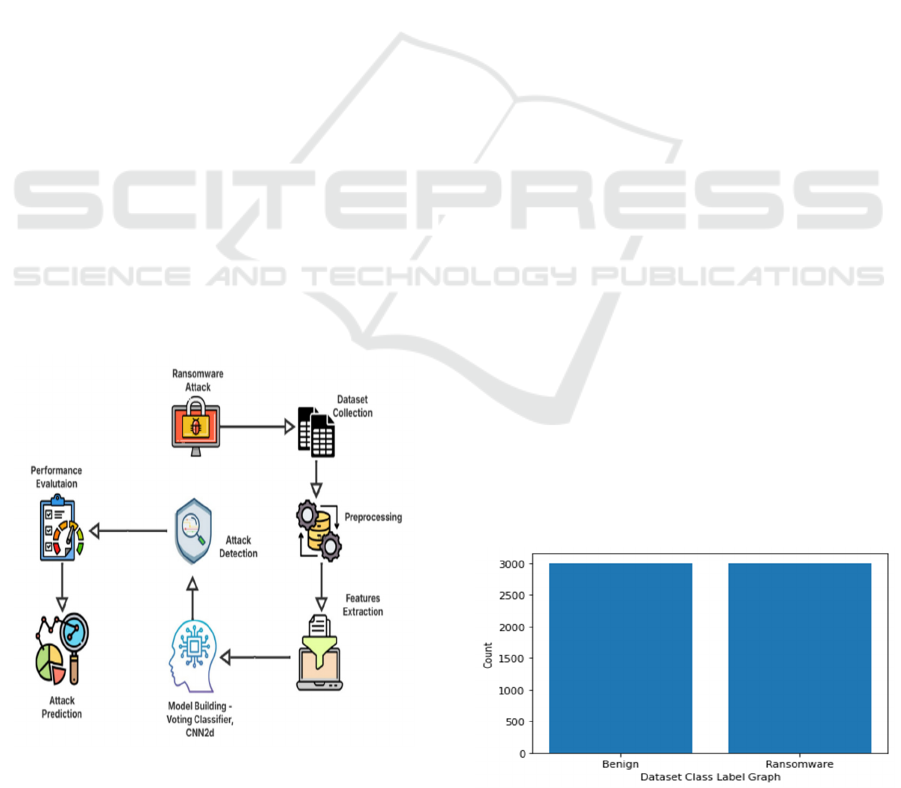
Figure 1: Architecture diagram.
The major benefits of this system are early
ransomware detection, which avoids data encryption
and system lockout, and protection of electronic
health records (EHRs), medical imaging files, and
other sensitive healthcare information from
ransomware attacks. Figure 1 shows the
Architecture
Diagram.
6 MODEL TRAINING AND
EVALUATION
6.1 Data Collection
The information is derived from Harvard Dataverse,
an open data repository.
The chosen HPC and I/O dataset is system-level
behaviour change that happens when a system is
under ransomware infection. The dataset has 6,000
samples with high-volume capture of major hardware
performance counters (HPCs) and disk I/O values.
The dataset has features such as instructions retired,
cache misses, branch load misses, disk read/write
requests, and flush operations, which provide insights
on how ransomware modifies system behaviour.
Using a heatmap, we analyse the correlation of
attributes and discover key parameters that diverge
greatly in the presence of ransomware.
6.2 Feature Selection
Important system metrics such as instructions
executed, cache misses, disk read/write requests, and
flush operations are extracted to analyse ransomware
impact.
6.3 Data Preprocessing
The dataset is cleaned and normalized to remove
missing values and scale numerical features for better
model performance.
Figure 2: Dataset class label graph.
ICRDICCT‘25 2025 - INTERNATIONAL CONFERENCE ON RESEARCH AND DEVELOPMENT IN INFORMATION,
COMMUNICATION, AND COMPUTING TECHNOLOGIES
190
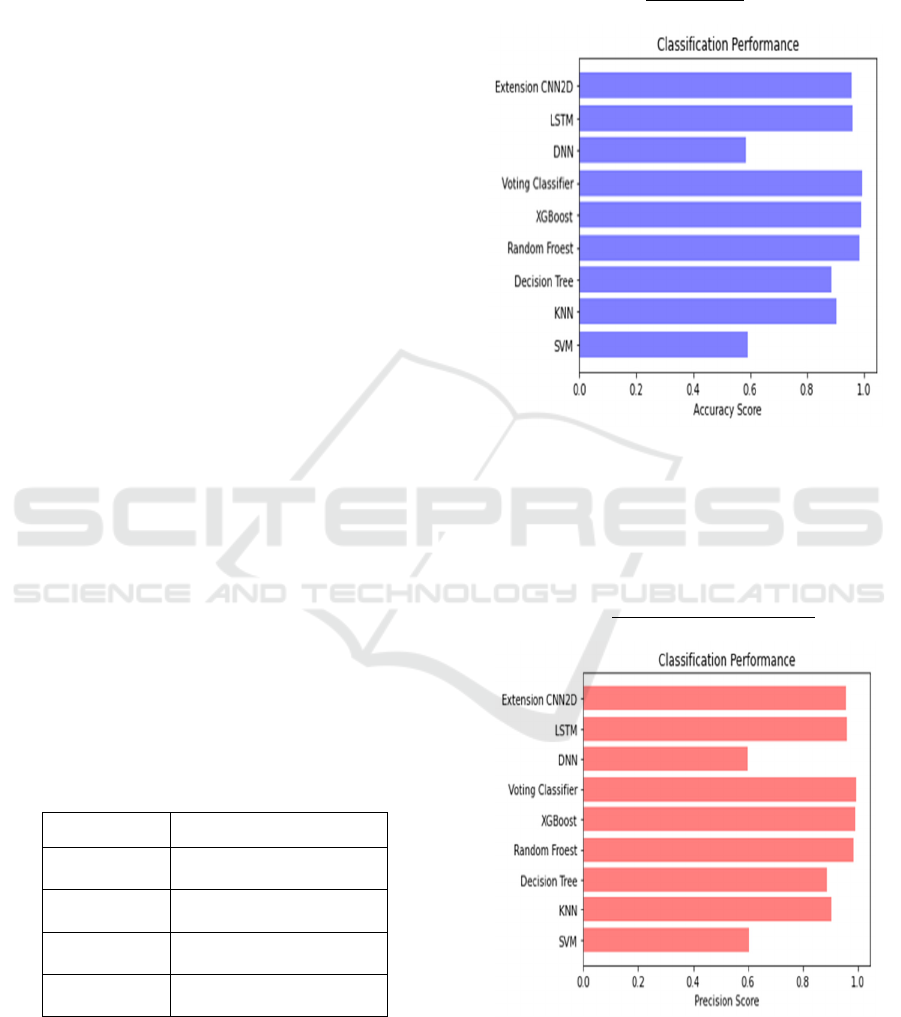
The above Figure 2 presents a summary of observed
system behaviour changes, highlighting significant
alterations in processor activity and disk operations
when a ransomware attack occurs. This dataset forms
the foundation for training our machine learning-
based ransomware detection model, ensuring high
accuracy and real-world applicability in securing
critical systems.
In the dataset, the 'label' column represents the
target or dependent variable, where:
0 → Indicates legitimate (benign)
samples
1 → Indicates ransomware-infected
samples
6.4 Data Splitting
The dataset is divided into 80% training and 20%
testing data, ensuring a balanced model evaluation.
● Training Size (80%): 4800
● Testing Size (20%): 1200
6.5 Model Training
Machine Learning Models (XG Boost, Random
Forest, SVM, KNN, Decision Trees) and Deep
Learning Models (CNN, LSTM, DNN) are trained
using Scikit-learn and TensorFlow/Keras libraries.
The Voting Classifier integrates predictions from
various algorithms here we integrated AdaBoost and
Random Forest. This ensemble approach improves
the ransomware detection system's robustness and
accuracy by considering diverse perspectives from
different models.
7 MODEL EVALUATION
Table 1: Possible classification outcomes.
Classification Description
True Positive
(TP)
Test passes on benign file
True Negative
(
TN
)
Test fails on ransomware
file
False Positive
(
FP
)
Test passes on
ransomware file
False
Negative (FN)
Test fails on benign file
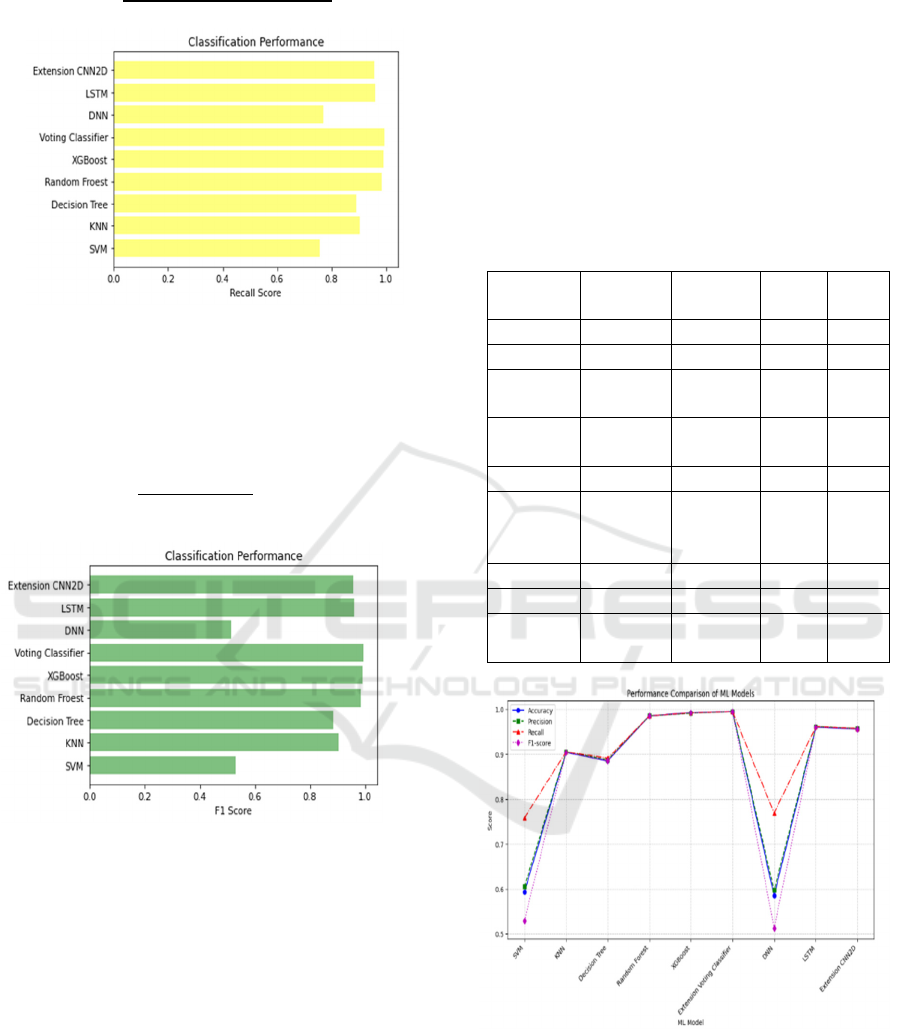
Performance is evaluated using Accuracy, Precision,
Recall, and F1-score to determine how well the
models detect ransomware. Table 1 show Possible
classification outcomes.
Accuracy: Accuracy is defined as the ratio of
correctly classified instances to the total number of
instances. Figure 3 illustrate Accuracy Graph.
𝐴𝑐𝑐𝑢𝑟𝑎𝑐𝑦
(1)
Figure 3: Accuracy graph.
Precision: Mathematically, Precision is defined as
the ratio of true positives to the sum of true positives
and false positives (FP). Figure 4 illustrate Precision
Graph.
𝑃𝑟𝑒𝑐𝑖𝑠𝑖𝑜𝑛
(2)
Figure 4: Precision graph.
Recall: Mathematically, recall is defined as the ratio
of true positives (TP) to the sum of true positives and
false negatives (FN). Figure 5 illustrate Recall Graph.
Ransomware Detection in Healthcare: Enhancing Cybersecurity with Processor and Disk Usage Data
191
𝑅𝑒𝑐𝑎𝑙𝑙
(3)
Figure 5: Recall graph.
F1 Score: F1 score is the harmonic mean of precision
and recall, and provides a single metric that balances
both measures. Figure 6 illustrate F1 Score Graph.
𝐹1 2 ∗
∗
(4)
Figure 6: F1 score graph.
8 RESULT
The performance of different machine learning and
deep learning models was tested on accuracy,
precision, recall, and F1-score. Table 2 shows
Possible classification outcomes. The results show
that Voting Classifier and XG Boost performed better
than all others in accuracy, followed by Random
Forest and CNN.
● Voting Classifier was the top one, with an
accuracy rate of 99.5%, and the most
consistent method of detecting ransomware.
● Random Forest and XG Boost also did not
disappoint, posting 99.2% and 98.5%
respectively.
● CNN and LSTM performed very well, with
CNN attaining 95.6% accuracy and LSTM
96.0%, which indicates their performance in
pattern recognition.
● SVM and DNN were the worst on accuracy,
which suggests that they may not be the best
to use for classifying ransomware.
Table 2: Possible classification outcomes.
ML
Model
Accuracy Precision Recall F1-
score
SVM 0.593 0.605 0.758 0.529
KNN 0.904 0.905 0.905 0.905
Decision
Tree
0.885 0.887 0.891 0.885
Random
Forest
0.985 0.985 0.985 0.985
XGBoost 0.992 0.991 0.992 0.992
Extension
Voting
Classifier
0.995 0.995 0.995 0.995
DNN 0.585 0.587 0.513 0.513
LSTM 0.96 0.961 0.961 0.961
Extension
CNN2D
0.956 0.957 0.957 0.956
Figure 7: Comparison graph.
9 CONCLUSIONS
Ransomware poses a serious risk to healthcare
settings. It can throw a wrench in operations, put
ICRDICCT‘25 2025 - INTERNATIONAL CONFERENCE ON RESEARCH AND DEVELOPMENT IN INFORMATION,
COMMUNICATION, AND COMPUTING TECHNOLOGIES
192

patient data at risk, and jeopardize vital medical
services. Unfortunately, traditional detection methods
frequently struggle to keep up with the fast-paced
changes in ransomware tactics, leaving systems open
to further attacks. This study seeks to enhance
healthcare security through the proposal of a machine
learning method for ransomware detection via
tracking processor and disk I/O behaviour. Our
Random Forest and XG Boost classifier model were
highly accurate at low system performance cost while
providing real-time protection without interrupting
hospital-critical functions. Our findings indicate that
hardware-based monitoring is an efficient and
effective way to detect the presence of ransomware.
The proposed solution was evaluated against various
ransomware variants and varied hospital workloads,
indicating its flexibility and reliability. Looking
ahead, the combination of deep learning models and
adversarial machine learning methods would
continue to enhance ransomware detection through
enhanced resilience against sophisticated attacks. In
addition, growing dataset heterogeneity and
incorporating real-time dynamic analysis will further
improve performance. With the use of proactive, AI-
driven cybersecurity technologies, healthcare
organizations can significantly reduce the risk of
ransomware attacks, ensuring the security, integrity,
and availability of critical patient data and medical
systems.
10 FUTURE SCOPE
Our detection features could be improved, even
though our proposed approach is yielding some
genuinely encouraging results. To improve our
feature extraction and pattern recognition skills and
stay ahead of the consistently changing threat of new
ransomware types, we might think about deploying
deep learning algorithms like LSTM and CNNs. Plus,
incorporating real-time threat intelligence and cloud-
based monitoring could speed up our response times,
reducing the potential damage from attacks. As we
move forward, it’ll be essential to diversify our
datasets and bring in adversarial machine learning
techniques to make our detection models tougher
against clever evasion tactics. Future research might
also delve into using blockchain-based security
frameworks to add an extra layer of data integrity and
protection. By embracing AI-driven cybersecurity
solutions, healthcare institutions can take proactive
steps to fend off ransomware threats, ensuring that
medical services run smoothly, protecting patient
data, and bolstering overall system security.
REFERENCES
A. Vehabovic, N. Ghani, E. Bou-Harb, J. Crichigno, and A.
Yayimli, “Ransomware detection and classification
strategies,” 2023.
B. Marais, T. Quertier, and S. Morucci, “Ai-based malware
and ransomware detection models,” 2022.
Ferdous, J., Islam, R., Mahboubi, A., & Islam, M. Z.
(2024). “AI-Based Ransomware Detection: A
Comprehensive Review.” IEEE Access, Digital Object
Identifier: 10.1109/ACCESS.2024.3461965. Received:
12 August 2024, Accepted: 11 September 2024,
Published: 16 September 2024, Current Version: 30
September 2024
Ispahany, J., Islam, M. R., Islam, M. Z., & Khan, M. A.
(2024). “Ransomware Detection Using Machine
Learning: A Review, Research Limitations, and Future
Directions.” IEEE Access, Digital Object Identifier:
10.1109/ACCESS.2024.3397921. Received: 11
February 2024, Accepted: 3 May 2024, Published: 7
May 2024, Current Version: 22 May 2024.
Jayanthi, M., Prakash, S. G., Ajay, A. J., & Vijayakumar,
K. (2023). "Detection and Decryption of Ransomware."
Proceedings of the Second International Conference on
Applied Artificial Intelligence and Computing
(ICAAIC 2023), IEEE Xplore, Part Number:
CFP23BC3-ART, ISBN: 978-1-6654-5630-2.
K. Lee, J. Lee, S. Lee, and K. Yim, “Effective ransomware
detection using entropy estimation of files for cloud
services,” Sensors, vol. 23, p. 3023, 03 2023.
Kunku, K., Zaman, A., & Roy, K. (2023). “Ransomware
Detection and Classification using Machine Learning.”
Department of Physics & Computer Science, Wilfrid
Laurier University, Waterloo, ON, Canada; Department
of Computer Science, North Carolina A&T State
University, Greensboro, NC, USA.
M. Masum, M. J. H. Faruk, H. Shahriar, K. Qian, D. Lo,
and M. I. Adnan, “Ransomware classification and
detection with machine learning algorithms,” in 2022
IEEE 12th Annual Computing and Communication
Workshop and Conference (CCWC). IEEE, Jan 2022.
R. A. Mowri, M. Siddula, and K. Roy, “Application of
explainable machine learning in detecting and
classifying ransomware families based on api call
analysis,” 2022.
S. Razaulla, C. Fachkha, C. Markarian, A. Gawanmeh, W.
Mansoor, B. C. M. Fung, and C. Assi, “The age of
ransomware: A survey on the evolution, taxonomy, and
research directions,” IEEE Access, vol. 11, pp. 40 698–
40 723, 2023.
Usha, G., Madhavan, P., Cruz, M. V., Vinoth, N. A. S.,
Veena, & Nancy, M. (2023). “Enhanced Ransomware
Detection Techniques using Machine Learning
Algorithms.” Department of Computing Technology,
SRM Institute of Science and Technology (SRM IST),
Kattankulathur, India.
Ransomware Detection in Healthcare: Enhancing Cybersecurity with Processor and Disk Usage Data
193
