
Detection and Prediction of Primary Productivity in Coastal
Environment Using Ensemble Models
R. Sivaranjini
1
and Sharanya S
2
1
Department of Computer Science & Engineering, SRM Institute of Science & Technology, Kattankulathur, Chennai, Tamil
Nadu, India
2
Department of Data Science and Business Administration, SRM Institute of Science & Technology, Kattankulathur,
Chennai, Tamil Nadu, India
Keywords: Algae Bloom, CNN, HCNN, LSTM, Convolutional LSTM, Autoencoders.
Abstract: Prediction on marine productivity in the ecosystem is a challenging task nowadays. Fault prediction in
marine ecosystem occurs due to the climate change, waste water infusion in the marine environment which
leads to the harmful primary production in the marine ecosystem. In traditional method it was a struggle to
focus on the complexity and the changes in the variation metrices. To overcome those complexity deep
learning acts as a powerful tool to predict modelling methods in various domains. Deep learning algorithm
mainly has an ability to differentiate patterns from huge dataset. This study empirically analyses the
effectiveness of various deep learning algorithm used to analyse prediction in primary productivity mainly
focusing on algae bloom. General key performance metrices like accuracy, recall, precision and F1 score are
analysed. The algorithms like Convolutional Neural Network (CNN) and Hybrid Convolutional Neural
Network (HCNN) are the superior models in predicting accuracy when compared to traditional methods.
Overall, this study focuses on the use of various deep learning algorithm which can be implemented to
analyse the algae bloom in marine ecosystem. This concept will be helpful for the readers focusing on Algae
Bloom.
1 INTRODUCTION
Primary productivity is the rate at which
photosynthetic organisms such as plants and algae
convert energy into organic molecules through the
photosynthesis process. Using sunlight, this process
transforms carbon dioxide and water into glucose
and creates oxygen. The generated organic
substances supply nutrition to rest of the ecosystems.
1.1 Environmental Value of Main
Productivity
In marine ecosystems, primary production
constitutes the base of the food chain. Where the
Producers or autotrophic organisms changes the
solar energy into chemical form which is later
passed on to herbivores and predators within the
ecosystem.
During Photosynthesis Primary producers
combines nutrients like carbon, nitrogen, and
phosphorus into their tissues. These nutrients are
returned into the environment when these nutrients
are consumed and broken down by other species or
by natural processes, hence encouraging nutrient
cycling in ecosystems.
Production of Oxygen: The major function of
photosynthesis is oxygen creation. Most living
organisms depends on atmospheric oxygen levels,
which plants and algae considerably contribute in
releasing oxygen as a byproduct while they make
glucose for their energy level.
Carbon dioxide from the atmosphere is taken by
the Primary producers during photosynthesis, hence
changes occurs in the global carbon cycle. This
absorption influences atmospheric carbon dioxide
levels, consequently impacting the Earth's
temperature and global climate patterns.
Main production is also incredibly vital for
human civilizations since it produces food, fiber,
fuel, and pharmaceuticals among other requirements.
Direct or indirectly dependant on productive
ecosystems include fishing, agriculture, forestry, and
ecotourism.
Sivaranjini, R. and S., S.
Detection and Prediction of Primary Productivity in Coastal Environment Using Ensemble Models.
DOI: 10.5220/0013909000004919
Paper published under CC license (CC BY-NC-ND 4.0)
In Proceedings of the 1st International Conference on Research and Development in Information, Communication, and Computing Technologies (ICRDICCT‘25 2025) - Volume 4, pages
115-124
ISBN: 978-989-758-777-1
Proceedings Copyright © 2026 by SCITEPRESS – Science and Technology Publications, Lda.
115
1.2 Field dimensions
Direct monitoring of oxygen production by primary
producers (e.g., aquatic plants, phytoplankton)
employing techniques including light and dark bottle
tests. This requires monitoring fluctuations in
dissolved oxygen concentrations in under control
situations.
Direct monitoring of biomass building and
growth rates of key producers are done across time.
This generally requires measuring biomass using
growth chambers or harvesting and weighing plant
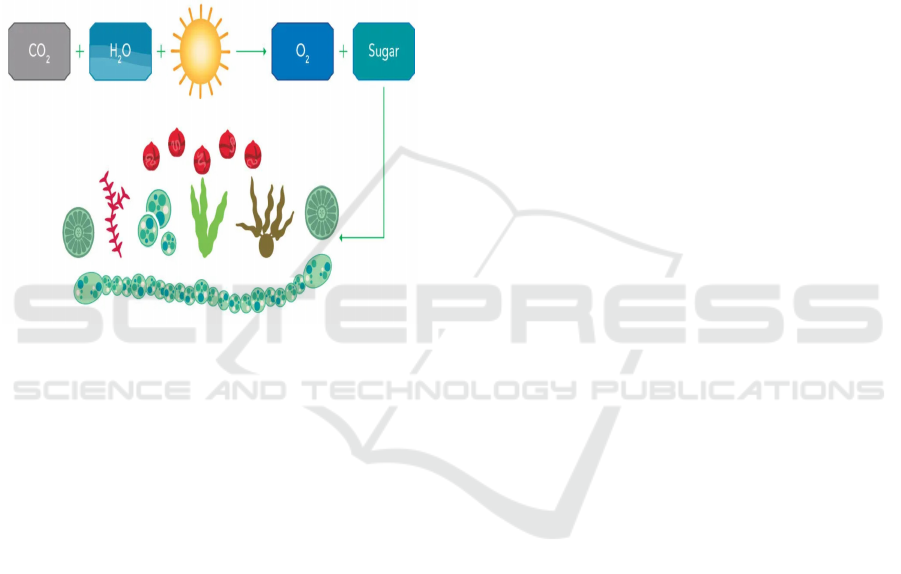
materials. The figure 1 shows Algal Bloom process.
Figure 1: Algal Bloom process.
2 RELATED SURVEYS
This survey focusses on the application and
methodologies that were implemented by various
researchers in marine environment.
Deep learning for marine species recognition was
proposed by Lian Xu et al focus on deep learning
techniques that are used to identify automatically the
species in marine environment. The author
implements CNN to overcome the challenges that
are faced by the traditional methods. With the help
of CNN, the author analysed underwear imagery and
acoustic data. With this analysis he classified the
data according to their characteristics.
Deep learning and transfer learning features for
plankton classification, Alessandra Lumni et al uses
deep learning techniques to differentiate plankton.
Author uses transfer learning, pre-tuning and fine-
tuning models o train the model. Ensemble model is
proposed by the author to improve the performance.
CNN method is implemented for identification of
plankton.
Defining a procedure for integrating multiple
oceanographic variables in ensemble models of
marine species distribution, D. Panzeri et al focus
five different modelling approaches. For each
approach different spatial data and test data set is
used to enhance performance. Depth, spatiotemporal
variables are used as input for simple model and
Oceanographic variables are used for complex
model. The author focusses on space and time on
European lake.
Species distribution modelling for machine
learning practitioners, Sara Beery et al here in his
work the author implemented SDM Species
Distribution Modelling to focus where the huge
number species were found in the marine ecosystem.
This modelling used to predict the spatial and
temporal patterns of species.
There are lot of work are done in the filed of
marine environment focusing on Algal Bloom and
however there are lot of limitations too.
2.1 Preprocessing and Data Gathering
2.1.1 Data Gathering
There are several sources from which primary
productivity data can be measured and monitored.
Some of the common sources are listed for obtaining
primary productivity data.
2.1.2 Satellite Imagery
Measuring vegetation indicators like Normalized
Difference Vegetation Index (NDVI) and Enhanced
Vegetation Index (EVI) are done with the help of
Moderate Resolution Imaging Spectroradiometer
(MODIS) which provides global coverage.
NDVI = (NIR — VIS)/ (NIR + VIS)
[13]
EVI = G * ((NIR - R) / (NIR + C1 * R – C2 * B
+ L))
[14]
Another method is Landsat which gives higher
spatial resolution than MODIS, suitable for complete
land cover and vegetation dynamic monitoring.
2.1.3 Satellites in Ocean Colour
Measuring ocean colour to estimate concentration of
chlorophyll-a is monitored using Sea-Viewing Wide
Field-of- View Sensor (SeaWiFS). Hence
phytoplankton biomass and marine algal bloom can
be measured. The figure 2 shows Satellite image by
SeaWiFs for Algal detection
.
ICRDICCT‘25 2025 - INTERNATIONAL CONFERENCE ON RESEARCH AND DEVELOPMENT IN INFORMATION,
COMMUNICATION, AND COMPUTING TECHNOLOGIES
116

Figure 2: Satellite image by SeaWiFs for Algal detection.
2.1.4 Field Measurements
Chamber-based methods allow to analyse
photosynthesis rates of plants or algae. Often
employing gas exchange measurements to estimate
carbon dioxide absorption and oxygen production,
Gathering plant or algal samples to measure biomass
growth over time is the biomass harvesting method.
Tracks carbon absorption and integration into
organic matter using isotopically labelled carbon
dioxide (e.g., ^14C).
2.1.5 Environmental and Climate Data
Recording information on temperature, precipitation,
solar radiation, and other environmental conditions
impacting major production are analysed with the
help of meteorological stations.
Soil Measurements is used to identify the soil
characteristics including nutrient content, pH, and
moisture levels that impact plant growth and
production effects. The figure 3 shows
Environmental and climate change image.
Figure 3: Environmental and climate change image.
2.2 Remote Sensing Products and
Database
To access a wide range of satellite data products,
including MODIS, Landsat, and other remote
sensing datasets NASA Earth Observing System
Data and Information System (EOSDIS) provides
large dataset in real time.
European Space Agency (ESA) Earth
Observation Data offer satellite data for monitoring
land and ocean conditions essential to primary
production.
2.2.1 Data Preprocessing
Getting major productivity data available for deep
learning models relies crucially on data preparation.
Typical cleaning, preprocessing, and data
preparation techniques are discussed.
2.2.2 Data Cleansing
Managing Missing Values: Find and fix missing data
points. Strategies like imputation using mean,
median, or mode or deletion of incomplete records
may be utilized dependent on the dataset and nature
of missing information.
Look for outliers that might alter the data
distribution or impair model performance. Statistical
tools (e.g., z-score) or domain-specific knowledge
may assist one to locate outliers.
To boost model training convergence,
normalization /standardization is used to size
numerical features to a similar range. Common
strategies include standardizing (scaling to zero
mean and unit variance) or min-max scaling (scaling
to [0, 1].
2.2.3 Data Translation
Feature engineering extract new features from
present ones maybe enhancing model performance.
Regarding major productivity, this can involve
aggregating meteorological variables (e.g., monthly
averages) or calculating vegetation indices from
satellite data (e.g., NDVI, EVI).
To minimize noise and capture long-term trends,
temporal aggregation is used to aggregate daily
measurements which converts into meaningful
intervals either monthly or seasonal averages.
Using interpolation methods e.g., bilinear
interpolation aligns spatial resolutions of various
datasets (e.g., satellite pictures, climate data) to a
same grid or resolution.
Detection and Prediction of Primary Productivity in Coastal Environment Using Ensemble Models
117

2.2.4 Information Integration
Integrate various datasets e.g., satellite photos,
temperature data, ground measurements into a
cohesive dataset appropriate for deep learning
models. Throughout merging, maintain uniformity in
timestamps, geographical locations, and data
formats.
While lowering dimensionality and
computational complexity, pick important qualities
that most assist to forecast major production. Feature
selection may benefit from approaches including
feature significance from machine learning models
or correlation analysis from statistical models.
2.2.5 Split Data
Creates various set of data for training, validation,
and testing from the given dataset. The deep learning
model is trained using the training set; the validation
set sets hyperparameters and records model
performance; the test set analyses the final model
performance on unprocessed data.
For time-dependent data that instance, seasonal
swings in primary productivity ensure that training
and testing datasets are split in a method that
respects temporal dependencies and mimics real-
world deployment conditions.
2.2.6 Getting Model Training Input Data
Transpose data into representations suited for deep
learning models (like tensors for neural networks).
Make that input features suit the specified deep
learning framework (e.g., TensorFlow, PyTorch) and
are correctly ordered.
Considering hardware restrictions (e.g., GPU
RAM), partition the training data into batches to
facilitate efficient model training and optimization.
Following these preprocessing strategies enables
to ensure correct cleaning, transformation, and
integration of essential productivity data for training
deep learning models. Appropriately produced data
boosts the generalizability, accuracy, and reliability
of models used to predict primary output in
ecosystems.
3 FEATURE REVIEW
When anticipating primary production, feature
engineering is particularly crucial in increasing the
performance of deep learning models. Several other
variables or qualities acquired from the data can
potentially boost model performance.
3.1 Vegetational Indices
Calculated using satellite photographs to assess
green vegetation, Normalized Difference Vegetation
Index are sensitive to differences in canopy structure
and chlorophyll content, NDVI is a robust indication
of photosynthetic activity and primary production.
Designed to limit atmospheric influences and soil
background changes, Enhanced Vegetation Index
(EVI) like NDVI but delivers a more accurate
assessment of vegetation density.
3.2 Variables of Climate and Weather
Over various periods e.g., the growth season
average, maximum, or lowest temperatures impact
photosynthetic rates and plant development.
Rainfall frequency and quantity affects soil
moisture levels and nutrient availability,
consequently influencing plant yield.
Incoming light energy effects photosynthetic rate
as well as overall plant growth.
3.3 Land Surface Features
Using satellite data or land use maps enables one to
identify land cover types (e.g., woodlands,
grasslands, croplands) in respect to key productivity
variations.
Terrain characteristics like height, slope, and
aspect effect microclimatic conditions and water
availability, consequently impacting plant growth.
3.4 Attributes of Soil
Soil Moisture- The quantity of moisture in the soil
impacts plant water stress and nutrient absorption,
consequently impacting major production.
Plant growth and biomass building are regulated
by differences in nitrogen, phosphorus, potassium,
and other important nutrients.
3.5 Phenological Measurements
The length of the growth season is, the duration of
favourable conditions for plant development affects
output patterns.
Satellite data enables one to calculate time of leaf
emergence and senescence, hence revealing seasonal
variations in vegetation activity.
ICRDICCT‘25 2025 - INTERNATIONAL CONFERENCE ON RESEARCH AND DEVELOPMENT IN INFORMATION,
COMMUNICATION, AND COMPUTING TECHNOLOGIES
118
3.6 Metrics Derived from Satellite Data
Patterns and variability in vegetation indicators
across time for example, seasonal patterns,
anomalies to capture changes in primary output.
Spatial heterogeneity in vegetation indices or
climatic factors allows comprehension of landscape-
scale processes and ecosystem productivity
gradients.
4 DEEP LEARNING
ALGORITHMS
Several aspects including data type (e.g., satellite
imagery, time series data), computational resources,
and unique research purposes impact the choice of
deep learning architectures for assessing key
productivity. These are several common deep
learning architectures that might fit.
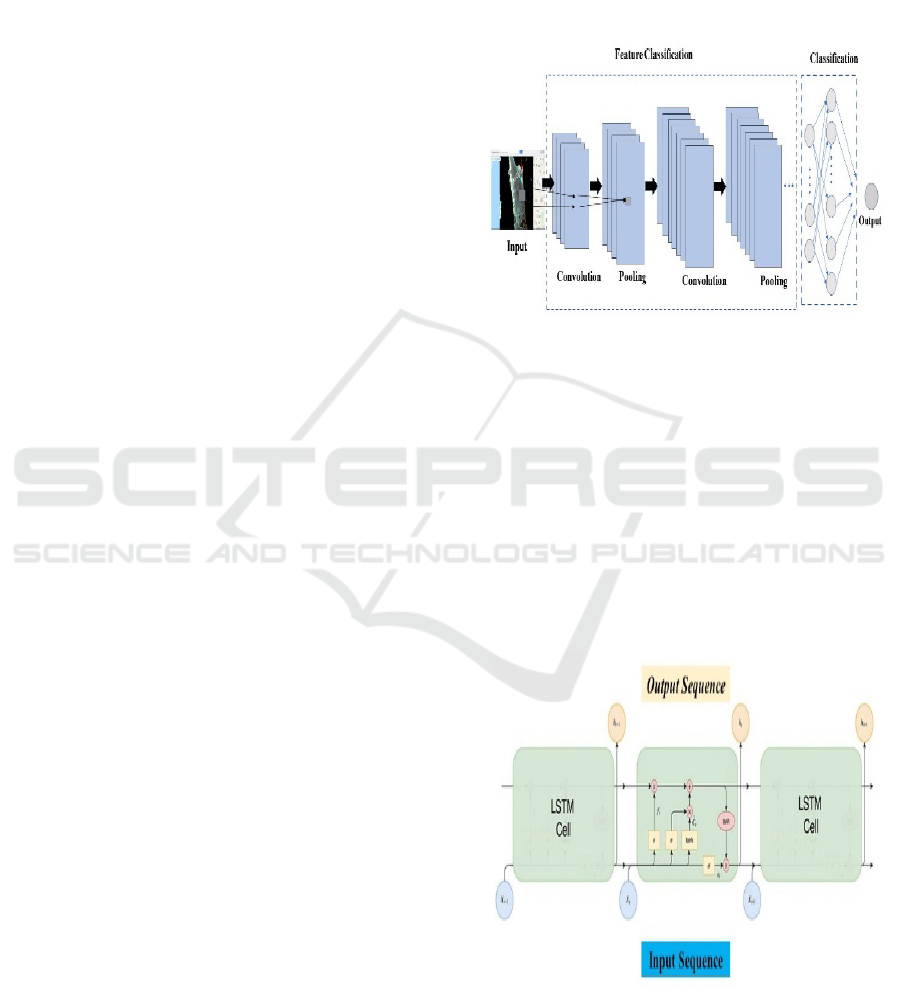
4.1 Convolutional Neural Networks
(CNN)
CNNs are ideal for analysing spatial data like land
cover maps or satellite photos. Usually containing
convolutional layers for feature extraction, pooling
layers for spatial down sampling, and fully
connected layers for classification or regression,
architecture. Effective capture of spatial
dependencies and patterns makes one robust to
spatial transformations and fluctuations.
Accepts input data usually satellite pictures or
other spatial data shown as multi-channel tensors
(e.g., RGB channels for imaging). Convolutional
layers enable you capture spatial patterns by means
of feature extraction utilizing convolutional filters.
Every layer employs a set of filters then activates
using functions. ReLU (Rectified Linear Unit) is
commonly employed because of its efficiency and
aptitude to handle sparse gradients. Down sample
feature maps to smaller spatial dimensions while still
keeping considerable information using pooling
layers. For usage in fully connected layers, flattening
layer turns 2D feature maps into a 1D vector.
Fully Connected (Dense) Layers: Handle the
flattened features for either classification or
regression operations. Usually employing a softmax
activation for classification or a linear activation for
regression, Layer creates predictions.
Randomly marks a fraction of input units to zero
during training to avoid overfitting and increase
generalization. The figure 4 shows convolutional
Neural Network.
Normalizing input data throughout the mini-
batch, batch normalisation stabilises and speeds up
the training process. Penalizes large weights to
prevent overfitting and model complexity.
Figure 4: Convolutional Neural Network.
4.2 Long Short-Term Memory (LSTM)
Appropriate for time series data includes primary
production temporal patterns, phenological metrics,
or climatic influences. RNNs and LSTMs handle
sequential input by way of recurrent connections,
hence capturing temporal relationships and patterns
across time. Suitable for prediction and anomaly
detection in time series data, advantages include
managing variable-length sequences and keeping
remembrance of earlier inputs.
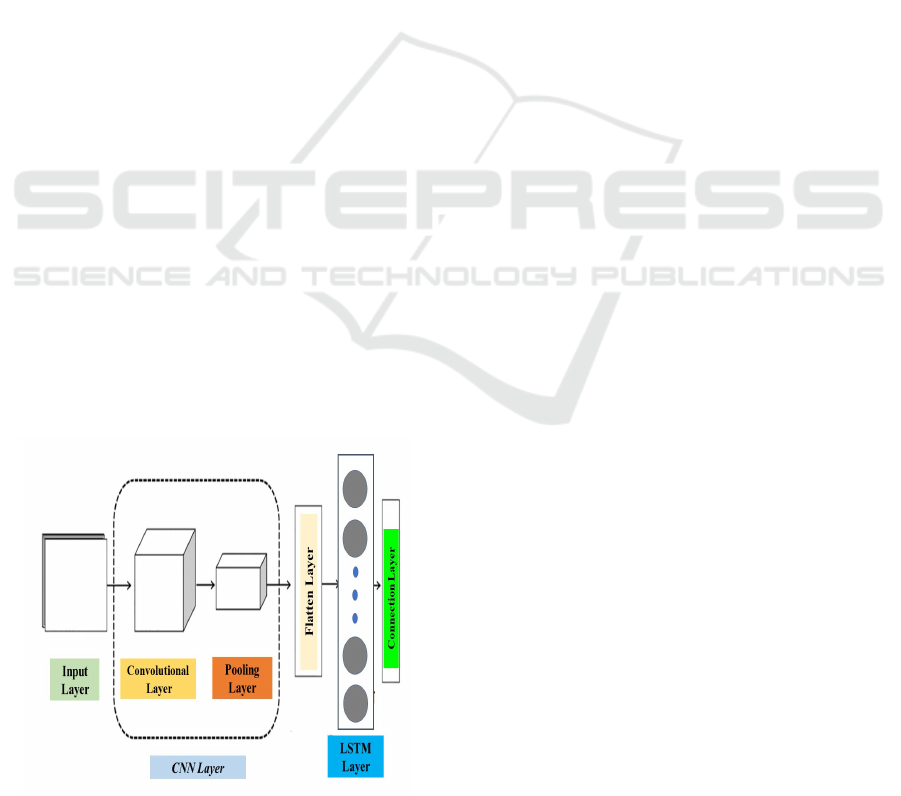
Figure 5: LSTM.
Accepts sequential data containing temporal
trends in key productivity or climatic variable time
Detection and Prediction of Primary Productivity in Coastal Environment Using Ensemble Models
119
series. Process sequential input data in LSTM (or
RNN) Layers retaining a memory state to capture
temporal dependencies. Often utilized tanh or
sigmoid activations inside LSTM cells to modulate
information flow. Based on the studied sequence
data it generates predictions.
Applied to LSTM (figure 5) cell input and
recurrent connections, Dropout helps to decrease
overfitting and boost model generalization. L2
Regularization: Possibly employed to penalize
network's large weights.
4.3 Convolutional-LSTM
Ideal for spatiotemporal data analysis, application
blends spatial and temporal linkages. Combining
CNNs with LSTM cells lets the model learn spatial
patterns via convolutional operations and temporal
dynamics via recurrent connections. Effective for
evaluating key production trends considering both
geographical and temporal interactions, it also aids
satellite-derived data with both spatial and temporal
dimensions.
Like in a normal CNN, convolutional layers
extract spatial information from incoming data.
Replace standard pooling layers with LSTM cells to
incorporate temporal dependencies and enable the
model continuously record spatial and temporal
trends. ReLU for convolutional layers and tanh or
sigmoid within LSTM cells comprise activation
function. Based on the unique building design,
optional pooling layers.
Applied for regularity both convolutional and
LSTM layers is Dropout. During training, batch
normalisation enhances stability and convergence
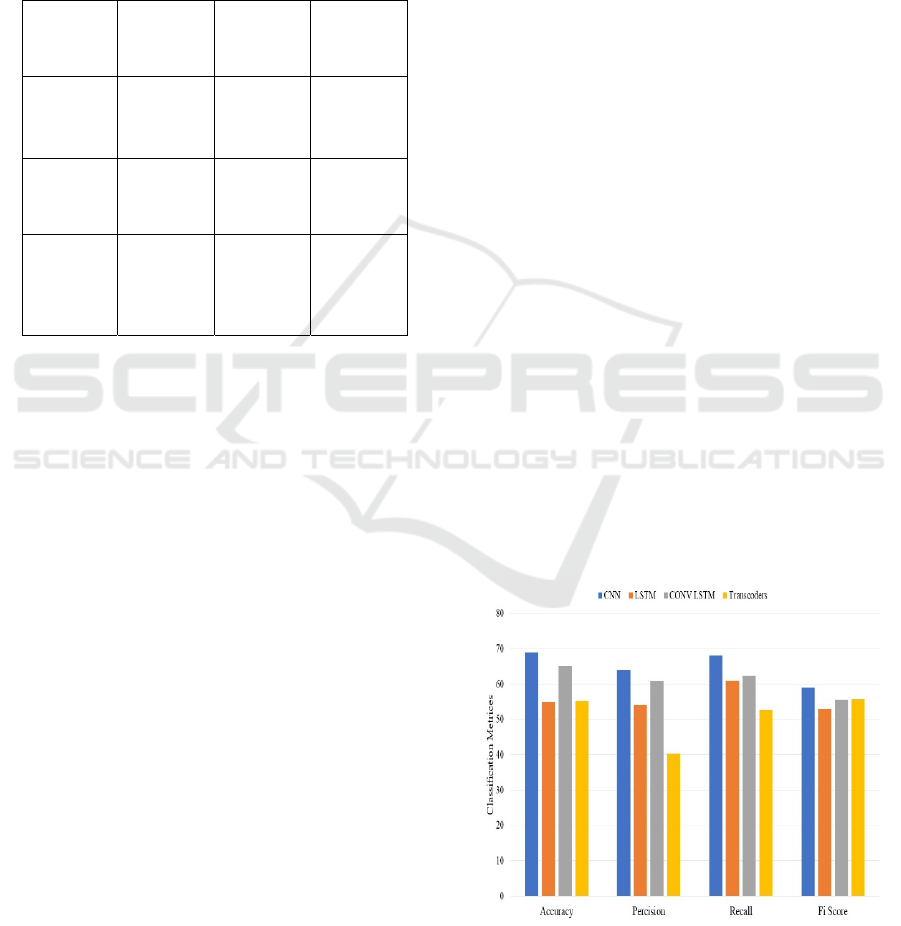
speed. The figure 6 shows Convolutional- LSTM
Architecture.
Figure 6: Convolutional- LSTM Architecture.
4.4 Architectures Based on
Transformers
Recently updated for sequential data with intricate
relationships, such satellite time series or
meteorological data, such application. Transformer
models like the well-known BERT (Bidirectional
Encoder Representations from Transformers) use
self-attention approaches to discover global
dependencies and links in input sequences. Scalable
to enormous datasets, able to capture long-range
associations, and efficient in operations employing
context knowledge and pattern identification in time
series data. Useful for analysing intricate time series
or satellite data, attention mechanism employs self-
attention layers to represent global dependency
across input sequences. Comprising multiple layers
of multi-head attention and feedforward neural
networks, Transformer Blocks aid to allow data
context and relationship learning. Usually
incorporates ReLU in feedforward networks and, if
necessary, softmax for classification duties. Applied
to feedforward networks and attention layers,
dropout helps to prevent overfitting. Applied
separately across the features of every sample, Layer
Normalisation is analogous to batch normalisation.
5 TRAINING PROCESS FOR
PARAMETER VALIDATION
Setting up the training process, modifying
hyperparameters, and assessing model performance
encompass three essential stages in constructing
deep learning models for analysis of primary
production. Here is a broad overview of how this
training technique normally proceeds.
5.1 Data Preparation
Create training, validation, and test sets out from the
dataset. The model is trained using the training set;
hyperparameter tweaking and performance
monitoring during training are conducted using the
validation set; the test set analyzes the performance
of the final model on unprocessed data. Apply
adjustments including rotation, scaling, or flipping
to offer additional training data by decreasing
overfitting and hence boosting model generalization.
ICRDICCT‘25 2025 - INTERNATIONAL CONFERENCE ON RESEARCH AND DEVELOPMENT IN INFORMATION,
COMMUNICATION, AND COMPUTING TECHNOLOGIES
120

5.2 Model Choosing
Based on the sort of the primary production data
either spatial, temporal, or spatiotemporal. select an
appropriate deep learning architecture (such as
CNN, LSTM, ConvLSTM, Transformer).
5.3 Hyperparameter for Learning Rate
Change the model's weight update rate during
training. While too low could result from delayed
convergence, too high might generate instability.
Find out the sample count handled prior to
weight update for the model. Though they may
demand more memory, greater batch sizes may
boost computer efficiency.
Specify the total number of times the full dataset
is passed through the model during training.
Choose an optimizer (such as Adam, SGD) that
updates the weights of the model based on the loss
function's gradient.
To stop overfitting, alter dropout rates, L2
regularization strength, or batch normalizing
parameters.
5.4 Training Models
Table 1: Sample Water Quality Parameters.
Water Quality
Parameters
Summer 2024
Jan Feb Mar Apr
Salinity
Min
Max
30
33
29
31
30
31
30
36
Temperature
Min
Max
30
31
29
32
31
36
32
35
pH
Min
Max
6
8
7.2
8.3
7.5
8.1
7.8
8.5
Dissolved Oxygen
Min
Max
3.1
3.6
2.6
3.5
2.8
4.2
2.5
3.4
Nitrite
Min
Max
0.172
0.394
0.13
0.36
0.546
0.881
0.526
0.914
Nitrate
Min
Max
0.89
1.1
0.80
1.11
1.12
1.9
2.18
1.76
Phosphate
Min
Max
0.31
0.61
0.39
0.58
0.74
1.1
0.52
1.18
Silicate
Min
Max
6.6
25.5
10.6
20.8
23.7
75.4
23.6
79.53
Feed batches of training data into the model then
execute predictions.
Using a suitable loss function for e.g., mean
squared error for regression, categorical cross-
entropy for classification to calculate the loss (error)
between anticipated outputs and actual objectives.
The table 1 shows Sample Water Quality
Parameters.
Using automated differentiation, construct
gradients of the loss with relation to model
parameters Backward Pass (Backpropagation).
Update model weights using the specified optimizer
to decrease the loss function is called gradient
descent.
In the assessment of water nutrients, water
samples were collected on a monthly basis. Samples
of water were taken from the near channels and
examined for nutrient levels that include nitrite,
nitrate, phosphate and silicate.
5.5 Proof
Periodically check the model on the validation set
during training to monitor performance parameters
(e.g., accuracy, RMSE) and detect overfitting.
Stop training if, after a defined period of epochs,
performance on the validation set does not rise to
prevent overfitting.
6 RESULTS AND DISCUSSIONS
Depending on the individual task the classification,
regression, or time series forecasting is done with
the help of certain metrices. Variety of evaluation
criteria may be employed to measure the
Detection and Prediction of Primary Productivity in Coastal Environment Using Ensemble Models
121
effectiveness of deep learning models for assessing
primary production. These are some significant
evaluation criteria widely used in numerous
contexts.
6.1 Classification Measurements
6.1.1 Confusion Matrix
Table 2: Correct and Inaccurate Predictions.
Predicted
Algae A
Predicted
Algae B
Predicted
Algae C
Actual
Algae A
20 (TP) 5 (FN) 1 (FN)
Actual
Algae B
3 (FP) 15 (TP) 2 (FN)
Actual
Algae C
0 (FP) 2 (FP) 18 (TP)
Table 2 displaying below is divided down by each
class, the number of correct and inaccurate
predictions given by a classifier. The figure 7 shows
Classification Metrics.
• True Positive (TP): Specific class
anticipated accurately.
• False Positive (FP): Said to be a specific
class but in reality, it belongs to another class.
• False Negative (FN): is not anticipated as a
given class while it truly belongs to that class.
• True Negative (TN): Designed to be not a
certain class, predicted precisely.
The model failed predicting Algae A five times (FN),
but accurately predicted Algae A twenty times (TP).
When Algae A was missing, the model
mistakenly predicted Algae A three times (FP).
By using these variables, one may create
accuracy, recall, and other metrics to analyze the
performance of the model for every class.
6.2 Accuracy
computes among all the model's predictions the
proportion of correct forecasts. The table 3 shows
Comparative study between Standard Technique and
Deep learning.
Acc(A) = sum of all estimated predictions/ Total no
of overall predictions
Here:
Correct guesses aggregated across all classes: 20 +
15 + 18 = 53.
Total number of predictions 53+5+3+1+2+2=66
Acc (A)= about 0.80.
6.3 Precision
Calculates among all the positive forecasts the
proportion of true positive predictions, sometimes
known as properly expected positives.
Precision (P) =TP/(TP+FP)
Precision (P for Algae A) = = 0.87 approximately.
Precision (P for Algae B) = = 0.75
Precision (P for Algae C) = ≈ 0.86
6.4 Recall
Calculates, from all the actual positives in the
dataset, the proportion of real positive predictions.
Recall (R for Algae A) =TP/(TP+FN)
Recall (R for Algae A) = 0.80 precisely.
Recall (R for Algae B) = = 0.88 approximately.
Recall (R for Algae C) = = 0.90 approximately.
6.5 F1-SCORE
Harmonic mean of accuracy and recall delivers a
reasonable evaluation of the two metrics.
F1 Score =2* (Precision*recall)/(Precision+Recall)
Algae A's F1 score Roughly 0.83
Algae B's F1 score equally 0.81
Algae C's F1 score Roughly 0.88
Figure 7: Classification Metrics.
ICRDICCT‘25 2025 - INTERNATIONAL CONFERENCE ON RESEARCH AND DEVELOPMENT IN INFORMATION,
COMMUNICATION, AND COMPUTING TECHNOLOGIES
122

Table 3: Comparative study between Standard Technique and Deep learning.
Categories Deep learning models Traditional models
Precision &
Predictive range
Usually displays outstanding accuracy when taught
on huge sets.
Can handle intricate interactions in the data and
nonlinear linkages.
Useful only on a tiny quantity of data. They
often may be tested against theoretical
frameworks and gives insights on causal
links.
Openness &
Interoperability
Though they are advancing in interpretability
methodologies, deep learning models may still
lack the direct causal insights afforded by
mechanistic models.
In ecological research, where verifying
model assumptions and grasping model
outputs hinges on enhanced interpretability
and transparency, classical methodologies
give precisely these traits.
Scalability &
Data
requirement
Although they are resource-intensive, deep
learning models gain from scalability with
enormous datasets.
Smaller datasets and preserve interpretability
make conventional techniques more
practical; consequently, they match studies
with constrained data availability or when
clear ecological theories lead modelling.
7 CONCLUSIONS
Marine environment prediction is a challenging task.
This work provides a detailed empirical analysis on
various deep learning algorithms used for
forecasting primary productivity in marine
environment. Various classification metrices were
also studied. Although deep learning models has
been applied successfully in various application
areas, building a appropriate model is essential
based on their variations and dynamic nature for the
real world problems. High level data representation
and large amount of raw data can be produced with
deep learning. A successful technique should provide
accurate data driven modelling based on the nature
of raw data. Deep learning has proved to be useful in
analysing various range of applications.
REFERENCES
Xu, L., Bennamoun, M., An, S., Sohel, F., & Boussaid, F.
(2019). Deep learning for marine species recognition.
In V. E. Bales, S. S. Roy, D. Sharma, & P. Samui
(Eds.), Handbook of Deep Learning Applications (pp.
129-145). (Smart Innovation, Systems and
Technologies; Vol. 136). Springer Science + Business
Media. https://doi.org/10.1007/978-3-030-11479-4_7.
Lumini, Alessandra & Nanni, Loris. (2019). Deep learning
and transfer learning features for plankton
classification. Ecological Informatics. 51.
10.1016/j.ecoinf.2019.02.007.
Bachimanchi, Harshith & Pinder, Matthew & Robert,
Chloé & De Wit, Pierre & Havenhand, Jon & Kinnby,
Alexandra & Midtvedt, Daniel & Selander, Erik &
Volpe, Giovanni. (2024). Deep‐learning‐powered data
analysis in plankton ecology. Limnology and
Oceanography Letters. 10.1002/lol2.10392.
Lopez-Vazquez, V., Lopez-Guede, J.M., Chatzievangelou,
D. et al. Deep learning based deep-sea automatic
image enhancement and animal species classification.
J Big Data 10, 37 (2023). https://doi.org/10.1186/s405
37-023-00711-w
D. Panzeri et al., "Defining a procedure for integrating
multiple oceanographic variables in ensemble models
of marine species distribution," 2021 International
Workshop on Metrology for the Sea; Learning to
Measure Sea Health Parameters (MetroSea), Reggio
Calabria, Italy, 2021, pp. 360-365, doi:
10.1109/MetroSea52177.2021.9611559.
Beery, Sara & Cole, Elijah & Parker, Joseph & Perona,
Pietro & Winner, Kevin. (2021). Species Distribution
Modeling for Machine Learning Practitioners: A
Review. 329-348. 10.1145/3460112.3471966.
Goodwin, Morten & Halvorsen, Kim & Jiao, Lei &
Knausgård, Kristian & Martin, Angela & Moyano,
Marta & Oomen, Rebekah & Rasmussen, Jeppe Have
& Sørdalen, Tonje & Thorbjørnsen, Susanna. (2022).
Unlocking the potential of deep learning for marine
ecology: Overview, applications, and outlook. ICES
Journal of Marine Science. 79. 10.1093/icesjms/fsab2
55.
Detection and Prediction of Primary Productivity in Coastal Environment Using Ensemble Models
123

Deivasigamani, Menaka & Gauni, Sabitha. (2021).
Parametric prediction of Ocean using Deep Learning
Technique for Sustainable Marine Environment. IEEE
Access. PP. 1-1. 10.1109/ACCESS.2021.3122237.
Marin, Ivana & Mladenovic, Sasa & Gotovac, Sven &
Zaharija, Goran. (2021). Deep-Feature-Based
Approach to Marine Debris Classification. Applied
Sciences. 11. 5644. 10.3390/app11125644.
Botella, Christophe & Joly, Alexis & Bonnet, Pierre &
Monestiez, Pascal & Munoz, François. (2018). A deep
learning approach to Species Distribution Modelling.
Alghazo, Jaafar & Bashar, Abul & Latif, Ghazanfar &
Zikria, Mohammed. (2021). Maritime Ship Detection
using Convolutional Neural Networks from Satellite
Images. 432-437. 10.1109/CSNT51715.2021.9509628.
Sasi, J.Priscilla & Pandagre, Karuna & Royappa, Angelina
& Walke, Suchita & G, Pavithra & L, Natrayan.
(2023). Deep Learning Techniques for Autonomous
Navigation of Underwater Robots. 1630-
1635.10.1109/UPCON59197.2023.10434865.
https://earthobservatory.nasa.gov/features/MeasuringVeget
ation/measuring_vegetation_2.php
Balasubramaniam J, Prasath D, Jayaraj KA.
Microphytobenthic biomass, species composition and
environmental gradients in the mangrove intertidal
region of the Andaman Archipelago, India. Environ
Monit Assess. 2017 May;189(5):231. doi:
10.1007/s10661-017-5936-0. Epub 2017 Apr 24.
PMID: 28439805.
S. F. Hagh et al., "Autonomous UAV-Mounted LoRaWAN
System for Real-Time Monitoring of Harmful Algal
Blooms (HABs) and Water Quality," in IEEE Sensors
Journal, vol. 24, no. 7, pp. 11414-11424, 1 April1,
2024, doi: 10.1109/JSEN.2024.3364142.
Y. Zhang, R. Ma, H. Duan, S. A. Loiselle, J. Xu and M.
Ma, "A Novel Algorithm to Estimate Algal Bloom
Coverage to Subpixel Resolution in Lake Taihu," in
IEEE Journal of Selected Topics in Applied Earth
Observations and Remote Sensing, vol. 7, no. 7, pp.
3060 3068, July 2014, doi:10.1109/JSTARS.2014.232
7076.
C. W. Park, J. J. Jeon, Y. H. Moon and I. K. Eom, "Single
Image Based Algal Bloom Detection Using Water
Body Extraction and Probabilistic Algae Indices," in
IEEE Access, vol. 7, pp. 84468-84478, 2019, doi:
10.1109/ACCESS.2019.2924660.
D. Xu, Y. Pu, M. Zhu, Z. Luan and K. Shi, "Automatic
Detection of Algal Blooms Using Sentinel-2 MSI and
Landsat OLI Images," in IEEE Journal of Selected
Topics in Applied Earth Observations and Remote
Sensing, vol. 14, pp. 8497-8511, 2021, doi:
10.1109/JSTARS.2021.3105746.
ICRDICCT‘25 2025 - INTERNATIONAL CONFERENCE ON RESEARCH AND DEVELOPMENT IN INFORMATION,
COMMUNICATION, AND COMPUTING TECHNOLOGIES
124
