
Predicting Mental Health Issues Using Machine Learning Techniques
Kotapati Sai Prasanna, Yagala Suchitra, Talari Umadevi,
Gaddam Drakshayani and Kondakrindi Sucharitha
Department of CSE, Ravindra College of Engineering for Women, Kurnool, Andhra Pradesh, India
Keywords: Mental Health Chatbot, Generative AI, Natural Language Processing, Personality Assessment, Crisis
Detection, Medical Reports, Healthcare Integration, Prompt Engineering.
Abstract: MANAS stands as an advanced mental health chatbot which uses generative AI combined with prompt
engineering together with natural language processing (NLP) to give custom care for people experiencing
mental health problems. MANAS applies a broad personality assessment method to customize dialogues with
users through a combination of their emotional profile and psychological traits made up of openness,
conscientiousness, extraversion, agreeableness, and neuroticism. The system contains crisis detection
mechanisms which can identify suicidal behavior and self-harm so it can activate emergency response
protocols. Through its detailed report generation feature MANAS compiles a summary of patient interactions
as well as emotional states and emerging concerns which healthcare providers can access to support
assessment and treatment. The system resolves current mental health chatbot restrictions through its single
interactive solution that features customized assistance along with distress handling capabilities and
healthcare exchange capabilities. The implementation uses OpenAI API (GPT-3.5) together with NLTK and
spaCy as the underlying library systems.
1 INTRODUCTION
The rising mental health problems which affect
everyone from different backgrounds have become
more widespread throughout the world. Personal
needs of mental health support are higher than
available professionals can manage because of which
patients face extended periods of waiting before
receiving assistance. Traditional therapy and
counseling often require in-person interactions,
which can be inconvenient, costly, and inaccessible for
many. In recent years, digital mental health solutions
have emerged to address these challenges, offering
accessible, cost- effective, and anonymous avenues
for support. However, existing mental health chatbots
often lack the depth of personalization, crisis
detection capabilities, and the ability to integrate
with healthcare systems to provide holistic care. This
gap presents a critical opportunity for innovation in
the realm of mental health technology.
Objectives The MANAS Project (Mental
Assistance Network for Alleviating Suffering) is a
transformative mental health venture based on a
contemporary model that integrates cutting edge
artificial intelligence (AI) with patient-tailored
support methods. The OpenAI GPT-3. 5) MANAS'
simulated human interactions create enriched
servicing for consumers of mental health through the
use of 5 API. The proposed system MANAS has
implemented a sophisticated personality assessment
system, which adapts the response based on
identifying the user's personality, for example, the
behavior of openness and conscientiousness and
introversion and agreeableness and neuroticism. With
this capability the system provides patients with very
specific support that adapts how it is presented to
account for the emotional state of the user.
One aspect of MANAS that sets it apart is its
ability to detect signs of crisis, like suicidal ideation
or self-harm, by analyzing user input. Upon
detecting these vital signals, the behavior-driven
system promptly triggers a pre-designed crisis
protocol to notify appropriate channels, such as
mental health experts or emergency services,
guaranteeing that when users are in critical condition,
they receive prompt assistance. It is an important
move in the direction of an emerging crisis
management strategy which, when properly
equipped-for in advance, stands to save lives through
timely intervention in mental health emergencies.
108
Prasanna, K. S., Suchitra, Y., Umadevi, T., Drakshayani, G. and Suchar itha, K.
Predicting Mental Health Issues Using Machine Learning Techniques.
DOI: 10.5220/0013908900004919
Paper published under CC license (CC BY-NC-ND 4.0)
In Proceedings of the 1st International Conference on Research and Development in Information, Communication, and Computing Technologies (ICRDICCT‘25 2025) - Volume 4, pages
108-114
ISBN: 978-989-758-777-1
Proceedings Copyright © 2026 by SCITEPRESS – Science and Technology Publications, Lda.

With this level of sensitivity, MANAS can facilitate
help not only for users dealing with everyday mental
health and chronic problems but also those seeking
mental health support during acute distress.
Additionally, MANAS extends beyond simple
conversation assistance by creating comprehensive
medical reports summarizing the interaction with the
user, their emotional state, and the possible
problems. These reports are a complete
documentation that can be shared with the health
providers leading to better-advised and quicker
diagnosis. These reports allow users to continue to
receive mental health support, even after they have
engaged in the conversation with the chatbot. The
unique paradigm of easy sharing of medical reports
with professionals makes MANAS an important tool
in a large mental health ecosystem and serves as a
bridge between digital and traditional care.
The new system provides significant updates,
compared to traditional mental health chatbots,
because it can maintain full medical records, offer
customized conversations and assist in crisis
situations.
The MANAS system merges multiple services
using composite personality assessment and crisis
detection capabilities along with report generation
functions to assist the individuals dealing with
mental health challenges. This great system has also
got some AI-powered dialog and gives you a
personalized interaction at your fingertips that
supports you throughout every interaction.
What makes the MANAS Project innovative is its
integrative approach to mental health care, bringing
together state-of-the-art AI technology with a rich
understanding of human psychology. MANAS
aspires to provide a safe and healthy space for users
to seek help around mental health challenges by
processing emotional cues and tracking responses
accordingly in a direction that is gentle, caring and
empathic. The primary goal of MANAS is not only to
provide immediate support services but also to
connect them to longer-term mental health care for
sustained health and recovery.
2 LITERATURE SURVEY
The advent of artificial intelligence (AI) has played a
part in revolutionising mental health care worldwide.
Olawade et al. (2024) examines the current trends and
the future prospects of optimizing mental health with
artificial intelligence, detailing its transformative
potential in the diagnosis and treatment of mental
health issues. AI-Powered Solutions for Mental
Health CareAI-enabled solutions address the mental
health gap with immediate, customized solutions. The
Ajayi (Singh, L. (2024) study proposes the use of AI
driven technology as an asset to manage complex
mental health crisis and also towards addiction
treatment programs and is a sign of AI's ability to
provide targeted treatment strategies at scale.
AI applications for specific uses in mental health
have received attention in several investigations in
the last few years. Lee et al. analyze the clinical
applications of AI in mental health care.
(Koutsouleris et., al. 2022) that address both
diagnostic aid and treatment capabilities, as well as
challenges that concern ethics and clinical uptake.
Koutsouleris et al. We discuss moving the promises
of AI into a functional mental healthcare
infrastructure (Thirupathi et., al. 2025) for real-world
use within clinical practice. This research illustrates
the potential opportunities and challenges that the
introduction of AI systems poses for the delivery of
mental health services.
Singh introduces the concept of AI-human
synergy in mental health, emphasizing the potential
for creating mental health applications that support
mental health workers' well-being. This approach
explores how AI can serve as a supportive tool for
professionals, enhancing their ability to manage
complex cases. On the other hand, Thirupathi et al.
2025 investigate the role of AI and the Internet of
Things (IoT) in providing continuous, personalized
mental health care, offering solutions for digital
diagnostics and long-term support. Their research
points to the evolution of mental health tools from
crisis management to ongoing, individualized care.
AI through chatbots presents itself as a valuable
solution for mental health support when built
specifically for this purpose. The study by Yoon
examines AI-based digital therapeutics that handle
adolescent mental health care programs focusing on
disaster response applications. The research by
Manole et al. 2024 features chatbots which use AI for
anxiety intervention through individualized mental
health assistance Dutta, D., & Muni, A. D. (2024).
The applications serve both urgent emotional
requirements as well as establishing continuous
programs for mental health maintenance.
Scientific research includes AI usage in mental
health fields through its application to psychiatric and
nursing care systems. Nashwan et al. examine how AI
strategies enhance psychiatric patient care by
explaining its value for mental health nursing practice
to reach better outcomes. According to Dutta and
Muni (2024), AI demonstrates its ability to detect
depression early alongside managing this condition
Predicting Mental Health Issues Using Machine Learning Techniques
109

within elderly populations.
The healthcare field is now tackling issues of
security and morality that arise from AI
implementation in mental health practices. De Freitas
et al. (2024) present essential information about the
security aspects of generative AI chatbots for mental
health alongside necessary precautions for their
appropriate utilization. Singh (2023) explains that AI
tools such as ChatGPT will reshape mental health care
but healthcare providers need to supervise their
implementation to maintain ethical compliance. The
evaluation by Denecke et al. (2021) examines the
implementation risks and opportunities of AI-
powered chatbots in mental health care while
identifying the requirement for safe and effective
methods of deployment.
Two research studies by Ahmad et al. (2022) and
Sweeney et al. (2021) focus on personality-adaptive
conversational agents designed for mental health care
use. The research by Ahmad et al. discusses how
agents responding through conversation should adjust
to precisely match users' personalities to maximize
their impact. This study by Sweeney et al. investigates
how healthcare professionals perceive chatbots
through their evaluation of potential advantages along
with integration barriers for AI in mental health
service delivery.
3 PROPOSED METHODOLOGY
The MANAS Project provides services to mental
health patients by integrating artificial intelligence
generative AI solutions with natural language
processing and personality evaluations. By
identifying crisis moments as well as delivering
tailored ongoing patient care, the system delivers a
full healthcare services package. The system provides
empathetic and accurate answers because it recognize
user emotional states along with personality features
and environmental elements. The structure presented
consists of essential portions that initially capture
information and employ man made intelligence
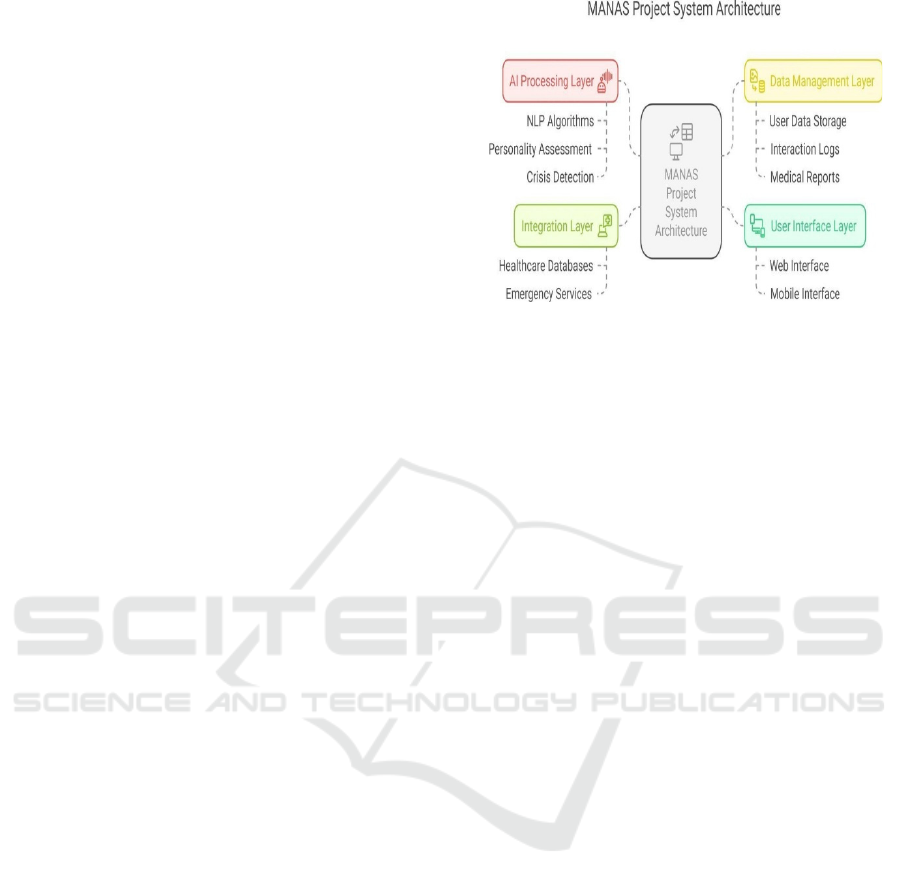
calculations. Figure 1 shows the system architecture.
3.1 Personality Assessment and
Emotional Context Detection
MANAS begins the process with personality
evaluation based on the Five-Factor Model (FFM) to
analyze users traits of openness, conscientiousness
extraversion, friendliness and neuroticism. Detecting
emotional cues in user inputs, analyzing the
emotional states, and creating a database of emotional
cues leads to an assessment of user emotions. The
necessary knowledge to adjust conversation style is
provided to the system by user feedback, as it allows
the chatbot to offer suggestions that align with a
person's traits. The personalized response system
builds emotional resonance with users who face
mental health challenges creating an emotionally
nuanced tone for mental health care support. At the
same time, MANAS also uses state-of-the-art NLP
techniques to recognize the emotional context of the
user's input and detect the signs of distress, sadness,
anxiety or other emotional state. This information is
essential to modify the chatbot response and tone
depending on real-time user interaction. For instance,
if the system senses that a user is feeling low or
stressed, the chatbot might take a gentler, more
encouraging approach. Detecting the emotional
context is essential for improving user interaction,
establishing trust and ensuring the chatbot responds
ideal to different emotions.
3.2 Crisis Detection and Emergency
Protocol Activation
The second segment of the methodology uses
intelligent algorithms to identify signs of a crisis
through analytical of user- generated text contents for
recognized warning signs. The model is extensively
trained on diverse mental health datasets to learn the
patterns of identification for speech content related to
crisis and mental health keywords. Once a mental
health crisis is detected by the system it employs a
predetermined alert protocol to reach out to relevant
stakeholders such as crisis hotlines along with mental
health professionals and other emergency contacts.
MANAS has a distinctive approach where a ready-
made model of a conversation integrates users with
instant help which is its competitive advantage
against other mental health chatbots.
We also propose an escalation mechanism that
adjusts intervention severity according to the type of
crisis detected, thus further refining the crisis
detection process. For instance, if a user is reported
to be suicidal, the MANAS can prioritize responding
quicker by calling emergency services or send a
message to the user's primary emergency contact. The
goal of the system is to respond based on urgency
and not leave the user in a situation where they are
dealing with a life-threatening situation alone.
ICRDICCT‘25 2025 - INTERNATIONAL CONFERENCE ON RESEARCH AND DEVELOPMENT IN INFORMATION,
COMMUNICATION, AND COMPUTING TECHNOLOGIES
110
3.3 Data Collection and Continuous
Care through Medical Reporting
The third component of the methodology is the
ongoing collection and analysis of user data for
mental health monitoring. As users engage with the
chatbot, their emotional state, responses, and
behavioral patterns are tracked for analysis. These
logs are not personally identifiable, but they give us
valuable information about how the user interacts
with us. The system analyzes the collected data and
automatically generates detailed medical reports that
summarize the user's emotional state, behavioral
trends, and interactions. These reports provide
medical professionals with context to evaluate the
mental state of the user over time.
MANAS delivers ongoing treatment by
providing users with a platform to monitor their
mental health journey. A user can show these reports
to healthcare providers, enabling continuous mental
health support and better clinical assessments. It
provides an objective perspective of the user’s mental
health trajectory, and supplements physical therapy
approaches by documenting real-time indicators of a
user’s mental state and emotional excesses.
3.4 Integration and User Experience
Lastly, the methodology emphasizes on the inclusion
of interface that allows the user to interact with
system and access all other components in a unified
way. Our chatbot is user-friendly with which to
communicate so it offers intuitive options for to start
conversations, track their feelings and ask for
assistance. You are built on a modern tech stack using
ReactJS for the front-end, providing an excellent
user experience on all devices. It is pivotal that user
interface shall go hand in hand with AI-driven
algorithms for real-time personalized support, which
makes the experience better for the user and
motivates them for continuous interaction with the
system.
In addition, MANAS acts to bridge a gap in the
human web of healthcare professionals, tapping them
into existing healthcare systems for easy transfers
when users need it. This integration uses secure
sharing features to let healthcare providers view user
reports and evaluate their mental health alongside
other clinical data. MANAS bridges the gap between
digital health interventions and traditional healthcare
systems by facilitating a holistic, continuous care
process, where users can access professional help on
demand when they need it most.
Figure 1: System architecture.
4 RESULTS AND DISCUSSION
The MANAS Project uses machine learning, natural
language processing and computer graphics to create
a highly personalized and empathetic mental health
support system. These methods will yield anticipated
results for both the user experience and mental health
care: The system harnesses complex data pattern
extraction to create profiles of users' emotional
states, behavioral patterns, and contextual
information, so as to effectively present tailored
responses. One of the most important functions of the
chatbot is its ability to adapt to different
personalities, emotional signals, and changes in
external circumstances, such as crisis detection, to
allow the system to respond in dynamic and
personalized ways to users.
We expect the model to adapt to a variety of user
inputs, making it more intuitive and empathetic. For
example, during periods of heightened emotional
distress, the system is expected to change the tone and
topic of its content to deliver more supportive,
comforting and urgent responses. Moreover, if users
display signs of a mental health crisis, such as suicidal
thoughts, the system will trigger appropriate
emergency responses, notifying healthcare
professionals or crisis hotlines instantaneously - all
throughout the process, personal information and
concerns will never be stored., this adaptable model
will learn to recognize and respond to different
emotional states and provide a more effective,
targeted solution than has historically been possible.
4.1 Expected Trends in User
Interactions
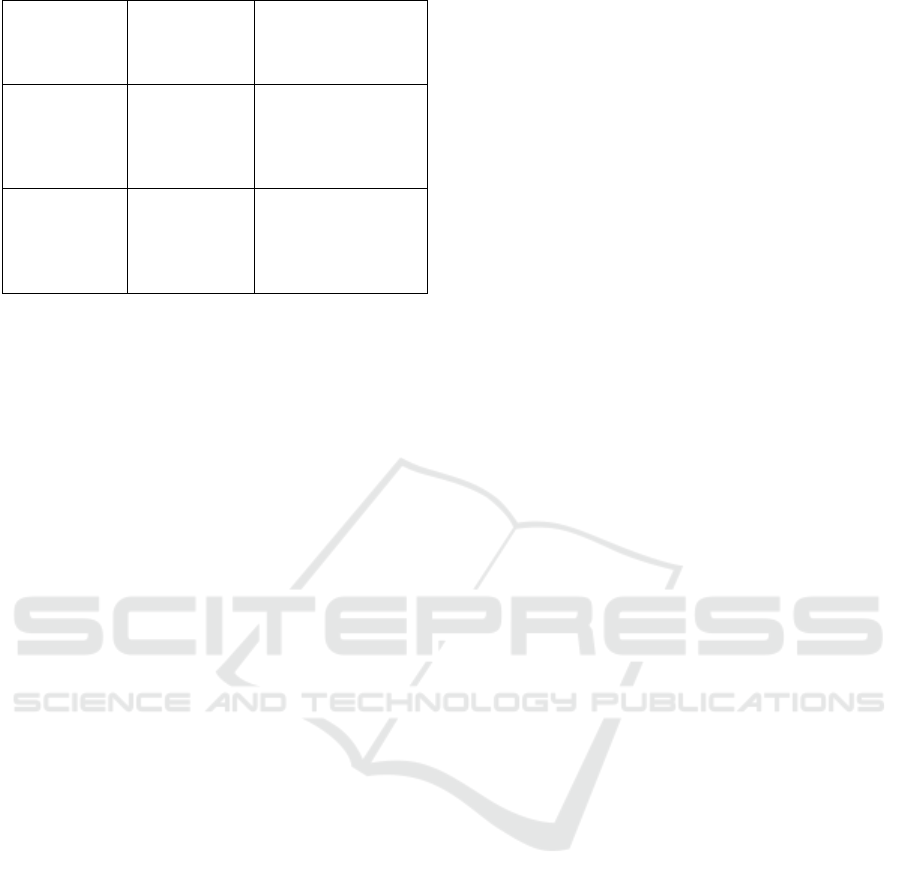
The user will most likely have different behavior and
Predicting Mental Health Issues Using Machine Learning Techniques
111
data than other users, which the model should pick
up on. For instance, users with high rates of
neuroticism might show more frequent signs of
emotional distress and may warrant more immediate
crisis detection and intervention. On the other hand,
users who tend to show more agreeableness or
extraversion are likely to have more casual and
positive conversations, making space for long-term
mental health interventions for the chatbot rather
than immediate intervention. Therefore, the system's
flexibility is needed to cope with these dynamics in
real-time, providing personalized and relevant
responses grounded on the user's individual
emotional and psychological features.
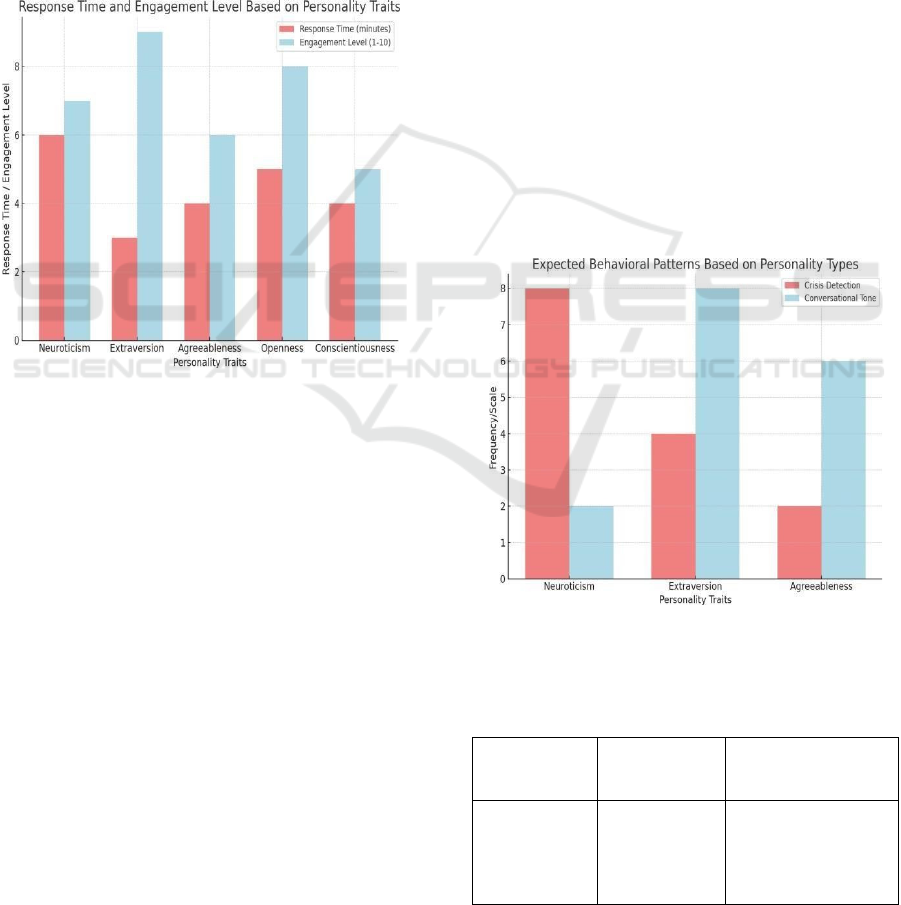
Figure 2: Response time and engagement level based on
personality traits.
Figure 3: - This Graph Shows What Predicts Different
Personality Traits (Neuroticism, Extraversion, Etc) As Well
As the Time It Takes The Chatbot to Respond (In Minutes)
and How Engaged the User Was (Score of 1-10). Figure 2
Shows the Response Time Is Depicted Through the Red
Bar, and Engagement Levels Through The Blue.
Other anticipated developments are the system’s
capacity to observe trends in people’s responses
throughout time, allowing it to monitor mental health
progress and adjust support accordingly. For
example, if a user shows improved mood and
emotional well-being, the system may provide
suggestions for their continued mental health journey,
whereas a user who returns with a decline in their
emotional well-being may be offered an immediate
intervention or referred to professional care. Table 1
shows impacts on user behaviour.
4.2 Comparative Analysis: MANAS vs.
Traditional Methods
Comparative to traditional therapy which is time
consuming, expensive and requires physical
attendance, MANAS gearing up better advantages by
providing standard mental health service provision.
MANAS provides users constant availability as well
as personalized representation support which also
captures and stores user progress independently over
time. Instant therapeutic solutions for users via AI-
based operational models housing these that extract
mental health support through emotional input and
identify crises at this very moment.
Traditional approaches may often return profuse
examples of querying and information which do not
offer the same level of relevance depending on the
information received from the user; the MANAS
system works to differentise itself in this aspect. High
user engagement and user satisfaction compared
with standard mental health chatbots without
personalization is likely to be an outcome of this.
Additionally, the incorporation of crisis detection and
medical report generation offers a holistic, end-to-end
solution that is unparalleled by traditional systems.
Figure 3: Expected behaviour patterns based on personality
types.
Table 1: Expected impact of external data (weather,
economic variables) on user behavior.
External
Factor
Expected
Impact on
User Behavio
r
Notes
Weather
(Seasonal)
Increased
depressive
symptoms in
colder
months.
Emotional cues
might indicate a
need for more
support during
winter.
ICRDICCT‘25 2025 - INTERNATIONAL CONFERENCE ON RESEARCH AND DEVELOPMENT IN INFORMATION,
COMMUNICATION, AND COMPUTING TECHNOLOGIES
112
Economic
Conditions
Higher stress
levels due to
economic
downturns.
System may detect
increased anxiety
and offer targeted
interventions.
Social Events Positive mood
during
holidays,
higher
en
g
a
g
ement.
The system may
shift its tone to
reflect a more
positive
environment.
Media
Exposure
Increased
exposure to
negative news
could cause
distress.
Adjustments in
response tone, with
crisis detection if
needed.
5 CONCLUSIONS
MANAS Project is an important developmental step
in digitalmental health support due to its integration
of generative AI technologywith a personality
assessment and crisis detection in a single interface.
Through analysis of thought and act in emotional
state and personality traits, MANAS can generate
real-time responses allowing MANAS to provide
mental healthcare with a higher degree of empathy
compared to the traditional approach. The system is
capable of detecting crises and issuing complete
medical records for continuous health care needs,
thus enabling patients to achieve complete mental
wellness from the entire system. Mental health
support systems face a paradigm shift for the future
as it will provide better support methods that suit the
individual needs as well as support operational
outputs to improve therapeutic outcomes on the
mental health of a patient.
6 FUTURE SCOPE
Capabilities that support the mental health
component of the MANAS Project will have the
highest leverage impact. Recommended Future Work
Further improvement of MANAS Project could user
multi patient data as Vocal tone, biological sensor
data for complete emotional state analysis. In
addition, the model can be expanded in its
applications by integrating multiple health conditions
along with assessing them continuously through
wearable sensors so as to enhance its usability in pre-
crisis and crisis realms of treatment. Improving
Multilingual Support Features The system should be
able to address a broader range of language
populations that it can serve. Incorporation with
Electronic Health Records (EHRs) and telemedicine
systems enabling seamless communication between
traditional and digital mental health services will
make MANAS further integrated with healthcare.
REFERENCES
Ahmad, R., Siemon, D., Gnewuch, U., & Robra-Bissantz,
S. (2022). Designing personality-adaptive
conversational agents for mental health care.
Information Systems Frontiers, 24(3), 923-943
De Freitas, J., Uğuralp, A. K., Oğuz‐ Uğuralp, Z., &
Puntoni, S. (2024). Chatbots and mental health: Insights
into the safety of generative AI. Journal of Consumer
Psychology, 34(3), 481-491.
Denecke, K., Abd-Alrazaq, A., & Househ, M. (2021).
Artificial intelligence for chatbots in mental health:
Opportunities and challenges. In Multiple Perspectives
on Artificial Intelligence in Healthcare: Opportunities
and Challenges (pp. 115-128).
Depression in Elderly Citizens. Library of Progress-Library
Science, Information Technology & Computer, 44(3).
Dutta, D., & Muni, A. D. (2024). Artificial Intelligence for
Mental Health: A Review Based Analysis of Early
Detection and Management of
Koutsouleris, N., Hauser, T. U., Skvortsova, V., & De
Choudhury, M. (2022). From promise to practice:
towards the realisation of AI-informed mental health
care. The Lancet Digital Health, 4(11), e829-e840.
Manole, A., Cârciumaru, R., Brînzaș, R., & Manole, F.
(2024). Harnessing AI in Anxiety Management: A
Chatbot-Based Intervention for Personalized Mental
Health Support. Information, 15(12), 768.
Nashwan, A. J., Gharib, S., Alhadidi, M., El-Ashry, A. M.,
Alamgir, A., Al-Hassan, M., ... & Abufarsakh, B.
(2023). Harnessing artificial intelligence: strategies for
mental health nurses in optimizing psychiatric patient
care. Issues in Mental Health Nursing, 44(10), 1020-
1034.
Olawade, D. B., Wada, O. Z., Odetayo, A., David-
Olawade, A. C., Asaolu, F., & Eberhardt, J. (2024).
Enhancing mental health with Artificial (AI) Graham,
S. A., Kim, H. C., ... & Jeste, D. V. (2021). Artificial
intelligence for mental health care: clinical
applications, barriers, facilitators, and artificial
wisdom. Biological Psychiatry: Cognitive
Neuroscience and Neuroimaging, 6(9), 856-864..
Singh, L. (2024). Revolutionizing Care: Developing an AI-
Human Synergy Mental Health Application for Mental
Health Worker’s Well-Being (Doctoral dissertation,
Capella University).
Singh, O. P. (2023). Artificial intelligence in the era of
ChatGPT: Opportunities and challenges in mental
health care. Indian Journal of Psychiatry, 65(3), 297-
298.
Sweeney, C., Potts, C., Ennis, E., Bond, R., Mulvenna, M.
D., O’Neill, S., ... & McTear, M. F. (2021). Can
chatbots help support a person’s mental health?
Perceptions and views from mental healthcare
Predicting Mental Health Issues Using Machine Learning Techniques
113

professionals and experts. ACM Transactions on
Computing for Healthcare, 2(3), 1-15.
Thirupathi, L., Kaashipaka, V., Dhanaraju, M., &
Katakam,V. (2025). AI and IoT in Mental Health Care:
From Digital Diagnostics to Personalized, Continuous
Support. In Intelligent Systems and IoT Applications in
Clinical Health (pp. 271-294). IGI Global.
Yoon, S. (2024). AI-Based Digital Therapeutics for
Adolescent Mental Health Management and Disaster
Response. Information, 15(10), 620.
ICRDICCT‘25 2025 - INTERNATIONAL CONFERENCE ON RESEARCH AND DEVELOPMENT IN INFORMATION,
COMMUNICATION, AND COMPUTING TECHNOLOGIES
114
