Leveraging Deep Neural Networks for Real‑Time Detection of
Cyberbullying and Offensive Memes in Social Network
K. Jayasurya, T. Periyasamy, S. Prasanth, S. Sibhisaran and A. Ananya
Department of Artificial Intelligence and Machine Learning, M. Kumarasamy College of Engineering, Karur, Tamil Nadu,
India
Keywords: Social Media, Freedom of Speech, Hate Speech, Cyberbullying, Sentiment Analysis.
Abstract: Although connection to other people is possible through the use of social media, the result has been what the
social media users use to call as freedom of speech, which means that hate speech is also possible, and cyber
bullying. Free speech has come to mean liberty to post vengeful memes or to harass individuals or groups
based on their gender, colour, or religion. To locate such risky content, this study recommends a two-part
approach that involves natural language processing and optical character recognition. The model takes textual
and the visual input through deep neural recognition and analyses the sentiment of the text through a sentiment
recognition dictionary and a sentiment estimator. Negative content is filtered according to script and feedback
provided by the users of the application. When implemented on social media networks, these insights, which
are delivered in real-time, can significantly improve the fight against the use of technology to perpetrate abuse.
1 INTRODUCTION
But most important is – how open and available the
SM communication is. Open one or several accounts
in social networks and begin to share with other
people opinions, ideas and beliefs. But it has now
become a crucial facet of the current society because
modern society does not know it. As they said that all
those people who spread hate in one way or the other,
for example in politics, racists etc. are the ones who
are most likely to become either abusive or harassing
towards them in such a type of stage. Some ideas like
the use of politics or racism usually occur via the
various social media platforms. Unfortunately, such
purposes are increasingly often used for such actions
as blackmail, abuse, and even computer criminality.
By this it has become easier to know and interact with
other communities or organizations of like nature
through networks. Slightly above a third of these
network users are below 30 years of age. These
platforms are filled with a wealth of information to
enable researchers undertake comprehensive analysis
within targeted sub-topics of study. The process of
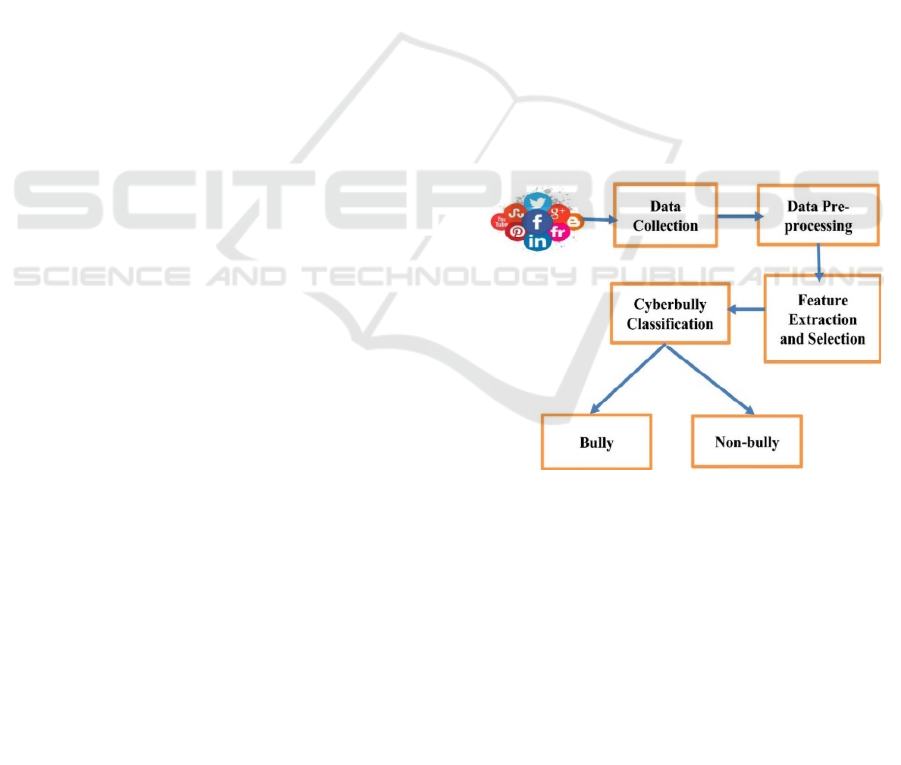
identifying cyber bullying is depicted by the
following the figure 1 below.
Figure 1: Social media types.
Dialectically, via social media, members of societies
worldwide can communicate, exchange information,
build personal relationships, and influence one
another (Mozafari et al.; Mosca et al.). However,
convenience brings risks, particularly among youth
under 30, who face threats like online blackmail,
cyberbullying, and emotional distress (Sabat et al.;
Gravano et al.). Social networking platforms facilitate
communication between individuals and
organizations while simultaneously generating vast
quantities of user-generated content (Alkomah &
Ma). Among the most commonly applied methods to
Jayasurya, K., Periyasamy, T., Prasanth, S., Sibhisaran, S. and Ananya, A.
Leveraging Deep Neural Networks for Real-Time Detection of Cyberbullying and Offensive Memes in Social Networ k.
DOI: 10.5220/0013908200004919
Paper published under CC license (CC BY-NC-ND 4.0)
In Proceedings of the 1st International Conference on Research and Development in Information, Communication, and Computing Technologies (ICRDICCT‘25 2025) - Volume 4, pages
69-74
ISBN: 978-989-758-777-1
Proceedings Copyright © 2025 by SCITEPRESS – Science and Technology Publications, Lda.
69

analyze this content is sentiment analysis, widely
used in previous research (Fortuna et al.; Aluru et al.).
1.1 Background
Social media operates as both a communication and
an information-sharing platform due to its global
reach (Patil et al.). However, the same digital
connectedness allows harmful content like memes
containing hate speech or provocative humor, and
cyberbullying messages to spread rapidly (Toraman
et al.; Antypas & Camacho-Collados). Cyberbullying
involves deliberate acts of harassment or threats using
digital tools, while offensive memes often relay
derogatory and hateful messages with even greater
virality (Sabat et al.; Zhou et al.). Such content affects
users’ mental health, undermines platform standards,
and threatens the credibility of social media
businesses (Velankar et al.; Akuma et al.). Given the
volume of textual content online, it is infeasible for
human moderators to review every post, even with
filtering rules (Mullah & Zainon; Rabiul Awal et al.).
This calls for real-time, automated detection systems
to mitigate the spread of harmful material (Gravano
et al.; Malik et al.).
2 LITERATURE REVIEW
This research applies a Deep Convolutional Neural
Network (DCNN) to detect hate speech and offers a
multilingual study using 16 datasets across 9
languages (Roy et al.; Aluru et al.). While hate speech
has long been studied in humanities, its exploration in
computer science remains nascent (Alkomah & Ma;
Fortuna et al.). One key proposal is DeepHate, a deep
learning model leveraging high-dimensional text
representations for robust detection (Cao et al.).
Another approach, BiCHAT, combines BiLSTM,
CNN, and hierarchical attention for nuanced
detection (Khan et al. 2022a), while the AngryBERT
model jointly learns target and emotion contexts
(Rabiul Awal et al.). A BERT-based transfer learning
technique has also demonstrated success in detecting
hate speech from social media platforms (Mozafari et
al.).
The recently proposed HCovBi-Caps model
integrates convolutional layers, BiGRU, and capsule
networks to improve hate speech detection,
particularly considering its abstract nature (Khan et
al. 2022b). Further, methods like TF-IDF and Bag of
Words have been evaluated in combination with
machine learning models for hate classification on
live tweets (Akuma et al.). The cross-domain
transferability of hate speech detection models is
examined by Toraman et al., while Antypas &
Camacho-Collados evaluate robustness across
datasets. Meanwhile, context-based methods (Mosca
et al.) and sentiment-sharing models (Zhou et al.)
have enhanced semantic understanding in hate speech
systems. Moreover, offensive meme detection,
focusing on pixel-level content, pushes hate
moderation into multimodal dimensions (Sabat et al.).
3 EXISTING METHODOLOGIES
And even if individuals are communicating
asynchronously over the Internet, social networking
as a stylish and, most importantly, unobtrusive way
for people to show their respect to each other’s
individual opinions and beliefs is already a part of
everyday life. Today, the grown man who expresses
hatred through politics, misogyny, and racial
prejudice has harassed and mistreated other people.
Social networks are also gaining popularity among
users for online tyrant, including blackmail. Myspace
is a common social networking site through which
people can comfortably join one or many societies
that they find interesting Due to the sheer amount of
information that exists in SNSs, researchers have
been able to conduct extensive research in a number
of fields. Emotion analysis is one of the areas of
research that receive a lot of attention and primarily
use data from social media. Recommending filters
arrange the offered content list in relation to the
similarity between the desired item content and the
end user’s interests; whereas, collaborative filters
offer items based upon comparison with other like-
minded individuals. Since content-based filtering
processes are more or less focused on text-based
documents, Filtering, which categorizes the mass
incoming texts into relevant and irrelevant, must truly
be regarded as a single tag classification. Multi-label
text categorization is an advanced form of filter that
will categorize the communications partly by topics
and categories. The classifier generates automatically
according with the learning need from the set of
previously classified sample in content-based
filtering paradigm from the machine learning (ML)
framework, identified that Bag of Words (BoW)
method perform better when compare with complex
text representation method that may have better
statistical features but lower semantics.
ICRDICCT‘25 2025 - INTERNATIONAL CONFERENCE ON RESEARCH AND DEVELOPMENT IN INFORMATION,
COMMUNICATION, AND COMPUTING TECHNOLOGIES
70
4 PROPOSED
METHODOLOGIES
Another common and well-known tool of information
exchange share and communication involving
personal data is considered to be an online social
network (OSN). But one of the significant challenges
for OSNs is to provide the users with control over
their privacy and stopping the broadcasting of
unsuitable content. This work provides a solution to
the problem by allowing the users of OSN to decide
on the messages that appear on their walls. This is
done through allowing the users to set up their own
specific filtering rules of their choosing in a highly
flexible rule-based system. Moreover, there is
utilizing of the soft classifier founded on the option of
the machine learning for the messages’ automatic
recognition and content filtering. Every short
message is analyzed by four Deep Learning (DL) text
classification algorithms, which categorize the
message into one or more groups based on its content.
A dataset of the categorized words is developed to
check for any words that should not be in any
particular category.If there is any inappropriate
language in the correspondence, it will be filtered to
remove it from the Blacklists. Moreover, since the
wall message uses material technique, no immoral
word will be written on the wall of the user.
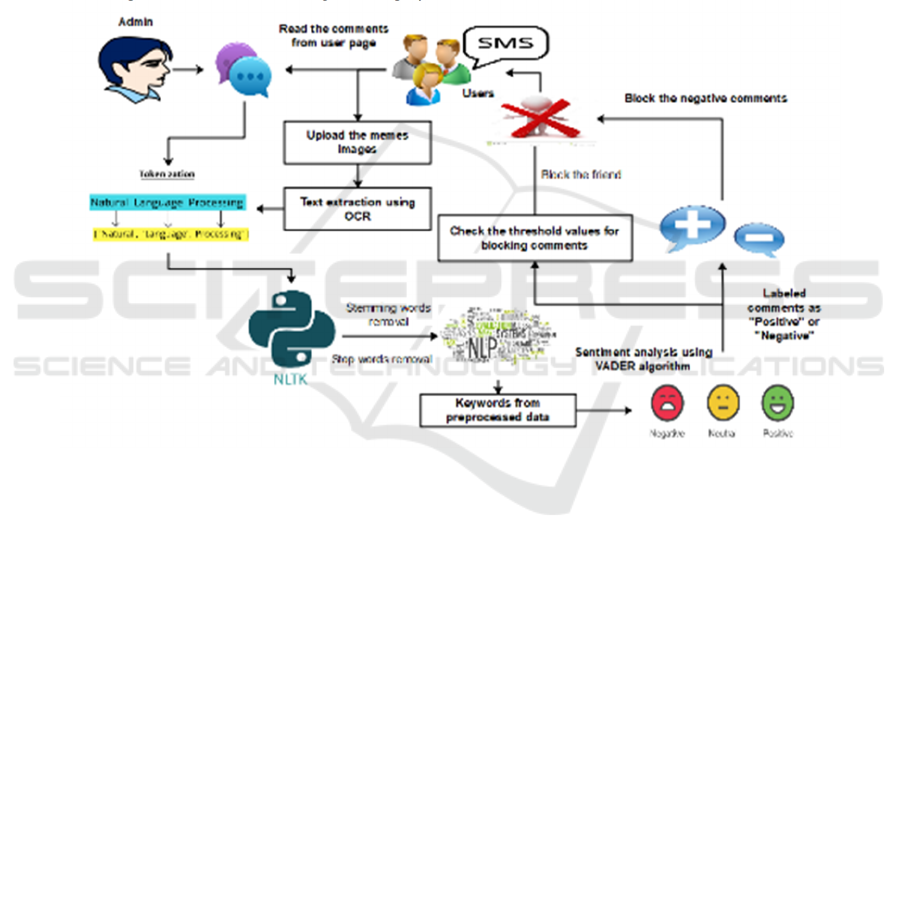
Figure 2: Framework.
Attributes such as text message content, users’ buddy
connections and other writer related characteristics
are also considered by a system, utilizing blacklists
for filtering contextless messages. The criteria of the
proposed structure include the application of deep
learning in helping the user define FRs used as an
understanding of filter rules, enhancement of fit rules
in the considered domain, and the expansion of the set
of attributes to be analyzed initially by the classifier.
context messages. The suggested framework
incorporates deep learning techniques to assist users
in defining Filtering Rules (FRs), improve fit rules
within the domain under consideration, and broaden
the collection of attributes initially examined during
the classification process. Figure 2 shows the
framework.
4.1 Framework
Social Networking Service or SNS is a particular type
of online platform that makes it possible to keep links
with people who have common interests, activities,
backgrounds, or acquaintance for all people,
regardless if it is casual or business related. As this
point grows increasingly flexible, it has been very
difficult to define social media. Social network is
human relations that are in which people share,
exchange and pass values, knowledge and
experience. Such interactions can be enhanced by
creating a graphical user interface where most of user
communication and necessary graphical and visual
triggers can be undertaken. Both user and admin
interfaces may be designed using this module. We are
providing users to interact with the system, respond
to invitations, post photos with friends, and upload
Leveraging Deep Neural Networks for Real-Time Detection of Cyberbullying and Offensive Memes in Social Network
71

meme images. They can then be forwarded to the
admin page to determine and analyze.
4.2 Words Extraction
Social networking has recently become more and
more an integral part of everyday online activities as
social apps and websites are taking social networking
forward as an important medium of communication.
Today social networking sites allow people to do a lot
of things that stimulate active participation such as
leave user comments and share multimedia. But
businesses know social media can help grow and
increase visibility and use social media for marketing,
brand promotion, connecting with customers as well
as making new alliances. Online social networks that
allow for free interaction and commentary are now
open discussion, however, they need content
management systems. By extracting text from
photographs through optical character recognition (or
text recognition), or OCR, content management,
filtering, and analysis on these platforms will be
improved.
4.2.1 Optical Character Recognition
• Extraction of Character boundaries from
Image,
• Building a Bag of Visual Words (BOW)
framework in remembering the Character
images,
• Loading trained Model,
• Consolidating predictions of characters
The text may consist of bigrams, multigram, or
unigrams. Feedback from social media users is
gathered using this component. Links, text, and brief
messages are just a few of the various formats that
comments might take. After being reviewed,
comments are sent to the server page.
4.2.2 Text Mining
Developing an effective deep learning classifier often
emphasizes identifying and extracting key features
that define and characterize the data. The typical
process in text mining consists of these steps:
• Exclude commonly used words that do not
add value to the analysis.
• Reduce words to their root forms to
standardize variations.
• Remove symbols, punctuation, and other
non-alphanumeric characters.
• Identify and isolate sentences that convey
the most relevant information.
• Simplify or replace lengthy phrases with
more appropriate or concise alternatives.
By taking these steps the text is pre-processed well
for the deep learning models to effectively classify
and analyse the text. By taking these steps the text is
pre-processed well for the deep learning models to
effectively classify and analyse the text.
4.3 Classification
In this module, we built an automatic mechanism
which we called Filtered Wall (FW) to filter
unsolicited communications coming from OSN user
walls. The three-tiered architecture supports OSN
services. The initial layer generally attempts to
provide the basic OSN capabilities (relations and
profiles). Additionally, some OSNs offer a further
layer allowing us to deal with external Social
Network Application (SNA). In the last, an additional
layer may be required for supporting SNA's graphical
user interfaces (GUIs). This thesis centres around the
development of a robust backpropagation neural
network (BPNN) that aims to extract and select a set
of discriminative and characteristic features. Text
classification interfaces between the constraints that
are specified, and the constraints that will be applied
in the process. In the approach, it is assumed that the
easiest to remove (likely best) is "neutral" sentences,
which do not contribute significantly to the
classification task. Finally, the remaining ‘non-
neutral’ sentences are assigned into the appropriate
‘classes’ of interest. This approach eliminates the
burden of the work and allows us to process the data
in a more organized fashion since, working from the
VADER point of view, we suggest a hierarchical two-
level method.
4.3.1 Developing the Deep Learning Model
The process works in developing a system to capture
and remove any offensive content from user
generated text. Here's the proposed workflow for
creating a deep learning-based classifier:
• First, we have to start with a collection of a
different kind of data or comments. This
includes both examples of offensive (hateful)
and non-offensive (neutral) language in this
data.
• Remove any character, symbol, or irrelevant
information that might interfere with analysis
in cleaned collected text.
• Therefore, deep learning such as the VADER
sentiment analysis algorithm or similar natural
language processing (NLP) algorithms is used
ICRDICCT‘25 2025 - INTERNATIONAL CONFERENCE ON RESEARCH AND DEVELOPMENT IN INFORMATION,
COMMUNICATION, AND COMPUTING TECHNOLOGIES
72

to train a model to differentiate between
hateful and non-hateful language.
• With the processed data feed into the model,
you want to use and tweaking the model’s
parameters according to the labelled examples
so the model can learn how to correctly
classify hate speech.
• After training, run the model inside a system
that can rapidly and correctly identify
offensive language of new user inputs to keep
things positive.
• Watchlists can also be used by the system to
keep track of offensive terms or expressions;
These lists auto flag content depending on the
relationship and context with the user, their
message. This screening can be tailored to the
specific needs of the domain so that the
filtering procedure is precise and appropriate
in any situation.
By the use of deep learning methods to classify
objectionable language, our solution ensures that
objectionable content is still effectively controlled
while increasing user experience.
4.4 Filtering Guidelines
Filtering should allow users to place restrictions on
content creators to suit particular circumstances. Such
guidelines can be based on conditions by
characteristics represented in user profiles. For
example, guidelines can be tailored according to the
likes of managing them for young creators, people
who espouse a certain religious or political view or
those deemed to have started in a particular subject
and lack experience. By applying filters to profile
attribute, such as work-related information, it can be
achieved. It can also use content-based parameters to
identify, track and manage communication. Take the
case of automatically banning people who keep
posting negative reviews above a certain level — five
times, let’s say. Additionally, such actions should be
notified to the users through those mobile devices.
4.5 Alert System
The BL overseeing system should be able to locate
individuals in the BL and know when customer
loyalty goals have been complete. The set of BL
specific rules guiding this process is intended to
increase system adaptability and threshold values are
key to these rules. Having set the thresholds, the
server defines acceptable levels of activity. This value
can then be used by users to do actions like allowing
or disallowing the posting of individuals that often
comment in a critical way. In addition, the system
should also send real time user notifications via
smartphone notifications to maintain transparency
and updated interfacing.
5 CONCLUSIONS
In this work, the hybrid model for harmful memes and
cyberbullying in the social media environment is
investigated, and we use the VADER sentiment
analysis algorithm along with natural language
processing to accomplish this. VADER helps the
model recognize the subtle linguistic patterns often
found in cyberbullying and is a proven effective
processor of social media material leading to a
reputable sentiment measure. Once OCR is added to
image analysis, the combination of VADER can
reliably detect offensive multimedia messages such
as abusive memes containing grotesque text
incorporated in images. The system’s adaptability
with respect to filtering options is also increased
through management of BLs. This is the first stage of
a bigger project. The early encouraging results with
the classification technique have motivated us to
work on other projects in order to improve
classification quality. The DL soft classifier is used to
filter out unwanted signals in this system. Using BL
increases the filtering system versatility. We will
design a system that incorporates more factors in
determining whether or not to introduce a user into
the BL. With a flexible language, the strong rule layer
generates Filter Rules (FRs) that constrain the system
to not display some data on their walls. The use in
FRs is to utilize user profiles and relationships.
REFERENCES
Akuma, Stephen, Tyosar Lubem, and Isaac Terngu Adom.
"Comparing Bag of Words and TF-IDF with different
models for hate speech detection from live tweets."
International Journal of Information Technology 14.7
(2022): 3629-3635.
Alkomah, Fatimah, and Xiaogang Ma. "A literature review
of textual hate speech detection methods and datasets."
Information 13.6 (2022): 273.
Aluru, Sai Saketh, et al. "Deep learning models for
multilingual hate speech detection." arXiv preprint
arXiv:2004.06465 (2020).
Antypas, Dimosthenis, and Jose Camacho-Collados.
"Robust hate speech detection in social media: A cross-
dataset empirical evaluation." arXiv preprint
arXiv:2307.01680 (2023).
Leveraging Deep Neural Networks for Real-Time Detection of Cyberbullying and Offensive Memes in Social Network
73

Cao, Rui, Roy Ka-Wei Lee, and Tuan-Anh Hoang.
"DeepHate: Hate speech detection via multi-faceted
text representations." Proceedings of the 12th ACM
Conference on Web Science. 2020
Fortuna, Paula, et al. "Directions for NLP Practices Applied
to Online Hate Speech Detection." Proceedings of the
2022 Conference on Empirical Methods in Natural
Language Processing. 2022.
Gravano, Agustín, et al. "Assessing the Impact of
Contextual Information in Hate Speech Detection."
IEEE Access, vol. 11, pp. 30575-30590, 2023, doi:
10.1109/ACCESS. 2023.3258973. (2023).
Khan, Shakir, et al. "HCovBi-caps: hate speech detection
using convolutional and Bi-directional gated recurrent
unit with Capsule network." IEEE Access 10 (2022):
7881-7894.
Khan, Shakir, et al. "BiCHAT: BiLSTM with deep CNN
and hierarchical attention for hate speech detection."
Journal of King Saud University-Computer and
Information Sciences 34.7 (2022): 4335-4344.
Malik, Jitendra Singh, Guansong Pang, and Anton van den
Hengel. "Deep learning for hate speech detection: a
comparative study." arXiv preprint arXiv:2202.09517
(2022).
Mosca, Edoardo, Maximilian Wich, and Georg Groh.
"Understanding and interpreting the impact of user
context in hate speech detection." Proceedings of the
Ninth International Workshop on Natural Language
Processing for Social Media. 2021.
Mozafari, Marzieh, Reza Farahbakhsh, and Noel Crespi. "A
BERT-based transfer learning approach for hate speech
detection in online social media." Complex Networks
and Their Applications VIII: Volume 1 Proceedings of
the Eighth International Conference on Complex
Networks and Their Applications COMPLEX
NETWORKS 2019 8. Springer International
Publishing, 2020.
Mullah, Nanlir Sallau, and Wan Mohd Nazmee Wan
Zainon. "Advances in machine learning algorithms for
hate speech detection in social media: a review." IEEE
Access 9 (2021): 88364-88376.
Patil, Hrushikesh, Abhishek Velankar, and Raviraj Joshi.
"L3cube-mahahate: A tweet-based marathi hate speech
detection dataset and bert models." Proceedings of the
Third Workshop on Threat, Aggression and 2022.
Rabiul Awal, Md, et al. "AngryBERT: Joint Learning
Target and Emotion for Hate Speech Detection." arXiv
e-prints (2021): arXiv-2103.
Roy, Pradeep Kumar, et al. "A framework for hate speech
detection using deep convolutional neural network."
IEEE Access 8 (2020): 204951-204962.
Sabat, Benet Oriol, Cristian Canton Ferrer, and Xavier
Giro-i-Nieto. "Hate speech in pixels: Detection of
offensive memes towards automatic moderation."
arXiv preprint arXiv:1910.02334 (2019).
Toraman, Cagri, Furkan Şahinuç, and Eyup Halit Yilmaz.
"Large-scale hate speech detection with cross-domain
transfer." arXiv preprint arXiv:2203.01111 (2022).
Velankar, Abhishek, Hrushikesh Patil, and Raviraj Joshi.
"A review of challenges in machine learning based
automated hate speech detection." arXiv preprint
arXiv:2209.05294 (2022).
Zhou, Xianbing, et al. "Hate speech detection based on
sentiment knowledge sharing." Proceedings of the 59th
Annual Meeting of the Association for Computational
Linguistics and the 11th International Joint Conference
on Natural Language Processing (Volume 1: Long
Papers). 2021.
ICRDICCT‘25 2025 - INTERNATIONAL CONFERENCE ON RESEARCH AND DEVELOPMENT IN INFORMATION,
COMMUNICATION, AND COMPUTING TECHNOLOGIES
74
