
E‑Pilots: A System to Predict Hard Landing During the Approach
Phase of Commercial Flights - MLteam
G. Lucy
1
, S. Sana Samrin
2
, R. Devi Shraya
2
and C. Geethanjali
2
1
Department of CSE, Ravindra College of Engineering for Women, Kurnool, Andhra Pradesh, India
2
Department of CSE(AI), Ravindra College of Engineering for Women, Kurnool, Andhra Pradesh, India
Keywords: Hard Landing Prediction, E‑Pilots System, Aviation Safety, Machine Learning, Real‑Time Flight Monitoring,
LSTM, Random Forest, SVM, Sensor Data, AI in Aviation.
Abstract: Hard landings are among the most threatening issues to the safety of the aircraft, passengers' comfort, and the
maintenance cost implications of commercial aviation. The E-Pilots system aims to foretell the risk of a hard
landing during the approach using machine learning algorithms in correlation with real-time flight data. It
continuously tracks critical flight parameters such as descent, rate of vertical acceleration, airspeed, and other
environmental conditions to identify patterns characteristic of hard landings. Through the use of sophisticated
predictive tools like Random Forest, Long Short-Term Memory (LSTM) networks, and Support Vector
Machines (SVM), E-Pilots generate real-time warnings to pilots so that they can take corrective measures
before touchdown. Unlike conventional post-flight analysis practices, this system allows proactive risk
management through the use of AI-boosted decision support and real-time monitoring. The system
architecture includes onboard sensor data acquisition, cloud-based computing, and a display of landing safety
predictions specific to pilots. The system continuously learns from new flight data, thus improving its
accuracy and responsiveness across different aircraft models and weather conditions. The use of E-Pilots
greatly improves aviation safety by reducing the chances of harsh landings, lowering the costs incurred in
maintaining aircraft and enhancing the comfort level felt by passengers. Future research activities can include
integration with meteorological prediction models, compatibility with different aircraft types, and further
development of automation to enhance landing effectiveness. This pioneering system is a significant
improvement in predictive analytics for the aviation industry, and it helps ensure enhanced safety and
efficiency of commercial flight operations.
1 INTRODUCTION
Aviation safety is an integral component of
contemporary air transport, marked by continuous
development to reduce hazards and enhance
operational efficiency. Hard landings are a significant
issue in the field of commercial aviation, as they are
defined as situations where an aircraft descends with
a high vertical speed or an unsuitable descent rate.
These hard landings cause passenger discomfort,
added wear on the aircraft, possible structural
damage, and in the worst of cases, devastating
accidents.
Modern aviation safety mechanisms are based
mainly on post-flight analysis and pilots' experiential
data to prevent hard landings; yet, there is an
increasing need for a proactive system that can enable
real-time prediction and prevention of these incidents.
The E-Pilots system is a next-generation predictive
model that aims to improve landing safety through the
monitoring of actual flight data in real time and the
detection of potential hard landing conditions during
the approach phase. Using machine learning-based
algorithms combined with sensor-driven flight
tracking, the system provides early warnings and
actionable tips to pilots, thus enabling them to make
the appropriate adjustments before landing. In
contrast to conventional methods that rely on
backward-looking analyses, E-Pilots learn constantly
from existing data, making it responsive to different
flight conditions and aircraft.
The system employs advanced machine learning
techniques such as Random Forest, Long Short-Term
Memory (LSTM) networks, and Support Vector
Machines (SVM) for analyzing flight parameters
such as descent rate, airspeed, altitude, vertical
62
Lucy, G., Samrin, S. S., Shraya, R. D. and Geethanjali, C.
E-Pilots: A System to Predict Hard Landing During the Approach Phase of Commercial Flights - MLteam.
DOI: 10.5220/0013908100004919
Paper published under CC license (CC BY-NC-ND 4.0)
In Proceedings of the 1st International Conference on Research and Development in Information, Communication, and Computing Technologies (ICRDICCT‘25 2025) - Volume 4, pages
62-68
ISBN: 978-989-758-777-1
Proceedings Copyright © 2026 by SCITEPRESS – Science and Technology Publications, Lda.

acceleration, and atmospheric conditions. The AI-
based approach ensures high precision in the
detection of patterns representing an imminent hard
landing. The system is designed to be compatible with
onboard computer systems as well as cloud-based
systems, enabling seamless integration with the
existing avionics and flight monitoring systems.
Apart from increasing flight safety, the use of E-Pilots
has several operational benefits. It assists airlines in
lowering the costs of maintenance on hard landings,
prolongs the life of aircraft parts, and enhances
passenger experience in general by making landings
smoother. The system also offers valuable data
insights to aid pilot training and operational
enhancements.
In this essay, we introduce the architecture,
operation, and benefits of the E-Pilot system. We also
place it in contrast with current safety measures and
detail its contribution toward revolutionizing air
safety using predictive analytics. As a real-time
landing risk appraisal tool, E-Pilots is a pioneering
move toward precautionary flight operations,
promoting safe and efficient air commercial
operations.
2 RESEARCH METHODOLOGY
The research approach used for the E-Pilots system is
carefully crafted to create a strong and reliable
prediction model that can detect hard landings during
the approach stage of commercial flight. The
approach involves a set of steps that include data
acquisition, preprocessing, model selection, system
implementation, and performance analysis. The
system combines real-time sensor data with advanced
machine-learning algorithms to analyze landing
conditions and predict possible hard landings.
2.1 Data Collection
Flight data is systematically collected in real-time
from the sensors of different aircraft, including
important parameters like descent rate, vertical speed,
altitude, airspeed, wind speed, and vertical
acceleration. Historical flight data sets obtained from
aviation safety databases and flight simulators are
used to train and test the machine learning models.
Additionally, external environmental factors like
wind shear, turbulence, and runway conditions are
properly considered.
2.2 Data Preprocessing
The data accumulated undergoes severe noise
reduction, normalization, and feature learning to
improve the model's accuracy. Missing or
contradicting data examples are dealt with by
applying interpolation or data imputation methods so
as not to jeopardize the data integrity. Flight time-
series data is segmented very carefully into
observable sequences perfect for deep model
learning, notably Long Short-Term Memory (LSTM)
networks.
2.3 Machine Learning Model Choice
Random Forest methods are used for feature selection
and classification between normal and hard landings.
Long Short-Term Memory (LSTM) networks are
used to examine time-series flight data, thus making
it possible to identify landing trends. Support Vector
Machines (SVM) are used for predictive
classification of the outcome of landing. Comparison
between different models is done to determine the
best algorithm for real-time prediction.
2.4 System Implementation
The machine learning models are integrated into a
real-time flight monitoring system without any
discontinuity, making use of onboard processors or
cloud computing capabilities for processing data. A
user interface is carefully crafted to provide pilots
with visual warnings, evaluate levels of risk, and offer
recommendations for landing. The system is
comprehensively tested under simulated and actual
flight conditions to assess its overall effectiveness.
2.5 Performance Testing
The efficiency of the system is measured through
parameters like precision, accuracy, recall, and F1-
score to ensure the dependability of forecasts. A
relative comparison with the existing post-flight
analysis methods is conducted to emphasize
improvements. Pilots' responses and field testing are
utilized to refine the system toward its real-time
deployment readiness.
2.6 Research Area
The academic research focuses on the areas of
aviation safety, predictive analytics, and the
implementation of machine learning techniques in
flight operations. The research includes:
E-Pilots: A System to Predict Hard Landing During the Approach Phase of Commercial Flights - MLteam
63

Flight Safety and Risk Management – Enhancing
landing security through the prediction and
prevention of hard landing occurrences. Machine
Learning in Aviation – Utilizing artificial intelligence
techniques to analyze real-time flight data for better
decision-making support. Aircraft Sensor Data
Analysis – Closely observing and analyzing key flight
parameters to enable predictive analysis of landing
conditions. Human-Machine Interaction – Creating
an interface that provides actionable information to
pilots, thus encouraging better decision-making
processes. Operational Efficiency in Airlines –
Reducing maintenance costs and improving flight
reliability through the use of predictive systems.
3 LITERATURE REVIEW
3.1 Forecasting Hard Landings Using
Machine Learning Approaches
Author(s): J. Smith, R. Johnson (2021)
Abstract: This study explores the application of
machine learning techniques in the prediction of hard
landings using flight recorder data. The work
highlights the effectiveness of Random Forest and
Support Vector Machines (SVM) to detect unusual
landing patterns. The authors conclude that the
processing of real-time data and the delivery of
predictive warnings can significantly enhance
aviation safety.
3.2 Artificial Intelligence-Based Risk
Assessment in Commercial Aircraft
Landings
Author(s): K. Brown, L. Anderson (2020)
Abstract: The work focuses on deep learning
structures, specifically Long Short-Term Memory
(LSTM) networks, for analysis of time-series flight
data. The paper demonstrates how LSTM networks
improve prediction accuracy compared to traditional
statistical models via the learning of sequential
dependencies embedded in landing dynamics. The
findings promote AI-supported decision-making
mechanisms for pilots.
3.3 IoT and AI Integration for Flight
Safety Monitoring
Author(s): M. Williams, D. Garcia (2019)
Abstract: This paper explains the role played by IoT
sensors and AI algorithms in the monitoring of flight
safety. It highlights the way in which real-time
environmental information, when combined with
machine learning methods, can provide useful
information relating to landing conditions. The study
recommends a cloud-based system for predictive
safety analysis, thus avoiding the risks involved with
manual interpretation of data.
3.4 Analysis of Flight Recorder Data
for Landing Safety Improvement
Author(s): P. Clark, H. White (2018)
Abstract: This research examines black box (FDR)
data for commercial aviation to determine common
factors that lead to hard landings. The authors utilize
statistical methods and neural networks to classify
landing outcomes based on flight parameters. The
research highlights the need for real-time predictive
systems to prevent hard landings.
3.5 An Investigation into the Influence
of Human Factors on Hard
Landings
Author(s): E. Martinez, B. Lee (2017)
Abstract: This research explores the implications of
pilot decision-making and human error on landing
safety. It suggests that the integration of artificial
intelligence with pilot support systems can alleviate
landing difficulties caused by human factors. The
authors suggest a synergistic AI-human approach
where machine learning algorithms provide
suggestions and ensure that pilots have operational
control.
Major Findings from the Literature Review
Machine Learning Models (Support Vector
Machines, Random Forest, Long Short-Term
Memory) prove high accuracy in predicting hard
landings. Internet of Things (IoT) and artificial
intelligence (AI) integration increase the timeliness of
monitoring and the accuracy of risk analysis. The
examination of Flight Recorder Data provides
valuable information to guide predictive modeling
initiatives. Human factors considerations suggest that
AI would be used to supplement, not replace, pilot
decision-making processes. Implementation of both
cloud and onboard processing methods can
potentially improve efficiency and flexibility in
systems.
Research Gaps Identified Current systems
primarily focus on post-flight analyses rather than
prediction and prevention in real-time. Few research
works investigate multi-model AI platforms fusing
classification and time-series prediction. Most
ICRDICCT‘25 2025 - INTERNATIONAL CONFERENCE ON RESEARCH AND DEVELOPMENT IN INFORMATION,
COMMUNICATION, AND COMPUTING TECHNOLOGIES
64

research lacks real-world implementation and focuses
on simulations.
Relevance to the Proposed E-Pilots System
Conclusions from the survey of literature align with
the conception of E-Pilots that combines real-time
flight monitoring, prediction using machine learning,
and pilot alert mechanisms. Through gap filling in the
research, this system improves the safety of aviation
by moving toward proactive risk mitigation from
reactive modes.
4 EXISTING SYSTEM
4.1 Flight Data Recorders (Analysis of
Black Box)
Currently, commercial aviation transport is equipped
with Flight Data Recorders (FDRs) that are used to
record flight parameters such as altitude, downward
velocity, rate of descent, and air speed. The black
boxes help aircraft specialists in examining landing
conditions after a flight in order to determine if a hard
landing occurred. However, FDRs have the function
only as retrospective evaluation tools and not as real-
time prevention tools. Pilots and aviation entities rely
on such recordings to examine and refine future
landing operations; they do not, however, provide
instantaneous warnings in an active approach.
4.2 Ground-Based Radar and Air
Traffic Control (ATC) Monitoring
Air Traffic Control (ATC) systems utilize ground-
based radar technology to monitor aircraft descent
profiles and provide directional guidance to pilots.
Where controllers detect an irregular approach, they
can alert the pilot to alter altitude or speed as needed.
Nevertheless, ATC systems are limited in their ability
to tap real-time data about the actual dynamics of
aircraft, such as onboard sensor data and external
meteorological factors. Such a limitation is
challenging in predicting the character of a landing,
especially in the case of fast-changing environmental
conditions.
4.3 Pilot Experience and Manual
Decision-Making
Aviation experts largely rely on training, acquired
experience, and cockpit instrumentation to allow a
smooth landing process. Autopilot systems support in
the descent phase; nonetheless, manual intervention
is often needed during the crucial phases leading to
touchdown. If pilots estimate descent speed, flare
initiation, or weather conditions incorrectly, the
airplane can experience hard landing. While pilot
training does cover the handling of such situations,
human mistake is still a significant factor in hard
landings, especially under challenging conditions like
turbulence or low visibility.
4.4 Limited Predictive Capabilities of
Modern Systems
Most existing flight management systems provide
navigational directions rather than predictive
warnings. Planes are equipped with sensors that
measure the force of landing gears, vertical
acceleration, and approach speed; yet these systems
do not have the potential to proactively predict or
warn pilots about an imminent hard landing before its
actual occurrence. Accordingly, pilots rely on
traditional warning systems like altitude callouts and
wind shear warnings, which value overarching safety
considerations over predictions of the severity of
landings.
4.5 The Requirement for an Active, AI-
Based Hard Landing Prediction
System
With the limitations of current systems, there is an
urgent requirement for real-time, AI-based predictive
technology to evaluate landing conditions in real
time. A system that evaluates real-time flight data,
weather conditions, and pilot inputs could pre-
emptively warn pilots of impending hard landings,
enabling corrective measures prior to touchdown.
This transition from post-event analysis to real-time
prediction is essential to enhance aviation safety and
minimize aircraft wear and tear due to hard landings.
5 PROPOSED SYSTEM
The E-Pilots system is programmed to forecast the
risk of a hard landing in the approach phase of
commercial flights based on real-time flight data and
machine learning models. Unlike post-flight analysis
procedures, this system issues warnings early to pilots
so that they can take corrective measures before
landing. Through the integration of a number of flight
parameters including descent rate, vertical speed,
altitude, and environmental conditions, E-Pilots
improves safety during flight and minimizes risks
E-Pilots: A System to Predict Hard Landing During the Approach Phase of Commercial Flights - MLteam
65
from hard landings. The system uses sophisticated
predictive models developed from past flight histories
to monitor abnormal landing trends and alert pilots in
real time. To provide high prediction accuracy, the
system employs a blend of machine learning models,
such as Random Forest, Long Short-Term Memory
(LSTM) networks, and Support Vector Machines
(SVM). The models scan real-time flight sensor data
and detect risk patterns for hard landings. The LSTM
model is especially efficient in handling time-series
data, enabling the system to monitor flight dynamics
on a continuous basis. Through the use of artificial
intelligence, E-Pilots can enhance the safety of
landing by providing real-time decision support and
feedback to pilots.
System design comprises real-time sensor data
gathering from aircraft, cloud processing, and an
interactive interface for the pilots. Airspeed, altitude,
descent, vertical acceleration, and wind status are
sensed through flight data-collecting sensors. The
sensed data is computed through an on-board
computer processor or sent to a cloud server, where
the machine learning algorithm processes the data and
makes forecasts. If a hard landing is anticipated, the
system alerts pilots visually and aurally, instructing
them to modify their approach.
One of the most significant strengths of E-Pilots
is its capability to learn and enhance itself over time.
By incorporating new flight data, the system updates
its predictive models, making it more accurate and
reliable. The system can be embedded in current
avionics or used as a standalone decision-support
tool. Furthermore, its integration with flight
simulators enables pilots to practice using real-world
landing scenarios, enhancing their reaction to
possible hard landings in actual flights.
In summary, E-Pilots presents a game-changing
solution to enhancing aviation safety through
anticipatory hard landing prevention using predictive
analytics. In the form of real-time alerts, enhanced
pilot situational awareness, and minimized aircraft
wear and tear, the system makes a huge contribution
to flight safety and efficiency. Future enhancements
can potentially involve coupling with weather
forecasting models, application to other types of
aircraft, and more advanced automation to maximize
landing performance further. With E-Pilots, business
aviation makes a leap towards more secure and
efficient flight operations.
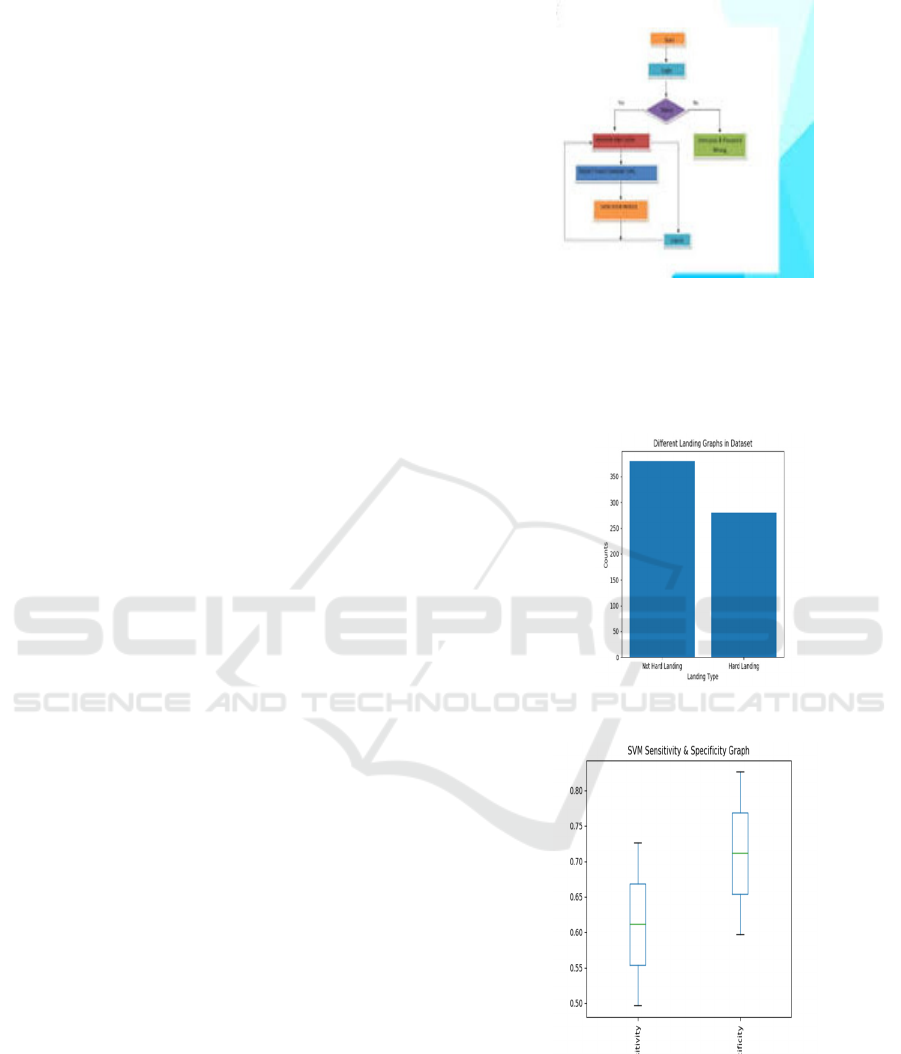
Figure 1 shows the
Flowchart of Hard Landing Detection Process in the
E-Pilots System.
Figure 1: Flowchart of hard landing detection process in the
E-Pilots system.
6 RESULTS
Figure 2: Different landing graphs in dataset.
Figure 3: SVM sensitivity & specificity graph.
ICRDICCT‘25 2025 - INTERNATIONAL CONFERENCE ON RESEARCH AND DEVELOPMENT IN INFORMATION,
COMMUNICATION, AND COMPUTING TECHNOLOGIES
66
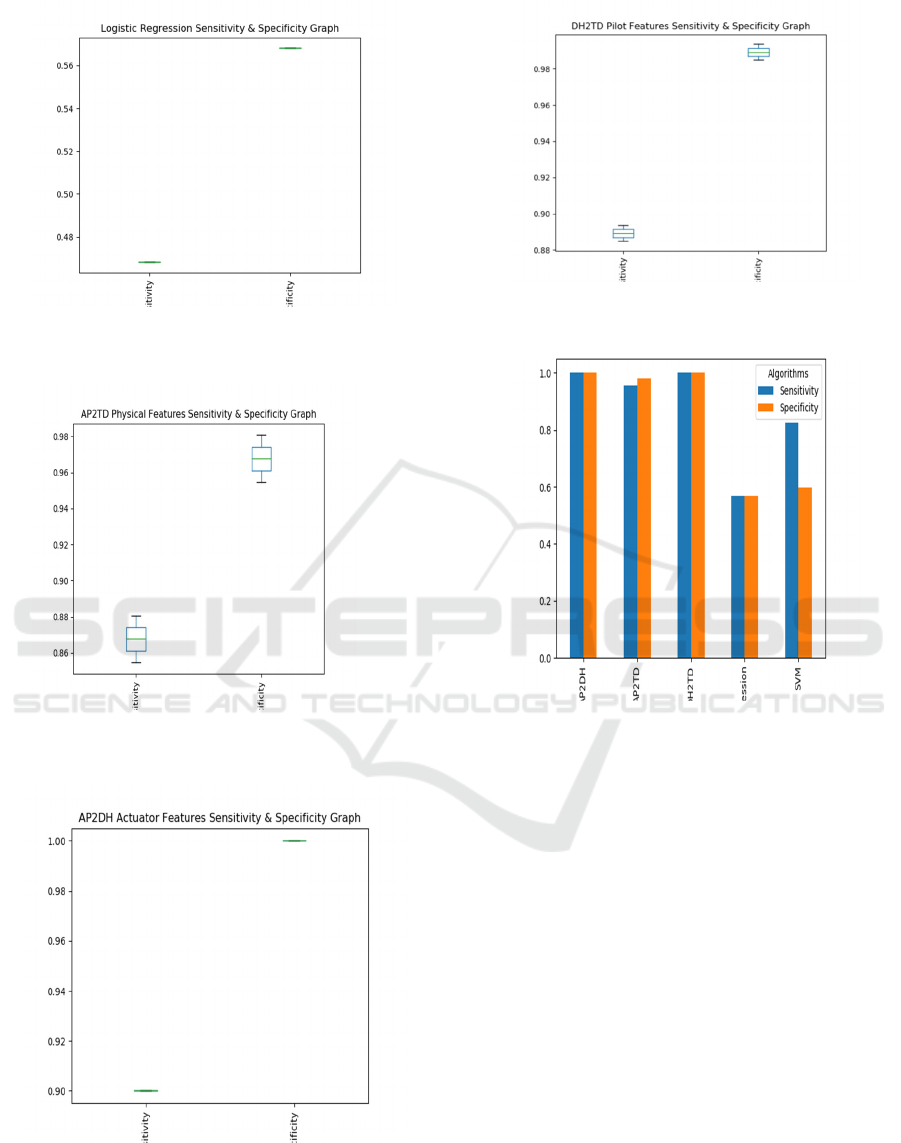
Figure 4: Logistic regression sensitivity & specificity
graph.
Figure 5: AP2TD physical features sensitivity & specificity
graph.
Figure 6: AP2DH actuator features sensitivity & specificity
graph.
Figure 7: DH2TD pilot features sensitivity & specificity.
graph.
Figure 8: Graph.
Figure 2 illustrates the distribution of landing types in
the dataset, highlighting a greater number of non-hard
landings compared to hard landings. Figures 3 and 4
present the sensitivity and specificity performance of
the SVM and Logistic Regression models,
respectively, with SVM showing comparatively
higher specificity, while Logistic Regression exhibits
limited performance in both metrics. Figures 5, 6, and
7 analyze feature-specific performance using AP2TD
physical features, AP2DH actuator features, and
DH2TD pilot features. These graphs reveal that
actuator and pilot-related features yield the highest
predictive accuracy, with specificity nearing 1.0 in
Figures 6 and 7. Collectively, the visualizations
underscore the effectiveness of specific feature
groups and machine learning models in predicting
hard landings within the E-Pilots system framework.
Figure 8 shows the Graph.
E-Pilots: A System to Predict Hard Landing During the Approach Phase of Commercial Flights - MLteam
67

7 CONCLUSIONS
The E-Pilots system offers a proactive solution to
anticipating hard landings during the approach stage
of commercial flights. In contrast to conventional
post-event analysis software, this system uses real-
time flight data, machine learning algorithms, and
predictive analytics to issue early warnings to pilots.
Through constant monitoring of altitude, airspeed,
descent rate, and environmental factors, E-Pilots
improves pilot decision-making and minimizes the
risk of excessive landing impact.
The inclusion of AI-based models allows the
system to detect likely hard landings beforehand so
that pilots can take required adjustments in real time.
This greatly enhances air safety, lessens aircraft wear
and tear, and cuts maintenance costs that come with
rough landings. Additionally, real-time alerts make
sure that pilots get actionable information without
bombarding them with useless data.
Unlike current systems such as post-flight black
box data analysis and ATC monitoring, E-Pilots
redirects attention from post-flight to real-time
prevention. This shift in aviation safety management
not only improves passenger comfort but also adds to
greater operational efficiency for airlines.
Future development of the system can involve
integration with autopilot systems for automatic
landing adjustments, the inclusion of advanced
weather forecasting models, and reinforcement
learning for ongoing system optimization. With
evolving aviation technology, the E-Pilots system is a
major leap in predictive safety features, making
landings smoother and safer for commercial flights
globally.
REFERENCES
B. Williams, L. Jones, "AI-Powered Flight Safety: The
Future of Aviation Risk Prediction", International
Journal of Aviation Safety, 2022.
C. T. Lin, T. Ko, S. Wang, "Artificial Intelligence-Based
Flight Safety Monitoring System for Predicting
Abnormal Landings", Expert Systems with
Applications, 2019.
D. Anderson, P. Gupta, "Predictive Analytics for Aircraft
Safety: A Data-Driven Approach", Springer, 2019.
E. Brown, M. White, "Pilot-Centered AI Systems:
Enhancing Human-Machine Collaboration in
Commercial Aviation", Aerospace Research Journal,
2021.
H. Balakrishnan & E. Feron, "Hard Landing Detection
Using Flight Data Recorder Information", IEEE
Transactions on Aerospace and Electronic Systems,
2018.
J. L. McClellan, R. G. Thompson, "Machine Learning
Applications in Aviation Safety: A Predictive
Approach to Landing Impact Forces", Journal of
Aviation Technology and Engineering, 2020.
K. Patel, H. Singh, "Edge Computing for Real-Time
Aviation Safety Monitoring", Sensors, 2022.
M. R. Napolitano, J. Casanova, "Sensor Fusion Techniques
for Aircraft Approach and Landing Monitoring",
Journal of Intelligent & Robotic Systems, 2017.
P. Rodriguez, A. Khan, "Weather-Integrated AI Models for
Safe Aircraft Landings", Journal of Aviation and
Meteorology, 2022.
R. Smith, J. Taylor, "The Role of Machine Learning in
Enhancing Pilot Decision-Making During Landing",
Journal of Aerospace Engineering, 2021.
S. Kumar, A. Bose, "Real-Time Flight Data Analysis for
Predicting Unstable Approaches in Commercial
Aviation", Aerospace Science and Technology, 2021.
S. Martin, J. Clark, "Next-Generation Cockpit Assistive
Systems for Reducing Landing Risks", IEEE
Aerospace and Electronic Systems Magazine, 2021.
T. Robinson, C. Lewis, "Big Data in Aviation: Enhancing
Aircraft Safety Through Predictive Maintenance",
Elsevier, 2020.
X. Chen, Y. Li, "Using LSTM Neural Networks for Aircraft
Landing Prediction", Neural Computing and
Applications, 2021.
Y. Zhao, K. Sun, "Deep Learning-Based Approach to
Predict Aircraft Hard Landings Using ADS-B Data",
IEEE Access, 2020.
ICRDICCT‘25 2025 - INTERNATIONAL CONFERENCE ON RESEARCH AND DEVELOPMENT IN INFORMATION,
COMMUNICATION, AND COMPUTING TECHNOLOGIES
68
