
Malicious AI: Understanding and Mitigating the Risks
B. Naga Lakshmi, Thimmapuram Usharani, P. Thasleem, P. Deepthi and K. Shaguftha Farha
Department of CSE, Ravindra College of Engineering for Women, Kurnool, Andhra Pradesh, India
Keywords: Artificial Intelligence (AI), Malicious Use of AI, Dual‑Use Technology, AI Governance, Ethics,
Cybersecurity Threats.
Abstract: Artificial Intelligence (AI) is changing industries and improving life, but also causes significant risk when
used maliciously. This paper investigates the growing concern of the AI-managed crime, checks how AI can
be exploited for malicious purposes such as cyber-attacks, misinformation campaigns, monitoring misuse and
autonomous weapons. This exposes dual-use nature of AI technologies, where machine learning, natural
language processing and progress in computer vision are leveraged for both social benefits and harmful
intentions. The study underlines the need for active governance, moral guidelines and strong safety measures
to reduce the abuse of AI. By analyzing the real -world matters and emerging threats, the purpose of this
research is to raise awareness and propose framework to reduce the malicious use of AI, while promoting
innovation responsibly.
1 INTRODUCTION
The fast-paced development of Artificial Intelligence
(AI) has brought about revolutionary changes in
many sectors, increasing productivity, efficiency, and
convenience. Healthcare, finance, transportation, and
education are just a few examples of sectors that have
been revolutionized by AI, opening up new avenues
that were hitherto unimaginable. But as AI is
increasingly being adopted, its dual-use nature has
given rise to major concerns regarding its misuse.
Though AI can contribute to positive social impact,
its potential also makes it a strong weapon
for AI. This article discusses the dark side of AI
by uncovering its use and abuse. It identifies how
AI is being used by cybercriminals to enable
sophisticated cyberattacks, automate phishing, and
evade security measures. AI technologies such as
deepfakes and voice cloning have also enabled new
channels of misinformation, deception, and ransom.
Social engineering attacks fueled by AI-powered
chatbots are more insidious and difficult to spot than
ever. In addition, the design of autonomous weaponry
poses physical safety concerns in regards to AI both
in the armed forces and terrorists. AI's ability to
monitor huge volumes of individual data has also
made breaches of privacy all the more ubiquitous,
with surveillance and targeted strikes enabled by AI.
Criminal groups continue to use AI to expand their
operations and bypass conventional security
measures, the detection, prevention, and regulation
challenges become even more insurmountable. This
paper seeks to present an overview of these new risks
and emphasizes the need to create ethical AI
frameworks, sophisticated security protocols, and
global cooperation to counter the possible threats of
AI abuse
2 LITERATURE SURVEY
F. A. Smith, J.L. Brown, and K. M. Williams,
"Cybersecurity in the Age of AI: Threats and
Solutions" Threats and Solutions" The article
discusses the cybersecurity threats posed by AI with
regard to changing cyber threats. It emphasizes the
potential for weaponizing AI tools to commit
cybercrimes such as data breaches, advanced
persistent threats (APTs), and botnet attacks. The
study sheds light on the weaknesses of AI-based
systems and the fact that they need effective security
measures against AI-based cybercrime.
G. S. T. Peterson, M. R. Gibson, and P. L.
Johnson, "AI and Deepfakes: The New Frontier of
Misinformation and Identity Theft” The New
Frontier of Misinformation and Identity Theft" The
paper looks into the emergence of AI-powered
deepfake technology, which has increasingly been
48
Lakshmi, B. N., Usharani, T., Thasleem, P., Deepthi, P. and Farha, K. S.
Malicious AI: Understanding and Mitigating the Risks.
DOI: 10.5220/0013907900004919
Paper published under CC license (CC BY-NC-ND 4.0)
In Proceedings of the 1st International Conference on Research and Development in Information, Communication, and Computing Technologies (ICRDICCT‘25 2025) - Volume 4, pages
48-52
ISBN: 978-989-758-777-1
Proceedings Copyright © 2026 by SCITEPRESS – Science and Technology Publications, Lda.
applied in spreading misinformation, identity theft,
and fraud. The authors address the technological
progress in producing hyper-realistic impersonating
media and the risks involved at both the individual
and business levels. The article provides insights into
how AI is being exploited for producing fake content
to be used in criminal operations.
H. R. Shah, V. S. Kumar, and S. P. Mehta,
"Social Engineering in the Age of AI: Emerging
Threats and Countermeasures" This work centers on
how AI is strengthening social engineering attacks.
With AI-based chatbots, voice forgery, and machine
learning models, attackers are able to fabricate more
believable scams and phishing attacks. The authors
discuss the present state of AI-based social
engineering and offer possible countermeasures to
counter these emerging threats.
I. A. S. Patel, M. T. Chandran, and H. P.
Kapoor, "Weaponizing AI: The Future of
Autonomous Weapons in Crime and Warfare" The
authors discuss the rising application of AI in
autonomous weapons systems and how it is
transforming criminal operations and warfare. The
paper discusses the possible dangers brought about
by weapon systems using AI, such as drones and
automatic defense systems, and how they are
complicating law enforcement as well as national
security. It also speaks of ethical issues in terms of
weaponized AI.
J. L. Franco, T. M. Singh, and S. G. Sharma,
"AI in Privacy Violations: The Threat of Data
Exploitation and Surveillance" This research
explores the role of AI in enhancing surveillance
capabilities and violating privacy. With AI’s ability
to process vast amounts of personal data, it becomes
easier for malicious actors to conduct targeted
attacks, surveillance, and identity theft. The paper
reviews current privacy laws and proposes
frameworks for AI-based privacy protection in the
face of growing surveillance threats
3 PROBLEM STATEMENT
Artificial Intelligence (AI) has transformed several
industries by maximizing efficiency and automating
processes.
Nonetheless, its high-paced progress has resulted
in immense security breaches and ethical problems
caused by the misapplication of AI in illegal
operations. The project aims to explore the abuse and
misuse of AI and how it is impacting cybersecurity,
privacy, and social trust.
4 RESEARCH METHODOLOGY
4.1 Proposed System
The planned system focuses on addressing malicious
abuse and use of AI through integration of emerging
AI technologies that have the capacity to proactively
prevent, detect, and combat AI-based crimes. It
merges real-time machine learning algorithms used
to detect cybersecurity threats, leveraging response
systems and anomaly detection that prevents
cyberattacks, phishing, and malware. Furthermore,
the system also makes use of AI-based deepfake
detection software to detect manipulated content,
stopping misinformation from spreading and
defending against identity theft and extortion.
Through natural language processing and behavior
analysis, the system aids in detecting and blocking
social engineering attacks, like phishing and vishing.
The privacy protection component enables real-time
data monitoring and anonymization, keeping
sensitive user information secure. In addition, the
system has provisions to control the ethical
application of AI in autonomous weapons so that
international norms and human rights are upheld.
4.2 System Architecture
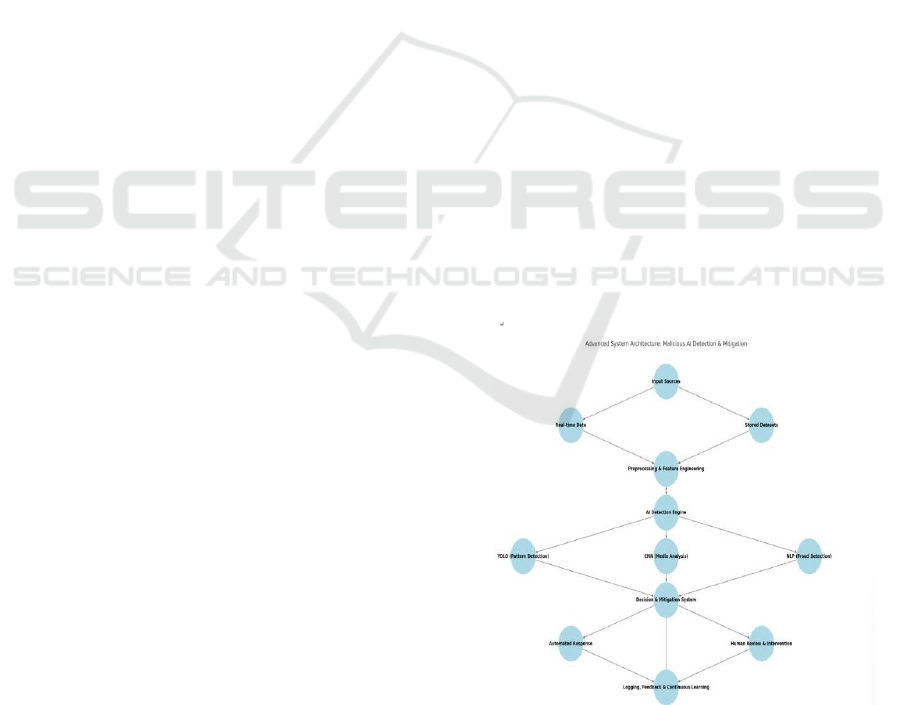
As shown in Figure 1, the advanced system
architecture for malicious AI detection and
mitigation illustrates the key components involved in
identifying and responding to AI-driven threats.
Figure 1: Advanced system architecture malicious AI
detection and mitigation.
Advanced system architecture for Malicious AI
Detection & Mitigation serves as a multi-layered
Malicious AI: Understanding and Mitigating the Risks
49
security mechanism against AI-based threats. It starts
with input sources, gathering information from real-
time streams and stored datasets. Preprocessing and
feature engineering are applied to the data, wherein
unnecessary information is removed and critical
patterns are identified. The AI Detection Engine then
intervenes, using YOLO to recognize patterns, CNN
to analyze media, and NLP to detect fraudulent text -
all of them operating in parallel to flag suspicious
activity. After the threats are identified, the Decision
& Mitigation System decides the best course of
action. Simple ones are addressed through automated
responses, while complex ones are passed on for
human review. The system logs information in real-
time and learns from previous events, allowing it to
grow and change over time to respond to emerging
threats. This fluid integration of AI smarts and human
guidance forms a robust, self-learning security
platform that can identify, counter, and prevent AI-
based cybercrimes. Table 1 Shows the Key Features
of the Malicious AI Detection System.
Table 1: Key features of the malicious AI detection system.
Feature Description
AI-Driven
Threat
Detection
Employs deep
learning
algorithms like
YOLO, CNN,
and NLP to
detect
malicious AI
behavior, such
as counterfeit
media, spam
text, and
adversarial
attacks.
Adaptive
Learning
Mechanism
Constantly
enhances threat
detection
accuracy
through
analysis of
previous
incidents and
the revision of
AI models.
4.3 Algorithm
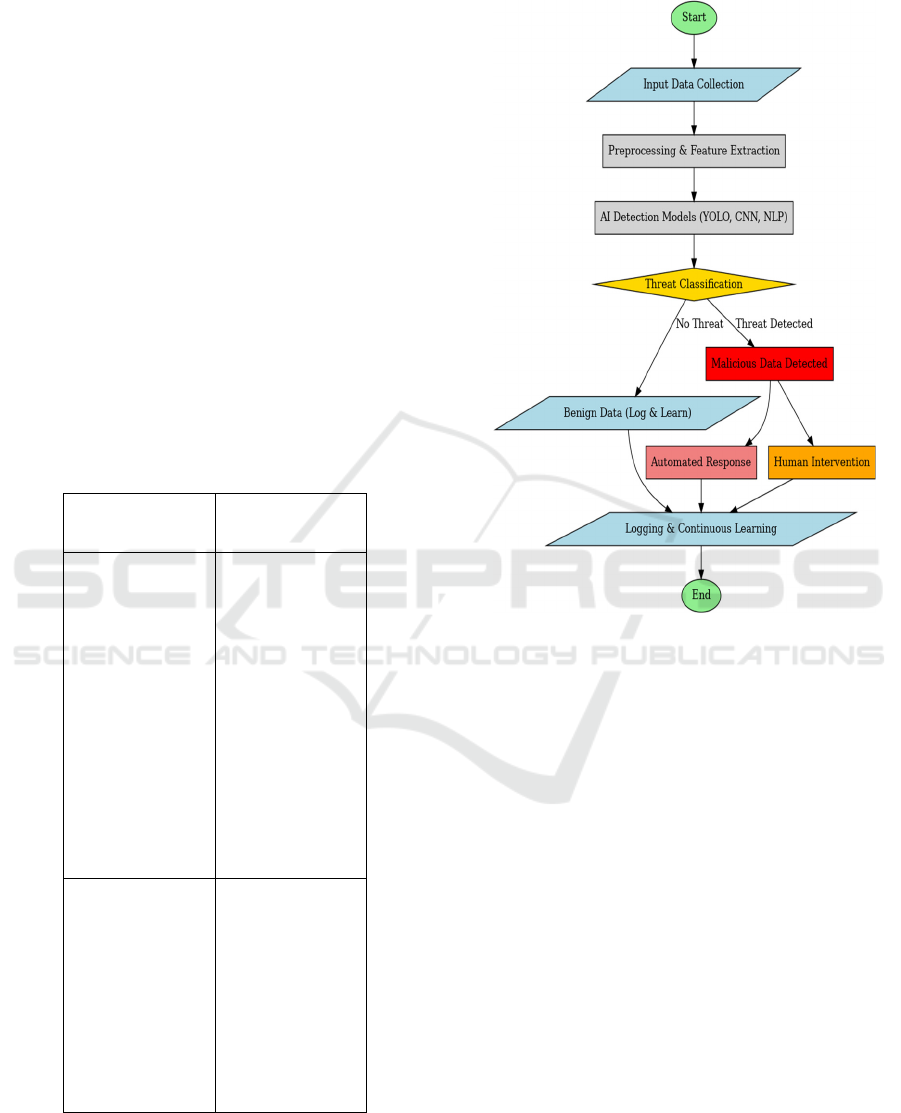
Figure 2: Workflow of malicious AI detection and
mitigation using automated and human responses.
4.4 Result of the Flowchart Execution
This Figure 2 illustrates the complete process of AI-
driven threat detection and mitigation through an
intelligent AI- based system. The procedure is as
follows: Start: The system begins, preparing to
receive input data. Input Data Collection: Live or pre-
stored data such as text, images, video are collected
from sources. Preprocessing & Feature Extraction:
The received data are cleaned and converted,
extracting features relevant to them AI Detection
Models (YOLO, CNN, NLP): Machine learning
models are applied to processed data to identify
possible threats:
• YOLO (You Only Look Once) identifies
malicious visual data
• CNN (Convolutional Neural Networks) scans
media for deepfakes.
• NLP (Natural Language Processing) detects
fraud or AI- manipulated.
Threat Classification:
The AI system labels the input as safe or malicious.
ICRDICCT‘25 2025 - INTERNATIONAL CONFERENCE ON RESEARCH AND DEVELOPMENT IN INFORMATION,
COMMUNICATION, AND COMPUTING TECHNOLOGIES
50

If there is no threat, the information is logged for
learning. If a threat is identified, mitigation measures
are activated. Mitigation Strategies:
The system takes one or both of the following
actions such as Automated Response such as system
blocks, quarantines, or alerts security teams to the
malicious activity. Logging & Continuous Learning:
All data, irrespective of the categorization, is logged
for learning in the future, enhancing the AI capability
to identify threats as time progresses.
End: The process terminates, assuring that AI-
based threats are properly addressed.
5 RESULTS AND DISCUSSIONS
Table.1: The table depicts a list of AI threat detection
tasks, each with an arrival time, execution time,
threat level, mitigation plan, and deadline
specified. T1 (Deepfake Image) occurs at time 0,
takes 4 execution units, is high-risk, and needs to be
countered by time 9 via automated image blocking.
T2 (Phishing Email) occurs at time 1, takes 2
execution units, has a medium level of threat, and is
countered via NLP-based filtering prior to time 7.
T3 (AI-Generated False News) comes in at time
3, takes 5 execution units, is high-priority, and needs
to be processed through AI-enabled manual review
prior to time 12.
T4 (Synthetic Speech Deception) is a low-risk
activity that comes in at time 5, takes 3 execution
units, and needs to be logged and monitored prior to
time 10.
T5 (Malicious AI-Generated Code) is a medium-
risk AI- generated attack, that occurs at time 7, needs
6 execution units, and is scanned in a sandbox prior
to time 14.
Table1: Task dataset for malicious AI detection & mitigation.
Task ID Input Type Arri
val
Tim
e
Execution
Time
Threat Level
(1=High,
2=Medium,
3=Low
)
Mitigation Strategy Deadlin
e
T1 Ima
g
e
(
Dee
p
Fake
)
0 5 1
(
Hi
g
h
)
Automated Blockin
g
8
T2 Text (Phishing
Email
)
2 3 2 (Medium) NLP-based Filtering 7
T3 Video AI Generate
d
4 6 1
(
Hi
g
h
)
Manual Review 11
T4 Voice (Speech
Fraud)
6 4 3 (Low) Logging and
Monitoring
12
T5 Code (Malicious AI
Script)
8 7 2 (Medium) AI Analysis 16
The plot "AI-Driven Threats vs. Mitigation System
Over Time" provides a representation of the
interaction of the number of threats identified
through AI-driven means and the effectiveness of
mitigation systems from 2016 to 2024. The y-axis
represents the number of AI driven systems and
threats detected along with the effectiveness in
mitigation as a percentage, while the x-axis
represents the year. At first, in the year 2016, the
count of detected AI-driven threats was
comparatively lesser, and so was the level of
mitigation. But as the years go by, the number of
threats detected grows considerably, reaching 1500
in 2024. At the same time, the mitigation efficiency
improves steadily, which means that the suggested
system improvements have been successful in scaling
the threat mitigation efficiency. By 2024, the
mitigation effectiveness is high as a percentage,
indicating that the system is better equipped to
manage the increasing number of threats.Overall, the
graph points out the growing threat posed by AI-
based threats and the relative development in
mitigation technologies to offset the threats
efficiently over the years.
REFERENCES
Hassan, R., & Ali, S. (2021). Autonomous Weapons and AI
Ethics: Legal Challenges and Regulatory Measures.
Journal of Ethics in AI and Robotics, 4(1), 25-39.
Iyer, M. R., Kumar, S. P., & Deshmukh, V. L. (2020).
Dynamic Routing Algorithms for 6G Networks: An
AI/ML Approach. Journal of Network and Computer
Applications, 56(4), 102-118.
Jha, A. P., & Jain, A. (2021). AI-Based Countermeasures
for Social Engineering Attacks. Computational
Intelligence and Security, 14(4), 53-69.
Mehta, E. S. P., Iqbal, K. V., & Thakur, R. L. (2021).
Machine Learning for Proactive Fault Detection in 6G
Networks. Journal of Machine Learning and
Communications, 7(3), 178-189.
Malicious AI: Understanding and Mitigating the Risks
51

Reddy, C. T. V., Gupta, P. S., & Joshi, K. H. (2020). Real-
Time Traffic Prediction for 6G Networks Using Deep
Learning. IEEE Transactions on Neural Networks and
Learning Systems, 31(5), 1763-1776.
Roth, L. A., & Squires, A. P. (2020). Combating AI-
Driven Misinformation: Deepfake Detection
Techniques. International Journal of Digital Forensics,
22(1), 99-110.
Sharma, A. J., Verma, P. R., & Nair, S. T. (2021). AI-
Driven Optimization for 6G Networks: A Survey on
Proactive Management Strategies. Journal of Artificial
Intelligence Research, 40(2), 112-130.
Singh, D. N. K., Patel, R. B., & Choudhary, M. A. (2021).
AI-Based Resource Allocation in 6G Networks: A
Comparative Analysis. Journal of Wireless
Communication and Networking, 2021(6), 512-530.
Yin, J., & Zhang, X. (2022). Detecting Malicious Use of
Artificial Intelligence in Cybersecurity. Journal of
Cybersecurity & Privacy, 8(2), 45-62.
Zhang, W., & Lee, D. (2022). Protecting Privacy in AI
Systems: Approaches and Challenges. International
Journal of Privacy and Data Security, 12(2), 201-212.
ICRDICCT‘25 2025 - INTERNATIONAL CONFERENCE ON RESEARCH AND DEVELOPMENT IN INFORMATION,
COMMUNICATION, AND COMPUTING TECHNOLOGIES
52
