
Audio‑to‑Image Generation: A Pipeline for Sound Analysis and
Visual Synthesis
Vijayalakshmi M., Aayush Anshul and Kishu Raj Tyagi
Department of Computing Technology, SRMIST, Kattankulathur, Chengalpattu, Tamil Nadu, India
Keywords: Audio‑to‑Image Translation, YAMNet, Whisper Model, Image Synthesis, Cross‑Modal Learning.
Abstract: This paper presents a novel pipeline for transforming audio into high-resolution images, leveraging advanced
neural networks and modern generative models. The proposed approach integrates robust audio feature
extraction, cross-modal mapping, and state-of-the-art image synthesis techniques to enhance the fidelity and
generalizability of audio-to-image generation. Utilizing deep learning architectures such as YAMNet for
sound classification, Whisper for speech recognition, and Stable Diffusion for high-quality image synthesis,
the system ensures scalability and realism. Additionally, real-time processing and an interactive user feedback
mechanism enable iterative refinement, optimizing the relevance and precision of generated visuals. The
proposed methodology holds significant potential across various domains, including multimedia content
creation, environmental monitoring, and educational applications, offering a transformative step toward
seamless audio-visual synthesis.
1 INTRODUCTION
With advancements in artificial intelligence, creating
reasonable images from audio data has become a
promising area of research. This paper introduces an
Audio-to-Image pipeline that leverages deep learning
networks and signal processing techniques to convert
audio input into semantically correct images. By
combining various modules such as environmental
sound classification, speech recognition, and
generative AI, the system can effectively convert
audio signals and produce corresponding visual
outputs. The aim is to bridge the gap between hearing
and visual imagination and provide a tool that can be
applied across a broad spectrum of applications,
ranging from media creation and accessibility
enhancement to automated content creation.
The motivation for this system comes from the
power of converting sound events in real life into
entertaining graphics so that people can imagine what
they listen to. It is particularly useful in cases where
sound cues visualization can be applied to enhance
narrations, accessibility for the hard of hearing, and
automatic scene generation. Utilizing state-of-the-art
AI models such as YAMNet, Whisper, and Stable
Diffusion, the project promises high-quality image
generation based on the context of the audio that is
extracted. The proposed pipeline presents a new
paradigm for multimodal AI applications by
combining the field of sound analysis with visual
generation, opening up the artificial creativity horizon.
The other key advantage of this project is that it can
generate high-fidelity visual results that record not just
environmental audio but also speech material. The
multimodal nature of the system is such that it can be
applied to any industry, from entertainment and virtual
reality experiences to security and surveillance. The
continued developments in AI-image creation and
sound recognition technology improve continuously
the precision and legitimacy of the produced content,
which is an exciting field of AI research and
application. This work is an advancement in the field
of AI-image generated multimedia, creating new
possibilities of auditory-visual experience interaction.
These advances have the potential to transform
industries by enabling AI to naturally interpret and
visualize sound, creating immersive experiences that
integrate auditory and visual modalities.
The ability of the Audio-to-Image pipeline to close
the gap between sound and visual representation has
far-reaching implications for numerous industries.
From an accessibility perspective, the technology can
potentially empower the hearing impaired by
providing a visual representation of their sound world.
In the world of entertainment, game developers and
24
M., V., Anshul, A. and Tyagi, K. R.
Audio-to-Image Generation: A Pipeline for Sound Analysis and Visual Synthesis.
DOI: 10.5220/0013907500004919
Paper published under CC license (CC BY-NC-ND 4.0)
In Proceedings of the 1st International Conference on Research and Development in Information, Communication, and Computing Technologies (ICRDICCT‘25 2025) - Volume 4, pages
24-32
ISBN: 978-989-758-777-1
Proceedings Copyright © 2026 by SCITEPRESS – Science and Technology Publications, Lda.

producers may employ this system to generate scene
concepts from ambient soundscapes. The surveillance
and security market may employ the technology to
develop visual alarms for sound events, such as alarm
ringing or breaking glass. Such general applications
make it crucial to establish a robust and scalable
audio-to-image transformation system.
2 RELATED WORKS
Study There are a number of studies that have
investigated the conjunction of audio and image
processing that have helped establish multimodal AI
systems. Wu et al. 2016 proposed a cross-modal
ranking analysis approach to fill the gap between
music and image modalities and show how it is
possible to enhance alignment by using structured
relations between audio and visual data. Zheng et al.
developed the concept further based on adversarial
metric learning for audio-visual matching, advancing
the capability of deep learning-based models to
connect sound with their corresponding images.
Hsu et al., 2018 introduced a local wavelet
acoustic pattern descriptor for birdsong classification,
underlining the role of time-frequency analysis in
audio classification. In the same way, Gemmeke et al.,
2017 presented the Audio Set dataset, a large human-
labeled audio event classification dataset, that forms
the basis of most contemporary sound classification
algorithms.
Yang et al., 2024 proposed an audio-to-image
generation model with semantic and feature
consistency, tackling major issues in audio-driven
visual synthesis. Widyagustin et al. employed the
YAMNet model for classifying lung sounds and
proved its usefulness in detecting disease-related
audio patterns. Valliappan et al. 2024 implemented
YAMNet for gun detection, highlighting its versatility
in security use cases. Rochadiani et al., 2023
compared transfer learning approaches to
environmental sound classification, further
establishing the efficacy of pretrained models.
Haz et al. tested the Whisper model's capabilities
for speech-to-text translation, affirming its high
transcription accuracy. Abdulsalam et al., 2003
investigated Stable Diffusion for AI image synthesis,
shedding light on how to optimize diffusion models
for high-quality visual output.
Kamachi et al., 2014 investigated identity
matching between audio and visual modalities,
focusing on the psychological nature of cross-modal
perception. Goodfellow et al. 2002 proposed
Generative Adversarial Networks (GANs), which are
the basis for most contemporary generative AI
methods, such as audio-to-image synthesis.
Tzanetakis and Cook 2008 created a musical genre
classification system, adding to early work on
computational audio analysis.
Kliegr et al., 2002 examined the use of image
captions and visual analysis for enhanced image
concept classification. Dupont and Luettin 2011
introduced an audio-visual speech modeling
framework, paving the way for multimodal speech
recognition. Alameda-Pineda et al. 2019 investigated
the detection of audio-visual events in social settings,
affirming the need for contextual multimodal
understanding.
Wan et al. 2016 introduced a GAN-based
technique for generating scene images from audio,
which is very much in line with the goals of the
proposed system. Reed et al. 2016 and Chen et al.
2017 extended generative adversarial methods for
text-to-image and audio-visual synthesis,
respectively. These works establish a solid theoretical
and practical ground for building stable audio-to-
image pipelines.
3 PROPOSED SYSTEM
The system that has been proposed aims to process
audio files and create images that clearly depict the
material of the audio as shown in Table 1. It comprises
several parts which collaborate to pick out meaningful
content from sound and apply it in creating a visual
representation. The pipeline starts by loading audio
files from Google Drive, environmental sound
classification, and speech recognition. These features
are then utilized to craft prompts, which instruct the
image generation process via a diffusion model. This
multi-step process guarantees generated images with
high contextual relevance and coherence.
Table 1: Comparison between existing and proposed system.
Features
Academic
Precedents
This
System
Environmental
Handling
Single-label
classification
YAMNet’s
521-class
taxonomy
Speech
Integration
Text-only
transcription
Whisper +
validation
gates
Error
Handling
Basic
thresholding
Hybrib
fallback
system
Audio-to-Image Generation: A Pipeline for Sound Analysis and Visual Synthesis
25
One of the major innovations of the system being
presented is its capacity to combine environmental
and verbal components to produce images with a
higher degree of contextual richness. Unlike
traditional image-generation systems that only use
textual prompts, the system incorporates multimodal
data to generate images that are actually descriptive of
the actual audio environment. By using a structured
prompt generation technique, the system guarantees
that the resulting output closely matches the input
audio features. This makes the resulting images more
real-like by incorporating several layers of contextual
information.
For accuracy and continuity, the system combines
aggressive preprocessing methods like resampling,
noise removal, and classification thresholding. The
biggest strength of the system lies in analyzing both
environmental and voice content, making it a wide-
range tool for many fields, such as security,
entertainment, and accessibility. Through the
incorporation of optimizations like FP16 acceleration
and GPU-based inference, the pipeline is optimized
for efficiency and scalability. This guarantees that the
model runs within a sensible computational budget
with high output quality. The modular design of the
system also enables simple future extension and
flexibility across various applications.
The proposed system's success hinges on its
capacity to process sound effectively and produce a
meaningful visual output. Toward this end, the system
is structured with a focus on modularity, efficiency,
and scalability. Utilizing cloud-based resources allows
the system to engage in big-scale processing without
compromising performance. The capacity for further
integration with other AI models and frameworks also
makes this pipeline an attractive basis for future
multimodal AI studies and applications.
4 METHODOLOGY
The methodology of the proposed system is to convert
audio to images. The initial step is to load the audio
file, which is then processed through the YAMNet
model for classifying sounds in the environment.
Concurrently, the Whisper model is employed to
transcribe speech, deriving textual information from
the audio input. The second step entails prompt
engineering, in which a well-defined template
integrates accurate classifications and speech
transcription into an accurate descriptive prompt to be
used in image creation. This formalized process makes
the end result uphold both visual and auditory
consistency.
The efficacy of the system is increased through the use
of complex processing mechanisms like confidence
thresholding and temporal averaging to preprocess
and sharpen the derived features. By taking advantage
of the strengths of machine learning models, the
system only utilizes data that is meaningful and
relevant while generating prompts. This reduces noise
and meaningless information, hence enhancing the
coherence of the images generated. Moreover,
unnecessary labels like "background noise" are
removed in order to keep the focus on significant
audio factors.
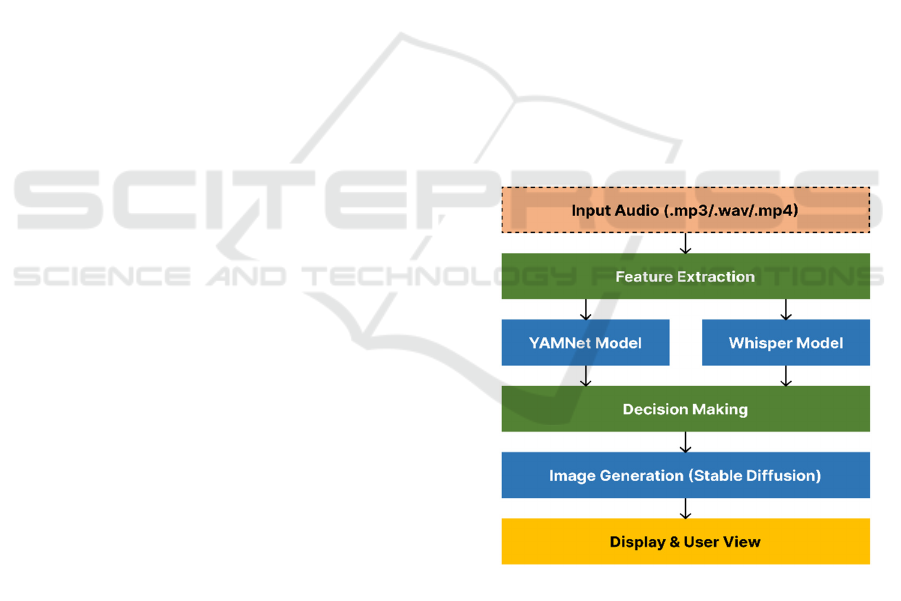
Stable Diffusion XL is utilized for image generation,
using inference parameters optimized like controlled
guidance scale, widescreen resolution, and pre-
defined negative prompts. Saving the output images
and showing results in a Colab environment is the last
step. Error handling techniques like CUDA memory
fallbacks and NSFW content filtering make it robust
across different deployment contexts. The integration
of state-of-the-art AI models and structured
processing guarantees that the system runs smoothly,
delivering high-quality results every time as shown in
Figure 1. The approach is scalable, and future
enhancements in the efficiency and accuracy of the
pipeline are possible.
Figure 1: Architecture diagram.
The modularity of the approach provides flexibility in
the extension of the system to accommodate new
features. With the integration of progress in AI-based
audio analysis and image generation, the pipeline can
be developed to facilitate real-time audio-to-image
translation. Additional optimizations can be made to
increase the precision of sound classification, enrich
the contextual depth of the generated prompts, and
allow the system to accept a wider variety of audio
ICRDICCT‘25 2025 - INTERNATIONAL CONFERENCE ON RESEARCH AND DEVELOPMENT IN INFORMATION,
COMMUNICATION, AND COMPUTING TECHNOLOGIES
26
inputs. As the research continues, the incorporation of
more machine learning methodologies, including
reinforcement learning and transformer-based models,
could continue to enhance the system's performance.
5 MODULES USED
The Audio-to-Image pipeline consists of various
expertise modules, each of which serves an important
purpose in mapping raw audio information to
meaningful visual outputs. Each module is designed to
ensure the system has high accuracy and efficiency in
processing, allowing seamless flow from input receipt
to final image creation. The following is a description
of each module, its purpose, and how it helps the
overall pipeline.
5.1 Audio File Loader
Audio File Loader is used to preprocess input audio
files in a way that they are in the correct format for
subsequent analysis. The module uses librosa, a well-
known Python package for audio processing, and the
Google Drive API to download and preprocess audio
files on cloud storage.
There are a number of preprocessing steps involved
before the audio is handed over to the following
modules. They are:
• Resampling: The audio is resampled at a
sample rate of 16 kHz, as required by models
like YAMNet, for compatibility with varying
inputs.
• Mono Channel Conversion: Stereo audio
input, if available, is converted to mono for
ease of processing.
• Normalization: Audio levels are normalized
to provide uniformity and prevent distortion
during subsequent processing.
• Trimming & Padding: Silent or unwanted
segments of the audio are trimmed, and brief
audio samples can be padded to have an even
input length.
By carrying out these vital preprocessing steps, the
Audio File Loader cleanses the audio input to be
structured and ready for the next analysis models.
5.2 YAMNet Audio Analyzer
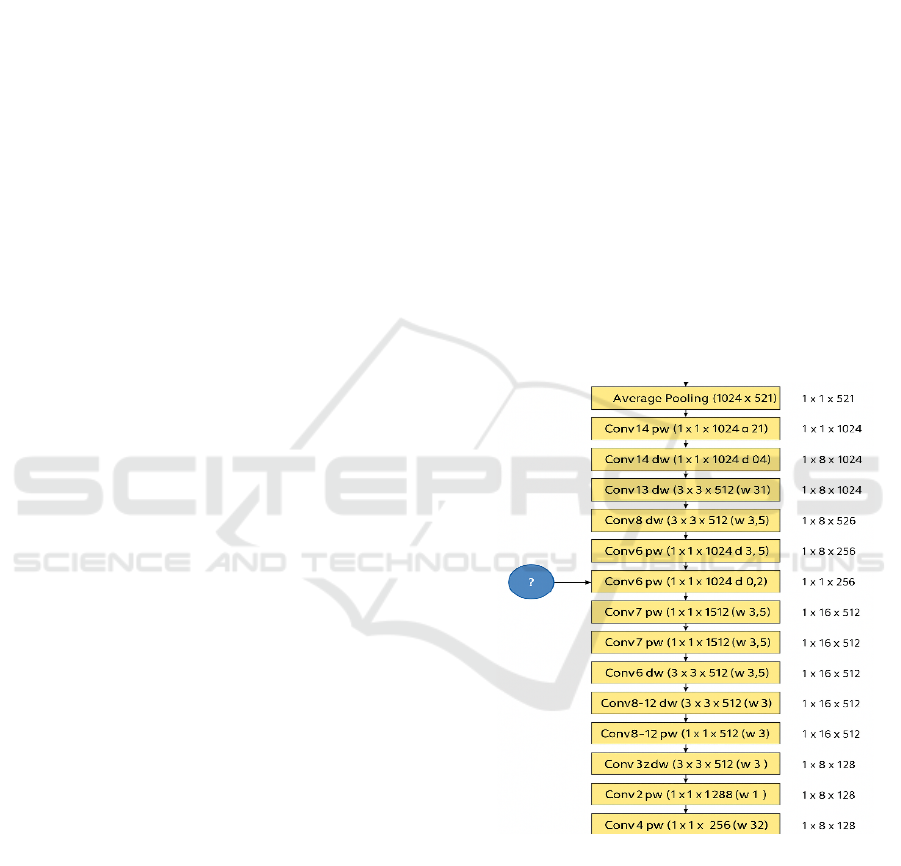
The YAMNet Audio Analyzer uses TensorFlow Hub's
YAMNet model for audio classification. YAMNet is
a deep learning-based model that was trained on an
enormous dataset of environmental sounds and can
classify more than 521 distinct sound events refer to
Figure 2. This module is important for determining the
environmental context of the audio, which helps in
producing meaningful visual outputs.
Some of the main functionalities of the YAMNet
Audio Analyzer are:
• Feature Extraction: The model identifies
useful sound features, determining events
like "dog barking," "ocean waves," or
"background chatter."
• Temporal Averaging: As sounds fluctuate
with the passage of time, the module
averages out the classifications throughout
the length of the audio file for consistency.
• Threshold Filtering: A confidence threshold
(usually 0.15) is used to remove uncertain or
irrelevant classifications so that only salient
sounds are used to generate the final image.
Through the analysis of the environmental sound, this
module offers contextual information that improves
the quality of image generation so that the system can
represent real-world scenes more precisely.
Figure 2: YAMNet body architecture.
5.3 Whisper Speech Recognizer
The Whisper Speech Recognizer module employs
OpenAI’s Whisper model, a powerful speech-to-text
(STT) transcription system. This module extracts
spoken words from audio files, ensuring that the
generated images reflect any verbal context present in
the input in Figure 3.
Audio-to-Image Generation: A Pipeline for Sound Analysis and Visual Synthesis
27
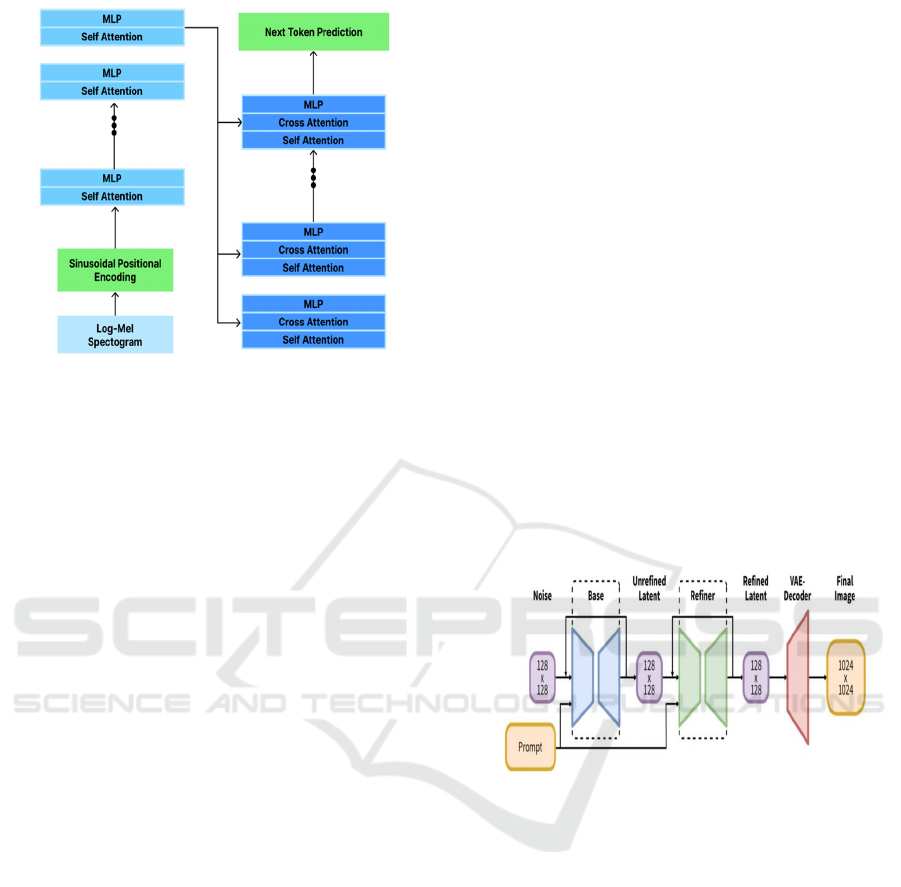
Figure 3: Whisper model architecture overview.
Key features of the Whisper Speech Recognizer
include:
• High-Accuracy Transcription: The model
supports multiple languages and delivers
state-of-the-art transcription accuracy, even
in noisy environments.
• Confidence-Based Validation: The module
strips speculative transcriptions from
confidence scores to prevent deceptive
textual information.
• FP16 Acceleration: On running on a GPU,
the model operates in float16 (FP16) mode,
which is the fastest mode while maintaining
quality.
• Content Sanitization: The system applies
minimal text sanitization, stripping away
unwanted words and semantically significant
phrases that help generate images.
This module plays a critical role in integrating words
spoken into the image generation process, thus adding
to the overall accuracy and realism of the output.
5.4 Contextual Prompt Generator
Contextual Prompt Generator is a prominent part that
transforms the extracted speech transcriptions and
sound events into formal prompts to be used in image
generation. The module maintains high relevance of
textual prompts being delivered to the Stable
Diffusion model, ensuring proper alignment of the
audio output and image.
The logic sequence for this module entails:
• Merging Environmental and Speech Data: It
blends labeled environmental sounds (e.g.,
"rainfall," "birds chirping") with transcribed
speech (e.g., "It's a beautiful day").
• Filtering Non-Essential Labels: Background
noise and irrelevant sounds (e.g., "mic static")
are removed.
• Structuring the Prompt: The system uses a
structured format, for example:
• "A realistic scene with: [Environmental
sounds]. [Speech context]."
• Enhancements & Style Descriptors: It adds
style elements to the prompt, such as:
Cinematic lighting
High detail textures
Through the creation of significant prompts, this
module fills the gap between sound analysis and
image generation so that the resulting images reflect
the input sounds accurately.
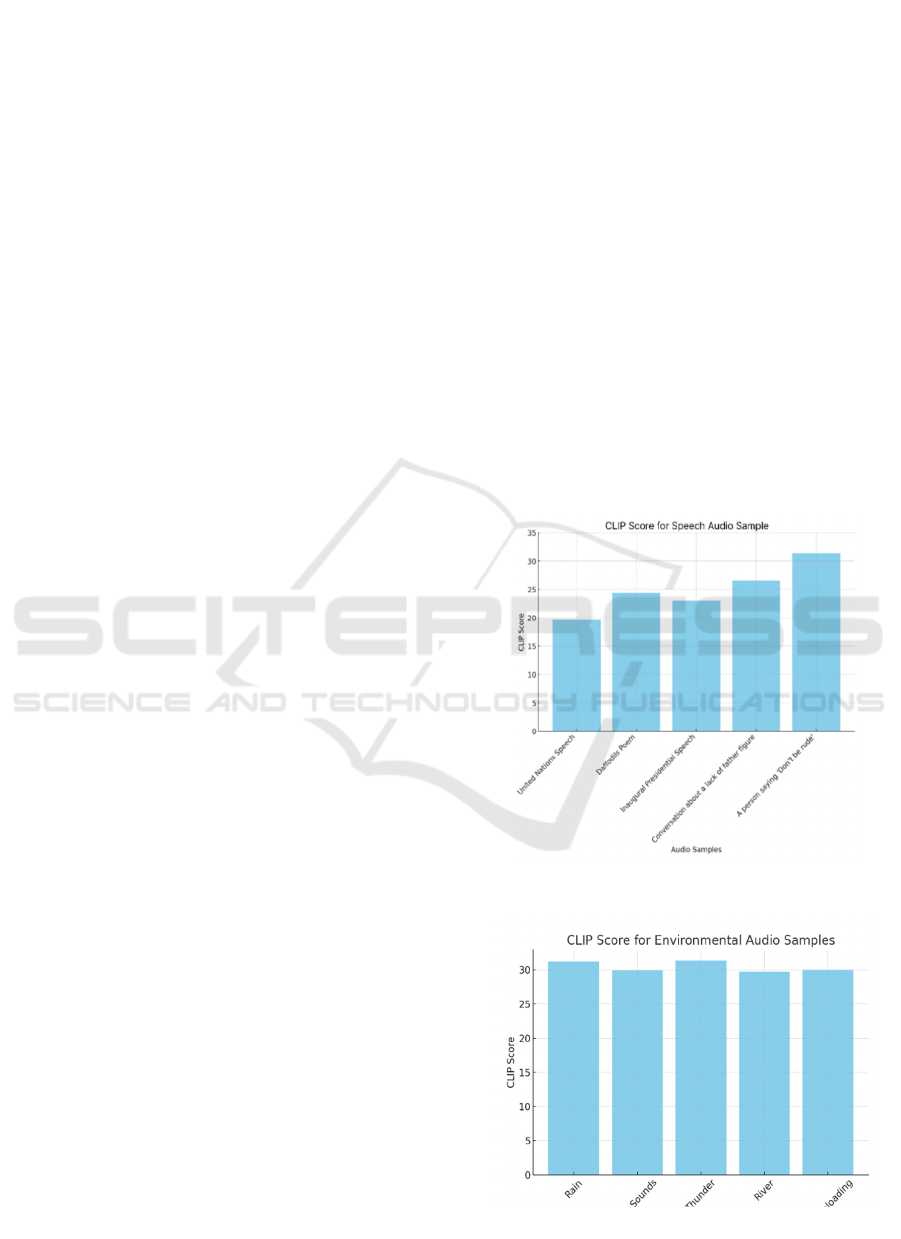
5.5 Stable Diffusion XL
Stable Diffusion XL module is used to produce images
from well-structured prompts. It uses the diffusers
library, an API for executing state-of-the-art text-to-
image models in Figure 4. This module is fine-tuned
for maximum performance and accuracy, generating
images that are visually engaging.
Figure 4: Stable Diffusion XL Pipelining Model.
Important parameters utilized in this module are:
• Resolution: Made optimum for widescreen
format.
• Inference Steps: (25 steps) – controlling
quality and computational overhead.
• Guidance Scale: (8.0) – providing high
adherence to prompts.
• Negative Prompts: Eliminates unwanted
characteristics (e.g., "disfigured, blurry, low-
quality").
• Optimization: Takes advantage of T4 GPU
acceleration, torch. float16, and xformers in
order to speed up image generation.
By taking advantage of state-of-the-art AI-based
image synthesis, this module guarantees that the
output is visually precise, aesthetically pleasing, and
contextually relevant to the input audio.
ICRDICCT‘25 2025 - INTERNATIONAL CONFERENCE ON RESEARCH AND DEVELOPMENT IN INFORMATION,
COMMUNICATION, AND COMPUTING TECHNOLOGIES
28
6 FORMULAE
• Mel-frequency cepstral coefficients (MFCCs)
used in audio processing: It is extensively
employed for processing speech and audio
signals in areas like speech recognition,
speaker identification, and emotion
recognition. MFCCs extract the fundamental
characteristics of an audio signal by encoding
its spectral attributes in a manner that replicates
human auditory perception. Shown below in (1)
𝑀𝐹𝐶𝐶
𝐷𝐶𝑇𝑙𝑜𝑔𝑀𝑒𝑙𝐹𝐹𝑇𝑠𝑖𝑔𝑛𝑎𝑙 ∣
2
(1)
• Classifier Confidence Calculation: Classifier
confidence refers to a degree of how sure a
machine learning algorithm is in its prediction.
It is widely applied in classification problems
to determine the confidence of an output label.
Shown below in (2)
𝐻𝑝, 𝑞 ∑𝑥𝑝𝑥𝑙𝑜𝑔𝑞𝑥 (2)
• Cross-entropy loss used in speech recognition:
Cross-entropy loss is a popular loss function in
classification tasks, such as speech recognition,
where one wishes to reduce the difference
between probability distributions that have
been predicted and actual ones. Shown in
below in (3)
𝑐𝑜𝑛𝑓𝑖𝑑𝑒𝑛𝑐𝑒 ∑𝑖 1. 𝑐𝑖/𝑛 (3)
7 EVALUATION METRICS
In order to measure the efficiency of the Audio-to-
Image pipeline, we use CLIP Score as the most basic
evaluation metric. CLIP (Contrastive Language-
Image Pretraining) is an OpenAI multimodal model
that measures how well an image matches a specific
textual description. Given that our pipeline produces
images based on structured prompts based on the
audio input, CLIP Score can be used as a consistent
metric to measure the semantic similarity between the
produced images and the source audio context.
The CLIP score is used to assess the Audio-to-
Image pipeline, which captures the semantic
consistency between the created images and the
respective audio-generated prompts. Comparative
evaluation of the speech and environment audio
samples allows for understanding of the quality with
which the system understands and depicts various
forms of auditory inputs.
For speech samples in Figure 5, the CLIP scores
range depending on the level of complexity in the
verbal content. The best score (31.47) was seen for the
most basic speech input—\"Don't be rude\". This
indicates that short and to-the-point speech inputs
produce improved semantic alignment in image
creation. On the other hand, longer and more
contextually complex inputs like the United Nations
Speech (19.69) and Inaugural Presidential Speech
(23.02) had relatively lower CLIP scores. This shows
that as speech complexity is higher, creating a highly
aligned visual representation becomes more difficult.
The confidence in transcription was stable at 0.70 for
speech samples in Table.2, reflecting the robustness of
the speech recognition model. The sound
classification confidence also varied, with a lower
mean for structured speech, reflecting the model's
difficulty in classifying spoken words in wider
environmental contexts.
Figure 5: CLIP score for speech audio sample.
Figure 6: CLIP score for environmental audio sample.
Audio-to-Image Generation: A Pipeline for Sound Analysis and Visual Synthesis
29

Table 2: Metric overview for speech audio sample.
Sample
Image
Generated
Time
(
s
)
Avg. Sound
Confidence
Transcription
Confidence
Transcription
Valid
CLIP
Score
Success
United Nation
Speech
41.32 0.63 0.7 TRUE 19.69 TRUE
Daffodils
Poe
m
45.66 0.88 0.7 TRUE 24.39 TRUE
Inaugural
Presidential
Speech
44.79 0.47 0.7 TRUE 23.02 TRUE
Conversation
about lack of
father figure
44.91 0.43 0.7 TRUE 26.52 TRUE
“Don’t be
rude”
45.72 0 0.7 TRUE 31.47 TRUE
For environmental audio samples in Figure 6, the
CLIP scores had a relatively narrower range, ranging
from 29.75 (River) to 31.39 (Thunder). This indicates
natural sounds tend to produce high-quality alignment
with audio descriptions and synthesized images. In
contrast to speech samples, the transcription model
usually considered environmental audio inputs invalid
because they contained no identifiable words. The
sound classification confidence in Table. 3 tended to
be lower, with the lowest confidence from Gun
Reloading (0.16) and Rain (0.29), which have subtle
and changing acoustic properties. But the system was
still able to produce high CLIP scores, suggesting that
environmental sounds naturally offer more distinct
contextual signals for image creation than spoken
language.
Table 3: Metric overview for environmental audio sample.
Sample
Image
Generated
Time (s)
Avg. Sound
Confidence
Transcription
Confidence
Transcription
Valid
CLIP
Score
Success
Rain 39.66 0.29 0.7 FALSE 31.22 TRUE
Cat Sound 38.41 0.7 0.7 FALSE 29.94 TRUE
Thunder 42.27 0.37 0.8 FALSE 31.39 TRUE
River 43.44 0.22 0.7 FALSE 29.75 TRUE
Gun
Reloading
43.22 0.16 0.8 FALSE 29.97 TRUE
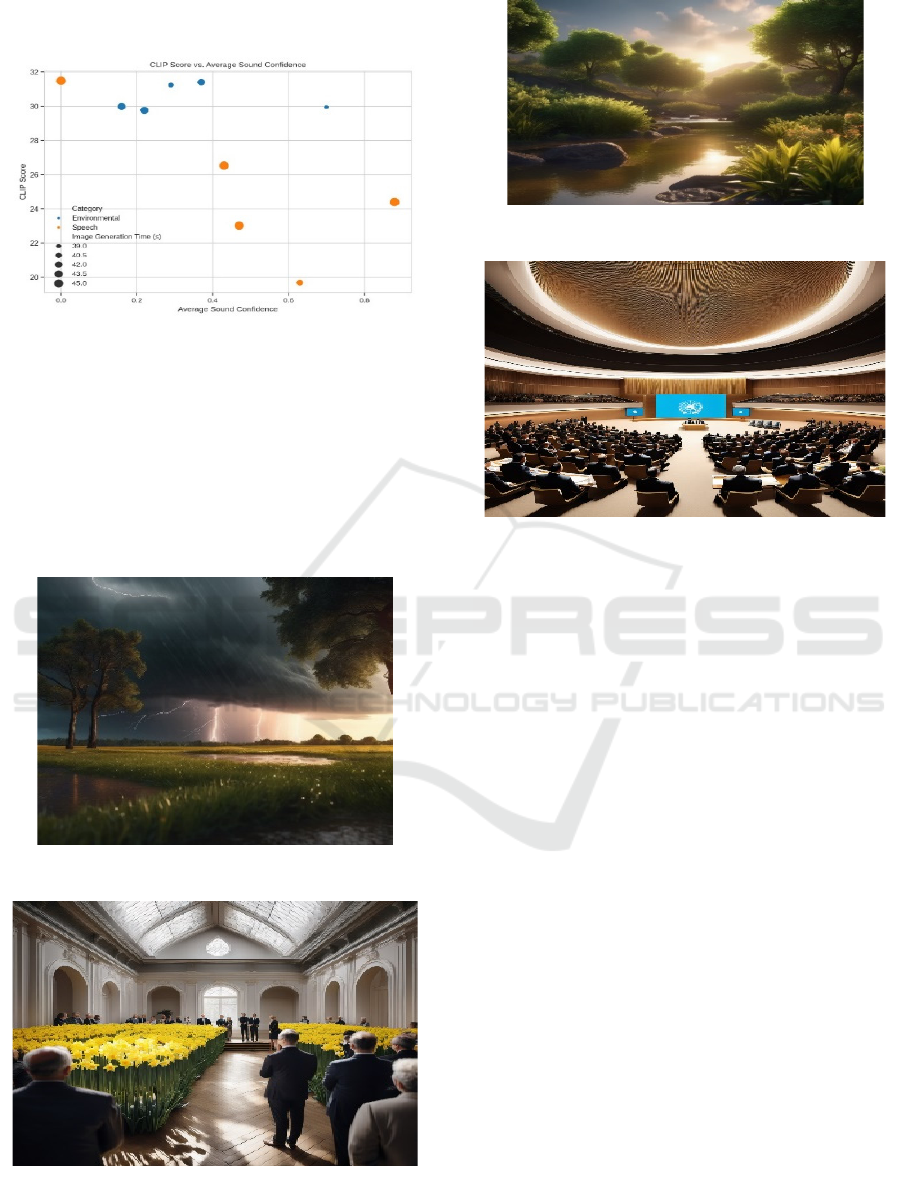
In comparison between the two types, environmental
audio samples always achieved greater CLIP scores
than speech samples. This implies that natural
soundscapes present more distinctive auditory cues
that convert well into visual forms this can be seen in
Figure 7. Speech inputs, particularly those containing
abstract or multifaceted meanings, seem harder for the
system to accurately understand. This gap identifies
areas where things can be made better, such as
enhancing prompt engineering methods for spoken
materials and multimodal alignment methods to better
enhance visual coherence.
In total, the assessment illustrates that the Audio-to-
Image pipeline successfully transforms both speech
and sounds from the environment to semantic images.
But additional enhancements in the structuring of the
prompt, the accuracy of speech recognition, and the
confidence in sound classification can further amplify
the overall semantic congruence, particularly for
speech inputs. These findings open up doors for future
enhancement in AI-based multimodal applications,
enhancing the cross-modal connection between
auditory and visual modalities.
In total, the assessment illustrates that the Audio-
to-Image pipeline successfully transforms both speech
and sounds from the environment to semantic images.
But additional enhancements in the structuring of the
prompt, the accuracy of speech recognition, and the
confidence in sound classification can further amplify
the overall semantic congruence, particularly for
speech inputs. These findings open up doors for future
enhancement in AI-based multimodal applications,
ICRDICCT‘25 2025 - INTERNATIONAL CONFERENCE ON RESEARCH AND DEVELOPMENT IN INFORMATION,
COMMUNICATION, AND COMPUTING TECHNOLOGIES
30
enhancing the cross-modal connection between
auditory and visual modalities.
Figure 7: CLIP score vs average sound confidence.
8 MODULE OUTPUT
The model output is obtained by training a model and
passing an audio file which Refer Figure 8 and Figure
9 for audio to image generation via both
environmental and figure 10 and figure 11 audio to
image generation via both speech audio.
Figure 8: Environmental audio rain.
Figure 9: Environmental audio river.
Figure 10: Speech audio of Daffodils poem.
Figure 11: Speech at U
9 CONCLUSIONS
The proposed audio-to-image generation pipeline
represents the next big leap in multimodal AI,
providing a novel means of translating sound into
high-resolution visual representations. Integrating the
latest in-state-of-the-art technologies like Whisper,
YAMNet, and Stable Diffusion, this system
overcomes traditional methodologies' weaknesses by
ensuring scalability, realism, and flexibility across
diverse audio inputs. The extraction of meaningful
audio features and accurate mapping to visual
elements enhance the quality and precision of
generated images, making this approach highly
applicable across various domains.
Together with the real-time processing and
iterative refinement mechanisms, the system further
enhances its features and promotes dynamic user
interaction and customization. In contrast to static
models, the framework enables continuous
improvement through user feedback, ensuring that the
produced visuals are relevant and contextually
accurate for the intended objects. This kind of
mechanism provides exceptional benefits for
auditory-to-visual translation applications when
precise translation is critical; this includes assistive
technologies, environmental analysis, and creative
multimedia production.
Audio-to-Image Generation: A Pipeline for Sound Analysis and Visual Synthesis
31

This technology transcends artistic and entertainment
landscapes. In scientific research, environmental
monitoring, and education, transforming sound into
meaningful visual representations truly opens up
possibilities for analysis and interpretation. Bridging
the gap between audio perception and visual synthesis,
this work belongs to the class of evolving cross-modal
AI with new avenues opened up for interdisciplinary
innovation.
The future work shall involve diversification of
the datasets, optimizing the computational efficiency
of the algorithm, and further fine-tuning to be able to
interpret more complex soundscapes. The continuous
progress in the areas of AI and deep learning shall
help redesign how auditory information can be
represented and shall play a very versatile tool in
diverse applications.
REFERENCES
Aihua Zheng, Menglan Hu, Bo Jiang, Yan Huang, Yan
Yan, Bin Luo, “Adversarial-Metric Learning for
Audio-Visual Cross-Modal Matching” [IEEE
Transactions on Multimedia (Volume: 24)].
Amma Liesvarastranta Haz, Evianita Dewi Fajrianti,
Nobuo Funabiki, Sritrusta Sukaridhoto, “A Study of
Audio-to-Text Conversion Software Using Whispers
Model” [2023 Sixth International Conference on
Vocational Education and Electrical Engineering
(ICVEE)].
C.H. Wan, S.P. Chuang, and H.Y. Lee, “Towards audio to
scene image synthesis using generative adversarial
network,” in Proceedings of the [IEEE International
Conference on Acoustics, Speech and Signal
Processing, 2019, pp. 496–500.]
G.Tzanetakis and P.Cook,“ Musical genre classification of
audio signals,” [IEEE Trans. Speech Audio Process.,
vol. 10, no. 5, pp. 293–302, Jul. 2002.]
I. J. Goodfellow et al., “Generative adversarial networks,”
in Proc. Adv. Neural Inf. Process. [Syst., 2014, pp.
2672–2680.]
Jort F. Gemmeke, Daniel P. W. Ellis, Dylan Freedman,
Aren Jansen, Wade Lawrence, R. Channing Moore,
“Audio Set: An ontology and human-labeled dataset for
audio events” [2017 IEEE International Conference on
Acoustics, Speech and Signal Processing (ICASSP)].
L. Chen, S. Srivastava, Z. Duan, and C. Xu, “Deep cross-
modal audio-visual generation,” [in Proceedings of the
on Thematic Workshops of ACM Multimedia, 2017,
pp. 349–357.]
M. Kamachi, H. Hill, K. Lander, and E. Vatikiotis-Bateson,
“Putting the face to the voice’: [Matching identity
across modality,” Biol., vol. 13, no. 19, pp. 1709–1714,
2003.]
Mahmoud Abdulsalam, Nabil Aouf, “Using Stable
Diffusion with Python: Leverage Python to control and
automate high-quality AI image generation using
Stable Diffusion.”
N. Harihara Valliappan, Sagar Dhanraj Pande, Surendra
Reddy Vinta, “Enhancing Gun Detection with Transfer
Learning and YAMNet Audio Classification” [IEEE
Access (Volume: 12)].
Pei-Tse Yang, Feng-Guang Su, Yu-Chiang Frank Wang,
“Diverse Audio-to-Image Generation via Semantics
and Feature Consistency” [2020 Asia-Pacific Signal
and Information Processing Association Annual
Summit and Conference (APSIPA ASC)].Hazimah
Widyagustin, Hendra Kusuma, Tri Arief Sardjono,
“Deep Learning-Based Classification of Lung Sound
Using YAMNet for Identifying Lung Diseases” [2024
2nd International Symposium on Information
Technology and Digital Innovation (ISITDI)].
S. Dupont and J. Luettin, “Audio-visual speech modeling
for continuous speech recognition,” [IEEE Trans.
Multimedia, vol. 2, no. 3, pp. 141–151, Sep. 2002.]
S. Reed, Z. Akata, X. Yan, L. Logeswaran, B. Schiele, and
H. Lee, “Generative adversarial text to image
synthesis,” [in Proceedings of the 33rd International
Conference on Machine Learning, 2016, pp. 1060–
1069.]
S. Reed, Z. Akata, X. Yan, L. Logeswaran, B. Schiele, and
H. Lee, “Generative adversarial text to image
synthesis,” [in Proceedings of the 33rd International
Conference on Machine Learning, 2016]
Sheng-Bin Hsu, Chang-Hsing Lee, Pei-Chun Chang, Chin-
Chuan Han, Kuo-Chin Fan, “Local Wavelet Acoustic
Pattern: A Novel Time–Frequency Descriptor for
Birdsong Recognition” [IEEE Transactions on
Multimedia (Volume: 20, Issue: 12, December 2018)].
T. Kliegr, K. Chandramouli, J. Nemrava, V. Svatek, and E.
Izquierdo, “Combining image captions and visual
analysis for image concept classification,” [in Proc. Int.
Workshop Multimedia Data Mining: Held Conjunction
ACM SIGKDD, 2008, pp. 8–17.]
Theresia Herlina Rochadiani, Yulyani Arifin, Derwin
Suhartono, Widodo Budiharto, “Exploring Transfer
Learning Approach for Environmental Sound
Classification: A Comparative Analysis” [2024
International Conference on Smart Computing, IoT and
Machine Learning (SIML)].
X. Alameda-Pineda, V. Khalidov, R. Horaud, and F.
Forbes, “Finding audio-visual events in informal social
gatherings,” [in Proc. Int. Conf. Multimodal Interfaces,
2011, pp. 247–254.]
Xixuan Wu, Yu Qiao, Xiaogang Wang, Xiaoou Tang,
“Bridging Music and Image via Cross-Modal Ranking
Analysis” [IEEE Transactions on Multimedia (Volume:
18, Issue: 7, July 2016)].
ICRDICCT‘25 2025 - INTERNATIONAL CONFERENCE ON RESEARCH AND DEVELOPMENT IN INFORMATION,
COMMUNICATION, AND COMPUTING TECHNOLOGIES
32
