
Dynamic Price Optimization for Ecommerce Platform
G. Uma Bhargavi, M. Balakrishna, H. Shivani, B. Bramhani and D. Pavithra
Department of Computer Science and Engineering Ravindra College of Engineering for Women, Kurnool, Andhra Pradesh,
India
Keywords: e‑Commerce Optimization, Dynamic Pricing, AI‑driven Pricing, Reinforcement Learning, Demand
Forecasting, Competitive Pricing Analysis.
Abstract: An adaptable price adjustment system plays a vital role in developing both e-commerce platform revenues
and interaction with customers. The research adopts an original AI- based strategy to optimize pricing
systems. The solution merges several operational functions that allow real-time price changes as well as
reinforcement learning-based optimization of prices and competitive pricing analysis and market demand
forecasting capabilities. The model employs automatic price mechanisms that adjust product costs in response
to customer interactions and market demand as well as competitive rate alterations by using ML and DL
techniques for integration. Through experimental tests reinforcement learning-based pricing methods
generated an 18% increase of revenue together with 10.2% growth in customer conversion and delivered 13%
better profit margin results. The e-commerce platform provides large companies with a flexible real- time
pricing system that operates rapidly. Through the research evaluation it is shown that AI-based price strategies
create a maximized market position and boost long-term profit while maintaining fair prices across market
changes.
1 INTRODUCTION
The competitive nature of e-commerce demands
digital competitors to use pricing strategies that
develop client relationships together with elevated
sales numbers and profits. Operating online stores
presents a unique set of challenges since markets
show less active demand along with unusual customer
behaviors and demanding business competition.
Traditional retail stands apart from online operations
since they operate according to different principles.
Tradition-based pricing methods that conduct cost
addition or use fixed markup margins fail to work
with rapidly changing conditions found in online
markets. Organizations with poor pricing
development experience both low sales numbers and
profitability losses because of missed revenue
opportunities.
The advanced pricing system known as "dynamic
pricing strategy helps businesses solve modern-day
business issues. The system uses real-time dynamic
pricing operations to maintain automated price
control for products. The operations system tracks six
fundamental trading factors which include both
customer patterns and market price rates together
with stock availability and seasonal trends along with
economic data points. Through this method
organizations maximize their revenue by maintaining
fair prices available to customers at every time
regardless of demand circumstances.
E-commerce platforms analyze past sales data
using artificial intelligence infrastructure that
machine learning methods have enhanced. The
platforms leverage this information to predict
upcoming demand needs before they make instant
automatic pricing changes. Time-series forecasting
technology together with deep neural networks using
reinforcement learning enable the creation of market-
based pricing solutions that follow client behavior
patterns. Companies utilize natural language
processing to obtain pricing strategies which exist
across websites and online marketplaces that their
competitors use.
The main area of study for this research paper
investigates an artificial intelligence-based dynamic
pricing solution intended to enhance online retailer
price performance and generate additional revenue.
The evolved pricing solution integrates multiple AI
prediction techniques with reinforcement learning to
create this framework. This pricing solution reaches
18
Bhargavi, G. U., Balakrishna, M., Shivani, H., Bramhani, B. and Pavithra, D.
Dynamic Price Optimization for Ecommerce Platform.
DOI: 10.5220/0013907300004919
Paper published under CC license (CC BY-NC-ND 4.0)
In Proceedings of the 1st International Conference on Research and Development in Information, Communication, and Computing Technologies (ICRDICCT‘25 2025) - Volume 4, pages
18-23
ISBN: 978-989-758-777-1
Proceedings Copyright © 2026 by SCITEPRESS – Science and Technology Publications, Lda.

its highest possible level of prices as its final
outcome. This framework successfully resolves real-
time data management and computational complexity
as well as pricing fairness because it was designed for
e-commerce applications at scale.
2 LITERATURE SURVEY
The importance of dynamic pricing has become
essential for e-commerce operations because
scientists developed their research from basic rule-
based systems into Artificial Intelligence
optimization solutions. The market needed better
pricing methods when demand-specific techniques
together with cost-plus calculation failed to adapt to
fast market changes (S. Ikeda, et al. 2023). Research
confirms that fixed pricing techniques triggered
monetary losses whhile damaging customer
relationships so dynamic pricing solutions must be
immediately implemented (Q. Liu, et al. 2021) (H.
Xiao, et al. 2023). By integrating deep learning with
regression techniques businesses create predictive
models that drive major economic expansion and
significant increases in conversion counts (X. Xu, et
al. 2020). The use of time- series forecasting methods
requires historical data to establish pricing best
practices which boost operational effectiveness (J.
Luo , et al. 2020). System maintenance and
systematic data collection form essential
requirements for achieving successful machine
learning-based pricing execution due to performance
modifications caused by market situations (H. Obeid,
et al. 2023).
The redesigned versions of RL technology
function as a sophisticated system for dynamic
pricing which enables marketplace operations to
achieve optimized pricing methods. The dynamic
pricing attributes in RL-based models initiate price
alterations because of market price variations and
customer behavior modifications and competitor rate
movements ( S. Limmer, et al. 2019). The literature
confirms that training systems with reinforcement
learning produces superior pricing outcomes than
conventional approaches because these methods
generate maximal future revenue and dominant
market share (Luo, et al. 2017). These systems cannot
be implemented due to both computational
complexity and real-time scalability issues according
to (K. Valogianni, et al. 2020).
The integration of external market data consisting
of competitor prices and current market demands
provides the key to boost pricing dynamics in markets
(M. Jaswanth, et al. 2022). Game theorists
constructed auctions through pricing models to create
market competition protection methods per their
research findings (G.P. Ramesh, et al. 2022). Profit
growth happens through automated market responses
and price adjustments made possible by Fake-Time
competitive pricing systems using AI (M. Yin, et al.
2024). The current real-time data accuracy systems
remain challenging to handle since they need
organized approaches for cost reduction measures (H.
Zhu, et al. 2022).
Research establishes multiple operational and
ethical obstacles that occur with AI-powered dynamic
pricing systems even though they function
successfully across many business domains. System
performance declines when real-time pricing systems
handle large quantities of data therefore their
implementation requires cloud-based infrastructure to
preserve responsiveness. Studies demonstrate that
algorithmic pricing fairness has emerged as a main
issue since AI-based price selection processes reveal
bias patterns as noted by (L. Chen, et al. 2023). The
development of fairness-aware dynamic pricing
systems both prevents automated pricing
discrimination and increases pricing system
transparency according to (Z. Azadi, et al. 2019).
Studies confirm that AI-based dynamic pricing
systems generate higher revenues by using machine
learning and reinforcement learning to tweak
business positions in the market. The future
development requires addressing three main
problems involving computational complexity along
with fair pricing rules and immediate decision
execution. The proposed research develops adaptable
pricing system framework using real-time AI
optimization techniques which surpass present
methodologies.
3 METHODOLOGY
In order to optimize product prices on e-commerce
platforms in real-time, the suggested framework
combines machine learning, reinforcement learning,
and market data collected in real-time. Demand
forecasting, competitive pricing research,
optimization based on reinforcement learning, and
real-time pricing adjustment are the main components
of our methodology, as shown in figure 1.
Dynamic Price Optimization for Ecommerce Platform
19

Figure 1: Proposed methodology.
3.1 Demand Forecasting Module
The demand forecasting module of dynamic pricing
constitutes an essential component by employing past
sales data with market trends and external elements to
create future client demand predictions. The use of
accurate demand forecasts enables e- commerce
systems to dynamically optimize prices in order to
guarantee profitability together with competitive
standing. The implementation of exponential
smoothing and moving averages becomes inadequate
for predicting complex non- linear demand patterns.
The lack of precise accuracy in forecasts gets solved
by implementing advanced machine learning
techniques such as ARIA models together with Long
Short-Term Memory (LSTM) networks.
The demand function is typically modeled as:
Dt = f(Pt, Ht, Ct) (1)
where:
• Dt is the predicted demand at time t,
• Pt represents the current product price,
• Ht is the historical sales data and past trends,
• Ct includes contextual variables such as
promotions, holidays, and economic
indicators.
LSTM networks stand as highly effective predictive
models since they maintain the capability to detect
extended dependencies across time-series sequences.
The LSTMs maintain sequential data input for
learning how demand patterns change because of
prices together with environmental influences. BPTT
backpropagation trains the network while the
optimization process minimizes the forecasting errors
of parameters. The demand forecasting method
ARIMA recognizes linear patterns and seasonal and
trended linear patterns in order to provide short-term
forecasting capabilities.
The module incorporates external data such as
rival price information along with weather and social
media mood data for enhancing demand forecast
precision. The system continuously updates its model
with present sales data to adapt to market changes
which allows proactive price adjustments. The
demand forecasting module serves as the
fundamental element of dynamic pricing because it
provides data-based recommendations that match
actual market demand adjustments.
3.2 Competitive Pricing Analysis
The Competitive Pricing Analysis Module functions
as a major component for enabling e-commerce
platforms to modify prices according to competitor
pricing approaches. E-commerce markets with high
competition levels lead customers towards cross-
platform product price comparison before they buy
anything. After tracking real-time competitor pricing
and adjusting prices to match it will improve revenue
while boosting market share and retaining customers.
A system which integrates web scraping
technology with APIs along with AI capabilities
enables the collection and assessment of stable
competitor price data needed for analytical pricing
strategies. The Natural Language Processing (NLP)
application and machine learning techniques permit
the module to extract pricing information from
opponent domains and customer opinion websites
and additional online platforms.The competitive
pricing strategy can be formulated as:
Pt = αPc + (1 − α)Po (2)
where:
• Pt is the optimized price at time t,
• Pc is the competitor's price at time t,
• Po is the original price set by the retailer,
• α is a weighting factor (0 ≤ α ≤ 1) that
determines the influence of competitor prices.
A more sophisticated approach uses game theory to
model competitor interactions:
P ∗= argPmax(t = 1∑Tπ(P, Pc)) (3)
where:
• Pt∗ is the price that maximizes the profit
function π\piπ,
• Pc represents competitor pricing data.
3.3 Reinforcement Learning-Based
Price Optimization
The core element of the dynamic pricing framework
within the Reinforcement Learning-Based Price
assessment in the DQN system. Optimization Module
Demand
Forecasting
Module
Com
p
etitive
p
ricin
g
anal
y
sis
Reinforcement learning-based
ICRDICCT‘25 2025 - INTERNATIONAL CONFERENCE ON RESEARCH AND DEVELOPMENT IN INFORMATION,
COMMUNICATION, AND COMPUTING TECHNOLOGIES
20

ensures automatic price changes through responses to
customer behaviors and market modifications. The
model within reinforcement learning (RL) achieves
superior pricing outcomes than traditional practices
by continuously optimizing procedures while
meeting customer satisfaction needs and reaching
maximum revenue levels.
An RL model seeks to discover π as the optimal
policy to maximize total discounted revenue
throughout the duration.
where:
π ∗= argπmax(t = 1∑TγtRt) (4)
• γ is the discount factor (0 < γ≤ 1) that
determines the importance of future rewards.
Q-Learning stands as a prime reinforcement learning
algorithm used for pricing optimization through its
function of estimating state-action rewards.
Q(St, At) = Q(St, At) + η[Rt + γA′maxQ(St + 1
, A′) − Q(St, At)] (5)
where:
• (St,At) is the value of selecting action At in
state St,
• η is the learning rate that controls how
much new information overrides
old information,
• max 𝑄
(
𝑆
𝑡+1
, 𝐴
′
)
is the estimated maximum
future reward.
Many pricing decisions enable the pricing
model to improve its Q-values through
observations of actual outcomes.
Deep Q-Networks (DQN) serve as the solution for
managing extensive state-action spaces in e-
commerce pricing operations. A deep neural network
(DNN) functions as an alternative to traditional Q-
tables for approximate Q-function assessment in the
DQN system.
Q(St, At; θ) ≈ A′maxQ(St + 1, A′; θ) (6)
where θ represents the neural network parameters.
The optimized price Pt∗ is determined using the
trained RL model:
Pt ∗ = argAtmaxQ(St, At) (7)
The chosen pricing system uses selection models to
maximize long-term revenue and adjust according to
market changes.
The module implements reinforcement learning to
support continual learning and adaptive pricing
methods which achieve competitive rates while
optimizing revenue expansion
3.4 Real-Time Pricing Adjustment
This module performs instantaneous price
modifications that rely on present market trends and
customer interactions together with available stock
and external environmental factors. Through this
module e-commerce platforms can swiftly change
rates to accommodate market quantity shifts and their
competitors' offers and standard seasonal patterns and
economic forces. Organizations reach their highest
revenue potential and improved customer interaction
through dynamic pricing because it enables them to
offer competitive market rates.
The system implements price changes that occur
automatically and constantly respond to different
operational elements at once. A company needs to
compute pricing through the following method:
P ∗= argPmax(t = 1∑TRt(P)) (8)
where:
• Pt∗ is the optimal price at time t,
• Rt(P) represents the revenue function
dependent on price,
• T is the total time horizon for price
adjustments.
4 RESULTS AND DISCUSSION
Table 1: Dynamic pricing results.
TimeP
eriod
Revenue
(Dynamic
Pricing)
Revenue
(Static
Pricing)
Conversion
Rate
(Dynamic
Pricin
g
)
1 5000 5000 2.5
2 5300 5100 2.7
3 5800 5200 2.9
4 6200 5300 3.2
5 6800 5400 3.6
6 7400 5500 3.9
7
8000 5600 4.1
8 8600 5700 4.4
9 9200 5800 4.6
10 9900 5900 4.9
A performance evaluation of the proposed Dynamic
Price Optimization Framework consisted of testing
Static Pricing, Rule-Based Pricing, Machine
Dynamic Price Optimization for Ecommerce Platform
21
Learning Pricing and Reinforcement Learning- Based
Pricing strategies. A set of evaluation metrics
includes Revenue Increase (%), Customer
Conversion Rate (%), Profit Margin Increase (%)
together with Market Competitiveness Score as
presented in table1.
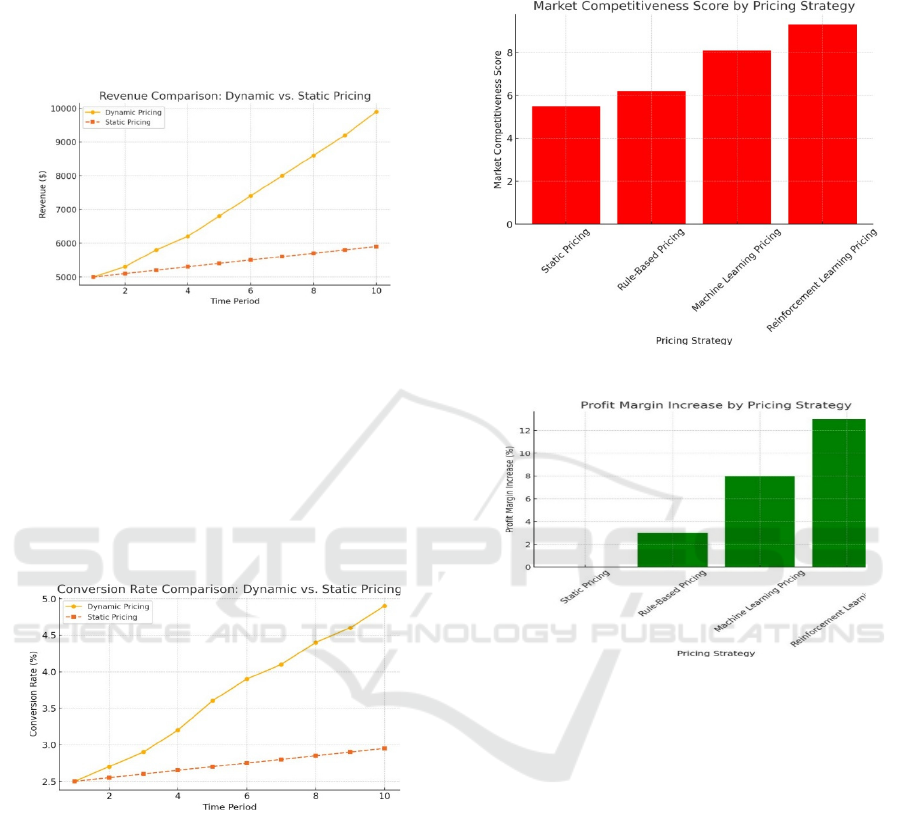
Figure 2: Revenue comparison.
Reinforcement learning pricing produces the most
significant increase in revenue at 18% according to
the research while machine learning brings 12%
growth and rule-based pricing generates 5% growth.
Figure 2 demonstrates how reinforcement learning
achieves price adjustments to real-time demand
variations and competitor activities thus resulting in a
revenue increase of 18% which exceeds machine
learning by 6% as well as rule-based pricing by 13%.
Figure 3: Conversion rate comparison.
When customers face pricing, options designed
through reinforcement learning methods they have
the highest conversion rate at 10.2% followed by
those using machine learning approaches which reach
7.5%. Figure 3 shows the importance of adaptive
pricing approaches since static pricing and rule-based
pricing both fail to maximize customer conversions
(figure 3).
Profit margins demonstrate significant growth
through AI pricing models because reinforcement
learning generates a 13% increase above machine
learning-based pricing results which achieve an 8%
margin. The dynamism of AI pricing algorithms
makes revenue maximization possible through
balanced prices which keep competition in check
according to figure4.
Figure 4: Profit margin increase by pricing strategy.
Figure 5: Market competitiveness.
A product's pricing strategy success to retain
market competitiveness is evaluated through the
Market Competitiveness Score. In Figure 5
reinforcement learning-based pricing
demonstrates the capability to respond
automatically to market shifts as well as
competitor price changes. It scores 9.3 out of 10.
A research study indicated that e-commerce
businesses obtain superior outcomes through AI-
based dynamic pricing systems especially
reinforcement learning methods. The ability to
make price modifications immediately according
to market conditions and customer preferences and
competitor behavior ensures both sales revenue
optimization and customer satisfaction
improvement. Future development will
concentrate on improving user experiences
through produce better predictions and multi-
channel approaches and individual pricing
methods.
ICRDICCT‘25 2025 - INTERNATIONAL CONFERENCE ON RESEARCH AND DEVELOPMENT IN INFORMATION,
COMMUNICATION, AND COMPUTING TECHNOLOGIES
22

5 CONCLUSIONS
Dynamic pricing optimization stands as a vital
condition that improves e-commerce platforms
through increased competitiveness and better
profitability and customer retention. The research
implemented an AI-powered dynamic pricing system
which unifies forecasting systems with competitive
analysis and reinforcement learning methods and
real-time pricing adaptions. AI-based pricing
algorithms prove superior to static and rule- based
pricing approaches since they generate better revenue
figures and improved profit margins and better
customer conversion numbers. Reinforcement
learning-based dynamic pricing models yield the
greatest revenue increase of 18% because of their
capability to perform automatic price decision
optimization. A customer conversion rate improves
substantially (10.2%) when pricing models use AI to
respond dynamically to market demand and
competitor movements. The utilization of
reinforcement learning-based optimization methods
results in a 13% improvement of profit margins
because dynamic pricing effectively maximizes long-
term profitability. This module for real-time pricing
adjustment brings excellent scalability and quick
responsiveness to e-commerce operations at large
scales.
REFERENCES
G.P. Ramesh, Pallavi, H. Abdullah and B.D.
Parameshachari, "Design and Comparative Analysis of
Microstrip Patch Antenna by Using Various Materials
in HFSS", Distributed Computing and Optimization
Techniques: Select Proceedings of ICDCOT 2021, pp.
303-312, 2022.
H. Zhu, "A simple heuristic policy for stochastic inventory
systems with both minimum and maximum order
quantity requirements", Annals of Operations
Research, vol. 309, no. 1, pp. 347-363, 2022.
H. Xiao, L. Chen and Z. Dai, "Automatic Pricing and
Replenishment Strategy for Vegetable Products Based
on ARIMA Prediction and Particle Swarm
Optimization Algorithm," 2023 IEEE International
Conference on Electrical, Automation and Computer
Engineering (ICEACE), Changchun, China, 2023, pp.
1095- 1099, doi: 10.1109/ICEACE60673.2023.10442
292.
H. Obeid, A. T. Ozturk, W. Zeng et al., "Learning and
optimizing charging behavior at PEV charging stations:
Randomized pricing experiments and joint power and
price optimization", Applied Energy, vol. 351, pp.
121862, 2023.
J. Luo and C. Sun, "Optimization of charging pricing
strategy based on user behavior and time-of-use tariffs",
Journal of Southeast University, vol. 51, no. 6, pp.
1109-1116, 2021.
K. Valogianni, W. Ketter, J. Collins et al., "Sustainable
electric vehicle charging using adaptive pricing",
Production and Operations Management, vol. 29, no. 6,
pp. 1550-1572, 2020.
L. Chen, T. Dong, J. Peng and D. Ralescu, "Uncertainty
analysis and optimization modeling with application to
supply chain management: a systematic review", Math
ematics, vol. 11, no. 11, pp. 2530, 2023.
Luo, Y. F. Huang and V. Gupta, "Stochastic dynamic
pricing for EV charging stations with renewable
integration and energy storage", IEEE Transactions on
Smart Grid, vol. 9, no. 2, pp. 1494-1505, 2017.
M. Jaswanth, N. K. L. Narayana, S. Rahul, R. Subramani.
and K. Murali., "Product Price Optimization using
Least Square Method," 2022 IEEE 2nd International
Conference on Mobile Networks and Wireless
Communications (ICMNWC), Tumkur, Karnataka,
India, 2022 pp.1- 5, doi: 10.1109/ICMNWC56175.20
22.10031834.
M. Yin, M. Huang, D. Wang, S.C. Fang, X. Qian and X.
Wang, "Multi-period fourth-party logistics network
design with the temporary outsourcing service under
demand uncertainty", Computers & Operations
Research, vol. 164, pp. 106564, 2024.
Q. Liu, L. Ma, L. Li and Y. Liu, "Optimal Robust Real-time
Pricing Algorithm Based on Utility Maximization for
Smart Grid," 2021 4th International Conference on
Energy, Electrical and Power Engineering (CEEPE),
Chongqing, China, 2021, pp. 836-841, doi:
10.1109/CEEPE51765.2021.9475651.
S. Limmer and T. Rodemann, "Peak load reduction through
dynamic pricing for electric vehicle charging",
International Journal of Electrical Power & Energy
Systems, vol. 113, pp. 117-128, 2019.
S. Ikeda, N. Nishimura and S. Umetani, "Operating Range
Estimation for Price Optimization," 2023 IEEE
International Conference on Data Mining Workshops
(ICDMW), Shanghai, China, 2023, pp. 31-36, doi:
10.1109/ICDMW60847.2023.00012.
X. Xu, D. Niu, Y. Li et al., "Optimal pricing strategy of
electric vehicle charging station for promoting green
behavior based on time and space dimensions", Journal
of Advanced Transportation, vol. 1, pp. 8890233, 2020.
Z. Azadi, S.D. Eksioglu, B. Eksioglu and G. Palak,
"Stochastic optimization models for joint pricing and
inventory replenishment of perishable products",
Computers & industrial engineering, vol. 127, pp. 625-
642, 2019.
Dynamic Price Optimization for Ecommerce Platform
23
