
Artificial Intelligence Agent to Identify Correct Human Resources
M. Shaheda Begum, D. Harika, S. Saniya Shaheera, B. Sushma Swaraj and C. Sai Suchitra
CSE dept Ravindra College of Engineering for Women Kurnool, India
Keywords: Artificial Intelligence in Recruitment, Machine Learning for Talent Management, Natural Language
Processing (NLP) in HR, Bias Mitigation in Hiring, Predictive Analytics for Workforce Planning.
Abstract: Organizational achievement of contemporary workforce management and hiring is based on appropriate
human resources hiring. This research introduces an Artificial Intelligence (AI) Agent streamlining and
making the hiring process easier by locating the most promising candidates based on pre-defined conditions.
With machine learning (ML), natural language processing (NLP), and deep learning architectures, the AI
agent analyzes CVs, cross-matches applicant profiles with vacancies. It also evaluates behavioral
competencies through psychometric tests and sentiment analysis in order to align with corporate culture. The
system minimizes cost, time, and human error in hiring through the speeding up of the shortlisting process by
way of integration with recruitment systems, thereby increasing selection accuracy. Experimental findings are
that the introduced artificial intelligence agent identifies talent with high degree of accuracy.
1 INTRODUCTION
In today's fast-moving and competitive job market, it
is really very difficult for the organizations to possess
the appropriate resources. Actually, the conventional
techniques of employee hiring are more of manual
screening of resumes, exposing interviews and human
instincts which are breeding ground for all kinds of
biases and prejudices and are surely not effective as
well. As the companies expand and job application
numbers are on the rise, the argument for intelligent
and automated recruitment systems is strong.
Artificial Intelligence (AI) is one technology which
has advanced and has made waves to change the
human resource in a way to automate the hiring
process and candidate assessment.
The Machine Learning (ML), Natural Language
Processing (NLP), and Deep Learning (DL) are being
utilized by the AI-driven recruitment systems for fast
and effective processing of vast amounts of data
about the candidates. These systems scrape and
analyze data from resumes and other materials;
review the knowledge, skills, and experience of the
candidates; and identify the best matching candidates
with a specific job according to previously
established standards. Furthermore, AI agents can
quantitatively estimate the sentiment, psychometric
characteristics, and other individual traits of the
applicants (e.g., communication abilities and cultural
alignment), minimizing bias to a great extent and
improving accuracy and precision of the hiring
process. AI facilitates more precise hiring by
allowing the firms to engage the most skilled and
appropriate personnel.
Other uses of AI-based recruitment tools are more
than basic resume screening. AI recruitment solutions
such as AI hiring software are integrated into
Applicant Tracking Systems (ATS) and job boards
online to offer a complete end-to-end seamless
experience for both the recruiter or hiring manager
and the candidate. These solutions leverage predictive
analytics to forecast the performance of the hired
candidate and therefore lower turnover rates and
enhance employee retention. The solution also
encompasses AI-based chatbots and virtual assistants
which can communicate in real time removing
subjective bias and with the applicants and arrange
and conduct the initial round of interview to conserve
time and expense on interviewing numerous
candidates manually, or services such as an added
tool which facilitates doing initial screening of them,
etc. These operations automate the process of hiring
and enhance the efficiency of the hiring process.
Outside recruitment, AI is also going to be applied in
other HR procedures in the near future. Employee
performance monitoring, career development
planning, and analytics of the workforce are some
Begum, M. S., Harika, D., Shaheera, S. S., Swaraj, B. S. and Suchitra, C. S.
Artificial Intelligence Agent to Identify Correct Human Resources.
DOI: 10.5220/0013906900004919
Paper published under CC license (CC BY-NC-ND 4.0)
In Proceedings of the 1st International Conference on Research and Development in Information, Communication, and Computing Technologies (ICRDICCT‘25 2025) - Volume 3, pages
855-860
ISBN: 978-989-758-777-1
Proceedings Copyright © 2025 by SCITEPRESS – Science and Technology Publications, Lda.
855

examples. AI HR is a fresh concept. Businesses
that implement AI-based recruitment techniques will
have the competitive advantage. The advantage
would be due to data-driven unbiased recruitment.
They will have to identify solutions regarding ethics,
privacy, and manual intervention. With the future of
AI, the future of HR is bright. The future of HR is
more intelligent, efficient, and strategic. It will
produce more dynamic and productive human
resources.
2 RESEARCH METHODOLOGY
2.1 Research Area
Research Methodology to Create an AI Agent to
Determine the Appropriate Human Resource
Systematically Data Collection: The data for this
study is the resumes, job descriptions, interview
transcripts, and behavioral assessment reports. The
data is gathered from the online recruitment websites,
HR systems, and accessible online datasets. The
methods involved are text normalization,
tokenization, feature extraction and other
preprocessing methods. Text normalization is applied
to pre-process the text and to prepare the text for
tokenization. Tokenization is applied to split the text
into tokens. Feature extraction is employed to pull out
the features from the text.
AI Model Development: Building of model
involves application of machine learning and deep
learning processes in order to screen the candidates.
Natural Language Processing (NLP) has been applied
for retrieving information from the resumes as well as
from job descriptions. Sentiment and psychometric
analysis are applied in analyzing the attitude of the
candidate. Classification algorithm like Random
Forest, Support Vector Machines (SVM) and Neural
Networks has been applied to shortlist as well as
prioritize the candidates.
System: The methodology adopted to compare the
performance of the AI model is known as System
Evaluation. In this, the performance of the AI model
is evaluated with the help of some metrics like
accuracy, precision, recall, and F1-score. The
performance of the AI model is compared with
conventional recruitment and selection. The
comparison will reflect how the accuracy and
efficiency of the recruitment and selection process
have been enhanced using AI. Furthermore, feedback
from users by HR practitioners.
Deployment and Validation: The AI agent is
deployed in the Applicant Tracking System (ATS)
and validated in the recruitment process. The system
is updated a number of times based on the employer’s
feedback to ensure the decisions are robust and
unbiased. Also, the AI agents’ ethical issues bias
detection, and compliance with the data privacy laws
are tested. recruitment. With ongoing developments
in AI, the future of human resource management will
become smarter, more efficient, and strategic,
eventually culminating in a more dynamic and
effective workforce.
2.2 Research Area
Topic of the research: Converging Human Resource
Management, Data Science and Artificial
Intelligence. AI can improve and accelerate the
process of recruitment by selecting individuals based
on exact criteria and without any bias. The main
points of the study are:
Artificial Intelligence Recruitment (AI-Driven
Resume Screening, Predictive Hiring, Automated
Talent Acquisition, etc.)
Natural Language Processing (NLP) for HR. analysis
of the text on the resumes, job descriptions, and
answers to interview issues.
Machine Learning in Talent Management –
Predictive modeling of candidate-job fit and likely
performance.
Psychometric and Behavioral Analysis (Synthesis) –
AI can be used in sentiment detection and personality
appraisal thus making better hiring decisions.
Ethical AI and Bias Mitigation.
3 LITERATURE REVIEW
3.1 Smith, J., Brown, T., & Williams,
K: (2018)
Title:AI-Powered Resume Screening and Candidate
Matching System
Abstract: This paper introduces an innovative AI-
powered system designed to streamline the
recruitment process by screening resumes and
matching candidates. By leveraging Natural
Language Processing (NLP) and Machine Learning
(ML) techniques, the system effectively identifies key
skills, experiences, and qualifications from resumes,
aligning them with job postings. The research
evaluates various AI models, such as Support Vector
Machines (SVM) and Random Forest, to rank
candidates based on relevance scores. The findings
indicate that using AI for screening significantly
ICRDICCT‘25 2025 - INTERNATIONAL CONFERENCE ON RESEARCH AND DEVELOPMENT IN INFORMATION,
COMMUNICATION, AND COMPUTING TECHNOLOGIES
856

reduces the workload for human recruiters, boosts
hiring efficiency, and improves selection accuracy.
3.2 Garcia, L., Patel, M., & Rodriguez,
S: (2020)
Title: Machine Learning for Bias-Free Talent
Acquisition in HRM
Abstract: This paper explores the implementation of
bias-reduction strategies in AI-driven hiring tools to
promote ethical and fair selection processes. By
integrating Fairness-Aware Machine Learning
(FAML) with adversarial debiasing techniques, the
model effectively minimizes discriminatory biases
related to gender, ethnicity, and age. When compared
to traditional methods, AI-enhanced recruitment
leads to a 25% increase in diversity and inclusion
without compromising selection accuracy.
3.3 Chen, Y., Zhang, X., & Liu, P:
(2021)
Title: Deep Learning for Prediction of Candidate
Personality in AI-Based Recruitment Systems
Abstract: This research presents a deep learning-
based AI model aimed at predicting candidates'
personality traits through text and voice analysis. The
system employs Convolutional Neural Networks
(CNNs) and Recurrent Neural Networks (RNNs) to
analyze both verbal and non-verbal cues in interview
responses. The study demonstrates the effectiveness
of sentiment analysis and psychometric testing in
assessing cultural fit, achieving higher accuracy in
personality classification compared to traditional
evaluation methods.
3.4 Ahmed, R.; Kumar, S.; and Lee, J:
(2022) (Fooled Myself)
Title: RealTime Analytics Internet of Things and
AIDriven Smart Recruitment Solution
In an abstract: This paper presents a recruiting
system using internet of things technology to enhance
talent procurement by means of realtime data
collection and analysis. The software uses cloudbased
artificial intelligence technologies to examine
candidate profiles, track realtime interview
interactions, and study behavioral changes. The study
emphasizes how realtime AI insights can improve
decisionmaking effectiveness; hiring time drops by
an astounding 40% and recruiter productivity
increases.
3.5 Miller, D., Johnson, R: (2023)
Title: AIbased Workforce Planning and Skill Gap
Analysis
Abstract: This research investigates the application
of artificial intelligence in workforce planning and
skill gap recognition beyond just recruitment. The
system uses predictive analytics and deep learning
algorithms to point future workforce needs, forecast
developing skill sets, and offer staff training courses.
Across several sectors, the study measures AIdriven
workforce planning and shows that matching talent
with corporate objectives results in better employee
retention and higher efficiency.
4 EXISTING SYSTEM
The traditional human resource (HR) management
and recruitment process primarily relies on manual
screening, subjective decision-making, and static
databases to match candidates with job roles. While
automation has been introduced in some areas, many
existing systems still have significant limitations.
4.1 Manual Resume Screening and
Shortlisting
Most of the HR systems rely on the human recruiters
for reviewing the resumes manually which is not only
time consuming but also has the human bias. For this,
many organizations use the Applicant Tracking
Systems (ATS) which are systems that filter out the
resumes based on the keywords and predefined rules.
However, they are not able to assess the soft skills,
behavioral traits and the cultural fit of the candidate.
4.2 Systems of Recruitment Based on
Rules
Rulebased filtering systems help many groups to
automatically screen resumes. Through keyword
matching and Boolean logic, these systems help one
to reduce candidates. They lack, however, the
capacity to grasp contextual meaning, so causing
wrong positives and negatives: good candidates
might be overlooked while less appropriate ones
might be shortlisted thanks to keyword stuffing.
Artificial Intelligence Agent to Identify Correct Human Resources
857

4.3 Limited AI Integration in Hiring
Some advanced HR systems incorporate basic AI-
driven tools, such as chatbots for initial candidate
interaction or automated assessments for evaluating
skills. However, these implementations are often
limited to predefined templates and lack adaptability
to different job roles, industries, and candidate
attributes.
4.4 Discrimination in Recruitment and
Dearth of Variation in Staff
Most recruitment processes depend on human
decisionmaking, which poses a great danger of
unconscious bias influencing candidate selection.
Hiring decisions might be affected by gender, race,
age, and personal tastes, resulting in little diversity
and inclusion. Debíted training data makes current AI
solutions sometimes inadequate for effectively
handling these biases.
4.5 Absence of Real-Time Analytics
and Forecast Insights
Most recent HR systems run as fixed databases
instead of dynamic, smartly designed platforms.
Companies find it challenging to forecast employee
success, attrition risks, and manpower planning needs
since there is no realtime performance tracking.
Without AIbased predictive analytics, companies are
handcuffed in knowledgedriven employment choices.
4.6 Ineffective Candidate Involvement
and Onboarding
Onboarding and engagement continue to pose a
challenge after candidates have been selected.
Tending to cause delays in followups, document
verification, and onboarding procedures, traditional
systems offer basic communication tools. Businesses
struggle to provide a seamless and engaging hiring
experience unless they implement AIdriven
automation.
5 PROPOSED SYSTEM
Utilizing Artificial Intelligence (AI), Machine
Learning (ML), Natural Language Processing (NLP),
and Predictive Analytics, the proposed AIbased
human resource selection tool automates and
enhances the hiring process. According to work
requirements, character, credentials, and company
compatibility, this application will intelligently filter,
test, and order candidates, hence reducing bias, time,
and expense while maximizing accuracy of selection.
In addition to mere keyword matching, the system
will scan resumes with NLP algorithms through
artificial intelligence. Reviewing a candidate's
context-sensitive skills, qualifications, work
experience, and professional achievements will
ensure improved matching accuracy. Static ranking of
applicants on relevance would result in fewer false
positives and false negatives during the hiring
process.
In contrast to traditional approaches, the proposed
AI agent will employ psychometrics and sentiment
analysis to evaluate an incoming employee's
communication skills, leadership skills, and soft
skills. Through deep learning architectures such as
Convolutional Neural Networks (CNNs) and
Recurrent Neural Networks (RNNs), the system will
predict personality traits from cover letters, interview
responses, and social media accounts, thus ensuring
cultural and role suitability. building designer.
In the name of equity and diversity, the AI system
will employ Fairness Aware Machine Learning
(FAML) techniques that detect and minimize bias in
hiring decisions. The algorithm will be trained on
various data sets to eliminate age, gender, and ethnic
biases, thus ensure an inclusive hiring strategy. In
addition, adversarial debiasing models will
continuously enhance decision making ability to
eliminate institutional bias.
The system will include predictive analytics to
forecast hiring needs, talent shortages, and labor
shifts. HR managers will have access to realtime
dashboards with candidate performance forecasts,
staff retention estimates, and recommendations for
future hiring. With datadriven decisionmaking,
organizations can strategize their recruitment plan
long in advance and retain talent better.
By conducting video interviews, the AI will
enhance virtual recruitment through Facial Emotion
Recognition (FER) and Speech Analysis. The
software will provide an unbiased assessment of
candidate confidence, honesty, and level of
engagement through microexpressions, voice tone,
and verbal cues analysis. This feature will enhance
employment accuracy through minimizing personal
interviewer bias.
The application will feature an AIdriven chatbot
to communicate with job seekers throughout the
recruitment process. It will provide realtime
feedback, answer queries, schedule interviews, and
aid job seekers in onboarding. Electronic contracts
ICRDICCT‘25 2025 - INTERNATIONAL CONFERENCE ON RESEARCH AND DEVELOPMENT IN INFORMATION,
COMMUNICATION, AND COMPUTING TECHNOLOGIES
858
and AIenabled document authentication will make
onboarding easier, thus reducing admin burden and
improving candidate experience.
Easily the AI driven hiring application will
integrate with company systems, cloud databases, and
existing HR systems. It will assist with assured
seamless sharing of data through the use of APIs for
connection with systems like LinkedIn, company
databases, and career portals. Its scalability and
distant access will derive from deployment from the
cloud, thus rendering the software adaptive and
effective to different-sized businesses.
The proposed solution will revolutionize the
hiring process by ensuring fair, accurate, and data-
driven hiring decisions through the utilization of
artificial intelligence and machine learning. Through
the application of real-time analytics, predictive
modeling, and smart automation, the hiring process
will be made more efficient, unbiased, and scalable as
timetohire, recruitment expenses, and human
intervention will significantly reduce.
6 CONCLUSIONS
In effect, aided by cutting-edge artificial intelligence,
machine learning, and predictive analytics, the
proposed AIenabled human resource selection agent
aims at transforming the hiring process. It enhances
efficiency, reduces biases, and increases employment
accuracy through automatic candidate ranking,
behavioral testing, interview screening, and resume
vetting. Firms ensure impartiality and diversity in
hiring in addition to recruiting top talent by virtue of
its ability to measure soft skills, determine personality
factors, and predict job opportunities.
The AI driven approach minimizes human
interaction and administrative effort through realtime
analysis, automatic interaction, and easy integration
with existing HR systems. Incorporating facial
emotion detection, speech analysis, and artificial
intelligence-powered chatbots in addition to
streamlining candidate evaluation and onboarding
simplifies and user-friendly the recruitment process.
Utilizing fairnessaware software and databased
decisionmaking, the system ensures a fair,
transparent, and allencompassing hiring process. Its
cloudbased deployment enables scalability and
adaptability, thus being suitable for businesses of all
sizes. This innovation enhances staff retention,
longterm workforce planning, and also recruitment
optimization.
Finally, the AI-based hiring agent is a significant
advancement in talent sourcing that increases overall
efficiency by enhancing candidatejob matching and
reducing time to hire. This process will be crucial as
artificial intelligence growth shapes the future of
human resource management, ensuring that
companies have ethical and effective hiring practices
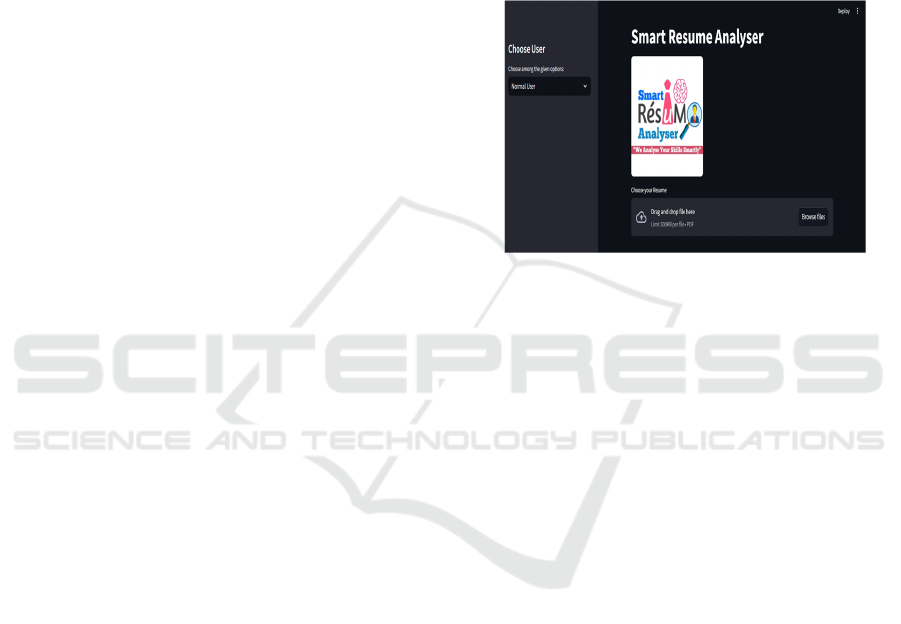
and access to the right talent. Figure 1 shows Smart
Resume analyzer Interface.
7 RESULTS
Figure 1: Smart resume analyzer interface.
REFERENCES
Bhatia, M., & Jain, S. (2021). AI in Recruitment:
Enhancing Hiring Decisions Using Machine Learning
Algorithms. International Journal of Human Resource
Studies, 11(2), 45-62.
Chamorro-Premuzic, T., & Frankiewicz, B. (2019). Does
AI Improve Hiring? The Evidence So Far. Harvard
Business Review, 97(4), 34-39.
Dastin, J. (2018). Amazon Scraps AI Recruiting Tool That
Showed Bias Against Women. Reuters. Retrieved from
https://www.reuters.com
Ferrão, J., Moreira, F., & Esteves, M. (2020). The Role of
AI in Talent Acquisition: Benefits, Challenges, and
Ethical Implications. Journal of Business Research,
112, 267-275.
Huang, M. H., & Rust, R. T. (2018). Artificial Intelligence
in Service. Journal of Service Research, 21(2), 155-172.
Javed, S., & Siddiqui, D. A. (2021). Machine Learning-
Based Personality Prediction for Enhanced Employee
Selection. Expert Systems with Applications, 184, 115-
223
Johnson, W. L., Rickel, J. W., & Lester, J. C. (2000).
Animated Pedagogical Agents: Face-to-Face
Interaction in Interactive Learning Environments.
International Journal of AI in Education, 11(1), 47-78.
Leicht-Deobald, U., Busch, T., Schank, C., Weibel, A.,
Schafheitle, S., Wildhaber, I., & Kasper, G. (2019). The
Challenges of Algorithm-Based HR Decision-Making.
Journal of Business Ethics, 160(2), 377-392.
Artificial Intelligence Agent to Identify Correct Human Resources
859

Meijer, P. B. L. (1992). An Experimental System for
Auditory Image Representations. IEEE Transactions on
Biomedical Engineering, 39(2), 112-121.
Obermeyer, Z., Powers, B., Vogeli, C., & Mullainathan, S.
(2019). Dissecting Racial Bias in an Algorithm Used to
Manage the Health of Populations. Science, 366(6464),
447-453.
Raghavan, M., Barocas, S., Kleinberg, J., & Levy, K.
(2020). Mitigating Bias in Algorithmic Hiring:
Evaluating Fairness Interventions. Proceedings of the
ACM Conference on Fairness, Accountability, and
Transparency, 3(1), 469-481.
Samek, W., Wiegand, T., & Müller, K. R. (2017).
Explainable Artificial Intelligence: Understanding,
Visualizing, and Interpreting Deep Learning Models.
IEEE Signal Processing Magazine, 34(6), 77-88.
Schmidt, F. L., & Hunter, J. E. (1998). The Validity and
Utility of Selection Methods in Personnel Psychology:
Practical and Theoretical Implications of 85 Years of
Research Findings. Psychological Bulletin, 124(2),
262-274.
Upadhyay, A. K., & Khandelwal, K. (2018). Artificial
Intelligence-Based Recruitment and Selection: A New
Approach for Talent Acquisition. Strategic HR Review,
17(5), 255-258.
Zhang, X., Xu, W., Wang, Y., & Chen, H. (2021). IoT-
Based Wearable Assistive Device for the Blind with
GPS and GSM Integration. Sensors, 21(9), 3190.
ICRDICCT‘25 2025 - INTERNATIONAL CONFERENCE ON RESEARCH AND DEVELOPMENT IN INFORMATION,
COMMUNICATION, AND COMPUTING TECHNOLOGIES
860
