
Improving Software Defect Prediction Accuracy Using Machine
Learning
J. David Sukeerthi Kumar, Shaik Mithaigiri Mohammad Akram, Mulinti Abhinay,
Desam Pavan Kumar, Shaik Mansoor Hussain and Ponnaganti Bharath Kumar
Department of Computer Science and Engineering (AI‑ML), Santhiram Engineering College, Nandyal, Andhra Pradesh,
India
Keywords: Support Vector Machines (SVM), Deep Learning, Random Forest, Decision Trees, Machine Learning,
Supervised Learning, Software Defect Prediction, Data Preprocessing, Model Optimization, Software
Quality, Defect Detection.
Abstract: Software defect prediction plays an important role in enhancing software quality by detecting potential
problems at an early stage of the development life cycle. Traditional methods rely upon the time-consuming,
and often faulty, static analysis and manual code reviews. Machine learning (ML) offers a powerful alternative
that uses historical defect data to enhance the prediction of defect-prone modules. In this project, we
experiment with different types of ML methods including supervised learning techniques like Random Forest,
Decision Trees, SVM, and Deep Learning models to solve the task. We utilize feature engineering, data
prepossessing and model optimization to improve prediction performance. In this paper, the project discusses
various models to see how effectively various types of models can predict software defects when tested on
commonly used software defect datasets and measures their success with appropriate metrics such as precision
& recall and F1-score the proposed method helps to improve accuracy in defect prediction, maintain software,
lower maintenance cost, and improve reliability of software system.
1 INTRODUCTION
Software defect prediction is a crucial step in
development a software; it helps the developers in
detecting the critical issues, creating quality software,
reducing maintenance cost and ensuring a robust
delivery. With the growing complexity and size of
software systems, manual code review, static
analysis, and other traditional defect detection
methods have become increasingly impractical,
costly, and error-prone.
This has given rise to an interest in novel
techniques such as machine learning (ML) motivated
by the need for improved and accelerated defect
prediction techniques.
As an advanced software defect prediction tool,
machine learning predicts defective components with
much higher accuracy than traditional techniques
(e.g., rule-based methods) by recognizing patterns in
previous defect data. Using historical project data to
train machine learning models, these models can
accurately predict defects probabilities in multiple
software system modules. Moreover, this ML models
have the advantage of flexibility to new development
environments and development of software projects.
This paper focuses on exploring how varied
approaches can be used to apply machine learning
techniques that can improve the prediction for bugs in
software. Here, we focus on software bugs detection
using supervised learning techniques like Decision
Trees and Random forest and Support vector
machines (SVM) and Deep Learning. We compare
these techniques across several popular software
defect datasets and use precision, recall, and F1-score
metrics to examine how they perform under different
contexts.
We are working not just on the right models
selecting, but also on features adjusting, data polishing
and optimization techniques tuning to increase
model’s accuracy and make them less specific to the
scenario. While feature engineering helps in choosing
the best possible attributes that can be useful in
predicting defects, data preprocessing makes sure that
the input data is sufficient enough to be deployed in
ML algorithms. Although nothing but data, they were
844
Kumar, J. D. S., Akram, S. M. M., Abhinay, M., Kumar, D. P., Hussain, S. M. and Kumar, P. B.
Improving Software Defect Prediction Accuracy Using Machine Learning.
DOI: 10.5220/0013906700004919
Paper published under CC license (CC BY-NC-ND 4.0)
In Proceedings of the 1st International Conference on Research and Development in Information, Communication, and Computing Technologies (ICRDICCT‘25 2025) - Volume 3, pages
844-854
ISBN: 978-989-758-777-1
Proceedings Copyright © 2025 by SCITEPRESS – Science and Technology Publications, Lda.

optimized by hyperparameters which tuned the model
into producing the best possible output.
By incorporating machine learning, this technique
will help to reduce the need for manual inspection, can
decrease the human error rate, and speed up the
software development cycle. The aim is to develop a
robust solution that can strengthen the prediction
accuracy of software fault prediction systems and
consequently, result in superior software quality and
reduced development time and maintenance costs.
This work contributes to the study of software defect
prediction by providing a comparative analysis of the
machine learning models used in the area, along with
recommendations to successfully deploy these models
in real software development contexts.
2 LITERATURE REVIEW
Software defect prediction has been a significant area
of research concern in the past few decades since it
plays an essential role in software quality
improvement, costs saving through reduction of
maintenance cost, and overall achievement of
dependability of software systems. Manual code
reviews, static analysis, inspections, etc., are a few
standard techniques which have been the backbone
of defect identification in software engineering. But
these methods are often slow and hit-or-miss,
particularly when it comes to large, complex
systems. There has thus been a growing interest in the
use of machine learning (ML) techniques to enable
automatic defect prediction and improve the
prediction accuracy. In this section, we highlight
pertinent work in software defect prediction while
focusing on traditional methods, machine learning
techniques, and recent trends.
2.1 Defect Prediction Using Machine
Learning
Later, in machine learning context, researchers
developed ways of using these algorithms for
automating defect prediction on large software
datasets by identifying patterns and accurate
predictions. Supervised learning approaches have
been in high demand where algorithms are trained on
tagged defect data to predict potential future defects.
2.1.1 Decision Trees
Decision trees, such as the CART (Classification and
Regression Trees) algorithm, were one of the most
common algorithms used for predicting defects due to
their simplicity and interpretability. Several studies
have demonstrated how decision trees can effectively
predict defects based on multiple software metrics,
including complexity, size, and code changes.
2.1.2 Random Forests
As an ensemble learning algorithm, Random Forest
has become a popular choice for defect prediction as
it combines multiple decision trees to achieve a higher
prediction accuracy compare to individual models. It
is proven that Random Forests have better
performance than individual classifiers due to their
less overfitting and greater generalization to unseen
data.
2.1.3 Support Vector Machines (SVM)
Support Vector Machines (SVM’s) perform well for
the software defect prediction, as they deal very well
with high-dimensional data of high dimensional
feature sets. And the algorithms they use can offer
compelling precision especially when used in
conjunction with kernel functions that can map the
feature space into a form that is easier to interpret.
Because SVM’s are highly effective with high
dimensional data and high - dimensional feature sets,
SVM’s can be well used in software defect prediction.
And research indicates they can yield tremendous
accuracy especially when integrated with kernel
functions which reshape the feature space to be more
interpretable.
2.1.4 Deep Learning Models
Recently, deep learning models, such as Neural
Networks and Convolutional Neural Networks
(CNNs), have been used for defect prediction and
shown a considerable improvement in accuracy
compared to traditional models when big datasets are
used. Because of their ability to automatically learn
complex feature representations, these models are
well suited to software defect prediction tasks with
high dimensional feature sets.
2.2 Feature Engineering and Data
Preprocessing
Feature Engineering has a significant impact on the
performance of defect prediction. Machine learning
models are often been trained using features like
code complexity, historical defect data, module size,
and developer experience. Various feature selection
techniques are investigated in the literature to
improve the quality of the input data leading to
Improving Software Defect Prediction Accuracy Using Machine Learning
845

higher model performance. Overall, data
preprocessing steps that include normalization,
missing value processing, outlier detection, and more
are important steps that profoundly affect defect
prediction model accuracy.
2.3 Old Defect Prediction Approaches
Older defect prediction models utilized mostly
statistical methods, rule-based systems, and manual
inspection techniques. One of the common approaches
involved using historical defect data and applying
statistical methods to analyze the patterns in the
defects. The Naive Bayes classifier and logistic
regression are among the trained models for predicting
defects based on the features extracted from software
modules, including code complexity metrics, number
of changes, and developer experience.
2.4 Feature Engineering and Data
Preprocessing
Feature engineering plays a critical role in enhancing
machine learning model performance for software
defect prediction. Measures such as code complexity,
historical defect records, module size, and even the
experience of a developer are often the constituents
for training out these models. Seeking to boost the
quality of the data going in and improve the models’
performance, researchers have explored various
methods of selecting the best features. Furthermore,
data pre-processing tasks such as normalizing values,
replacing missing values, and detecting outliers
greatly contribute to the accuracy of the predictions.
2.5 Recent Developments
More recently, researchers tried different hybrid
models, combining different machines learning
approaches together or mixing classical defect
prediction techniques with deep learning strategies.
Ensemble models that combine the guesses of a
number of classifiers, for instance, have been shown
to improve prediction accuracy. Some studies, on the
other hand, have proposed a different approach
altogether using transfer learning, in which defect
prediction models can adapt to new projects based on
lessons learned from work they’ve already done.
3 CONTRIBUTIONS
The "Comparative Analysis of Machine Learning
Algorithms" takes a deep dive into various supervised
learning techniques like Decision Trees, Random
Forest, Support Vector Machines (SVM), and Deep
Learning models. It breaks down what each approach
does well and where it falls short when it comes to
predicting software defects. "Feature Engineering and
Data Preprocessing" highlights why crafting the right
features and getting the data ready are so crucial for
making machine learning models work better. It
walks through various ways to pick out the most
important features and prep the data, showing how
these steps can make a real difference in how
accurately the models predict. Contribution to the
Field of Predictive Software Analytic to the emerging
field of predictive software analytic by showing how
machine learning can be applied to predict software
defects more effectively than existing approaches.
The paper enhances the knowledge of how ML can be
utilized in the software engineering process to obtain
improved software quality.
4 PAPER ORGANISATION
4.1 Background and Related Work
Here, we present a discussion of current literature on
software defect prediction methods in terms of classic
approaches and increasingly the use of machine
learning within this area. We present current research,
the issues, and the shortcomings of current methods
to emphasize the requirements for more accurate
defect prediction algorithms. This section introduces
the machine learning models and methodologies
adopted in this research. We discuss the supervised
learning algorithms examined, such as Decision
Trees, Random Forest, Support Vector Machines
(SVM), and Deep Learning models. The
methodology includes the feature engineering
process, the steps involved in prepossessing the data,
and model optimization methods implemented during
the experiments.
4.2 Experimental Setup and Dataset
In this section, we outline the datasets employed in
the research, providing information on the selection
criteria and the nature of the software defect datasets.
We also discuss the experimental setup, including the
evaluation measures (precision, recall, F1-score) and
model configurations, and the tools and libraries
employed for implementation.
ICRDICCT‘25 2025 - INTERNATIONAL CONFERENCE ON RESEARCH AND DEVELOPMENT IN INFORMATION,
COMMUNICATION, AND COMPUTING TECHNOLOGIES
846

5 METHODOLOGY
We’re suggesting a detailed strategy to ramp up the
accuracy of software defect prediction by tapping into
a mix of machine learning methods, clever feature
design, data tidying, and model tuning. Our plan is all
about making these prediction models sharper, more
versatile, and actually useful for real-world coding, so
developers can build software that’s more dependable
and easier to manage. Our approach weaves together
some key machine learning tactics to tackle the tricky
parts of predicting software defects. By thoughtfully
cleaning up the data, picking the most useful features,
and fine-tuning the model settings, we’re looking to
boost how well different machine learning methods
can spot defects. A head-to-head comparison will
point us to the top-performing model and give us
some fresh ideas on how machine learning can level
up software quality while keeping maintenance costs
in check. Table 1 shows the Dataset Parameters.
Table 1: Dataset Parameters.
Title Language Source Code Modules Features Defective Defect-Free Defect Rate
CM1
C
NASA
Spacecraft
498 22 49 449 9.83%
Instrument
5.1 Data Collection and Preprocessing
To train the machine learning models, we first gather
defect data from publicly available software defect
datasets, such as the NASA MDP (Metrics Data
Program) dataset, Prominent Software Engineering
Data Sets, or industry-specific datasets. These
datasets contain software metrics (e.g., cyclomatic
complexity, lines of code, and number of changes)
along with information on whether a defect was
identified in each module.
5.1.1 Feature Engineering and Selection
Feature engineering involves creating new, relevant
features from raw data to enhance model
performance. For software defect prediction, key
features are typically derived from various software
metrics, such as:
• Code Complexity: Metrics like cyclomatic
complexity, Halstead complexity, and lines of
code are used to measure the complexity of a
module.
• Change Metrics: The number of changes
made to a module, the frequency of changes,
and the number of commits or code churn
during development can serve as important
features for predicting defects.
• Developer Attributes: Information such as
developer experience, the number of defects
previously introduced by a developer, or team-
based features can be useful in predicting
defects.
5.1.2 Model Selection and Training
• Decision Trees (CART): A simple and
interpretable model that partitions the feature
space based on feature values to predict the
defect status.
• Support Vector Machines (SVM): A
powerful classifier that maximizes the margin
between defect and non-defect classes by
using kernel functions to transform the feature
space.
• Deep Learning (Neural Networks): A more
advanced approach that automatically learns
feature representations through multiple layers
of neurons. We utilize Multilayer Perceptions
(MLP) and explore deeper architectures to
assess the model's ability to handle large-scale
data. Each model is trained using a training
dataset, and model parameters (e.g., depth of
trees for Decision Trees, number of estimators
for Random Forest, and regularization
parameters for SVM) are tuned using cross-
validation to avoid overfitting.
5.1.3 Model Optimization
To improve model performance, we apply various
hyperparameter optimization techniques, such as:
• Grid Search: Systematically searching through a
range of hyperparameters to find the optimal
configuration for each model.
• Random Search: Randomly searching
hyperparameters within predefined limits for
faster results than grid search.
Improving Software Defect Prediction Accuracy Using Machine Learning
847

• Bayesian Optimization: An advanced approach
that models the performance of the algorithm as a
probabilistic function to select the most promising
hyperparameters more efficient. Summarized
Literature Review on Feature Selection Shown in
the Table
Table 2: Summarized literature review on feature selection.
Ref. No Title Author(s) / Year Approach Used
1
Minimum Redundancy Feature
Selection (MRFS) from Microarray
Gene Expression Data
-
MRFS algorithm is an effective
feature selection method for
microarray gene expression
data.
2
A Correlation-Based Feature Selection
Algorithm for Machine Learning
-
Introduces the CFS algorithm,
which addresses limitations of
traditional feature selection by
considering both relevance and
redundancy.
3
Fast Correlation-Based Filter for
Wrapper Approaches
Lei Yu and Huan Liu (2003)
Presents a novel filter approach
combining correlation-based
filters and wrapper approaches
for efficient and effective
feature selection.
4
A Relief-Based Feature Selection
Method for Classification Problems
Robnik-Šikonja and
Kononenko (2003)
Introduces the Relief algorithm
to select relevant and
discriminative features,
improving classification
p
erformance.
5
A Comparative Study on the Effect of
Feature Selection on Classification
Accuracy
Esra Mahreneci Karabulut et al.
(2012)
Provides a comparative
analysis of feature selection
techniques and their impact on
classification accuracy across
datasets like Breast Cancer and
Lun
g
Cancer.
6
Approaches to Multi-Objective Feature
Selection: A Systematic Literature
Review
Qassem Al-Tashi et al. (2020)
Offers a systematic review on
multi-objective feature
selection, aiming to identify the
most relevant and informative
features using evolutionary
al
g
orithms.
7
Feature Selection Approaches for
Machine Learning Classifiers on
Yearly Credit Scoring Data
Ilter Fakhoury, Damla &
Kocakgil, Ozan & Ravshanker
(2019)
Focuses on credit scoring,
analyzing different machine
learning techniques and feature
selection to identify key credit-
related variables.
8
Efficient Feature Selection for
Intrusion Detection Systems
Seyedeh Sarah Ahmadi et al.
(2019)
Addresses feature selection in
IDS by identifying relevant
features to enhance
classification accuracy while
reducing computational
overhead.
6 MECHANISM OF THE
PROPOSED APPROACH
The way our proposed approach works to improve
software defect prediction accuracy is by following a
clear, step-by-step process that ties together several
pieces like data cleanup, feature crafting, model
picking, training, and testing. The aim is to build a
solid workflow that taps into machine learning to spot
defects more accurately, all while cutting down on the
need for hands-on human effort.
ICRDICCT‘25 2025 - INTERNATIONAL CONFERENCE ON RESEARCH AND DEVELOPMENT IN INFORMATION,
COMMUNICATION, AND COMPUTING TECHNOLOGIES
848

6.1 Data Collection and Preprocessing
The mechanism begins with the collection of software
metrics data and defect information from publicly
available datasets or project-specific defect logs. The
dataset typically includes software metrics such as:
Lines of Code (LOC), Cyclomatic Complexity,
Halstead Complexity Metrics, Number of Changes,
Developer Information.
6.1.1 Data Cleaning
Missing or incomplete data is identified and handled
through imputation techniques (e.g., mean or median
for numerical values, mode for categorical attributes).
Duplicate or irrelevant records are removed to ensure
data quality.
6.1.2 Normalization/Standardization
We take features that come in all sorts of ranges like
lines of code (LOC) or complexity scores and adjust
them to fit the same scale, using tricks like min-max
normalization or z-score standardization. This way,
every feature gets a fair shot at shaping the learning
process.
6.2 Feature Engineering
Feature engineering is critical for improving the
model's ability to predict defects accurately. In this
phase, various software metrics are transformed and
new features are derived from the raw data to capture
relevant patterns associated with defects.
6.2.1 Key Feature Extraction
• Code Complexity Metrics: Measures such as
Cyclomatic Complexity and Halstead Metrics
are used to capture the structural complexity
of the code. Higher complexity often
correlates with a higher likelihood of defects.
• Developer Activity Metrics: Metrics such as
code churn, commit frequency, and developer
experience are incorporated. High code churn
or frequent changes may indicate areas more
prone to defects.
• Historical Defect Data: Previous defect
counts for modules or files in the software
provide predictive signals of future defects in
similar components.
6.3 Model Selection and Training
Once the features are engineered and pre-processed,
the next step is to select appropriate machine learning
models and train them using the prepared dataset.
6.3.1 Model Selection
The following machine learning algorithms are
considered for defect prediction:
• Decision Trees (CART): The decision tree
model splits the dataset iteratively based on
feature values until potentially splitting each
software on being defective or defect-free.
• Random Forest: An ensemble of many
decision trees. This means it prevents
overfitting by averaging the output of
predictions, which results in a more robust
model.
• Support Vector Machines (SVM): SVM
encourages the creation of the optimal
hyperplane that maximizes the margin
between defective and non-defective
modules which is helpful in dealing with
the high-dimensional data.
• Deep Learning (Multilayer Perceptron,
MLP): Neural networks with multiple per
layer that can learn complex feature
representation themselves. This is even
better for large datasets with complex
patterns that may be lost on traditional
models.
6.4 Model Evaluation
After training, each model’s performance is evaluated
on the test dataset, which it has not seen during the
training phase. The evaluation process includes the
following:
Precision: Measures how many of the
predicted defects are actual defects. This is
particularly important in minimizing false
positives, which could lead to unnecessary
effort spent on non-defective modules.
• Recall: Indicates how many of the actual
defects were successfully predicted. A higher
recall value ensures fewer missed defects
(false negatives), which is essential for
detecting as many potential issues as possible.
6.5 Model Optimization
To further enhance the model’s predictive power,
various optimization techniques are applied:
Improving Software Defect Prediction Accuracy Using Machine Learning
849
• Hyperparameter Tuning: By playing around
with methods like Grid Search, Random
Search, or Bayesian Optimization, we tweak
the settings of our chosen models to figure out
setup for predicting defects
• Ensemble Methods: Bagging (Bootstrap
Aggregating) and Boosting (e.g., AdaBoost,
Gradient Boosting) are used to combine the
predictions of multiple models, improving
stability and accuracy. Stacking can also be
used, where the predictions of multiple base
models are used as inputs for a meta-model,
further enhancing predictive accuracy.
6.6 Final Model Deployment and
Monitoring
After we’ve settled on the best model and tweaked it
just right, it’s all set to be put to work. We can hook it
up to a continuous integration/continuous
deployment system to keep things running smoothly
(CI/CD) pipeline for real-time defect prediction in an
ongoing software project. Additionally, the model is
periodically retrained using new defect data to keep it
updated and ensure it remains accurate as the
software evolves. Monitoring the model's
performance in production is crucial to ensure it
continues to provide reliable predictions. Metrics like
precision, recall, and F1-score should be continuously
tracked, and the model should be retrained as
necessary when performance degradation is
observed. Table 3 Shows the Characteristics of
datasets used.
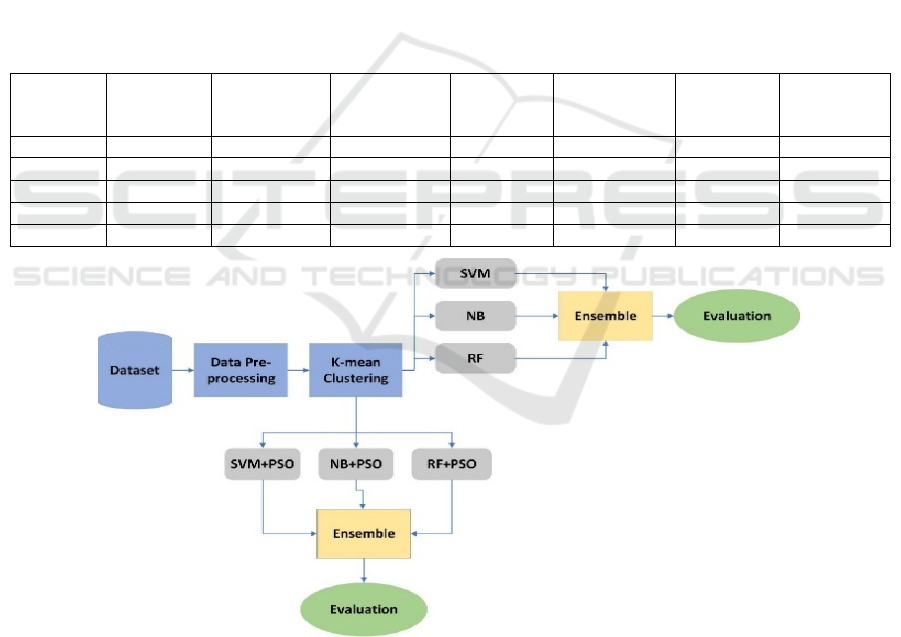
Proposed Method Shown in Figure 1.
Table 3: Characteristics of Datasets Used.
Name of
the
Dataset
Instance Attributes
Missing
Attributes
Non-
Faulty
instance
Defective
instance%
Faulty
Instance
Used
language
PCI 1109 22 NO 1032 6.94% 77 NA
KCI 2109 22 NO 1783 15.45% 326 C++
JMI 10885 22 NO 8779 19.35% 2106 C
CMI 498 22 NO 449 9.83% 49 C
KC2 522 22 NO 415 20.49% 107 C++
Figure 1: Proposed Method.
6.7 Software Tool
To implement the proposed methodology for software
defect prediction, several software tools, libraries,
and frameworks are used. These tools help facilitate
data preprocessing, feature engineering, machine
learning model development, evaluation, and
optimization. Below is a list of the key software tools
employed in the study:
ICRDICCT‘25 2025 - INTERNATIONAL CONFERENCE ON RESEARCH AND DEVELOPMENT IN INFORMATION,
COMMUNICATION, AND COMPUTING TECHNOLOGIES
850

6.7.1 Programming Languages
• Python: We’re using Python as the main
language for this project because it’s got a ton
of handy libraries and is super easy to work
with. It sets us up nicely for messing with data,
building machine learning models, and
digging into stats. We picked Python since it’s
so versatile and comes with a bunch of
awesome tools that make data processing,
feature tweaking, and model crafting a breeze.
6.7.2 Data Processing and Manipulation
• Pandas: For data manipulation and analysis It
also offers robust data structures, such as Data
Frames, for reading, cleaning, and
preprocessing defect prediction data. The
Pandas library is very helpful for dealing with
elaborate data sets, missing values, and feature
engineering.
• NumPy: All number crunching and mathy
stuff, particularly in cases where we’re
working with matrices or doing vector math
very quickly during the data preprocessing or
feature creation phase. It’s a champ for
handling large, multi-dimensional arrays and
matrices like it’s nothing.
• SciPy: SciPy provides functionality for a
wider range of mathematical operations (e.g.,
optimization algorithms, statistical tests,
numerical integration) useful for data
(preprocessing, analysis, and optimization)
tasks.
6.7.3 Machine Learning Libraries
• Scikit-learn: Scikit-learn is the machine
learning toolkit we’ll be using in this project;
it’s the part of the project where we’ll actually
start to build the models. It comes loaded with
options for things like classification,
regression, clustering, and testing how well
our models are performing. It is used to create
Decision Trees, Random Forests, Support
Vector Machines (SVM) and more. Plus, it
has got all the nifty utilities we desire such as
splitting the data, selecting the features, fitting
the models, performing cross-validation,
tuning hyperparameters, and evaluating
performance.
• TensorFlow: TensorFlow is used for
building deep learning models. It is especially
used to building Deep neural networks,
Multilayer Perceptron (MLP) models for
defect prediction. Avoid Using TensorFlow
Directly: Though TensorFlow is a powerful
library for machine learning, it is better to use
high-level APIs such as Keras that will take
care of most operations related to building,
fitting and evaluation of deep learning models.
• Keras: Keras is an open-source deep learning
library that serves as an interface for the higher
level of TensorFlow. Keras makes it easy to
create and train deep learning models with its
pre-built layers, optimizers, and training
utilities. We in this project use it to build
neural network architectures like MLP.
• XGBoost: XGBoost is an optimized version
of gradient boosting machines (GBM). It is
used to construct ensemble models that
enhance defect prediction performance.
XGBoost has the fastest in terms of runtime
and scaling as well on much huge data.
6.7.4 Data Visualization Tools
• Matplotlib: Matplotlib is a low-level data
visualization library for creating graphs, plots,
and charts to better visualize data
distributions, feature importance, and model
performance. It gives a flexible interface to
view the outcomes of machine learning.
• Seaborn: Seaborn is a library that works with
Matplotlib and provides an easier way of
creating more attractive and informative
statistical graphics. Insider generate
visualizations for feature versus defect status
plots, correlation matrices, and performance
metrics of models.
6.7.5 Development and Deployment Tools
• Jupyter Notebooks: Jupyter Notebooks is
used for interactive development and
experimentation. It allows easy
documentation, data visualization, and model
evaluation in an interactive and reproducible
manner.
• Git: Git is used for version control, allowing
us to track code changes, collaborate, and
maintain a history of the development process.
• Docker: Docker is used for containerizing the
machine learning environment. This ensures
reproducibility of results and simplifies the
deployment of models to various platforms. It
provides a consistent development
Improving Software Defect Prediction Accuracy Using Machine Learning
851
environment, making it easier to collaborate
on projects.
• TensorFlow Serving: TensorFlow Serving is
used for deploying the trained deep learning
models in production. It is a flexible, high-
performance serving system for machine
learning models designed for scalable
deployment.
7 RESULTS AND DISCUSSION
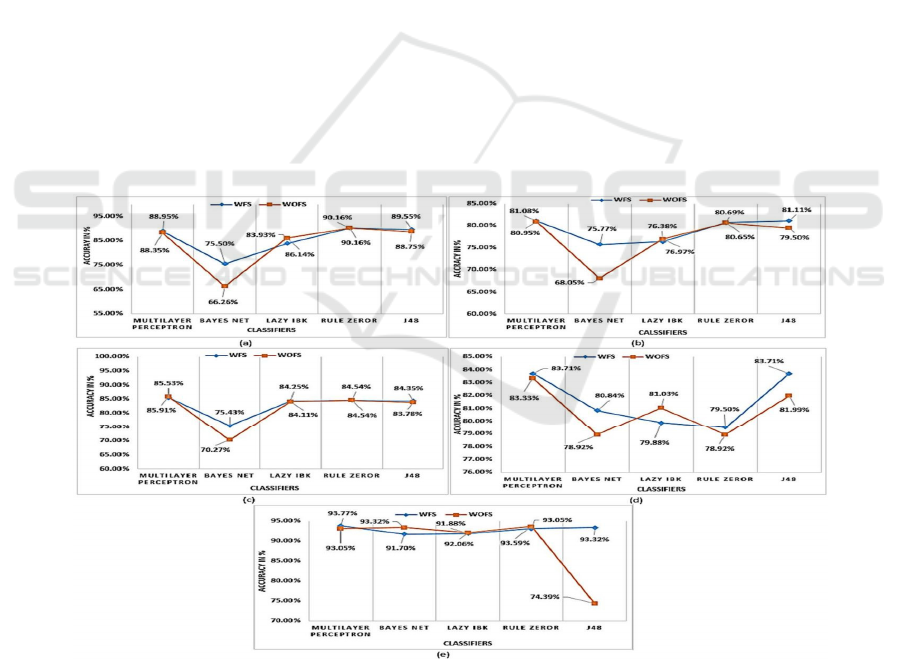
To figure out how much feature selection helps with
predicting software defects, we tapped into some
freely available NASA PROMISE datasets CM1,
PC1, JM1, KC1, and KC2. We ran a bunch of
machine learning classifiers on them, like Lazy IBK,
Bayes Net, Rule Zero R, Multi-layer Perceptron, and
J48. Then, we checked out how accurate the defect
predictions were when we used feature selection
(WFS) versus when we skipped it (WOFS).
The results demonstrated that feature selection
improved defect prediction accuracy across most
datasets and classifiers. Specifically, the KC2 data set
showed the highest accuracy improvement, with all
classifiers except Lazy IBK showing better
performance with feature selection. Similarly, the J48
classifier delivered the best results among all models,
achieving the highest accuracy rates across multiple
datasets.
A 30-fold cross-validation technique was applied
to enhance result precision. On average, feature
selection improved defect prediction accuracy by
approximately 5%. However, in certain cases,
datasets with inherent data complexities exhibited
marginally better results without feature selection.
When comparing the proposed feature selection
approach with an existing method (WOFS from
Alsaeedi and Khan’s study), the accuracy gains were
evident across four datasets (JM1, CM1, KC2, and
PC1). Among the classifiers, Logistic Regression
outperformed others in terms of overall defect
prediction accuracy.
To statistically validate the improvements, a
paired t-test was conducted using Mini tab software.
The test confirmed that the accuracy of WFS was
significantly higher than WOFS, with a p-value of
0.000, reinforcing the effectiveness of the proposed
method. Figure 2 Shows the Performance
Comparison of Classifiers with and without Feature
Selection Across Multiple Datasets.
Figure 2: Performance comparison of classifiers with and without feature selection across multiple datasets.
ICRDICCT‘25 2025 - INTERNATIONAL CONFERENCE ON RESEARCH AND DEVELOPMENT IN INFORMATION,
COMMUNICATION, AND COMPUTING TECHNOLOGIES
852

8 CONCLUSIONS AND FUTURE
WORK
8.1 Conclusions
To see if picking the right features makes a difference
in spotting software defects, we dug into some open
NASA PROMISE datasets CM1, PC1, JM1, KC1,
and KC2. We threw a handful of machine learning
tools at them, like Lazy IBK, Bayes Net, Rule Zero
R, Multi-layer Perceptron, and J48. After that, we
compared how well the defect predictions turned out
when we narrowed down the features (WFS) versus
when we just used everything (WOFS).
We also integrate some ensemble methods such as
Bagging, Boosting, and Stacking in our approach to
make the models robust and generalize better.
Besides this, we applied recipes such as Grid Search
and Bayesian Optimization to adjust the models'
parameters and make them shine.
The findings underscore the fact that defect
prediction models based on machine learning have
the potential to be a powerful tool in software
engineering given their accuracy, reduced
maintenance costs, and enhanced reliability of
software. By streamlining the process of spotting
defects, software teams can spend their time
resolving potential issues earlier, thereby enhancing
the overall quality of the software.
8.2 Future Work
While models like Random Forest and XGBoost have
been real standouts, there’s still room to play around
with some fancier machine learning options. Think
Neural Networks, Recurrent Neural Networks
(RNNs), or even Transformer-based models we could
tweak them to tackle defect prediction, picking up on
long-term connections and patterns that show up over
time in software development data.
8.2.1 Cross-Domain Defect Prediction
Usually, software defect prediction models are built
using data from just one area or project. Looking
ahead, it’d be cool to see if these models can hop
between different software fields or project styles. We
could use transfer learning tricks to take a model
trained on one dataset and get it working nicely on
another, cutting down on the need for tons of labeled
data when switching to something new.
8.2.2 Real-Time Defect Prediction
Integrating machine learning models into real-time
development environments could allow for
continuous defect prediction as software is being
developed. Future work could explore ways to
incorporate online learning and active learning
techniques, where the model continuously updates
and refines itself based on new code changes and bug
reports.
8.2.3 Incorporating More Complex Data
Sources
Beyond traditional software metrics (like lines of
code or complexity), there is a growing interest in
incorporating additional data sources, such as code
review comments, developer experience, and team
dynamics. Future work could explore the impact of
these data sources on defect prediction accuracy,
making the models more context-aware and adaptive.
8.2.4 Explainability and Interpretability
Machine learning models are accurate but provide
very minimal transparent solution, especially in
cases of deep learning models. Research to derive the
explainability of the defect prediction models,
utilizing explainable AI (XAI) techniques, can be a
vital future direction. This would help developers
understand why a specific software module is
predicted to be faulty and assist in optimizing defect
resolution efforts.
8.2.5 Incorporating the Impact of
Maintenance and Refactoring
Future studies could incorporate the impact of code
maintenance and refactoring practices on defect
prediction. Understanding how defects propagate
over time during the maintenance phase could lead to
models that predict defects more accurately in long-
lived software systems.
REFERENCES
David Sukeerthi Kumar. J (2023). Automating reviews for
E-Government services with artificial intelligence.
Proceedings of International Journal of Progressive
Research in Engineering Management and Science.
David Sukeerthi Kumar. J (2023). Sequence classification
of credit card fraud detection. Proceedings of
International Journal of Scientific Research and
Engineering Development.
Improving Software Defect Prediction Accuracy Using Machine Learning
853

David Sukeerthi Kumar. J (2024). Iris recognition modern
voting system based on deep learning. Proceedings of
International Journal of Progressive Research in
Engineering Management and Science.
David Sukeerthi Kumar. J (2024). Air quality index
forecasting via genetic algorithm based improved
extreme learning machine. Proceedings of International
Journal of Progressive Research in Engineering
Management and Science.
David Sukeerthi Kumar. J (2024). A fused 3D-2D
convolution neural network for spatial-spectral feature
learning and hyperspectral image classification.
Proceedings of Journal of Theoretical and Applied
Information Technology.
Hall, M. A. (2009). Feature selection for machine learning:
Comparing a selection of algorithms. IEEE
Transactions on Knowledge and Data Engineering.
Iglewicz, B., & Hoaglin, D. C. (1993). How to detect and
handle outliers. SAGE Publications.
Khoshgoftaar, T. M., & Seliya, N. (2005). Software quality
prediction using machine learning techniques.
Proceedings of the International Conference on
Software Engineering.
Kim, S., & Zimmermann, T. (2009). Predicting defects in
software systems: An empirical analysis. Proceedings
of the IEEE International Conference on Software
Engineering.
Paternoster, N., & Sillitti, A. (2016). Evaluation of software
defect prediction models: A survey. IEEE Software.
Tufano, M., & Palomba, F. (2017). Defect prediction in
software systems using SVM. IEEE Software.
Vasilescu, B., & Soni, P. (2018). Challenges in software
defect prediction: A comprehensive survey. Empirical
Software Engineering.
Xie, T., & Pei, J. (2011). Predicting faults in software using
machine learning techniques. IEEE Transactions on
Software Engineering.
Zhang, Y., & Zhao, L. (2019). Deep learning for software
defect prediction: A survey. IEEE Transactions on
Neural Networks and Learning Systems.
ICRDICCT‘25 2025 - INTERNATIONAL CONFERENCE ON RESEARCH AND DEVELOPMENT IN INFORMATION,
COMMUNICATION, AND COMPUTING TECHNOLOGIES
854
