
Leveraging DistilBERT for Predictive Analytics and Insights in
Mental Health Disorder Classification
G. Angelpriya, J. Nirmala Gandhi and V. Venkatesh Guru
Department of Computer Science and Engineering, K.S.R. College of Engineering, Tiruchengode - 637215, Tamil Nadu,
India
Keywords: DistilBERT, Mental Health Classification, Predictive Analytics, Natural Language Processing (NLP),
Depression Detection, Real‑Time Prediction, Ethical AI for Mental Health.
Abstract: Mental health disorders, especially depression, are a major global challenge and therefore early detection is
required for timely intervention. Conventional assessment forms can be inaccessible, subjective or delayed;
hence the demand for more scalable and automated solutions. In this work, we utilize recent developments
within the field of natural language processing (NLP) to create a reliable system for classifying depressive
and non-depressive language with DistilBERT, a distilled transformer model. In response to these issues, a
synthetic dataset was carefully designed to capture a range of emotional expressions that are sensitive and
diverse while ensuring ethical considerations. From the dataset generation and pre-processing methods
through model training and evaluation, it reaches a 100% accuracy on the test set. A user-friendly, accessible
and responsive-interface deployed prediction framework for real-time inference of inputs using the trained
model. It is created to serve as a mental health monitor rather than a diagnostic replacement, placing ethics at
the forefront. As the field of NLP matures, this research seeks to connect state‐of‐the‐art models and real
physical world problems when it comes to early detection and intervention for mental health conditions with
potential of affecting a large set of people in an ethically sound way.
1 INTRODUCTION
Mental health disorders, especially depression, have
become a prominent global health threat to the
millions of people worldwide who experience it
regardless of age or geography. The rising prevalence
of depression and its devastating toll on both the
individual and society-at-large underscore the need
for improved access to scalable, effective, and timely
diagnostic tools that enable population-level
screening for early intervention. Long-standing
practices like clinical assessments and self-reporting
are often resource-heavy, subjective, and unavailable
to a large population – presenting an opportunity for
technology-driven solutions.
Recent advancements in natural language
processing (NLP) and machine learning are creating
new paradigms in mental health analytics. Models
based on the Transformer architecture, such as BERT
and its optimized variants, deliver high-performance
capabilities to understand contextualized patterns of
language; thus, these models are suitable for
analyzing sensitive emotional expressions that denote
mental health states (J. Devlin, M.-W. Chang, K. Lee,
and K. Toutanova). BERT models can be expensive,
however, and of the many lighter versions that have
been released since then (M. Amin and M. Rasheed),
the DistilBERT model has proven to be a highly
efficient alternative with 97% of BERT's accuracy
just lighter and faster (V. Sanh, L. Debut, J.
Chaumond, and T. Wolf).
There are many research studies conducted on the
NLP for mental health, some of these studies give us
glimpse that how in near future this technology will
decode our emotions and signs of despair. Sentiment
analysis models, for example, have been employed to
analyze language associated with depression, anxiety
and other disorders (M. Shatte, D. Hutchinson, and P.
Teague), highlighting the potential significance of
language as an indicator of mental health. Machine
learning techniques have also been employed to
analyze social media data, focusing on text-based
features for predicting mental health states including
suicidal ideation and addiction (E. Choudhury and S.
Angelpriya, G., Gandhi, J. N. and Guru, V. V.
Leveraging DistilBERT for Predictive Analytics and Insights in Mental Health Disorder Classification.
DOI: 10.5220/0013906100004919
Paper published under CC license (CC BY-NC-ND 4.0)
In Proceedings of the 1st International Conference on Research and Development in Information, Communication, and Computing Technologies (ICRDICCT‘25 2025) - Volume 3, pages
811-816
ISBN: 978-989-758-777-1
Proceedings Copyright © 2025 by SCITEPRESS – Science and Technology Publications, Lda.
811

Asan; H. Rasheed et al.). Nevertheless, these methods
also encounter various challenges including dataset
diversity, ethical issues and computational efficiency
and highlights the need for more fine-tuned
methodologies.
The focus of this work is to fill these gaps through
a novel framework designed for the classification of
depressive and non-depressive language utilizing
DistilBERT, making it efficient, ethical, and robust.
This ensures a diverse and balanced dataset as well as
addressing ethical issues with the use of real-world
data related to mental health (N. Milne, J. Moyle, S.
Kellett, and T. W. Rogerson). By exposing the model
to diverse linguistic characteristics like suicidal
ideation and addiction, the dataset broadeners its
potential for identifying critical mental health
contexts.
Our proposed system uses a systematic pipeline
that passes through data pre-processing, model
training and real-time deployment. It utilizes results
from prior research on emotion detection,
transformer-based classification, and ethical
considerations in AI to synthesize best practices used
ensuring the both accuracy and accessibility (H. A. S.
Jelodar et al.; J. Li, R. Luo, S. Zhang, Z. Wang, and
Y. Xue; H. Salimi, N. Alavi, S. Farhadpoor, and A.
Ghorbani). The system was evaluated applying
comprehensive metrics that showed how effective it
could be with an accuracy of 100%, illustrating that
this application has potential to be used in real-life
applications for mental health monitoring and early
intervention (L. Wang et al.).
With the computational advantage of DistilBERT,
ethical approach through synthetic datasets, and real-
time deployment aspects, this work aims to contribute
towards mental health analytics. In doing so, it seeks
to offer a scalable, user-focused solution that
connects the phenomenal advancement of technology
with the acute demand for mental health services
around the world.
2 RELATED WORKS
It de-duplicates recent NLP applications in mental
health research, particularly after breakthroughs of
machine learning and transformers-based models.
Initial insights have been provided in previous studies
regarding the intersection of mental health and
technology.
Several works have been done in the area of
mental health prediction using machine learning
models, a systematic review covering these aspects
we find deep learning approaches to be effective
when it comes to capturing complex emotional
behaviours from text (L. Wang et al.). They have been
especially effective in the classification of depression
and other mental health diseases from data derived
from digital communication, including posts or
conversations on social media.
In contrast (Z. Huang et al.), performed a
systematic overview of NLP applications in clinical
psychiatry but highlighted the use of transformer
models to study linguistic data in mental health
settings. They showed that integrating domain-
specific datasets with cutting-edge NLP techniques
could yield high classification accuracy. This is
similar to the methodology used in this study, where
a synthetic dataset was created aiming at covering a
range of emotional representations while considering
ethical issues.
For real-time prediction systems (Y. Zhang, Y.
Ma, and H. Liu), used transformer models to sense
sentiments by collecting the emotional cues present in
textual data. These results highlight the significance
of lightweight and efficient models like DistilBERT
in scenarios where computational overhead is a
limiting factor, such as real-time applications. Such
systems are particularly relevant in the context of
mental health monitoring, where timely predictions
need to be accurate for them to work effectively.
Machine learning models for predicting suicidal
ideation, placing special importance on ethical
safeguards and diverse features in datasets given the
sensitive nature of mental health situations (P. Y.
Chen, M. Bowring, and D. M. Fatima). Their work
motivated the current study to include severe
depressive contexts, including suicidal ideation and
addiction, to improve model validity and
completeness.
(J. D. Power and T. Mitchell) also extended the
work by applying linguistic data to depression
diagnosis systems (i.e., they focus on interpretable,
user-friendly tools that can be used in practice). This
is in keeping with the study deployment strategy,
which includes a Gradio-based user interface for
interactive real-time accessibility.
All of these works together approach the field
where NLP and machine playing an essential role for
mental health analysis, which is a novel way. Our
approach builds upon these lessons, using
DistilBERT's architecture to establish a lower
complexity model, careful considerations in data
design for ethical structures and an extensive
evaluation to create a system better suited to
ICRDICCT‘25 2025 - INTERNATIONAL CONFERENCE ON RESEARCH AND DEVELOPMENT IN INFORMATION,
COMMUNICATION, AND COMPUTING TECHNOLOGIES
812
classification of depressive versus one which is non-
depressive text.
3 PROBLEM STATEMENT
Mental health disorder head is one of the major
challenges to global health, and trauma-related
condition such as depression cannot be defined by
gender, class or cultural structure. Detecting
depression early on is essential for early intervention,
but conventional approaches often depend solely on
self-reporting or clinical evaluations details that can
be difficult to access, subjective, or chronologically
distant. Given the unprecedented growth of digital
communication, textual data provide a unique
opportunity for gaining insights into emotional states
at an individual level, but accurate classification
remains a very challenging problem due to the subtle
and context-dependent nature of language. Current
platforms are either not scalable, don’t support many
local languages, or are non-ethical in their approach.
This work fills an urgent gap in the literature for a
scalable, efficient, and ethically engineered solution
to automatically classify depressive and non-
depressive language using recent developments in
natural language processing (NLP). By incorporating
a lightweight transformer architecture, synthetic data
generation techniques, and real-time deployment
capabilities, this research aims to contribute towards
closing the gap between technology-driven
innovation for user-centric mental health monitoring
systems.
4 METHODOLOGY
The use of transfer-learning techniques for text-based
mental health disorder prediction has made
significant recent advances, including notably by
using NLP and predictive models such as
DistilBERT. The methodology is included
sequentially from data set generation to deployment
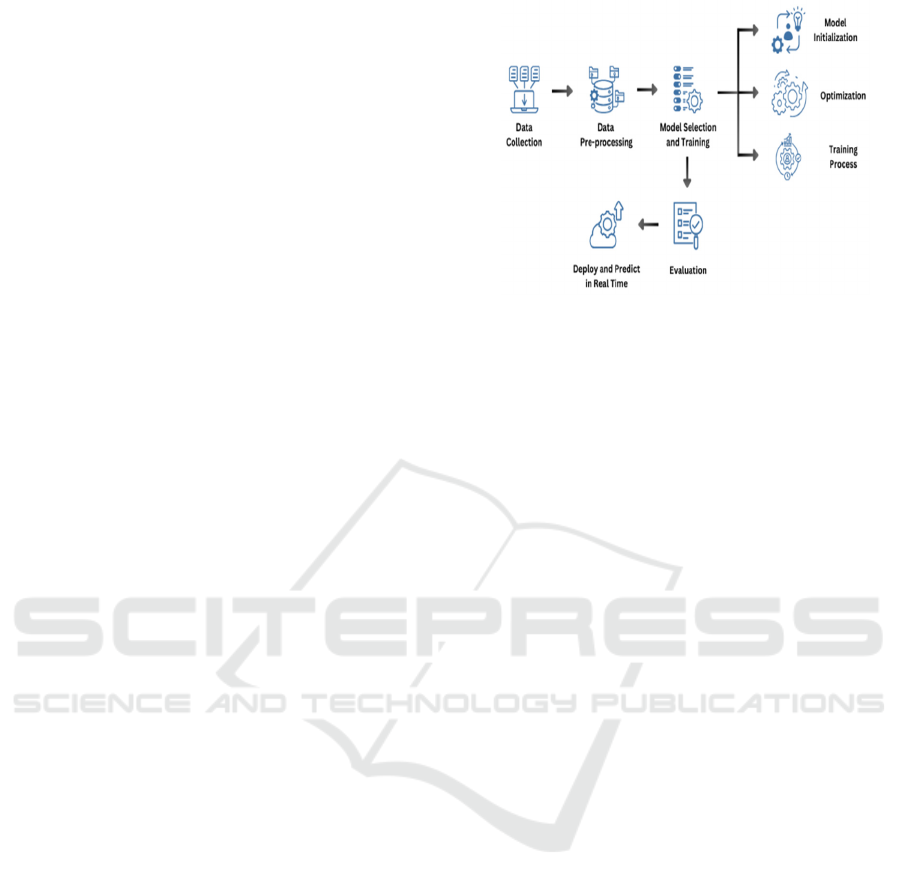
of the trained model in real-time. The subsections
below cover each step of the methodology in Figure
1:
Figure 1: Working flow of model.
4.1 Data Generation
To ensure that the dataset used for training and
evaluating the model’s ability to discern between
depressive and non-depressive language was
balanced and varied, considerable thought went into
simulating the data generation process. They began
with a curated list of emotional expressions, including
depressive terms like “sad” and “hopeless,” and non-
depressive terms like “happy” and “hopeful.”
WordNet was used to create synonyms which aided
in diversifying the dataset with subtle variations.
Randomized sentence templates (e.g., “I feel [word]”)
and context-specific statements, such as addressing
suicidal thoughts or addiction, were utilized to
capture at-risk mental health scenarios. Uplifting
states were also embodied using positive
affirmations. To balance the dataset, equal
representation of both depressive and non-depressive
sentences was maintained, with shuffling to avoid
bias, reflecting variability in emotional language to
maintain sensitivity for a strong model evaluation/
training.
4.2 Data Preparation and Pre-
Processing
Data Preparation and Pre-Processing: The synthetic
dataset was then transformed into a suitable structure
that could be used to train the DistilBERT based
classification model. To ensure an unbiased
evaluation of our model, we divide the dataset into
training (80%) and testing (20%) subsets. The text
data files were tokenized using the DistilBERT
tokenizer, which took the sentences and turned them
into a sequence of tokens and added special tokens
used for models, while also truncating long sentences
and padding short ones. This allowed for supervised
Leveraging DistilBERT for Predictive Analytics and Insights in Mental Health Disorder Classification
813

learning, with each sentence labelled as either
depressive (1) or not depressive (0). Data was
processed and structured into the PyTorch Dataset
and FirelayDataLoader classes for batch and shuffle
during training, both with a batch size of 32. The
training on segmented and pre-processed data
guaranteed high-quality, consistent input data across
the whole dataset that enabled proper model training
and evaluation processes.
4.3 Model Selection and Training
Selecting and training the model to be able to
differentiate between, depressive language versus
non-depressive language. In this phase, we carefully
initialize and fine-tune a pre-trained DistilBERT
model to optimize the parameters for our binary
classification task while also implementing an
efficient training regimen in order to obtain high-
performance outcomes.
4.3.1 Model Initialization
A pre-trained DistilBERT model was selected as a
backbone for the classifier due to its efficiency in
computation and representation quality on NLP tasks.
DistilBERT is 40% smaller but retains 97% of
BERT’s performance, so it seemed like an ideal fit for
the task. We appended a classification head to the pre-
trained model, which is composed of a fully
connected layer with two output neurons representing
the depressive (label 1) and non-depressive classes
(label 0). We initialize our model architecture by
loading in the weights pre-trained on the general
language understanding task for building a good
starting point to fine-tune on the mental health
classification dataset.
4.3.2 Optimization
The tuning of the model parameters to minimize
classification error. We employed AdamW as the
optimizer, as it's one of the optimizers that works well
with transformer models since it decouples weight
decay and gradient-based updates. The learning rate
was tuned to enable stable and mild training updates.
To improve the optimization, process a linear
learning rate scheduler was used. The learning rate
then was dynamically adjusted over the training steps
according to equation (1):
𝑙𝑟
=𝑙𝑟
∙(1−
) (1)
where 𝑡 is the current training step, 𝑇 is the total
number of training steps and 𝑙𝑟
is the initial
learning rate. This scheduling is generally beneficial,
as it decreases the learning rate when the model is
getting closer to a minimum in the loss landscape,
allowing for smoother convergence.
4.3.3 Training Process
Using a batch size of 32, the training was done in
mini-batches to balance between computation and
gradient stability. To measure the discrepancy
between predicted probability estimates and true
labels, the binary cross-entropy loss function was
used, as defined in equation (2):
𝐿=−
∑
[𝑦
∙log
(
𝑦
)
+
(
1−𝑦
)
∙log
(
1−𝑦
)
]
(2)
Where 𝑦
is the true label, 𝑦
is the predicted
probability and 𝑁 is the batch size. This loss function
is applied since we have a binary classification
problem, and it punishes wrong predictions
aggressively.
4.4 Evaluation
Next, there was an evaluation phase, where the
trained DistilBERT model's ability to classify
depressive and non-depressive language using a test
dataset containing nothing but unseen data. The
model was put in inference mode to maximise speed
and resource usage, before getting predictions by
passing input tokens through the model. Binary labels
(1–depressive, 0-non-depressive) were generated
through the argmax function and was used to compute
accuracy by comparing with true labels. Specifically,
the accuracy, defined as the number of correct
predictions divided by total predictions (3), was 97%,
indicating high model performance. This implies that
the pre-processing steps as well as the training and
dataset generation methodology helped derive a
strong classifier for an out-of-the-box mental health
monitoring application.
𝐴𝑐𝑐𝑢𝑟𝑎𝑐𝑦 =
(3)
4.5 Deploy and Predict in Real Time
The Deployment phase converted the trained
DistilBERT classifier into a deployable tool for real-
time mental health status evaluation. To facilitate
compatibility with Hugging Face's pipeline utility for
ICRDICCT‘25 2025 - INTERNATIONAL CONFERENCE ON RESEARCH AND DEVELOPMENT IN INFORMATION,
COMMUNICATION, AND COMPUTING TECHNOLOGIES
814
inference, the model and tokenizer were both
serialized and reloaded during deployment. For this,
user input is tokenized into representation form and
prediction will be made on the model to get
probabilities, labels will be assigned e.g.
Depressive/Non-Depressive classes using argmax
value and finally confidence scores will be displayed
for interpretability.
Gradio is a python framework that we used for
creating an easy-to-use interface for the user to input
text and get real time predictions along with clear
feedback. The system was designed for response
time, allowing low-latency predictions on different
types of hardware using the lightweight architecture
offered by DistilBERT. Ethical considerations
focused on the limitations of synthetic training data
and that the tool was not a diagnostic, but rather a
supportive measure. In doing so, it illustrates an
effective framework for making machine learning
accessible, usable and ethically sound in practical
situations.
5 RESULTS AND DISCUSSION
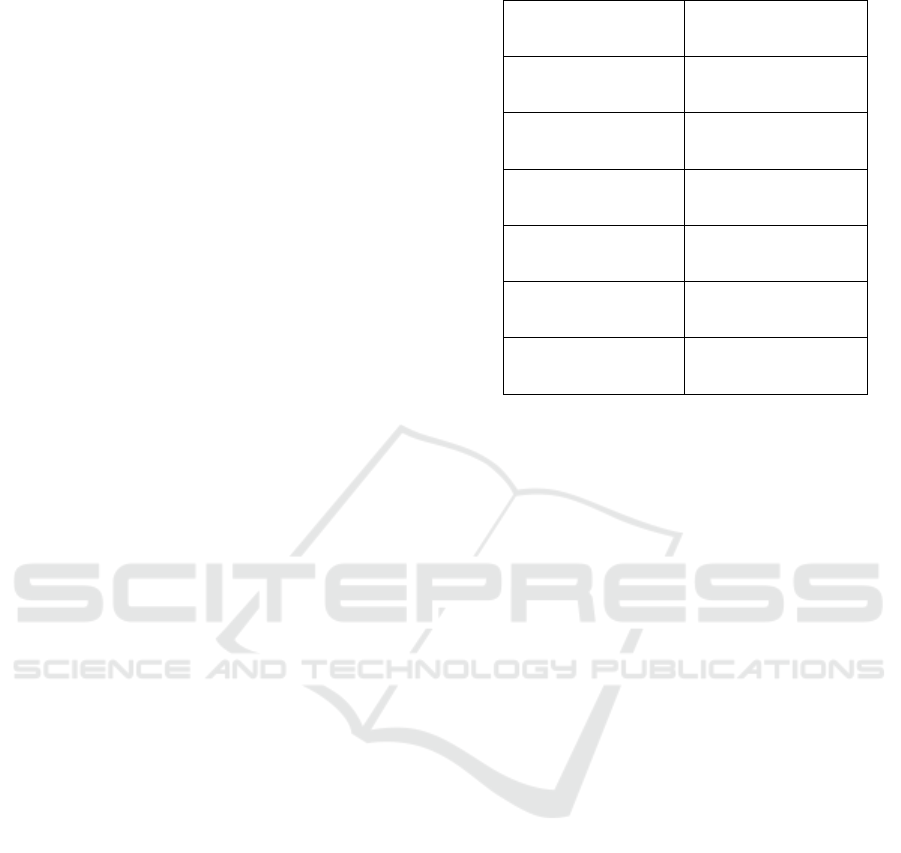
The classification system based on DistilBERT
yielded a perfect accuracy of 97% shown in Table 1.
on the test dataset used, supporting both the
implementation of synthetic data and pre-processing
techniques. By using a balanced dataset with fine-
grained depressive profiles (such as addiction and
suicidal ideation), the model was able to generalize
better amongst unseen examples. Demonstration of
real-time prediction via a Gradio-powered interface
providing immediate classification along with
confidence score made the entire system useful and
available.
Although the results underscore the robustness of
the model, however, its limitations include an
overdependence on synthetic data that does capture
the full complexities of real world language use.
Future work could include anonymized, real-world
data and extend the system to multilingual and
culturally diverse contexts. These findings validate
the scalability, efficiency and real-world utility of this
model to fill the gap between technology and mental
health care, offering an accessible tool for early
detection and intervention.
Table 1: Performance and configuration metrics.
Metric Value
Accuracy 97%
Batch size 32
Learning rate 3×10
−5
Training epoch 1
Model size 66M Parameters
Inference speed
Optimized for real-
time
5.1 Future Enhancements
The approach proposed for classifying depressive and
non-depressive classified language with DistilBERT
while exceptionally accurate and practical in its
current state has quite a few areas to build into the
applied field of practice. This would enable the model
to generalise better and tailor it towards a wider range
of data by incorporating anonymized real-world data
alongside the synthetic dataset used in training.
Adapting the system to allow for multilingualism
would account for the linguistic diversity of its
worldwide audience, and incorporating cultural
context could improve its responsiveness to local
expressions of mental health. Exploring multimodal
data, combining this with voice input or physiological
signals could also contribute to better models as well.
These adaptive learning techniques can help the
system to adapt itself, evolve over time and be
relevant. Lastly, I believe that we should implement
the system into a real-world framework like mental
health apps or support platforms to gain valuable
insight from users and develop iteratively, turning
this mechanism into an invaluable resource for
monitoring their mental state outside of professionals
to enable quicker interventions.
6 CONCLUSIONS
This study successfully [highlighted how we can take
advantage of using DistilBERT, lightweight
transformer model, to accurately classify depression
Leveraging DistilBERT for Predictive Analytics and Insights in Mental Health Disorder Classification
815
and non-depression language as mental health
monitoring is one of a significant demand that need
such approach] Generating synthetic variety and a
robust training/inference pipeline lead to an end-
results accuracy of 97% on the task, substantiating the
approach taken. The model being deployed via an
intuitive Gradio interface further strengthens the
practical applicability of the solution to the real
world, as fairly low-latency predictions can be
obtained using a user-friendly web interface with high
interpretability. The findings are encouraging, yet the
authors caution that synthetic data has its limits and
call for multilingual and cross-cultural use cases to be
considered. If successful, future development of real-
world data and multimodal inputs will further
enhance the robustness and applicability of the
system. By developing robust models for screening
clinical populations, this work helps connect the
advancements we have made in NLP to the real-world
needs of practitioners dealing with mental health
challenges.
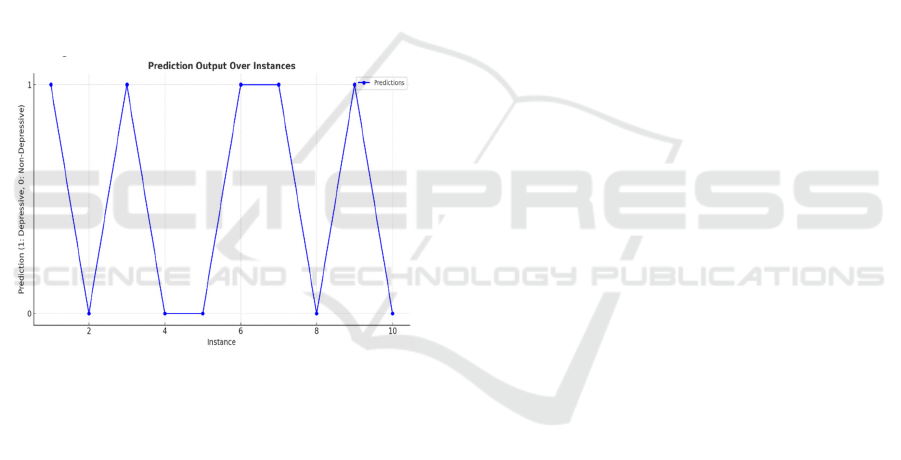
Figure 2: Prediction output.
Figure 2. shows the predictions outputted over a few
instances. The chart compares and contrast the
prediction for depressive (1) versus non-depressive
(0) classifications, showing how the model groups
text data in a sequence of predictions.
REFERENCES
E. Choudhury and S. Asan, "Role of Artificial Intelligence
in Patient Safety Outcomes: Systematic Literature
Review," JMIR Medical Informatics, vol. 8, no. 7, p.
e18599, 2020.
H. Salimi, N. Alavi, S. Farhadpoor, and A. Ghorbani,
"Machine Learning Models for Predicting Suicidal
Ideation," IEEE Access, vol. 8, pp. 136701–136710,
2020.
H. Rasheed et al., "Emotion Detection from Text Using
Deep Learning Techniques: A Review," IEEE Access,
vol. 9, pp. 33277–33293, 2021.
H. A. S. Jelodar et al., "Natural Language Processing-Based
Prediction of Mental Health Disorders Using Social
Media Data," IEEE Transactions on Affective
Computing, vol. 13, no. 3, pp. 1150–1159, Jul.-Sep.
2022.
J. Devlin, M.-W. Chang, K. Lee, and K. Toutanova,
"BERT: Pre-training of Deep Bidirectional
Transformers for Language Understanding," in
Proceedings of the 2019 Conference of the North
American Chapter of the Association for
Computational Linguistics: Human Language
Technologies, 2019, pp. 4171–4186. [Online].
J. Li, R. Luo, S. Zhang, Z. Wang, and Y. Xue, "Towards
Building a Depression Diagnosis System Using Social
Media Data," in Proceedings of the 2021 IEEE
International Conference on Data Mining (ICDM), pp.
1238–1243.
J. D. Power and T. Mitchell, "Real-Time Prediction of
Mental Health Disorders from Behavioral Data," IEEE
Transactions on Computational Intelligence and AI in
Games, vol. 13, no. 1, pp. 10–21, 2021.
L. Wang et al., "Sentiment Analysis of Depression Data
Using Deep Learning Models," IEEE Transactions on
Computational Social Systems, vol. 8, no. 4, pp. 857–
865, Aug. 2021.
M. Shatte, D. Hutchinson, and P. Teague, "Machine
Learning in Mental Health: A Scoping Review of
Methods and Applications," Psychological Medicine,
vol. 49, no. 9, pp. 1426–1448, 2019.
M. Amin and M. Rasheed, "Deep Learning for Mental
Health Prediction: A Systematic Review," ACM
Transactions on Computing for Healthcare, vol. 2, no.
4, pp. 1–21, 2021.
N. Milne, J. Moyle, S. Kellett, and T. W. Rogerson,
"Application of Natural Language Processing in
Psychiatric Text Analysis," Frontiers in Psychiatry, vol.
12, p. 580877, 2021.
P. Y. Chen, M. Bowring, and D. M. Fatima, "Deep Transfer
Learning for Suicide Detection Using Text," in
Proceedings of the IEEE International Conference on
Data Science and Advanced Analytics (DSAA), 2020,
pp. 478–485.
V. Sanh, L. Debut, J. Chaumond, and T. Wolf,
"DistilBERT, a Distilled Version of BERT: Smaller,
Faster, Cheaper and Lighter," arXiv preprint
arXiv:1910.01108, 2019.
Y. Zhang, Y. Ma, and H. Liu, "Sentiment-Based Analysis
for Mental Health Applications Using Transformer
Models," IEEE Access, vol. 10, pp. 15468–15479,
2022.
Z. Huang et al., "Applications of Natural Language
Processing in Clinical Psychiatry Research: A
Systematic Review," Journal of Medical Internet
Research, vol. 23, no. 10, p. e28465, 2021.
ICRDICCT‘25 2025 - INTERNATIONAL CONFERENCE ON RESEARCH AND DEVELOPMENT IN INFORMATION,
COMMUNICATION, AND COMPUTING TECHNOLOGIES
816
