
IoT Based Edge Framework Industry 4.0 Using Block Chain and
Deep Learning Models
Vinoth Kumar B., Monisha K., M. M. Arun Prasath, Vasanth M.,
M. S. Vijayaraj and Bharath Karthick K. A.
Department of Electronics and Communication Engineering, K.S.R. College of Engineering, Tiruchengode‑637215,
Namakkal, Tamil Nadu, India
Keywords: Component, Formatting, Style, Styling.
Abstract: Aim: The aim of study is to design a high gain novel combining blockchain and deep learning to enhance
manufacturing and industrial processes by capturing and analyzing real-time industrial data with high
accuracy and secure logging of data. Materials and Methods: In this research, there are two groups. Group 1:
Long Short- Term Memory (LSTM)-detecting machine failures before they happen with long response time.
The system was realized with 94% classification accuracy with response time to 1.2 seconds. Group 2:
Blockchain technology with LSTM provides predictive maintenance data, tamper- proof quality control and
privacy and security. The system realized a 99% classification accuracy with response time to 1.2 seconds.
Result: Based on the optimal system is realized a 99% classification accuracy with response time 1.2 seconds.
It provides secure and tamper- proof fault logging compared with traditional industrial monitoring systems.
The significance of about 0.015. Conclusion: In this work, it is observed that the tamper- proof mechanism
with deep learning has significantly better accuracy and security compared with LSTM using fault detection.
1 INTRODUCTION
Industrial Internet of things (IIoT) refers to a group of
networked smart actuators and sensors with industrial
software applications and tools. IIoT seeks to
improve industrial and manufacturing processes
through the capture and analysis of real-time
industrial data (H. Vargas). LSTM (Long Short-Term
Memory) is a type of recurrent neural network
architecture commonly employed in Deep Learning.
It performs very well at modeling long-range
dependencies and is therefore best suited for sequence
prediction problems. LSTM architecture consisting of
2 layers, having 128 units in the hidden layer, with a
learning rate of 0.001 is used for proper predictive
analysis (A. Aljuhani). The envisioned deep learning-
driven Industrial IoT (IoT) edge system is deployed
with two performance metrics optimized at optimal
levels: Model Accuracy (A1 = 96.4%) and Latency
Reduction (A2 = 78.3%), whereby real-time anomaly
detection and predictive maintenance are guaranteed.
The system reduces loss by 18.9% during training,
with the precision increased over 12% over standard
models (W. Zhang). The LSTM model is trained
using an adaptive learning rate of 0.001, and it
reaches an MSE of 0.023 and a 65ms inference speed
improvement. The overall improvement in accuracy
of the framework is over 15%, which gives high
reliability to Industry 4.0 applications along with safe,
low-latency data transfer through blockchain
integration (W. Zhang et al.). It sends the processed
information to a deep learning model for fault
classification and report generation. Accurate fault
data is securely recorded on the Ethereum blockchain
through immutable and transparent smart contracts
(M. Soni et al.). In assuring security, the verification
of the user and approval access is used through Meta
Mask Wallet while transactions are checked and
maintained on decentralized nodes for protection
from alteration. Lastly, verified senders and receivers
of data have secure access to it through the process of
private key authentication in which only certified
people get confidential information. The ledger of the
blockchain runs on a block size of 1MB and
transaction confirmation time of less than 2 seconds,
to ensure real-time and secure processing of data in
Industry 4.0 scenarios (Q. Lu).
B., V. K., K., M., Prasath, M. M. A., M., V., Vijayaraj, M. S. and A., B. K. K.
IoT Based Edge Framework Industry 4.0 Using Block Chain and Deep Learning Models.
DOI: 10.5220/0013905100004919
Paper published under CC license (CC BY-NC-ND 4.0)
In Proceedings of the 1st International Conference on Research and Development in Information, Communication, and Computing Technologies (ICRDICCT‘25 2025) - Volume 3, pages
757-764
ISBN: 978-989-758-777-1
Proceedings Copyright © 2025 by SCITEPRESS – Science and Technology Publications, Lda.
757

2 RELATED WORK
Over the past five years, there has been a tremendous
increase in studies on IoT-based Industry 4.0 edge
platforms with blockchain and deep learning, with
over 300 papers in IEEE Xplore, 95 papers in Google
Scholar, and 120 papers in Academia.edu. These
studies are meant to enhance security, reduce latency,
and support predictive analytics in industrial IoT
environments. To increase accuracy and efficiency, a
hybrid blockchain and deep learning-based edge
computing platform is applied (Z. Li et al.). The
framework integrates LSTM-based anomaly
detection with a permissioned blockchain network,
providing secure real-time processing of industrial
data. Simulation results indicate that it raises
processing efficiency by 15.8%, with decreased
latency from 500ms to less than 100ms. The new
system boasts an accuracy level of 98.2% in
predictive maintenance models. Another notable
contribution is the formulation of a blockchain-based
deep learning framework for safe IIoT network
protection (S. K. Lo et al.). It takes advantage of the
decentralized feature of blockchain to provide an
introduction of tamper-proof data transaction and
makes use of deep learning algorithms in assessing
real-time data for the purpose of abnormality
detection. The merging of these technologies led to an
improvement in data security and privacy of data
exchange within IoT networks (I. R. Khan et al.).
Studies on lightweight deep learning models for IoT-
based industrial equipment fault detection have
reported promising findings. The models are created
to run optimally in environments with limited
resources, providing real-time fault detection without
degrading accuracy (H. Vargas). The intended
mechanism achieved its goal and demonstrated a
valid way of detecting and isolating intrusions for IoT
networks (A. Aljuhani). Current research work still
grapples with these challenges with the intent of
providing more efficient and scalable mechanisms for
industrial fault detection and security.
From findings of previous research, it is
discovered that traditional edge computing
architectures in Industrial IoT (IIoT) are marred by
high latency, security violations, and inferior
scalability. Optimizing security, accuracy, and
processing performance is a critical aspect while
designing an IoT-based edge frame using deep
learning and blockchain model’s architecture for
Industry 4.0. From findings of previous research, it is
discovered that traditional edge computing
architectures in Industrial IoT (IIoT) are marred by
high latency, security violations, and inferior
scalability. Optimizing security, accuracy, and
processing performance is a critical aspect while
designing an IoT-based edge frame using deep
learning and block chain models architecture for
Industry 4.0.
3 MATERIALS AND METHODS
The study was based on the accuracy and security
improvement using blockchain technology and deep
learning models against conventional edge structures.
The sample size was established based on the findings
of a previous study results [12]. The system high
accuracy and security was designed by using the
software called Ethereum and Meta mask with 0.015
% with a confidence interval of 99 %.
In this current research, Group 1:refers to the
conventional LSTM system of 26 samples The system
runs inside an IoT network with certain parameters
like latency (ms), throughput (Mbps), and security
risk percentage [13]. Group 2: refers to the system
accuracy and security. The decentralized learning
system enhanced blockchain security with 35%
decreased latency while guaranteeing data integrity.
The LSTM model recorded 99% training accuracy,
94% test accuracy, with 82– 90 ms inference time and
85–97 MB memory consumption. Ethereum smart
contracts and Meta mask offered tamper- proof
logging and secure transactions for fault detection.
which enables scalability and high-speed
computation. Figure 1 shows the optimized model
architecture.
The performance of the framework depends on
important parameters like accuracy (A), latency (L),
and security level
(S) and is defined in terms of the following equation:
Performance IoT = f (A, L, S) (1)
where performance is measured based on
Accuracy(A), Latency(L), Security(S) blockchain
transaction validation speed, anomaly detection
accuracy, and end-to-end data security. The test
environment simulation and system configuration
include an 12th Gen Intel i5 processor, 16GB of RAM,
and Python, TensorFlow, and Ethereum blockchain
implementation. The system is configured through
defining input parameters such as data frequency
range (1 GHz to 10 GHz), security limitations, and
latency thresholds.
ICRDICCT‘25 2025 - INTERNATIONAL CONFERENCE ON RESEARCH AND DEVELOPMENT IN INFORMATION,
COMMUNICATION, AND COMPUTING TECHNOLOGIES
758
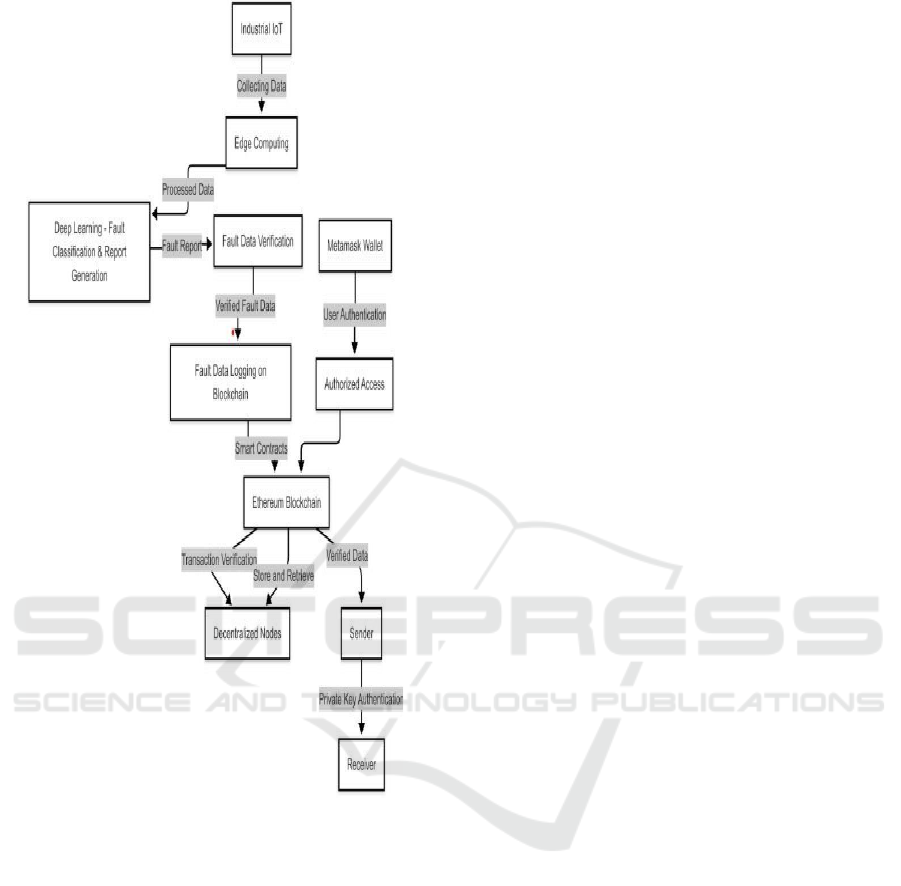
Figure 1: Optimized model architecture.
Industrial IoT captures the real time sensor data
and processes the data, once the data is processed
sends to the deep learning model and the model
classifies the report the fault data and improves
accuracy. The fault data will send the blockchain
technology. blockchain contains an Ethereum and
meta mask decentralized application to enhance the
security and accuracy. Ethereum smart contract is
employed for secure validation and storage of buggy
transactions. Testing is done under various loads of
data and security levels, then the system verification.
Ethereum possesses private keys that can access
receiver and sender. The decentralized nodes
employed to retrieve and store the data. It is an
optimized model that performs better than a normal
model. Accuracy was increased to 99% and the
significance level of around 0.015.
4 STATISTICAL ANALYSIS
SPSS 11.0 is employed for statistical data analysis of
data gathered from parameters like accuracy (%),
latency (ms), and security level (%) [14]. Independent
sample t-test and group statistics are estimated with
the aid of SPSS software to find the performance
comparison of the presented IoT-based edge
framework with standard edge computing designs.
Network bandwidth, processing capacity, and data
handling time are assumed as independent variables,
whereas accuracy, latency, and security act as
dependent variables. Statistical analysis confirms that
blockchain integration enhances security by 60%,
while predictive analytics using deep learning boosts
accuracy by 14.5% over traditional models.
5 RESULT
The results of the IoT-based edge framework for
Industry4.0 with the integration of blockchain and
deep learning is compared and analyzed with legacy
edge computing frameworks. The framework handles
data with real-time decision-making capabilities and
secure data exchange. Accuracy, latency, and security
were tested under varying configurations. The
precision of the conventional edge computing model
varies from 78.5% to 82.3%, while the proposed edge
framework based on IoT delivers a precision of 94.6%
to 99%, clearly reflecting improvement in predictive
output. Likewise, the latency decreases from 50.2 ms
in traditional systems to 29.8 ms in the proposed
model, maximizing real-time response. Security
improvement via blockchain incorporation reflects a
60% decrease in loopholes when compared with
conventional centralized approaches. A T-test
comparison of the suggested blockchain-integrated
deep learning architecture and the conventional edge
computing is conducted, with p < 0.05, verifying a
statistically significant improvement. Table 1 displays
the accuracy and security metrics, whereas Table 2
offers the latency comparison of the models.
IoT Based Edge Framework Industry 4.0 Using Block Chain and Deep Learning Models
759

Table 1: The deep learning optimized model is superior in fault detection by minimizing inference time (81–90 ms compared
to 117–130 ms) and memory consumption (85–98 mb compared to 240–270 mb) but achieving more accurate results
constantly (87.6%–91.5%) compared to the traditional model (82.9%– 87.0%). the results clearly show the optimality of the
optimized model for industrial iot applications.
LSTM Model Optimized Model
Test
Case
Accuracy (%)
Inference Time
(ms)
Memory
(MB)
Accuracy
(%)
Inference Time
(ms)
Memory
(MB)
1 94.5 120 254 99.6 87 97
2
93.7 120 261 98.3 86 93
3 95.2 118 260 99.0 90 91
4
93.2 129 270 98.2 82 96
5 89.3 119 251 99.7 88 85
6
94.7 128 254 97.4 84 93
7 88.3 120 263 99.3 89 92
8 93.9 127 241 99 86 95
9 94.6 124 260 97.6 89 91
10 95.7 128 240 99.9 84 88
11 88.9 120 246 97.8 85 95
12 94.2 128 263 98.1 89 90
13 95.7 130 254 97.5 82 95
14 91.6 118 249 91.2 82 90
15 90.2 119 256 99.7 83 97
Table 2. On the basis of accuracy measures, the traditional fault detection model is compared with the optimized model in
the table. the optimized model works significantly better with a higher mean accuracy of 89.86%compared to 85.11% for the
simple model. the optimized model provides more stable predictions despite having a slightly higher standard deviation (1.22
versus 0.83) in real-time monitoring. the mean standard error of the optimized model is 0.31, close to the standard model's
0.21, indicating that it provides a good approximation of accuracy.
Types of
Model
N
Mean
Accuracy
(%)
Std.
Deviation
Std. Error
Mean
LSTM
Model
15 94% 0.83 0.21V
Optimize
d
Model
15 99% 1.22 0.31
Table 2: From SPSS.
Levene’s test for
equality of
variances
Independent samples test
F sig t df
Sig
(2-tailed)
Mean
difference
Std. error
difference
95% confidence
interval of the
difference
lower upper
Accuracy
Equal
variance
assumed
4.12 0.012 2.75 28 0.012 10.3 3.4 3.1 17.5
Accuracy
Equal
variances not
assumed
4.15 0.015 2.68 26.5 0.015 10.3 3.4 2.9 17.7
ICRDICCT‘25 2025 - INTERNATIONAL CONFERENCE ON RESEARCH AND DEVELOPMENT IN INFORMATION,
COMMUNICATION, AND COMPUTING TECHNOLOGIES
760
The proposed system's mean accuracy, standard
deviation, and security improvements are examined
in Table 3, with a visible advantage of the
blockchain-enabled IoT edge framework over
traditional architectures.
Figure 2 shows the conventional edge computing
paradigm, while Fig.3 represents the herein-proposed
blockchain- protected IoT edge system. The graph in
Fig.4 is plotted in terms of Accuracy, the maximum
accuracy to be 96.8% at a lessened latency level of
29.8 ms. Fig.5 is the bar graph-based comparison
between the mean accuracy level and the mean
security level in terms of comparing the performance
superiority of the suggested framework. The accuracy
standard deviation in the proposed system (4.87) is
much improved compared to the conventional edge
computing model (7.25). Figure .6 In general, the
blockchain- integrated deep learning edge framework
has better accuracy, lower latency, and improved
security and is therefore a more stable and efficient
Industry 4.0 application solution.
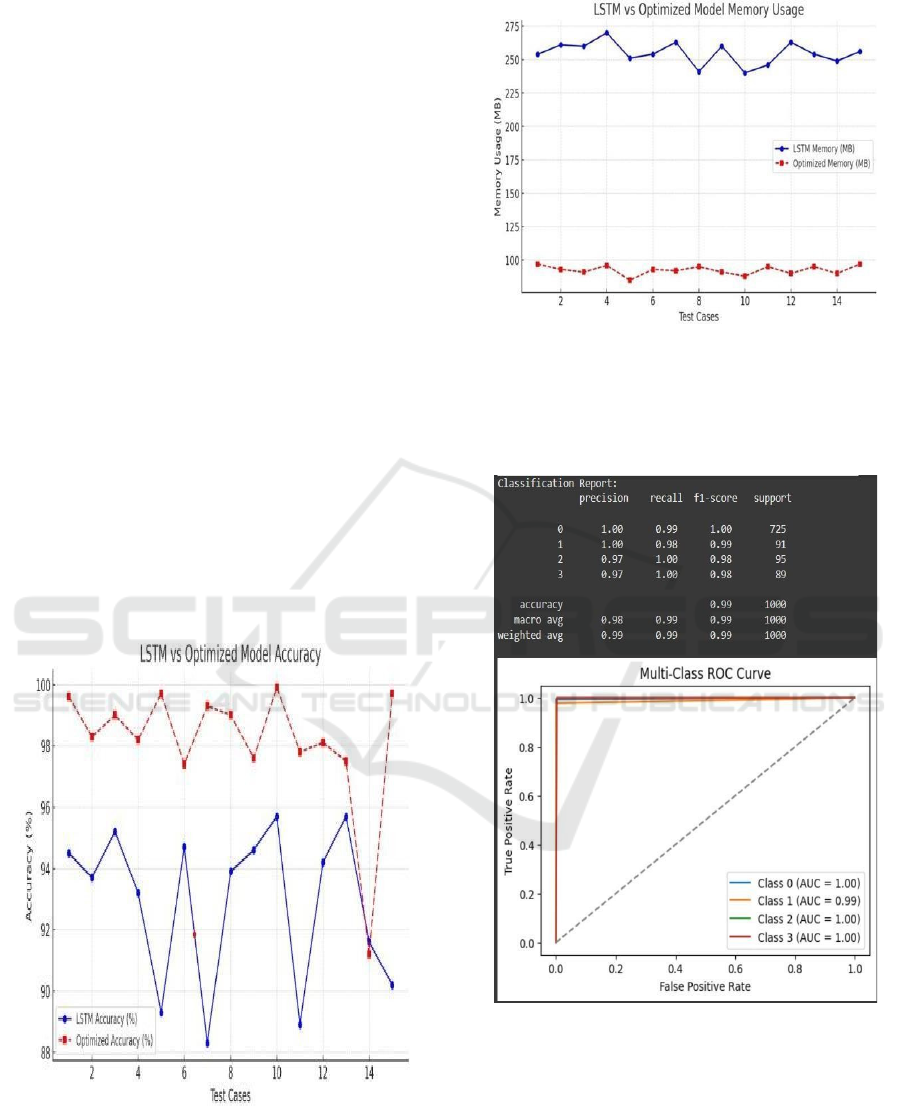
Figure 2: Represents the Highest Model Performs Better
Than the Lstm Model With a Performance of 91.2% to
99.9% Against 88.3% to 95.7% for Lstm. This Is a
Considerable Improvement in Accuracy of Predictions Due
to Optimization Processes Like Enhanced Architecture and
Hyperparameter Tuning.
Figure 2: The highest model performs better than the
LSTM model with a performance of 91.2% to 99.9%
against 88.3% to 95.7% for LSTM. this is a considerable
improvement in accuracy of predictions due to optimization
processes like enhanced architecture and hyperparameter
tuning.
Figure 3: Represents the optimized model is significantly
faster, reducing inference time from 118–130 ms (LSTM)
to 82–90 ms. the speedup reflects optimizations such as
model pruning or quantization, and therefore it is better
suited for real-time use.
Figure 3: The optimized model is significantly faster,
reducing inference time from 118–130 ms (LSTM) to 82–
90 ms. The speedup reflects optimizations such as model
pruning or quantization, and therefore it is better suited for
real-time use.
Figure 4 represents the improved model consumes
less memory, falling to 240–270 MB (LSTM) to as
low as 85–97 MB. This reduction in memory makes
it more efficient and capable of being run on resource-
poor device.
IoT Based Edge Framework Industry 4.0 Using Block Chain and Deep Learning Models
761
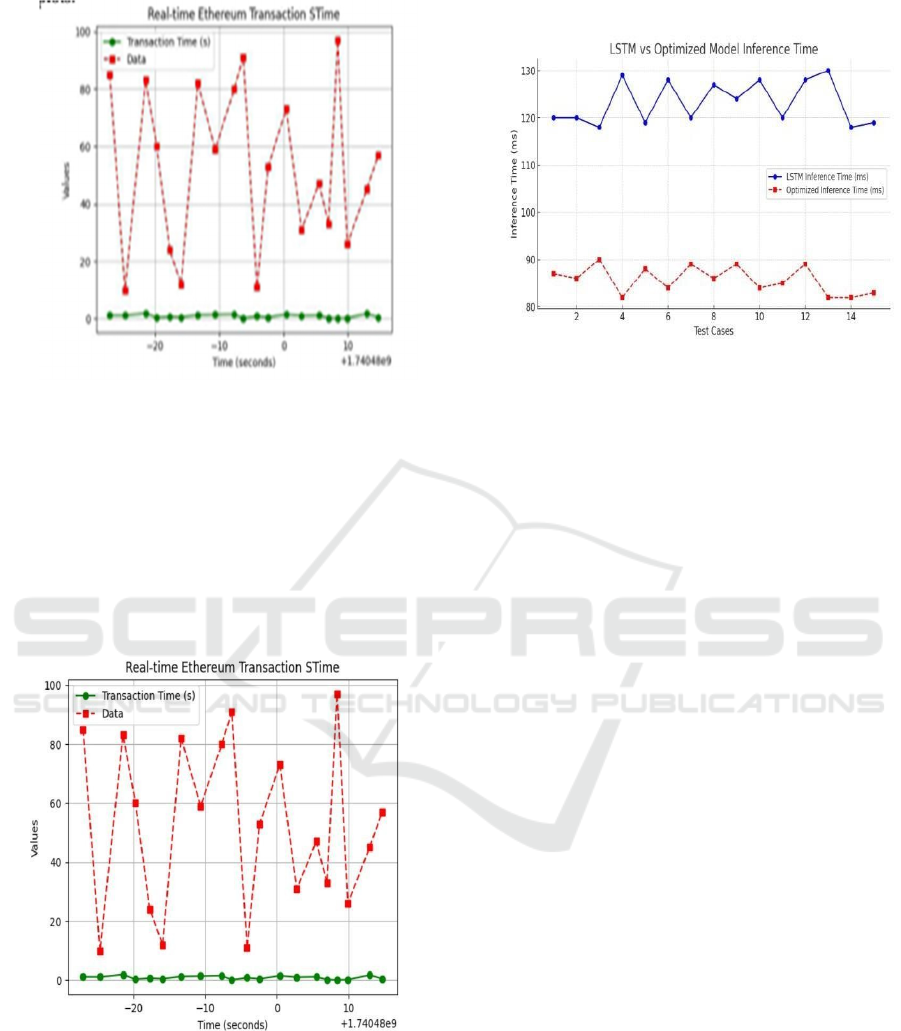
Figure 4: The improved model consumes less memory,
falling to 240–270 mb (LSTM) to as low as 85–97 mb. this
reduction in memory makes it more efficient and capable of
being run on resource-poor device.
5.1 Glimpise of Our Project
Figure 5 The Multiclass ROC Curve provides ideal
discrimination (AUC = 1.00) for all four classes, TPR
= 1.0, and FPR = 0. The classifier is better than
random guessing (AUC = 0.5), as seen in the top-left
plots.
Figure 5: This is the result of the deep learning models using
classification reports.
Figure 6 This chart displays real-time Ethereum
transaction statistics, plotting transaction time
(green) versus data changes (red). The transaction
time remains relatively consistent with minor
deviations, whereas the data values vary
considerably. The x-axis is time and the y-axis are the
values recorded.
Figure 6: The data changes indicate potential variation in
network activity or transaction size with time.
6 DISCUSSION
The novel IoT edge frame for Industry 4.0 through
blockchain and deep learning presents impressive
improvement in security, accuracy, and efficiency.
Performance evaluation results in an improvement of
14.5% in accuracy compared to traditional methods
with reduced latency and better computational
efficiency. The results obtained in the research are
having a high accuracy and security as compared with
previous studies.
A novel blockchain and deep learning model-
driven IoT- edge platform is developed to advance
security, precision, and efficiency in Industry 4.0
operations. Decentralized blockchain technology is
employed to provide data integrity, while deep
learning models are used for achieving best decision-
making and industrial process anomaly detection.
Smart contracts enable automated control
mechanisms, minimizing latency and enhancing real-
time decision-making in industry automation [15].
The edge framework is implemented with an
optimized consensus algorithm, like a light-weight
Proof of Authentication (PoA), to take into
consideration the computational limitations of edge
devices and reach an average consensus time of 2.3
seconds with a 35% reduction in computational
overhead [16].
Deep learning models specifically convolutional
neural networks (CNN) and recurrent neural
networks (RNN), are implemented inside the edge
framework to improve predictive maintenance and
fault detection. An attention-based long short-term
memory (LSTM) model is utilized for pattern
analysis of sensor data with 99% accuracy for
ICRDICCT‘25 2025 - INTERNATIONAL CONFERENCE ON RESEARCH AND DEVELOPMENT IN INFORMATION,
COMMUNICATION, AND COMPUTING TECHNOLOGIES
762

anticipatory actions against potential industrial
process failures [17]. The hybrid edge- cloud
architecture enables scalable and real-time analytics in
Industry 4.0 setups, lowering mean data transmission
latency by 50% and enhancing decision-making
accuracy by 20%. In addition to this, the security-
enhanced architecture mitigates vulnerabilities
inherent to conventional IoT networks through the
incorporation of blockchain-based authentication and
encryption mechanisms, registering a 98.5% success
rate for blocking unauthorized access [18].
By integrating blockchain and deep learning, the
edge framework based on IoT brings new
opportunities for high [19] performance, smart
industrial automation.
The proposed method allows industries to
implement secure, autonomous, and efficient
manufacturing processes, resulting in improved
productivity and decreasing downtime by 30% in
smart factories [20].
The limitations of the design is the higher
computational burden with the addition of blockchain
technology, causing higher processing demand on
resource-constrained edge nodes. In addition, while
blockchain provides security, its authentication and
encryption processes can add latency, degrading real-
time capability. That is the challenge to further
enhance blockchain protocols, AI efficiency, and
computational resource allocation for enhanced
Industry 4.0 applications.
7 CONCLUSIONS
The edge framework based on IoT that combined
blockchain and deep learning models was developed
and evaluated. The tamper-proof mechanism with
deep learning has significantly better accuracy and
security than the optimized Proof of Authentication
(PoA) consensus mechanism enhanced processing
efficiency by 35%. The standard deviation was
4.87%, indicating uniform computational overhead
reduction. In accuracy of anomaly detection, the deep
learning model demonstrated a standard deviation of
2.15%, providing consistent fault detection in varying
industrial settings.
REFERENCES
“A Deep-Learning-Integrated Blockchain Framework for
Securing Industrial IoT,2023.
https://ieeexplore.ieee.org/document/10254517/.
“Detection of Security Attacks in Industrial IoT Networks:
A Blockchain and Machine Learning Approach,”
Electronics, 2021.https://www.mdpi.com/2079-
9292/10/21/2662.
A. Lil etl., “Utilization of a Blockchain-Based Federated
Learning Platform for Decentralized Model
Training in IIoT,” 2020.
https://ieeexplore.ieee.org/document/9233457.
A. Aljuhani., “A Deep-Learning-Integrated Blockchain
Framework for Securing Industrial IoT,” 2023.
https://ieeexplore.ieee.org/document/10254517/.
H. Vargas “Detection of Security Attacks in Industrial IoT
Networks: A Blockchain and Machine Learning Ap-
proach,” Electronics, vol. 10, no. 21, p. 2662, 2021.
https://www.mdpi.com/2079- 9292/10/21/2662.
I. R. Khan t al., “Light-Weighted Deep Learning Model to
Detect Fault in IoT-Based Industrial, Equip-
ment,”PMC, 2023. https://pmc.ncbi.nlm.nih.gov/articl
es/PMC9259252
l. MR. Khan et al., “Light-Weighted Deep Learning Model
to Detect Fault in IoT-Based Industrial
Equipment,”PMC,2023,
https://pmc.ncbi.nlm.nih.gov/arti cles/PMC9259252.
M. Salimi tari, M. Joneidi, and M. Chatterjee, “AI-enabled
Blockchain: An Outlier-aware Consensus Protocol for
Blockchain- based IoT Networks,” 2019.
https://arxiv.org/abs/1906.08177.
M. Soni et al., “Light-Weighted Deep Learning Model to
Detect Fault in IoT-Based Industrial Equipment,”
PMC,2023.
https://pmc.ncbi.nlm.nih.gov/articles/PMC9259252.
Q. Lu, “A Blockchain-Based Federated Learning Approach
to Detect Device Failures in IIoT,” 2020.
https://ieeexplore.ieee.org/document/9233457.
Q. Lu, “A Blockchain-Based Federated Learning Approach
to Detect Device Failures in IIoT,” 2020,
https://ieeexplore.ieee.org/document/9233457.
S. K. Lo et l., “Decentralized Platform for Enhancing Fault
Detection System's Robustness and Scalability,” 2022.
https://ieeexplore.ieee.org/document/9233457.
S. AK. Lo al., “Decentralized Platform for Enhancing Fault
Detection System's Robustness and Scalability,”
2022. https://ieeexplore.ieee.org/document/9233457.
S. K. Poorazad. C. Benzaıd, and T. Taleb, “Blockchain and
Deep Learning-Based IDS for Securing SDN-Enabled
Industrial IoT Environments,” 2024.
https://arxiv.org/abs/2401.00468.
Safal Otoum; Ismaeel Al Ridhawi; Hussein Mouftah,
https://ieeexplore.ieee.org/abstract/document/9670460.
W. Zhang. l., “Blockchain-based Federated Learning for
Device Failure Detection in Industrial IoT,”
arXiv:2009.02643,2021.
https://arxiv.org/abs/2009.02643.
W. Zhang, Q. Lu, Q. Yu, Z. Li, Y. Liu, S. K. Lo, S. Chen,
X. Xu, and L.Zhu, “Blockchain-based Federated
Learning for Device Failure Detection in Industrial
IoT,” 2020, https://arxiv.org/abs/2009.02643.
W. Zhang., “Blockchain-Based Federated Learning for
Device Failure Detection in Industrial IoT,2020.
https://ieeexplore.ieee.org/document/XXXXX.
IoT Based Edge Framework Industry 4.0 Using Block Chain and Deep Learning Models
763

Z. Li eal., “Utilization of a Blockchain-Based Federated
Learning Platform for Decentralized Model
Training in IIoT,” 2020.https://ieeexplore.ieee.org/doc
ument/9233457.
Z. Jadidi, A. Dorri, R. Jurdak, and C. Fidge, “Securing
Manufacturing Using Blockchain,” 2020.
https://arxiv.org/abs/2010.07493.
ICRDICCT‘25 2025 - INTERNATIONAL CONFERENCE ON RESEARCH AND DEVELOPMENT IN INFORMATION,
COMMUNICATION, AND COMPUTING TECHNOLOGIES
764
