
Dynamic and Secure Social Networking Platform: A Scalable
Solution for Community Engagement
V. S. S. Ashish Babu, K. Ashish Paul, Rishu Jaiswal, P. Ravi Charan and Gayathri Ramasamy
Department of Computer Science and Engineering, Amrita School of Computing, Bengaluru, Amrita Vishwa
Vidyapeetham– 560035, Karnataka, India
Keywords: Social Networking, User Interface, Content Management, User Roles, Real‑Time Interaction, Secure
Sessions, Administration, Multimedia, Dynamic Carousels, Data Tables, PHP, MySQL, Bootstrap,
JavaScript, Scalability, Modularity, Device Compatibility, Community Management, Content Sharing.
Abstract: This paper presents the development of a contemporary social networking platform designed to provide a
seamless user experience with an intuitive interface, dynamic content management, and robust administrative
functionalities. The platform incorporates secure session-based access control, defining distinct user roles
such as administrators and staff. Key features include real-time content processing for user profiles, avatars,
likes, and comments, ensuring an engaging and interactive environment. The system supports multimedia
viewers, dynamic post carousels, and integrated post and page plugins, including charts and date pickers, to
enhance user engagement. Advanced administrative tools, such as responsive data tables and maintenance
modules, facilitate efficient system management. Developed using PHP, MySQL, Bootstrap, and JavaScript,
the platform ensures scalability, modularity, and cross-device compatibility. By offering secure, user-friendly,
and high-performance functionality, this system fosters effective online community management and
streamlined content sharing.
1 INTRODUCTION
The usage of social networking platforms stands
essential for modern information sharing and
communication needs between individual users and
corporate organizations. The proposed social
networking platform pursues full scale development
that optimizes contemporary web technologies to
offer users interactive end-to-end security combined
with ease of use. The system makes use of PHP and
MySQL along with Bootstrap and JavaScript for the
backend and AJAX for the frontend functions. A
comprehensive User Management and
Authentication module enables the system to control
user access through defined roles for administrators
as well as users and staff members. The system uses
session-based authentication as its security measure
to protect sensitive data while maintaining safe user
sessions. Profiles serve as the main feature for users
who can add their avatars but administrators possess
extra system configuration and user account
management capabilities.
Users can perform all types of content actions on
this platform because dynamic content interaction
creates features for post creation and viewing
alongside like and comment functions. Parts of
multimedia content are combined into a carousel for
engaging users. Through real-time comments
tracking users can participate in real time thus
strengthening their interactions with the community.
The platform achieves better user experience through
its navigational system which uses responsive
sidebars together with top bars and modals. The
system enables administrators to conduct content
moderation and maintenance tasks which gives them
control in managing user interaction activities
efficiently. Specifications in this system use tables to
enable sorting and filtering processes while assigning
user roles by using responsive data tables and
maintaining all information through a centralized
module. The user and administrative experiences gain
further enhancement through the addition of data
visualization tools and date pickers and chart
generation features that act as plugins.
750
Babu, V. S. S. A., Paul, K. A., Jaiswal, R., Charan, P. R. and Ramasamy, G.
Dynamic and Secure Social Networking Platform: A Scalable Solution for Community Engagement.
DOI: 10.5220/0013905000004919
Paper published under CC license (CC BY-NC-ND 4.0)
In Proceedings of the 1st International Conference on Research and Development in Information, Communication, and Computing Technologies (ICRDICCT‘25 2025) - Volume 3, pages
750-756
ISBN: 978-989-758-777-1
Proceedings Copyright © 2025 by SCITEPRESS – Science and Technology Publications, Lda.

Security and scalability together with modularity
comprise the main objective of this project.
Philosophical session control along with navigation
and content output and multimedia operations
operates through modular PHP code segments to
make system maintenance easier and extension
possible. A real-time content update system along
with error-handling features maintains data reliability
and effortless system usage. The developed platform
functions as a communication platform and provides
an example for building secure social networking
systems with interactive and scalable capabilities.
The project reaches usability-functionality balance
through advanced web integration to provide a solid
foundation for running and managing online
communities.
2 RELATED WORKS
Social networking was viewed by Coyle et al.as both
a revolution and an advancement in international
communication. They looked at how platforms
facilitate social, professional, and personal
connections by providing tools for information
sharing and teamwork. The report also highlighted
the difficulties, such as digital exclusion, user
privacy, and data usage ethics. However, Coyle et al.
argued that social networking has the potential to
build inclusive digital ecosystems in the long run by
finding a careful balance between security and
accessibility.
Abdullah et al. used the Facebook case study to
examine the technological architecture of the social
networking site. They investigated the collaboration
between front-end and back-end technologies,
including JavaScript, PHP, and MySQL. The writers
talked about delivering smooth user experiences,
covering subjects like responsive design, real-time
updates, and effective database administration. They
emphasized that scalable architectures are essential to
meeting the ever-increasing complexity of modern
web applications, which calls for modular
frameworks.
Hussein et al. contend that a web-based
communication system needs to be lightweight,
effective, and easy to use. They do this by using
HTML and PHP to create a chat network application.
Their study concentrated on a number of principles in
order to address issues including secure data transfer,
real-time synchronization, and system reliability.
They demonstrated how minimalism design can be
leveraged to create useful communication tools,
laying the groundwork for more complicated apps
using PHP code and an HTML user interface.
Nixon et al. covered in detail how to create
dynamic websites using PHP, MySQL, JavaScript,
and HTML5 in the main course. AJAX integration,
data visualization, user authentication, and how to
make it live and interactive in real time are among the
topics covered in the book. Nixon also emphasized
the fundamentals of code optimization, performance
enhancement, and code measurement. The guide
offers developers a foundation for creating
dependable, scalable, and interactive online
applications with detailed examples and
implementations where feasible.
Bhagwat et al. investigate how social media sites,
particularly Facebook, affect businesses. Their main
finding is that businesses use these platforms for
targeted marketing, consumer engagement, and brand
building. Additionally, case studies are provided to
show how effective advertisements have attracted
viewers and increased conversion rates.
The Laravel framework for PHP-based web
development, specifically for small and medium-
sized businesses (SMEs), was evaluated by Amini et
al. The study elucidated Laravel features that
facilitate development and code maintainability, such
as routing, authentication, and built-in security. The
authors demonstrate how Laravel has sped up
development times and increased the scalability of
applications through a case study. They claim that the
framework is suitable for SMEs looking to implement
reliable but affordable online solutions.
Zuo et al. examine the effects of sharing
experiences of physical exercise on social networking
sites during the COVID epidemic. They discovered
that these exchanges-maintained users' social
connections and improved their mental health. They
discovered through a cross-sectional study that active
content sharing boosts community involvement and
reduces feelings of loneliness. According to the study,
social networking sites could help with mental health
issues when people are socially isolated.
In order to examine the impact of information
overload and irrelevant content, Guo et al. looked into
information avoidance behavior on social networking
sites. They discovered that when there is excessive or
unnecessary content, people frequently leave the
platform. To address these problems, this study
suggested tailored content curation and design
solutions. Guo et al. noted that successful platform
usability and satisfaction depend on striking a balance
between user preferences and content delivery.
The structure and features of social networking
platform database management were discussed by
Dynamic and Secure Social Networking Platform: A Scalable Solution for Community Engagement
751

Nurmamatovich et al. The study covered
sophisticated SQL capabilities including indexing
and transaction management in order to fully utilize
modern SQL and manage large-scale databases. The
authors emphasized the significance of SQL in the
process by pointing out its data integrity, scalability,
and effective query processing in dynamic web
contexts.
Abdellahi et al.talked about the design and
execution of a web application that uses social media,
emphasizing modular architecture and user-centric
design. Their study described technical features such
secure authentication, responsive interfaces, and real-
time data synchronization. Modular architectures'
scalability and maintainability—that is, their ability
to be readily upgraded or expanded with minimal
impact—were also emphasized.
JavaScript and PHP are used in online
applications for data collecting and processing, as
explained by Goslin et al. They demonstrated how
real-time data collection and processing made
possible by these technologies might help guide
decision-making. Transparency and user permission
were two other ethical topics covered in the study.
Desai et al. attempted to use the MERN stack
(MongoDB, Express, React, Node.js) to create a
social platform. This stack will provide benefits
including real-time interaction, scalability, and quick
development cycles. An analysis of a case study that
provided a real-world implementation of the MERN
stack, showcasing its usefulness in creating dynamic
online platforms
Lamsal et al. detailed a process for making a
dynamic website using PHP, including creating
features that would interact with users such as user
registration, and content management. These results
demonstrate the impact of modularity and scalability
in delivering on changing user needs. Lamsal stressed
that PHP makes backend work much simpler and
more performant
Different from most of the IoT applications
available in the market today, Samrat et al. developed
a web-based application for smart farming to show
the adaptability of social networking platforms in
niche industry. Real time data sharing, decision
support systems and friendly user interfaces were
their application. Such technologies, the authors
argued, could revolutionize traditional practice and be
more efficient.
Joshi et al. introduced a framework optimization
for social media platforms using XAMPP. Their work
focused on improving platform performance through
database optimization, load balancing, and enhanced
security measures. They concluded that systematic
optimizations are critical for ensuring reliability and
scalability in social networking applications.
3 METHODOLOGY
3.1 System Design
• The platform’s architecture and
graphical user interface (GUI) are
designed to be smooth and effective for
user interaction.
• The Entity-Relationship (ER) diagram
is utilized to create individual database
tables and their relationships, ensuring
data integrity. It also serves as a
blueprint for wireframes of key site
components, including dashboards,
navigation, and content views.
• The backend design incorporates
CRUD operations, authentication, and
APIs to facilitate interactions between
system modules such as member
profiles, posts, and notifications. The
figure 1 shows Entity Relationship
Diagram.
Figure 1: Entity relationship diagram.
3.2 Database Development
• The database structure is implemented to
support the platform’s core functionalities.
• The application database consists of tables
for entities such as members, posts, likes,
comments, friend requests, notifications,
and administrators.
• Data integrity is maintained using
relationships, primary keys, and foreign
keys. Additional constraints, such as unique
email addresses and cascading deletes,
ensure consistency and reliability.
ICRDICCT‘25 2025 - INTERNATIONAL CONFERENCE ON RESEARCH AND DEVELOPMENT IN INFORMATION,
COMMUNICATION, AND COMPUTING TECHNOLOGIES
752

3.3 Implementation
3.3.1 Backend Development
• The backend is designed to securely and
efficiently handle platform operations.
• Secure authentication and session
management are implemented using
PHP. APIs are developed for managing
posts, comments, likes, notifications,
and friend requests. CRUD operations
manage user, post, and admin data.
• Friend requests and role-based access
control are implemented using business
logic, ensuring scalability and seamless
functionality.
3.3.2 Frontend Development
• The front end is developed to be responsive
and user-friendly, providing an engaging
interface for users and administrators.
• Dynamic components, such as profile
management, post creation, and notifications,
are implemented using HTML, CSS,
Bootstrap, and JavaScript.
• The frontend is integrated with backend APIs
to enable real-time updates and is optimized
for compatibility across desktop and mobile
devices.
3.3.3 Testing and Debugging
• Comprehensive testing is conducted to ensure
the platform functions correctly and is free of
bugs.
• Unit testing is performed for individual
modules, such as user authentication and
notifications, while integration tests validate
interactions between different modules.
• Performance, security, and usability tests are
conducted under various conditions. Identified
bugs are fixed to optimize platform efficiency.
3.4 Deployment
• The platform is deployed to a live environment
for user access. The server environment is
configured, including Apache or Nginx and
MySQL.
• The database is migrated, and the frontend and
backend code are deployed to the server.
• The domain is configured, and SSL
certificates are applied to ensure secure access,
making the platform fully operational.
4 NOVELTY
The objective is to develop an efficient and accurate
post-curation system that prioritizes content retrieval.
Through optimized SQL queries, the platform enables
users to perform highly targeted and customized post
searches. Users can filter content based on criteria
such as time filters, user tags, keywords, and more.
Hand-crafted SQL queries enhance the search feature,
reducing latency and improving overall query
performance. The system processes large datasets
without compromising accuracy or efficiency by
leveraging query optimization techniques and
indexed tables. This approach not only enhances
content retrieval but also improves the platform's
scalability. By striking a balance between
technological complexity and user-centric design,
this feature distinguishes the platform in the social
networking industry.
5 RESULTS AND EVALUATION
The Social Networking Site platform was
successfully developed and implemented, achieving
the following results:
5.1 Login System
The login system allows the authentication of the
users and also introduces a feature of account
management. Figure 2 shows that in the login page
users can log in with valid credentials or can create a
new account. The page is responsive and user friendly
and access free for all devices.
Figure 2: Login page.
Dynamic and Secure Social Networking Platform: A Scalable Solution for Community Engagement
753
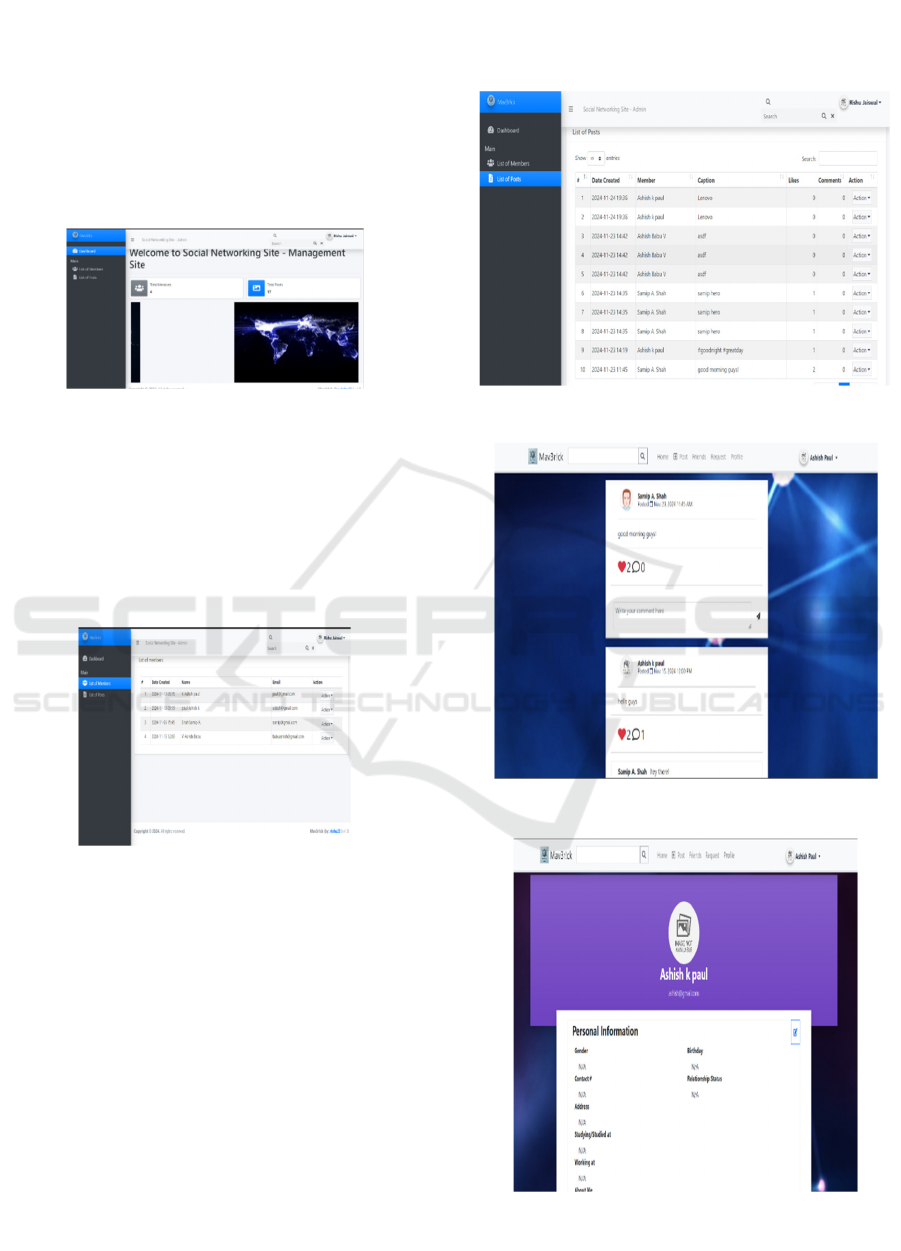
5.2 Admin Dashboard
Created an admin dashboard so administrators had a
high-level overview of platform activity. The
dashboard is shown in the figure 3, where total
number of members and posts is displayed. Utilizing
this dashboard allows us to navigate quickly to
sections to manage members, and posts handling
administrative tasks.
Figure 3: Admin page.
5.3 User Management
It includes a full user management module. The figure
4 shows the member list user details like name, email,
and registration date. User management is guaranteed
by administrators who can do such actions as editing
user accounts or removing them.
Figure 4: Member list with administrative options.
5.4 Post Management
To allow administrators to view and manage user-
generated posts we built post management
functionality. In the figure 5, we have the post list,
including their captions, likes and comments. From
this module, administrators can filter, edit or delete
posts.
5.5 User Feed
User feed allows users to see, like and comment on
posts in real time. Feeding outposts in a visually
catchy format as depicted in Figure 6, allows
interaction options to likewise encourage user
engagement. The feed is responsive feed and works
perfectly fine on mobile and desktop devices. The
figure 7 shows Users profile.
Figure 5: Post management panel for administrators.
Figure 6: User feed.
Figure 7: Users profile.
ICRDICCT‘25 2025 - INTERNATIONAL CONFERENCE ON RESEARCH AND DEVELOPMENT IN INFORMATION,
COMMUNICATION, AND COMPUTING TECHNOLOGIES
754

6 DISCUSSIONS
The developed social networking platform
successfully integrates essential functionalities such
as user authentication, profile management, content
sharing, and real-time engagement. The system
ensures data integrity through structured database
relationships while maintaining scalability and
security through modular backend and frontend
implementations.
The authentication system, built using PHP
session management, effectively safeguards user
data, preventing unauthorized access. The frontend,
developed with Bootstrap and JavaScript, enhances
user engagement by providing an interactive and
responsive experience across devices. The integration
of AJAX enables real-time updates for posts,
comments, and likes, fostering an engaging and
dynamic user interaction.
One of the key innovations of this platform is its
efficient content retrieval system, which optimizes
SQL queries for precise and fast search results.
Indexed tables and query optimization strategies
significantly reduce latency, ensuring smooth
performance even with large datasets. Additionally,
role-based access control enhances security by
defining different access privileges for users,
administrators, and staff.
Despite these advancements, certain limitations
remain. The platform currently lacks an AI-powered
recommendation system for personalized content
suggestions. Furthermore, the existing system could
be enhanced with multilingual support to cater to a
broader user base. Addressing these aspects in future
development could further improve the usability and
inclusivity of the platform.
7 CONCLUSIONS
This research successfully developed a scalable and
secure social networking platform that enables
seamless communication, content sharing, and
community interaction. The platform effectively
integrates dynamic content updates, real-time user
interactions, and administrative functionalities to
manage users and content efficiently.
By leveraging modern web technologies such as
PHP, MySQL, Bootstrap, and JavaScript, the
platform provides a robust and responsive user
experience. Secure authentication mechanisms,
modular backend design, and query-optimized search
features collectively contribute to its efficiency and
reliability.
The results demonstrate that the system meets the
functional and security requirements of a modern
social networking platform. Future enhancements
may include AI-driven content recommendations,
improved privacy controls, and advanced moderation
tools to further refine user experience and
engagement. The developed system serves as a
prototype for building scalable and interactive social
networking solutions, balancing technological
advancements with user-centric design.
REFERENCES
A. K. Hussein, "Chat network study and design using
HTML and PHP web programming," Indonesian
Journal of Electrical Engineering and Computer
Science, vol. 27, no. 1, pp. 442-446, 2022.
Abdellahi, Heiballa, and Abdellatif Kobbane. "Design and
implementation of a social media-based web
application." (2020): 30.
Bhagat, K., Kumar Das, A., Kumar Agrahari, S., Aanand
Shah, S., RT, D., and Ramasamy, G. (2024). Cross-
Language Comparative Study and Performance
Benchmarking of Sorting Algorithms. Available at
SSRN 5088751.
C. L. Coyle and H. Vaughn, "Social networking:
Communication revolution or evolution" Bell Labs
Technical Journal, vol. 13, no. 2, pp. 13-17, 2008.
F. M. J. M. Shamrat, M. Asaduzzaman, P. Ghosh, M. D.
Sultan, and Z. Tasnim, "A web-based application for
agriculture: Smart Farming System," International
Journal of Emerging Trends in Engineering Research,
vol. 8, no. 6, 2020.
H. M. Abdullah and A. M. Zeki, "Frontend and backend
web technologies in social networking sites: Facebook
as an example," in Proc. 2014 3rd International
Conference on Advanced Computer Science Applicati
ons and Technologies, pp. 85-89, Dec. 2014.
K. Goslin and M. Hofmann, Applied User Data Collection
and Analysis Using JavaScript and PHP. Chapman and
Hall/CRC, 2021.
K. Joshi, R. Kumar, A. Kumar, J. Reshi, A. Sharma, and A.
Dumka, "A framework optimization in social media
using Xampp: A systematic approach in Proc. 2022
International Conference on Fourth Industrial
Revolution Based Technology and Practices
(ICFIRTP), Uttarakhand, India, 2022.
K. Desai and J. Fiaidhi, "Developing a social platform using
MERN Stack," Authorea Preprints, 2023.
Kumar Agrahari, Sanskar, Arjun Kumar Das, Aaditya
Yadav, and Gayathri Ramasamy.” Next-Gen Routing
and Scalability Enhancements in Mobile Ad Hoc
Networks.” Available at SSRN 5089037 (2024).
M. Amini et al., "Mahamgostar.com as a case study for
adoption of Laravel framework as the best programmi
Dynamic and Secure Social Networking Platform: A Scalable Solution for Community Engagement
755

ng tools for PHP-based web development for small and
medium enterprises," Journal of Innovation & Knowle
dge, vol. 6, pp. 100-110, 2021.
R. Nixon, Learning PHP, MySQL, JavaScript, CSS &
HTML5: A Step-by-Step Guide to Creating Dynamic
Websites. O'Reilly Media, Inc., 2014.
Ramasamy, G., Shaik, B. A., Kancharla, Y., and
Manikanta, A. R. (2025). A Bash-based approach to
simulating multi-process file systems: Design and
implementation. In Challenges in Information,
Communication and Computing Technology (pp. 200-
206). CRC Press.
S. Bhagwat and A. Goutam, "Development of social
networking sites and their role in business with special
reference to Facebook," Journal of Business and
Management, vol. 6, no. 5, pp. 15-28, 2013.
Shanmukha Reddy, A., Charan, K. S., Ramasamy, G., and
Naga Sai, N. (2024). Quantitative Analysis of
Scheduling Efficiency: A Case Study of Fcfs and
Round Robin Algorithms. Kolla Sriram and
Ramasamy, Gayathri and Naga Sai, Nisankarrao,
Quantitative Analysis of Schedul- ing Efficiency: A
Case Study of Fcfs and Round Robin Algorithms
(November 15,2024)
T. I. Nurmamatovich and N. A. Z. Azizjon o’g, "The SQL
server language and its structure," American Journal of
Open University Education, vol. 1, no. 1, pp. 11-15,
2024.
Y. Guo, Z. Lu, H. Kuang, and C. Wang, "Information
avoidance behaviour on social network sites:
Information irrelevance, overload, and the moderating
role of time pressure," International Journal of
Information Management, vol. 52, pp. 102067, 2020.
Y. Zuo, Y. Ma, M. Zhang, X. Wu, and Z. Ren, "The impact
of sharing physical activity experience on social
network sites on residents’ social connectedness: A
cross-sectional survey during COVID-19 social
quarantine," Globalization and Health, vol. 17, pp. 1-
12, 2021.
ICRDICCT‘25 2025 - INTERNATIONAL CONFERENCE ON RESEARCH AND DEVELOPMENT IN INFORMATION,
COMMUNICATION, AND COMPUTING TECHNOLOGIES
756
