
Watt Wallet: A Blockchain‑Enabled Decentralized Marketplace for
Renewable Energy Credits with AI‑Driven Predictive Analytics
D. Dhanush, V. Baladitya, P. Jaswanth, T. Kritin, Gayatri Ramasamy and Gurupriya M.
Department of Computer Science and Engineering, Amrita School of Computing, Bengaluru, Amrita Vishwa Vidyapeetham,
Karnataka, India
Keywords: Decentralized Energy Management, Dual‑Currency System, Tokenized Consumption, AI Sales Prediction,
Secure Ledger Tracking.
Abstract: The decentralized platform WattWallet uses dual-currency methodology to modernise Renewable Energy
Credits (RECs) management and tokenized energy consumption handling. WattWallet builds its platform with
Next.js version 15.0.3 as its dynamic frontend together with MongoDB Atlas as a cloud NoSQL database
service, Prisma for safe data operations and secure authentication provided by Clerk. WattWallet operates
with two different payment forms including Credits purchased through simulated cash while users acquire
Energy Tokens (ETs) by spending Credits. Users can power fans, lights, televisions along with other
appliances through WattWallet using Energy Tokens which run out at a dedicated rate of one token per five
seconds of operational time. All financial data together with energy information gets recorded on an advanced
ledger system through hashed database entries to guarantee security and maintain visibility. WattWallet
implements a sales prediction system enabled by an AI module which operates with the Random Forest
algorithm to analyze data. Operational forecasts of future sales metrics reach 87.3% to 94% accuracy levels
through historical transaction data processing by the predictive engine. By leveraging sales forecast data
administrators obtain capabilities to take proactive inventory decisions while distributing resources effectively
to make strategic assessments. WattWallet provides an advanced solution toward sustainable energy
management by implementing decentralized transaction tracking combined with dual-currency operations
together with future sales prediction capabilities.
1 INTRODUCTION
Modern technologies combined with environmental
stewardship have always been resulted in innovative
digital platforms because the global community
prioritized sustainable energy practices and renewable
resource management. The handling systems for
Renewable Energy Credits (RECs) experience
difficulties because they present bureaucratic
obstacles alongside unclear processes and reduced
customer participation. WattWallet functions as an
advanced decentralized system which transforms
traditional REC management by bringing together
web technology elements with blockchain transaction
functions while using predictive analysis methods.
WattWallet supports payment transactions using
its dual-currency platform to maintain clear visibility
for energy management functionalities. The platform
functions using Credits together with Energy Tokens
(ETs) as virtual currency. Users in WattWallet
generate Credits through digital cash transactions
between their user base for their primary financial
operation. Users can exchange Credits into Energy
Token payments when they need to charge digital
applications for power utilization. Every time a user
activates a virtual device like fans lights or televisions
by using Energy Tokens the operating duration
requires one token which gets deducted during active
usage. The operating system on the platform uses
actual user energy habits to track energy usage while
enhancing efficiency through clear visibility into
usage metrics. The platform follows an essential
design principle based on clear design combined with
a single-color palette and transparent navigation
elements that deliver smooth movements to increase
user interaction. MongoDB Atlas functions as the
cloud-based NoSQL database to provide flexible
storage solutions for whole system information
718
Dhanush, D., Baladitya, V., Jaswanth, P., Kritin, T., Ramasamy, G. and M., G.
Watt Wallet: A Blockchain-Enabled Decentralized Marketplace for Renewable Energy Credits with AI-Driven Predictive Analytics.
DOI: 10.5220/0013904400004919
Paper published under CC license (CC BY-NC-ND 4.0)
In Proceedings of the 1st International Conference on Research and Development in Information, Communication, and Computing Technologies (ICRDICCT‘25 2025) - Volume 3, pages
718-728
ISBN: 978-989-758-777-1
Proceedings Copyright © 2025 by SCITEPRESS – Science and Technology Publications, Lda.

ranging from user profiles to wallet balances to
transaction histories and product details. The
application uses Prisma as its type-safe ORM layer to
link with MongoDB and ensure data type enforcement
and avoid runtime mistakes. Clerk serves as secure
user management and authentication through
WattWallet by offering dependable and streamlined
identity management account protection solutions.The
decentralized nature of WattWallet is further
emphasized through its blockchain-inspired ledger
system. Every transaction whether it is the purchase of
Credits, the conversion to Energy
Tokens, or the buying and selling of products
within the platform is recorded in a secure, hashed
ledger. This immutable record ensures full
transparency and auditability, which are essential for
maintaining trust in a decentralized marketplace. A
centralized Bank module oversees the overall supply
of both Credits and Energy Tokens, starting with a
fixed reserve (10,00,000 Credits and 10,00,00,000
Energy Tokens) and facilitating continuous
conversion based on predefined rates (10 tokens
equating to 1 Credit).
The primary features of WattWallet stand out
through its combination with artificial intelligence
(AI) that works to improve business intelligence
alongside operational efficiency. The model uses
Random Forest algorithms to forecast future sales
trajectories with the combination of historical
transactions and time-patterns with user metrics. This
AI module provides administrators with sales
prediction capabilities amounting to 87.3% to 94%
accuracy which helps optimize inventory management
alongside strategic decision-making. The AI-based
sales prediction system delivers live market data
which serves as an essential planning instrument and
resource allocation tool for the platform.
WattWallet delivers an inclusive solution which
integrates decentralized transaction management with
dual-currency operation alongside analytics
predictions for renewable energy management system
development. The integration of advanced web
technologies with blockchain principles and machine
learning makes WattWallet capable of maintaining
efficiency and also providing proper transparent
accountable solutions to the modern digital world.
2 LITERATURE SURVEY
The Energy Community Platform (ECP) operates
through modular architecture to process advanced big
data and blockchain features for better sustainable
energy usage in local energy communities. The
Energy Community Data Platform (ECDP) collects
and analyzes energy consumption information
whereas the Energy Community Tokenization
Platform (ECTP) utilizes smart contracts to benefit
users with tokenization systems. The platform
delivers flexible operation along with cryptographic
data protection and effective solutions to match
energy information with its users.
The driving force behind economic expansion
known as digital transformation makes use of AI and
IoT and data analytic technologies to boost both
organizations and customers. The paper by Bhuiyan
et al. (2024) shows that digital tools drive innovation
along with business process enhancements and
sustainable solution development specifically for
startups and SMEs in developing economies. Low
digitalization and insufficient infrastructure remain
difficulties even though the research supports digital
literacy development and supportive digital
environments.
Buna Africa serves as an electronic platform that
supports small fish farmers while managing their data
submissions to official government departments.
Users benefit from a sustainable aquaculture
environment on this platform because it offers
features enabling real-time messaging along with
production calculators and health diagnostics. The
platform has a design framework that focuses on
users to create easier interactions for illiterate
audiences while accelerating digital aquaculture
progress throughout rural African communities.
Prasad (2018) established a decentralized
marketplace application on Ethereum blockchain to
solve marketplace problems such as high costs and
privacy deficits and discriminatory practices. The
application utilizes smart contracts together with
interplanetary file systems to execute cost-efficient
secure transactions autonomously on the Rinkeby test
network.
Sánchez (2024) introduce a blockchain market
solution that enables fair payment for manufacturing
data through privacy-friendly methods and represents
data using NFTs. The model fills essential gaps
present in data market centralization through
elimination of unfair data access and inefficient
payment practices while improving transaction
outcomes regarding transparency and speed and data
reliability.
The research conducted by Srinivasan (2024)
investigates AI forecasting for sales through CRM
systems while employing machine learning
functionalities that include natural language
processing and deep learning applications. AI
demonstrates its capability to enhance sales process
Watt Wallet: A Blockchain-Enabled Decentralized Marketplace for Renewable Energy Credits with AI-Driven Predictive Analytics
719

optimization and resource management while
improving user interaction according to the research
findings.
The authors Delardas and Giannos (2023) present
a study about blockchain-based renewable energy
certification solutions while tackling Guarantees of
Origin trading issues. Through blockchain
technology companies gain better transparency while
systems self-track and deliver logged records that
show any attempted modification thus stopping
instances of greenwashing. The major obstacles in the
way of progress stem from compatibility limitations
and regulatory requirements.
Akiladevi (2024) develop a blockchain network
system that tokenizes energy resources while
improving market security and operational efficiency
and asset transparency. The implementation of
blockchain technology depends on developing
effective rules because it faces technical barriers and
regulatory complexities to reshape energy asset
management.
Zuo (2022) describes a blockchain platform
which serves as an issuance center for Renewable
Energy Certificates followed by trading and
verification functionalities. This platform reduces
business expenses and it maintains permanent
transaction logs through tokenization features which
removes dependency on intermediaries. This research
identifies scaling restrictions and regulatory hurdles
together with establishing the capability of private
blockchains for this system.
The tutorial presented by Satheesh (2015) covers
how to construct web applications from end to end
with MongoDB and Node.js by demonstrating
RESTful API creation through Express.js as well as
NoSQL database adjustments and cloud deployment
capabilities (O. Delardas and P. Giannos., 2023). The
tutorial demonstrates how contemporary technology
stacks function practically and at scale (O. Delardas
and P. Giannos., 2023).
3 METHODOLOGY
The creation of WattWallet moves through distinct
developmental periods to advance its fundamental
elements of the system. The methodology provides a
complete view of the development sequence that
includes building both front-end and back-end
systems while integrating blockchain technology and
designing databases and energy token systems and e-
commerce capabilities and integrating an AI-based
sales forecasting module.
3.1 System Architecture Overview
3.1.1 Platform Components
User Module: The end users interact through this
module to access the platform. Customers access a
complete management platform that enables wallet
control and currency trades next to product purchases
and appliance operation. The interface system follows
usability standards as well as present clear
information while its secure authentication system
protects data access for authorized users.
Admin Module: Platform administrators use this
module to maintain complete system operation
control. The interface gives administrators tools to
track system performance while reviewing
transaction logs and user engagement and examining
power use behavior for better assessment of system
efficiency. The software uses artificial intelligence
(AI) prediction to help administrators plan
strategically by forecasting sales and managing
inventory.
Bank Module: Through its operations the Bank
Module controls the circulation of both system
currencies between the economy and the players. The
Bank Module operates with defined rates to facilitate
conversions between its reserved Credits and Energy
Tokens. The Bank Module manages both monetary
supplies from a fixed reserve and continually adds
tokens to the system. Automatic transactions and
permanent ledger entries are another responsibility of
this module.
3.2 Frontend Development
3.2.1 Framework and Core Technologies
Next.js Framework: The platform runs on Next.js
version 15.0.3 for its foundation that enables server-
side rendering and static site generation features.
Next.js (version 15.0.3) enables fast loading along
with better SEO performance and provides
responsive functionality to improve UX.
Responsive Design: The user interface has responsive
design elements that transform its layout and
functions to operate across multiple device sizes such
as desktops, tablets and smartphones. The display
changes according to screen size through
implementations of flexible layout techniques
combined with media queries.
ICRDICCT‘25 2025 - INTERNATIONAL CONFERENCE ON RESEARCH AND DEVELOPMENT IN INFORMATION,
COMMUNICATION, AND COMPUTING TECHNOLOGIES
720

3.2.2 User Interface and Visual Design
Minimalist Aesthetic: The user interface adopts
minimum design principles and implements a solitary
color palette. Elegance combined with
professionalism results from minimal presentation
design made up of clean definition lines and lots of
white space alongside transparent navigation panel
elements.
Smooth Animations and Transitions: A series of
smooth animations gender transitions improve user
interaction capabilities in the design. Brown
University Website fosters a better user experience
through its visual effect feedback system which
responds during button clicks and page shifts.
3.2.3 Authentication and Session
Management
Secure Authentication: The system integrates an
authenticated third-party service to manage user
registration processes as well as both logins and
additional authentication methods. The system
safeguards user data together with access-limiting its
functionality to authorized users.
Session Persistence: User sessions stay active on the
platform thus users can move between application
pages without requiring separate logins. The system
keeps active sessions which lead to unbroken and
easy-to-use operation.
3.3 Backend Development
3.3.1 Server Environment and API
Development
Node.js and Express.js: The development of the
backend uses Node.js as its runtime environment in
combination with Express.js to build its RESTful
APIs. Through their integration Node.js and
Express.js create a flexible system that effectively
operates many simultaneous requests.
Middleware and Security Measures:API systems
implement middleware functions which fulfill tasks
for validation, error management and security
regulation. The measures implemented by
middleware functions protect both the security of data
processing operations and the operational efficiency
of APIs.
3.3.2 Database Integration and Data
Management
MongoDB Atlas: The solution employs MongoDB
Atlas to serve as its cloud-based NoSQL database
system. MongoDB Atlas provides an elastic storage
system which allows users to store different types of
data from user profiles to wallet balances to
transaction records to product details.
3.3.3 Prisma ORM
Prisma functions as a typed Object-Relational
Mapping tool to connect the application with
MongoDB through proper data representation. The
tool provides strong data management and strict data
type rules to protect against errors.
3.3.4 Data Schema Design
The database has several collections which organize
its schema.
- User profiles together with authentication
information and wallet references are stored in the
Users collection within the database.
- Each record inside the Wallets collection contains
individual entry points for tracking both Credits and
Energy Tokens of each user alongside Bank records.
- Every transaction has its own unique hashed
identifier and timestamps together with the details of
both sender and receiver and amounts within the
Transactions collection.
- The Products collection maintains complete
descriptions of all e-commerce section products.
3.4 Ledger and Transaction
Management
Immutable Ledger: All deals conducted on the
platform get permanently saved to an unalterable
record. The record contains a hashed transaction
identifier together with sender and receiver
information and transaction amount, currency type
and timestamp. Championed by blockchain concepts
this method delivers absolute transparency as well as
trust to users.
Transaction Workflows: Real-time transactions and
product purchases together with currency
conversions and energy token deductions happen
automatically. Detailed sequence-based log
recordkeeping enables full auditing activities along
with immediate identification and resolution of any
detected errors.
Watt Wallet: A Blockchain-Enabled Decentralized Marketplace for Renewable Energy Credits with AI-Driven Predictive Analytics
721

3.5 Blockchain Integration and Energy
Tokenization
3.5.1 Dual-Currency System Mechanics
Credits: The platform features Credits as its main
operational monetary unit. The platform generates
credits by duplicating actual financial transactions
which then function as the core unit for all future
transactions. The platform uses Credits as its primary
payment method for acquiring Energy Tokens
together with access to other system features.
Energy Tokens: The operational units that enable
virtual appliances function are called Energy Tokens.
Users need to exchange Credits into Energy Tokens
according to a fixed conversion ratio like obtaining
10 Energy Tokens per 1 Credit. The utility tokens get
reduced the moment appliances start operating as a
realistic representation of energy usage.
Automated Rules for Transactions: Smart contract-
like automated rules control the conversion of Credits
to Energy Tokens as well as the deduction of tokens
during appliance operation and all transactions. All
financial activities remain consistent and accurate due
to the execution of governing rules.
3.5.2 Bank Module Operations and
Currency Replenishment
Initial Currency Reserves: The initial establishment
of the Bank Module contains a defined and fixed pool
of Credits and Energy Tokens to support the dual-
currency framework. The platform's transaction
liquidity stays fully funded by the reserves that were
established before operations began.
Automated Replenishment: The system performs
automatic replacement of minimal Credits and
Energy Tokens amounts during scheduled intervals to
sustain operational continuity. The system maintains
an automatic process of replenishment which allows
users to maintain continuous transaction capabilities.
3.6 e-Commerce Integration
3.6.1 Product Catalog and Storefront
Management
Management of Product Information: All product
details with descriptions together with pricing
information and images reside inside the database
system. This system features a product catalog design
which enables easy addition of new items whenever
necessary.
User-Friendly Store Interface: Founded with a focus
on user convenience the storefront shows its products
through an organized format where users can choose
items with Credits. The product pages contain all
required information needed for customers to make
well-informed purchases.
3.6.2 Transaction Processing in the Store
Payment Processing and Currency Deduction: When
a user makes a purchase the system takes Credits
directly from his wallet in the amount needed for the
transaction. The Bank Module handles the conversion
process for Credits and Energy Tokens when such
conversions are needed.
Verification and Recording of Transactions: The
system immediately confirms each purchase before
writing it permanently to the unmodifiable ledger.
Leer coin tracks all financial movements accurately
while simultaneously updating stock levels.
3.7 AI-Driven Sales Prediction Module
3.7.1 Data Collection and Preprocessing
Aggregation of Data Sources: AI gathers historical
purchase information stored in the ledger system
which contains information about volumes,
timestamps, user activities and product classification.
Background data about seasonal cycles and
promotional activities is part of the gathered
information.
Data Cleaning and Normalization: The dataset
undergoes a thorough cleaning process which
eliminates inconsistencies together with outliers. The
normalization techniques enable data scaling which
makes the training data ready for modeling.
Feature Engineering: The processed raw data creates
new features which enhance the model performance.
The data contains several additional features
comprising moving average calculations, time series
patterns, and categorical categories, together with
statistical aggregates that identify basic patterns in the
information.
3.7.2 Random Forest Model Specification
and Configuration
Choice of Algorithm: A Random Forest algorithm
functions as the selected method because it preserves
robustness within non-linear relational structures.
The method employs ensemble learning which
integrates several decision trees for developing
precise and stable forecast results.
ICRDICCT‘25 2025 - INTERNATIONAL CONFERENCE ON RESEARCH AND DEVELOPMENT IN INFORMATION,
COMMUNICATION, AND COMPUTING TECHNOLOGIES
722

Hyperparameter Tuning: During the model
configuration process the parameters include 100
decision trees and a maximum depth that spans
between 10 and 20 layers. The predictive model uses
fixed random state parameters together with feature
subsampling to maintain high consistency and reduce
overfitting issues.
Performance Evaluation: The assessment process
includes evaluation metrics composed of accuracy
and Mean Squared Error. The experimental outcomes
demonstrate that the prediction accuracy of the model
reaches between 87.3% and 94%.
3.7.3 Model Integration and Deployment
API-Based Deployment: The platform operates
through an API endpoint which accepts input data
then processes it with the Random Forest model and
returns predicted sales together with confidence
measurements.
Integration with the Admin Dashboard: The AI model
shows its generated predictions through the Admin
Dashboard so administrators can view live sales
forecasts. The inventory management and marketing
strategies benefit from this information by enabling
proactive decision-making.
Continuous Model Improvement: The model receives
regular updates through new transaction data to
maintain accurate forecasting capability during the
period. The ongoing improvement method enables
the platform to respond effectively to market
transformations and changes in user conduct.
3.8 Testing, Evaluation, and Quality
Assurance
3.8.1 Unit Testing
The platform tests each separate portion such as
frontend components and backend APIs and database
operations to confirm their correct functionality.
3.8.2 Integration Testing
A set of extensive testing procedures checks how the
entire platform modules perform together smoothly
with the user interface alongside backend services
and database operations and ledger recording
elements.
3.8.3 End-to-End Testing
The whole workflow gets verified through
simulations that start with authentication then
continue through wallet management and transaction
execution and product purchase processing. The tests
provide valuable information about possible
problems that could occur in practical usage.
3.8.4 Performance and Load Testing
High volume transaction tests are applied to the
platform to ascertain its performance times and
throughput levels as well as its ability to scale.
WattWallet maintains peak performance during high-
volume periods as part of its testing procedures.
3.8.5 User Acceptance Testing
The system’s usability and functionality together with
user experience receive feedback from a user and
administrator testing group. The platform’s
functionality is enhanced through analysis of
collected user feedback.
3.8.6 Continuous Monitoring and
Maintenance
System performance together with security events
and transaction integrity is monitored by real-time
tools after the system goes live. A set of scheduled
maintenance routines together with fast response
strategies guarantee platform durability throughout
time.
3.9 Deployment and Future
Enhancements
3.9.1 Deployment Strategy
The platform runs on a secure cloud-based system
which provides both high scalability and security
along with reliability. CI/CD pipelines provide
smooth update and maintenance procedures through
their continuous integration and continuous delivery
capabilities.
3.9.2 Monitoring and Operational Support
The monitoring systems consist of detailed
mechanisms that monitor system performance and
user interactions in real-time fashion. The systems
use alerts to detect rapid issues and quickly resolve
them.
3.9.3 Future Enhancements
The roadmap for further system enhancement
contains two parts: first, investigating two-stage
blockchain protocols to boost transaction speed
Watt Wallet: A Blockchain-Enabled Decentralized Marketplace for Renewable Energy Credits with AI-Driven Predictive Analytics
723

alongside selecting alternative blockchain
ecosystems and second, improving AI algorithms
through additional database inputs and enhancing AI
characteristics while implementing smart technology
monitoring systems and developing electronic
commerce beyond its current limitations through
forming collaborations with green energy suppliers.
4 IMPLEMENTATION AND
RESULTS
4.1 User Implementation Overview
The analysis of Apple’s policy concerning
WattWallet platform included understanding both
innovative technologies and their application toward
creating energy tokenization and REC marketplace.
The frontend development required the selection of
Next.js which enabled the tool to build a flexible
responsive layout for the webpage. The user
authentication employed Clerk Authentication
because users would need the ability to conduct
transactions or payments through the internet.
Node.js and Express.js were used for building the
backend with MongoDB Atlas for storing user
information together with their transaction history
and energy token counts and product data through
Prisma ORM.
Figure 1: User dashboard: displaying credit and energy
token balances, active appliances.
Users could buy credits from the platform through
disposal of Energy tokens to obtain Credit tokens.
Users can calculate their energy usage by converting
energy tokens through devices such as lights,
televisions and fans that use these tokens as
measurement units of energy consumption. The
Smart Contracts implemented token exchange
policies based on blockchain principles. Ahead of
every transaction execution on the platform which
encompasses energy token purchases and sales and
product acquisition the system generates appropriate
transaction records to uphold platform integrity.
Figure 1 shows the User Dashboard: Displaying
Credit and Energy Token Balances, Active
Appliances.
The system performed testing through the
processes of buying tokens and credits and operating
appliances like the fan and the light and television.
The frontend interface of this application joined with
the user's request system to provide access to wallets
and purchase energy tokens as well as manage
appliances. The assessment found that energy usage
was properly handled since tokens detached from
appliances based on their operating duration. The
store processing mechanism let users accumulate
credits through purchases after which all data was
properly entered into the ledger.
The system achieved its target of uniting e-commerce
functionality with energy tokenization operations at
an effective level. Users viewing this dual-currency
system environment can operate inside marketplace
framework to buy products and control their energy
usage. Security of all transactions became possible
through the decentralized block chain ledger which
functions as an impenetrable database containing
every conducted action. MongoDB proved to be a
beneficial data storage solution and using Prisma
ORM resulted in an easy to manage database system
which would support expansion in future
developments.
Figure 2: User dashboard: display of transaction history.
Figure 2 shows the User Dashboard: Display of
transaction history. Very few obstacles emerged
during the implementation attempts. Clerk
ICRDICCT‘25 2025 - INTERNATIONAL CONFERENCE ON RESEARCH AND DEVELOPMENT IN INFORMATION,
COMMUNICATION, AND COMPUTING TECHNOLOGIES
724

Authentication demanded a unique method for
dealing with user data alongside resolving every
workTestData connection to the appropriate owner
during user sign-in process streamlining. Testing and
further refinement of the proposed learner support
system for the dual–currency system must follow
since its implementation needs more pilot sessions to
achieve smooth operation for learners in their
particular scenarios beyond insufficient energy
tokens or credits.
4.2 Admin Implementation Overview
Platform administration through the Admin
Dashboard brings administrators a complete interface
to handle management functions while monitoring
token deals and tracking utility usage statistics. The
dashboard operates under the Next.js framework for
delivering consistent performance during
administrative activities through an elegant user
interface. Administrators can use the dashboard to
access an AI model which delivers sales predictions
for the upcoming 100 days because it enables better
decisions.
User Management: The User Management module
shows administrators a thorough set of user profiles
that display energy token account data alongside
entire transaction records and active account
indicators. This module enables efficient oversight
functions by providing administrators with quick
access to resolution of any arising issues. The
dashboard presents two options to administrators for
account enforcement after unusual user behavior is
detected through its monitoring features. A graphical
user interface on the module shows both a
comprehensive list of all users together with essential
data which enables administrators to assess their user
base efficiently as they detect and respond to
unpredictable events.
Transaction Overview: The platform provides real-
time Transaction Overview data about all the
transactions happening through its system. Users can
execute three types of transactions through the
platform: buying energy tokens along with selling
products and effecting credit transfers. Transaction
administrators can read complete transaction records
which get safely stored in both secure storage and
provide quick retrieval. This module allows
administrators to verify transaction statuses so they
can confirm all operations progress as intended by
platform policies. Transaction record storage with
security guarantees both supports financial
accountability along with generating a path of
evidence that can be used for future audits.
Energy Consumption Monitoring: Production of
energy consumption data from all users forms the
core function of Energy Consumption Monitoring.
The module delivers an extensive record of energy
token utilization through comprehensive usage
patterns with the capability to detect inefficient
energy consumption areas. Energy tracking practices
depend heavily on visualization software which
shows administrators easy-to-interpret trends and
daily energy consumption ratesImportant insights
allow administrators to manage token distribution
more effectively while simultaneously developing
energy-conservation strategies for the platform.
Platform Analytics: A single dynamic dashboard
through the Platform Analytics module presents
major performance indicators to users. The Platform
Analytics module presents three essential metrics that
consist of active user numbers, total energy token
exchanges as well as transaction volume statistics.
Administrators can use interactive filters to split data
into different timescales and user categories which
produces highly detailed information about platform
wellness. Through the analytics module
administrators achieve three objectives by evaluating
strategy performance and uncovering enhancement
opportunities and directing forthcoming growth.
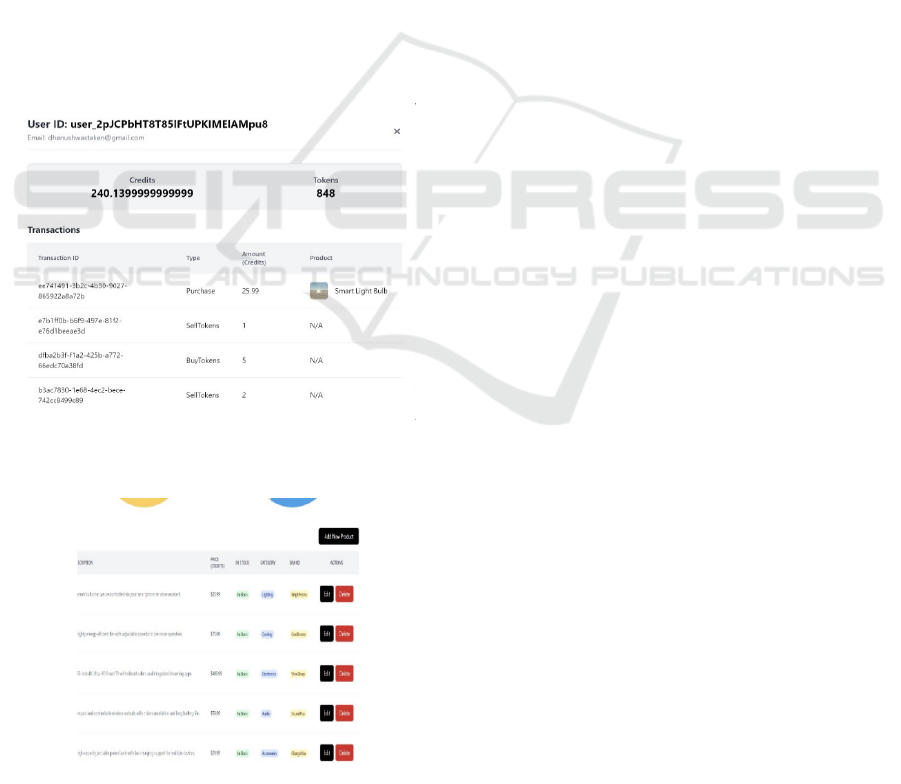
Figure 3: Admin dashboard with user accounts.
Sales Prediction (AI Model): The primary
function of the Admin Dashboard includes its AI-
based sales prediction module capability. This
module implements Random Forest classifier
technology to conduct sales predictions for the
following 100 days. The AI system evaluates
previous sales patterns together with present platform
behavior by processing data that includes historical
sales records while taking into account historical
trends and seasonal patterns and user interactions.
The system shows regular updates of prediction
results through its graphical presentation format for
Watt Wallet: A Blockchain-Enabled Decentralized Marketplace for Renewable Energy Credits with AI-Driven Predictive Analytics
725
easy understanding of forecasted data. The sales
forecasts generate meaningful outcomes which help
administrators make better choices for their inventory
management as well as resource distribution and
promotional strategies.
Figure 3 illustrates the Admin
dashboard with user accounts.
Security and Data Management: The sensitive
information within the Admin Dashboard receives
authentication protection through Clerk
Authentication platform. The authentication
procedure exists to limit entry to authorized staff
members who protect operational information and
user-sensitive information. The platform utilizes
Prisma ORM together with MongoDB to streamline
its data management operations. The simultaneous
use of Prisma ORM with MongoDB provides both
effective data storage and retrieval together with
superior level data performance standards. High-load
situations do not affect the dashboard operation
because the backend infrastructure is strong enough
to support its smooth operation. Figure 4 shows the
Admin's Display of a particular User's transaction
history.
Figure 4: Admin's display of a particular user's transaction
history.
Figure 5: Schematic flow of theoretical structure.
Figure 5 depicts the Schematic Flow of Theoretical
Structure. All crucial functions for platform
administration exist as a unified experience within the
Admin Dashboard system. User management along
with transaction monitoring and energy consumption
analysis and predictive analytics capabilities that the
dashboard delivers are fundamental elements which
make the WattWallet platform maintain its integrity
security and operational efficiency. The platform
achieves enhanced strategic value because its AI
capabilities enable administrators to identify future
trends and optimize resource use for continuous
operating improvements.
4.3 AI Model
The analysis of Random Forest classifier relied on
synthesized energy token transaction and sales
patterns to develop a training dataset for evaluation
purposes. The created synthetic data included
characteristics that would normally exist in genuine
transactional records. We used 100 samples which
included 5 features per sample while the target
variable contained two classifications for binary
prediction (such as forecasting sales events).
The analysis assigned 80% of the data to model
training purposes while the remaining 20% served to
evaluate performance. Testing the performance of the
classifier required this separation method to
determine its extrapolation capacity with new data
points. The model reached 93% accuracy after its
training phase while processing test samples. The
model demonstrates strong capability for extracting
hidden patterns in synthetic data because it shows
high accuracy rates.
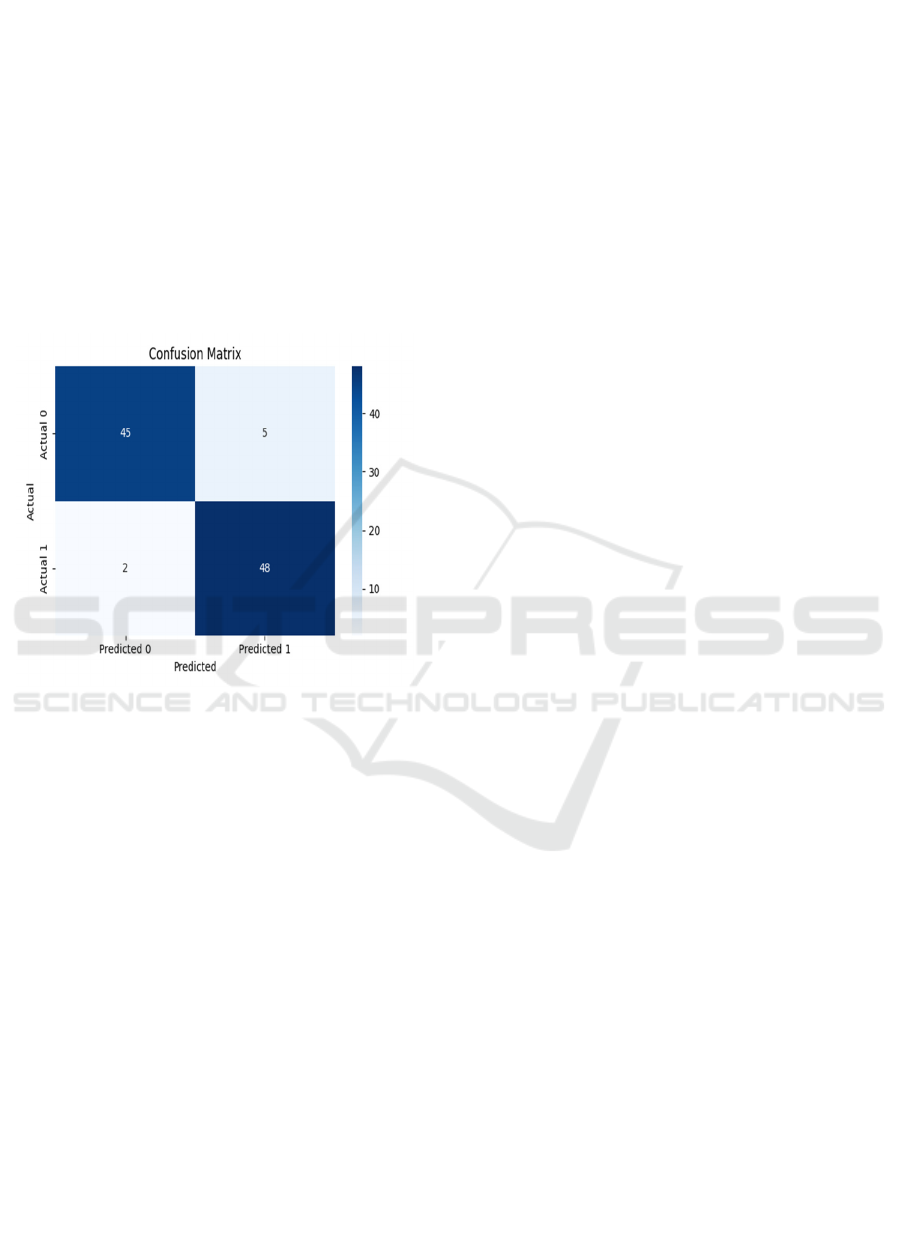
Through the confusion matrix we received
additional assessment of the model's effectiveness by
showing how correctly and incorrectly classified data
distributions appeared. There were minimal
classification mistakes on the test samples while most
of the data points received precise predictions
according to the results. The classification report
included precision and recall and F1-score
measurements which confirmed a dependable
prediction system that effectively represented both
classes.
The entire training process of the model happened
exclusively with synthetic information. A controlled
environment enabled simulation of expected features
and data patterns which would naturally occur in the
WattWallet platform. Future implementation will
train and validate the model with actual transactional
data obtained from the platform while using synthetic
data to derive initial promising results. The evaluation
ICRDICCT‘25 2025 - INTERNATIONAL CONFERENCE ON RESEARCH AND DEVELOPMENT IN INFORMATION,
COMMUNICATION, AND COMPUTING TECHNOLOGIES
726
of genuine platform dataset will lead to model
optimization for stronger performance in actual sales
forecasting and business decision-making scenarios.
The trial of Random Forest classifier with
synthetic data shows natural performance whereby
the accuracy reaches an approximate 93% (figure 6
shows the confusion matrix). The positive metrics
demonstrate that this AI model delivers important
understanding of sales patterns which can help
WattWallet implement effective inventory
management strategies and strategic business
planning options. A strong proof-of-concept that uses
these initial results enables future development which
will enhance real-world testing potential.
Figure 6: Confusion matrix.
5 CONCLUSION AND FUTURE
WORKS
Research develops a blockchain-powered
decentralized trading marketplace utilizing AI to
enhance operational efficiency of energy
management along with better sales prediction. Users
can perform safe and efficient energy trades through
the system because it combines dual-currency
operations with smart contract tokenization along
with a clear view of all transaction records. The
Admin Dashboard enables simple transaction
monitoring together with energy consumption
tracking and user behavior surveillance while the AI-
based sales prediction model gives important
information about future energy deals to optimize
resource use. The platform succeeds at minimizing
costs and promoting energy efficiency but its
developers need to improve the AI forecasts through
enhanced model accuracy and work on interface
design to create a better user experience to help
achieve wider scalability.
The approach for future work involves optimizing
blockchain efficiency through analysis of layer 2
solutions and alternative blockchain networks to
handle transactions and real-time information better.
The development of the AI sales forecasting model
requires additional variables along with IoT
integration for instant energy monitoring and
complete regulatory adherence implementation. The
platform will gain market expansion through
increased token liquidity and energy provider
collaborations together with better user experience
features from enhanced interaction and feedback
implementation. Long-term platform success in
promoting sustainable energy usage together with
renewable energy solutions will be improved through
these developments.
REFERENCES
A. Haese, Q. Rouhani, N. Mabasa, et al., "Addressing
Accessibility of Online Platforms for Low-Literacy
Users in Small-Scale Aquaculture," Water Research
Commission Report, No. 3136/1/24, ISBN 978-0-6392-
0613-4, 2024.
A. R. Akiladevi, S. Sardha, and R. Shruthi, "Tokenization
of Energy Assets: A Multichain Blockchain Approach,"
2024 5th International Conference on Mobile
Computing and Sustainable Informatics (ICMCSI), pp.
702–706, 2024. doi:
https://doi.org/10.1109/ICMCSI61536.2024.00110.
B. Bordel Sánchez, R. Alcarria, L. Ladid, and A. Machalek,
"Using Privacy-Preserving Algorithms and Blockchain
Tokens to Monetize Industrial Data in Digital
Marketplaces," Computers, vol. 13, no. 104, 2024. doi:
https://doi.org/10.3390/computers13040104.
L. Gagliardelli, L. Zecchini, L. Ferretti et al., "A big data
platform exploiting auditable tokenization to promote
good practices inside local energy communities,"
Future Generation Computer Systems, vol. 141, pp.
595–610, 2023. doi:
https://doi.org/10.1016/j.future.2022.12.007.
M. Satheesh, B. J. D'mello, and J. Krol, Web Development
with MongoDB and NodeJS, 2nd ed., Packt Publishing,
Birmingham, 2015.
M. R. Islam Bhuiyan, "Examining the Digital
Transformation and Digital Entrepreneurship: A
PRISMA Based Systematic Review," Pak. J. Life Soc.
Sci., vol. 22, no. 1, pp. 1136–1150, 2024. doi:
https://doi.org/10.57239/PJLSS-2024-22.1.0077.
Naga Sudha, D. K. S., Hari Priya, C., Bindu Sree, M.,
Sankar, D. M., Sri Hanish Kumar, M. S., & Ramasamy,
G. (2024). Intelligent Innovations in Personal Security:
A Smarter Approach for Enhanced
Protection. Mandapati and Sankar, Divity Mani and Sri
Watt Wallet: A Blockchain-Enabled Decentralized Marketplace for Renewable Energy Credits with AI-Driven Predictive Analytics
727

Hanish Kumar, Meka Sai and Ramasamy, Gayathri,
Intelligent Innovations in Personal Security: A Smarter
Approach for Enhanced Protection (November 15,
2024).
O. Delardas and P. Giannos, "Towards Energy Transition:
Use of Blockchain in Renewable Certificates to Support
Sustainability Commitments," Sustainability, vol. 15,
no. 258, 2023. doi:
https://doi.org/10.3390/su15010258.
Ojas, O., Vashishtha, A., Kumar Jha, S., Kumar Shah, V.,
Kumar, R., & Ramasamy, G. (2024). James: Enhancing
Judicial Efficiency with Smart
Administration. Available at SSRN 5091509.
R. V. Prasad, R. Dantu, A. Paul, P. Mears, and K. Morozov,
"A Decentralized Marketplace Application on The
Ethereum Blockchain," 2018 IEEE 4th International
Conference on Collaboration and Internet Computing,
pp. 90–96, 2018. doi:
https://doi.org/10.1109/CIC.2018.00023.
Ramasamy, G., Shaik, B. A., Kancharla, Y., & Manikanta,
A. R. (2025). A Bash-based approach to simulating
multi-process file systems: Design and implementation.
In Challenges in Information, Communication and
Computing Technology (pp. 200-206). CRC Press.
S. Venkataramanan, A. K. R. Sadhu, L. Gudala, and A. K.
Reddy, "Leveraging Artificial Intelligence for
Enhanced Sales Forecasting Accuracy: A Review of
AI-Driven Techniques and Practical Applications in
Customer Relationship Management Systems," Aus. J.
ML Res. & App., vol. 4, no. 1, pp. 267–275, 2024. doi:
https://sydneyacademics.com/.
Y. Zuo, "Tokenizing Renewable Energy Certificates
(RECs)—A Blockchain Approach for REC Issuance
and Trading," IEEE Access, vol. 10, pp. 134477–
134481, 2022. doi:
https://doi.org/10.1109/ACCESS.2022.3230937.
ICRDICCT‘25 2025 - INTERNATIONAL CONFERENCE ON RESEARCH AND DEVELOPMENT IN INFORMATION,
COMMUNICATION, AND COMPUTING TECHNOLOGIES
728
