
Intelligent OTT Platform System Leveraging Advanced Machine
Learning Techniques
P. Renuka
1
, S. Fahimuddin
2
, K. Pavan Kumar
1
, Mahammad Yousuf
1
,
S. Arif Hussian
1
and Y. Dhanush Kumar Raju
1
1
Department of Artificial Intelligence and Data Science, Annamacharya University, Rajampet, Andhra Pradesh, India
2
Department of Electronics and Communication Engineering, Annamacharya University, Rajampet, Andhra Pradesh, India
{pasupuletirenuka805, fahimaits, pavankumarkundeti237, msmahammadyousuf, arifhussainshaik24, rajdhanush020}@gma
il.com
Keywords: Content Management, Collaborative Filtering, Cosine Similarity, Machine Learning, Movie
Recommendations, Natural Language Processing (NLP), Real‑Time Analytics, TF‑IDF.
Abstract: The explosive growth of OTT service providers requires high-end systems that provide flexible content
management and personalized user experience. We introduce a machine-learning based cable-like solution
that is capable to suggest the most suitable content for the given set of users while maintaining the operational
performance of an OTT platform invisible to the user. Using cosine and tiff similarity on a large dataset of
movies, the system uses UIs from Streamlit to make accurate movie recommendations. The hybrid
recommendation algorithm integrates collaborative filtering and content-based recommendation algorithms
to have the flexibility of authoritative recommendation, considers contextual factors like user details and
viewing history, allowing it to be adjusted to the internal properties of the user. The platform also uses NLP
(natural language processing) to analyze user sentiment and comments to improve the results of content
recommendations even more.
1 INTRODUCTION
The rise of over-the-top (OTT) video streaming
services has caused a radical change in how people
consume media (Nagaraj, Samala, et al,2021) with a
plethora of content available for on-demand viewing.
With the rivalry in this space growing, a highly
personalized user interface is emerging as a critical
component for platforms to differentiate themselves
and engage users. As a result, cutting-edge machine
learning techniques have been integrated, able to tailor
content recommendations by studying what users do,
what they say they prefer and data found inside the
ecosystem. Cosine similarity and TF-IDF (Term
Frequency-Inverse Document Frequency) is also used
to help the more interesting and relevant material that
meets users' perception become increasingly more
recommended by the platform Sutcliffe, (Alistair, et
al, 2022)
Demand for customized content in dawn media
has seen a sharp rise. In industry sentiment survey
data, personalized recommendations have a
significant effect on user satisfaction, and thus
retention. In fact, research shows (Ko, Hyeyoung, et
al, 2022) that, in certain scenarios, platforms with
robust recommendation engines can create up to 30
percent more user engagement. Then, applying
advanced machine learning algorithms on top of the
intelligence that the, to great extend their content are,
and making recommendations to improve them is
nothing but an addition that they have adopted as their
strategy. for OTT (Paid over-The-Top) companies
seeking to sustain their competitive advantage and
customer satisfaction in as the segment continues to
grow. Artificial intelligence techniques in ott systems
the ott systems are facing multi-faceted problems
relating to the observation of users such as the views
of content and the predicting about the content that a
specific user is compromising trying out. Traditional
Details. By using hybrid models Burke, Robin, 2002)
that combines collaborative filtering and content-
based algorithms, platforms can potentially provide
more accurate and relevant recommendations. It
enhances user satisfaction and encourages longer use
of the platform.
Additionally, by using natural language
processing (NLP) to analyze mood and reaction,
Renuka, P., Fahimuddin, S., Kumar, K. P., Yousuf, M., Hussian, S. A. and Raju, Y. D. K.
Intelligent OTT Platform System Leveraging Advanced Machine Learning Techniques.
DOI: 10.5220/0013904300004919
Paper published under CC license (CC BY-NC-ND 4.0)
In Proceedings of the 1st International Conference on Research and Development in Information, Communication, and Computing Technologies (ICRDICCT‘25 2025) - Volume 3, pages
713-717
ISBN: 978-989-758-777-1
Proceedings Copyright © 2025 by SCITEPRESS – Science and Technology Publications, Lda.
713

platforms can continuously adapt to evolving user
behaviors and tastes. This helps keep content
recommendations relevant and personalized. Our
work here offers an intelligent OTT platform solution
(Chakraborty, Debarun, et al, 2023) that utilizes these
recent techniques to enable efficient content
management and best content recommendation. This
system uses streamlit as the UI that recommends
personalized movies based on any movie Dataset is
processed TFIDF and cosine distance. New trends and
data are provided by providing insight into the
behavior of users, the real time analytics features of
the system alters the content offering and marketing
approaches for a proactive operation of the system. By
translating these advancements into actions, our
platform intends to raise the bar of personalized
material distribution by enhancing the user experience
and involvement (O’Brien, et al, 2008) in the
wrecking OTT realm.
2 LITERATURE SURVEY
A plethora of methods have been investigated prior
focused at tuning content recommendation
mechanisms more so in over-the-top (OTT)
environment. Early work concentrated on
collaborative filtering methods (Koren, et, al, 2021)
data that takes the form of user activity and is used to
recommend products based on preferences of similar
users. These methods while being able to achieve
relevant suggestions, often lacked scalability and
faced the cold start problem. In order to transcend
these constraints, scientists started to adopt content-
based filtering, which provides recommendations
based on item properties and user profiles. By
combining the two, this hybrid approach hoped to get
the best out of both the worlds and provide a more
accurate and personalized recommendation. Goyani et
al, 2020 and favourite tools for making them! In, they
do content-based and collaborative filtering using the
movie recommendation example to find similar
people. These techniques can be combined to get
better than the efficacy. These systems are employed
by companies such as Facebook, LinkedIn, Pandora,
Netflix, and Amazon to boost revenue and enhance
user experience within their products. To investigate
this phenomenon, this paper studies various
paradigms and heuristics for movie selection.
Agrawal et al. The users play an important role in
collaborative filtering providing a hybrid method to
improve the movie recommendation systems. To
enhance recommendation precision, the purpose of
these techniques are neural networks and many more
algorithms of collaboration with the matrix-
factorization which has enabled solvers also observe
all issues confronted with sparse data.TF-IDF and
compute the similarity of items using cosine similarity
(Yunanda, et al, 2017) With that, platforms have a
better method to combine what users want with the
available content and this leads to an overall quality of
recommendation. Kumar et al. In different with
MOVREC method (Boddapati,et al, 2023) that is
trained on user data, we design a movie
recommendation system which only needs data of
persons and as long as user review can be analyze it,
this method is use for recommend movie for them.
Rajarajeswari et al. proposed the way. recommender
systems and information filtering tools that are based
on big data and analyze users interests or preferences
reshapes e-commerce applications and websites
towards users (Wu, Hao, et al, 2018)
More recently, machine learning and natural
language processing have leveraged advanced
algorithms and models to greatly enhance the
capabilities of recommendation systems. Neural
networks and matrix factorization both have been used
to address challenges like sparse data, dynamic
customer preferences, and recommendation accuracy.
factorization. Wang et al, the model-based movie
recommendations method is proposed, which
segments user space by applying evolutionary
algorithms and K-means clusterings. We apply
principal component analysis (PCA) as a
dimensionality reduction that concentrate the movie
space in the population. This method tackles the issue
of information explosion in web-based interactive
movie recommendations and achieves a more accurate
movie recommendation than traditional methods and
more consistent personalize film. Reddy et al.
proposed a recommender system is a hardware
technology that mencarhighly personalized. That
provides data-driven recommendations for songs,
movies and books. Movie recommendation systems
predict users’ choices based on params like directors,
actors and genres.
3 PROPOSED METHODOLOGY
Recommendation systems are used for giving
consumer specific content according to consumer
interest and behavior. Therefore, the recommendation
systems are mainly based on the interaction of how
the past data with the users will be helpful in
forecasting and suggesting the users the content that
the users very well may find interesting or relevant.
These systems are often built on the principle that
ICRDICCT‘25 2025 - INTERNATIONAL CONFERENCE ON RESEARCH AND DEVELOPMENT IN INFORMATION,
COMMUNICATION, AND COMPUTING TECHNOLOGIES
714
similar users, or similar items, exhibit similar POIs or
attributes. Top-N recommendation systems focus on
improving the user experience by recommending
tailored items that match the user preference and
interests based on input of items features and users’
behaviors. Hence showing content that is relevant for
what each user cares about is a sure-shot way to boost
user interest and satisfaction. Cosine similarity is
used here to compare the TF-IDF vectors of different
movies for the recommendation system.
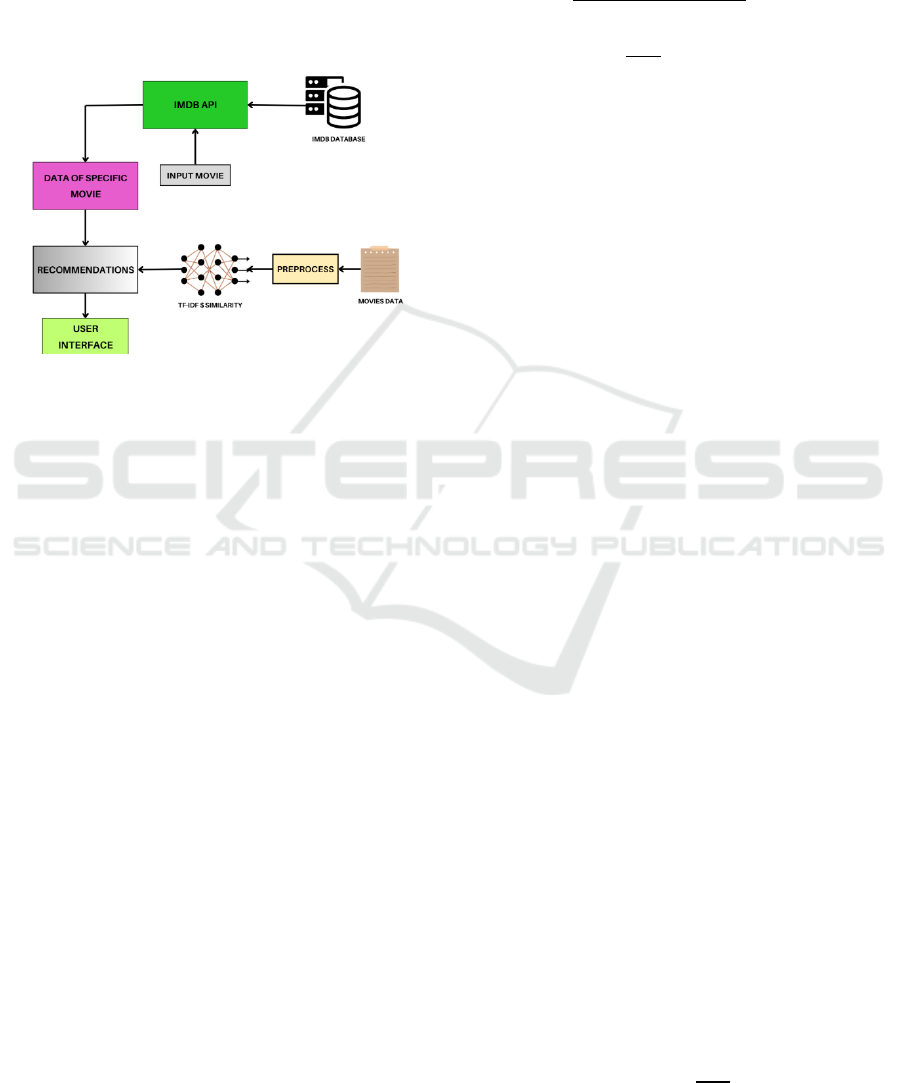
Figure 1: Architecture of the System.
Cosine Similarity calculates the angle across two
vectors to see how similar they are to each other with
regards to content. If there is a high cosine similarity,
it indicates that the two movies have more in common
features and are likely to have the same target
audience. So, such a technique is very beneficial in
providing content retrieval thus enabling us to come
up with relevant recommendations based on the
written representation of movie synopsis. The figure
1 shows the Architecture of the System. Hybrid
techniques are applied to improve performance of
recommendation system by aggregating of multiple
recommendation algorithms. We propose a hybrid
recommendation system that combines both
collaborative filtering methods and content-based
filtering.
3.1 TF-IDF
TF-IDF is a statistical measure to determine and
evaluate a word's importance within a document
relative to the set of a corpus or collection of
documents TF-IDF is all about weighing words in
accordance with how rare they are across the corpus
and how frequently they are used in the text. This
technique can be used to identify highly specialized
terms that appear often in a specific text and rarely
elsewhere. TFIDF score is higher for terms used very
frequently in a document and is rare in others
highlighting that these are the words determining
document contents. It is most commonly used in text
processing tasks such as text mining and information
retrieval. It allows you to identify key phrases that
more richly quantify papers, and thus is much more
user friendly.
(1)
(2)
Here, N is the total number of documents, df is the
number of documents that contain the term t, and d
is the number of documents.
(3)
Not taking an account a word importance and
relation with other words in the same text. As a
consequence, it can overlook subtle meanings and
neglect parts of the entire context surrounding words.
TF-IDF can be used along with other approaches
which provide better semantic information such as,
word embedding or deep learning algorithms to
overcome such drawbacks. Even though TF-IDF has
these downsides it is still powerful part of a
recommendation system and text-analysis when
combined with more modern methods you have learnt
about up until this point [3.1]. Combining TF-IDF
with state-of-the-art approaches like NLP models has
the potential to overall improve the performance of
text-based applications.
3.2 Cosine Similarity
Cosine similarity determines how similar vectors are
in the multidimensional space, and it does this by
calculating the cosine of the angle between them. The
concept is borrowed from vector space models that
represent things or documents as multi-dimensional
vectors representing multiple attributes or phrases.
Cosine similarity: it creates the cosine of the angle
between 2 vectors providing a measure on the limit of
directionality when an input is given to find similar
ones based on content or properties, this approach
works well (text processing, recommendations...)
Cosine similarity is frequently used in text analysis,
where it computes the closeness of two document
vectors (the vectors of the given two documents). One
use case in text data processing would be the
transformation of documents into vectors like the use
of TFIDF with word embeddings and so on.
(4)
Intelligent OTT Platform System Leveraging Advanced Machine Learning Techniques
715
Cosine Similarity is the measure of similarity
between two vectors using their angle with each other
rather than their relative position. Therefore, it
handles changes in document-length and component-
count very well. One of the options that is commonly
used for many applications is using cosine similarity,
since it is still easy to implement and computationally
relatively cheap to calculate. But, there are some
disadvantages of cosine similarity though. Hence here
it might not be well represented the signification of
some concepts or features with high frequencies due
to it does not consider the absolute magnitude of the
vectors. Moreover, whenever semantic relations play
a role such as determining the meaning of a word or
its context among multiple words calculating cosine
similarity might struggle to match different sentences
correctly.
4 RESULTS
Implementation of Efficient Movie Recommendation
System using Advanced Machine Learning
Algorithms Cosine similarity is then used for
similarity measurement, while TF-IDF is used to
analyze and detect the movies most likely to be
recommended to the user. The recommender system
recommends a short list of relevant films to the user,
and generates recommendations from the user's
selections = keyword = rating figure 2 & 3). By
focusing on understanding the preferences of users
rather than simply recommending popular movies or
shows, this method can provide a more tailored
experience that improves user satisfaction by
providing more relevant recommendations. →
Several metrics are used to evaluate the recommender
system performance goals for the recommendations
to be of high quality and relevant. Common
evaluation metrics include recall, F1- score and
precision, which measure relevance and accuracy of
suggestions.
Recall assesses how good the system is at
identifying all the relevant movies, while precision
assesses how many of the movies the system
recommended to the user were actually relevant. F1-
score is a pretty reasonable measure of a system’s
quality, as it considers both recall and precision.
Customer responses and interactions tell algorithms
how well suggestions perform and how much users
like them Recommendation system provides
suggestion to the user based on his interaction with
the interface.
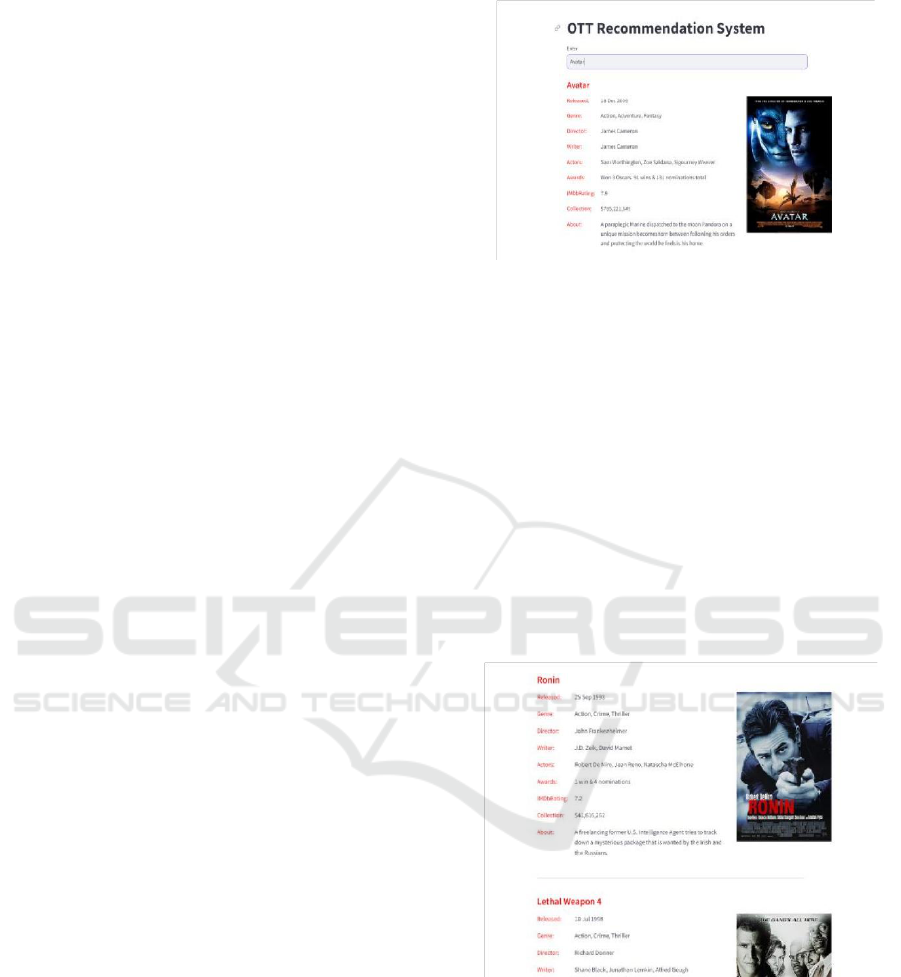
Figure 2: Ott User Interface.
On a fundamental level, a recommendation engine
takes user input genres selected or keywords
searched, for example and spits out a list of films that
meet the input. The Figure 2 Shows the OTT User
Interface. tye TFIDF and cosine similarity makes
recommendations revolve around the most relevant
and similar movies that facilitates providing up-to-
date and intelligible recommendations to users.
Suggestions are designed in real time, adding an
interactive element to the experience giving instant
feedback, tailoring content to an individual.
Reflection and adaptation: While the suggestions are
real time, they are also dynamic, adapting to an
individual and changing what is offered based on
previous interactions.
Figure 3: Predictions on User Interface.
Then displaying a simple interface using streamlit
where you can input items and get recommendations
back. The design of the interface has allowed for ease
of use, such that users can input their desired options
and suggest instantly. Users were allowed to make
their choices like types of movies, search list, more
options like, date, keywords, and ratings, with a few
interactive components like dropdown menu, sliders,
and text inputs. The figure 3 shows the Predictions
ICRDICCT‘25 2025 - INTERNATIONAL CONFERENCE ON RESEARCH AND DEVELOPMENT IN INFORMATION,
COMMUNICATION, AND COMPUTING TECHNOLOGIES
716

on User Interface.The user interface for browsing and
selecting material is implemented with attractive
design, including the suggestion of movies (with
names, posters and descriptions). You train on data
until October 2023. We write code for an interface
where people can click on their favorite movies and
vote. Users are able to rate movies back to the date
they came out, until keywords dates relating to their
interests, and select categories from the menu that
appears on the site. Then into recommendation engine
is generating the list of movies resembles user profile.
5 CONCLUSIONS
The movie recommendation engine works pretty well
by implementing some machine learning techniques,
cosine similarity for measuring similarity between the
same line or parts of the lines and TF-IDF for text
processing, to serve relevant content for users.
Implementing the Application to the User Interface,
A Basic Streamlit based UI providing a realtime and
interactive platform for the user to enter preferences,
views suggestions and wisely decide what to watch.
Like real-time processing capabilities that improve
user experience overall, that ensures consumers are
getting the latest thinking, relative to the constraints
they put in place. As evidenced by evaluation metrics
and user reviews, as the system successfully identifies
and presents movies to users that align with their
interests, this increases user satisfaction and leads to
the discovery of new enjoyable content. This, while
meant to expedite the recommendations process, the
blend of complex algorithmsand user-friendly
interface ensures that the stage is set for future
developments, including the integration of more
machine learning methods and user data for
increasingly accurate and customized
recommendations. Antoutin, the induction of a hand
of an over-all much crucial for which end-high
respect system assstirs the tool(s) of content
personalization, that offers Artists Another upstream
of insight data, as well as, enhancing a parasitism
watching experience, simply high-via the changing
consumer needs.
REFERENCES
Agrawal, Shreya, and Pooja Jain. "An improved approach
for movie recommendation system." 2017 international
conference on I-SMAC (IoT in social, mobile, analytics
and cloud) (I-SMAC). IEEE, 2017.
Boddapati, Mohan Sai Dinesh, et al. "Creating a Protected
Virtual Learning Space: A Comprehensive Strategy for
Security and User Experience in
Online Education." International Conference on
Cognitive Computing and Cyber Physical Systems.
Cham: Springer Nature Switzerland, 2023.
Burke, Robin. "Hybrid recommender systems: Survey and
experiments." User modeling and user-adapted
interaction 12 (2002): 331-370.
Chakraborty, Debarun, et al. "Watching is valuable:
Consumer views–Content consumption on OTT
platforms." Journal of Retailing and Consumer Services
70 (2023): 103148.
Goyani, Mahesh, and Neha Chaurasiya. "A review of movie
recommendation system: Limitations, Survey and
Challenges." ELCVIA: electronic letters on computer
vision and image analysis 19.3 (2020): 0018-37.
Ko, Hyeyoung, et al. "A survey of recommendation
systems: recommendation models, techniques, and
application fields." Electronics 11.1 (2022): 141.
Koren, Yehuda, Steffen Rendle, and Robert Bell.
"Advances in collaborative filtering." Recommender
systems handbook (2021): 91-142.
Nagaraj, Samala, Soumya Singh, and Venkat Reddy Yasa.
"Factors affecting consumers’ willingness to subscribe
to overthe-top (OTT) video streaming services in
India." Technology in Society 65 (2021): 101534.
O'Brien, Heather L., and Elaine G. Toms. "What is user
engagement? A conceptual framework for defining user
engagement with technology." Journal of the American
society for Information Science and Technology 59.6
(2008): 938-955.
Rajarajeswari, S., et al. "Movie recommendation system."
Emerging Research in Computing, Information,
Communication and Applications: ERCICA 2018,
Volume 1. Springer Singapore, 2019.
Reddy, S.R. S., et al. "Content-based movie
recommendation system using genre correlation."
Smart Intelligent Computing and Applications:
Proceedings of the Second International Conference on
SCI 2018, Volume 2. Springer Singapore, 2019.
Sutcliffe, Alistair. Designing for user engagment: Aesthetic
and attractive user interfaces. Springer Nature, 2022.
Wang, Zan, et al. "An improved collaborative movie
recommendation system using computational
intelligence." Journal of Visual Languages &
Computing 25.6 (2014): 667675.
Wu, Hao, et al. "Dual-regularized matrix factorization with
deep neural networks for recommender systems."
KnowledgeBased Systems 145 (2018): 46-58.
Yunanda, Gisela, Dade Nurjanah, and Selly Meliana.
"Recommendation system from microsoft news data
using TFIDF and cosine similarity methods." Building
of informatics, technology and science (BITS) 4.1
(2022): 277-284.
Intelligent OTT Platform System Leveraging Advanced Machine Learning Techniques
717
