
Instantaneous Sign Language Interpretation Leveraging Advanced
Neural Networks
Ulenda Deepika, Shaik Muskan Tahseen, M. Bala Krishna,
Syeda Adeeba Samreen and Nallagoti Nissitha
Department of Computer Science Engineering, Ravindra College of Engineering for Women, Kurnool, Andhra Pradesh,
India
Keywords: Sign Language, Deep Learning, Communication Barriers, Gesture Recognition, Convolutional Neural
Networks (CNNs), Recurrent Neural Networks (RNNs), Computer Vision, Hand Gestures, Facial
Expressions, Body Gestures.
Abstract: Native sign language is most commonly used by hearing disabled individuals for communication Deep
learning algorithms are making way for motion and gesture detection and classification. This topic is getting
more popular due to advancement in deep learning techniques and computer vision. CNN’s assistance toward
closing the gap between signers and non-signers. A web app is created with the trained model to make it
publicly available. When input this image, it has used computer vision and neural network and detects the
signs and gives the respective text as output. The recognized gestures are then converted into text or voice
output, which can be used to display on the screen, or using some speaker to speak. The system captures video
frames of sign language gestures using a camera. In this paper, we are developing a sign language recognition
system using deep learning techniques in real time. The system is an intended solution to a problem by
providing real-time translation of sign language gestures to either text or speech, serving to bridge the gap
between deaf and hearing individuals.
1 INTRODUCTION
Sign language is the primary method of
communication among hearing and speech impaired
individuals. Since the public has little understanding
about sign languages, this poses many barriers for
individuals in interaction or inclusivity in the broader
scheme of life. The challenge that needs to be
addresses with his gap requires something robust,
efficient, and accessible for it to be successful in
translation; sign language can be interpreted as
spoken pr written text.
Novel gesture recognition applications and
innovative applications from recent advancements in
deep learning and computer vision pave the way
toward effective recognition. Deep learning models,
especially the CNNs and RNNs, have performed very
well and are highly reliable in recognizing the
complex patterns present in hand movement, facial
expression, and even gestures of the whole body. In
video streams, these models may extract meaningful
features and classify them into predefined categories
corresponding to a sign language gesture.
Unlike traditional methods that rely on human-
crafted features, these methods can automatically
learn complex patterns and representations from large
datasets of sign language videos, resulting in better
accuracy and robustness.
In this Paper, a real-time sign language
recognition system based on deep learning-based
models is proposed to effectively convert sign
language gestures to text or spoken words, to improve
communication and understanding between deaf and
hearing communities.
2 RELATED WORKS
The Sign Language Recognition System represents a
transformative convergence of human cognition and
technological innovation, enabling real-time
recognition of sign language using advanced machine
learning techniques (Pavlovic et al.). Neural network
700
Deepika, U., Tahseen, S. M., Krishna, M. B., Samreen, S. A. and Nissitha, N.
Instantaneous Sign Language Interpretation Leveraging Advanced Neural Networks.
DOI: 10.5220/0013904100004919
Paper published under CC license (CC BY-NC-ND 4.0)
In Proceedings of the 1st International Conference on Research and Development in Information, Communication, and Computing Technologies (ICRDICCT‘25 2025) - Volume 3, pages
700-706
ISBN: 978-989-758-777-1
Proceedings Copyright © 2025 by SCITEPRESS – Science and Technology Publications, Lda.

architectures such as Convolutional Neural Networks
(CNNs) and Long Short-Term Memory (LSTM)
models have made it possible to translate gestures
into text with near-human accuracy, approximating
spoken language semantics (Sun et al.; Wang et al.).
One notable system introduced at the UNI-TEAS
2024 conference translates spoken input to text and
then into International Sign Language (ISL). It
operates offline and predicts signs or phrases based
on real-time video feed, achieving ~100% accuracy
in sign recognition and ~96% for phrase structures
(Goyal & Singh; Wang et al.).
A significant contribution to Indian Sign
Language research utilized MobileNetV2 with
transfer learning for accurate ISL gesture recognition,
aiming to improve accessibility for the hearing-
impaired in India (Karishma & Singh; Goyal &
Singh). Additionally, CNNs have been combined
with Generative Adversarial Networks (GANs) for
both recognition and video generation of ISL signs,
resulting in high-quality outputs as shown by a PSNR
of 31.14 dB and an SSIM of 0.9916 (Khadhraoui et
al.; Ni et al.). These metrics confirm minimal
distortion and high fidelity in the generated video
content.
Systems that recognize sign language using
depth-sensing tools like Microsoft Kinect have shown
effective alphabet recognition, further supporting
real-time communication (Dong et al.). Hand gesture
datasets, such as the 2D ASL dataset proposed by
Barczak et al., have served as foundational resources
for gesture training and classification. Furthermore,
gesture-based systems have been explored for
enhancing decision support in sports through visual
cues (Bhansali & Narvekar), and wearable
technologies like ISL-to-speech gloves have
demonstrated real-world applicability (Heera et al.).
Mobile applications integrating image processing
for sign translation provide scalable, platform-
independent solutions for American Sign Language
(Jin et al.). Likewise, early research into gesture
interfaces laid the groundwork for modern deep
learning-based systems (Lesha et al.). Altogether,
these efforts underscore the evolution of sign
language recognition from static image interpretation
to dynamic, intelligent systems capable of real-time
translation and inclusive communication (Murthy et
al.).
3 METHODOLOGY
3.1 Data Sets
• Feature Extraction: Relevant features such as
hand shape, finger orientation, and joint positions
need to be extracted from the hand images.
• Normalization: Normalized the features that
have been extracted in order to standardize input
to the model.
• Deep Learning Model Selection: CNN for
Spatial Features: Perform convolutional neural
networks to extract spatial features of hand
gestures in every frame. RNN for Temporal
Features: Implement the RNNs such as LSTMs
to describe the temporal dynamics that
encompass the sign language gestures in several
frames.
• Training the Model:
• Dataset Splitting: Divide the collected dataset
into a training set, a testing set as well as a
validation set.
• Training the Network: For the CNN or RNN
model, train on the training data and optimize the
parameters so that the gesture in the sign
language can be classified most accurately.
• Hyperparameter Tuning: Learn adjustment of
learning rate, batch size, and other
hyperparameters to improve model performance.
• Real-time Inference: Frame by frame analysis,
Frame extraction, Features extracted from the
Frame, Feature extracted on every frame is feed
into the learnt model for prediction of
corresponding sign language gesture.
• Translates the recognized signs into text or
speech output, Important Consideration, Sign
Language Variation, Consider the specific sign
language dialect when gathering data and
training the model.
• Robustness to Noise: Implement ways of dealing
with changes in lighting, background clutter, and
hand movements.
• A detector detects a number in this sign language
recognition system which can be easily extended
to cover a wide range of other signs and hands
sign including alphabets. In the model that we
use to develop our system, we are employing a
machine learning model known as CNN.
• With the camera turned on, the user can make
hand signs, and the system will decode the sign
and display it for the user. Making hand signs,
the person can send out a lot of information in a
short period of time. Sign language recognition
Instantaneous Sign Language Interpretation Leveraging Advanced Neural Networks
701
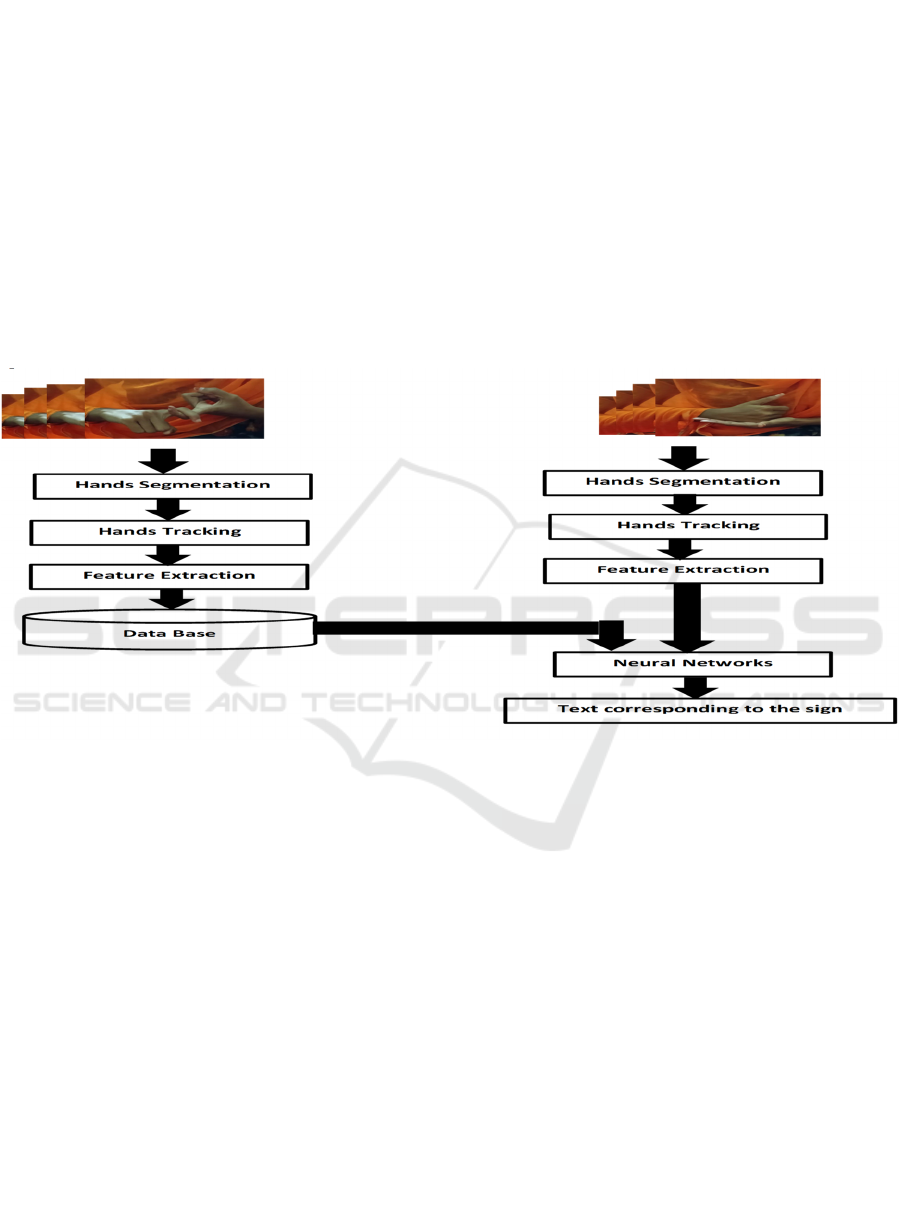
is a great help system for deaf-mute people,
which has been studied for many years. The sad
fact is, every research has some limitations and
yet they are not able to commercialize it.
3.2 Data Preprocessing
Real-time sign language recognition using deep
learning methodology generally comprises the
following: Capture video data from a signer, pre-
process the frames to isolate hand gestures, extract
features using a convolutional neural network (CNN)
to identify key hand shapes and movements, and
finally classify gestures in real time using a trained
model that can translate sign language into text or
speech.
Communication with a person who has a hearing
disability might not be that easy. It is the best medium
for deaf and mute people to tell their stories to their
thoughts and feelings. But simply devising sign
language isn’t enough. Automatic sign gesture
detection systems can bridge the communication gap
that has existed for ages. Finally, the paper presents a
DL-based SLR solution based on two classifiers and
a hybrid optimization algorithm. Using such a hybrid
model improves recognition accuracy and gives the
ability to handle variability in the execution of sign
language.
3.3 Model Architecture
Figure 1: Sign language gesture recognition system.
Hands Tracking: Tracking describes how movement
of the signer's hands is followed over a sequence of
frames. This captures the dynamic nature of sign
language since the movement, position and
orientation of hands over time are all meaningful
parts of a sign.
Feature Extraction: This involves extracting and
measuring the most salient characteristics of the
segmented hand shapes and motions.
Hand orientation: The angle that the hand has with
respect to the body or the camera.
Hand location and movement trajectory: The path
of the hand as it moves through space.
Database: Large number of sign language
examples (recording of hand movements and
positions, corresponding to the linguistic data) to be
trained on as well as test. Figure 1 shows Sign
Language Gesture Recognition System.
Neural Network: Machine learning models used
are of power because the task involved requires
extraction of the most complex patterns from features
associated with certain signs; thus, neural networks
best work when applied.
3.4 Training
Data Acquisition refers to the process of capturing the
hand images representing different signs. The system
is trained and tested on a publicly available data set.
The dataset consists of 9 classes in total. The signs
represented in this dataset are Friends, Help, More,
Yes, Sorry, No, Please, Stay, Again/Repeat. The
dataset comprises a multitude of image collections of
Emblem gestures that were recorded and used to
render realistic scenes.
ICRDICCT‘25 2025 - INTERNATIONAL CONFERENCE ON RESEARCH AND DEVELOPMENT IN INFORMATION,
COMMUNICATION, AND COMPUTING TECHNOLOGIES
702
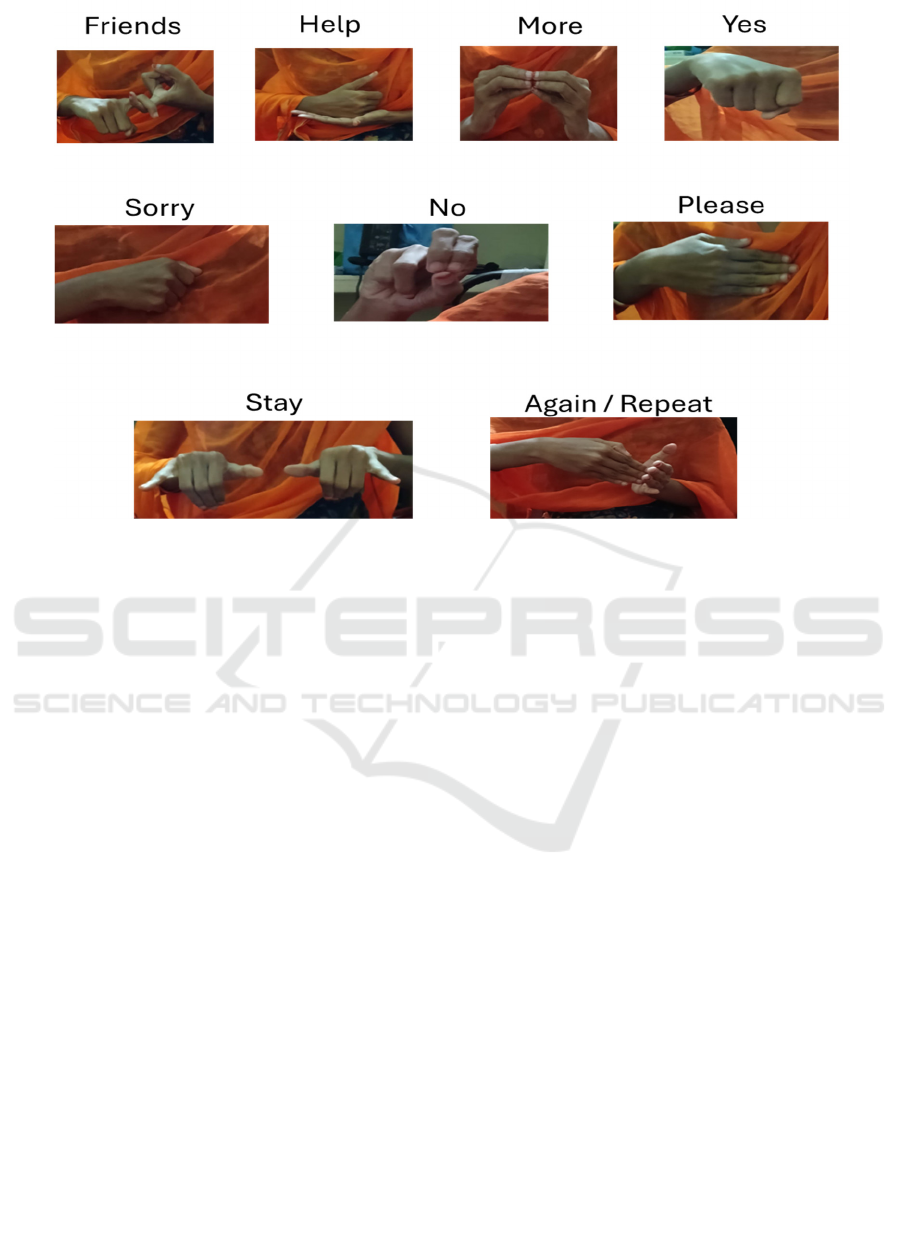
Figure 2: Hand gesture recognition dataset for sign language.
Most gestures in the original images render
several expressions in sign language. Every picture
has a noise-like, blurred, messy and colourful
background, such that people can appear to be in real
life communication image scene. These sign gestures
are known as ‘Emblems’, that are known for their
direct and specific meaning. These gestures can often
be used as a substitute for a spoken word; essentially,
they are fully formed signs with a clear translation in
the signed language.
Figure 2 shows Hand Gesture
Recognition Dataset for Sign Language.
Image Processing: Before performing any task
like sign language recognition, image preprocessing
is a must. Similar to cleaning and segregating data
before analysis, pre-processing makes sure that the
images are in the format required by the computer
vision model. This could mean cutting out noisy
backgrounds or resizing images to the same sizes.
Preprocessing is a necessary step because it improves
the quality of the data that is fed to the model. The
proposed noise-reducing model utilizes the selected
salient features of the image to provide a more
accurate representation of input data.
Normalization: Images are typically stored as
grids and pixels, with each pixel quantified by its
numeric value and its colour intensity. These values
depend on the format of the image. Using raw data
led to challenges for CNN:
• Inconsistent data
• Activation Function
Resizing: Using data without resizing the
information appropriately may cause various issues
when preparing the CNN, such as computational
complexity and difficulties in learning patterns.
4 RESULTS AND DISCUSSION
Real-time sign language translation via experimental
learning in deep learning.
Experimental learning in this context involves
designing and conducting systematic experiments to
construct and test a real-time sign language
translation system. Here's a structured approach for
such a design:
Define Objectives: Translates real-time sign
language gestures into text or speech. Identify static
and dynamic gestures by using deep learning.
Achieve high precision while maintaining the low
latency for the real-time application.
Here Accuracy curve shows the contrast between
the Training Accuracy and Validation Accuracy,
Validation Data Signed Distribution shows the
Validation Data Signed Distribution, Year of
Publications It shows the increasing number of
Publications and Cumulative Publications,
Instantaneous Sign Language Interpretation Leveraging Advanced Neural Networks
703

Enhancing the applicability of sign language
translation.
4.1 The Discussion of Findings
The real-time sign language translator using deep
learning shows great promise in filling gaps in
communication while maintaining high accuracy in
controlled settings. However, variability in signing
styles, lighting, occlusions, and latency issues all
detract from the performance of real-world systems.
Static gestures were well recognized, but dynamic
and complex gestures are problematic. User feedback
emphasized the need for broader sign language
support, multi-modal integration, and improved
usability in diverse settings. These insights
underscore the importance of dataset diversity, model
optimization, and user-centric enhancements to make
the system more robust and inclusive.
4.2 Recommendation for Future Work
Future development of the real-time sign language
translator should be focused on practical application
challenges. More diverse and inclusive datasets must
be collected, including regional sign variations and
gestures performed in real-world conditions.
Usability will greatly benefit from advances in
algorithm design for complex and dynamic gestures
as well as improvements in the responsiveness of the
system on a variety of hardware. Integrating facial
expression recognition and user-definable gestures
would be much easier. Testing the system across a
range of settings with end-users will be critical
together feedback which will be necessary to
optimize the system and to ensure that it is within the
capacity of the diverse communities that might need
to use it.
4.3 Performance Evaluation
You can train on data till October 2023. Energy
performance needed to analyse gesture recognition
accuracy & real time performance of system.
Because of the requirements for gesture observation
in real time, crucial metrics like accuracy, precision,
recall and F1 score were used to establish how
successfully the system recognizes gestures and
avoids false alarms whilst FPS and latency are a must
for seamless translation in real-time. Moreover, it
needs to be tested across different environments with
different light, background, and different signing
styles for it to be robust. We want to obtain the
knowledge about the usability part of the system and
whether it satisfies the requests of sign language
users, replies obtained from user feedback. By
carefully examining these elements in this way, the
system can be tuned for better dependability and
performance in a number of scenarios.
4.3.1 Accuracy
The real-time sign language translator also holds
accuracy over the recognition care sets of sign
language a word into text or voice. This metric gives
a general indication for how well the system is
working by taking the ratio of correct predictions,
both gestures and non-gestures, made by the model to
the total number of predictions. Typically, the
accuracy of deep learning-based sign language
translator is calculated based on the number of
correct predictions by comparing the model output
with the corresponding gestures in the test dataset.
𝐴𝑐𝑐𝑢𝑟𝑎𝑐𝑦 =𝑇𝑃+
+𝐹𝑁+𝑇𝑃+𝑇𝑁 (1)
Where:
• TP: True Positives (correctly classified
gestures)
• TN: True Negatives (correctly identified
non-gestures)
• FP: False Positives (incorrectly classified
gestures)
• FN: False Negatives (missed gestures)
4.3.2 Precision
Precision in the context of a real-time sign language
translator model means it is able to identify gestures
accurately once it predicts them. It is very important
in systems where error in gesture recognition might
confuse the parties in communication or
misunderstand what is being communicated. High
precision henceforth ensures that when the system
identifies a gesture, it is almost certain and has fewer
false positives, which are incidents where the system
indicates a non-gesture as a gesture.
𝑃𝑟𝑒𝑐𝑖𝑠𝑖𝑜𝑛 =
+𝐹𝑃 (2)
4.3.3 Recall
Recall, in particular, measures the percentage of true
gestures that the system correctly classified against
the total number of true gestures in the dataset, which
constitutes both correctly and incorrectly recognized
gestures: True Positives, TP, along with False
Negatives, FN.
ICRDICCT‘25 2025 - INTERNATIONAL CONFERENCE ON RESEARCH AND DEVELOPMENT IN INFORMATION,
COMMUNICATION, AND COMPUTING TECHNOLOGIES
704

𝑅𝑒𝑐𝑎𝑙𝑙 =
+𝑇𝑃 (3)
4.3.4 Sensitivity
The instantaneity of sign language interpretation with
sophisticated neural networks is a measure of how
well the system can identify and interpret sign
language gestures in real time with high accuracy and
contextuality. It entails the identification of complex
hand and finger motions, comprehension of facial
expressions that are part of meaning, and
differentiation between confusingly similar signs
with context.
4.3.5 Specificity
Specificity measures the proficiency of a live sign
language to translate correctly; it identifies any
frames that might not correspond with any gesture:
distinguishing non-gesture frames from a gesture.
That is calculated with the ratio: true negatives
correct identification of being a non-gesture frame,
where the total quantity of non-gesture frames is
obtained by adding true negative and false positives.
𝑆𝑝𝑒𝑐𝑖𝑓𝑖𝑐𝑖𝑡𝑦 =
+𝐹𝑃 (4)
4.3.6 F1-Score
The F1 score is a measure that combines precision
and recall for an appropriate balanced measure of the
performance of a model, especially when the data is
imbalanced. Precision is how many of the predicted
gestures are correct, and recall is how many actual
gestures were correctly identified.
𝐹1 𝑆𝑐𝑜𝑟𝑒 =2⋅Precision+
𝑅𝑒𝑐𝑎𝑙
𝑃𝑟𝑒𝑐𝑖𝑠𝑖𝑜𝑛 ⋅Recall
(5)
4.3.7 Mean Absolute Error (MAE)
MAE is a measurement that evaluates a model's
estimation accuracy when its system outputs continue
values, say, numerical values of probabilities
corresponding to gestures and their translations. It
computes an average of the differences between the
obtained and actual values as their absolute values. In
the case of a real-time sign language translator, if the
system predicts a numerical probability or a
translation score for a certain gesture, MAE helps
measure how far off those predictions are from the
true value.
5 DATA OVERVIEWS
A significant improvement in the communication of
the deaf or hard of hearing people with others who do
not understand sign language is potential through sign
language translation systems. These systems can
recognize gestures performed with the hands and
translate them into something other people can
comprehend, such as text or speech. What makes the
systems so strong is that they adapt to styles of
signing. People do not all sign alike, and different
signs can carry the same meaning. They are also
sensitive to the movement of the body and facial
expressions.
This is one of the key elements in conveying
meaning. Despite the challenges in further developing
this technology - for example, the noise with low light
data environments- this technology will advance to
make the world a more inclusive place. It will help
ease the communication barriers that create isolation
in this increasingly global world
6 CONCLUSIONS
Real-time sign language translation using deep
learning is one of the interesting developments that
might help bridge the communication gap between
deaf and hearing individuals. In the future, this
technology is likely to be able to make conversations
more fluid and inclusive and allow people to express
themselves freely without language barriers.
Although there are still many challenges to be
overcome, such as accuracy in difficult conditions,
the system's ability to interpret a wide variety of
gestures, the progress that has been shown so far is
almost promising. Further research and development
will move this technology toward a world where
people can communicate freely and effectively
regardless of their degree of hearing loss.
REFERENCES
Barczak, Andre & Reyes, Napoleon & Abastillas, M &
Piccio, A & Susnjak, Teo. (2011). A New 2D Static
Hand Gesture Colour Image Dataset for ASL Gestures.
Res Lett Inf Math Sci. 15.
C. M. Jin, Z. Omar, M. H. Jaward, “A mobile application
of American sign language translation via image
processing algorithms,” in Proc. IEEE Region 10
Symposium (TENSYMP), Bali, Indonesia, 2016, pp.
104–109.
Instantaneous Sign Language Interpretation Leveraging Advanced Neural Networks
705

Dong, Cao & Leu, Ming & Yin, Zhaozheng. (2015).
American Sign Language alphabet recognition using
Microsoft Kinect. 44- 52. 10.1109/CVPRW.2015.730
1347.
Goyal, Kanika & Singh, Amitoj. (2014). Indian Sign
Language Recognition System for Differently-able
People. Journal on Today's Ideas - Tomorrow's
Technologies. 2. 145 151. 10.15415/jotitt.2014.22011.
Heera, S & Murthy, Madhuri & Sravanti, V & Salvi,
Sanket. (2017). Talking hands — An Indian sign
language to speech translating gloves. 746-751.
J. -H. Sun, T. -T. Ji, S. -B. Zhang, J. -K. Yang and G. -R. Ji,
"Research on the Hand Gesture Recognition Based on
Deep Learning," 2018 12th International Symposium
on Antennas, Propagation and EM Theory
(ISAPE), 2018, pp. 1- 4, doi: 10.1109/ISAPE.2018.86
34348.
Karishma D, Singh JA (2013) Automatic Indian sign
language recognition system. In: Proceedings of the
2013 3rd IEEE international advance computing
conference, pp 883–887
Khadhraoui, Taher & Faouzi, Benzarti & Alarifi, A. &
Amiri, Hamid. (2012). Gesture determination for hand
recognition. CEUR Workshop Proceedings. 845. 1-4.
Lesha Bhansali and Meera Narvekar. Gesture Recognition
to Make Umpire Decisions. International Journal of
Computer Applications 148(14):26-29, August 2016.
Ni, Zihan, Jia Chen, Nong Sang, Changxin Gao and Leyuan
Liu. “Light YOLO for High-Speed Gesture
Recognition.” 2018 25th IEEE International
Conference on Image Processing (ICIP) (2018): 3099-
3103.
V. I. Pavlovic, R. Sharma and T. S. Huang, "Visual
interpretation of hand gestures for human-computer
interaction: areview," in IEEE Transactions on Pattern
Analysis and Machine Intelligence, vol. 19, no. 7, pp.
677-695, July 1997, doi: 10.1109/34.598226.
Wang, Xianghan & Jiang, Jie & Wei, Yingmei & Kang, Lai
& Gao, Yingying. (2018). Research on Gesture
Recognition Method Based on Computer Vision.
MATEC Web of Conferences. 232. 03042.
10.1051/matecconf/201823203042.
ICRDICCT‘25 2025 - INTERNATIONAL CONFERENCE ON RESEARCH AND DEVELOPMENT IN INFORMATION,
COMMUNICATION, AND COMPUTING TECHNOLOGIES
706
