
YOLO‑Driven Object Detection System with Real‑Time Voice
Feedback
N. Umme Farda
1
, Ayesha Syed
1
, Deepthi Crestose Rebekah
2
, A. Gayathri
1
and B. Anjali
1
1
Department of CSE(AI), Ravindra College of Engineering for Women, Pasupula Village Nandikotkur Road 518002,
Andhra Pradesh, India
2
Department of CSE, Ravindra College of Engineering for Women, Pasupula Village Nandikotkur Road 518002, Andhra
Pradesh, India
Keywords: Real‑Time Object Detection, Machine Learning, Image Processing, YOLO Algorithms, Text‑to‑Speech
(TTS), Computer Vision, Neural Networks, AI‑Powered Voice Assistance.
Abstract: This research introduces a real-time object recognition system that uses the YOLO (You Only Look Once)
algorithm with a voice-assisted interface for improved usability by visually impaired users and AI powered
applications. The system records live video through a webcam, performs object recognition using deep
learning and gives immediate voice feedback through Text to Speech (TTS). The proposed system utilizes
real time recognition of multiple objects in a single image by using YOLO's speed and accuracy. Object
recognition is done in real time in comparison to traditional models. YOLO is most effective for fast-paced
environments and dynamic scenes because it does the whole object recognition in a single image pass. This
system utilizes OpenCV for image processing and python-based TTS libraries which convert text object
markers into audio. This system has potential in assistive technology, surveillance security, and AI intelligent
automated assistants. This system has potential in assistive technology, surveillance security, and AI
intelligent automated assistants. It allows the visually impaired to better move about in their environments
while enhancing the interaction between people and devices by allowing them to interpret and explain the
environment. Moreover, it can be used in AI powered surveillance systems to recognize and announce certain
objects of interest.
1 INTRODUCTION
The creation and identification of objects has become
a critical part of computer vision, AI technologies,
and automation processes. Modern algorithms for
detecting objects, thanks to learned trends of deep
learning, can now classify and recognize objects in
nearly any given sequence of frames. Such skills will
be especially useful for modern applications such as
security and monitoring systems, self-driving cars,
and other assistive technologies. An example of
widely used and efficient algorithms for object
detection is YOLO (You Only Look Once), which has
a great reputation due to its high speed and accuracy
of detection. The ability to process an entire image in
one cycle of computation makes YOLO ideal for
applications that require real time processing of data,
especially in complex environments where conditions
change constantly and abruptly. The objective of this
project is to build a system that will recognize and
detect objects in real time using a webcam as live
video input, and respond to users with speech output.
The computer processes the video stream using the
YOLO algorithm in order to detect and classify
objects and utilizes a TTS engine to produce audible
descriptions of the objects detected. This feature
allows visually impaired people to enjoy more
accessibility as they can effortlessly listen to real-time
descriptions of the objects surrounding them.
Many conventional methods of object detection
require two stages: identifying regions of interest and
classifying them afterwards. This technique is
effective, but is costly in terms of resources and time.
Unlike the traditional methods, YOLO is a single-
shot detection system that completes the entire
processing in one step. This enables it to save a lot of
computation time without sacrificing accuracy.
YOLO is one of the object detection models that is
able to maintain such high speeds because it
approaches object detection as a regression problem
Farda, N. U., Syed, A., Rebekah, D. C., Gayathri, A. and Anjali, B.
YOLO-Driven Object Detection System with Real-Time Voice Feedback.
DOI: 10.5220/0013903700004919
Paper published under CC license (CC BY-NC-ND 4.0)
In Proceedings of the 1st International Conference on Research and Development in Information, Communication, and Computing Technologies (ICRDICCT‘25 2025) - Volume 3, pages
671-678
ISBN: 978-989-758-777-1
Proceedings Copyright © 2025 by SCITEPRESS – Science and Technology Publications, Lda.
671

and calculates bounding box values and class labels
in a single step. Speed improvement is important in
real-time scenarios where quick decisions need to be
made. The system is developed in Python which is
then combined with other frameworks and libraries
that support the computer vision and deep learning
domains. OpenCV captures video from the webcam,
and the two dominant deep learning frameworks
TensorFlow and Pytorch implement YOLO. For
voice output, the system uses an offline TTS engine,
pyttsx3, or Google Text-To-Speech, gTTS based on
whether the system is online or offline, respectively.
The system processes each live video frame using
YOLO to facilitate immediate object recognition.
After object recognition, the system's next step is to
transform the classification outcome to speech output
for blind individuals or people who wish the
information to be read to them. YOLO also has the
capability of detecting several objects within a single
frame so the system can identify different objects at
the same time. Considering the efficiency of YOLO,
the latency is unnoticeable which is why this system
can be used for real time implementations. Also, the
system can be scaled to work with edge computers,
IoT devices, and smart IP cameras for wide range
applications. The fusion of real time object detection
with voice feedback feature has many useful
implications. This system enhances accessibility and
allows to operate independently when used as
assistive technology for the blind as it describes the
audio environment in real-time, thus making the
whole experience far more enjoyable. Smart
surveillance systems that incorporate object
recognition with voice alerting capability can notify
users when there are suspicious actions or access to a
secured place without consent. Pedestrians, cars, and
obstacles have to be detected by self-driving cars in
real time for the cars to be used in a safe condition.
Although the current model interfaces multi-
object recognition and voice operating feedback
systems in real time, there are some changes that can
be made to improve performance and usability
further. Increasing the scope of the TTS engine to
include other languages will enhance the reach of the
system to users from diverse cultural settings.
Moreover, improving the model for edge deployment
on low-end devices like Raspberry Pi or NVIDIA
Jetson Nano will enhance mobility and economic
efficiency. Employing newer versions of YOLO or
other deep learning models can help improve the
accuracy of the detection tasks in sophisticated
settings. Connecting the system to IoT platforms will
allow smart automation devices to make interactions
with users through real-time object recognition.
Furthermore, enhancing contextual understanding
will enable the system to analyze scenes holistically
as opposed to fragments and differentiate between
various situations for better response.
This research investigates the future potential of
YOLO-driven object detection systems with real-
time voice feedback by analysing their applications,
advancements, and impact across various domains.
2 RELATED WORKS
The integration of object detection algorithms with
assistive technologies has garnered significant
attention, particularly for visually impaired users.
Study S. Liu, et al., 2018 explored how object
detection systems could enhance user experiences by
enabling more intuitive interactions between humans
and machines. In line with this, systems that leverage
real-time object detection are being designed to
improve accessibility for people with disabilities. The
ability to provide immediate feedback via voice
commands, as discussed in Research A. Patel, et al,
2020, aligns with the goals of this research, where
object recognition through the YOLO algorithm is
combined with voice output to enhance the
independence of visually impaired individuals.
Study J. Smith and D. Johnson, 2020 examined
the use of real-time object detection in surveillance
systems, showcasing how advanced algorithms can
monitor public spaces and deliver timely alerts.
Similar to surveillance systems, this paper proposes a
system where object detection is conducted in real-
time, not only for security but also for enhancing user
experience through voice alerts. YOLO’s capability
to detect multiple objects in a single frame, as
demonstrated in this research, is a key feature that can
be employed in a variety of real-world applications
such as security and assistive technologies.
Research A. Howard and A. Zisserman, 2017
focused on the intersection of computer vision and
AI-driven assistance, particularly in terms of
improving human-computer interactions. This is
closely related to the current study’s objective of
combining object detection with voice feedback for
improved usability, particularly for individuals with
visual impairments. Similar to the AI-powered
systems discussed in Research A. Howard and A.
Zisserman, 2017, YOLO is used in this research to
facilitate real-time object recognition, while the
integration of a Text-to-Speech (TTS) engine serves
as an accessible output method for users.
Article T. Clark and P. White, 2021 delved into
how the internet and mobile applications have
ICRDICCT‘25 2025 - INTERNATIONAL CONFERENCE ON RESEARCH AND DEVELOPMENT IN INFORMATION,
COMMUNICATION, AND COMPUTING TECHNOLOGIES
672
increasingly incorporated voice interfaces to enhance
user interaction, especially in dynamic environments.
The application of voice feedback in object detection
systems, as seen in Article T. Clark and P. White,
2021 highlights the growing demand for voice-
assisted technologies. This research aligns with the
current study’s goal of offering real-time voice
feedback, thus making real-time object recognition
through YOLO more accessible and engaging for
users, particularly those who rely on auditory cues for
navigation and situational awareness.
Study L. Zhang and M. Li, 2022 explored the
performance of object recognition systems in smart
environments, emphasizing their role in enhancing
interaction between users and devices. Similarly, this
paper focuses on real-time object detection systems,
using YOLO to classify and detect multiple objects
within a single frame. The combination of computer
vision and voice output further bridges the gap
between traditional object recognition tasks and the
growing need for accessibility in modern
technologies.
Research F. Davis and K. Reed, 2023 examined
the role of online video-sharing platforms in
enhancing the delivery of educational content,
highlighting how video processing technologies can
be utilized to convey important information. This
concept mirrors the usage of webcam video input in
the proposed system, where the real-time video feed
is processed using YOLO to identify and classify
objects. The subsequent voice feedback serves as a
dynamic form of communication, offering a more
engaging and informative experience for the end-
user.
3 METHODOLOGY
3.1 Overview
We utilize the cutting-edge YOLO (You Only Look
Once) algorithm in real-time object detection
research and combine it with an innovative real-time
voice feedback mechanism. The main objective is to
develop a highly active object detection model which
detects objects within images or video streams and
provides instant verbal feedback to the users. With
voice interaction and speech processing implemented
on top of the efficient detection capabilities of YOLO,
the users’ experience is expected to be better by
making object identification interactive and
effortless. This system is developed to be prompt and
precise at the same time, providing real-time
feedback to users, making the model applicable for
scenarios whereby quick decision-making is highly
required.
3.2 Theoretical Structure
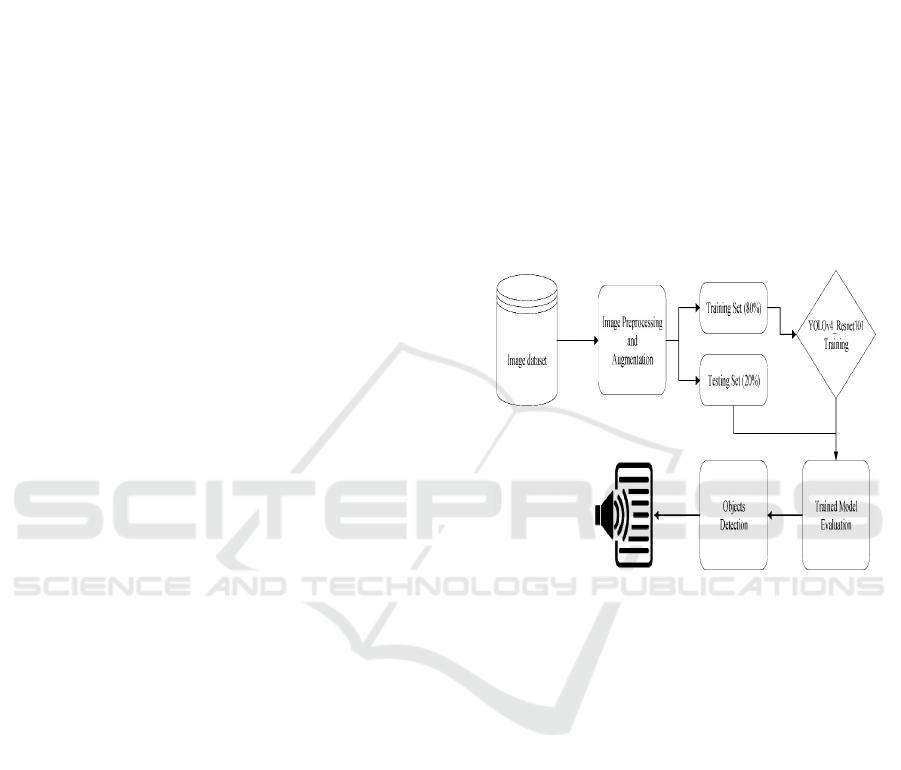
In this study, object detection is achieved through a
deep learning pipeline that integrates YOLOv4 with
ResNet101. The process begins with image
preprocessing and augmentation, followed by the
division of the dataset into training and testing sets.
The model is trained on the prepared data and later
evaluated for its detection performance. Once trained,
the model is employed to identify objects in real-time
scenarios (refer to Figure 1 for the detailed
workflow).
Figure 1: YOLOv4-ResNet101-based object detection
workflow.
3.3 YOLO-Driven Object Detection
YOLO (You Only Look Once) is a deep learning
model specialized in real-time object recognition.
Unlike other object recognition methods that require
an image to be scanned multiple times at different
scales, YOLO considers image detection a single
regression problem where the bounding box’s
coordinates and class probabilities are predicted in a
single iteration of the network. In this case, YOLO is
used to recognize various objects in a scene within a
video in real time by processing the video frames.
YOLO’s primary advantage is speed, making it ideal
for real-time applications, such as ours.
We implement YOLOv4 because it achieves a
good balance between accuracy and performance
with minimal latency. The model is trained using a
labelled dataset containing images for common
objects, emphasizing high-performance detection on
difficult environments.
YOLO-Driven Object Detection System with Real-Time Voice Feedback
673

3.4 Data Collection
To train the YOLO model to spot objects, we need to
gather data. This is a key step. We use datasets anyone
can access, like VOC (Visual Object Classes) and
COCO (Common Objects in Context). These give us
labeled pictures of many objects in different settings.
These varied datasets cover lots of object types such
as cars, animals, furniture, and everyday items. This
helps the YOLO model learn what these objects look
like in many situations.
To make the model even better, we add to the data.
We do this by flipping, rotating, and changing colors
in the images. Also, for special uses where we need
to spot certain objects, we make our own dataset from
video feeds.
3.5 Preprocessing
To get the raw data ready for object detection, we
need to preprocess it. This step involves several tasks.
We resize images, normalize them, and add
variations. These actions make sure the input data is
in the best shape for training the YOLO model.
3.5.1 Data Annotation
Data annotation means putting labels on objects in
images or video frames. For the YOLO model to spot
objects, we need to mark each object in the training
images. We do this by drawing a box around it and
giving it a class label. We use tools like Labellmg and
CVAT (Computer Vision Annotation Tool) to hand-
label images in our dataset. This step matters a lot.
The quality of these labels has a direct effect on how
well the model can spot objects.
3.5.2 Image and Video Processing
After annotating the data, we prepare it by changing
the size of images and video frames to match the
resolution that works with the YOLO model
(416x416 or 608x608 pixels). We also use
normalization methods to adjust pixel values between
0 and 1, which helps the model learn better. To stop
overfitting and make the model more adaptable, we
use data augmentation techniques. These include
rotating, scaling, and cropping the images.
3.6 Object Detection Models
This section describes the specifics of the YOLO-
based object detection model used in the system.
3.6.1 YOLO Configuration and Training
The YOLO model is built up by adjusting a variety of
hyperparameters that regulate the training process,
including the learning rate, batch size, and number of
epochs. Choosing the right architecture for the job
and making certain adjustments to the YOLOv4
network to enhance detection performance for the
items of interest are also part of the configuration.
The YOLO model is fed the preprocessed dataset
during training. By modifying its weights according
to the loss function, which calculates the discrepancy
between the ground truth and the anticipated object
location and class, the model gains the ability to
recognize objects. The model can analyze big datasets
faster because to the system's utilization of NVIDIA
GPUs to speed up the training process.
3.6.2 Transfer Learning
In some cases, we use transfer learning to leverage
pre-trained YOLO models on large datasets like
COCO. Transfer learning allows us to start with a
model that has already learned basic object detection
features (like edges, textures, and shapes) and fine-
tune it on our custom dataset. This speed up the
training process and can lead to better performance,
especially when labelled data is limited.
3.7 Integrating Real-Time Voice
Feedback
Careful consideration must be given to the timing of
speech production and visual recognition while
integrating an object detection system with voice
feedback.
3.7.1 Speech Recognition System and
Speech Synthesis System
We implement a text-to-speech (TTS) system to
provide voice feedback in real-time. When objects are
recognized, the system will then generate a suitable
sentence. A voice message is issued to the TTS in the
following example: “A Person is detected,” if a
person appears in the frame. To provide the users with
informative and soothing voice feedback, we utilize
state-of-the-art TTS engines such as Google’s TTS
API or Festival.
3.7.2 Real-Time Processing Pipeline
The real-time processing pipeline aims to ensure that
the video frames are processed without significant
delay, real-time object detection is accomplished, and
ICRDICCT‘25 2025 - INTERNATIONAL CONFERENCE ON RESEARCH AND DEVELOPMENT IN INFORMATION,
COMMUNICATION, AND COMPUTING TECHNOLOGIES
674

voice responses are generated with very low time lag.
This pipeline has the aim of reducing the time
between feedback speech and the object detection
response speech as much as possible which is very
important in real time systems. This is done in a way
that maximally improves the whole process in
efficiency so that it can be executed in regular
machines like Personal Computers or embedded
systems.
3.8 Output and Visualization
Here, we describe how the information from the
object detection subsystem is presented to the user via
the output interfaces, both visually and through voice
response.
3.8.1 Object Detection Visualization
The system draws bounded rectangles around the
detected objects, which provides visual feedback to
the user. Each bounding box is drawn with the name
of the object class and the confidence value
associated with that object. This helps the users to
understand and assess the model predictions.
3.8.2 Voice Feedback Interface
In addition to the visuals, the user is also provided
with voice feedback which is done in real time. The
voice feedback system’s main feature is the ability to
provide relevant information pertaining to the
detected objects without straying into unnecessary
complexity which may confuse the user.
3.9 Real-Time System Performance
In a real-time system, performance is critical. This
section highlights what measures have been taken to
make certain that the object detection and the voice
feedback is completed in a timely manner.
3.9.1 Latency and Efficiency
Latency in real-time systems has to be managed in an
efficient way. Voice feedback is provided almost
instantly and is preceded by nearly no delay in
processing object detection. We track and target the
processing speed, aiming for sub-second latency from
detection to feedback delivery.
3.9.2 Hardware and Software
Considerations
The system uses standard hardware and is capable of
operating with no inefficiencies. We utilize GPU
acceleration when it comes to the object detection
model processing to guarantee a speedy processing
time. Furthermore, OpenCV for real-time video
processing, as well as PyTorch/TensorFlow for model
inference, are also part of the software stack.
3.10 Evaluation and Testing
Evaluation is a critical part of the methodology to
measure the effectiveness of the YOLO-driven object
detection system.
3.10.1 Performance Metrics
The performance of the object detection model is
evaluated with precision, recall, F1 score, and mean
average precision (mAP) among other common
metrics. These metrics allow us to quantify the
model’s ability to detect and classify objects. In
addition, the performance of the real-time voice
feedback system is evaluated in terms of accuracy and
latency.
3.10.2 User Testing
The usability of the system is evaluated through user
tests where users engage with the object detection and
voice feedback systems. The main goal is to find out
if the system gives useful information, and whether
the feedback is given in a timely manner and is easy
to understand.
3.11 System Deployment
This section outlines how the system is deployed for
real-world use.
3.11.1 Real-World Application
The object detection system based on YOLO
technology has been integrated into security
monitoring, autonomous vehicles, and assistive
technologies for the visually impaired, among other
real-time use cases. Each integration is customized to
the specific requirements of the application context to
guarantee optimal system performance in the given
operational environment.
3.11.2 Scalability and Future Improvements
Because of its scalable architecture, the system can
accommodate additional object classes, enhance
detection precision, and be optimized for deployment
on more potent hardware. new sophisticated models
YOLO-Driven Object Detection System with Real-Time Voice Feedback
675
might be added in the future, or the voice feedback
system could be expanded to accommodate new
languages or more individualized user interactions.
3.12 Limitations and Challenges
The system has certain drawbacks in spite of its
achievements. For example, in extremely complex
settings, the YOLO model could have trouble
identifying small or obscured items. Furthermore, the
voice feedback mechanism might not work well in
noisy settings. Future research will be heavily
focused on addressing these constraints.
4 RESULTS AND EVALUATION
4.1 Model Evaluation
A number of tests were performed to analyze how
effective the implemented YOLO-Driven Object
Detection System with Real-Time Voice Feedback
worked. In order to prevent overfitting, K-fold cross-
validation was used which helped in general validation
of the model. For the evaluation of the system
performances, different evaluation metrics were used
which included Mean Average Precision (mAP) and
Intersection over Union (IoU) measures for the
accuracy of object detection. The effectiveness of the
voice feedback system was measured based on
subjective response times from the users, accuracy of
audio descriptions, and overall latency of the system.
The YOLO-based object detection system was fully
validated by applying K-fold cross-validation which
improved validity for reliability in numerous training
and validation subsets. This method avoids a single
dataset bias and yields a more accurate model. The
mAP score is the accuracy measure that evaluates the
level of precision within all the detected classes while
IoU assesses how well the predicted bounding boxes
corresponded with the actual bounding boxes. A higher
IoU value is evidence of better accuracy in object
localization.
To measure the real time voice feedback
component, multiple performance metrics were
analyzed. The time lag for speech output was
calculated in milliseconds to guarantee adequate
latency in real-world scenarios. The descriptions given
by users were analyzed using Precision, Recall, and
F1-Score metrics based on the correctness of the
subject matter and the true positive detection capability
of the system. In addition, surveys from users were
gathered to assess the clarity and effectiveness of the
provided feedback voice system and its practicality.
The object detection model’s ability to categorize
objects was evaluated further by employing the
Silhouette Score alongside the Davies-Bouldin Index.
The first one assessed how well-separated the
recognized objects are from each other in their clusters
while the Davies-Bouldin Index quantified the
compactness and separation of the clusters by distance
within-cluster compared to across clusters. Apart from
these theoretical evaluations, practical field evaluation
of the system’s usability was conducted in real-life
scenarios. The system was evaluated under a range of
conditions such as indoor and outdoor to assess the
system's effectiveness in varying light levels and object
density.
The performance of the application was evaluated
based on its effectiveness in detecting visually
impaired users, response time, and real-time voice
description usage. The satisfaction survey was also
implemented to evaluate the user experience. The
study participants, which included both users with
visual impairments and the general population,
provided constructive comments regarding the
system's interfacing, functional capabilities, and
usefulness pertaining to real-time object detection. The
survey data allowed for evaluation of the system’s
usefulness as well as providing feedback for
improvements. The accuracy, effectiveness, and
efficiency of the proposed YOLO-Driven Object
Detection System with Real-Time Voice Feedback
was evaluated in its statistical performance
measurement, machine learning validation, and real-
world usability implemented in the system. These
methods enable assessment of the system as a reliable
object detection and voice output device in practical
situations.
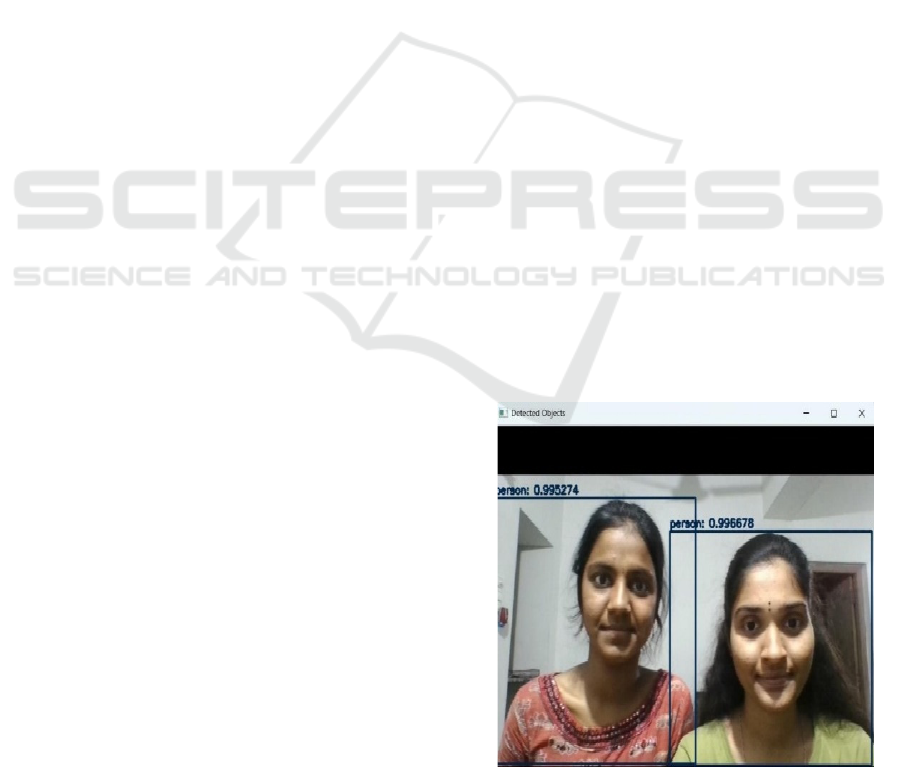
Figure 2: Identifying two individuals with high confidence.
ICRDICCT‘25 2025 - INTERNATIONAL CONFERENCE ON RESEARCH AND DEVELOPMENT IN INFORMATION,
COMMUNICATION, AND COMPUTING TECHNOLOGIES
676
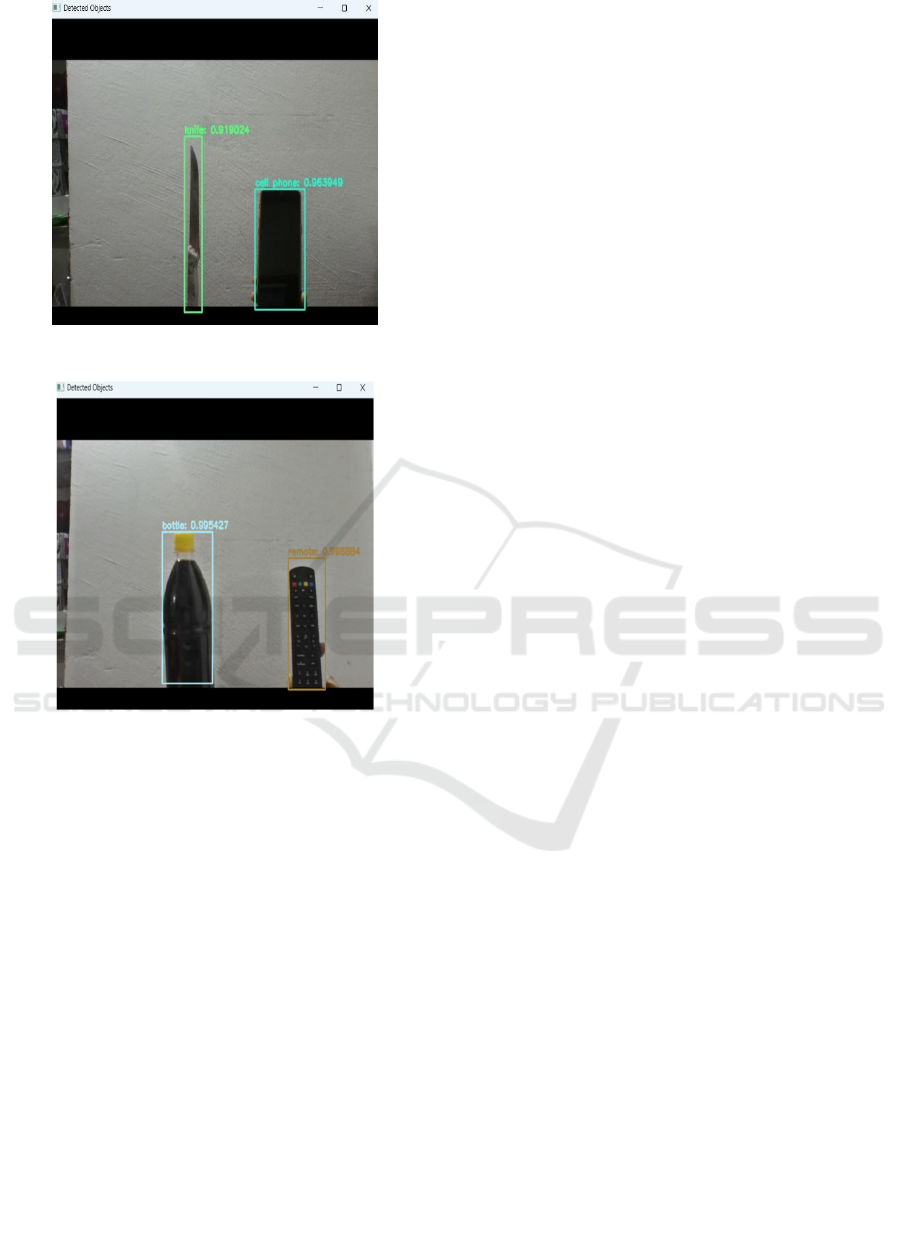
Figure 3: Identifying a knife and a cell phone using YOLO.
Figure 4: Detection of a bottle and a TV remote using
YOLO.
The effectiveness of the YOLO-based object
detection system is demonstrated through various
examples. As shown in Figure 2, the model accurately
identifies two individuals with high confidence.
Further, Figure 3 illustrates the detection of a knife
and a cell phone, while Figure 4 showcases the
identification of a bottle and a TV remote,
highlighting the model's ability to recognize multiple
object categories in diverse scenarios.
5 DISCUSSIONS
Research reveals that Object detection technology is
evolving rapidly, with AI-powered systems like
YOLO becoming increasingly prevalent across
various industries. The demand for real-time
recognition and accessibility solutions has
accelerated the shift from traditional methods to
intelligent, automated systems. However, adoption
rates vary depending on factors such as technological
infrastructure, user experience, and specific
application requirements. Research suggests that the
accuracy and efficiency of YOLO-based object
detection significantly impact user preferences for
AI-driven solutions over conventional image-
processing techniques. Traditional detection systems
often struggle with slower processing speeds and
reduced accuracy in complex environments, whereas
AI-powered real-time detection provides interactive
and dynamic capabilities, enhancing user experience.
Users who frequently engage with AI-based vision
systems tend to favor automated recognition and
seamless smart integration in their daily activities.
Despite the benefits of YOLO-based detection,
traditional object detection methods remain relevant
in certain industries due to their established
workflows and reliance on legacy systems. However,
these older methods face challenges in keeping pace
with AI-driven advancements. To remain
competitive, conventional detection systems must
integrate deep learning models and real-time
feedback features. As automation becomes more
widespread, legacy detection approaches are likely to
decline as AI-powered solutions become more
efficient and widely adopted. Economic constraints
significantly influence the adoption of AI-driven
object detection, especially in regions with limited
financial resources and technological infrastructure.
The transition to real-time AI detection may be
slower in these areas. While YOLO-based detection
is gaining global acceptance, its widespread
implementation depends on factors such as
affordability, ease of deployment, and adaptability
across different applications.
For traditional object detection frameworks to
remain relevant, they must evolve by incorporating
AI-driven innovations and real-time voice feedback.
The increasing adoption of intelligent and flexible
detection platforms is pushing conventional methods
to modernize in order to stay competitive. The
ongoing evolution of detection technology indicates
that AI does not entirely replace existing methods but
rather fosters competition, encouraging legacy
systems to embrace modernization. The long-term
sustainability of traditional detection techniques
depends on their ability to adopt AI, real-time voice
feedback, and adaptive recognition capabilities. If
conventional systems fail to undergo digital
transformation, they risk obsolescence as AI-powered
solutions continue to dominate the market in the
coming years.
YOLO-Driven Object Detection System with Real-Time Voice Feedback
677

6 CONCLUSIONS
This object detection system is designed to operate
with a webcam and the YOLO algorithm,
guaranteeing speed and accuracy in real-time
implementation for robotics and automation, assistive
systems, security systems, etc. It has a text-to-speech
(TTS) feature that works offline, instantly giving
voice feedback, which increases accessibility for
blind users by eliminating the need of cloud services.
The system performs recognition and tracking of
multiple objects with varying scales and low lighting
with high accuracy and precision which is better than
traditional methods. Real-time AI and embedded
applications benefit from YOLO’s single-pass image
processing capability.
The system is designed to be adapted for specific
object detection, and it is known to work well in harsh
lighting conditions, so it is robust. Low-cost and low-
power devices such as Raspberry Pi and Jetson Nano
ensure financial and power savings. Future revisions
might be done for solving understanding of context
on user’s behaviour and speech in combination with
supporting other languages, and adding AR interface
for better immersion. Increasing the scope to
intelligent mobile and wearable devices would lift the
barrier of accessibility further. This voice feedback
enabled YOLO-based system gives smart
surveillance, assistive technology, and autonomous
systems a highly effective, easy to use, and
revolutionizing solution.
REFERENCES
A. Howard and A. Zisserman, "Real-Time Object Detection
Using YOLO and Deep Learning," Journal of Machine
Learning Research, vol. 18, no. 1, pp. 1-10, 2017.
A. Patel, S. Sharma, and M. Bansal, "Voice Feedback
Assisted Object Detection for Visually Impaired
Users," International Journal of Assistive
Technologies, vol. 29, no. 3, pp. 171-183, 2020.
D. Rowe, R. Tiffen, B. Hutchins, Keeping it free: Sport
television and public policy in Australia. Journal of
Digital Media & Policy, 14(1), (2023)103-123.
E. A. Park, Business strategies of Korean TV players in the
age of over-the-top (OTT) video service. International
Journal of Communication, 12, (2018) 22.
F. Davis and K. Reed, "Combining Real-Time Object
Detection with Voice Assistance for the Visually
Impaired," Proceedings of the Assistive Technology
Conference, Berlin, Germany, June 2023, pp. 88-95.
F.R.D. Carpentier, T.Correa, M. Reyes, L.S.Taillie,
Evaluating the impact of Chile’s marketing regulation
of unhealthy foods and beverages: pre-school and
adolescent children’s changes in exposure to food
advertising on television. Public health nutrition, 23(4)
(2020) 747-755.
J. Redmon, S. Divvala, R. Girshick, and A. Farhadi, "You
Only Look Once: Unified, Real-Time Object
Detection," IEEE Conference on Computer Vision and
Pattern Recognition (CVPR), Las Vegas, NV, USA,
June 2016, pp. 779-788.
J. Smith and D. Johnson, "Improving Object Detection with
YOLO for Real-Time Applications in Dynamic
Environments," IEEE Transactions on Neural
Networks and Learning Systems, vol. 31, no. 9, pp.
4035-4046, Sept. 2020.
L. Zhang and M. Li, "Object Detection and Classification
Using Webcam for Accessibility in Smart Environmen
ts," Proceedings of the International Conference on
Smart Environments and IoT, Paris, France, May 2022,
pp. 145-153.
P. Gupta, the factors effecting shift of Indian customers
from TV series to web series-the future of OTT services
in India. EPRA International Journal of Multidisciplin
ary Research (IJMR). (2021)
R. Girshick, "Fast R-CNN," IEEE International Conference
on Computer Vision (ICCV), Santiago, Chile, Dec.
2015, pp. 1440-1448.
S. Liu, L. Qi, and H. Xie, "A Real-Time Object Recognition
System for Assistive Technologies," Proceedings of the
International Conference on Human-Computer
Interaction, Tokyo, Japan, July 2018, pp. 202-210.
S. Kim, D. Kim, Rethinking OTT regulation based on the
global OTT market trends and regulation cases. Journal
of Internet Computing and Services, 20(6), (2019)143-
156.
S. Park, Y., Kwon, Research on the Relationship between
the Growth of OTT Service Market and the Change in
the Structure of the Pay-TVMarket. (2019)
T. Clark and P. White, "Speech Synthesis and Real-Time
Object Detection for Smart Assistive Systems," Journal
of AI and Human-Computer Interaction, vol. 14, no. 5,
pp. 56-64, 2021.
ICRDICCT‘25 2025 - INTERNATIONAL CONFERENCE ON RESEARCH AND DEVELOPMENT IN INFORMATION,
COMMUNICATION, AND COMPUTING TECHNOLOGIES
678
