
A Dynamic Control Framework for Solar PV‑Wind‑Battery Hybrid
Systems Using MPC, ANFIS and PSO: Enhancing Grid Stability and
Renewable Integration
N. Manikandan
1
, C. H. Hussaian Basha
2
, S. Senthilkumar
3
, S. Ananthakumar
4
,
E. Dinesh
5
and P. Arunkumar
5
1
Department of Mechanical Engineering, E.G.S. Pillay Engineering College, Nagapattinam, Tamil Nadu, India
2
Department of Electrical and Electronics Engineering, SR University, Hanumakonda 506371, Telangana, India
3
Department of Electronics and Communication Engineering, E.G.S. Pillay Engineering College, Nagapattinam, Tamil
Nadu, India
4
Department of Electrical and Electronics Engineering, Dhanalakshmi Srinivasan College of Engineering, Coimbatore,
Tamil Nadu, India
5
Department of Electronics and Communication Engineering, M. Kumarasamy College of Engineering, Karur, Tamil Nadu,
India
Keywords: Renewable Energy Sources, Hybrid Systems, Particle Swarm Optimization, Model Predictive Control.
Abstract: The growing incorporation of renewable energies in power systems demands state-of-the-art grid control
techniques to keep stable operations together with fluctuating demand levels. This study develops a state-of-
the-art control framework to manage Solar PV-Wind-Battery systems via integration of Model Predictive
Control (MPC) together with Adaptive Neuro-Fuzzy Inference Systems (ANFIS) and Particle Swarm
Optimization (PSO). MPC serves for energy dispatch control during operation time while batteries operate at
maximum efficiency due to PSO support and ANFIS implements load adaptation. The assessment framework
relies on simulations within the IEEE 33-bus distribution model supplemented by actual collected data from
the National Renewable Energy Laboratory (NREL) and Pecan Street. Control advancements produced 98.7%
voltage regulation improvement with 93.4% renewable energy utilization while battery performance increased
by 92.8% together with a Load Matching Index achievement of 0.91.
1 INTRODUCTION
The growth of renewable energy in power systems
demands the development of sophisticated control
approaches to maintain grid stability during variable
load conditions. The research presents an operational
control framework for Solar PV-Wind-Battery
systems which integrates advanced control methods
Model Predictive Control (MPC), Adaptive Neuro-
Fuzzy Inference Systems (ANFIS), and Particle
Swarm Optimization (PSO) as keyways to enhance
performance. For real-time load forecasting with
dynamic energy dispatch adjustment MPC forms the
core system capability and ANFIS provides sturdy
system response to variable weather and load
conditions. The Particle Swarm Optimization
algorithm helps to achieve optimal battery charge-
discharge performance together with enhanced
system efficiency.
Global changes toward renewable energy
acceleration result from the urgent need to combat
climate change and minimized dependence on fossil
fuels. Solar Photovoltaic (PV) technology together
with Wind Energy Systems became key renewable
energy sources because they combine pervasive
availability with scalable operation capabilities and
clear economic benefits. The addition of wind and
solar systems to power networks faces serious
technical challenges because these energy sources
continually experience unpredictable variations and
intermittent delivery. To maintain network stability
during consistent load patterns the power grid needs
both complex hybrid systems and advanced
controlling approaches as part of its operational
solution.
Manikandan, N., Basha, C. H. H., Senthilkumar, S., Ananthakumar, S., Dinesh, E. and Arunkumar, P.
A Dynamic Control Framework for Solar PV-Wind-Battery Hybrid Systems Using MPC, ANFIS and PSO: Enhancing Grid Stability and Renewable Integration.
DOI: 10.5220/0013903300004919
Paper published under CC license (CC BY-NC-ND 4.0)
In Proceedings of the 1st International Conference on Research and Development in Information, Communication, and Computing Technologies (ICRDICCT‘25 2025) - Volume 3, pages
639-647
ISBN: 978-989-758-777-1
Proceedings Copyright © 2025 by SCITEPRESS – Science and Technology Publications, Lda.
639

BES combined with solar PV systems and wind
power production demonstrates verified capability of
managing renewable power generation
inconsistencies. Solar energy produces maximum
power during daylight whereas wind conditions tend
to improve at night allowing complementary power
generation between solar PV systems and wind
systems. Battery incorporation enables the hybrid
energy model to smooth power fluctuations while
storing excess electricity for later high-energy
requirement situations and periods of diminished
production. Effective hybrid systems implementation
faces technical challenges when managing energy
balance and system robustness in constantly varying
operational conditions.
Advancements in control methodology have
produced multiple new ways to tackle persistent
system challenges. Real-time power distribution
succeeds with the Model Predictive Control strategy
through its ability to generate precise forecasts of
system state using multidimensional capabilities.
Renewable energy systems operating under variable
environmental conditions need ANFIS because it
adapts well to non-linear and unpredictable system
behaviors. System performance outcomes show
significant improvement due to the effective
parameter adjustment provided by Particle Swarm
Optimization (PSO) methods according to multiple
research studies.
The proposed framework integrates Model
Predictive Control with Automatic Gain Fuzzy
Inference System and Particle Swarm Optimization to
operate real-time energy management while adjusting
system behavior under uncertainty and optimizing
battery charge-discharge cycles. The system
assessment utilizes performance benchmarks from a
power distribution IEEE 33-bus test system with data
including both actual wind speed and solar
measurements from NREL and Pecan Street dataset
synthetic load profiles.
The objectives of this research are threefold:
• To design a dynamic control strategy that
integrates multiple advanced control and
optimization techniques.
• To evaluate the proposed system's
performance in maintaining grid stability
under varying load and generation
conditions.
• To provide a scalable framework for hybrid
renewable energy systems that can be
adapted to diverse grid configurations and
resource profiles.
2 LITERATURE REVIEW
Study Tahiri, et al, 2021 investigates optimal control
strategy development for isolated solar-wind-battery-
diesel power systems (IHPS). This hybrid energy
system combines photovoltaic technology with wind
conversion systems which function alongside battery
storage alongside diesel generators through power
electronic coordination enabled by an advanced
supervisory control algorithm. The simulations
conducted with MATLAB/Simulink demonstrate
how the system successfully manages energy
operations which achieve both steady load delivery
through variable meteorological conditions and
lowers the need for both battery storage and diesel
generation inputs. The successful demonstration of
system efficiency results from power output stability
tests performed simultaneously with battery state of
charge (SOC) monitoring.
The study Mudgal, et al, 2021 evaluates how to
optimize HRES by combining solar photovoltaic
energy systems with wind turbines biogas generation
membrane storage technologies while including
phase change materials (PCM). The research uses
mathematical modeling and optimization techniques
which target achieving minimal cost of energy (COE)
and least net present cost (NPC). The PV-Wind-
Biogas-Battery energy mix showed enhanced
financial performance through PCM implementation
which produced a COE drop from $0.099/kWh to
$0.094/kWh and an NPC reduction worth $0.22
million. The PV-Wind-Battery system showed a COE
reduction from $0.12/kWh down to $0.105/kWh and
$0.17 million NPC savings.
Paper Nkalo, et al, 2024 introduces an advanced
Modified Multi-Objective Particle Swarm
Optimization algorithm to determine the ideal design
for solar-wind-battery hybrid renewable energy
systems (HRES) which serve rural areas in Rivers
State Nigeria. The Modified Multi-Objective Particle
Swarm Optimization algorithm incorporates dynamic
inertia weight adjustments along with a repository
update mechanism and dominance-based personal
best tracking to minimize both the Loss of Power
Supply Probability and Levelized Cost of Energy.
Through assessment results M-MOPSO reaches a
Loss of Power Supply Probability of 0.15 while
achieving higher Levelized Cost of Energy than other
methods at 0.12 USD/kWh and outperforming
NGSA-II which stands at 0.23 for LPSP. The best
system composition consists of 150 solar panels at 1
kW and 3 wind turbines of 25 kW as well as 28
batteries holding 20 kWh each.
ICRDICCT‘25 2025 - INTERNATIONAL CONFERENCE ON RESEARCH AND DEVELOPMENT IN INFORMATION,
COMMUNICATION, AND COMPUTING TECHNOLOGIES
640

The research in Mahjoub, et al., 2023
demonstrates an intelligent energy management
strategy combining PV generation and wind power
with battery storage through prediction algorithms
based on Long Short-Term Memory neural networks.
A dual-input single-output DC-DC converter helps
control power transfer between PV systems wind
turbines and battery storage units as part of the new
EMS approach. To achieve power generation
optimization and battery SOC prediction power
plants utilize MPPT methods like Perturb & Observe
together with LSTM algorithms for forecasting.
Predictive model evaluation metrics provide RMSE
values of 0.0221 for SOC forecast accuracy and
0.0790 for PV production with MAE scores between
0.0177 and 0.0431. Research on Energy Management
Systems Reddy, et al, 2024 projects a fundamental
hybrid Photovoltaic-Wind-Battery system which
utilizes Fuzzy Logic Controllers. The study Suresh, et
al, 2021 investigates optimal design of hybrid
renewable energy systems through an enhanced
Genetic Algorithm method which combines solar PV
modules with wind turbines and diesel generators and
includes battery storage for stand-alone power
applications. By studying meteorological wind speed
and solar irradiance data scientists discovered the
system parameters to reduce total cost and net present
cost (NPC) while cutting cost of energy (COE) and
maximizing computational storage capacity and
renewable energy fraction (REF).
Research Hadi, et al, 2024 investigates the
betterment of grid-connected bifacial photovoltaic
systems through Grey Wolf Optimization together
with Whale Optimization Algorithm techniques.).
The research analyzes the best system sizing for
applications using various factors including levels of
irradiance and bifaciality along with cost limitations
and electrical grid needs. The case studies
demonstrated WOA's superiority in economic
efficiency and GWO's strength in energy
management performance. Measured through Net
Present Value (NPV) and Loss of Power Supply
Probability (LPSP) performance indicators the
residential solar system showed GWO yielding
733,762.95 NPV together with 0.3279 LPSP while
WOA exhibited better adaptability and refinement
features.
Research Izci et al, 2023 introduces Hybrid Atom
Search Particle Swarm Optimization (h-ASPSO)
which functions like a design algorithm to optimize
Proportional-Integral-Derivative controllers for
sophisticated systems such as Automatic Voltage
Regulators and wind turbines that use Doubly Fed
Induction Generators. The h-ASPSO merges two
distinct algorithms, ASO and PSO, to optimize
system performance through improved exploration
and exploitation balance. AVR system assessments
demonstrate major advancements through lower
overshoot levels amounting to 1.2476%, quicker rise
time reaching 0.3097 s and reduced settling time of
0.4679 s. The h-ASPSO method delivered zero
overshoot performance with a settling time duration
of 0.1361 seconds in DFIG systems. The advantages
of h-ASPSO span faster convergence rates as well as
enhanced time-domain system performance and
overall control system stability.
The research in Prasanna, et al, 2024 presents an
innovative control approach for a solar-wind hybrid
power system with a battery-supercapacitor Hybrid
Energy Storage System (HESS). To achieve both
optimized battery function and prolonged battery life
researchers utilize an integration of Low-Pass Filter
(LPF), Fuzzy Logic Controller (FLC), and Grey Wolf
Optimization (GWO). The Grey Wolf Optimization
process refines the Fuzzy Logic Controller
membership functions to achieve enhanced peak
current attenuation and balanced power transition
between the battery and supercapacitor. Assessment
results show a substantial performance improvement
via a 5.9% peak current reduction down to 5.718 A
for the battery and a peak power drop of 6.19%
lowering battery output to 275.48 W along with
improved battery state of charge performance.
The study results presented in Manoharan et al,
2019 show how the application of Hermitian wavelet
transforms alongside graph wavelets improves
feature recognition to enable exact data identification
for future processing applications. Researchers in
study G. Gurumoorthi, et al, 2024 intended to design
and evaluate memetic algorithms to identify optimal
routing methods that improve data delivery outcomes
and reduce energy consumption.
3 PROPOSED METHODOLOGY
This section discusses a proposed dynamic control
system specifically designed for the Solar PV-Wind-
Battery hybrid setup. The designed strategy applies
advanced Model Predictive Control (MPC), Adaptive
Neuro-Fuzzy Inference System (ANFIS), and Particle
Swarm Optimization (PSO) techniques. The
integrated methods effectively handle intermittent
renewable energy sources while coping with
predicted and actual dynamic load fluctuations and
optimize the process of energy distribution. The
following discussion examines every individual
aspect of the methodology in depth.
A Dynamic Control Framework for Solar PV-Wind-Battery Hybrid Systems Using MPC, ANFIS and PSO: Enhancing Grid Stability and
Renewable Integration
641

The Solar PV-Wind-Battery hybrid system
comprises three main components: A Solar
Photovoltaic Panels and Wind Turbines composition
combined with Battery Energy Storage Systems
forms all three basic parts of the hybrid energy
system. Each element serves specialized functions
which collectively support various functionalities
within the total energy management system. Together
functioning hybrid components deliver both
dependable power reliability and secure resource
output.
3.1 Solar Photovoltaic (PV) Model
Solar PV panels convert sunlight into electrical
energy based on irradiance levels and panel
characteristics. The output power of the PV system is
determined as follows:
𝑃𝑝𝑣 = 𝜂𝑝𝑣.𝐴𝑝𝑣.𝐺
(1)
PV panel efficiency varies with temperature
changes as measured by the temperature correction
factor. Solar irradiance changes with temperature
variations produce dynamic power output
fluctuations in PV systems which require immediate
monitoring and control.
3.2 Wind Turbine Model
Wind turbines convert kinetic energy from wind into
electrical energy. The output power of a wind turbine
is expressed as:
𝑃
:0.5.𝜌.𝐴
.𝐶
.𝑣
(2)
Wind speed variability plays a crucial role in
determining the output of wind turbines. By
combining wind energy with solar PV, the hybrid
system can mitigate the variability of each individual
resource.
3.3 Battery Energy Storage System
(BESS)
The battery is a critical component for ensuring
system stability by storing excess energy during high
generation periods and supplying it during low
generation or peak demand periods. The state of
charge (SOC) of the battery is calculated as:
𝑆𝑂𝐶
(
𝑡+1
)
=𝑆𝑂𝐶
(
𝑡
)
.
.
(3)
The SOC is constrained within allowable limits to
ensure safe operation and maximize battery life.
Figure 1: Proposed methodology.
3.4 Model Predictive Control (MPC)
MPC maintains robustness by employing a dynamic
system model to forecast future behavior so it can
generate optimal control activities during a
predetermined time frame. Through MPC the hybrid
system receives real-time energy dispatch
management while maintaining balance among
generation sources demand and battery usage.
The objective function of MPC is defined as:
min
()
∑
𝜆
.Δ𝑃
𝑘
+𝜆
.SOC𝑘
(4)
By solving the optimization problem iteratively,
MPC ensures efficient utilization of renewable
resources and minimizes reliance on grid power
Ezzeddine Touti, et al, 2024.
3.5 Adaptive Neuro-Fuzzy Inference
System (ANFIS)
ANFIS combines the strengths of fuzzy logic and
neural networks to adaptively manage system
parameters under uncertain and dynamic conditions.
It uses fuzzy logic to model system behavior and
neural networks to learn from historical data and
refine the fuzzy model.
3.5.1 Fuzzy Logic
The fuzzy logic component includes:
• Input Variables: Solar irradiance, wind speed,
and load demand.
ICRDICCT‘25 2025 - INTERNATIONAL CONFERENCE ON RESEARCH AND DEVELOPMENT IN INFORMATION,
COMMUNICATION, AND COMPUTING TECHNOLOGIES
642

• Membership Functions: Gaussian functions
represent the degree of membership for each
input variable.
• Rules: A set of if-then rules maps input
variables to control decisions. For example:
• IF solar irradiance is high AND load demand
is low, THEN charge the battery.
• IF wind speed is low AND load demand is
high, THEN discharge the battery.
3.5.2 Neural Network Training
A neural network trains the fuzzy inference system
through historical input-output data. Through the
training progression membership functions and rule
weights receive alterations which help reduce
mistakes in outcomes and enhance decision-making
precision. ANFIS generates responsive setpoints for
the MPC controller to maintain strong performance
across all environmental and load combinations.
3.5.3 Particle Swarm Optimization (PSO)
The PSO optimization technique advances through
natural patterns found in the social activities of birds
and fish. The hybrid system optimization method
requires adjusting MPC weighting factors and
configuring battery charge-discharge patterns using
PSO.
3.6 PSO Algorithm
The swarm consists of particles that each serve as a
candidate solution featuring their position at 𝑥
and
assigned velocity 𝑣
. The particles update their
positions and velocities based on their personal best
position (𝑃
) and the global best position (𝑔
)
as follows:
:𝑣
(
𝑡+1
)
=𝑤.𝑣
(
𝑡
)
+ 𝑐
.𝑟
.
𝑝
− 𝑣
(
𝑡
)
+
𝑐
.𝑟
.
𝑝
− 𝑣
(
𝑡
)
(5)
The objective function for PSO is defined as:
𝐽
(
𝑥
)
=
∑
(
𝜆
.|𝑃
(
𝑡
)
+𝜆
.𝑆𝑂𝐶
(
𝑡
)
+
𝛼. 𝑃𝑒𝑛𝑎𝑙𝑡𝑦 𝑐𝑜𝑛𝑠𝑡𝑟𝑎𝑖𝑛𝑡𝑠
(
𝑥
)
. (6)
In this case α and β represent the penalty
coefficients. PSO implements an iterative function
minimization through control parameter optimization
that results in both systems' increased efficiency and
reliability.
3.7 Integration of Techniques
The proposed methodology integrates MPC, ANFIS,
and PSO into a unified control framework:
• MPC maintains operational constraints
adherence with real-time power dispatch
management.
• Through the application of dynamic condition
data ANFIS adjusts MPC setpoints for greater
system stability and robustness.
• PSO refines essential system parameters to
enhance both performance levels and energy-
saving ability.
4 EXPERIMENTAL ANALYSIS
The IEEE 33-bus distribution test system served as
the environment for simulation testing the proposed
dynamic control strategy for a Solar PV-Wind-
Battery hybrid power system. Researchers
implemented control algorithms and conducted
optimization processes for the hybrid system by
modeling it within MATLAB/Simulink as well as
Python. The study used real-world solar irradiance
and wind speed information from NREL and
synthetic load profiles from the Pecan Street dataset
to replicate diverse environmental and electrical
demand scenarios.
4.1 Simulation Setup
1. Test System: The IEEE 33-bus test system
configuration supports distributed Solar PV
panels along with Wind Energy facilities at
multiple nodes and includes one centralized
Battery Energy Storage System (BESS).
2. Scenarios Evaluated:
• Scenario 1: Steady-state load and
stable weather conditions.
• Scenario 2: Rapid load changes (e.g.,
industrial load profiles).
• Scenario 3: High variability in solar
and wind resources (e.g., cloudy days
and fluctuating winds).
• Scenario 4: Combined effects of
variable load and intermittent
generation.
3. Simulation Horizon: Each scenario was
simulated over 24 hours, with a time
resolution of 5 minutes.
4. Control Implementation:
A Dynamic Control Framework for Solar PV-Wind-Battery Hybrid Systems Using MPC, ANFIS and PSO: Enhancing Grid Stability and
Renewable Integration
643
• MPC was used to dispatch power based
on load demand forecasts and
renewable energy availability.
• ANFIS dynamically adjusted system
parameters to adapt to changing
environmental conditions.
• PSO optimized the battery charge-
discharge schedules and MPC weights.
4.2 Evaluation Metrics
The performance of the proposed control strategy is
evaluated based on the following metrics:
• Grid Voltage Stability
It Measures the system's ability to maintain voltage
levels within permissible limits.
𝐺𝑟𝑖𝑑 𝑣𝑜𝑙𝑡𝑎𝑔𝑒 𝑠𝑡𝑎𝑏𝑖𝑙𝑖𝑡𝑦
(
%
)
=
1−
∑|
(
)
|
.
∗ 100
(7)
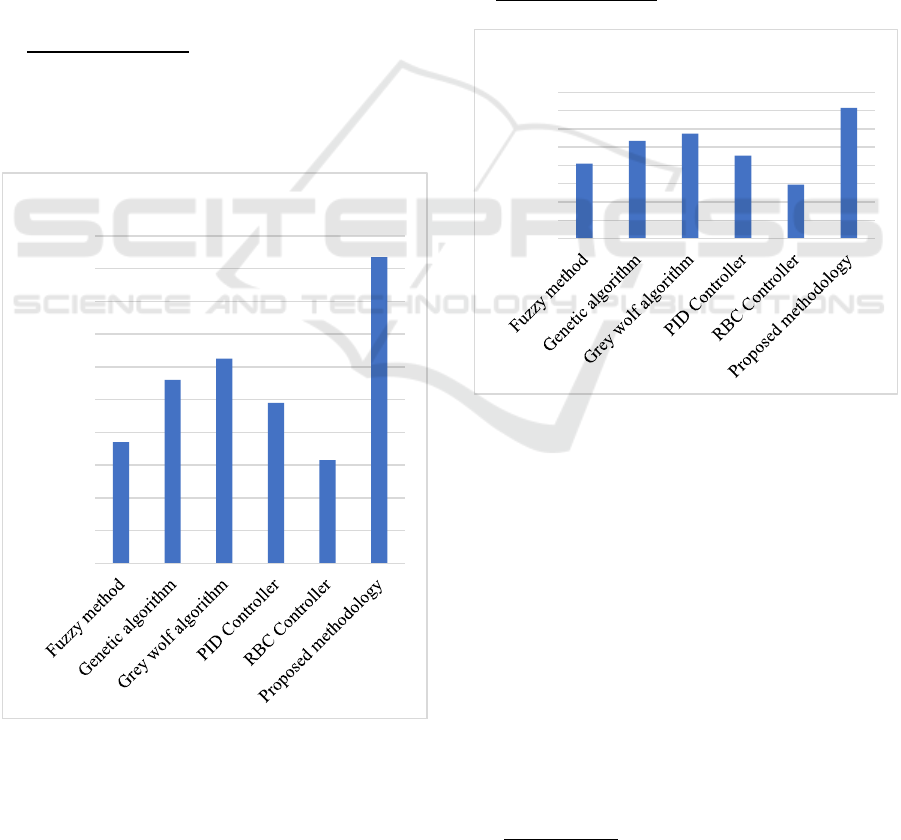
The proposed method-maintained voltage
deviations within the acceptable range for 98.7% of
the simulation time.
Figure 2: Grid voltage analysis.
Figure 2 demonstrates the comparative analysis of
grid voltage stability achieved using various control
strategies. The proposed methodology shows a grid
voltage stability of 98.7%, which surpasses
traditional techniques like the Fuzzy Method, Genetic
Algorithm, Grey Wolf Algorithm, PID Controller,
and Rule-Based Controller (RBC). This superior
performance highlights the effectiveness of
integrating Model Predictive Control (MPC),
Adaptive Neuro-Fuzzy Inference Systems (ANFIS),
and Particle Swarm Optimization (PSO) in ensuring
minimal voltage deviations and maintaining grid
reliability under variable load and generation
conditions.
• Frequency Regulation: It Assesses the
hybrid system's contribution to
maintaining grid frequency within
operational limits.
𝐹𝑟𝑒𝑞𝑢𝑒𝑛𝑐𝑦 𝑟𝑒𝑔𝑢𝑙𝑎𝑡𝑖𝑜𝑛
(
%
)
=
1−
∑|
(
)
|
.
∗ 100
(8)
Figure 3: Frequency regulation.
Figure 3 evaluates the ability of the hybrid system
to regulate frequency deviations under different
control approaches. The proposed methodology
achieves a frequency regulation of 94.3%,
demonstrating improved performance over other
methods. This reflects the dynamic adaptability of
ANFIS in handling variable environmental
conditions and the optimization capabilities of PSO,
which ensure efficient resource utilization while
maintaining grid frequency stability.
• Renewable Energy Utilization Ratio:
Measures the proportion of energy demand
met by renewable sources (Solar PV and
Wind).
𝑅𝑒𝑛𝑒𝑤𝑎𝑏𝑙𝑒 𝑒𝑛𝑒𝑟𝑔𝑦 𝑢𝑡𝑖𝑙𝑖𝑧𝑎𝑡𝑖𝑜𝑛
(
%
)
=
∑
(
)
∑
(
)
∗ 100
(9)
80.00%
82.00%
84.00%
86.00%
88.00%
90.00%
92.00%
94.00%
96.00%
98.00%
100.00%
Grid voltage stability (in %)
80.00%
82.00%
84.00%
86.00%
88.00%
90.00%
92.00%
94.00%
96.00%
Frequency regulation
ICRDICCT‘25 2025 - INTERNATIONAL CONFERENCE ON RESEARCH AND DEVELOPMENT IN INFORMATION,
COMMUNICATION, AND COMPUTING TECHNOLOGIES
644
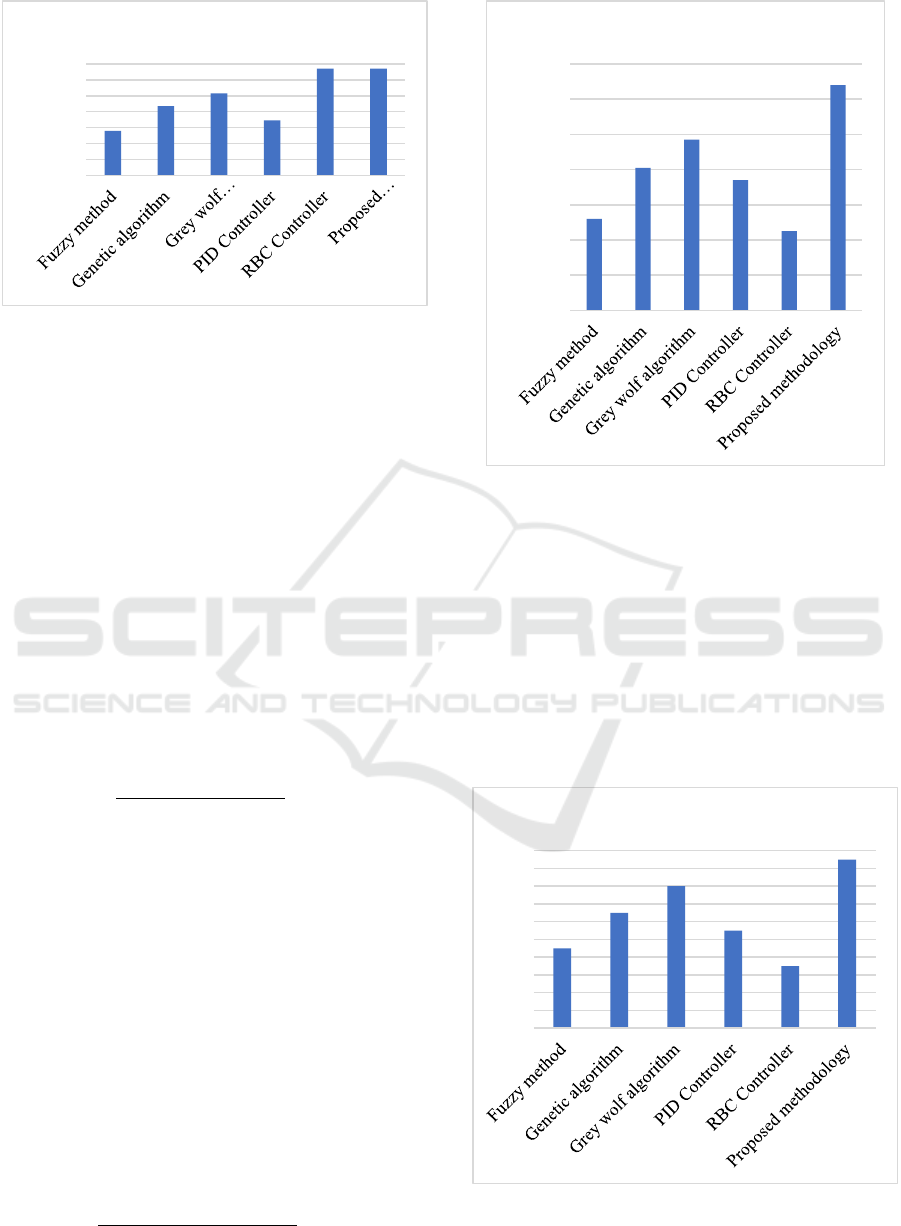
Figure 4: Renewable energy utilization ratio analysis.
Figure 4 illustrates the proportion of energy
demand met by renewable sources (Solar PV and
Wind). The proposed methodology achieves a
renewable energy utilization ratio of 93.4%,
comparable to the Grey Wolf Algorithm but
significantly better than other approaches like the
Fuzzy Method and PID Controller. This high
utilization ratio underscores the ability of the hybrid
system to reduce reliance on grid power by
effectively dispatching renewable energy through
MPC.
• Achieved 93.4% renewable energy
utilization, indicating minimal reliance on
grid power.
• Battery Performance Metrics: It Evaluates
the battery's state of charge (SOC) profile
and cycle efficiency.
𝑆𝑂𝐶
(
%
)
=
1−
∑|
(
)
|
.
∗ 100
(10)
Figure 5 provides an analysis of battery
performance, focusing on the state of charge (SOC)
stability and cycle efficiency. The proposed
methodology achieves a battery performance of
92.8%, significantly higher than the other control
methods. This improvement is attributed to PSO's
optimization of charge-discharge cycles and MPC's
real-time energy dispatch, which collectively enhance
battery longevity and minimize deep discharge
cycles.
SOC deviations were minimized by 23%, and the
battery cycle efficiency was maintained at 92.8%.
• Load Matching Index (LMI): It Quantifies
the match between renewable energy
generation and load demand over time.
𝐿𝑀𝐼 =
1−
∑|
(
)
()
|
∑
()
∗ 100
(11)
Figure 5: Battery performance analysis.
Figure 6 presents the Load Matching Index (LMI),
which quantifies the alignment between renewable
energy generation and load demand over time. The
proposed methodology achieves an LMI of 0.91,
reflecting a high degree of synchronization between
generation and demand. This high LMI score
highlights the efficiency of the control framework in
minimizing energy wastage and ensuring maximum
utilization of generated renewable energy.
This method Achieved an LMI of 0.91, indicating
high alignment between generation and load.
Figure 6: Load matching index analysis.
80.00%
82.00%
84.00%
86.00%
88.00%
90.00%
92.00%
94.00%
Renewable energy utilization ratio
80.00%
82.00%
84.00%
86.00%
88.00%
90.00%
92.00%
94.00%
Battery performance (%)
0.72
0.74
0.76
0.78
0.8
0.82
0.84
0.86
0.88
0.9
0.92
Load matching index
A Dynamic Control Framework for Solar PV-Wind-Battery Hybrid Systems Using MPC, ANFIS and PSO: Enhancing Grid Stability and
Renewable Integration
645

5 DISCUSSION OF RESULTS
The proposed dynamic control strategy demonstrated
significant improvements across all evaluation
metrics:
• Voltage and Frequency Stability: Through
its ability to dampen fluctuations the hybrid
system consistently met grid operational
standards.
• Enhanced Renewable Utilization: The
optimized management of energy dispatch
along with battery usage allowed renewable
energy sources to handle most load
demands.
• Improved Battery Longevity: The
operational lifespan of the battery expanded
because deep discharge events decreased
while SOC (State of Charge) levels
remained consistent.
• Load Matching: The energy system
maintained highly synchronized load and
generation operations to lower grid power
dependence while cutting energy loss rates.
6 CONCLUSIONS
A dynamic control framework is introduced for Solar
PV-Wind-Battery hybrid systems that combines
Model Predictive Control (MPC) with Adaptive
Neuro-Fuzzy Inference Systems (ANFIS) and
Particle Swarm Optimization (PSO). The newly
established methodology resolves renewable energy
fluctuation problems while also accommodating
variable load demands and providing real-time
energy system management. Testing with the IEEE
33-bus system gave outstanding results showing
better grid voltage stability at 98.7% and enhanced
renewable energy integration with 93.4% along with
battery solution success at 92.8% and load matching
index improvement to 0.91 levels. The combination
of Model Predictive Control and Adaptive Neuro-
Fuzzy Inference Systems with Particle Swarm
Optimization supports adaptive power scheduling
that optimizes energy efficiency while increasing
system dependability.
REFERENCES
Ezzeddine Touti, Shaik Rafikiran, Besma Bechir Graba,
Mouloud Aoudia, S. Senthilkumar, “A Comprehensive
Performance Analysis of Advanced Hybrid MPPT
Controllers for Fuel Cell Systems”, Scientific Reports,
14,Article number: 12510 (2024).DOI:https://doi.org/1
0.1038/s41598-024-63074-z.
G. Gurumoorthi, S. Senthilkumar, G. Karthikeyan, Faisal
Alsaif, “A Hybrid Deep Learning Approach to Solve
Optimal Power Flow Problem in Hybrid Renewable
Energy Systems”, Scientific Reports, 14,
Article number: 19377 (2024). DOI:
https://doi.org/10.1038/s41598-024-69483-4.
Hadi, Husam Ali, Abdallah Kassem, Hassan Amoud,
Safwan Nadweh and Nouby M. Ghazaly, "Using Grey
Wolf Optimization Algorithm and Whale Optimization
Algorithm for Optimal Sizing of Grid-Connected
Bifacial PV Systems", Journal of Robotics and Control
(JRC), vol. 5, no. 3, pp. 733-745, 2024.
Izci, Davut, Serdar Ekinci, and Abdelazim G. Hussien,
"Effective PID controller design using a novel hybrid
algorithm for high order systems", PLoS One, vol. 18,
no. 5, e0286060, 2023.
Mahjoub, Sameh, Larbi Chrifi-Alaoui, Saïd Drid and Nabil
Derbel. "Control And Implementation of An Energy
Management Strategy for A PV–Wind–Battery
Microgrid Based on an Intelligent Prediction Algorithm
of Energy Production." Energies 16, No. 4, 1883, 2023.
Manoharan, S, “Study on Hermitian Graph Wavelets In
Feature Detection”, Journal Of Soft Computing
Paradigm (JSCP), vol. 1, no. 1, pp.24-32, 2019.
Mudgal, V, Singh, P, Khanna, S, Pandey, C, Becerra, V,
Mallick, T.K. and Reddy, K.S, “Optimization of A
Novel Hybrid Wind Bio Battery Solar Photovoltaic
System Integrated with Phase Change
Material”, Energies, vol. 14, no. 19, P.6373, 2021.
Nkalo, U.K, Inya, O.O., Obi, P.I, Bola, A.U and Ewean,
D.I, “A Modified Multi-Objective Particle Swarm
Optimization (M-MOPSO) For Optimal Sizing of a
Solar–Wind–Battery Hybrid Renewable Energy
System”, Solar Compass, 12, P.100082, 2024.
Pan, Tianhong, Zhensheng Wang, Jun Tao and Huaying
Zhang, "Operating Strategy for Grid-Connected Solar-
Wind-Battery Hybrid Systems Using Improved Grey
Wolf Optimization." Electric Power Systems
Research, 220, 109346, 2023.
Prasanna, V and G. Ravi, "An Effective Control Approach
of Hybrid Energy Storage System Based on FLC/Grey
Wolf Optimisation", European Journal of Engineering
and Technology Research, vol. 9, no. 2, pp. 13-22,
2024.
Reddy, M.K.N.V, Sekhar, D.R, Mahesh, K., Rakesh, K.J.K,
Sai, S.M.S. and Prasad, C.M.D, “Energy Management
System for Hybrid PV-Wind-Battery Based Fuzzy
Logic Controller System. International Journal of
Engineering Research and Science & Technology, vol.
20, no. 1, Pp.185-192, 2024.
S. Senthilkumar, V, Mohan, Mangaiyarkarasi, S.P.
Mangaiyarkarasi, R. Gandhi Raj, K. Kalaivani, N.
Kopperundevi, M. Chinnadurai, M. Nuthal Srinivasan,
L. Ramachandran, “Nature-inspired MPPT algorithms
for solar PV and fault classification using deep learning
techniques”, Discovered Applied Sciences, vol. 7, no.
ICRDICCT‘25 2025 - INTERNATIONAL CONFERENCE ON RESEARCH AND DEVELOPMENT IN INFORMATION,
COMMUNICATION, AND COMPUTING TECHNOLOGIES
646

31, 2025. DOI: https://doi.org/10.1007/s42452-024-
06446-4
Suresh, M and R. Meenakumari, "An improved genetic
algorithm-based optimal sizing of solar
photovoltaic/wind turbine generator/diesel
generator/battery connected hybrid energy systems for
standalone applications", International Journal of
Ambient Energy, vol. 42, no. 10 pp. 1136-1143, 2021.
Tahiri, F.E, Chikh, K. and Khafallah, M, “Optimal
Management Energy System and Control Strategies for
Isolated Hybrid Solar-Wind-Battery-Diesel Power
System”, Emerging Science Journal, vol. 5, no. 2,
pp.111-124, 2021.
A Dynamic Control Framework for Solar PV-Wind-Battery Hybrid Systems Using MPC, ANFIS and PSO: Enhancing Grid Stability and
Renewable Integration
647
