Enhancing the Data Security in Healthcare System
Teki Saikrishna, Kallam Thanuja, Devarapalli Tejaswi and Krovvidi Prudhvi Nagaraju
Department of Advanced Computer Science and Engineering, Vignan's Foundation for Science, Technology & Research
(Deemed to be University), Vadlamudi, Guntur (Dt)‑522213, Andhra Pradesh, India
Keywords: Appointment Scheduling, Billing Management, Medical Record Updates, Notification System, Security
Measures: HL7, SQL Injection Attack (SQLi), AES Encryption Technique, XSS Attack, Password Hashing.
Abstract: Hospital Management System (HMS) using MERN stack (MongoDBExpress. js, React, Node. js) to help
hospitals operate more efficiently while safeguarding sensitive patient information. Sensitive information like
patient records are secured via encryption and decryption with AES methods. The admins have it under control
regarding the staff accounts. The receptionist can only register patients and encrypted information is securely
saved in MySQL. When a doctor needs to consult or treat the patient, the decrypted patient information will
be available for him/her.
1 INTRODUCTION
The healthcare sector is increasingly adopting digital
solutions to streamline operations and enhance
patient care. An effective Hospital Management
System (HMS) is essential for enabling hospitals to
carry out daily functions such as patient registration,
managing medical records, making appointments,
managing billing, and much more! Yet, as the industry
shifts deeper into digital systems, safeguarding
sensitive health records has become increasingly
critical. Sensitive information including patient
records, personal identification information, and
billing details must be protected from unauthorized
users, hacking, and data exfiltration. Protecting this
information is critical for maintaining trust and
ensuring adequate medical care. Classic hospital
management systems focus on functionality and
operational efficiency but generally lack protection
against sophisticated cyber threats. Security
vulnerabilities like SQL Injection (SQLi) (Zhang H
et., al. 2018) (D. A. Kindy and A. K. Pathan, 2011)
and Cross-Site Scripting (XSS) (M. I. P. Salas and E.
Martins, 2014). Can put the privacy and integrity of
sensitive medical data at risk. HMS (Hospital
Management System) to MERN stack (MongoDB,
Express. js, React, Node. js) for its scalability while
adding modern security layers to secure sensitive
health data. System uses AES encryption and
decryption to ensure the data is protected and the
patient data is not disclosed. Moreover, by integrating
a Cyber Attack Detection (MCAD) module, the
system becomes capable of recognizing and
neutralizing sophisticated document-based attacks,
such as SQL (Zhang H et., al. 2018) and NoSQL
injections, XSS, and command injections, leading to
a more resilient cybersecurity approach.
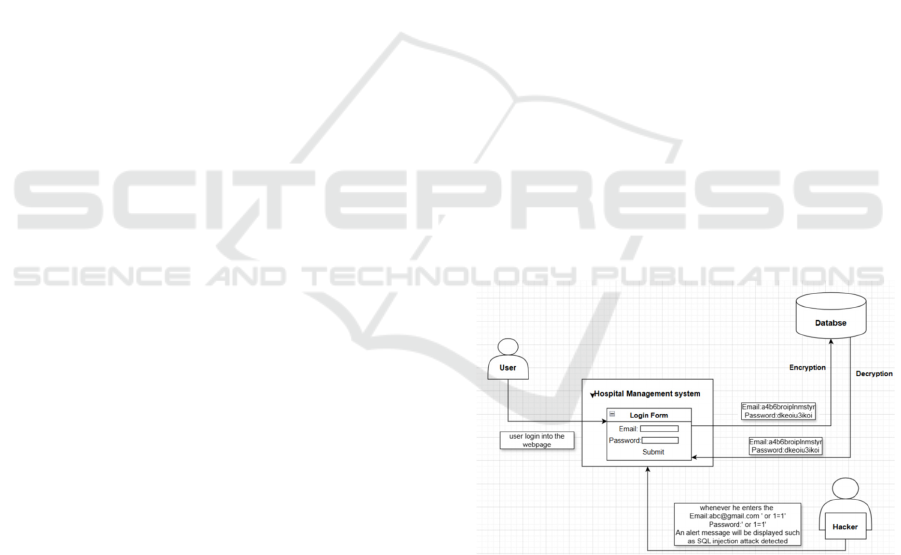
Figure 1
shows the block diagram of SQL injection attack.
Figure 1: Block diagram of SQL injection attack.
It also follows HL7 international standards
(2021) (2021) to provide interoperability between
heterogeneous Healthcare systems. Moreover, a DoS
attack detection module has been incorporated to
prevent potential service disruption by malicious
users. This project aims at creating a hospital
management system as well as research into a strong
security framework around it to meet the pathogenic
Cybersecurity threats encountered in the healthcare
Saikrishna, T., Thanuja, K., Tejaswi, D. and Nagaraju, K. P.
Enhancing the Data Security in Healthcare System.
DOI: 10.5220/0013902800004919
Paper published under CC license (CC BY-NC-ND 4.0)
In Proceedings of the 1st International Conference on Research and Development in Information, Communication, and Computing Technologies (ICRDICCT‘25 2025) - Volume 3, pages
609-617
ISBN: 978-989-758-777-1
Proceedings Copyright © 2025 by SCITEPRESS – Science and Technology Publications, Lda.
609

domain. Such a system may help protect patient data,
maintain privacy and create a safe atmosphere for the
working of the hospital. In the healthcare industry,
one of the challenges is operating the hospital while
keeping the patient data secure and private. Current
systems often have difficulty integrating hospital
functions, such as staff management, patient
registration, appointment, and billing, and applying
these healthcare standards (e.g., HL7 (2021)) to
them. In addition, there are fears of unauthorized
access to sensitive patient data and attacks with DoS
vulnerabilities. This common occurrence results in
inefficiencies, data breaches and interruptions in
service delivery. The following project is a hospital
management system using the MERN stack that will
manage hospital operations in a simplified manner.
You will use Hassan, M., Saeed, M. (2021). AES
encryption and password hashing to secure sensitive
data to keep the integrity and confidentiality. Data
processing of patient data from managing medical
records to billing will also be incorporated into the
system to achieve a secure patient management
system (HIMSS) (2022). It will also support
interoperable data transfer with other healthcare
systems via encrypted HL7 data exchanges (2021). In
addition, this system will include a detection module
for DoS attacks, which is essential to prevent service
disruptions, providing enhanced security and
scalability and reliability.
2 LITERATURE SURVEY
In the literature review, previous studies and research
on the hospital management system, data security in
healthcare, cyber-attacks, and technologies to
improve protection of healthcare systems will be
explored. This review aims to identify the existing
gaps and limitations of current systems and explain
how this research is adding value to existing
evidence.
Exasperation in healthcare management system:
History and Evolution of Hospital Management
Systems Hospital management systems have been
widely adopted throughout healthcare for digital
transformation. Sharma et al. (2018), HMS has
simplified many aspects of the hospital to improve
operations including patient records, appointment
scheduling and billing management. These systems
indeed help streamline operations, but Patel and Patel
(2019) states that they do not enforce strong security
practices, leaving hospital data open to cyber raids.
The majority of existing HMS solutions depend on
simple practices encryption and networks cut off; few
incorporate extended solution layers which create
automated, real-time attack detection systems or
security intrusion prevention measures. Zhang et al.
(2017) claimed that hospitals SQL Injection, XSS,
and DoS attacks are the most common attacks
targeting healthcare systems as a whole due to the
vulnerabilities present within the software associated
with hospital management. Consequently, these
vulnerabilities leave a void in protecting patient data
and this research aims to fill in that void. HL7 (2021)
Security and communication networks: In healthcare,
securing patient data is not merely a technical
necessity; it’s a core duty. Medical records contain
particularly sensitive information, so ensuring that
they are secure is paramount. Cheng et al. (2020)
studied various encryption methods to secure
electronic health records (EHRs), finding that AES
encryption is one of the most preferred and suitable
standards. While a number of healthcare systems that
use encryption, there’s often little emphasis on end-
to-end security, especially when data transfers
between various systems and providers. Bambang et
al. (2018) that emphasized the necessity of encrypting
data at rest and in transit, but few studies have tried to
address the specific challenges of providing access to
data across distributed healthcare systems in which
multiple actors require access. This research intends
to fill that void by embedding the AES encryption
algorithm within the MERN stack architecture to
ensure that patient data stays secure at every point in
transit, exchange, and access amid healthcare
domains.
3 METHODOLOGY
The methodology of this research is centered towards
the implementation of a Hospital Management
System (HMS) that offers increased efficiency in
hospital operation management along with improved
security for sensitive healthcare data. In this section
we present the research design: the methods and
techniques used in the development/evaluation of the
system and the proposed model/algorithm for
cybersecurity detection and encryption/system
architecture.
System Design and Development.
The Hospital Management System (HMS)
development using the MERN stack (MongoDB,
Express. js, React, Node. js) and MySQL for storing
data. The system has a set of functionalities, which
include: Appointment booking Patient management
ICRDICCT‘25 2025 - INTERNATIONAL CONFERENCE ON RESEARCH AND DEVELOPMENT IN INFORMATION,
COMMUNICATION, AND COMPUTING TECHNOLOGIES
610
medical records notifications the development is being
done following the agile development methodology,
so we can always continuously test it and obtain
feedback. The main elements of the system are:
• Frontend: Built with React. js, offering a
dynamic and responsive interface for
administrators, doctors, receptionists and
patients.
• Backend: Express Built backend using
express. js and Node. js, managing API
requests, role-based access, encryption and
communication with the database.
• Database: Patient records are stored
securely using MySQL, and data is
encrypted with AES encryption.
• Cybersecurity Validation through
Simulations to validate the security features
of the system, simulations, and experiments
are conducted to assess how the system
performs under different threat scenarios.
• These include: SQL Injection, XSS attack
simulations evaluating the system’s ability
to detect and block SQL Injection and Cross-
Site Scripting (XSS) attacks using adaptive
machine learning models. The
implementation methodology adopts a
systematic approach:
• MERN Stack: The MERN stack is a full-
stack JavaScript framework designed for
building interactive web applications. It
comprises four core technologies:
MongoDB, Express, ReactJS, and NodeJS.
• MongoDB: Manages the storage and
retrieval of unstructured patient data within
a NoSQL database. Express.js– Handles API
and middleware for backend frameworks.
• React.js: Used for user interface
development in dynamic websites. Node.js–
Server-side processing is done via this
JavaScript runtime environment.
• Security Technologies: These include
protecting the patient’s sensitive information
from any unauthorized access to maintain
the confidentiality, Integrity, and
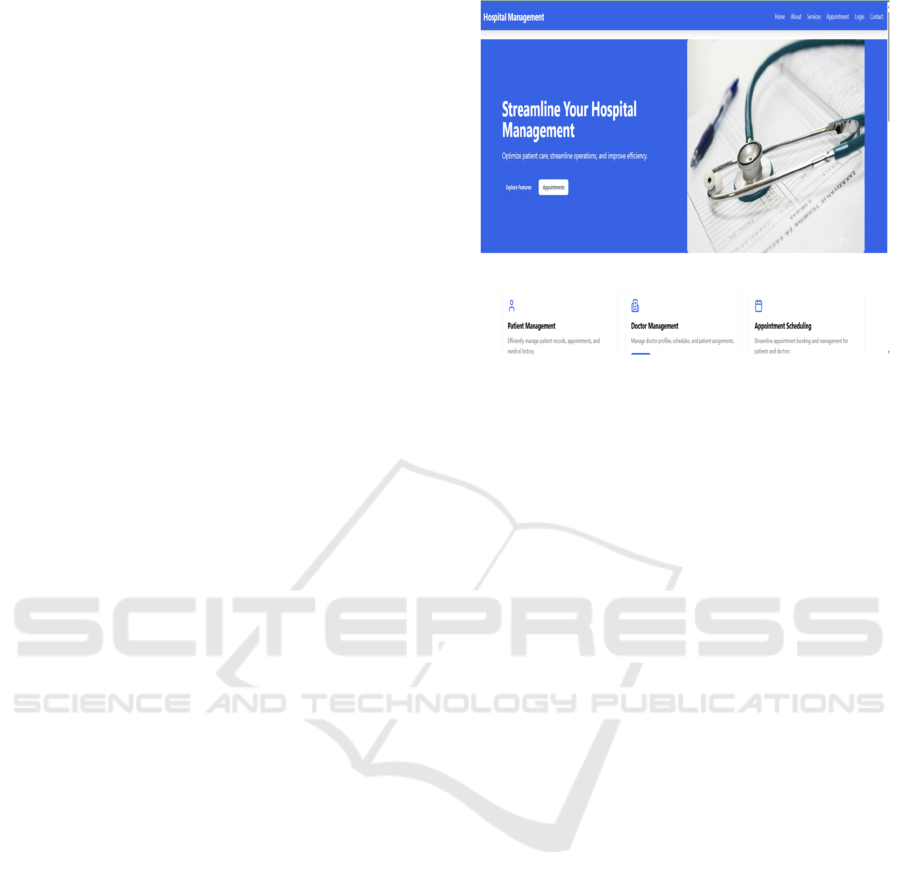
Availability of the data. Figure 2 shows the
Home Page of hospital management system.
• AES Encryption: It is a strong encryption
algorithm that safeguards the sensitive data
of patients during storage and retrieval.
• AES Encryption: It is a strong encryption
algorithm that safeguards the sensitive data
of patients during storage and retrieval.
Figure 2: Home page of hospital management system.
• JWT (JSON Web Token): For secure
authentication a role-based access control
(RBAC).
• Bcrypt.js: Enables the hashing of
passwords for safer storage.
• HL7 (Health Level Seven): It is a new
standard that is similar to the GDPR and
HIPAA. The HL7 (Health Level Seven)
standard mainly focuses on protecting
healthcare data when the data is exchanged
between the web application and the
database.
• Cybersecurity Threat Detection:
Detecting Cyber threats such as SQL
Injection, XSS, NoSQL Injection, and DoS
attacks is essential for maintaining the
security of web applications. One common
attack method involves hackers inputting
malicious SQL commands like‘’ or 1=1’ ’—
into a login form. If successful, this can
grant them unauthorized access to sensitive
data or even control over the system.
4 RESULTS AND DISCUSSIONS
To safeguard against such attacks, our system
continuously monitors for any suspicious inputs. If
someone tries to enter a potentially harmful command
in the login field, an alert is immediately triggered,
preventing unauthorized access. This proactive
security measure helps protect sensitive information
and ensures that the system remains safe for
legitimate users.
Enhancing the Data Security in Healthcare System
611
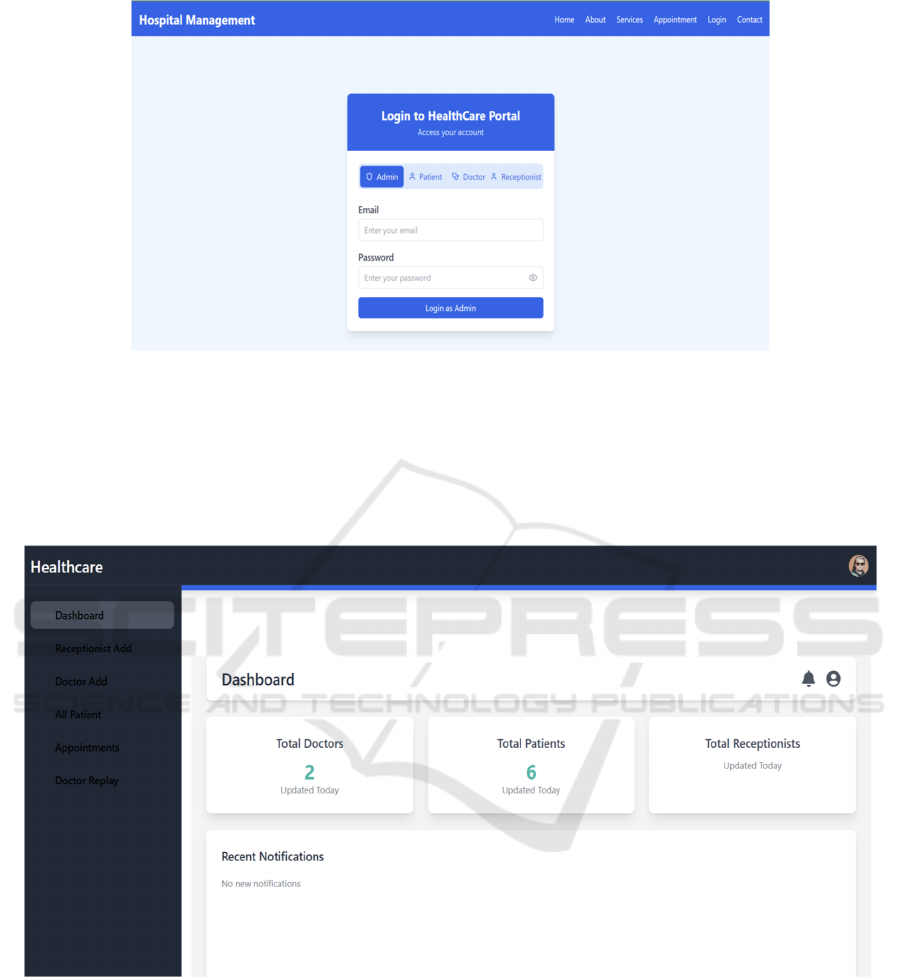
Figure 3: Login page.
The image in figure 3 shows the login page of our
Hospital Management System. It includes separate
login forms for different users, such as administrators,
doctors, patients, and receptionists, ensuring that each
person can securely access their respective
information.
1. ADMIN: Figure 4 represents the dashboard of an
admin page, where the admin has access to add
the doctors belonging to different departments and
receptionists and he can also check who all the
available patients present in the hospital are.
Figure 4: Admin dashboard.
In Figure 5, the admin is going to enter all the
information related to the receptionist, and he can
view all the receptionists present in the hospital along
with their details, such as first name, last name,
contact number, and date of birth. The admin can also
edit the information related to a particular
receptionist, and he can delete the receptionist from
the list once they resign from their job.
Figure 6
shows the page for Form for adding Doctors.
ICRDICCT‘25 2025 - INTERNATIONAL CONFERENCE ON RESEARCH AND DEVELOPMENT IN INFORMATION,
COMMUNICATION, AND COMPUTING TECHNOLOGIES
612
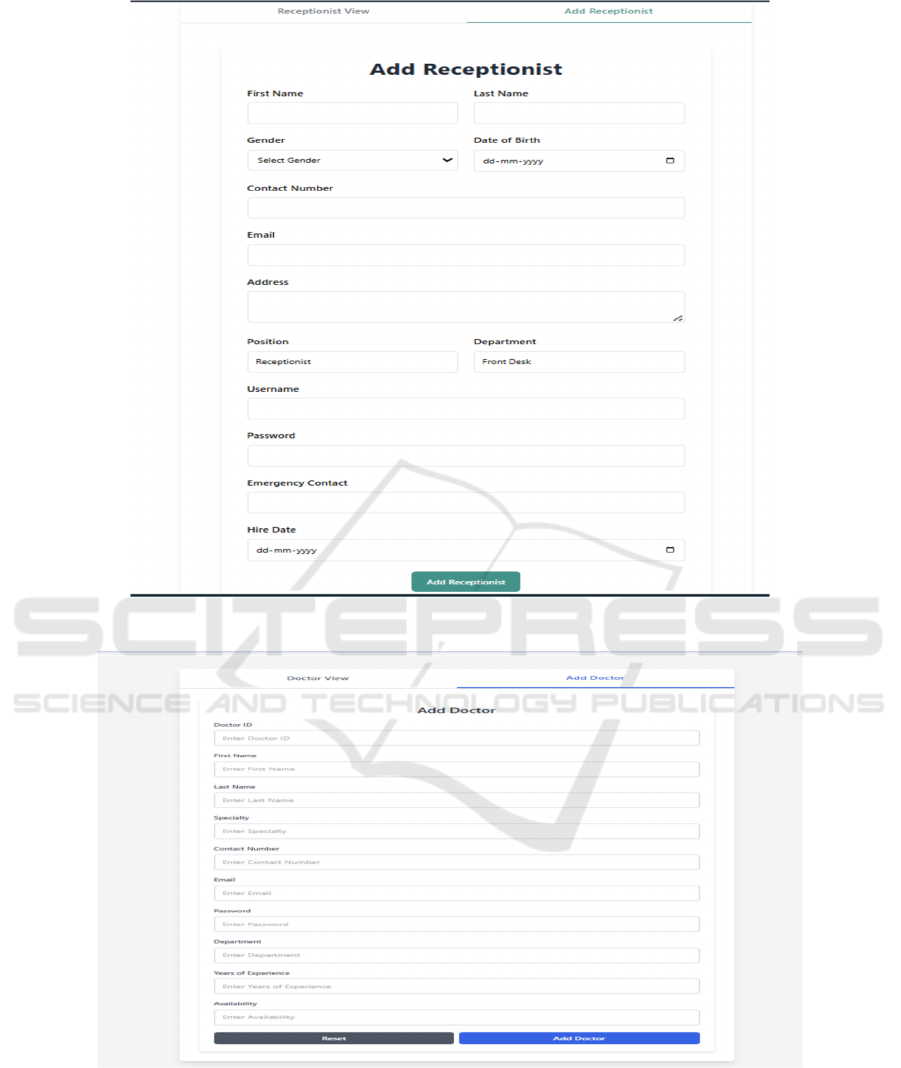
Figure 5: Form for adding receptionist.
Figure 6: Form for adding doctors.
2. DOCTOR: The figure 7 represents the login page
for the doctor. Whenever the doctor logs in with
their respective email and password, the
dashboard will be displayed, consisting of their
personal information such as name, email,
specialization, years of experience, contact
number, and availability i.e.,whether he/she is
available 24/7 or not.
Enhancing the Data Security in Healthcare System
613
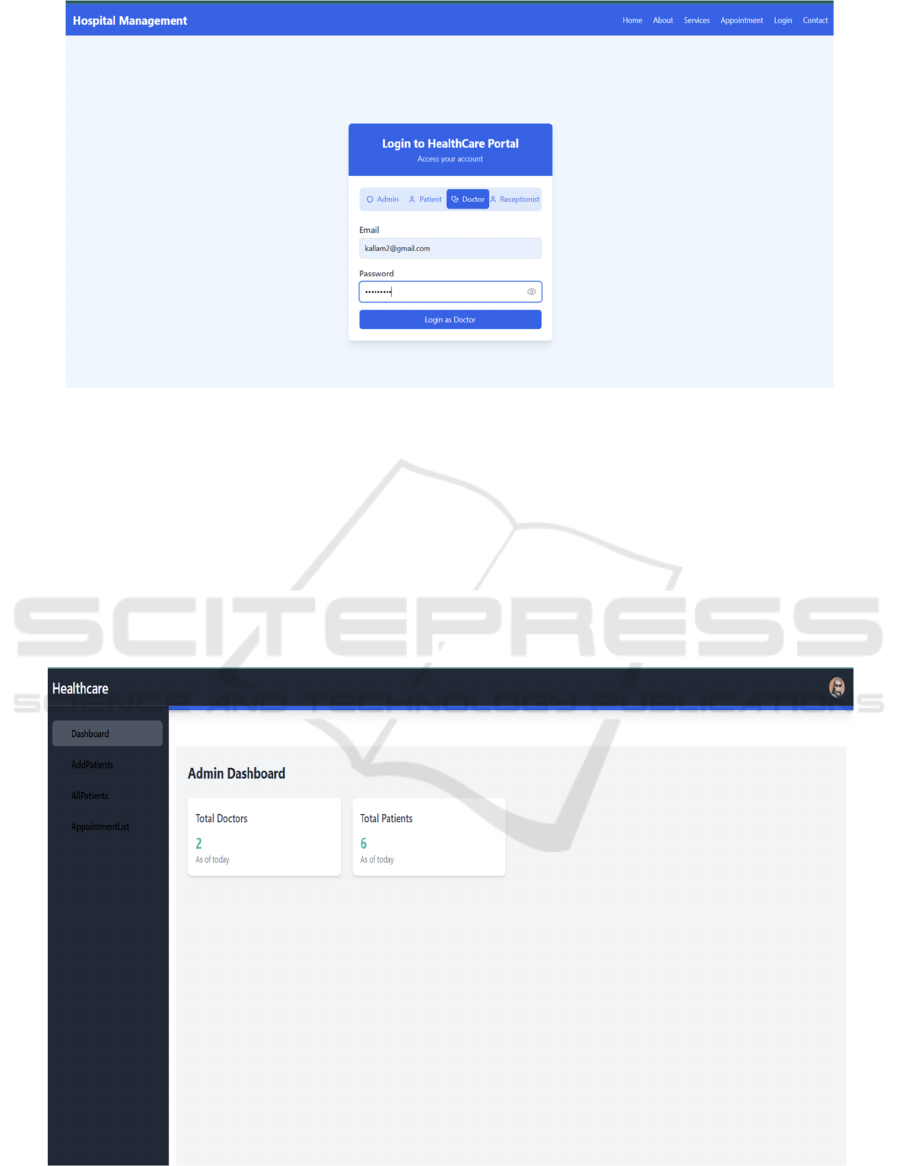
Figure 7: Doctor login page.
In their particular dashboard he can also see who
are the patients assigned to him and he can also give
the prescriptions for the patients who have been under
his consideration and the patients who have booked
an appointment.
3. PATIENT: Whenever a patient logs in with their
particular email he/she will be redirected to
another web page which consists of his/her
personal information such as patient ID, email,
symptoms, health condition, assigned doctor, etc.
The patient can also see the reply given by the
doctor about his/her condition.
4. RECEPTIONIST: Receptionist has access to add
new patients and can view the list of available
patients in the hospital (figure 8).
Figure 8: Receptionist dashboard.
ICRDICCT‘25 2025 - INTERNATIONAL CONFERENCE ON RESEARCH AND DEVELOPMENT IN INFORMATION,
COMMUNICATION, AND COMPUTING TECHNOLOGIES
614
5 ATTACKS PERFORMED ON
HOSPITAL MANAGEMENT
SYSTEM
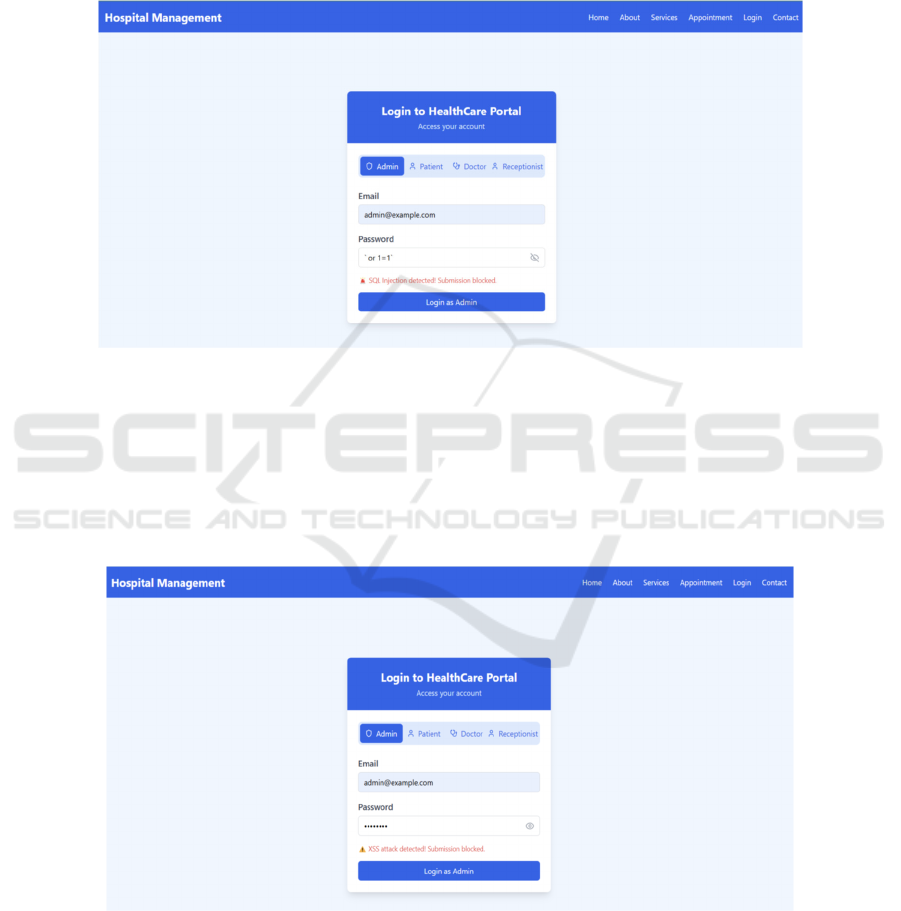
SQL INJECTION ATTACK: SQL Injection is a
widespread security vulnerability in web applications
that occurs when attackers insert harmful SQL code
into input fields. This can enable them to access
confidential data, modify database records, or even
gain control over the system. Understanding and
mitigating SQL Injection is one of the corner stones
of web application security in protecting user data
(figure 9).
Figure 9: Prevention of SQL injection attack.
XSS ATTACK: A Reflected Cross-Site Scripting
vulnerability in canonical link tag occurs when an
attacker trick a user into clicking on a URL parameter
with a manipulated value that contains malicious
code. When a user clicks that URL, their browser
unknowingly executes the malicious code which can
result in major security problems. Such an attack is
capable of endangering user data and even changing
the content of a website. It underscores the need for
strong security measures to detect and block such
threats (figure 10).
Figure 10: Prevention of XSS attack.
When the attacker attempts to input any XSS header,
such as the tag, an alert message will display and the
attacker will not be able to log in to the web page.
Otherwise, every time the attacker attempts to
change the URL of the web page, it outputs the result
shown in Figure 11, indicating that ‘404 - Page Not
Found’.
Enhancing the Data Security in Healthcare System
615
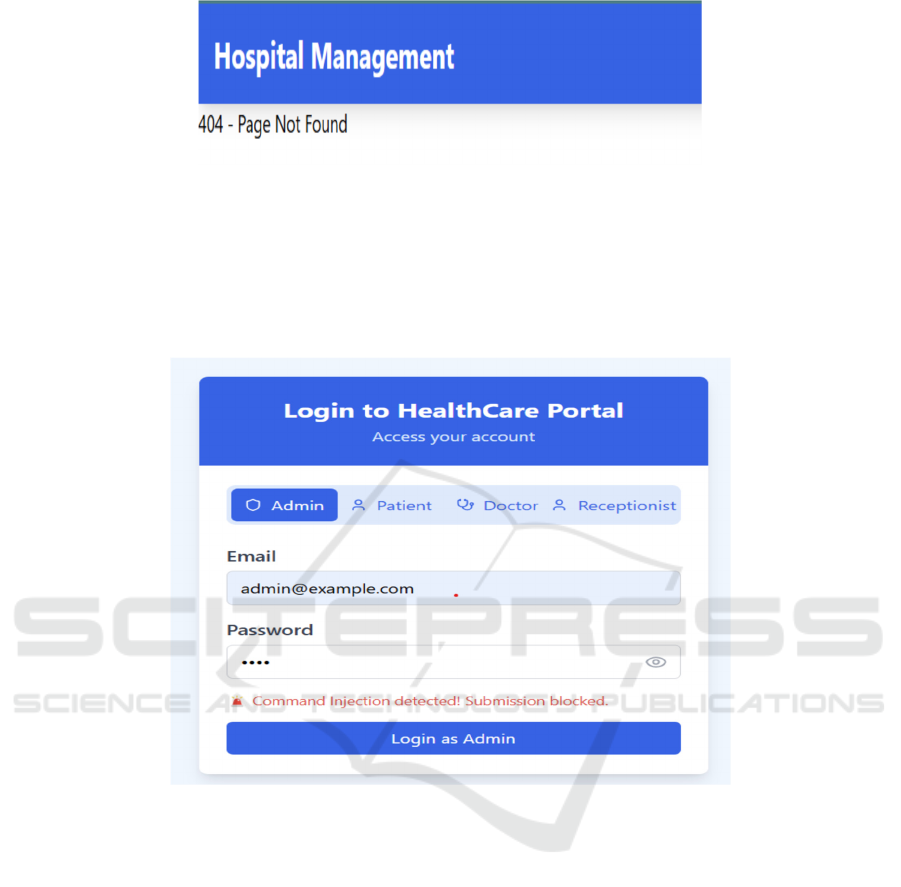
Figure 11: Prevention of XSS attack.
COMMAND INJECTION ATACK: When hackers
make a web, app execute undesirable operating
system commands that is what we call a command
injection attack. The attacker may leverage the
vulnerabilities found within the application to inject
and execute harmful commands. This can result in
data breaches, manipulation of the web application,
or other security threats, hence it is important to
secure your applications against such attacks (figure
12).
Figure 12: Prevention of command injection attack.
6 CONCLUSIONS
The paper contributes to an efficient and effective
Hospital Management System (HMS) based on
MERN stack through eliminating the various issues
on data security in the health care system. Our
research emphasises the need to have Solid Security
measures in place that can keep sensitive patient
information from unauthorised access and a host of
cyber threats. The introduction of encryption using a
method such as AES, as well as enhanced
cybersecurity implementations with attack detection
methods like SQL injection (SQLi) detection and
Cross-Site Scripting (XSS) detection, helps to
improve the security of medical records substantially.
Therefore, the existence of these helps ensure the
confidentiality and integrity of patient data, and the
overall safety of patient information in the medical
environment. This confirms that by integrating these
security protocols, the overall efficiency of hospitals
is improved while remaining compliant in ensuring
the confidentiality and integrity of patient data. Our
system supports secure data sharing between different
healthcare systems, following HL7 standards to meet
compliance requirements & ensuring interoperability.
Nonetheless, we acknowledge that there are hurdles
to overcome in terms of ongoing staff training and
system updates, especially with the rapidly changing
landscape of cyber threats. It will be significant for
future research to design adaptive security measures
robust against prospective attacks that can respond to
new threats in real-time. In summary, securing your
hospital management system records is fundamental
ICRDICCT‘25 2025 - INTERNATIONAL CONFERENCE ON RESEARCH AND DEVELOPMENT IN INFORMATION,
COMMUNICATION, AND COMPUTING TECHNOLOGIES
616

to ensure patient trust and providing quality services.
With the ongoing digital transformation across the
healthcare landscape, it is essential that every link in
the chain places a high priority on data security and
plan out a world where patient data is respected and
protected. This sets the stage for continued research
into novel security mechanisms that can adequately
address the evolving threats present within the
healthcare domain.
REFERENCES
Ariani, M., Wulandari, R. (2021). “Improving Security in
Healthcare Information Systems: A Case Study of Data
Breaches and Mitigation Strategies.” Procedia
Computer Science, 179, 110- 118. doi:10.1016/j.procs
.2021.01.016
Cybersecurity Challenges in Hospital Management
Systems: Vulnerabilities and the Need for Enhanced
Protection” by Sharma et al. (2018), Patel and Patel
(2019), Zhang et al. (2017).
D. A. Kindy and A. K. Pathan,” A Survey on SQL Injection:
Vulnerabilities, Attacks, and Prevention Techniques
2011 IEEE.
Hassan, M., Saeed, M. (2021). “A Comprehensive Survey
on Cyber- Attacks in Healthcare Systems: Vulnerabili
ties, Threats, and Countermeasures.” Computers,
Materials Continua, 67(1), 533- 550.doi:10.32604/cmc
.2021.014298
Hassan, M., Saeed, M. (2021). “A Comprehensive Survey
on Cyber- Attacks in Healthcare Systems: Vulnerabilit
ies, Threats, and Countermeasures.” Computers,
Materials Continua, 67(1), 533- 550. doi:10.32604/cm
c.2021.014298
Health Level Seven International (HL7). (2021). HL7
Standards Overview. Retrieved from https://www.hl7.
org/
Health Level Seven International (HL7). (2021). HL7
Standards Overview. Retrieved from https://www.hl7.
org/3.
Healthcare Information and Management Systems Society
(HIMSS). (2022). Cybersecurity in Healthcare:
Protecting Patient Data and Information. HIMSS
Analytics. Retrieved from https://www.himss.org/
M. I. P. Salas and E. Martins, “Security testing
methodology for vulnerabilities detection of XSS in
web services and ws-security,” Electron Notes in
Theoretical Computer Science, vol. 302, pp. 133–154,
2014
National Institute of Standards and Technology (NIST).
(2020). Cybersecurity Framework for Healthcare. NIST
Special Publication 800-53. Retrieved from
https://www.nist.gov/cybersecurity-framework
Patel, R., Shah, N. (2021). ”Machine Learning-Based
Cyber-Attack Detection in Healthcare: A Review.”
Journal of Healthcare Cybersecurity, 6(2), 112-128.
doi:10.1109/JHCS.2021.3045.
Zhang H, Zhang X. " SQL injection attack principles and
preventive techniques for PHP site,” in Proceedings of
the 2nd International Conference on Computer Science
and Application Engineering.2018;1-9.
Enhancing the Data Security in Healthcare System
617
