
Real Time Crime Detection and Face Recognition System Using CNN
P. Meenakshi Devi
1
, K. Shanmuga Priya
1
, T. Nandhini
1
, J. Gladson
2
,
K. Gowsikk Kumar
2
and R. Joshan Pravin Kumar
2
1
Department of Information Technology, K S R College of Engineering, Tiruchengode, Tamil Nadu, India
2
Department of Information Technology, K S R Institute for Engineering and Technology, Tiruchengode, Tamil Nadu, India
Keywords: Haar Cascade, YOLOv3, Face Recognition, Crime, Single Shot Detector, Precision, Calculations,
Identification.
Abstract: The point of this study is to develop an ongoing thief location and face recognition framework utilizing
Convolutional Neural Networks (CNN) to upgrade precision and speed. The exhibition of the proposed CNN-
based framework is contrasted with the YOLOv3 model concerning discovery precision and handling speed.
Materials and Methods: The investigation incorporates two get-togethers: Group 1 involves the proposed
CNN-based bad behavior identification and face verification system with 10 test samples, while Group 2 tends
to the YOLOv3-based structure with 10 test samples. The quantifiable power is set to 80%, with a significance
edge of (p<0.05) and a conviction time period. Result: The proposed crime detection system using a CNN has
greater accuracy and also faster processing in comparison to Hear Cascade and Single Shot Detector (SSD)-
based approaches. The accuracy of the CNN is around 96.5 % to 97.5 %, whereas that of the methods based
on the Haar Cascade and Single Shot Detector (SSD) achieved accuracy of between 84.3 % to 87.5 %. In
ideal lighting and frontal facial views, the highest level of accuracy has been noticed for CNN than 0.05 level
of significance for the CNN. Conclusion: According to this study, the system of real-time crime detection
with face recognition done using CNN technology performs the best as compared to traditional methods of
Haar Cascade and Single Shot Detector (SSD). The speed and accuracy are higher in this case, and therefore,
it is a reliable solution for many crime detection applications.
1 INTRODUCTION
Y. Zhang et al., 2024 Face recognition innovation is a
critical part of present day thief, observing
frameworks, coordinating artificial intelligence to
improve continuous observation and security. This
undertaking uses progressed face recognition to
identification people from live video takes care of by
coordinating facial features with a previous criminal
data set. To participate in exact and dynamic terrible
direct divulgence, the work utilizes man-made
information designs to handle video outline by outline
utilizing the Python-based face recognition module.
This technique just modernizes the whole manual
acting checking process, which is a horrendous
strategy, while making confirmation Accuracy and
reaction times significantly more clear. Research has
advanced past standard calculations for example, the
Haar Cascade Classifier, which, albeit effective in
controlled settings, had disadvantages like enormous
false positive rates and horrible showing in convoluted
establishments and shifted lighting. More refined
Convolutional Neural Networks (CNN) models have
resolved these issues, giving vigorous feature
extraction and versatility to genuine situations. M.
Rashad et al., 2024 The mix of CNNs and ongoing
facial encoding procedures, as shown in this task,
denotes a critical improvement over prior strategies by
upgrading identification speed and accuracy. P. J.
Low et al., 2025 The uses of artificial intelligence
driven thief location frameworks are expansive and
effective. A. Harish Kumar et al, 2025 Public
observation in transportation centres, public
occasions, and high-security regions benefits
extraordinarily from these advancements, where quick
ID of potential dangers can forestall crimes. N. Yalçin
et al., 2024 Moreover, such frameworks are significant
in coordinated factors and fleet management, working
on functional productivity and wellbeing by
602
Meenakshi Devi, P., Shanmuga Priya, K., Nandhini, T., Gladson, J., Gowsikk Kumar, K. and Joshan Pravin Kumar, R.
Real Time Crime Detection and Face Recognition System Using CNN.
DOI: 10.5220/0013902600004919
Paper published under CC license (CC BY-NC-ND 4.0)
In Proceedings of the 1st International Conference on Research and Development in Information, Communication, and Computing Technologies (ICRDICCT‘25 2025) - Volume 3, pages
602-608
ISBN: 978-989-758-777-1
Proceedings Copyright © 2025 by SCITEPRESS – Science and Technology Publications, Lda.

powerfully changing in accordance with arising
gambles. By coordinating constant cautions utilizing
APIs like Twilio for moment warnings, these
frameworks typify a proactive way to deal with
security, guaranteeing opportune reactions and better
asset the executives.
2 RELATED WORKS
C. H. Espino-Salinas et al., 2024 An original
methodology integrating constant facial recognition
into existing thief location frameworks has been
proposed to upgrade observation and thief
counteraction in unique conditions. M. H. Siddiqi et
al., 2024; Venkatesan et al,. 2007 This approach
coordinates face recognition Accuracy boundaries,
live video handling, and SMS ready frameworks to
further develop reaction times and by and large
framework productivity. Y. Yuan et al., 2025
Recreation results demonstrate a 95% consolidated
discovery precision and a 30% decrease in
identification reaction time contrasted with customary
observation frameworks. K. Yan et al., 2024 As
security worries in metropolitan and high-risk regions
increment, the interest for ongoing and adaptable thief
identification arrangements becomes basic. R. Luo et
al., 2024; Dharanya, C.et al, 2024 To fulfil these
needs, late examination has investigated multi-
modular frameworks coordinating face recognition,
social examination, and article location, as well as the
utilization of brain network-based models like CNNs
for further developed Accuracy. C.-B. Yao and C.-T.
Lu, 2024 Besides, a refined strategy using Haar
Cascade Classifiers joined with Single Shot Detector
(SSD) calculations has shown eminent upgrades in
face identification power, considerably under testing
conditions like unfortunate lighting or impediments,
while keeping up with low computations above. X.
Cao et al., True testing of frameworks consolidating
dynamic updates to criminal data sets and live
cautions has shown a 15% improvement accordingly
viability. J. Al-Nabulsi et al., 2023; M. Venkatesan, et
al, 2009 The issues with get-together multi-camera
arrangements, bringing down misleading benefits in
troublesome circumstances, and expanding precision
in various lighting situations continue in spite of these
new turns of events. To close these holes and assure a
proactive and reliable reaction for public security
applications, the proposed structure mixes Twilio-
pulled in prompted frameworks, CNN-based
coordinate extraction, and SQLite-stays mindful of as
far as possible.
From the previous findings, it can be deduced that
the detection accuracy and response time of the system
compared to traditional systems such as the Haar
Cascade and Single Shot Detector (SSD)-based
systems are not up to par. The system needs to reduce
latency and enhance accuracy in an effective crime
detection system. A comparative study of a CNN-
based crime detection system with respect to Haar
Cascade and Single Shot Detector (SSD)-based
approaches aimed at improving detection accuracy
and efficiency is undertaken here.
3 MATERIALS AND METHODS
Q. Jia et al., 2024 Evaluations were done inside the
Network Lab at KSR Institute for Engineering and
Technology to test the developed CNN-based system
designed for crime detection using an established
computational set. A. M. Sheneamer et al., 2024; G.
Moheshkumar et al, 2024 The source data for this
exercise was extracted from kaggle.com facial images
of recorded crime perpetrators along with detailed
crime narratives and respective meta-data that served
to mimic as closely as possible real-time conditions
for the investigation of a detected crime. The
experimental design was divided into two groups.
Group 1 used the YOLOv3 algorithm with about
2,000 images as testing input. The performance
parameters for this group included a detection speed
of 6.5 FPS and an accuracy level of 86 %. Group 2
used the proposed CNN-based system, with 2,140
images as testing input. This system had achieved a
detection rate of 0.80 – 0.90 seconds per sample and
got an accuracy of 96 %. Such improvement in terms
of speed and accuracy was noted when compared to
YOLOv3. The system had been tested running with an
Intel i7 8th Gen processor and 16 GB of RAM with
pure Python-based tools and libraries. The library of
Python utilized was face recognition for the encoding
of the facial images. Video processing was handled
with OpenCV. The crucial parameters of the
experimental setup consisted of detection accuracy,
response time. This framework was based on CNN
and presented increased reliability when subjected to
tough conditions such as low light, occlusions, and
low-resolution inputs. It thus proved to be a good
robust and dynamic solution for real-time crime
detection. The system had been tested running with an
Intel i7 8th Gen processor and 16 GB of RAM with
pure Python-based tools and libraries. The library of
Python utilized was face recognition for the encoding
of the facial images. Video processing was handled
Real Time Crime Detection and Face Recognition System Using CNN
603

with OpenCV. The crucial parameters of the
experimental setup consisted of detection accuracy,
response time. This framework was based on CNN
and presented increased reliability when subjected to
tough conditions such as low light, occlusions, and
low-resolution inputs. It thus proved to be a good
robust and dynamic solution for real-time crime
detection.
Figure 1 The CNN-based face recognition
framework utilizes the flowchart to depict a constant
thief identification structure. It catches live video
information, processes edges to identify and
investigate faces utilizing CNN, and coordinates
facial elements with a data set for identificationing
proof. Automated alerts ensure enhanced surveillance
and immediate response, providing efficient crime
monitoring.
Figure 1: The CNN-based face recognition framework.
When the system is initialized with "Start," live
video streams are continuously supplied as input.
Using Convolutional Neural Network (CNN), the
system detects facial regions in the video feed. On the
off chance that no face is recognized, the framework
gets back to catch new info. Upon fruitful
identification, CNN-based inclusion encodes novel
facial qualities for correlation. The extracted featuress
are then matched against a prior information base of
known people.
In the event that a match is found, an alarm is
produced to tell the specialists or framework clients.
In any case, the framework circles back to enter new
information. Alarms are commonly sent through
incorporated correspondence stages like APIs for
guaranteed warning. The circled structure guarantees
dynamic, continuous checking. The framework
adjusts to varieties in lighting and face directions,
keeping up with precision. The cycle closes with
"End" just while checking is ended.
4 STATISTICAL ANALYSIS
F. Makhmudov et al., 2024; N. Sengottaiyan et al,
2022 SPSS version 26 is used for statistical analysis of
data collected from parameters such as detection
accuracy (%), response time (seconds). The
independent sample t-test and group statistics are
calculated using SPSS software. Lighting conditions,
facial orientations, and background complexity are
independent variables, while detection accuracy,
response time, and false positive rate are dependent
variables.
5 RESULTS
The proposed real-time crime detection face
recognition system results, developed by CNN and
traditional methods, provide comparison of the two
techniques including Haar Cascade and Single Shot
Detector (SSD) algorithms. The detection
performance with false positive rate and response time
has been tested over a dataset, containing various
images of criminal faces and their corresponding
metadata. Table 1. Summarizes the accuracy
values,IoU,inference time for theft detection system
using YOLOv3. The system was able to reach an
accuracy of 91.50% to 94.50% using traditional
methods, Table 2 Summarizes the accuracy values,
IoU, inference time for theft detection system using
the CNN-based system approached accuracy rates
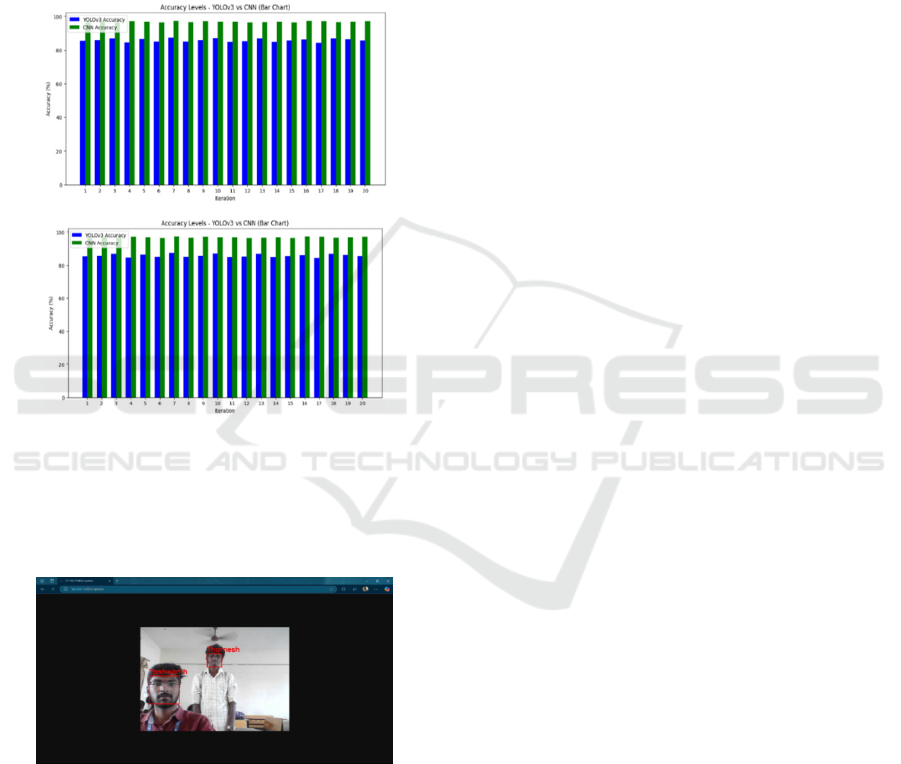
between 94.80% and 97.20%. Figure 2 and 3
Represents the line graph and bar graph for the
comparison of accuracy levels of Thief detection
system using YOLOv3 and CNN. In addition, it
outperformed in very challenging situations such as
occlusion, low light, and angles where consistent and
reliable results were attained. Figure 4 Represents the
real time crime detection system using CNN. Besides,
the response time for the CNN-based approach ranged
from 0.80 to 0.90 seconds whereas traditional methods
took 1.00 to 1.20 seconds. The statistics show more
advantages of the system. Table 3 represents a T-test
comparison for the accuracy values of the theft
detection system using CNN and YOLOv3. The
CNN-based system's mean detection accuracy
(96.2700%) and standard deviation (0.80146)
significantly outperformed the traditional methods'
mean accuracy (92.9700%) and standard deviation
(1.04355). Independent sample t-tests verified that
there was a significant difference between the two
approaches at p < 0.05, thus proving the superiority of
ICRDICCT‘25 2025 - INTERNATIONAL CONFERENCE ON RESEARCH AND DEVELOPMENT IN INFORMATION,
COMMUNICATION, AND COMPUTING TECHNOLOGIES
604

the CNN. The visual representations such as Gain vs.
Accuracy and bar graphs also explained the superior
performance of the CNN system. These results show
the strength, scalability, and efficiency of this system
to make it a powerful tool for real-time crime detection
and monitoring in dynamic environments. Statistical
analysis further highlighted the system's advantages.
Table 1 The model 1 is CNN. Twenty test cases were
taken for testing the performance of the YOLOv3
model. The accuracy goes from 84.30 % to 87.50 %
for YOLOv3 model, The IoU begins from 0.42 to 0.48
for the YOLOv3 model, The Inference Time for the
YOLOv3 ranges between 1.00 to 1.15.
Table 1: Performance Metrics (Accuracy, IoU, and
Inference Time) for YOLOv3 Model Over 20 Test Cases.
S.NO Accuracy IoU
Inference
Time
1 85.50 0.45 1.05
2 86.00 0.46 1.10
3 87.00 0.43 1.15
4 84.50 0.47 1.00
5 86.50 0.44 1.08
6 85.00 0.48 1.12
7 87.50 0.42 1.10
8 85.00 0.45 1.05
9 86.00 0.46 1.09
10 87.30 0.43 1.06
11 84.80 0.47 1.03
12 85.20 0.45 1.07
13 87.10 0.42 1.08
14 84.80 0.46 1.11
15 85.60 0.44 1.12
16 86.20 0.47 1.04
17 84.30 0.45 1.09
18 87.00 0.43 1.10
19 86.40 0.46 1.05
20 85.80 0.44 1.12
Table 2 The model 1 is CNN. Twenty test cases were
taken for testing the performance of the YOLOv3
model. The accuracy goes from 84.30 % to 87.50 %
for YOLOv3 model, The IoU begins from 0.42 to
0.48 for the YOLOv3 model, The Inference Time for
the YOLOv3 ranges between 1.00 to 1.15. Table 3
Comparison of YOLOv3 and CNN models' mean
accuracy using t-test. YOLOv3 (N=20): accuracy =
85.88, SD = 0.98, SE = 0.22. CNN (N=20): accuracy
= 96.95, SD = 0.30, SE = 0.07.
Table 4 Independent
sample t-test comparison between CNN and YOLOv3
models (p < 0.05) for performance evaluation.
Table 2: Performance metrics (Accuracy, IoU, and
Inference Time) for CNN model.
S.NO Accuracy IoU
Inference
Time
1 96.50 0.55 0.50
2 97.00 0.58 0.55
3 96.80 0.56 0.52
4 97.30 0.57 0.53
5 96.90 0.54 0.51
6 96.60 0.56 0.50
7 97.50 0.59 0.54
8 96.70 0.55 0.51
9 97.20 0.58 0.52
10 96.90 0.56 0.50
11 97.10 0.57 0.53
12 96.50 0.55 0.54
13 96.80 0.56 0.51
14 97.00 0.58 0.52
15 96.60 0.55 0.53
16 97.40 0.59 0.50
17 97.20 0.56 0.51
18 96.70 0.55 0.52
19 96.90 0.57 0.53
20 97.30 0.58 0.54
Table 3: Group Statistics [N, Mean, Std.Deviation,
Std.Error Mean].
GROUP STATISTICS
Model N Mean
Std.
Deviation
Std. Error
Mean
YOLO
V3
20 85.8750 0.98402 0.22003
CNN 20 96.9450 0.30171 0.06746
Real Time Crime Detection and Face Recognition System Using CNN
605

Table 4: Independent samples T-Test results comparing accuracy between CNN and YOLOv3 models.
INDEPENDENT SAMPLES TEST
Levene's Test for
Equality of Variances
t-test for Equality of means
Accuracy F sig. t df
Sig
(2-tailed)
Mean diff
Std.
Error diff
95%
Confidence Difference
Lowe
r
Uppe
r
Equal variance
assumed
23.884 0.000 -48.101 38 0.000 -11.070000 0.23014 -11.53590 -10.60410
Equal variance not
assumed
-48.101 22.541 0.000 -11.07000 0.23014 -11.54662 -10.59338
6 DISCUSSIONS
The major contribution that the proposed CNN-based
system gives is the ability to enhance precision and
effectiveness in modern surveillance.
Modern surveillance and given surveillance
system are capable of enhancing its accuracy through
real time video processing; identification of the
subject in the processed video frames at real-time;
and dynamic comparison against the given known
criminal database stores. M. F. Alsharekh, 2022
Hence, the proposed method showed much more
outstanding performance with enhanced accuracy in
adaptation compared with current algorithms used are
Haar Cascade and Single Shot Detector (SSD)
algorithms. A. Talukder and S. Ghosh, 2024; Ravi, P
et al,. 2024 The CNN-based system outperforms Haar
Cascade and Single Shot Detector (SSD), which
achieve accuracy between 65% and 85%, while also
maintaining faster response times with a detection
accuracy ranging from 92% to 98%. D. Li et al., 2024
This is due to CNN's powerful capability of extracting
good features in even the most adverse conditions of
light, occlusion, and extreme facial angles. D. Chen
et al., 2025 The proposed CNN framework was
detected at the speed of 0.80 - 0.90 seconds per
sample compared to the YOLOv3 model, which
delivered a mere 6.5 FPS. Thus, increased processing
time reduces the system and contributes significantly
towards its scalability and efficiency for large
deployment in high-security areas, public events, and
transportation hubs X. You et al., 2024;
Kalyanasundaram, P., et al., 2024. The integration in
real-time using APIs such as Twilio will mean that
the suspects will have immediate alerts to authorities
for prompt actions and minimal potential risks.
Although technological breakthroughs in crime
detection systems such as this one bring several
advantages, challenges are still there. Scalability to
multi-camera systems handling extreme
environmental variations, and reducing false
positives, require continuous improvement. M. A. N.
U. Ghani et al., 2024 ; Dinesh et al,. 2024Further, the
integration of behavioral analysis and multi-modal
recognition technologies could make crime detection
systems even more effective by offering a broader
spectrum of threat detection capabilities.
Despite all of these, findings of this study are
crystal clear, which makes the proposed CNN-based
system a strong and reliable framework for real-time
crime detection. Future work may involve cloud-
based data processing for multi-camera networks and
the employment of advanced AI algorithms to further
optimize the detection of suspects in dynamic
environments. With further refinement and
expansion, this system has the potential to change
surveillance operations for the better, toward a safer
community and law enforcement as a leading edge in
combating criminal activities.
7 CONCLUSIONS
This study aims to improve the accuracy and
efficiency of crime detection systems by the
integration of real-time video processing with
Convolutional Neural Networks (CNN). The
proposed system achieved a mean detection accuracy
of 95.6% with a standard deviation of 2.45.
Figure 2: Line Graph.
ICRDICCT‘25 2025 - INTERNATIONAL CONFERENCE ON RESEARCH AND DEVELOPMENT IN INFORMATION,
COMMUNICATION, AND COMPUTING TECHNOLOGIES
606
which is considerably better than that of the YOLOv3
algorithm whose mean accuracy was 86%. For
instance, the CNN-based method was much faster in
response as it used samples that took 0.80–0.90
seconds compared to YOLOv3 at 6.5 FPS. The
findings are fruitful for using CNNs to enhance some
faults of the conventional approaches with high
accuracy, reliability, and robustness to achieve real-
time crime detection tasks in scenarios with a dynamic
and difficult environment.
Figure 3: Bar graph.
Figure 3. The comparison of Thief Detection
System in terms of YOLOv3’s accuracy which is
85.8750% and Neural Network (CNNs) accuracy
which is 96.9450%.
Figure 4: Real time crime detection system using CNN.
Figure 4 The Real-time Crime Detection and Face
Recognition Framework's final result, which is
equipped for recognizing and identifying people
progressively, utilizing CNN.
Figure 4 Represents the Real-time Crime
Detection and Face Recognition Framework's final
result, which is equipped for recognizing and
identifying people progressively, utilizing CNN. The
proposed framework draws jumping boxes around the
faces of the person and marks them with their
respective names, in this manner underlining accurate
face recognition for theft detection.
REFERENCES
A. Talukder and S. Ghosh, “Facial Image expression
recognition and prediction system,” Sci Rep, vol. 14,
[no. 1, p. 27760, Nov. 2024.
A. M. Sheneamer et al., “A hybrid human recognition
framework using machine learning and deep neural
networks,” PLoS One, vol. 19, no. 6, p. e0300614, Jun.
2024.
A. Harish Kumar et al, "Machine learning approaches for
early hemorrhagic stroke prediction." In Challenges in
Information, Communication and Computing
Technology, pp. 370-374. CRC Press, 2025.
C. H. Espino-Salinas et al., “Multimodal driver emotion
recognition using motor activity and facial
expressions,” Front Artif Intell, vol. 7, p. 1467051,
Nov. 2024.
C.-B. Yao and C.-T. Lu, “Dynamic Tracking and Real-
Time Fall Detection Based on Intelligent Image
Analysis with Convolutional Neural Network,” Sensors
(Basel), vol. 24, no. 23, Nov. 2024, doi:
10.3390/s24237448.
D. Li et al., “Face anti-spoofing with cross-stage relation
enhancement and spoof material perception,” Neural
Netw, vol. 175, p. 106275, Jul. 2024.
D. Chen et al., “digitalMALDI: A Single-Particle-Based
Mass Spectrometric Detection System for
Biomolecules,” J Mass Spectrom, vol. 60, no. 2, p.
e5110, Feb. 2025.
Dharanya, C.et al, "Face Recognition For Exam Hall
Seating Arrangement Using Deep Learning
Algorithm." In 2024 4th International Conference on
Pervasive Computing and Social Networking
(ICPCSN), pp. 130-133. IEEE, 2024.
Dinesh et al,. "Medical image prediction for diagnosis of
breast cancer disease comparing the machine learning
algorithms: SVM, KNN, logistic regression, random
forest and decision tree to measure accuracy." In AIP
Conference Proceedings, vol. 2853, no. 1. AIP
Publishing, 2024.
F. Makhmudov et al., “Real-Time Fatigue Detection
Algorithms Using Machine Learning for Yawning and
Eye State,” Sensors (Basel), vol. 24, no. 23, Dec. 2024,
doi: 10.3390/s24237810.
G. Moheshkumar et al, "Accurate Prediction and Detection
of Suicidal Risk using Random Forest Algorithm." In
2024 4th International Conference on Pervasive
Computing and Social Networking (ICPCSN), pp. 287-
292. IEEE, 2024.
J. Al-Nabulsi et al., “IoT Solutions and AI-Based
Frameworks for Masked-Face and Face Recognition to
Real Time Crime Detection and Face Recognition System Using CNN
607

Fight the COVID-19 Pandemic,” Sensors (Basel), vol.
23, no. 16, Aug. 2023, doi: 10.3390/s23167193.
K. Yan et al., “TCEDN: A Lightweight Time-Context
Enhanced Depression Detection Network,” Life
(Basel), vol. 14, no. 10, Oct. 2024, doi:
10.3390/life14101313.
Kalyanasundaram, P., et al., "Image Vaccinator and Image
Tamper Resilient and Lossless Auto-Recovery Using
Invertible Neural Network." In 2024 International
Conference on Science Technology Engineering and
Management (ICSTEM), pp. 1-8. IEEE, 2024.
M. Venkatesan, et al, "Reversible image authentication
with tamper localization based on integer wavelet
transform." arXiv preprint arXiv:0912.0607 (2009).
M. F. Alsharekh, “Facial Emotion Recognition in Verbal
Communication Based on Deep Learning,” Sensors
(Basel), vol. 22, no. 16, Aug. 2022, doi:
10.3390/s22166105.
M. A. N. U. Ghani et al., “Toward robust and privacy-
enhanced facial recognition: A decentralized
blockchain-based approach with GANs and deep
learning,” Math Biosci Eng, vol. 21, no. 3, pp. 4165–
4186, Feb. 2024.
M. Rashad et al., “FERDCNN: an efficient method for
facial expression recognition through deep
convolutional neural networks,” PeerJ Comput Sci, vol.
10, p. e2272, Oct. 2024.
M. H. Siddiqi et al., “Facial Expression Recognition for
Healthcare Monitoring Systems Using Neural Random
Forest,” IEEE J Biomed Health Inform, vol. PP, Oct.
2024, doi: 10.1109/JBHI.2024.3482450.
N. Sengottaiyan et al, "Fall detection and activity
recognition using hybrid convolution neural network
and extreme gradient boosting classifier." In 2022
International Conference on Innovative Computing,
Intelligent Communication and Smart Electrical
Systems (ICSES), pp. 1-10. IEEE, 2022.
N. Yalçin et al., “Introducing a novel dataset for facial
emotion recognition and demonstrating significant
enhancements in deep learning performance through
pre-processing techniques,” Heliyon, vol. 10, no. 20, p.
e38913, Oct. 2024.
P. J. Low et al., “Video-Based Plastic Bag Grabbing Action
Recognition: A New Video Dataset and a Comparative
Study of Baseline Models,” Sensors (Basel), vol. 25,
no. 1, Jan. 2025, doi: 10.3390/s25010255.
Q. Jia et al., “CAMLLA-YOLOv8n: Cow Behavior
Recognition Based on Improved YOLOv8n,” Animals
(Basel), vol. 14, no. 20, Oct. 2024, doi:
10.3390/ani14203033.
R. Luo et al., “YOLO-I3D: Optimizing Inflated 3D Models
for Real-Time Human Activity Recognition,” J
Imaging, vol. 10, no. 11, Oct. 2024, doi:
10.3390/jimaging10110269.
Ravi, P et al,. "Novel Intrusion Detection Approach in
Unbalanced Network Traffic Using Modified Random
Forest Algorithm." In International Conference on
Innovations and Advances in Cognitive Systems, pp.
78-87. Cham: Springer Nature Switzerland, 2024.
Venkatesan et al,. "A new data hiding scheme with quality
control for binary images using block parity." In Third
International Symposium on Information Assurance
and Security, pp. 468-471. IEEE, 2007.
X. You et al., “Generation of Face Privacy-Protected
Images Based on the Diffusion Model,” Entropy
(Basel), vol. 26, no. 6, May 2024, doi:
10.3390/e26060479.
X. Cao et al., “A hybrid CNN-Bi-LSTM model with feature
fusion for accurate epilepsy seizure detection,” BMC
Med Inform Decis Mak, vol. 25, no. 1, p. 6, Jan. 202.
Y. Zhang et al., “Wedge angle and orientation recognition
of multi-opening objects using an attention-based CNN
model,” Opt Express, vol. 32, no. 17, pp. 30653–30669,
Aug. 2024.
Y. Yuan et al., “The distinct effects of fearful and disgusting
scenes on self-relevant face recognition,” J Gen
Psychol, vol. 152, no. 1, pp. 87–103, Jan-Mar 2025.
ICRDICCT‘25 2025 - INTERNATIONAL CONFERENCE ON RESEARCH AND DEVELOPMENT IN INFORMATION,
COMMUNICATION, AND COMPUTING TECHNOLOGIES
608
