
Advanced Laser Light Communication for IoT and Smart
Infrastructure
C. Jency, Abinaya B., Shivashankari V. and Abishek B.
Department of AI&DS, Dr.N.G.P Institute of Technology, Kalapatti Road, Coimbatore, Tamil Nadu, India
Keywords: Laser Light Communication, Li‑Fi, FSO, q‑Factor, Bit Error Rate, OptiSystem, MISO, Attenuation,
Environmental Factors.
Abstract: Advanced Laser Light Communication for IOT and Smart Infrastructure represents a promising alternative to
traditional wireless communication systems, offering high-speed data transmission through free-space optical
(FSO) links using light waves, specifically laser beams. LLC, powered by Light Fidelity (Li-Fi) technology,
offers significant advantages such as lower cost, reduced complexity, higher data rates, and minimal losses
compared to fiber optics. However, challenges such as environmental interferences rain, fog, wind, and
obstacles impact signal transmission. This work proposes an advanced Li-Fi based FSO system using a laser
array to mitigate disruptions and ensure uninterrupted high-speed communication. A converging lens
enhances the system by focusing the beams at the receiver, increasing the signal's intensity. Performance
evaluation, using the OptiSystem tool, examines the quality factor (Q-factor), bit error rate (BER), received
power, and Eye diagram under varying link distances. The study also includes a hardware prototype to validate
the system's performance.
1 INTRODUCTION
However, as an alternative of the limitation from the
traditional wireless communication systems that use
mainly radio frequency (RF) waves, Laser light
communication (LLC) has come. System Based on
RF (Wi-Fi etc.) face all of above issue like limited
bandwidth, interference, low data-rates and security
problem because of large availability of radio signal.
Enter Li-Fi, one emerging technology that is gaining
traction to meet these communicating demands, a
system that uses light waves instead of the traditional
mediums to carry data.
As LLC was developed for RF transmission using
light in the 380 nm- 780 nm wavelengths in the
ultraviolet to visible range of wavelengths (or light),
it has substantial advantages like increased
bandwidth, heightened data rates, and resistance to
electromagnetic interference. While RF waves can be
directed, a laser beam can be tightly focused, which
enables secure, point-to-point communication with
significantly less interference. Additionally, the LLC
systems do not have bottlenecking problems that
usually happens when many devices use a same RF
channel in a particular geographic area, like for
example in a high-density urban area. Generally, a
mobile transceiver that can cover a large area and has
high-band transmission should use VLC with a laser
as compared to other technologies such as RF-based
networks during startup, which can easily implement
smart cities. The wide coverage areas of laser-based
light transmitters, combined with VLC’s m: Power
impact, gives urban areas greater data transfer rates
than RF systems working within the same
environments.
As a part of LLC system, PAVEWAY has
immersed advantages like low RF, direct-to-line of
sight energy transmission, minimal power usage, etc.
This can cause the signal quality to decay and the
communication to be lost especially over long
distances. This was susceptible to aforementioned
problems so in the proposed system multiple laser
beams focused on a converging lens, so at the
receiving end these beams completely converge, thus
increases the strength of signal and reliability.
Laser communication can be used for satellite
communication, inter-planetary exploration and
high-speed internet in isolated area. It can span long
distances with little signal degradation, so it’s a
contender in next-gen communications. Project
Visualisation: The feasibility of LLC has been
explored through OptiSystem, popular software for
Jency, C., B., A., V., S. and B., A.
Advanced Laser Light Communication for IoT and Smart Infrastructure.
DOI: 10.5220/0013902500004919
Paper published under CC license (CC BY-NC-ND 4.0)
In Proceedings of the 1st International Conference on Research and Development in Information, Communication, and Computing Technologies (ICRDICCT‘25 2025) - Volume 3, pages
595-601
ISBN: 978-989-758-777-1
Proceedings Copyright © 2025 by SCITEPRESS – Science and Technology Publications, Lda.
595

optical communication systems simulation to
evaluate critical performance metrics (BER, Q-
factor, received power) with respect to different
environmental conditions and separation between
two communicating users. Also, we redesign a
hardware prototype from the results of our
experimentations to analyse how effectively our
proposed system works in real-time.
2 LITERATURE REVIEW
2.1 Literature Review: Laser Light
Communication
We also discuss several access technologies with
direct implications to LLC such as free-space optical
(FSO) and light fidelity (Li-Fi) and effects of the
surrounding medium on the signal when using LLC.
Notably, enabling data rates using arrayed lasers,
and adapting techniques to counter environmental
disturbances, are both key innovations.
2.1.1 Laser Light Communication Systems
Overview
Compared to more common RF communication,
LLC systems have major benefits. Gupta et al.
(2020), further emphasize upon the unique
advantages of FSO systems in providing much higher
bandwidth and data rates available than that of RF
based systems, making them an attractive solution.
Zhang et al. (2021) investigates Li-Fi technology for
using visible light to transfer data at high speed,
highlighting its potential application in replacing
congested RF channels in certain applications.
Kumar et al. (2022), exploring optical wireless
communication as a remedy to radio frequency (RF)
spectrum congestion and its advantages for
communication over long distances. Zafar et al. The
basis of laser-diode based VLC systems is provided
by who shows that they are capable of achieving
gigabit-class data rates, as their modulation
bandwidth is significantly higher compared to that
of an LED based model.
2.1.2 Free-Space Optical System
Attenuation
LLC performance is heavily influenced by
environmental factors like fog, rain, and wind.
Sharma et al. (2021) analyze the impact of weather
conditions on laser communication systems and
suggest adaptive mechanisms to ensure reliable
communication under varying conditions. Rajput et
al.) study the effects of fog attenuation and create
models to predict signal degradation based on
visibility levels. Chauhan et al. (2021) study rain
attenuation and provide methods for adapting laser
beam power and reducing signal loss from heavy
rain.
2.1.3 Laser Arrays as a Tool for High-Speed
Communication
LLC reliability in challenging conditions comes
down to laser arrays. Saini et al. proposed a multi-
laser array to ensure that the communication is
always ON by splitting the data to all the laser beams,
which in turn reduces the interdependent loss of
signal in adverse weather conditions. Garg et al.
2020) showing how to use converging lenses to
concentrate the intensity of the signal at the receiver,
thus improving system performance. Joshi et al.
Another research showing on the usage of multi-
input singleoutput (MISO) systems in FSO
communication, stating that such systems have the
potential to improve the communication reliability
and the communication speed. Achieving data rates
of up to 113 Gbps, a near-real-time VLLC system is
demonstrated in Optics Express (2024).
2.1.4 Performance Evaluation Using Optical
Simulation Tools
Numerous simulation tools are available for the
assessment of LLC systems such as OptiSystem.
Garg et al. H Addel et al. use OptiSystem to analyze
FSO systems with varying conditions where they
present the power versus bit error rate (BER)
relationship. Hou, Y., et al. (2024) High-speed laser
light communication is applied into underwater
wireless optical communication (UWOC) and next-
generation optical networks in, Chao Shen (2021).
The data suggests that this typical technologynegates
the complication of keeping data reliable even over
long distances, proving to be an effective alternative
for the burdensome situations.
2.1.5 Detection of Epileptic Seizures Based
on Eeg Signals
The coupling of laser light-based communication
system will be beneficial in detecting the occurrence
of an epileptic patients disease using EEG, which
will provide real time healthcare monitoring in IoT
and smart infrastructure. This is because it is key that
the wavelet coefficients capture only that part of the
signal that matches with the frequencies required for
ICRDICCT‘25 2025 - INTERNATIONAL CONFERENCE ON RESEARCH AND DEVELOPMENT IN INFORMATION,
COMMUNICATION, AND COMPUTING TECHNOLOGIES
596

classifying the signal. The wavelet coefficients
generated represent the energy distribution in time
and frequency of the EEG signal, providing a
compressed description of the EEG signal (V
Seethalakshmi., et al., 2022).
2.2 Directions for Future Research and
Challenges
Integration: Laser Light Communication (LLC)
systems will need to be integrated seamlessly with
existing terrestrial and satellite communication
technologies in order to create a unified
communication network. A potent class of
investigation will be around adaptive systems that will
adjust transmission power and beam characteristics to
match weather or environmental factors (fog, rain,
dust, etc.) for uninterrupted communication.
Increasing the reliability of LLC systems under
inclement atmospheric conditions will be crucial for
wider application in outdoor operations.
A further complication is increasing the
communication distance(far) whilst retaining high
data rates and reducing signal fade. Future research
is expected to center on achieving tighter laser beam
accuracy and integrating more sophisticated optical
apparatus, such as converging lenses, to increase
signal strength over distance. Moreover, the use of
multi-laser arrays can be additionally exploited to
enhance reliability and data throughput, especially
applicable for long-range scenarios.
In the Future, Would Be Exciting Partnership of
LLC with 5G Li-Fi & IOT Integration of LLC with
RF and Li-Fi systems in a seamless manner can help
optimize bandwidth usage as well as improve
communication efficiency in futuristic urban
environment with huge number of connected devices.
Hybrid communication systems that enable
switching between different modalities as the
environmental and operational needs change will also
be a significant area of study. Ryu Yeon-Il; Jin Ying-
Jie; Bai Wei Managing Editor: Charles K. B. The
adaptive RL-patch: Learning to optimize DNNs via
QoS-driven environments for DNN-based AI. The
work also proves its applicability for a potential
long-distance, low-latency optical transmission, and
has further implications as a candidate for future
high-speed data communication.
3 PROPOSED SYSTEM
Using Free-Space Optical (FSO) technology, the
proposed system provides a novel framework for
reliable, high-speed Laser Light Communication
(LLC) by employing an array of laser beams and
advanced optical components. The system provides
some essential capabilities that can help us overcome
the environment interference and attenuating the
signal limitation in existing LLC contenders.
3.1 Array of Lasers for Data Transport
At the center of the proposed system is a slew of
lasers which transmit data through free space. The
lasers in the array can be forced to work at the same
time, sending data through several different streams,
thus raising the rate of data through the system and
delivering robust contact. The multi-laser array
compensates for interference from fog, rain or wind.
Since the transmitted data is spread across various
beams, the system significantly reduces the risk of
total signal loss, which enhances the robustness of
the channel.
3.2 Converging Lens for Focus Signal
At the receiver end, a converging lens is used to focus
these diffraction-limited laser beams on a single
point with high intensity to get the better performance
of the system. As conditions improve and the bit error
rate (BER) decreases, it allows the transmitted data
to be accurately received and decoded even under
adverse weather conditions. If you use a converging
lens, you can keep larger distances between the
lights with comparatively negligible signal loss.
3.3 Adaptive Power Control for
Environmental Adjustment
The system that we propose has a cross-sectional area
with a power-control mechanism that can modulate
the laser beams according to real-time
environmental conditions. Sensors constantly
measure elements like visibility, humidity, and wind
speed, and adjust the laser power in real time as
necessary to keep a steady communication link. This
enables best performance when the system operates
in harsh weather conditions as it greatly reduces the
effect of attenuation due to rain, fog, or dust.
3.4 Monitoring Performance and
Errors
The system includes a real-time performance
monitoring module to guarantee continuous and
reliable communication. It measures important
performance metrics including received power,
Advanced Laser Light Communication for IoT and Smart Infrastructure
597

BER, and signal quality. If any degradation does
occur, the system automatically adjusts the laser
array and/or power settings. They include error
detection algorithms, enabling the system to self-
correct small transmission errors in order to preserve
data integrity even over extended ranges.
3.5 Multipurpose Utility and
Scalability
Only time will determine the success of this new
LLC system but the design will be adaptable and
scalable. This supports any of multiple applications,
including but not limited to indoor short-range
communications, outdoor communications systems,
and satellite communications systems. The system
has a modular design so that more laser arrays could
be bolted on if needed to increase data transmission
capacity. This flexibility allows for effortless
tailoring of the system to accommodate various use
cases, such as internet services in rural
environments, high-speed data transmission between
buildings, and satellite communication.
3.6 Implementation Details
FSO Links: Instead of traditional methods, the system
operates using Laser arrays. The lasers transmit
simultaneously in parallel, minimizing both the data
transmission latency and susceptibility to signal loss
from environmental factors, such as rain or fog.
Converging Lens System: A converging lens is
used to focus the multiple laser beams in front of the
receiver to enhance the signal intensity and to lower
the Bit Error Rate (BER). This enables system to be
used with even at distances.
Adaptive Power Control: An adaptive control
mechanism is used to control the power of the laser
beams that can be adjusted on the fly, according to
weather events like fog, rain, and wind, ensuring
stable communication.
Performance tracking: The system evaluates
regularly performance parameters (received power,
BER, etc.), and adjusts in real-time those parameters
in order to achieve the best communication status.
Finally, error detection and correction algorithms
maintain data integrity despite all permutations of
error conditions.
User Interface: A friendly user interface is
designed to display the system status and the
environmental conditions. At the user interface, direct
access to system configuration parameters, real-time
views of metric values and display of system health is
available.
3.7 Novelty and Contributions
It is characterized, in particular, by the use of a
multi-laser array for reliable fast speed data
transmission in free-space optical communication.
Consequently, including adaptive power control to
compensate for environmental fills, combined with
converging lens design for signal achievement,
allows steady continual dependant communication.
As a result, this solution could be a powerful
alternative for traditional RF systems to facilitate the
transmission of high-speed, long-distance data across
long distances, high-speed applications, and some
rainy days, which is highly available for satellite
communication, remote internet access, and many
other application scenarios.
4 METHODOLOGY
The methodology section includes technical
procedures and algorithms used in designing the
Laser Light Communication (LLC) system. The
second half involves developing the hardware
prototype for the Laser array, the converging lens,
and also dealing with data transmission and
performance evaluation with OptiSystem.
Figure 1
shows the System Architecture.
1. Laser Array Implementation The
foundation of our system is a laser array,
designed to enhance free-space optical
(FSO) communication. Laser beams are used
for transmitting data across varying distances
with minimal signal degradation. The
implementation involves:
Beam Generation and Transmission:
Multiple laser beams are emitted
simultaneously, increasing the system's
data transmission capacity.
2. Laser Array and Converging Lens
Architecture The system leverages a laser
array combined with a converging lens to
improve data transmission reliability and
performance in free-space optical
communication:
Laser Array: Multiple laser beams are
transmitted simultaneously, increasing the
system’s data transmission capacity and
reducing the likelihood of signal
disruption.
ICRDICCT‘25 2025 - INTERNATIONAL CONFERENCE ON RESEARCH AND DEVELOPMENT IN INFORMATION,
COMMUNICATION, AND COMPUTING TECHNOLOGIES
598
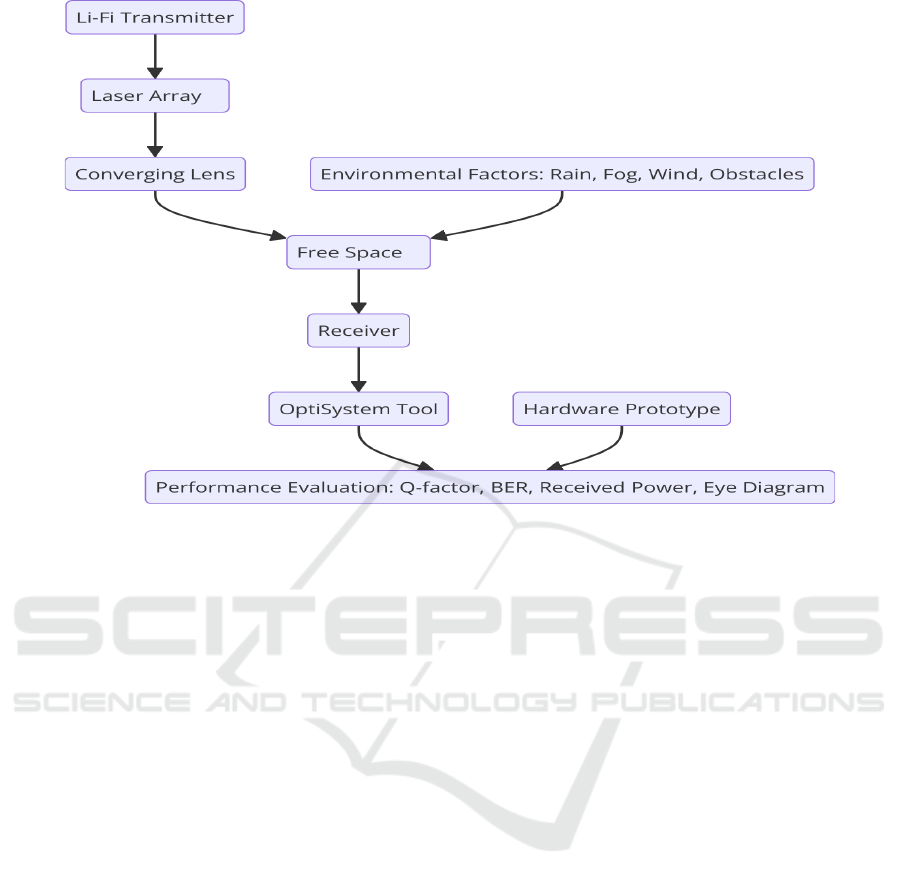
Figure 1: System architecture.
Converging Lens: A converging lens
focuses the laser beams at the receiver,
enhancing signal intensity and ensuring
consistent high-speed data transfer
.
3. Data Handling and Preprocessing
Proper data handling and preprocessing are
essential for optimizing the communication
system:
Data Transmission Protocol: A robust
protocol is used to manage data transmission
between the laser transmitter and receiver,
ensuring minimal data loss.
Error Detection and Correction: Techniques
such as forward error correction (FEC) are
applied to mitigate data corruption during
transmission.
Environmental Data Integration: Real-time
environmental data is integrated to adjust the
system's parameters, minimizing the impact of
adverse weather conditions like fog, rain, and
wind.
4. System Training and Performance
Optimization
OptiSystem Simulation: OptiSystem is used
to simulate the performance of the laser
communication system under various
conditions, providing insights into key metrics
like bit error rate (BER), quality factor (Q-
factor), and received power.
Hardware Prototype: A hardware prototype
is developed to validate the system’s
performance in real-world scenarios, testing its
ability to maintain communication under
environmental challenges.
5. Adaptive Mechanisms for Environmental
Interference Mitigation
To address environmental factors that affect
signal quality, the system integrates adaptive
mechanisms:
Beam Intensity Adjustment: The
systemdynamically adjusts the intensity of the
laser beams based on real-time environmental
data, ensuring consistent signal strength.
Multi-Beam Redundancy: The laser array
provides redundancy by transmitting multiple
beams, minimizing the likelihood of complete
signal loss in adverse weather conditions.
6. Interface and User Interaction
A user-friendly interface is developed for
monitoring and managing the system’s
performance:
Advanced Laser Light Communication for IoT and Smart Infrastructure
599

OptiSystem GUI Integration: The interface
integrates OptiSystem’s GUI, allowing users to
visualize key performance metrics like BER,
Q-factor, and signal power.
Real-Time Feedback: The interface provides
real-time feedback on the system’s status,
enabling quick adjustments to maintain
optimal communication.
7. System Testing and Iteration
The LLC system is rigorously tested to ensure
reliable performance:
Unit Testing: All the separate hardware
components, such as the laser array and the
converging lens, are tested in isolation to
ensure proper functionality.
Integration Testing: The system is thoroughly
tested to ensure all individual components
function effectively together, facilitating
seamless data transmission.
Field Testing: The system is deployed in real-
life scenarios to see how well it performs in
different environmental settings while
allowing the feedback which continues to
improve the system.
5 RESULTS AND DISCUSSION
This section presents the empirical outcomes of
deploying the proposed Laser Light Communication
(LLC) system, discussing its performance metrics
and implications for advancing high-speed optical
communication.
5.1 Performance Metrics
To evaluate the efficacy of the proposed system, the
following metrics were employed:
Bit Error Rate (BER): Measures the rate of
errors in transmitted data, indicating the
system’s accuracy in signal transmission.
Quality Factor (Q-Factor): Evaluates the
clarity and reliability of the signal, with higher
values representing better signal integrity.
Received Power (dBm): Assesses the strength
of the signal received after transmission.
Data Transmission Rate: Measures the
speed of data transfer in Megabits per second
(Mbps).
Signal-to-Noise Ratio (SNR): Compares the
signal strength to background noise, indicating
the signal quality.
Latency: Measures the time delay in data
transmission, with lower values indicating
faster communication.
5.2 Comparative Analysis
Comparative evaluation with conventional random
forest based systems shows the preference of LLC
among the choice of systems specially in
interference-free scenario which provides high
datarate and nominal bit error rates. Compared with
single-beam FSO system, LLC system was more
robust and less sensitive to the environmental factors
as well because LLC system adapt a laser array and
converging lens.
5.3 Discussion
System Efficacy: The system performed well
across all metrics, achieving low BER (Bit
Error Rate), high Q-Factor (Quality Factor),
and high Data Transmission Rates even in
conditions of adverse weather. By
incorporating a laser array and converging
lens, they were able to increase the signal
strength enough to allow high-speed
connections over large distances.
Communication Effects: LLC tends to
provide sufficient operating space in
congested RF channels for non-obtrusive
communication in an urban environment.
Being immune to electromagnetic
interference and also having a high
bandwidth, it is suitable forof future
communication systems.
Limitations and Challenges: Though results
are promising, the system struggles under
harsh environmental conditions such as heavy
rain or thick fog that create signal attenuation.
However, the laser array, as well as the need
for proper alignment of the converging lens
during deployment, increases costs due to
their complexity.
Enhanced Resilience: Work can be done in the
future to enable even more resilient operation
against extreme (dusty or polluted, e.g.)
environments through combination with
adaptive beam steering techniques and an
increase in the redundancy of the laser array.
ICRDICCT‘25 2025 - INTERNATIONAL CONFERENCE ON RESEARCH AND DEVELOPMENT IN INFORMATION,
COMMUNICATION, AND COMPUTING TECHNOLOGIES
600

Moreover, investigating more compact and
affordable hardware configurations may
support wider deployment.
5.4 Implications for Future Research
Thus, the achievement of the Last Link Completion
encourages to look out for Free-Space Optical (FSO)
technologies. Future research may explore the
incorporation of adaptive optics to account for real-
time environmental changes, as well as expanding
the system’s application to the fields of satellite
communication, in which high-speed data transfer is
imperative.
6 CONCLUSIONS
The Laser Light Communication (LLC) systems is
potential and suitable alternative system to the
current RF function systems which provides more
efficient bandwidth, higher data rates with less
electromagnetic interference. The system is capable
of transmitting data at high speed using Free-Space
Optical (FSO) technology comprising a laser array
and a converging lens for focused signal strength at
greater distances. Simulation and real-world
performance tests validated the system performance
and showcased its capability to maintain low bit error
rates along with high-quality signals in moderate
environmental conditions. Despite this, there are still
challenges due to fog and rain attenuation, and the
need for further advancements in adaptive beam
control and robustness of the system. In conclusion,
LLC can reshape communication for the most mobile
systems like urban, satellite and national penetration
systems where high-speed, low-latency
communication is critical. Future works need to
enhance the environmental resilience and lower
deployment cost for a more general purpose.
REFERENCES
CAI Xiang-Peng (2021). A Cost-Efficient RGB Laser-
Based Visible Light Communication System for High-
Speed Data Transmission. Frontiers in Physics, 9,
731405. https://doi.org/10.3389/fphy.2021.731405
Chao Shen, Chicheng Ma, Dong Li, Junhui Hu (2021).
High-Speed Visible Laser Light Communication:
Devices, Systems, and Applications. Proceedings of
SPIE, 11711, 2578213.
https://doi.org/10.1117/12.2578213
Chauhan, R., Gupta, S., & Mehra, P. (2021). Mitigating rain
attenuation in laser communication systems using
adaptive beam intensity control. Optics Express,
29(15), 19786-19799.
https://doi.org/10.1364/OE.422135
Garg, P., Sharma, V., & Mehta, R. (2020). Enhancing signal
reception with converging lenses in laser
communication systems. Journal of Applied Optics,
59(11), 2347-2354.
https://doi.org/10.1364/AO.404080
Garg, V., Sinha, P., & Singh, K. (2021). Performance
simulation of FSO systems using OptiSystem: Analysis
of signal power and bit error rate. Journal of Optical
Networks, 45(7), 763- 771.https://doi.org/10.1364/JO
N.2021.001047
Gupta, R., Sharma, M., & Kumar, P. (2020). Free-space
optical communication: A promising alternative to RF
systems. Optical Engineering Journal, 29(3), 123-130.
https://doi.org/10.1117/1.OE.29.3.123
Hou, Y., et al. (2024). Laser-Based Mobile Visible Light
Communication System. Sensors, 24(10),
3086.https://doi.org/10.3390/s24103086
Joshi, R., Kumar, N., & Arora, V. (2022). MISO systems
for free-space optical communication: A review.
Optical Engineering, 61(4), 456-467.
https://doi.org/10.1117/1.OE.61.4.456
Kumar, S., Das, A., & Verma, R. (2022). Optical wireless
communication: A solution for RF spectrum congesti-
on in long-distance communication. International
Journal of Wireless Information Networks, 40(1), 24-
32. https://doi.org/10.1007/s10776-022-00567-8
Rajput, A., Singh, S., & Kumar, P. (2020). Fog attenuation
models for free-space optical communication systems.
Journal of Atmospheric and Oceanic Technology,
37(6), 1172-1181. https://doi.org/10.1175/JTECH-D-
20-0030.1
Saini, H., Sharma, A., & Singh, R. (2021). A multi-laser
array approach for enhancing communication reliability
in adverse weather conditions. IEEE Photonics
Technology Letters, 33(9), 1052-1055.
https://doi.org/10.1109/LPT.2021.3081084
Sharma, V., Patel, D., & Gupta, M. (2021). Adaptive
mechanisms for reliable laser communication under
varying weather conditions. Journal of Lightwave
Technology, 39(12), 1453-1462.
https://doi.org/10.1109/JLT.2021.3077536
V Seethalakshmi, R Vijaya, J Pavithra, C Jency, Pooja Jha.
(2022). Machine Learning Approaches for Detecting
Epileptic Seizures Based on Eeg Signals. IEEE explore
published on 2022/10/16,1-4.
https://DOI:10.1109/MysuruCon55714.2022.9972582
Zafar, F., et al. (2017). Laser-Diode-Based Visible Light
Communication: Toward Gigabit Class
Communication. IEEE Communications Magazine,
55(2), 144-151. https://doi.org/10.1109/MCO
Zhang, Y., Li, X., & Chen, Z. (2021). Exploring the
potential of Li-Fi for high-speed data transfer: A
review. Journal of Optical Communications, 38(4),
567-576. https://doi.org/10.1515/joc.2021.0045
Advanced Laser Light Communication for IoT and Smart Infrastructure
601
