
Enhancing Image Quality Using Advanced Deep Learning
Techniques
Sajja Radha Rania, Modala Venkata Ranga Satya Pallavi, Chikkudu Sri Vardhan,
Mannem Naveen Kumar Reddy and Kalwa Eswar
Department of Advanced Computer Science and Engineering, Vignan’s Foundation for Science, Technology and Research,
Guntur, Andhra Pradesh, India
Keywords: Computer Vision, High Resolution Imaging, Generator‑Discriminator Framework, Super Resolution,
Adversarial Training, Perceptual Loss, Content Loss, Generative Adversarial Networks, Adversarial Loss,
Convolutional Neural Networks.
Abstract: This work introduces a new approach for image super resolution using a specifically designed Generative
Adversarial Network architecture with significant improvement in facial recognition. Our approach involves
a two-stage training procedure where the discriminator is pre-trained on the whole dataset to strongly separate
detailed features and minute differences between real images. After the discriminator builds a consistent
baseline, the entire GAN model is trained with a reinforced generator including extra layers with the purpose
of filtering noise and maintaining fine features. By enhancing the generator structure, the developed method
not only generates high-quality images but also maintains important facial details, hence overcoming typical
pitfalls in low resolution image re- construction. Experimental outcomes verify that this augmented GAN
design successfully fills the gap between low resolution inputs and high-quality outputs, providing significant
potential for applications in real life in face recognition and more.
1 INTRODUCTION
Super resolution of images is a crucial research area
that aims to restore low resolution images into high
resolution images, recovering much detail lost during
image acquisition or compression. The major aim is
to recover images that not only are clearer but also
retain the authenticity of their original details.
Traditional interpolation methods
(Zhang et., al.
2018
) are often at shortfalls in this regard, resulting in
blurred or artifact-ridden output. Conversely,
contemporary deep learning techniques,
Convolutional Neural Networks, have shown
immense success by using their layered structure to
extract low-level textures and high-level semantic
information. This development opens doors to more
precise and realistic image reconstructions, which are
vital for a variety of real-world applications.
The history of CNNs in image processing has
been impressive because they can learn hierarchical
representations from data. By piling multiple
convolutional layers, such networks are well-
positioned to pick up features on different scales and
complexities ranging from basic edges and textures to
higher- level patterns and contextual signals.
Nevertheless, much as their performances are
remarkable given these virtues, CNN- based
strategies occasionally under-perform against some
of the limitations Lin and Shum (2004) inherent in the
super resolution processes. Our proprietary
generative method is spearheaded by its aim to
harness the maximum yield and enrichment of facial
features out of low resolution images, where the
requirement especially becomes a mission-critical
operation in surveillance systems. Conventional super
resolution techniques tend to have difficulty with
noisy inputs, which can produce suboptimal or
distorted outputs that do not capture critical facial
details. In order to counter this problem, we have
incorporated a denoising module directly into our
GAN architecture. This adjustment is specifically
designed to counteract the noise commonly found
in surveillance video ( M. Elad and M. Aharon, 2006),
producing cleaner outputs that are more likely to
retain facial features. The clean, denoised images
generated by our model can then be used as better
inputs for more sophisticated facial restoration
Rania, S. R., Pallavi, M. V. R. S., Vardhan, C. S., Reddy, M. N. K. and Eswar, K.
Enhancing Image Quality Using Advanced Deep Learning Techniques.
DOI: 10.5220/0013902200004919
Paper published under CC license (CC BY-NC-ND 4.0)
In Proceedings of the 1st International Conference on Research and Development in Information, Communication, and Computing Technologies (ICRDICCT‘25 2025) - Volume 3, pages
579-586
ISBN: 978-989-758-777-1
Proceedings Copyright © 2025 by SCITEPRESS – Science and Technology Publications, Lda.
579

methods, like GFPGAN ( Xintao, et al. 2021), that
further refine and sharpen facial features. This two-
step, combined process thus successfully
circumvents the drawback caused by noise to
deliver better accuracy and reliability in face
recognition in high-stakes use cases.
In addition, our GAN model is particularly
altered in that it consists of extra layers in the
generator, which are used to absorb a wider range of
image characteristics and reduce noise. This
denoising feature ( M. Elad and M. Aharon, 2006), is
especially useful in situations where images are
contaminated by environmental noise like low-light
or sensor noise. For instance, improving night vision
surveillance footage or recovering corrupted photos is
possible with our method, as the network successfully
eliminates un- wanted noise while reconstructing
missing details at the same time. The incorporation of
such denoising capabilities guaran- tees that output
images not only display better resolution but also
preserve the sharpness and integrity required for
important operations.
This paper is structured into the following
sections: section II contains previous work in the
image super resolution field. section III gives a clear
outline of the generative adversial networks. section
IV explains the methodology applied in the current
paper to achieve the desired outcome. section V give
experiments and results while Section VI summarizes
the work and highlights potential areas for future
exploration.
2 RELATED WORK
Recent developments in deep learning have
transformed image super resolution, first using CNN
architectures and subsequently with GAN-based
models for producing high- quality, realistic images.
The methods have tackled problems such as noise
removal, learning features, and image integrity, with
implications for applications including surveillance
and face recognition. Drawing on this research, our
approach presents a customized GAN model with an
innovative pre- training phase for the discriminator
and denoising components in the generator,
improving facial geometry and delivering improved
inputs to methods such as GFPGAN
(Wang et., al
2021). The next section discusses these
advancements, contrasting their advantages and
limitations, and illustrating how our technique
improves super resolution research.
Goodfellow et al. (2014) presented a seminal
adversarial setup for generative modeling, where two
models a generative model representing the data
distribution and a discriminator model separating real
data from G’s output are simultaneously trained in a
minimax game. G is learned to maximize the
probability that D makes an error, whereas D is
learned to correctly identify real vs. generated
samples. Trained with multilayer perceptrons, this
model is entirely trainable by backpropagation
without the need for sophisticated techniques such as
Markov chains. Experiments by them illustrate that
when the system is at equilibrium, G can restore the
original data distribution and D learns to produce a
constant output of 0.5, highlighting the effectiveness
of their adversarial method. Ledig et al. (2017)
proposed SRGAN, a single image super resolution
framework utilizing a generative adversarial network
to restore lost fine texture details during high
upscaling. Contrary to error-minimizing pixel-wise
approaches, SRGAN utilizes a perceptual loss
consisting of adversarial and content losses to
generate more photo-realistic images. Their method,
which is based on a deep residual network, improves
perceptual quality considerably, as verified by mean-
opinion-score tests, rendering outputs closer to
original high-resolution images. Lin and Shum
(2004) examine the intrinsic limitations of restoring
based super resolution algorithms (Z. Liu et., al.2022)
(Wang et., al. 2018) that model the image formation
process under local translation. They consider
whether there are inherent limits to the resolution
enhancement possible with these algorithms.
Employing perturbation theory and a conditioning
analysis of the coefficient matrix, the authors obtain
explicit bounds on the super resolution Ledig et al.
(2017) performance and find the minimum number of
low resolution images required to achieve these
limits. Their findings are reinforced by experiments
on artificial and real data, which reveal insight into
the real-world limits of reconstruction-based super
resolution.
Savchenko et al. (2019) suggest a two-stage
method for facial representation extraction to aid
gender, identity and age recognition in images. The
initial stage uses a customized MobileNet for face
recognition, predicting age (as the average of top
predictions) and gender as it extracts stable facial
features. Hierarchical agglomerative clustering
aggregates similar faces in the second stage, and
collective predictions decide age and gender for each
cluster. This technique, applied to an Android
application, provides competitive clustering
performance along with enhanced age/gender
identification at reduced computational expenses.
ICRDICCT‘25 2025 - INTERNATIONAL CONFERENCE ON RESEARCH AND DEVELOPMENT IN INFORMATION,
COMMUNICATION, AND COMPUTING TECHNOLOGIES
580

Vijay et al. (2022) introduced a smart attendance
system based on a channel-wise separable CNN to be
used in group face recognition. The method derives
image features and utilizes both SVM and Softmax
classifiers for precise classification. Trained on the
LFW database and tested with smart classroom data
utilizing IoT-based edge computing, the system has
an impressive 98.11% accuracy rate over other
methods available in face recognition.
Zhang et al. 2018. present a Residual Dense
Network for super resolution of images that
maximizes hierarchical features within low resolution
images. Contrary to most deep CNN architectures,
which fail to tap into such features, RDN uses
Residual Dense Blocks (RDBs) to harvest abundant
local details via densely connected layers. RDBs
utilize direct links among previous and the current
layer to build an adjacent memory system, promoting
fusion of features and maintaining training stability.
The network then performs global feature fusion to
combine these local features into a unified global
representation. Findings from experiments conducted
on standard datasets indicate that RDN performs
better than state of the art methods under a variety of
degradation conditions.
Abin Jose et al. 2018. introduce a content-based
image retrieval system that employs convolutional
layer features along with pyramid pooling to maintain
spatial information and pro- duce compact, location-
invariant feature vectors. Their system, experimented
on Holidays and Oxford5K using AlexNet, performs
better than fully connected layer or non-pooled
convolutional feature-based methods.
3 GENERATIVE ADVERSIAL
NETWORKS
Generative Adversarial Networks are a deep learning
architecture proposed by Ian Goodfellow et al. in
2014. GANs fall under the category of generative
models and are extensively applied to create high-
quality artificial data such as images, videos, and text.
GANs rely on a two-network structure involving a
generator (G) and a discriminator (D), which engage
in a zero-sum game paradigm. The generator attempts
to produce data that is similar to actual data, whereas
the discriminator attempts to separate real and
generated data. This adversarial process propels both
networks towards improvement, and highly realistic
data generation results.
Mathematical Formulation: Generative
Adversarial Networks are rooted in a two- network
adversarial model with a generator G and a
discriminator D. The generator seeks to produce
authentic data samples, whereas the discriminator
attempts to differentiate between genuine data. from
generated samples. This is ex- pressed as a min-max
optimization problem:
𝑚𝑖𝑛𝑚𝑎𝑥𝑉
𝐷,𝐺
=𝐸𝑥∼𝑝𝑑𝑎𝑡𝑎
𝑥
𝑙𝑜𝑔𝐷
𝑥
+
𝐸𝑧∼𝑝𝑧
𝑧
𝑙𝑜𝑔
1−𝐷𝐺
𝑧
(1)
where:
• 𝑥∼𝑝𝑑𝑎𝑡𝑎
𝑥
implements actual data
sampled from the actual data distribution.
• 𝑧∼𝑝𝑧
𝑧
represents latent noise drawn
from an earlier distribution (e.g Gaussian or
Uniform).
• G(z) is the generator function that transforms
noise into the data space.
• D(x) is the discriminator probability that x is
real.
The discriminator aims to maximize the above
objective, and the generator aims to minimize it,
forming a two-player adversarial game
.
4 METHODOLOGY
This section outlines our two-stage training procedure
for image enhancement improvement with better
facial recognition. The discriminator is pre-trained on
the whole dataset in the first stage to learn the fine
details and subtle features of real images. In the
second stage, the complete GAN is trained, with an
upgraded generator containing extra layers to
preserve fine details and reduce noise. This approach
guarantees that the generator generates high-quality
images with important facial features, as confirmed
by our experimental results.
4.1 Data Preparation
The data used in this research is a bespoke, non-
public dataset, collected with strict regard to privacy
and ethics since it comprises images of our colleagues
taken under properly lit classroom settings to
guarantee uniform lighting in all samples. The dataset
contains 2,500 high-resolution images. of 19- to 24-
year-old college students with a variety of facial
expressions that cover the seven basic emotions:
happy, sad, neutral, angry, frustrated, surprised, and a
separate unique expression to provide full emotional
coverage. Out of these 2,500 images, 2,000 pictures
Enhancing Image Quality Using Advanced Deep Learning Techniques
581
are utilized for training purposes and the remaining
500 images are left for testing. Each of the high
resolution (HR) images, originally 128×128×3 in
size, is subjected to a controlled degradation process
to simulate low resolution (LR) inputs by first
applying a Gaussian filter and then performing a
down sampling operation to generate LR images of
size 32×32×3. This intentional degradation not only
creates a difficult input situation for the super
resolution task but also preserves the important facial
details and fine expression cues that are vital for
subsequent facial expression recognition. The entire
dataset is held in confidence to protect the privacy of
the participating subjects, and all participants gave
informed consent for their images to be used solely
for research purposes within our institution.
4.2 Network Architecture
The network structure consists of three main
elements: a generator, a discriminator, and a
perceptual feature extractor. The generator is a deep
convolutional network that aims to enlarge a low-
resolution image (32×32) into a high resolution one
(128×128) while preserving fine facial features. It
starts with an initial convolutional layer with a large
9×9 kernel to extract low-level features, succeeded by
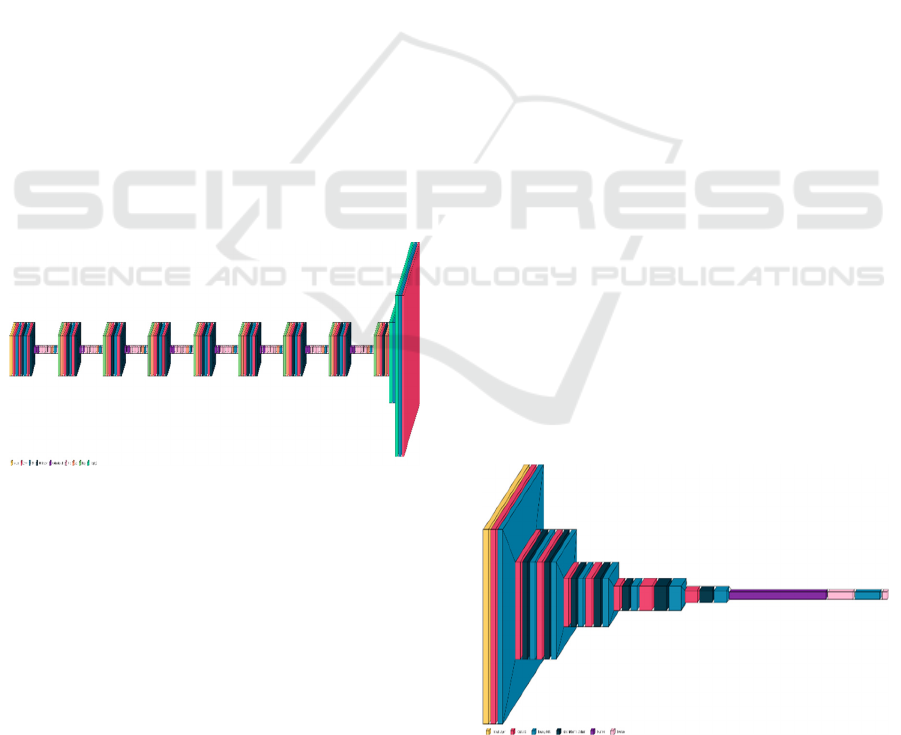
a PReLU activation. Figure 1 show the Generator
Architecture.
Figure 1: Generator architecture.
This is subsequently accompanied by a sequence
of eight residual blocks improved, each block
consisting of two dilated convolutional layers
(dilation rate of 2) separated by batch normalization
and PReLU activation. A channel attention mechanism
is incorporated in every block to weigh feature
channels dynamically, highlighting delicate facial
expression signals. Skip connections within every
residual block enable the combination of features at
both low and high levels, thus allowing efficient
gradient flow. Two sub-pixels up sampling blocks
incrementally recover the spatial resolution at the end,
and a final 9×9 convolutional layer reconstructs the
output into a three-channel high resolution image.
The discriminator is designed to effectively
differentiate between real high-resolution images and
those produced by the network. It consists of eight
convolutional layers with 64 filters initially and
growing to 512 filters, and each of these uses 3×3
kernels and stride convolutions for down sampling
the input in steps. LeakyReLU activations with an
alpha value of 0.2 are used everywhere to ensure non-
linearity and to prevent vanishing gradients. The
convolutional stack is followed by two dense layers
that summarize the learned features, leading to a
sigmoid activation function that yields a probability
score for the image’s authenticity. This well-
structured discriminator guarantees that the generator
is constantly under pressure to make the super-
resolved images even more realistic.
Accompanying the generator and discriminator is
the perceptual feature extractor, which is constructed
on top of a pre-trained ResNet101 model. By defining
high-level se- mantic features from an intermediate
layer (in this case,” conv4 block23 out”), the extractor
generates rich, detailed representations that assist in
the perceptual loss. Overall training strategy exploits
a number of loss functions, including adversarial
(GAN) loss and discriminator loss to encourage
realism, along with pixel-level and perceptual
measures such as Mean Squared Error, Structural
Similarity Index Measure, Peak Signal-to-Noise
Ratio and (Hore´ and D. Ziou 2010). The PSNR and
SSIM measures are especially significant since they
quantitatively assess the fidelity and structural quality
of the produced images. These losses collectively
lead the generator not only to generate visually
plausible high-resolution outputs but also to preserve
the subtle details essential for follow-up facial
expression recognition tasks.
Figure 2 show the
Discriminator Architecture.
Figure 2: Discriminator architecture.
ICRDICCT‘25 2025 - INTERNATIONAL CONFERENCE ON RESEARCH AND DEVELOPMENT IN INFORMATION,
COMMUNICATION, AND COMPUTING TECHNOLOGIES
582

4.3 Loss Functions
To effectively train our super resolution network, we
com- bine four loss functions together that jointly
induce the model to produce high-quality,
perceptually accurate images. Each loss term is
focused on a particular feature of the quality of the
image.
Discriminator Loss: This binary cross-entropy-
based loss trains the discriminator to correctly
identify between real high-resolution images and
fake images produced by the model. It is expressed
as:
𝐿𝐷 =
−𝐸𝐼
𝐻𝑅
−
𝑝
𝑑𝑎𝑡𝑎
𝑙𝑜𝑔𝐷
𝐼𝐻𝑅
−𝐸𝐼
𝐿𝑅
∼
𝑝
𝑑𝑎𝑡𝑎
𝑙𝑜𝑔
1−𝐷
𝐺
𝐼𝐿𝑅
(2)
Adversarial (GAN) Loss: This component of the
loss encourages the generator to generate images that
are indistinguishable from genuine images. It
decreases the negative log the likelihood of the
discriminator identifying the generated image as real:
𝐿𝐺𝐴𝑁=−𝐸𝐼𝐿𝑅∼𝑝𝑑𝑎𝑡𝑎𝑙𝑜𝑔𝐷𝐺
𝐼𝐿𝑅
(3)
Peak Signal to Noise Ratio Loss: Rather than
using pixel-wise MSE directly, we use PSNR [18] as
an image quality measure. where MAX represents
the highest value of a pixel (usually 1 for normalized
images or 255 otherwise). During our training, we
would like to maximize PSNR; therefore, the PSNR
loss is set to be the negative of PSNR:
ℒ
psnr
=−10⋅log
∑
|
|
(4)
Structural Similarity Index Measure (SSIM)
Loss: To maintain the perceptual quality and
structural detail of the images, SSIM loss is used. It is
a structure similarity measure between the real and
the generated images:
𝐿𝑆𝑆𝐼𝑀= 1 −𝑆𝑆𝐼𝑀𝐼𝐻𝑅,𝐺
𝐼𝐿𝑅
(5)
Training Strategy: The process of training is
separated into two broad stages in order to guarantee
stable convergence and strong learning of the fine
details needed for both facial expression recognition
and super resolution.
Phase 1: Discriminator Pre-training: First, the
discriminator is trained on the whole dataset, which
includes real HR images and their noisy or degraded
LR counterparts. In this process, the discriminator
learns the binary cross-entropy loss to differentiate
between real HR images and initial generator outputs.
This process provides the discriminator with a strong
feature representation and sets a good foundation for
the next adversarial training.
Phase 2: Adversarial Training: Following pre-
training of the discriminator, the model proceeds to
the adversarial training phase in which the generator
and discriminator are alternately updated. This phase
itself is split into two important sub-phases:
Generator updates: During this phase, the
generator is learned such that it seeks to minimize an
aggregate loss function, L
SR
, as a weighted sum of
several terms for loss. The Adversarial Loss (L
GAN
) is responsible for training the generator to generate
images that are capable of misleading the
discriminator. The conventional Mean Squared Error
loss is substituted with a Peak Signal-to-Noise Ratio
Loss that prioritizes reconstruction fidelity by
promoting greater PSNR values between the
synthesized images and the ground-truth HR images.
Additionally, the Structural Similarity Loss is used to
maintain perceptual quality by emphasizing the
structural details essential for correct facial expression
recognition. This pairing guarantees that the generator
outputs super-resolved images that are visually realistic
as well as abundant in subtle details.
Discriminator update: Having set the
parameters of the generator, the discriminator is then
trained by minimizing its binary cross-entropy loss.
This trains it to differentiate between actual HR
images and super-resolved images produced by the
network. By constantly improving its classification
accuracy, the discriminator encourages the generator
to generate increasingly realistic and detailed images.
The trade-off updating of discriminator and generator
creates a dynamic balance under which the generator
is always nudged to generate better images and the
discriminator is driven to better recognize subtle
differences.
This balanced adversarial process, assisted by
precisely calibrated optimizer parameters and learning
rate schedules, is essential in obtaining high resolution
outputs that preserve that fine features required for
successful facial expressions recognition.
5 EXPERIMENTS AND RESULTS
The model is trained using an NVIDIA Quadro RTX
5000 GPU with 30GB VRAM and an Intel Xeon
processor with 30GB RAM within an Anaconda
environment via the Spyder IDE. Training was done
across 100 epochs with a batch size of 128, utilizing
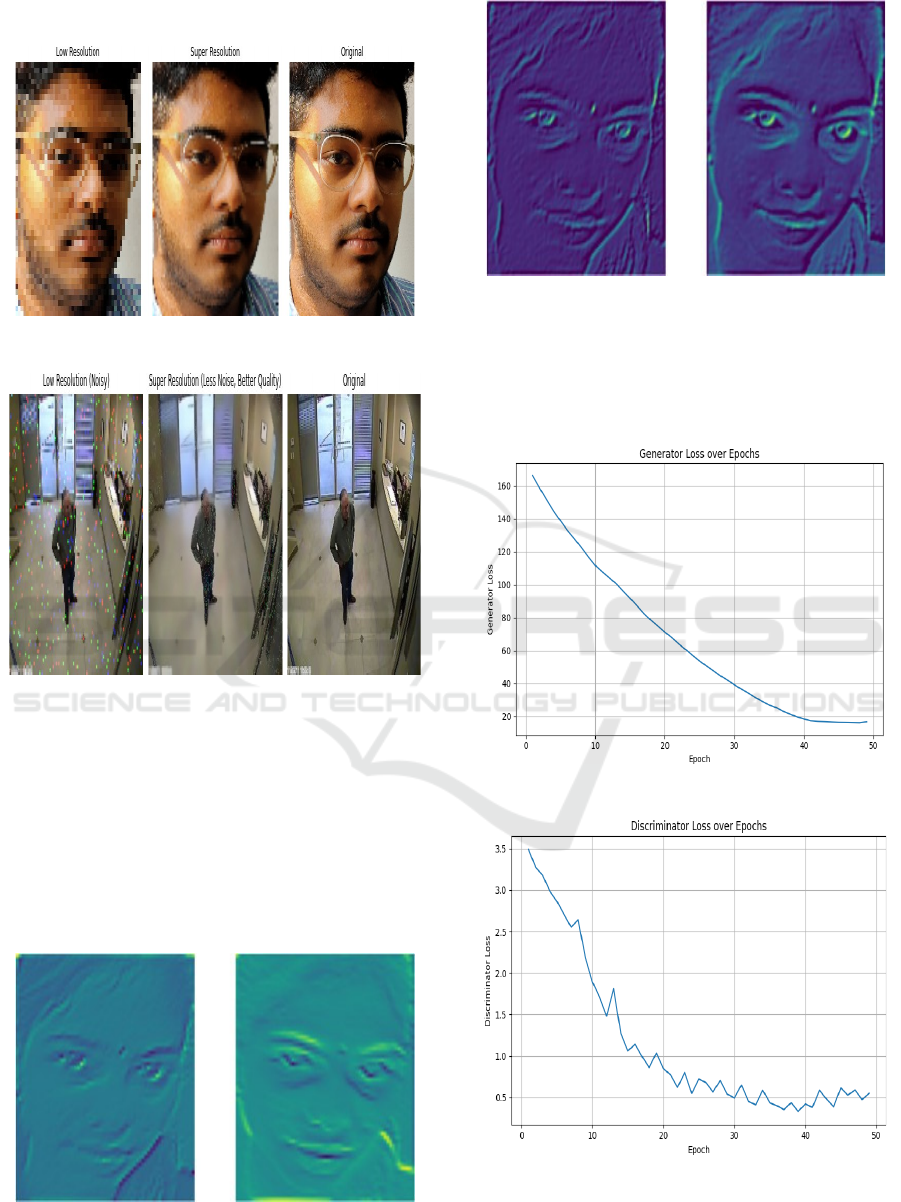
TensorFlow libraries. Figure 3 show the Super
Enhancing Image Quality Using Advanced Deep Learning Techniques
583
Resolution Output.
Figure 3: Super resolution output.
Figure 4: Super resolution output(noise).
Performance was assessed during training by
using the discriminator loss (LD), generator loss
(LG), and qualitative measures like Peak Signal-to-
Noise Ratio and for measuring similarity in images
Structural Similarity Index Measure Several
experiments were conducted by modifying
hyperparameters and applying different feature
extraction methods to improve performance. Figure 4
show the Super Resolution Output(noise).
Figure 5: SRGAN Features.
Figure 6: Proposed model features.
Figure 5 and 6 shows the SRGAN Features and
Proposed Model Features respectively. First, the
discriminator is separately pre-trained on another
dataset prior to its inclusion in the GAN model.
Figure 7: Generator training loss.
Figure 8: Discriminator training loss.
Figure 7 and 8 shows the Generator Training Loss
and Discriminator Training Loss respectively.
ICRDICCT‘25 2025 - INTERNATIONAL CONFERENCE ON RESEARCH AND DEVELOPMENT IN INFORMATION,
COMMUNICATION, AND COMPUTING TECHNOLOGIES
584
A custom training loop is utilized, whereby in
every epoch, the discriminator is trained both on fake
images and on high resolution images in order to have
a balance. At the same time, ResNet features are
extracted and the GAN model is trained on batches
with monitoring of all the metrics and losses. The
training loop prints average statistics at the end of
every epoch and saves the model every 10 epochs.
Table 1 show the comparison of PSNR and SSIM
across different methods.
Table 1: Comparison of Psnr and Ssim Across Different Methods.
Method PSNR SSIM
Bicubic 28.386 0.8249
EnhanceNet 28.548 0.8374
SFTGAN 29.913 0.8672
SRGAN 29.879 0.8694
Proposed Model 29.127 0.8264
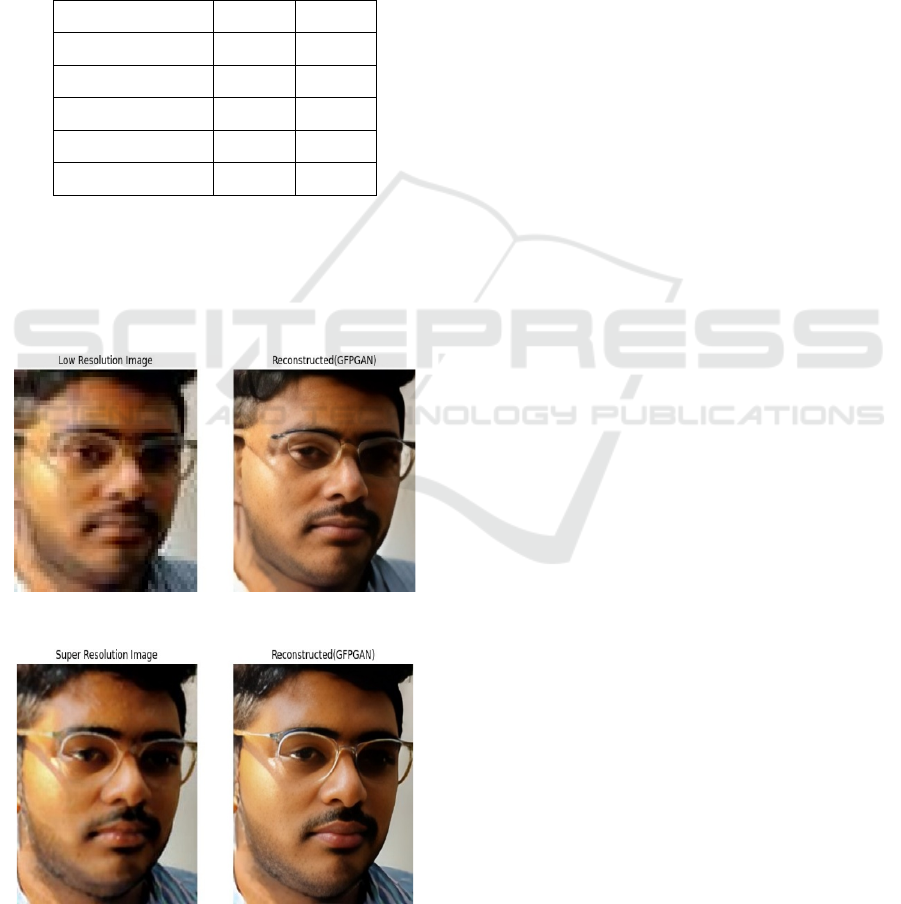
Additionally, face images that are passed through
the super resolution model are face reconstructed
using the GFPGAN model to ensure recovered facial
details. For reference, the following figure shows face
reconstruction with and without super resolution.
Figure 9: Restored Image from Low Quality.
Figure 10: Restored Image from High Quality.
Figure 9 and 10 shows the Restored Image from
Low Quality and Restored Image from high Quality
respectively.
6 CONLUSIONS AND FUTURE
SCOPE
In this work, we proposed a custom generative
adversarial network to increase image resolution
without compromising fine facial details essential for
expression recognition. Our method combines a deep
generator with enhanced residual blocks and channel
attention, a stable discriminator, and a ResNet101-
based perceptual feature extractor. With the use of a
combination of adversarial, PSNR, and SSIM loss
functions, the model efficiently produces high-quality
super-resolved images while retaining vital facial
details. Experimental verification on a varied dataset,
recorded under standardized lighting with high
variability in facial expressions, validates the efficacy
of our approach for reconstructing high-fidelity
images for facial analysis applications.
Future work will involve improving attention
mechanisms to better capture feature extraction,
generalizing the model to video super resolution, and
enhancing generalization across multiple datasets. It
will also investigate optimizing the model for real-
time processing on edge and mobile devices to widen
its applications in practice. These enhancements are
expected to further boost the efficiency and
adaptability of the developed model for real-world
applications in facial recognition and other related
tasks.
REFERENCES
A. Hore´ and D. Ziou,” Image quality metrics: PSNR vs.
SSIM,” in Proceedings of the 2010 IEEE International
Conference on Pattern Recognition (ICPR), pp. 2366-
2369, 2010, doi: 10.1109/ICPR.2010.579.
A. Jose, R. D. Lopez, I. Heisterklaus and M. Wien,”
Pyramid Pooling of Convolutional Feature Maps for
Image Retrieval,” 2018 25th IEEE International
Conference on Image Processing (ICIP), Athens,
Greece, 2018, pp. 480- 484, doi: 10.1109/ICIP.2018.
8451361.
A. A. Abello and R. Hirata,” Optimizing Super Resolution
for Face Recognition,” 2019 32nd SIBGRAPI
Conference on Graphics, Patterns and Images
(SIBGRAPI), Rio de Janeiro, Brazil, 2019, pp. 194-
201, doi: 10.1109/SIBGRAPI.2019.00034.
Alvarez-Ramos, V. & Ponomaryov, V. & Sadovnychiy,
Sergiy. (2018). ” Image super resolution via Wavelet
Enhancing Image Quality Using Advanced Deep Learning Techniques
585

Feature Extraction and Sparse Rep- resentation,”
Radioengineering, 27, 602- 609, 10.13164/re.2018.06
02.
C. Ledig et al.,” Photo-Realistic Single Image super
resolution Using a Generative Adversarial Network,”
2017 IEEE Conference on Computer Vision and Pattern
Recognition (CVPR), Honolulu, HI, USA, 2017, pp.
105-114, doi: 10.1109/CVPR.2017.19.
Ian J. Goodfellow, Jean Pouget-Abadie, Mehdi Mirza, Bing
Xu, David Warde-Farley, Sherjil Ozair, Aaron
Courville, Yoshua Bengio, Genera- tive Adversarial
Networks, 2014, https://arxiv.org/abs/1406.2661.
L. Hui and S. Yu-jie,” Research on face recognition
algorithm based on improved convolution neural
network,” 2018 13th IEEE Conference on Industrial
Electronics and Applications (ICIEA), Wuhan, China,
2018, pp. 2802- 2805, doi: 10.1109/ICIEA.2018.8398
186.
M. Elad and M. Aharon,” Image Denoising Via Sparse and
Redundant Representations Over Learned
Dictionaries,” IEEE Transactions on Image Processing,
vol. 15, no. 12, pp. 3736-3745, Dec. 2006, doi:
10.1109/TIP.2006.881969.
Pabba, C., & Kumar, P. (2022).” An intelligent system for
monitor- ing students’ engagement in large classroom
teaching through facial expression recognition,” Expert
Systems, 39(1), e12839, https://doi.org/ 10.1111/exsy.
12839.
Pabba, Chakradhar & Kumar, Praveen. (2023).” A vision-
based multi- cues approach for individual students’ and
overall class engagement monitoring in smart
classroom environments,” Multimedia Tools and
Applications, 83. https://doi.org/10.1007/s11042-023-
17533-w.
Savchenko AV.” Efficient facial representations for age,
gender and identity recognition in organizing photo
albums using multi-output ConvNet,” PeerJ Computer
Science 5:e197, 2019, https://doi.org/10. 7717/peerj-
cs.197.
Shi, Wenzhe & Caballero, Jose & Husza´r, Ferenc & Totz,
Johannes & Aitken, Andrew & Bishop, Rob &
Rueckert, Daniel & Wang, Zehan. (2016).” Real-Time
Single Image and Video super resolu- tion Using an
Efficient Sub-Pixel Convolutional Neural Network.”
https://doi.org/10.48550/arXiv.1609.05158.
V. M., D. R. and P. B. S.,” Group Face Recognition Smart
Attendance System Using Convolution Neural
Network,” 2022 International Confer- ence on Wireless
Communications Signal Processing and Networking
(WiSPNET), Chennai, India, 2022, pp. 89-93, doi:
10.1109/WiSP- NET54241.2022.9767128.
Wang, Xintao & Yu, Ke & Wu, Shixiang & Gu, Jinjin &
Liu, Yihao & Dong, Chao & Loy, Chen Change &
Qiao, Yu & Tang, Xiaoou. (2018). ESRGAN:
Enhanced super resolution Generative Adversarial
Networks. https://doi.org/10.48550/arXiv.1809.00219.
Wang, Xintao, et al.” Towards real-world blind face
restoration with generative facial prior.” Proceedings of
the IEEE/CVF conference on computer vision and
pattern recognition. 2021.
Xiao H, Wang X, Wang J, Cai JY, Deng JH, Yan JK, Tang
YD.” Single image super resolution with denoising
diffusion GANS,” Sci Rep. 2024 Feb 21;14(1):4272.
doi: 10.1038/s41598-024-52370-3. PMID:38383573;
PMCID: PMC11222509.
Z. Liu, Z. Li, X. Wu, Z. Liu and W. Chen,” DSRGAN:
Detail Prior-Assisted Perceptual Single Image super
resolution via Generative Adversarial Networks,” IEEE
Transactions on Circuits and Systems for Video
Technology, vol. 32, no. 11, pp. 7418-7431, Nov. 2022,
doi: 10.1109/TCSVT.2022.3188433.
Zhang, Yulun and Tian, Yapeng and Kong, Yu and Zhong,
Bineng and Fu, Yun,” Residual Dense Network for
Image super resolution,” Proceedings of the IEEE
Conference on Computer Vision and Pattern
Recognition (CVPR), June 2018.
Zhouchen Lin and Heung-Yeung Shum,” Fundamental
limits of reconstruction-based superresolution
algorithms under local translation,” IEEE Transactions
on Pattern Analysis and Machine Intelligence, vol. 26,
no. 1, pp. 83- 97, Jan. 2004, doi: 10.1109/TPAMI.200
4.1261081.
ICRDICCT‘25 2025 - INTERNATIONAL CONFERENCE ON RESEARCH AND DEVELOPMENT IN INFORMATION,
COMMUNICATION, AND COMPUTING TECHNOLOGIES
586
